Gua Sha Wholesale Weight Differences: A Manufacturing Risk Disclosure
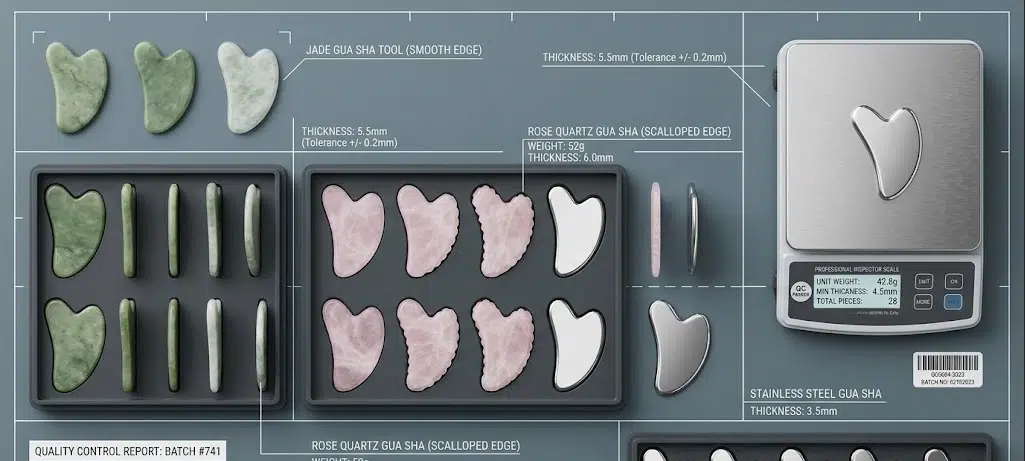
If you’ve ever compared two gua sha boards from different suppliers and felt like you were holding two completely different products, you weren’t imagining it. In gua sha wholesale sourcing, the weight of two tools listed under the same material name can differ by 20% to 50%, and a metal tool can weigh close to three times more than a crystal tool cut to the same outline. That spread isn’t random, and it isn’t a quality accident either. It comes from nine measurable variables — density, thickness, size, shape, edge finishing, hollow-versus-solid construction, surface treatment, natural mineral variance, and factory tolerance control — and every one of them can be specified, tested, and locked down before your container ships. This article is written from the production floor rather than the sales desk. You’ll see exactly where gua sha weight comes from, where the real risk sits in a guasha tools wholesale contract, and what separates a disciplined gua sha manufacturer from one that lets weight drift order to order. Material Density: The Root Cause Behind Every Gua Sha Wholesale Weight Difference Density decides more of a tool’s final weight than every other variable combined, and it’s the first thing worth checking before comparing two quotes in a gua sha wholesale conversation. Density is simply mass per unit of volume, so two boards cut from the exact same mold will weigh differently the moment the raw material changes. Gemologists measure this as specific gravity — the ratio of a stone’s weight to an equal volume of water — and rely on it as an identification tool because the value stays consistent within a narrow range for each mineral group, using it to identify gemstones by measuring how much heavier they are compared to water. That consistency is exactly what makes density useful to you as a buyer. If a supplier’s numbers fall outside the expected range for the stated material, something in the sourcing or the mix ratio is worth questioning before the purchase order gets signed. SOSNA Gems Quartz, Amethyst, and Rose Quartz Sit in the Same Weight Class White quartz, amethyst, and rose quartz share the same crystal structure, so they land within a fraction of a percent of each other at roughly 2.65 g/cm³. That’s useful for guasha tools wholesale buyers stocking multiple quartz colorways under one SKU family, because you can standardize thickness and size across the whole line and expect finished weight to track within a gram or two, color aside. Aventurine (often sold as 东陵玉) sits close behind at 2.60–2.70 g/cm³, which is why it gets swapped in as a lower-cost stand-in for true jade without most customers noticing the difference by hand-feel. This means you can mix quartz-family SKUs in a single container without recalculating your weight-based freight estimate for every individual color. Nephrite Runs Heavier, and That’s Not a Flaw Nephrite jade (和田玉) typically registers denser than common quartz and most commercial jade substitutes, which is why a nephrite board feels noticeably more substantial in the hand even at identical dimensions. GIA evaluates jadeite and nephrite on a distinct set of quality factors from ordinary quartz-group stones, including how size interacts with perceived value, noting that jadeite size is commonly expressed in millimeters and that value rises with size when other quality factors are held equal. For a gua sha manufacturer working with genuine nephrite, that added density is a selling point worth stating on the product page — heavier isn’t a defect here, it’s a verification signal. If a “nephrite” board weighs suspiciously close to a quartz board of the same size, that’s a reasonable moment to request a density check before the order scales up. Metal Tools Can Weigh Nearly Three Times More Stainless steel runs 7.7–8.0 g/cm³, and brass-alloy Kansa tools run 8.3–8.7 g/cm³ — roughly three times denser than any natural stone in this category. That single fact explains most of the sticker shock buyers feel when they request a metal SKU alongside their stone line: the mold hasn’t changed, but the gua sha weight on the packing list has nearly tripled. This means your per-unit freight cost for a metal line needs its own calculation rather than a scaled-up version of your stone-line numbers, so it’s worth requesting actual carton weights, not catalog estimates, before finalizing a metal SKU order. Thickness and Size: The Two Variables Gua Sha Wholesale Buyers Can Actually Control Once density is fixed by material choice, thickness and size are the two levers a gua sha manufacturer can adjust on your behalf without touching the stone type at all. Both get decided at the mold and cutting stage, which means both belong on your product spec sheet rather than left to a “standard size” assumption. Thickness is the more direct of the two, because it moves weight in something close to a straight line — so why do so many buyers still leave it unspecified on a first order? Thickness Moves Weight Almost in a Straight Line On a same-footprint white quartz board, a 5mm profile runs close to 60 grams, a 7mm profile climbs to roughly 85 grams, and a 9mm profile lands around 105 grams. That’s close to linear — each additional 2mm adds roughly 20 to 25 grams on this footprint — which is exactly why so many premium lines quietly move from 5mm stock to 7mm stock: the added mass reads as “substantial” in a customer’s hand well before it shows up as a meaningful cost increase per unit. This means you can build a “premium feel” tier and a “travel/light” tier from the same material and mold family just by specifying two thickness options, without re-tooling anything else in the gua sha wholesale order. Size and Surface Area Compound the Effect Length and width move weight in the same direction as thickness but compound faster, because surface area is being added across two dimensions at once instead of one. A board sized at 85 × 55mm and one
Gua Sha Wholesale Weight Differences: A Manufacturing Risk Disclosure Read More »
If you’ve ever compared two gua sha boards from different suppliers and felt like you were holding two completely different products, you weren’t imagining it. In gua sha wholesale sourcing, the weight of two tools listed under the same material name can differ by 20% to 50%, and a metal tool can weigh close to three times more than a crystal tool cut to the same outline. That spread isn’t random, and it isn’t a quality accident either. It comes from nine measurable variables — density, thickness, size, shape, edge finishing, hollow-versus-solid construction, surface treatment, natural mineral variance, and factory tolerance control — and every one of them can be specified, tested, and locked down before your container ships. This article is written from the production floor rather than the sales desk. You’ll see exactly where gua sha weight comes from, where the real risk sits in a guasha tools wholesale contract, and what separates a disciplined gua sha manufacturer from one that lets weight drift order to order. Material Density: The Root Cause Behind Every Gua Sha Wholesale Weight Difference Density decides more of a tool’s final weight than every other variable combined, and it’s the first thing worth checking before comparing two quotes in a gua sha wholesale conversation. Density is simply mass per unit of volume, so two boards cut from the exact same mold will weigh differently the moment the raw material changes. Gemologists measure this as specific gravity — the ratio of a stone’s weight to an equal volume of water — and rely on it as an identification tool because the value stays consistent within a narrow range for each mineral group, using it to identify gemstones by measuring how much heavier they are compared to water. That consistency is exactly what makes density useful to you as a buyer. If a supplier’s numbers fall outside the expected range for the stated material, something in the sourcing or the mix ratio is worth questioning before the purchase order gets signed. SOSNA Gems Quartz, Amethyst, and Rose Quartz Sit in the Same Weight Class White quartz, amethyst, and rose quartz share the same crystal structure, so they land within a fraction of a percent of each other at roughly 2.65 g/cm³. That’s useful for guasha tools wholesale buyers stocking multiple quartz colorways under one SKU family, because you can standardize thickness and size across the whole line and expect finished weight to track within a gram or two, color aside. Aventurine (often sold as 东陵玉) sits close behind at 2.60–2.70 g/cm³, which is why it gets swapped in as a lower-cost stand-in for true jade without most customers noticing the difference by hand-feel. This means you can mix quartz-family SKUs in a single container without recalculating your weight-based freight estimate for every individual color. Nephrite Runs Heavier, and That’s Not a Flaw Nephrite jade (和田玉) typically registers denser than common quartz and most commercial jade substitutes, which is why a nephrite board feels noticeably more substantial in the hand even at identical dimensions. GIA evaluates jadeite and nephrite on a distinct set of quality factors from ordinary quartz-group stones, including how size interacts with perceived value, noting that jadeite size is commonly expressed in millimeters and that value rises with size when other quality factors are held equal. For a gua sha manufacturer working with genuine nephrite, that added density is a selling point worth stating on the product page — heavier isn’t a defect here, it’s a verification signal. If a “nephrite” board weighs suspiciously close to a quartz board of the same size, that’s a reasonable moment to request a density check before the order scales up. Metal Tools Can Weigh Nearly Three Times More Stainless steel runs 7.7–8.0 g/cm³, and brass-alloy Kansa tools run 8.3–8.7 g/cm³ — roughly three times denser than any natural stone in this category. That single fact explains most of the sticker shock buyers feel when they request a metal SKU alongside their stone line: the mold hasn’t changed, but the gua sha weight on the packing list has nearly tripled. This means your per-unit freight cost for a metal line needs its own calculation rather than a scaled-up version of your stone-line numbers, so it’s worth requesting actual carton weights, not catalog estimates, before finalizing a metal SKU order. Thickness and Size: The Two Variables Gua Sha Wholesale Buyers Can Actually Control Once density is fixed by material choice, thickness and size are the two levers a gua sha manufacturer can adjust on your behalf without touching the stone type at all. Both get decided at the mold and cutting stage, which means both belong on your product spec sheet rather than left to a “standard size” assumption. Thickness is the more direct of the two, because it moves weight in something close to a straight line — so why do so many buyers still leave it unspecified on a first order? Thickness Moves Weight Almost in a Straight Line On a same-footprint white quartz board, a 5mm profile runs close to 60 grams, a 7mm profile climbs to roughly 85 grams, and a 9mm profile lands around 105 grams. That’s close to linear — each additional 2mm adds roughly 20 to 25 grams on this footprint — which is exactly why so many premium lines quietly move from 5mm stock to 7mm stock: the added mass reads as “substantial” in a customer’s hand well before it shows up as a meaningful cost increase per unit. This means you can build a “premium feel” tier and a “travel/light” tier from the same material and mold family just by specifying two thickness options, without re-tooling anything else in the gua sha wholesale order. Size and Surface Area Compound the Effect Length and width move weight in the same direction as thickness but compound faster, because surface area is being added across two dimensions at once instead of one. A board sized at 85 × 55mm and one