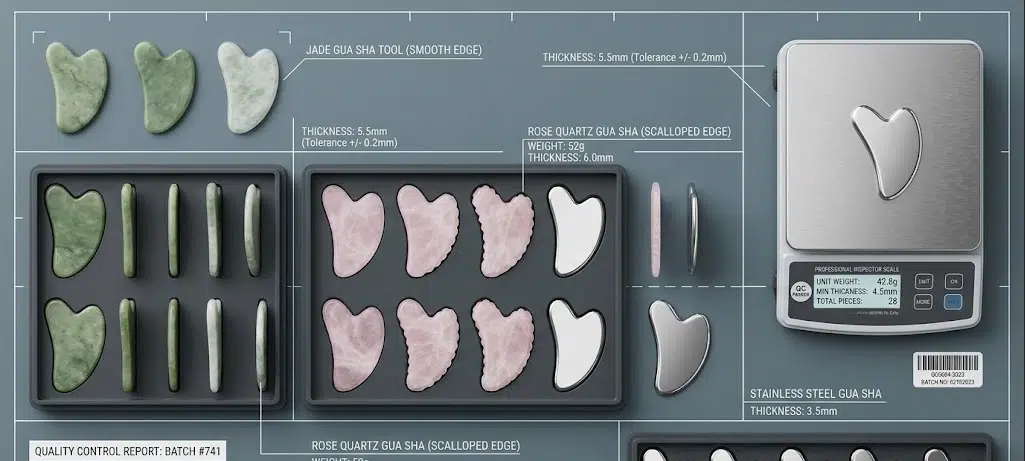
If you’ve ever compared two gua sha boards from different suppliers and felt like you were holding two completely different products, you weren’t imagining it. In gua sha wholesale sourcing, the weight of two tools listed under the same material name can differ by 20% to 50%, and a metal tool can weigh close to three times more than a crystal tool cut to the same outline. That spread isn’t random, and it isn’t a quality accident either. It comes from nine measurable variables — density, thickness, size, shape, edge finishing, hollow-versus-solid construction, surface treatment, natural mineral variance, and factory tolerance control — and every one of them can be specified, tested, and locked down before your container ships.
This article is written from the production floor rather than the sales desk. You’ll see exactly where gua sha weight comes from, where the real risk sits in a guasha tools wholesale contract, and what separates a disciplined gua sha manufacturer from one that lets weight drift order to order.
- Material Density: The Root Cause Behind Every Gua Sha Wholesale Weight Difference
- Thickness and Size: The Two Variables Gua Sha Wholesale Buyers Can Actually Control
- Shape and Structural Design: Why Gua Sha Wholesale Orders From the Same Mold Still Differ in Weight
- Natural Stone Variance: The Tolerance Range Every Gua Sha Wholesale Buyer Should Expect
- Weight vs. Experience: Debunking the "Heavier Is Better" Myth in Gua Sha Wholesale Sourcing
- Gua Sha Shipping Costs: How Product Weight Quietly Inflates Your Gua Sha Wholesale Landed Cost
- How to Vet a Gua Sha Manufacturer for Gua Sha Wholesale Weight Consistency
- Risk Disclosure: What Can Go Wrong in Gua Sha Wholesale Orders When Weight Isn't Controlled
- FAQs About Different Gua Sha Wholesale Weight
Material Density: The Root Cause Behind Every Gua Sha Wholesale Weight Difference
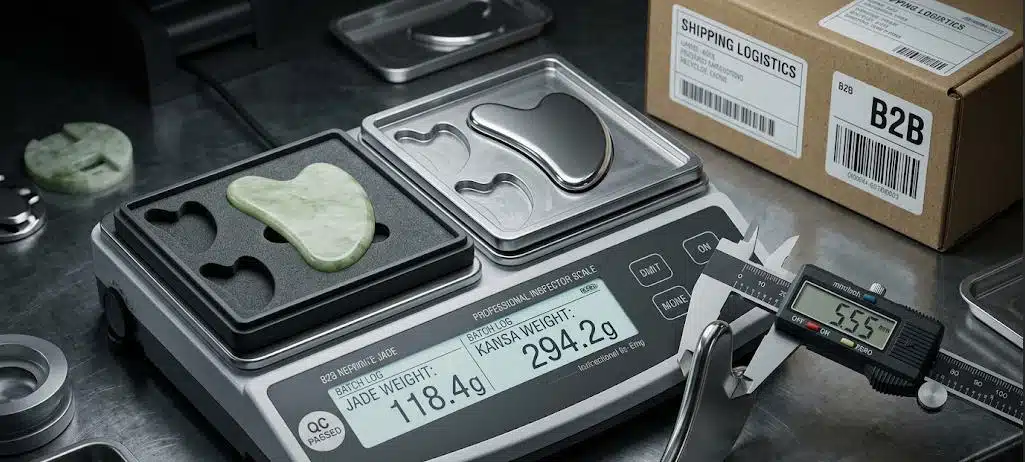
Density decides more of a tool’s final weight than every other variable combined, and it’s the first thing worth checking before comparing two quotes in a gua sha wholesale conversation. Density is simply mass per unit of volume, so two boards cut from the exact same mold will weigh differently the moment the raw material changes. Gemologists measure this as specific gravity — the ratio of a stone’s weight to an equal volume of water — and rely on it as an identification tool because the value stays consistent within a narrow range for each mineral group, using it to identify gemstones by measuring how much heavier they are compared to water. That consistency is exactly what makes density useful to you as a buyer. If a supplier’s numbers fall outside the expected range for the stated material, something in the sourcing or the mix ratio is worth questioning before the purchase order gets signed. SOSNA Gems
Quartz, Amethyst, and Rose Quartz Sit in the Same Weight Class
White quartz, amethyst, and rose quartz share the same crystal structure, so they land within a fraction of a percent of each other at roughly 2.65 g/cm³. That’s useful for guasha tools wholesale buyers stocking multiple quartz colorways under one SKU family, because you can standardize thickness and size across the whole line and expect finished weight to track within a gram or two, color aside. Aventurine (often sold as 东陵玉) sits close behind at 2.60–2.70 g/cm³, which is why it gets swapped in as a lower-cost stand-in for true jade without most customers noticing the difference by hand-feel. This means you can mix quartz-family SKUs in a single container without recalculating your weight-based freight estimate for every individual color.
Nephrite Runs Heavier, and That’s Not a Flaw
Nephrite jade (和田玉) typically registers denser than common quartz and most commercial jade substitutes, which is why a nephrite board feels noticeably more substantial in the hand even at identical dimensions. GIA evaluates jadeite and nephrite on a distinct set of quality factors from ordinary quartz-group stones, including how size interacts with perceived value, noting that jadeite size is commonly expressed in millimeters and that value rises with size when other quality factors are held equal. For a gua sha manufacturer working with genuine nephrite, that added density is a selling point worth stating on the product page — heavier isn’t a defect here, it’s a verification signal. If a “nephrite” board weighs suspiciously close to a quartz board of the same size, that’s a reasonable moment to request a density check before the order scales up.
Metal Tools Can Weigh Nearly Three Times More
Stainless steel runs 7.7–8.0 g/cm³, and brass-alloy Kansa tools run 8.3–8.7 g/cm³ — roughly three times denser than any natural stone in this category. That single fact explains most of the sticker shock buyers feel when they request a metal SKU alongside their stone line: the mold hasn’t changed, but the gua sha weight on the packing list has nearly tripled. This means your per-unit freight cost for a metal line needs its own calculation rather than a scaled-up version of your stone-line numbers, so it’s worth requesting actual carton weights, not catalog estimates, before finalizing a metal SKU order.
Thickness and Size: The Two Variables Gua Sha Wholesale Buyers Can Actually Control
Once density is fixed by material choice, thickness and size are the two levers a gua sha manufacturer can adjust on your behalf without touching the stone type at all. Both get decided at the mold and cutting stage, which means both belong on your product spec sheet rather than left to a “standard size” assumption. Thickness is the more direct of the two, because it moves weight in something close to a straight line — so why do so many buyers still leave it unspecified on a first order?
Thickness Moves Weight Almost in a Straight Line
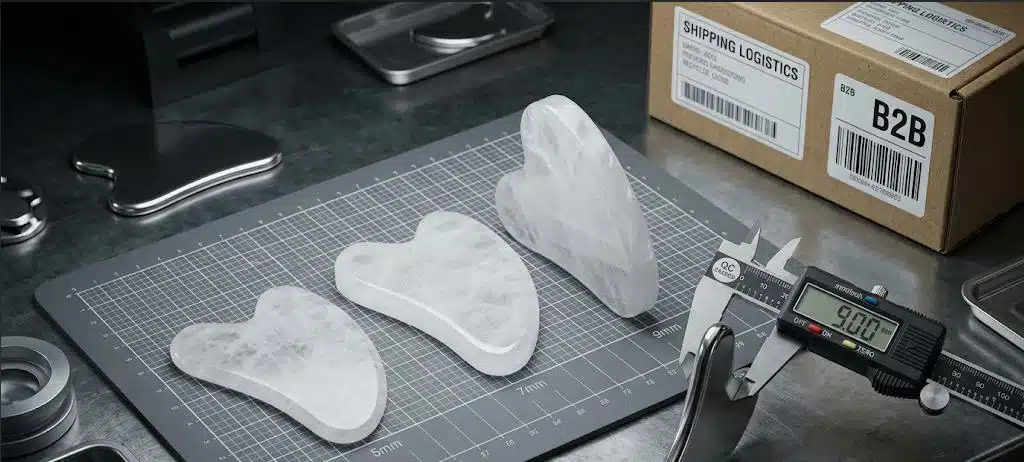
On a same-footprint white quartz board, a 5mm profile runs close to 60 grams, a 7mm profile climbs to roughly 85 grams, and a 9mm profile lands around 105 grams. That’s close to linear — each additional 2mm adds roughly 20 to 25 grams on this footprint — which is exactly why so many premium lines quietly move from 5mm stock to 7mm stock: the added mass reads as “substantial” in a customer’s hand well before it shows up as a meaningful cost increase per unit. This means you can build a “premium feel” tier and a “travel/light” tier from the same material and mold family just by specifying two thickness options, without re-tooling anything else in the gua sha wholesale order.
Size and Surface Area Compound the Effect
Length and width move weight in the same direction as thickness but compound faster, because surface area is being added across two dimensions at once instead of one. A board sized at 85 × 55mm and one sized at 100 × 60mm, cut from identical material and thickness, commonly land 20% to 50% apart in finished weight — a gap wide enough to change your carton count and your gua sha shipping quote before the design itself has changed at all. Buyers sourcing for facial or eye-area use tend to request the smaller footprint specifically to keep weight and control in balance, while body-focused SKUs push toward the larger end on purpose. This means a single size decision, made early in a guasha tools wholesale negotiation, can shift your landed freight cost by double digits with no change to material or finish — worth modeling before you lock a size, not after.
Shape and Structural Design: Why Gua Sha Wholesale Orders From the Same Mold Still Differ in Weight
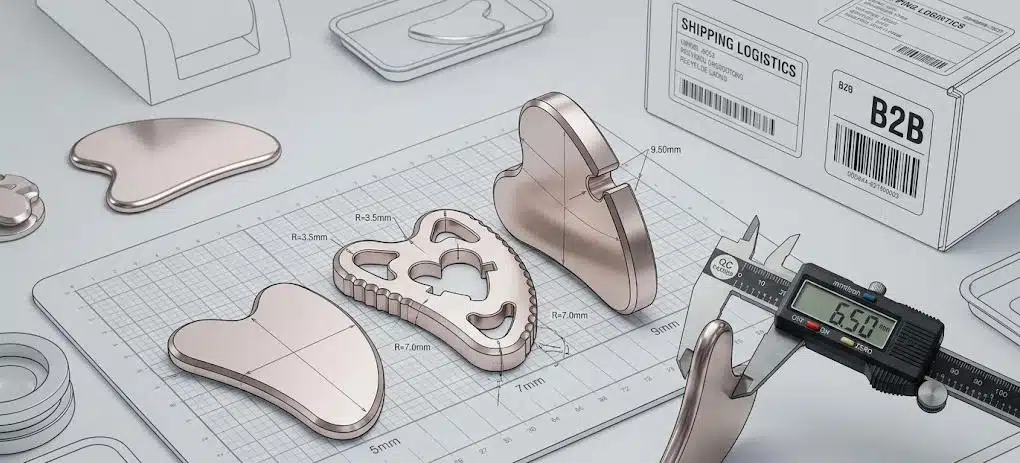
Two boards can share the same material, the same thickness, and even the same outer footprint, and still come off the line at noticeably different weights. The reason sits in the design details that don’t show up on a spec sheet unless someone writes them down: cutouts, edge treatment, hollow construction, and add-on processes. None of these show up in a basic “material + size + thickness” quote, which is exactly why they cause the most disputes in gua sha wholesale negotiations. A buyer assumes weight is locked once material and dimensions are agreed, and then the first shipment arrives lighter or heavier than the sample. Getting ahead of that gap means understanding four design-stage decisions before tooling starts.
Cutouts and Curves Remove Material You’re Not Paying to Ship
Heart, fish, V-shape, wing, and crescent profiles all remove material compared to a simple oval or rectangle of the same outer dimensions. More notches, more open curves, and more negative space in the silhouette all mean less actual stone volume, and less volume means less weight — sometimes by 10% or more on an elaborate cutout design versus a plain one at the same footprint. This isn’t a defect; it’s geometry. It does mean that comparing “weight per SKU” across your catalog without accounting for shape complexity will give you a distorted picture of your average carton weight, which then throws off your freight math before the container even ships.
Edge Chamfering: The Small Loss That Shows Up at Gua Sha Wholesale Batch Scale
Deep bevels, large radius corners, and heavy edge-rounding all remove material during finishing — usually just a few grams per piece, which sounds trivial until you multiply it across a production run. On a 5,000-piece order, a 3-gram-per-piece difference in edge treatment adds up to 15 kilograms of material variance across the batch, enough to shift your carton count calculation if it wasn’t specified up front. This is one of the easiest details to overlook during sampling, because a single sample piece feels identical in the hand regardless of exact edge radius. This means your production spec should state a chamfer radius in millimeters, not a vague “smooth edges” instruction, if consistent batch weight matters to your line.
Solid vs. Hollow Metal Construction Can Double the Weight Gap
This one applies mainly to stainless steel and Kansa tools, where the same outer shape can be built solid or hollow with no visible difference from outside. A solid stainless steel gua sha board commonly runs close to 150 grams, while a hollow-construction piece of the same outline can come in around 80 grams — nearly half the weight from a construction choice alone. Why does this matter more for metal than for stone? Because stone tools are almost always solid by default, while metal tooling gives a factory a genuine choice, and that choice changes your unit cost, your shipping weight, and the tool’s balance in the hand all at once. If a metal SKU quote seems unusually light for its size, ask directly whether the construction is solid or hollow before assuming it’s a pricing error.
Plating, Inlay, and Double-Layer Builds: What a Gua Sha Wholesale Spec Sheet Should Capture
Electroplating, stone inlay, double-layer laminate construction, and metal fittings all add weight, though usually in smaller increments than the factors above — often a few grams to a few tens of grams per piece. The bigger issue isn’t the gram count; it’s that these processes change hand-feel and perceived value in ways a buyer notices even when the weight shift itself is modest. This means it’s worth listing every add-on process explicitly on your guasha tools wholesale purchase order, since “with metal handle” or “electroplated rim” can otherwise mean three different things to three different production lines.
Natural Stone Variance: The Tolerance Range Every Gua Sha Wholesale Buyer Should Expect
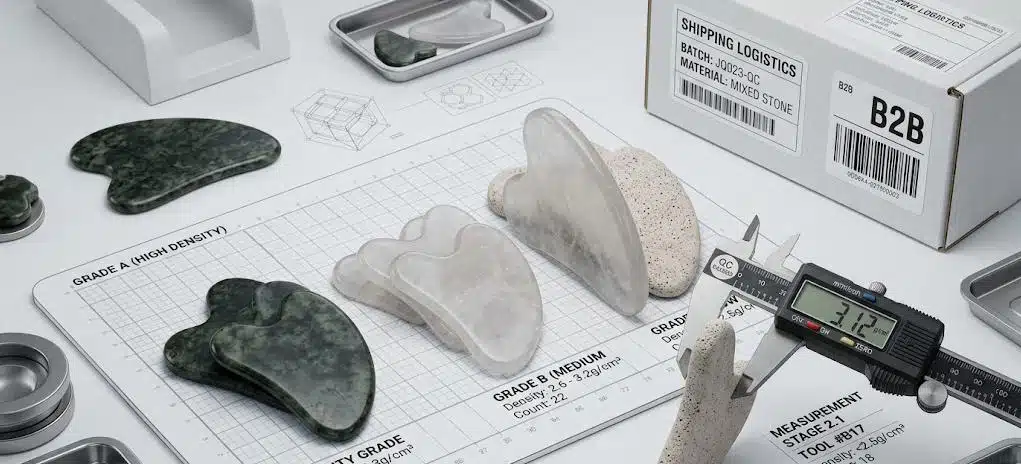
Even with every design variable locked down, natural stone doesn’t behave like a manufactured plastic resin. Real mineral material carries inclusions, micro-fracturing, and natural banding that shift density slightly from piece to piece within the same rough block. That’s not a manufacturing failure — it’s the nature of the raw material, and understanding it separates a reasonable gua sha wholesale buyer from one who rejects an entire batch over normal, expected variance.
Why ±2% to 5% Variance Is Normal, Not a Defect
A reputable testing lab identifies jade strictly through mineralogical and chemical composition rather than surface appearance alone, which is precisely why two visually identical pieces from the same rough block can still register slightly different specific gravity readings once tested. Jadeite’s coloration is often unevenly distributed within a single piece, giving the material a natural visual texture that carvers work with rather than against. Because of this natural inconsistency, a weight variance of roughly ±2% to 5% within the same production batch of natural stone tools falls inside normal, expected tolerance — anything wider than that points toward a mixed-material batch or an inconsistent raw material source, and is worth flagging with your supplier.
Writing Tolerance Into Your Gua Sha Wholesale Contract
The practical takeaway is contractual, not just technical: your purchase agreement should state an acceptable weight tolerance band rather than a single fixed gram figure. A single-number spec (“must weigh exactly 85g”) sets up a natural-material order to fail a QC check it was never realistic for it to pass. This means specifying something closer to “85g ±5%” protects both sides — you get a defensible basis for rejecting a batch that’s genuinely out of spec, and your factory isn’t penalized for the ordinary behavior of real stone.
Weight vs. Experience: Debunking the “Heavier Is Better” Myth in Gua Sha Wholesale Sourcing
A heavier gua sha board is not automatically a better one, no matter how often that assumption shows up in product listings across the gua sha wholesale market. Weight is a real factor in how a tool performs, but it’s one factor among several, and treating it as the deciding one steers buyers toward the wrong SKU for their actual customer base. A spa-supply buyer stocking for full-body treatments and a skincare brand stocking for under-eye use are solving two different problems, and a single “heaviest wins” sourcing rule serves neither one well.
Why Heavier Tools Feel Premium — and Where That Feeling Breaks Down
Extra mass lets a user apply pressure to the skin with less muscular effort, which reads as effortless strength during body-area gua sha work — glutes, back, calves, the areas where deeper pressure is the point. That same mass becomes a liability the moment the tool moves to the face. Facial skin and the muscles around the eyes fatigue quickly under sustained weight, and a board built for body work often gets set aside by the same customer within a week of facial use. This means a single “one tool does everything” SKU is usually a compromise dressed up as a feature, and splitting your guasha tools wholesale catalog into a body-weight tier and a face-weight tier tends to convert better than a universal middle ground.
Lighter Tools Aren’t a Downgrade for Every Use Case
A lighter board trades raw force for control, and control is exactly what a first-time user needs. New buyers consistently over-press with a heavy tool before they’ve learned proper technique, while a lighter board gives them room to build pressure gradually without bruising. Lighter tools also track tighter curves — cheekbones, jawline, the orbital bone around the eyes — areas where a bulky, heavy profile simply can’t follow the contour. The tradeoff is real: deep-tissue work on the body does take more hand effort with a light tool, so this isn’t a universal upgrade either. It’s a fit question, not a quality question, and framing it that way in your own product copy tends to reduce return requests tied to “this feels too light” complaints.
What Actually Drives the Gua Sha Experience
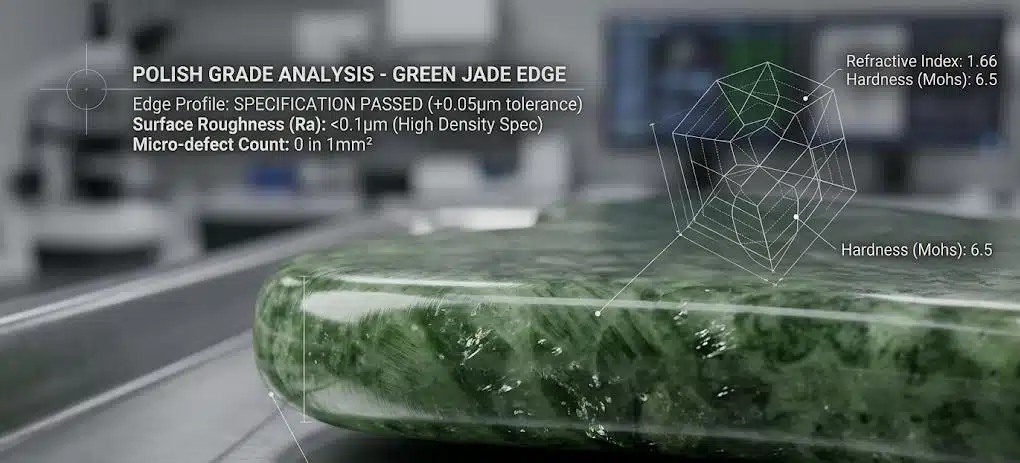
Edge curvature, surface polish, the angle a user holds the tool at, technique, and how much surface area actually contacts the skin all shape the experience far more than the number on the scale. Two boards can weigh the same and feel completely different in use — one gliding smoothly, one dragging or catching — purely because of how the edge was finished. This is where a gua sha manufacturer‘s actual production discipline shows up, and it’s a harder thing to fake than weight. This means that when you’re evaluating a new supplier’s sample, running your thumb along the edge under a loupe and checking the polish grade tells you more about long-term customer satisfaction than the shipping scale does — weight is easy to measure and easy to get obsessed with; finish quality takes more effort to assess and matters more.
Gua Sha Shipping Costs: How Product Weight Quietly Inflates Your Gua Sha Wholesale Landed Cost
So where does all this weight math actually turn into money leaving your account? At the freight invoice — and usually later than you’d like, because most buyers only discover the real number after the goods are already packed. Every decision covered so far — material, thickness, size, shape, construction — rolls up into a single number your freight forwarder cares about, and that number rarely matches what a buyer assumed going in.
Chargeable Weight, Not Actual Weight, Decides Your Freight Bill
International carriers bill shipments based on whichever is higher: the actual scale weight or the volumetric (dimensional) weight calculated from the carton’s size, since chargeable weight is always calculated on whichever is greater between actual weight and volumetric weight. That detail matters enormously for gua sha wholesale buyers, because it flips the usual intuition. A carton full of light, bulky quartz boards padded for protection can rack up a higher chargeable weight from volume than from mass, while a dense stainless-steel order might be billed closer to its true scale weight because it doesn’t need the same amount of protective packaging bulk. This means the packaging density of your carton — not just the gua sha weight of the tools inside it — belongs in your freight conversation from the start, not as an afterthought once the quote comes back higher than expected. Goodhopefreight
A Worked Example: Same Order, Different Thickness, Different Cost
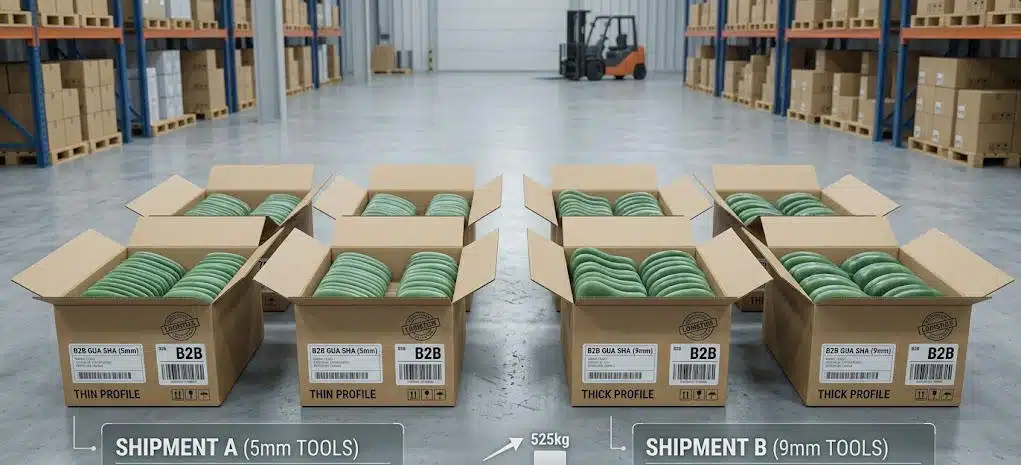
Take a 5,000-unit order of the same quartz board at two thickness options: 5mm (roughly 60g each) and 9mm (roughly 105g each). That’s 300kg of actual product weight at 5mm versus 525kg at 9mm — a 225kg difference before packaging is even added, and on an air-freight lane, that’s a direct, line-item cost difference on your invoice, not a rounding error. If your per-kilogram air rate sits anywhere in a typical China-to-US or China-to-EU range, that thickness decision alone can move your total gua sha shipping line by a four-figure sum on a single order of this size. This is exactly the kind of number worth modeling before you commit to a “premium thick” SKU across your whole catalog rather than as one tier among several — the added mass costs you twice, once in raw material and again at the border.
Sea Freight vs. Air Freight: When Product Weight Matters Most
Weight-driven cost swings matter far more on air freight than on ocean freight, because sea freight is typically priced by volume (per cubic meter) for smaller loads and by container for full-container orders, which flattens out a lot of the gram-level differences that dominate an air quote. If you’re testing a new gua sha manufacturer with a smaller trial order, air freight is common, and that’s precisely when a thickness or size decision has the most leverage over your total cost. Once volumes grow into full-container territory, weight matters less for the freight bill itself and more for how many units physically fit per container — which is really the same underlying variable wearing a different hat. Either way, asking your supplier for actual (not catalog) per-carton weights before quoting freight is one of the simplest habits that prevents a guasha tools wholesale order from arriving with a shipping bill that doesn’t match the number you budgeted.
How to Vet a Gua Sha Manufacturer for Gua Sha Wholesale Weight Consistency
Everything above explains where weight variance comes from. The more useful question, especially if you’re evaluating a new supplier for a gua sha wholesale program, is how to tell in advance whether a factory actually controls it rather than just promising to. Four checks catch most of the risk before a deposit changes hands.
Request Batch-Level Weight Data, Not a Single Sample
A single sample tells you almost nothing about batch consistency, because one piece can be hand-picked. Ask instead for weight records across an existing production run — twenty or thirty pieces pulled from a recent batch, with the spread shown, not just an average. If a gua sha manufacturer can produce this data on request, that’s a strong signal their quality system tracks weight as a real metric rather than an afterthought. If they can’t produce it at all, that’s informative too, and worth weighing against everything else in the quote.
Ask How Tolerance Is Controlled in Production
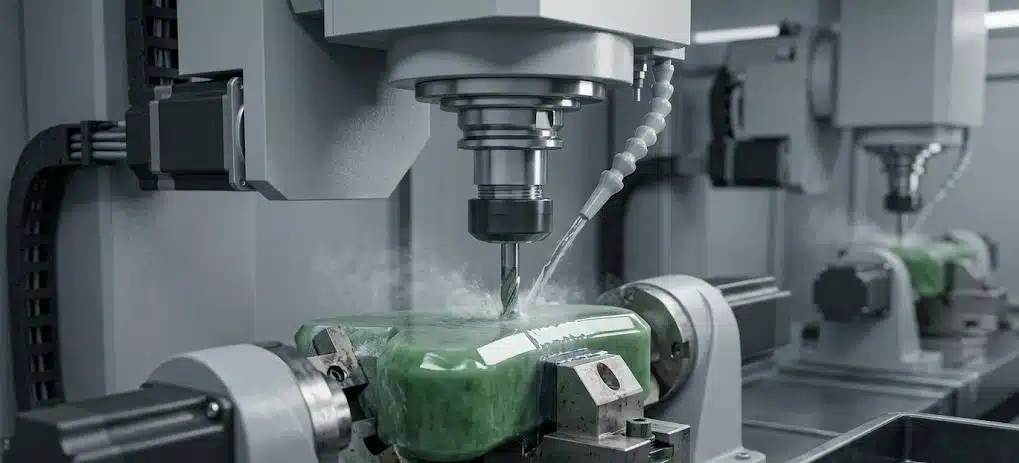
A factory that controls weight consistently is usually doing several specific things at once: sourcing raw material selected for consistent density, using CNC-controlled cutting rather than freehand shaping, holding to a fixed thickness standard across a run, and applying a standardized chamfer rather than a “smooth it by feel” instruction to individual workers. The strongest indicator is whether finished pieces are weighed — either 100% or by a defined sampling plan — before packing, with a stated tolerance such as ±3% to 5%. This means you can ask one direct question during supplier qualification: “What’s your stated weight tolerance, and how do you verify it before shipment?” A confident, specific answer says more than any brochure claim about quality.
Confirm CNC Cutting vs. Hand-Finishing
Hand-finished stone carries meaningfully more piece-to-piece variance than CNC-cut stone, particularly at the edge and chamfer stage where the most material gets removed inconsistently. Neither approach is automatically wrong — some artisanal lines lean on hand-finishing intentionally — but you should know which one you’re buying before you commit to a guasha tools wholesale order at scale. This means asking specifically which stages are CNC-controlled and which are manual, rather than assuming “CNC-cut” on a spec sheet covers the entire process end to end.
Get Real Carton Weights Before You Quote Freight
Tie this back to the shipping math from the previous section: ask for actual, measured per-carton weights from a real production run, not a catalog estimate calculated from theoretical unit weight times carton quantity. Packaging materials, void fill, and inner packaging all add real mass that a per-unit estimate misses. This means your freight forwarder quotes against real numbers instead of optimistic ones, which is the single easiest way to prevent a gua sha shipping bill from arriving higher than what you budgeted.
Risk Disclosure: What Can Go Wrong in Gua Sha Wholesale Orders When Weight Isn’t Controlled
This section is the reason for the article’s title, and it deserves plain language rather than marketing language. Three risk categories account for most of the disputes and unexpected costs that show up in gua sha wholesale sourcing once weight goes unmanaged. None of them are exotic. All of them are preventable with the checks covered above.
Customs Declaration Risk: Why Accurate Weight Documentation Matters
Customs authorities assess duties and screen shipments partly based on the weight and value declared on your commercial invoice and packing list. When a supplier’s catalog weight doesn’t match the actual measured weight of what ships, the mismatch can trigger inspection holds, valuation queries, or delays at the border — problems that cost time and money regardless of who was technically at fault. Is this the kind of risk most buyers think about before their first shipment? Rarely. This means it’s worth requesting that your packing list reflect actual measured carton weights rather than theoretical ones, and confirming that figure matches what your customs broker files, before the container leaves port.
Batch Rejection Risk: When Natural Variance Gets Misread as a Defect
A buyer who hasn’t built the ±2% to 5% natural-material tolerance into their QC criteria can end up disputing or rejecting an entire compliant batch over normal stone variance — a costly, avoidable conflict for both sides. This risk is entirely self-inflicted in the sense that it comes from a contract gap, not a manufacturing failure: the tolerance band simply wasn’t written down. This means the fix sits upstream of production, in the purchase agreement itself, where a stated tolerance range protects you from overpaying for an unrealistic standard and protects your supplier from being penalized for how real stone actually behaves.
Margin Erosion Risk: Underestimated Freight on Reorders
The riskiest moment in a gua sha wholesale relationship is often not the first order — it’s the reorder. A small trial batch shipped by air with generous margin built in can mask how much a spec upgrade (a thicker profile, a larger footprint, a heavier finish added after customer feedback) will cost once it’s scaled to a full container. Reordering without re-running the gua sha weight and freight math against the new specification is one of the quietest ways margin disappears from a growing product line. This means every spec change, however minor it looks on paper, earns a fresh freight calculation before the next PO goes out — not a recycled number from the original quote.
FAQs About Different Gua Sha Wholesale Weight
1. Why do two “quartz” gua sha boards from different suppliers weigh differently?
Usually thickness or size, not the material itself — quartz-family stones sit within a narrow density range, so a weight gap almost always traces back to a dimension that wasn’t specified.
2. Is a heavier gua sha tool always higher quality?
No. Weight reflects material and dimensions, not finishing quality. Edge polish and chamfer precision say more about craftsmanship than the number on a scale.
3. What weight tolerance should I write into a gua sha wholesale contract?
For natural stone, a band of roughly ±3% to 5% around a stated target weight is standard and realistic; a single fixed number invites disputes over normal material variance.
4. Does gua sha weight affect my shipping cost more by air or by sea?
By air, almost always — chargeable weight is based on whichever is greater, actual or volumetric, and that gap matters most on air lanes. Full-container sea freight is driven more by unit count per container than by gram-level weight differences.