Gua Sha Wholesale Limitations: An Honest Manufacturing Risk Disclosure
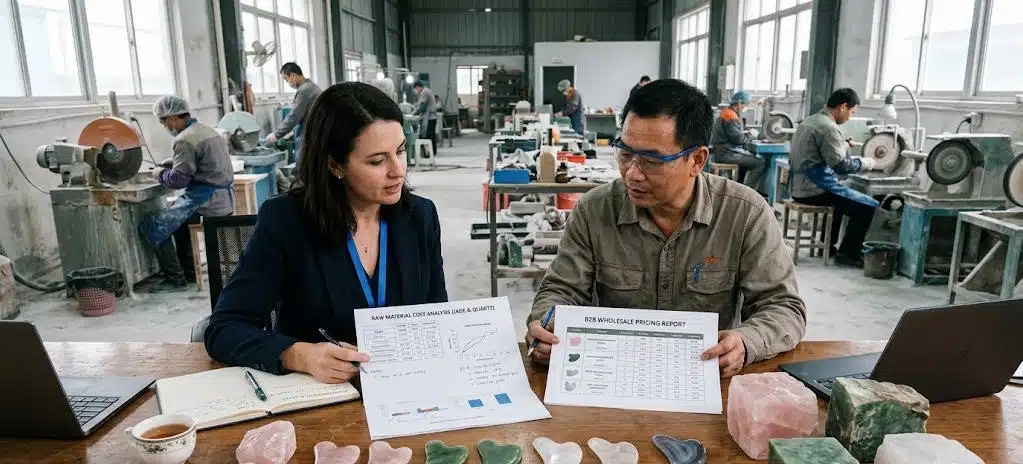
If you’ve priced out a gua sha wholesale order recently, you’ve probably run into a number that felt higher than expected. Here’s the number that matters more: on natural jade and quartz gua sha tools, raw material typically eats up 50% to 70% of total unit cost before a single hour of labor gets added. That one fact drives almost everything else in this guide. Buyers who understand it stop asking “can you go lower” and start asking better questions — about grade, about tolerance, about what a gua sha manufacturer can and can’t control. Whether you buy as a boutique brand or as a full-container guasha tools wholesale distributor, this article walks through seven structural limitations you’ll meet with any serious gua sha factory: price, lead time, minimum order quantity, shape, customization, material consistency, and quality standards. None of these are excuses. They’re geology, labor economics, and shipping physics, and knowing them in advance saves you weeks of back-and-forth. Why Gua Sha Wholesale Pricing Can’t Be Pushed Below a Certain Floor Every buyer asks the same question in the first email: can you make it cheaper? It’s a fair question, and the honest answer is: sometimes, and sometimes not. A price for a natural-stone order isn’t picked out of the air. It’s the sum of raw stone, cutting time, polishing labor, inspection, packaging, and freight, and none of those line items are elastic in the way a discount might be. This means you can negotiate margin, but you can’t negotiate physics — a block of jade that costs a certain rate per kilogram doesn’t get cheaper just because you ordered 10,000 pieces instead of 5,000. Material alone is usually the largest single cost driver. On a typical order, natural jade or quartz raw stock, together with yield loss during cutting, accounts for roughly half to two-thirds of the finished price, which is why spreading fixed costs across too few units makes the unit price unworkable for both sides of the negotiation. Yield matters more than most buyers expect: a boulder that carves cleanly into 60% usable material behaves very differently, price-wise, than one that only yields 35% after cutting around cracks and inclusions. A manufacturer who quotes without discussing yield is quoting blind. What Actually Sits Inside a Gua Sha Manufacturer’s Quote Beyond raw material, a working quote carries CNC cutting time, hand-finishing labor, polishing, quality inspection, packaging materials, and international freight. Each stage adds hours to the gua sha production timeline, and hours are the one input that can’t be compressed without cutting into the finished tool’s surface quality. Two factories quoting the same design can look identical on paper, but every gua sha factory allocates these line items slightly differently depending on their equipment and labor mix. A rushed polish shows up immediately under raking light, and a skipped inspection step shows up three months later as a return shipment. This means your unit price reflects a chain of decisions, not a single markup a supplier can simply shave off on request. How Material Grade Requests Change Your Gua Sha Wholesale Cost Specify a higher jade grade — no visible cracks, no black mineral spots, more even color, higher translucency — and the cost of qualifying raw material rises before cutting even starts. The same applies to complex silhouettes: a fish-shaped gua sha with a narrow tail takes longer to rough out on the wheel than a simple oval, and a thicker profile consumes more stone per piece even at the same footprint. Strict quality control adds a final variable, since tighter rejection criteria lower the percentage of pieces that pass, which raises effective cost per accepted unit. So what does that mean for your order? It means the fastest way to lower your gua sha wholesale unit price isn’t pressure on the factory — it’s adjusting one of three levers: grade, shape complexity, or acceptance tolerance. A gua sha supplier who explains this tradeoff instead of just dropping the number is the one worth building a long-term relationship with. Lead Time Limits: What a Responsible Gua Sha Factory Will Promise The second most common question sounds like this: can you guarantee delivery in exactly 20 days? No responsible gua sha factory will answer yes to that, and you should be careful of any supplier who does. Production timelines for natural stone tools depend on inputs that no single company fully controls, and treating a lead time as a fixed number instead of an estimate sets up a conflict that neither side wins. Four Variables Behind Every Gua Sha Production Schedule Raw material supply is the first variable, and it’s the one buyers underestimate most. Jade and quartz are mined, not manufactured, which means a specific color, texture, or block size can simply be out of stock at the source for weeks. Factory scheduling is the second: a workshop running multiple client orders at once absorbs delays from earlier jobs, rush insertions, and equipment maintenance, and CNC downtime on one line can push every order behind it back by days. Labor is the third variable, since polishing, hand-finishing, logo fill, and final QC all depend on skilled workers whose availability shifts around holidays, hiring cycles, and seasonal absence. Power restrictions, typhoons, flooding, and logistics disruption make up the fourth category, and in coastal manufacturing regions, at least one of these shows up in any given production quarter. Building Buffer Time Into a Gua Sha Wholesale Order This is why serious manufacturers quote an estimated lead time rather than a guaranteed one, and why your purchasing calendar should carry a buffer instead of running production to the wire. A 45-day estimate with a one-week cushion protects a launch date far better than a 38-day promise with zero room for a supply hiccup. Ask your gua sha supplier for their current backlog and their typical variance — most experienced factories can give you a realistic range rather than a single optimistic number, and that range tells you more
Gua Sha Wholesale Limitations: An Honest Manufacturing Risk Disclosure Read More »
If you’ve priced out a gua sha wholesale order recently, you’ve probably run into a number that felt higher than expected. Here’s the number that matters more: on natural jade and quartz gua sha tools, raw material typically eats up 50% to 70% of total unit cost before a single hour of labor gets added. That one fact drives almost everything else in this guide. Buyers who understand it stop asking “can you go lower” and start asking better questions — about grade, about tolerance, about what a gua sha manufacturer can and can’t control. Whether you buy as a boutique brand or as a full-container guasha tools wholesale distributor, this article walks through seven structural limitations you’ll meet with any serious gua sha factory: price, lead time, minimum order quantity, shape, customization, material consistency, and quality standards. None of these are excuses. They’re geology, labor economics, and shipping physics, and knowing them in advance saves you weeks of back-and-forth. Why Gua Sha Wholesale Pricing Can’t Be Pushed Below a Certain Floor Every buyer asks the same question in the first email: can you make it cheaper? It’s a fair question, and the honest answer is: sometimes, and sometimes not. A price for a natural-stone order isn’t picked out of the air. It’s the sum of raw stone, cutting time, polishing labor, inspection, packaging, and freight, and none of those line items are elastic in the way a discount might be. This means you can negotiate margin, but you can’t negotiate physics — a block of jade that costs a certain rate per kilogram doesn’t get cheaper just because you ordered 10,000 pieces instead of 5,000. Material alone is usually the largest single cost driver. On a typical order, natural jade or quartz raw stock, together with yield loss during cutting, accounts for roughly half to two-thirds of the finished price, which is why spreading fixed costs across too few units makes the unit price unworkable for both sides of the negotiation. Yield matters more than most buyers expect: a boulder that carves cleanly into 60% usable material behaves very differently, price-wise, than one that only yields 35% after cutting around cracks and inclusions. A manufacturer who quotes without discussing yield is quoting blind. What Actually Sits Inside a Gua Sha Manufacturer’s Quote Beyond raw material, a working quote carries CNC cutting time, hand-finishing labor, polishing, quality inspection, packaging materials, and international freight. Each stage adds hours to the gua sha production timeline, and hours are the one input that can’t be compressed without cutting into the finished tool’s surface quality. Two factories quoting the same design can look identical on paper, but every gua sha factory allocates these line items slightly differently depending on their equipment and labor mix. A rushed polish shows up immediately under raking light, and a skipped inspection step shows up three months later as a return shipment. This means your unit price reflects a chain of decisions, not a single markup a supplier can simply shave off on request. How Material Grade Requests Change Your Gua Sha Wholesale Cost Specify a higher jade grade — no visible cracks, no black mineral spots, more even color, higher translucency — and the cost of qualifying raw material rises before cutting even starts. The same applies to complex silhouettes: a fish-shaped gua sha with a narrow tail takes longer to rough out on the wheel than a simple oval, and a thicker profile consumes more stone per piece even at the same footprint. Strict quality control adds a final variable, since tighter rejection criteria lower the percentage of pieces that pass, which raises effective cost per accepted unit. So what does that mean for your order? It means the fastest way to lower your gua sha wholesale unit price isn’t pressure on the factory — it’s adjusting one of three levers: grade, shape complexity, or acceptance tolerance. A gua sha supplier who explains this tradeoff instead of just dropping the number is the one worth building a long-term relationship with. Lead Time Limits: What a Responsible Gua Sha Factory Will Promise The second most common question sounds like this: can you guarantee delivery in exactly 20 days? No responsible gua sha factory will answer yes to that, and you should be careful of any supplier who does. Production timelines for natural stone tools depend on inputs that no single company fully controls, and treating a lead time as a fixed number instead of an estimate sets up a conflict that neither side wins. Four Variables Behind Every Gua Sha Production Schedule Raw material supply is the first variable, and it’s the one buyers underestimate most. Jade and quartz are mined, not manufactured, which means a specific color, texture, or block size can simply be out of stock at the source for weeks. Factory scheduling is the second: a workshop running multiple client orders at once absorbs delays from earlier jobs, rush insertions, and equipment maintenance, and CNC downtime on one line can push every order behind it back by days. Labor is the third variable, since polishing, hand-finishing, logo fill, and final QC all depend on skilled workers whose availability shifts around holidays, hiring cycles, and seasonal absence. Power restrictions, typhoons, flooding, and logistics disruption make up the fourth category, and in coastal manufacturing regions, at least one of these shows up in any given production quarter. Building Buffer Time Into a Gua Sha Wholesale Order This is why serious manufacturers quote an estimated lead time rather than a guaranteed one, and why your purchasing calendar should carry a buffer instead of running production to the wire. A 45-day estimate with a one-week cushion protects a launch date far better than a 38-day promise with zero room for a supply hiccup. Ask your gua sha supplier for their current backlog and their typical variance — most experienced factories can give you a realistic range rather than a single optimistic number, and that range tells you more