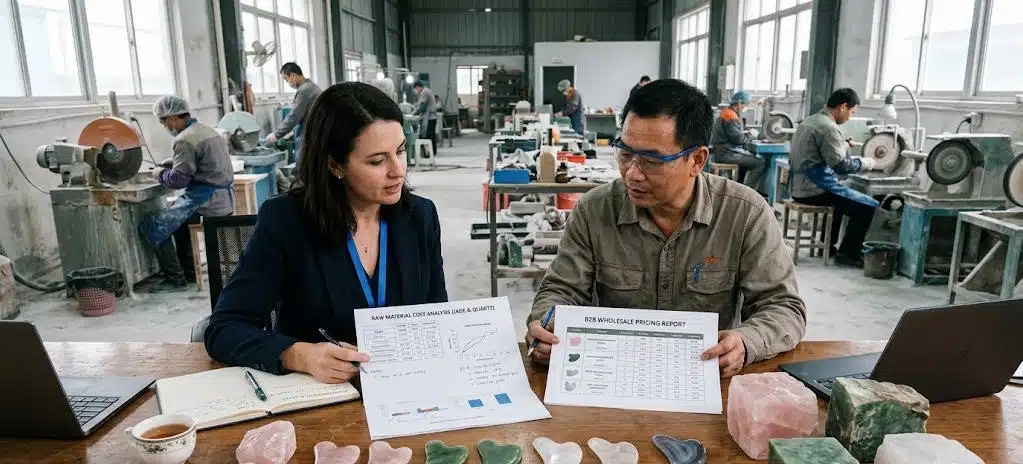
If you’ve priced out a gua sha wholesale order recently, you’ve probably run into a number that felt higher than expected. Here’s the number that matters more: on natural jade and quartz gua sha tools, raw material typically eats up 50% to 70% of total unit cost before a single hour of labor gets added. That one fact drives almost everything else in this guide. Buyers who understand it stop asking “can you go lower” and start asking better questions — about grade, about tolerance, about what a gua sha manufacturer can and can’t control. Whether you buy as a boutique brand or as a full-container guasha tools wholesale distributor, this article walks through seven structural limitations you’ll meet with any serious gua sha factory: price, lead time, minimum order quantity, shape, customization, material consistency, and quality standards. None of these are excuses. They’re geology, labor economics, and shipping physics, and knowing them in advance saves you weeks of back-and-forth.
Why Gua Sha Wholesale Pricing Can’t Be Pushed Below a Certain Floor
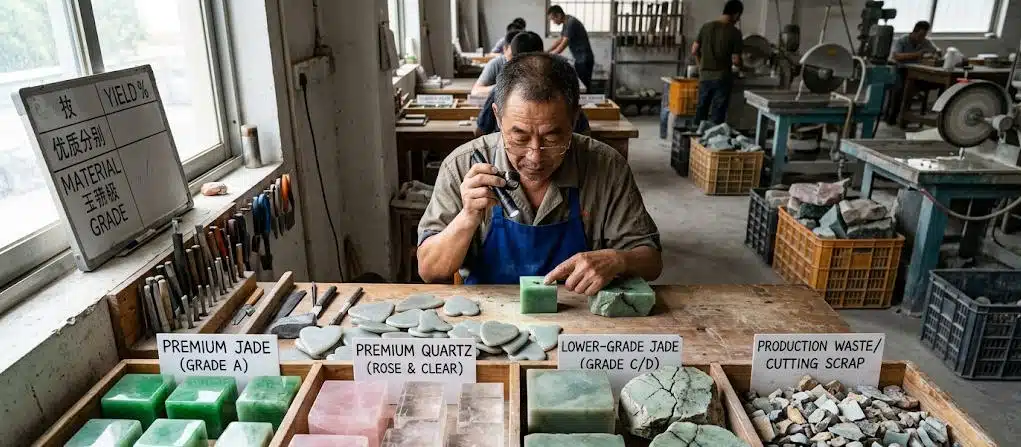
Every buyer asks the same question in the first email: can you make it cheaper? It’s a fair question, and the honest answer is: sometimes, and sometimes not. A price for a natural-stone order isn’t picked out of the air. It’s the sum of raw stone, cutting time, polishing labor, inspection, packaging, and freight, and none of those line items are elastic in the way a discount might be. This means you can negotiate margin, but you can’t negotiate physics — a block of jade that costs a certain rate per kilogram doesn’t get cheaper just because you ordered 10,000 pieces instead of 5,000.
Material alone is usually the largest single cost driver. On a typical order, natural jade or quartz raw stock, together with yield loss during cutting, accounts for roughly half to two-thirds of the finished price, which is why spreading fixed costs across too few units makes the unit price unworkable for both sides of the negotiation. Yield matters more than most buyers expect: a boulder that carves cleanly into 60% usable material behaves very differently, price-wise, than one that only yields 35% after cutting around cracks and inclusions. A manufacturer who quotes without discussing yield is quoting blind.
What Actually Sits Inside a Gua Sha Manufacturer’s Quote
Beyond raw material, a working quote carries CNC cutting time, hand-finishing labor, polishing, quality inspection, packaging materials, and international freight. Each stage adds hours to the gua sha production timeline, and hours are the one input that can’t be compressed without cutting into the finished tool’s surface quality. Two factories quoting the same design can look identical on paper, but every gua sha factory allocates these line items slightly differently depending on their equipment and labor mix. A rushed polish shows up immediately under raking light, and a skipped inspection step shows up three months later as a return shipment. This means your unit price reflects a chain of decisions, not a single markup a supplier can simply shave off on request.
How Material Grade Requests Change Your Gua Sha Wholesale Cost
Specify a higher jade grade — no visible cracks, no black mineral spots, more even color, higher translucency — and the cost of qualifying raw material rises before cutting even starts. The same applies to complex silhouettes: a fish-shaped gua sha with a narrow tail takes longer to rough out on the wheel than a simple oval, and a thicker profile consumes more stone per piece even at the same footprint. Strict quality control adds a final variable, since tighter rejection criteria lower the percentage of pieces that pass, which raises effective cost per accepted unit. So what does that mean for your order? It means the fastest way to lower your gua sha wholesale unit price isn’t pressure on the factory — it’s adjusting one of three levers: grade, shape complexity, or acceptance tolerance. A gua sha supplier who explains this tradeoff instead of just dropping the number is the one worth building a long-term relationship with.
Lead Time Limits: What a Responsible Gua Sha Factory Will Promise
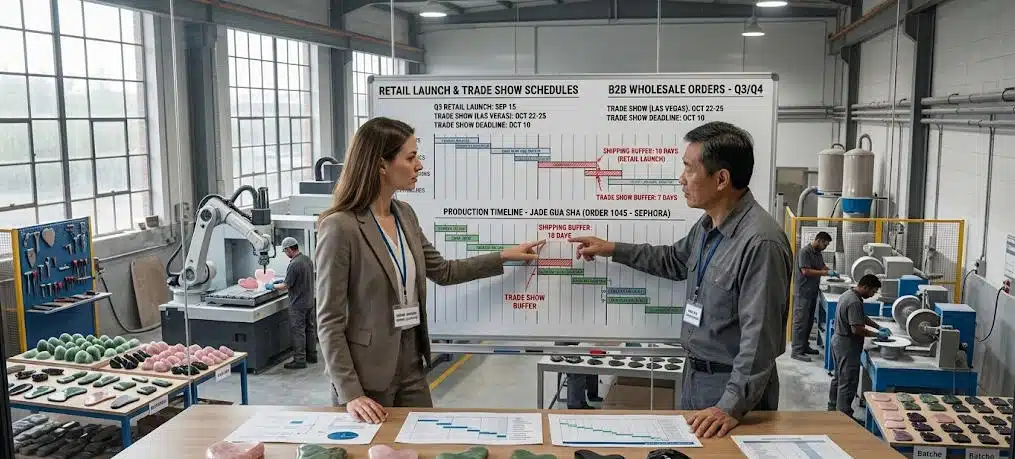
The second most common question sounds like this: can you guarantee delivery in exactly 20 days? No responsible gua sha factory will answer yes to that, and you should be careful of any supplier who does. Production timelines for natural stone tools depend on inputs that no single company fully controls, and treating a lead time as a fixed number instead of an estimate sets up a conflict that neither side wins.
Four Variables Behind Every Gua Sha Production Schedule
Raw material supply is the first variable, and it’s the one buyers underestimate most. Jade and quartz are mined, not manufactured, which means a specific color, texture, or block size can simply be out of stock at the source for weeks. Factory scheduling is the second: a workshop running multiple client orders at once absorbs delays from earlier jobs, rush insertions, and equipment maintenance, and CNC downtime on one line can push every order behind it back by days. Labor is the third variable, since polishing, hand-finishing, logo fill, and final QC all depend on skilled workers whose availability shifts around holidays, hiring cycles, and seasonal absence. Power restrictions, typhoons, flooding, and logistics disruption make up the fourth category, and in coastal manufacturing regions, at least one of these shows up in any given production quarter.
Building Buffer Time Into a Gua Sha Wholesale Order
This is why serious manufacturers quote an estimated lead time rather than a guaranteed one, and why your purchasing calendar should carry a buffer instead of running production to the wire. A 45-day estimate with a one-week cushion protects a launch date far better than a 38-day promise with zero room for a supply hiccup. Ask your gua sha supplier for their current backlog and their typical variance — most experienced factories can give you a realistic range rather than a single optimistic number, and that range tells you more about reliability than any promise ever could. If you’re planning an order tied to a retail launch or trade show date, work backward from that date with at least two weeks of slack, not zero.
Skip that buffer and the risk lands entirely on your side of the table when a gua sha factory runs its schedule with zero margin: a missed launch date, an empty retail shelf, or an expedited air-freight bill that erases your quarter’s margin. This means building a two-week cushion costs you nothing up front and protects the number that actually matters — your delivered-on-time rate for every guasha tools wholesale shipment that follows.
MOQ Limitations: Why Private Label Gua Sha and Gua Sha Wholesale Orders Need Minimums
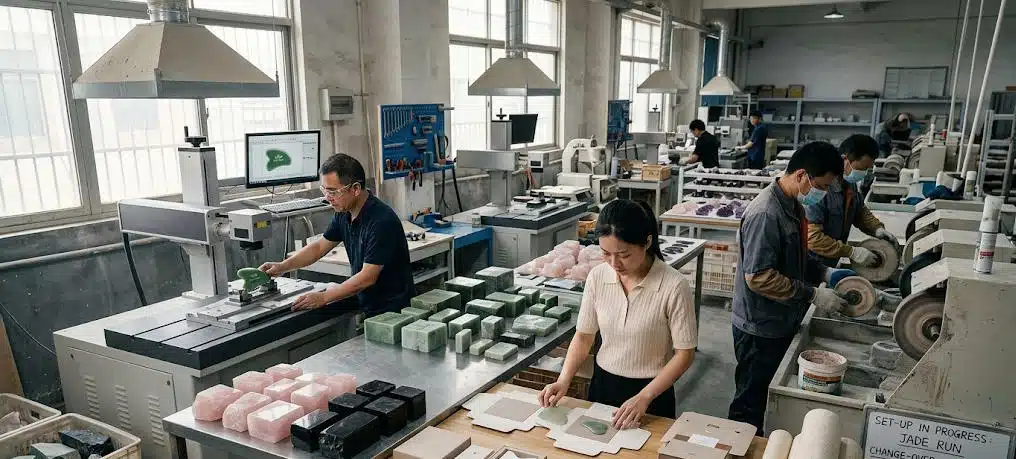
Most factories that offer OEM services also support private label gua sha work, but that doesn’t mean every order size fits every request. A minimum order quantity exists because certain setup costs get paid once, regardless of whether you order 200 pieces or 20,000, and spreading that fixed cost across too few units makes the price unworkable for both sides.
Why Custom Packaging Raises Your MOQ
Custom logo engraving needs laser calibration time that’s identical whether you’re running a short batch or a long one on any gua sha custom order. Branded packaging carries its own print-run minimum, since a print shop won’t set up a die-cut box for 100 units at a workable rate. Raw material purchasing works the same way — a gua sha factory buying jade in bulk gets a better rate than one buying a small, specific batch for a single client, and that rate gets passed through to your invoice either way. Line changeover time adds a final layer, because switching a polishing line from one client’s shape to another consumes labor hours that have to be recovered somewhere in the gua sha production schedule. So what does that mean for you? It means MOQ isn’t a sales tactic — it’s the point where setup cost per unit drops to something workable, and asking your gua sha manufacturer where that point sits for your specific design gives you a real number to plan around instead of guessing.
Planning Your Guasha Tools Wholesale Order Around MOQ
If your first order needs to stay small — a test batch before a bigger private label gua sha commitment, for example — ask your gua sha supplier directly whether a shared production run is possible, where your custom logo rides alongside a standard shape the factory already has in queue. This approach can bring a guasha tools wholesale trial order down closer to a workable minimum without asking the factory to absorb setup costs it can’t recover. It also gives you real product in hand before you commit to the full MOQ, which is a better use of a smaller initial budget than negotiating a discount that quietly shows up as thinner polish quality later. Once that trial batch performs well with your own customers, scaling up to a full production run is a far easier conversation, since both sides already know the design survives cutting, polishing, and shipping intact — the two or three data points that matter most before either party commits real capacity to a bigger order.
Shape and Design Limits: Engineering a Gua Sha Custom Order Around Brittle Stone
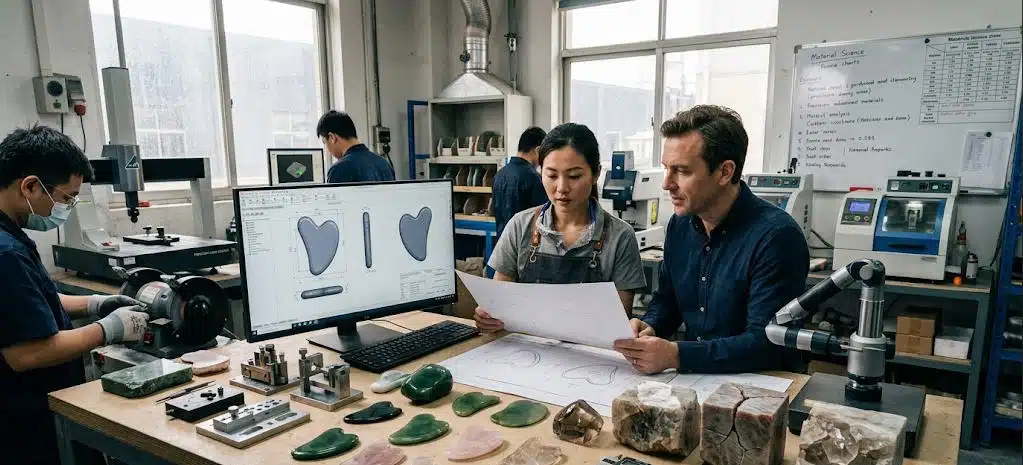
Plenty of buyers arrive with a fully unique silhouette in mind for their gua sha custom project, and plenty of those CAD files aren’t safe to cut in natural stone exactly as drawn. Jade and quartz are brittle materials — hard enough to resist scratching, but not naturally resistant to a sharp knock, and that distinction matters more than most first-time buyers realize.
High-Risk Design Features in Gua Sha Custom Projects
Sharp points, thin comb-like teeth, needle-shaped protrusions, thin connecting necks, tight inner corners, and long narrow tails are the six features that break most often, and they tend to fail at the same production stages every time: CNC roughing, hand-edge finishing, polishing, packaging, transit, and eventually in the customer’s hand. Gemological references on gem durability draw a useful distinction here: hardness, or resistance to scratching, is a separate property from toughness, or resistance to breaking under impact, and a material can rank reasonably high on hardness while still fracturing at a thin point under a sharp strike — a distinction GIA explains in detail. A protrusion only 2 to 3 millimeters wide is a realistic breaking point during a shipping bump, not a worst-case scenario — it’s a routine failure mode that shows up in claim photos more often than any other design issue. Ask your gua sha supplier for photos of similar shapes they’ve produced before finalizing any sharp-corner design.
How a Gua Sha Manufacturer Protects Your Design Through DFM
This is where Design for Manufacturability, or DFM, comes in. An experienced gua sha manufacturer doesn’t reject a design outright — instead, they add fillets to sharp inner corners, thicken narrow connection points, rebalance load-bearing curves, and adjust radius transitions so the tool keeps its intended look while surviving the full gua sha production and shipping chain. Jadeite sits at roughly 6.5 to 7 on the Mohs hardness scale and nephrite at 6 to 6.5, and both owe their real-world toughness to a densely interlocking crystal structure rather than raw hardness alone, a property well documented by the International Gem Society. This means you can usually keep most of your original design intent while gaining a return-rate improvement worth far more than the small visual compromise. A gua sha wholesale buyer who accepts one or two DFM adjustments up front almost always ends up with a lower total cost than one who insists on the original file and absorbs breakage losses downstream.
Customization Limits in Gua Sha Custom Logo and Color Work
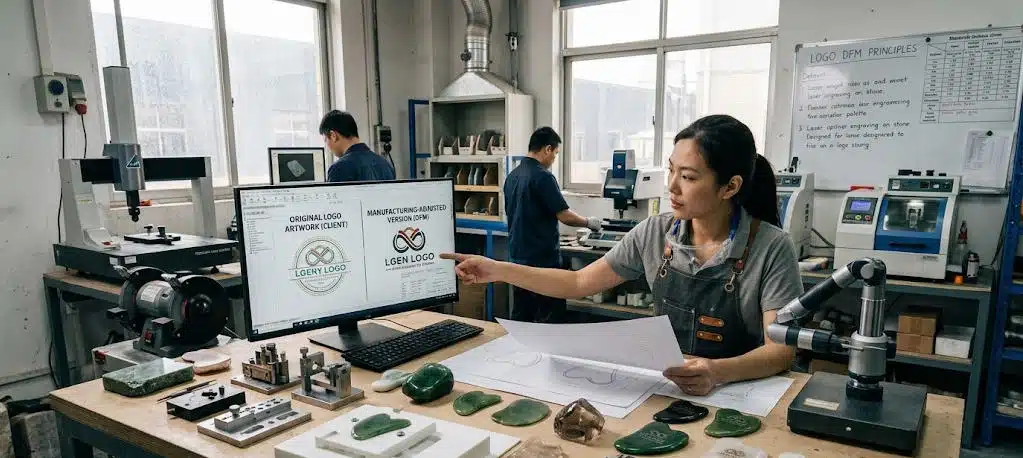
Not every logo file translates cleanly onto natural stone, and this catches buyers off guard more than almost any other limitation on this list. A design that looks crisp on a screen doesn’t automatically survive laser engraving and hand color-fill on a gua sha custom order the way it looked in the mockup.
Why Fine Lines Struggle on Private Label Gua Sha Pieces
Extremely thin lines are the first casualty, since engraving depth on stone has a practical floor — go thinner than that floor and the line either doesn’t register or fills in during polishing. Multi-color logos add a second risk: when color is applied by hand after laser engraving, adjacent colors sitting close together tend to bleed into one another, especially on a curved surface where a brush or fine tool can’t hold a perfectly straight edge. Extremely small text is the third problem, since engraving depth and fill thickness compete for the same tiny space, and past a certain point letters simply stop being legible. This means a logo that works well on a business card may need real adjustment before it works on a private label gua sha tool — and that adjustment isn’t a downgrade, it’s a translation between two different mediums.
Practical Adjustments That Raise Your Gua Sha Wholesale Yield
The fix is usually straightforward: thicken fine lines to a minimum width the engraving process can hold cleanly, reduce the color count on multi-tone logos, and bump small text up to a size the fill process can register reliably. A gua sha manufacturer who suggests these changes early is trying to protect your finished-product yield, not water down your brand. Skip that conversation and you’ll likely see it later in the QC report, where a batch gets flagged during gua sha production for smudged color fill or illegible engraving — a far more expensive place to discover the same design constraint. Buyers running a wholesale program across multiple SKUs benefit from locking these engraving rules once, at the design stage, across the whole guasha tools wholesale catalog rather than relearning them on every new product.
In practice, a laser-engraved line narrower than roughly 0.3 to 0.4 millimeters on polished jade tends to lose definition once color fill and a final buff pass are applied, which is why many factories set a minimum line width for logo artwork instead of accepting a file exactly as submitted. Text height below about 3 millimeters runs into the same ceiling, since the fill tool needs enough surface area inside each stroke to sit cleanly without bridging into the letter next to it. This means submitting vector artwork that already respects these two numbers saves at least one full round of file revision before your first physical sample ever reaches the polishing bench.
Natural Material Consistency: Why Gua Sha Wholesale Batches Vary
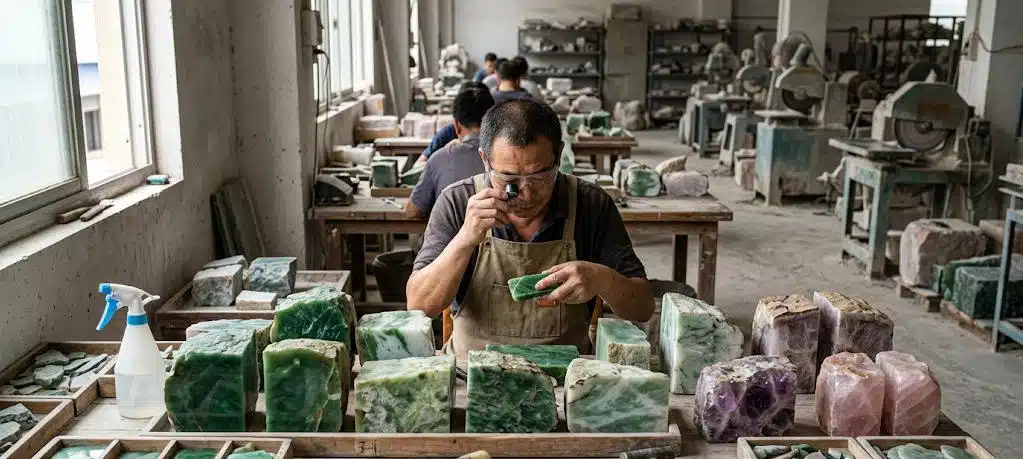
No two pieces of natural jade or quartz are identical, even when they’re cut from the same rough block, and that’s not a manufacturing inconsistency — it’s the nature of the material. Color, texture, transparency, cotton-like inclusions, mineral clusters, and color banding all vary naturally within a single piece of rough stone, let alone across a production run sourced from multiple blocks.
What GIA and IGS Say About Color, Clarity, and Inclusions
Gemological grading bodies formalize this variation rather than pretending it doesn’t exist. The International Gem Society’s grading guide groups colored gemstones into clarity types precisely because different materials naturally carry different amounts of internal characteristic — some species are typically eye-clean, others typically carry visible inclusions as a normal feature of the material, not a defect. Quartz varieties follow the same logic: rose quartz gets its color from fibrous mineral inclusions, and milky quartz carries visible internal cavities as a standard trait of the stone, both documented in the IGS quartz reference guide. GIA notes that color, transparency, and texture are the three factors that most affect jadeite’s value, a framework detailed in GIA’s jade buying guide. This means a wholesale batch of natural gua sha tools can only reasonably promise color consistency within an acceptable range — never full uniformity — and any supplier promising otherwise is either inexperienced or not being straight with you.
Setting Realistic Expectations With Your Gua Sha Supplier
The practical takeaway is to treat natural variation as a material property to plan around, not a flaw to eliminate. A gua sha supplier working in natural stone should be able to show you a color-range sample card up front, so your team knows what acceptable variation looks like before the first production run ships, not after. For color-sensitive product lines, sorting finished pieces into two or three shade bands before packing is a realistic middle ground — it costs some sorting labor but delivers noticeably tighter shelf consistency than an unsorted batch, and it matters even more for a guasha tools wholesale retailer stocking multiple shade-sensitive SKUs at once.
As a rough benchmark, factories that sort into two or three shade bands before packing typically see a noticeably lower rate of retail-level color complaints than those shipping straight off the polishing line, because the visible spread inside any single carton narrows even though the full production run still spans the natural range of the raw material. Sorting adds a modest percentage to labor cost, but that’s a far cheaper fix than a return shipment triggered by a customer holding two visibly different tools side by side.
Quality Standards and Acceptance Criteria for Gua Sha Wholesale Buyers
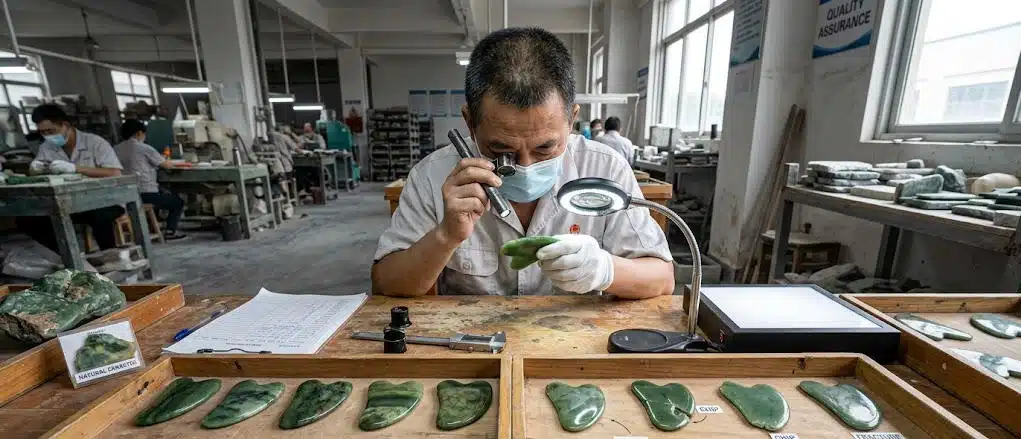
Natural stone will never match the absolute uniformity of an injection-molded plastic part, and holding it to that standard in any gua sha wholesale order sets up a dispute before production even starts. Even carefully sorted material can carry a slight color variation, a faint natural line, a small mineral inclusion, or a fine crystal texture that has nothing to do with workmanship.
Natural Feature or Genuine Defect?
The distinction matters commercially as much as technically. A natural color band running through a piece is a material characteristic; a crack running through the same piece is a structural defect. A faint mineral spot deep in the stone is typically a feature buyers accept once it’s explained; a chip on the working edge from a QC lapse is not. This means the conversation you want to have with your gua sha factory before production isn’t “will this be perfect” — it’s “what specifically counts as a defect on this order,” because that question has a concrete, checkable answer and the first one doesn’t.
Defining Acceptance Criteria Before You Order From a Gua Sha Manufacturer
Before your first purchase order, agree on acceptance criteria in writing — reference photos for acceptable natural characteristics, a defined maximum for eye-visible cracks, and a shared understanding of where color range starts and stops for that specific SKU. A gua sha production run inspected against clear written criteria produces far fewer disputes than one inspected against an unspoken assumption of “good quality,” a phrase that means something different to every buyer who says it. Independent gemological labs such as SSEF build their entire reputation on exactly this kind of written, testable standard rather than subjective impressions, and the same principle scales down to a wholesale purchase order for gua sha tools: specific, written, and checkable beats vague every time.
A written acceptance standard also makes third-party pre-shipment inspection meaningful rather than symbolic. When an inspector — whether your own staff or an independent QC firm — has a documented reference for what counts as an acceptable natural mark versus a rejected defect, a sampling check against AQL levels such as 2.5 or 4.0 becomes a repeatable process rather than a subjective call made on the spot. This matters most on a first order with a new gua sha factory, where neither side has yet built the shared vocabulary that comes from years of working together, and a written standard closes that gap immediately instead of over several shipments of trial and error.
Choosing a Gua Sha Wholesale Partner Who Explains Its Limits
Every limitation covered here — price floor, lead time variance, MOQ, brittle-material design risk, engraving constraints, natural color variation, and acceptance criteria — comes from the same source: you’re working with a natural material, not a synthetic one, and a natural material behaves like geology, not like plastic. Once you understand that, the right question shifts from “why won’t you just say yes” to “help me understand what’s realistic here,” and that shift changes the entire buyer-supplier relationship for the better.
If you’re evaluating a new manufacturing relationship for the first time, the conversation that saves the most time upfront covers four things: the material grade and color range you actually need, the shape complexity of your design and whether it will need DFM adjustments, your real launch date with a buffer already built in, and the written acceptance criteria both sides will inspect against. Buyers who bring these four points to the first call typically move from quote to signed purchase order faster than buyers who start with only a reference photo and a target price, because the manufacturer isn’t left guessing at the variables that actually set the number.
None of the seven limitations in this guide are reasons to avoid ordering gua sha tools in natural stone — they’re the terms under which that material has always been worked, from hand-carved pieces centuries ago to a CNC-assisted line today. Buyers who plan around them get a smoother order from quote to delivery. Buyers who ignore them usually find out the hard way, somewhere between sample approval and a container that lands three weeks later than the invoice implied.
You’ll get more long-term value from a gua sha manufacturer willing to walk through cost breakdowns, DFM adjustments, and acceptance criteria than from one that just agrees to everything up front and adjusts the story later. Deyi Gems has operated as a gua sha factory for more than 12 years, cutting, finishing, and shipping natural jade and quartz gua sha tools, and that time has mostly gone toward learning where these seven limits actually sit — not toward finding ways around them. If you’re planning a gua sha wholesale order and want a straight answer on cost, timeline, or MOQ for your specific design before your gua sha production run begins, that’s a conversation worth having before the purchase order, not after.
FAQs About Gua Sha Wholesale Limitations
1. Can a Gua Sha Manufacturer Guarantee an Exact Delivery Date?
Rarely, and you should be cautious of one that does. Natural material sourcing, shared factory scheduling, and skilled-labor availability all introduce variance that no single gua sha manufacturer fully controls, so an estimated range with a buffer is the more trustworthy answer than a fixed promise.
2. Why Do Wholesale Quotes Vary So Much Between Gua Sha Suppliers?
Because the inputs aren’t identical. Two quotes for the same gua sha wholesale order can differ by 30% or more once you account for raw material grade, yield rate, quality tolerance, and finishing labor — ask each gua sha supplier to break down their number by these categories rather than comparing bottom-line totals alone.
3. What’s a Typical MOQ for Private Label Gua Sha?
Because the inputs aren’t identical. Two quotes for the same gua sha wholesale order can differ by 30% or more once you account for raw material grade, yield rate, quality tolerance, and finishing labor — ask each gua sha supplier to break down their number by these categories rather than comparing bottom-line totals alone.
4. Can Any Design Be Custom-Made in Natural Stone?
Most can, with adjustment. A gua sha custom file with sharp points, thin necks, or long narrow tails usually needs DFM changes — added fillets, thicker connections — to survive production and shipping without breaking, while keeping the visual intent close to the original file.
5. Does Gua Sha Wholesale Pricing Include a Color Consistency Fee?
Not as a separate line item. Color grade affects your gua sha wholesale quote mainly through raw material selection, not through a distinct consistency charge on the invoice. Requesting a narrower, more uniform color range simply means the factory rejects a higher percentage of raw material during sorting, and that lower yield is what shows up in the final number, not a stated fee.
6. Is a Lower MOQ Ever Possible for a First-Time Buyer?
Sometimes, particularly if you’re willing to use a shape the factory already produces and add only a simple single-color logo rather than a fully custom silhouette. Sharing production capacity this way spreads setup cost across more than just your order, which is often the fastest route to a workable trial quantity while you evaluate the relationship.