Why Every Gua Sha Manufacturer Bevels the Edge: A Production, Safety, and Compliance Breakdown
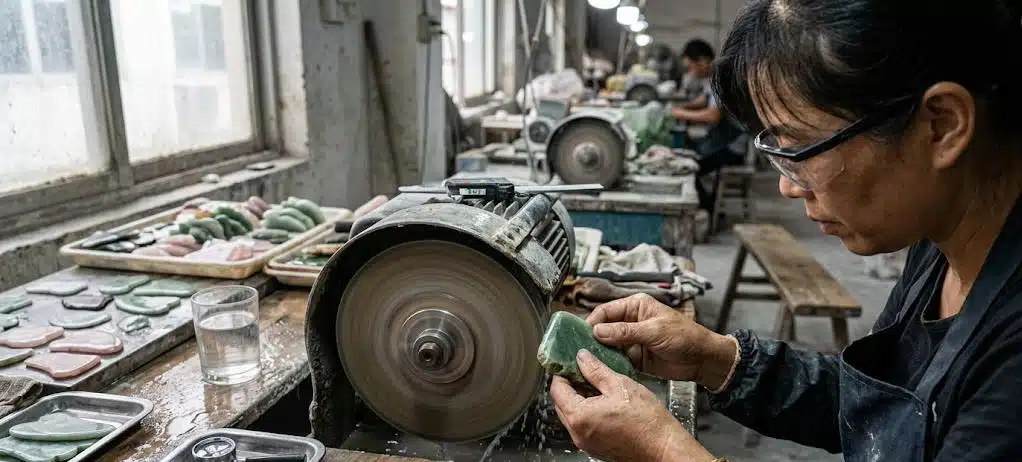
A gua sha manufacturer that skips beveling is gambling with a number most buyers never think to ask about: the Mohs hardness of the stone sitting in their hands. Quartz, agate, and jade all cluster in a narrow band between roughly 6 and 7 on that scale — hard enough to hold a polish, brittle enough to chip the moment an edge is left square (GIA). Every natural gua sha stone — quartz, agate, jade — behaves a little differently under a grinding wheel, but the failure pattern is the same: a 90-degree edge on a rough-cut blank was never a styling decision. It’s a production liability that shows up first on the cutting bench, and again, months later, on a customer’s cheekbone. Most buyers inspecting a sample check color, weight, and banding. Few ask whether the edge has actually been rounded, and fewer still ask why it matters. This article walks through both halves of that question — why beveling protects yield inside a gua sha factory, and why the same bevel protects skin once the tool leaves the box. You’ll also get the inspection points worth writing into your next purchase order — useful whether you’re sourcing a catalog line or a gua sha custom run — along with the rough cost logic behind treating beveling as a specified step instead of an afterthought. Why Sharp Edges Put Every Gua Sha Manufacturer‘s Yield at Risk If you’re comparing samples from more than one guasha supplier, the edge is usually the fastest place to spot a real difference in process control. Color and pattern can be matched almost anywhere. Edge finishing can’t be faked on a gua sha factory floor, and it can’t be fixed after the fact. The Hardness-Brittleness Paradox Every Gua Sha Manufacturer Has to Manage Hardness and durability are not the same property, and confusing the two is where a lot of edge failures start. White quartz sits at roughly 7 on the Mohs scale, rose quartz tests the same at 7 (GIA), agate runs 6.5 to 7, and jadeite comes in at 6.5 to 7 with nephrite slightly softer at 6 to 6.5 (GIA). Those numbers describe scratch resistance, not impact resistance — gemologists track a separate factor called toughness, plus a third one called stability, when they explain how a stone actually holds up under stress (GIA). A stone can resist a fingernail easily and still shatter along a corner if the load lands in the wrong spot. This means you can’t judge edge risk from a hardness number alone; you have to look at where the stress actually concentrates on the piece. Natural stone also carries something no synthetic material does: internal variation. Cloud-like inclusions, mineral banding, and hairline growth structures sit inside almost every rough blank a natural gua sha stone starts as, and each of those features quietly lowers the edge’s ability to absorb processing pressure. A cutting wheel or grinding belt doesn’t know a microcrack is there until it opens one. Square corners give that hidden weakness the smallest possible area to fail in, which is exactly why beveling — spreading the load across a wider transition — changes the outcome so consistently across a production run. How Beveling Lifts Yield Across the Gua Sha Factory Floor Walk the sequence any gua sha factory follows during gua sha production — rough-cutting, shaping, coarse grinding, fine grinding, beveling, polishing, inspection — and you’ll notice beveling sits deliberately before polishing, never after. That placement isn’t arbitrary. A squared edge carried into grinding tends to chip at the corner; carried into polishing, it tends to blow out under wheel pressure at exactly the stage where the piece has already absorbed the most labor. This is where gua sha beveling earns its keep inside the workshop, and it’s the kind of detail a serious gua sha manufacturer tracks batch over batch, not just on paper. Does a rounded corner really change a defect rate that much? Ask anyone running a gua sha factory floor and they’ll tell you the difference shows up fastest in the scrap bin at the polishing station, tied to that day’s gua sha production numbers. This means fewer finished pieces get written off after they’ve already eaten the cost of grinding and shaping — the loss shifts back to the cheap end of the line instead of the expensive end. Edge Beveling and Polishing: Why the Two Steps Can’t Be Separated A polishing wheel wants a continuous surface to travel across. Hit a square edge and the wheel’s pressure concentrates right on that corner, which is why unbeveled pieces tend to come out with a whitened or blotchy edge instead of an even shine. A properly angled transition lets the wheel keep contact and speed constant the whole way around the piece, so the gloss reads the same at the edge as it does across the face of the stone. That consistency isn’t a finishing touch. It’s the difference between a batch that passes inspection on the first pass and one that gets sent back for rework. Preventing Internal Crack Propagation Before It Starts Here’s the failure chain in plain terms: processing pressure meets a square edge, the pressure concentrates at that single point, any existing microcrack widens under the load, and the piece eventually snaps. Round that same edge into a bevel and the chain changes at step two — pressure spreads across a transition zone instead of a point, and the odds of a crack propagating drop accordingly (IGS). Why does a fraction of a millimeter of edge angle matter enough to change a scrap rate? Because fracture doesn’t consult your inspection sheet. It follows the path of least resistance, and a 90-degree corner on a brittle stone is exactly that path — during cutting, in transit, and occasionally in a customer’s hand months after the sale, reducing breakage during gua sha production at every one of those points. Why a Careless Gua Sha Manufacturer Puts Your
A gua sha manufacturer that skips beveling is gambling with a number most buyers never think to ask about: the Mohs hardness of the stone sitting in their hands. Quartz, agate, and jade all cluster in a narrow band between roughly 6 and 7 on that scale — hard enough to hold a polish, brittle enough to chip the moment an edge is left square (GIA). Every natural gua sha stone — quartz, agate, jade — behaves a little differently under a grinding wheel, but the failure pattern is the same: a 90-degree edge on a rough-cut blank was never a styling decision. It’s a production liability that shows up first on the cutting bench, and again, months later, on a customer’s cheekbone. Most buyers inspecting a sample check color, weight, and banding. Few ask whether the edge has actually been rounded, and fewer still ask why it matters. This article walks through both halves of that question — why beveling protects yield inside a gua sha factory, and why the same bevel protects skin once the tool leaves the box. You’ll also get the inspection points worth writing into your next purchase order — useful whether you’re sourcing a catalog line or a gua sha custom run — along with the rough cost logic behind treating beveling as a specified step instead of an afterthought. Why Sharp Edges Put Every Gua Sha Manufacturer‘s Yield at Risk If you’re comparing samples from more than one guasha supplier, the edge is usually the fastest place to spot a real difference in process control. Color and pattern can be matched almost anywhere. Edge finishing can’t be faked on a gua sha factory floor, and it can’t be fixed after the fact. The Hardness-Brittleness Paradox Every Gua Sha Manufacturer Has to Manage Hardness and durability are not the same property, and confusing the two is where a lot of edge failures start. White quartz sits at roughly 7 on the Mohs scale, rose quartz tests the same at 7 (GIA), agate runs 6.5 to 7, and jadeite comes in at 6.5 to 7 with nephrite slightly softer at 6 to 6.5 (GIA). Those numbers describe scratch resistance, not impact resistance — gemologists track a separate factor called toughness, plus a third one called stability, when they explain how a stone actually holds up under stress (GIA). A stone can resist a fingernail easily and still shatter along a corner if the load lands in the wrong spot. This means you can’t judge edge risk from a hardness number alone; you have to look at where the stress actually concentrates on the piece. Natural stone also carries something no synthetic material does: internal variation. Cloud-like inclusions, mineral banding, and hairline growth structures sit inside almost every rough blank a natural gua sha stone starts as, and each of those features quietly lowers the edge’s ability to absorb processing pressure. A cutting wheel or grinding belt doesn’t know a microcrack is there until it opens one. Square corners give that hidden weakness the smallest possible area to fail in, which is exactly why beveling — spreading the load across a wider transition — changes the outcome so consistently across a production run. How Beveling Lifts Yield Across the Gua Sha Factory Floor Walk the sequence any gua sha factory follows during gua sha production — rough-cutting, shaping, coarse grinding, fine grinding, beveling, polishing, inspection — and you’ll notice beveling sits deliberately before polishing, never after. That placement isn’t arbitrary. A squared edge carried into grinding tends to chip at the corner; carried into polishing, it tends to blow out under wheel pressure at exactly the stage where the piece has already absorbed the most labor. This is where gua sha beveling earns its keep inside the workshop, and it’s the kind of detail a serious gua sha manufacturer tracks batch over batch, not just on paper. Does a rounded corner really change a defect rate that much? Ask anyone running a gua sha factory floor and they’ll tell you the difference shows up fastest in the scrap bin at the polishing station, tied to that day’s gua sha production numbers. This means fewer finished pieces get written off after they’ve already eaten the cost of grinding and shaping — the loss shifts back to the cheap end of the line instead of the expensive end. Edge Beveling and Polishing: Why the Two Steps Can’t Be Separated A polishing wheel wants a continuous surface to travel across. Hit a square edge and the wheel’s pressure concentrates right on that corner, which is why unbeveled pieces tend to come out with a whitened or blotchy edge instead of an even shine. A properly angled transition lets the wheel keep contact and speed constant the whole way around the piece, so the gloss reads the same at the edge as it does across the face of the stone. That consistency isn’t a finishing touch. It’s the difference between a batch that passes inspection on the first pass and one that gets sent back for rework. Preventing Internal Crack Propagation Before It Starts Here’s the failure chain in plain terms: processing pressure meets a square edge, the pressure concentrates at that single point, any existing microcrack widens under the load, and the piece eventually snaps. Round that same edge into a bevel and the chain changes at step two — pressure spreads across a transition zone instead of a point, and the odds of a crack propagating drop accordingly (IGS). Why does a fraction of a millimeter of edge angle matter enough to change a scrap rate? Because fracture doesn’t consult your inspection sheet. It follows the path of least resistance, and a 90-degree corner on a brittle stone is exactly that path — during cutting, in transit, and occasionally in a customer’s hand months after the sale, reducing breakage during gua sha production at every one of those points. Why a Careless Gua Sha Manufacturer Puts Your