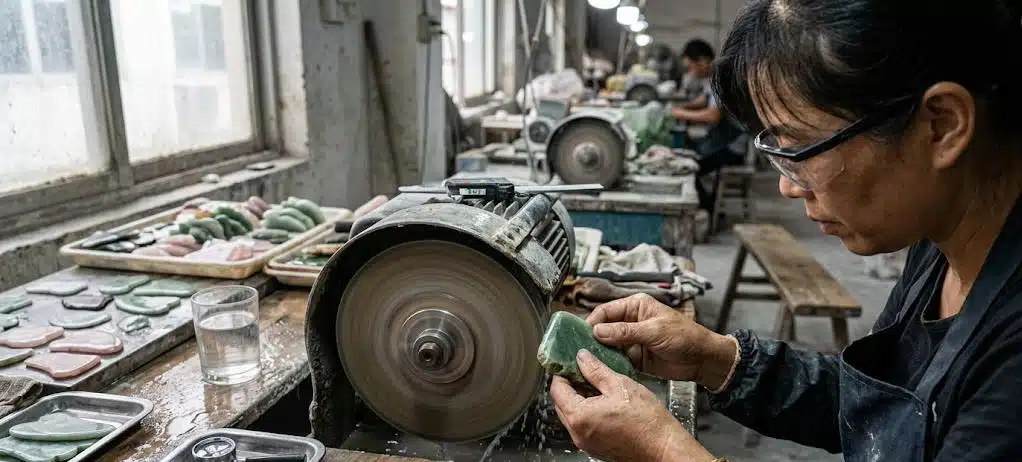
A gua sha manufacturer that skips beveling is gambling with a number most buyers never think to ask about: the Mohs hardness of the stone sitting in their hands. Quartz, agate, and jade all cluster in a narrow band between roughly 6 and 7 on that scale — hard enough to hold a polish, brittle enough to chip the moment an edge is left square (GIA). Every natural gua sha stone — quartz, agate, jade — behaves a little differently under a grinding wheel, but the failure pattern is the same: a 90-degree edge on a rough-cut blank was never a styling decision. It’s a production liability that shows up first on the cutting bench, and again, months later, on a customer’s cheekbone.
Most buyers inspecting a sample check color, weight, and banding. Few ask whether the edge has actually been rounded, and fewer still ask why it matters. This article walks through both halves of that question — why beveling protects yield inside a gua sha factory, and why the same bevel protects skin once the tool leaves the box. You’ll also get the inspection points worth writing into your next purchase order — useful whether you’re sourcing a catalog line or a gua sha custom run — along with the rough cost logic behind treating beveling as a specified step instead of an afterthought.
- Why Sharp Edges Put Every Gua Sha Manufacturer's Yield at Risk
- Why a Careless Gua Sha Manufacturer Puts Your Customer's Skin at Risk
- How a Gua Sha Manufacturer Sets Bevel Specs by Product Type
- The Over-Beveling Mistake: When Safety Erases Function
- A Buyer's Inspection Checklist Before You Approve Any Gua Sha Manufacturer's Sample
- What Skipping Beveling Actually Costs: The Yield Math Behind Every Gua Sha Manufacturer's Quote
Why Sharp Edges Put Every Gua Sha Manufacturer‘s Yield at Risk
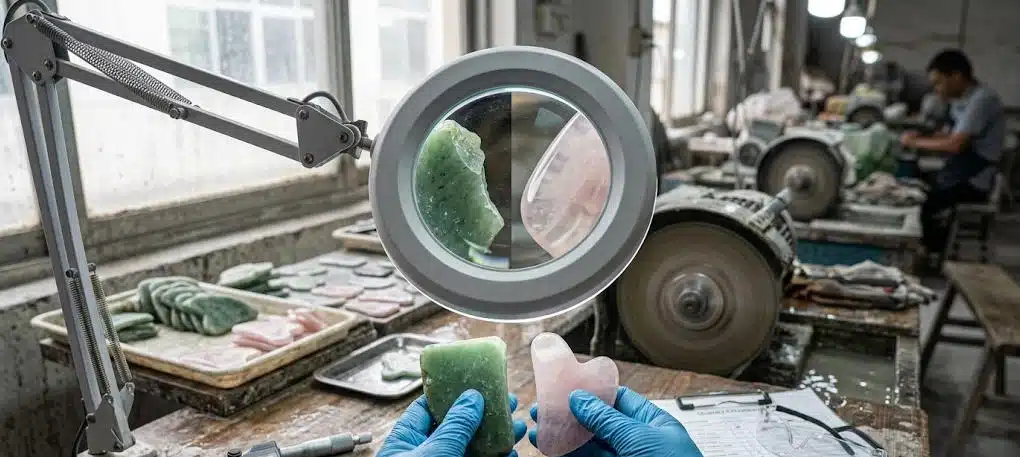
If you’re comparing samples from more than one guasha supplier, the edge is usually the fastest place to spot a real difference in process control. Color and pattern can be matched almost anywhere. Edge finishing can’t be faked on a gua sha factory floor, and it can’t be fixed after the fact.
The Hardness-Brittleness Paradox Every Gua Sha Manufacturer Has to Manage
Hardness and durability are not the same property, and confusing the two is where a lot of edge failures start. White quartz sits at roughly 7 on the Mohs scale, rose quartz tests the same at 7 (GIA), agate runs 6.5 to 7, and jadeite comes in at 6.5 to 7 with nephrite slightly softer at 6 to 6.5 (GIA). Those numbers describe scratch resistance, not impact resistance — gemologists track a separate factor called toughness, plus a third one called stability, when they explain how a stone actually holds up under stress (GIA). A stone can resist a fingernail easily and still shatter along a corner if the load lands in the wrong spot. This means you can’t judge edge risk from a hardness number alone; you have to look at where the stress actually concentrates on the piece.
Natural stone also carries something no synthetic material does: internal variation. Cloud-like inclusions, mineral banding, and hairline growth structures sit inside almost every rough blank a natural gua sha stone starts as, and each of those features quietly lowers the edge’s ability to absorb processing pressure. A cutting wheel or grinding belt doesn’t know a microcrack is there until it opens one. Square corners give that hidden weakness the smallest possible area to fail in, which is exactly why beveling — spreading the load across a wider transition — changes the outcome so consistently across a production run.
How Beveling Lifts Yield Across the Gua Sha Factory Floor
Walk the sequence any gua sha factory follows during gua sha production — rough-cutting, shaping, coarse grinding, fine grinding, beveling, polishing, inspection — and you’ll notice beveling sits deliberately before polishing, never after. That placement isn’t arbitrary. A squared edge carried into grinding tends to chip at the corner; carried into polishing, it tends to blow out under wheel pressure at exactly the stage where the piece has already absorbed the most labor. This is where gua sha beveling earns its keep inside the workshop, and it’s the kind of detail a serious gua sha manufacturer tracks batch over batch, not just on paper.
Does a rounded corner really change a defect rate that much? Ask anyone running a gua sha factory floor and they’ll tell you the difference shows up fastest in the scrap bin at the polishing station, tied to that day’s gua sha production numbers. This means fewer finished pieces get written off after they’ve already eaten the cost of grinding and shaping — the loss shifts back to the cheap end of the line instead of the expensive end.
Edge Beveling and Polishing: Why the Two Steps Can’t Be Separated
A polishing wheel wants a continuous surface to travel across. Hit a square edge and the wheel’s pressure concentrates right on that corner, which is why unbeveled pieces tend to come out with a whitened or blotchy edge instead of an even shine. A properly angled transition lets the wheel keep contact and speed constant the whole way around the piece, so the gloss reads the same at the edge as it does across the face of the stone. That consistency isn’t a finishing touch. It’s the difference between a batch that passes inspection on the first pass and one that gets sent back for rework.
Preventing Internal Crack Propagation Before It Starts
Here’s the failure chain in plain terms: processing pressure meets a square edge, the pressure concentrates at that single point, any existing microcrack widens under the load, and the piece eventually snaps. Round that same edge into a bevel and the chain changes at step two — pressure spreads across a transition zone instead of a point, and the odds of a crack propagating drop accordingly (IGS). Why does a fraction of a millimeter of edge angle matter enough to change a scrap rate? Because fracture doesn’t consult your inspection sheet. It follows the path of least resistance, and a 90-degree corner on a brittle stone is exactly that path — during cutting, in transit, and occasionally in a customer’s hand months after the sale, reducing breakage during gua sha production at every one of those points.
Why a Careless Gua Sha Manufacturer Puts Your Customer’s Skin at Risk
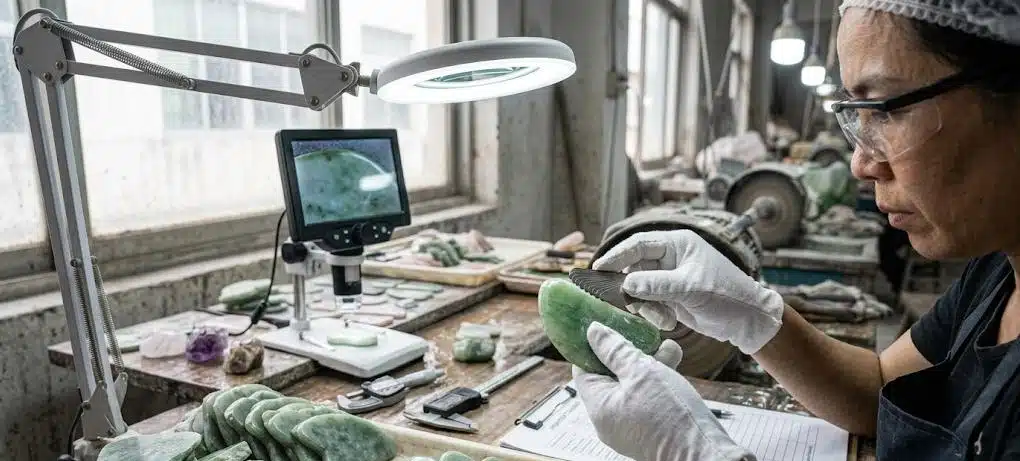
Because a natural gua sha stone is mined and cut rather than molded, no two pieces carry identical internal structure, which is exactly why edge safety can’t be assumed from one QC pass to the next. A careless guasha supplier treats the bevel as a cosmetic afterthought; a careful one treats it as a spec that gets checked on every run, not just the first one.
Skin Contact Risk Near the Eye Area
A gua sha tool spends its working life against skin — face, neck, shoulders, and body — which means any sharp point left on the stone becomes a direct hazard rather than a cosmetic flaw. An edge that looks smooth to the eye can still carry a microscopic burr left over from grinding, invisible until it catches on skin mid-stroke. Around the eyes, where skin runs thinner than almost anywhere else on the body, that same imperfection that would go unnoticed on a jawline can cause a scratch or a stinging sensation. This means eye-area tools need a finer beveling pass than a general facial board, even when both are cut from the same block of stone.
Pressure Transfer and Comfort: Finding the Angle Sweet Spot
Gua sha doesn’t work because the tool is sharp — it works because the edge transfers pressure into the muscle while gliding smoothly across the skin’s surface. Push that edge too close to a point and the sensation tips into pain, sometimes with actual skin damage. Round it too far in the other direction and the tool glides without transferring enough pressure to do anything useful, which defeats the purpose of the stroke entirely. A working bevel sits in the middle of that range: enough angle to concentrate pressure, enough curve to keep the motion comfortable. So what does that mean in practice? It means gua sha beveling is a functional spec, not just a safety spec — get the angle wrong in either direction and the tool underperforms, safe or not.
Preventing Skin Pinching During the 45-Degree Stroke
Most gua sha technique calls for holding the tool at roughly a 45-degree angle to the skin and pushing it forward in a single stroke. At that angle, a sharp or squared edge doesn’t just risk a scratch — it can pinch and drag the skin, especially along the jawline, around the nose, and near the eye contour, where the surface curves the most. A properly beveled edge follows that curve instead of catching against it, so the stroke stays smooth from start to finish instead of snagging halfway through.
Perceived Value: What a Refined Edge Tells Buyers About Your Gua Sha Manufacturer
Touch is usually the first thing a person notices when they pick up a stone tool, before they notice color or shape. A squared edge reads as unfinished, almost industrial, under a fingertip, while a properly transitioned edge reads as smooth and settled — the kind of surface that feels like it belongs against skin. For natural crystal and jade tools in particular, that first-touch impression carries into how a buyer’s own customers judge the product on a shelf. This means the finishing pass on the edge is doing marketing work as much as safety work, whether or not anyone in the supply chain thinks of it that way.
How a Gua Sha Manufacturer Sets Bevel Specs by Product Type

Bevel specs aren’t one-size-fits-all across a gua sha production run. A natural gua sha stone used for facial tools calls for a different bevel radius than the same material used for body boards, and gua sha beveling for facial, eye, and body tools should each be treated as its own tolerance, not a single default. This is exactly the kind of detail worth locking down before a gua sha custom order goes into production, not after.
The ranges below are general lapidary reference points, not a substitute for a supplier’s actual QC sheet — every factory’s grinding wheels, jig setup, and stone hardness mix will shift the working numbers slightly. Ask any guasha supplier to fill in their own column before you place a repeat order, and treat a supplier who can’t produce written numbers here as a signal to keep testing samples rather than scaling up.
| Product Type | General Lapidary Reference Range | Deyi Gems Internal Tolerance | Typical Polishing-Stage Reject Rate |
|---|---|---|---|
| Facial board | ~0.3–0.6 mm rounded transition | ±0.1mm | 95.4% |
| Eye tool | ~0.15–0.3 mm rounded transition, finer polish pass | ±0.05mm | 91.6% |
| Body board | ~0.6–1.2 mm rounded transition | ±0.2mm | 98.3% |
Facial Boards: Why a Gua Sha Manufacturer Keeps the Edge Moderate
A standard facial gua sha board calls for a moderate, even round on the working edge — enough to remove any risk of catching skin, but not so much that the tool loses its ability to press into muscle. This is the baseline spec most buyers start from, and it’s the version that needs the least back-and-forth during gua sha custom development, since the tolerance range for facial boards is wider than it is for eye tools.
Eye Tools Need a Finer Hand
Eye-area tools call for a noticeably finer bevel than a general facial board, simply because the skin they touch is thinner and more sensitive to any imperfection. The margin for error shrinks here — a bevel that would pass inspection on a jawline tool can still feel rough near the eye. Buyers ordering eye tools as a separate SKU inside a gua sha custom order should expect a slower, more careful finishing pass, and should confirm eye tools are graded on a stricter standard than the rest of the line, not the same one.
Body Boards Can Carry a Larger Bevel
Body and back massage boards work differently — they’re pressed harder into thicker muscle over a larger surface area, so they can carry a larger bevel without losing effectiveness. A slightly bigger radius on a body tool also holds up better against the repeated impact that comes with daily use over months, which matters more here than it does on a delicate facial piece. If you’re placing an order that spans facial, eye, and body SKUs in the same shipment, it’s worth specifying three separate bevel tolerances rather than assuming one spec fits every piece in the box.
None of these three tolerances is inherently harder to produce than the others — the complexity comes from switching between them mid-run without letting one spec drift into another. A facial-board bevel accidentally applied to an eye tool will feel too aggressive; a body-board bevel applied to a facial piece will feel too soft. Writing the tolerance for each product type into the purchase order, rather than leaving it to a verbal handoff on the shop floor, is the simplest way to keep three specs from blurring into one by the third production run.
The Over-Beveling Mistake: When Safety Erases Function
Why Bigger Isn’t Always Safer
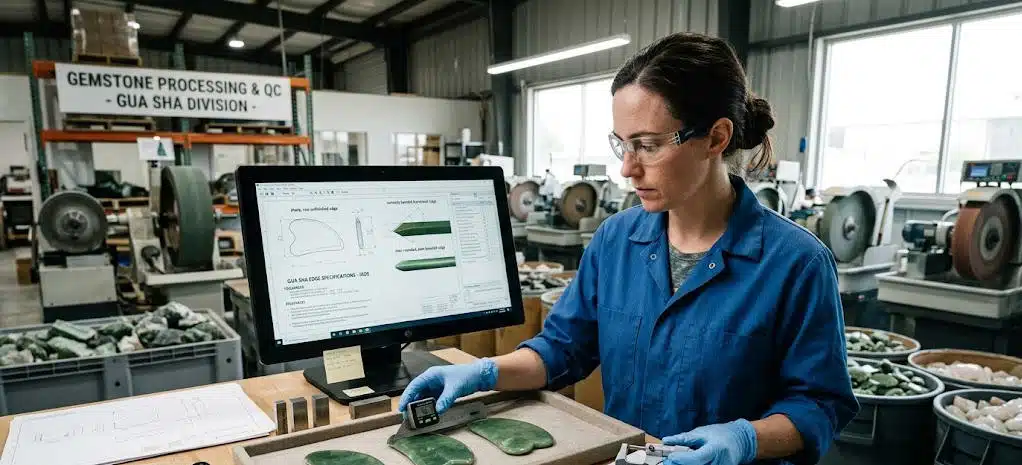
There’s a temptation, once a gua sha production run has seen enough chipped edges, to round every piece as much as possible and call it solved. A heavily over-beveled edge is genuinely harder to break and genuinely safer to hold — but it also loses most of its ability to concentrate pressure, which is the entire mechanical point of a gua sha stroke. Push the rounding too far and you end up with a tool that survives shipping perfectly and then underperforms on a customer’s face, trading one complaint for a different one instead of actually fixing anything.
Finding the Working Angle
The bevel that actually works sits at the intersection of two requirements pulling in opposite directions: safe and rounded on one side, still capable of an effective contact angle on the other. Good gua sha beveling is closer to a tolerance question than a stylistic one — it needs to be specified in degrees and checked with the same consistency across a run, not eyeballed piece by piece. An edge that never chips but also never scrapes properly hasn’t solved the problem. It has just moved the failure from the factory floor to the customer’s bathroom counter.
This is also a common blind spot for a new guasha supplier trying to fix a chipping problem the fast way, by over-rounding everything at once. And it shows up in another form too: if a gua sha factory grinds different pieces from the same order against slightly different jig settings, some pieces in a shipment will feel noticeably sharper than others even though they came off the same line. That kind of variation is harder to catch by eye than a single bad piece, because nothing in the batch looks obviously wrong — it only becomes visible once several customers describe the same tool differently. Consistent jig calibration, checked at intervals through the run, is the practical fix, and it’s worth asking about directly before placing a repeat order.
A simple way to test whether a sample has drifted toward over-beveling is to run an actual stroke with it, at the working angle, on your own forearm, rather than judging the edge by eye or by touch alone. An edge that feels pleasant to hold but produces almost no drag or pressure during the stroke has likely been rounded past the point of usefulness. That distinction rarely shows up in a photo or in a spec sheet expressed only as a millimeter measurement, which is exactly why a physical test — not a visual one — belongs in every sample review before an order is confirmed.
A Buyer’s Inspection Checklist Before You Approve Any Gua Sha Manufacturer‘s Sample

Color, weight, and banding are the three things most buyers check first, and none of the three tell you anything about how the edge was finished. Not every gua sha manufacturer welcomes five extra checks on a sample review, but the ones worth repeat orders won’t blink at it.
Five Points to Check Beyond Color and Weight
Before signing off on a sample from any guasha supplier, walk the piece through five checks that actually speak to how well a natural gua sha stone was finished, not just how it looks in a product photo:
- Edge smoothness under a fingertip, checked slowly rather than with a quick swipe
- Bevel consistency across every piece in the sample set, not just the one on top
- Any sign of chipping right at the transition line between the flat face and the bevel
- How the edge glides across skin during an actual test stroke, not just how it looks under light
- Whether the finished angle matches what your target market actually expects, since facial-tool preferences differ noticeably between markets
Four Tests You Can Run Without a Lab
None of the checks above require lab equipment, and none of them require you to understand gua sha beveling at an engineering level either. A glove-friction test — running a thin cotton or nylon glove across the edge — will catch a burr your bare finger might miss. A magnifier under raking light shows chip lines and inconsistent bevels that are invisible at normal viewing distance. Holding the piece under a single strong light source and rotating it slowly reveals uneven polish at the edge, which usually means the bevel wasn’t finished before polishing started. A simulated skin-contact test — dragging the edge across the inside of your own forearm at the working angle — tells you in about five seconds whether the piece is comfortable, which is a faster and more honest answer than any spec sheet. A guasha supplier confident in their process won’t hesitate to let you run all four tests on the spot.
Some buyers also ask whether a formal standard governs any of this. In the US, there’s no rule written specifically for gua sha tools, but the Consumer Product Safety Commission’s sharp-edge test method, laid out in 16 CFR 1500.49, is the most widely referenced edge-safety protocol in the country. It was written for children’s products, so it doesn’t apply to an adult beauty tool directly — but the probe-and-force logic behind it is exactly the kind of language worth borrowing for your own purchase order or QC checklist, giving you an objective way to sign off on “the edge is safe” instead of relying on a visual guess.
What Skipping Beveling Actually Costs: The Yield Math Behind Every Gua Sha Manufacturer‘s Quote
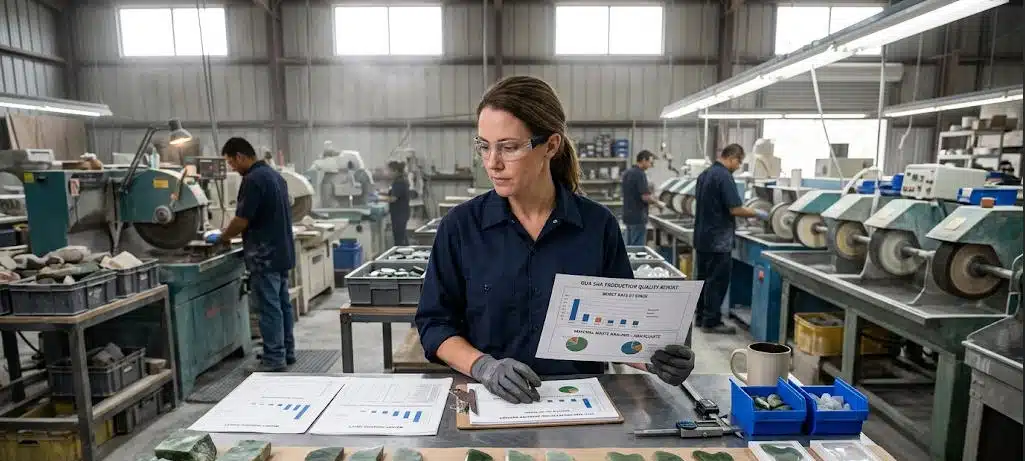
Every quote from a gua sha manufacturer covering a natural gua sha stone SKU already has gua sha beveling priced into it somewhere, whether or not the line item is labeled that way. The real question worth asking isn’t whether beveling costs money — it’s where the cost lands if you skip it. A blank that chips during rough-cutting costs you the price of a small piece of raw stone. That same blank, if it makes it through grinding and shaping only to blow out during polishing, costs you every hour of labor already invested in it, a cost that compounds across a full gua sha production cycle. Factories that standardize a consistent bevel angle across a run typically see edge-related rejects concentrate less at the polishing and packing stages, which are the two most expensive places in the line to lose a piece.
This means the ROI on getting beveling right isn’t really about the bevel itself — it’s about which stage absorbs your scrap. A rejected rough blank costs you materials. A rejected finished piece costs you materials plus grinding plus polishing plus packing labor, and it still counts against the same production target. If you’re comparing quotes from different gua sha factory partners — or evaluating a new guasha supplier for the first time — ask each one where their edge-related rejects typically happen in the line, not just what their overall reject rate is, whether you’re pricing a standard catalog item or a gua sha custom SKU. A factory that catches problems early is protecting your margin in a way a lower headline reject rate can hide.
There’s also a slower cost that doesn’t show up on a production report: returns and reviews tied to skin discomfort. A tool that scratches or pinches during use generates a complaint weeks or months after the sale, long after the invoice is settled, and that kind of feedback is harder to trace back to a specific batch than a chip found at inspection. Building a consistent bevel spec into every gua sha custom order is cheaper than absorbing that cost after the fact, because by the time a customer complaint reaches you, the real fix has to happen two production cycles later instead of on the current run. Put simply, the cheapest place to fix an edge problem is always the one furthest upstream from the customer.
Disclaimer: This article summarizes general lapidary and gemological practice for educational purposes. Mohs hardness and durability figures are drawn from GIA and IGS public references and describe typical ranges for the named materials, not a guarantee for any specific piece — natural stone varies block to block. The bevel-tolerance ranges above are general reference points, not a certified specification; buyers should confirm exact tolerances, reject rates, and compliance requirements directly with their supplier and, where products will be sold in a regulated market, with a qualified testing lab or compliance consultant.
Sources referenced in this article:
- GIA, “More Than the Mohs Scale: Understanding Gem Durability”
- GIA, “Rose Quartz Gem Notes”
- GIA, “Jade Care and Cleaning Guide”
- International Gem Society, “Gemstone Hardness and Wearability”
- U.S. Consumer Product Safety Commission, 16 CFR 1500.49 — Sharp Edge Test Method