
If you have opened a returned gua sha gift box and found the lid popped up, the magnets misaligned, or the stone board pressing against the underside of the lid, you are not looking at a random defect. You are looking at a production pattern that shows up across almost every gua sha manufacturer‘s early sample runs. Across more than a decade of tooling nephrite, jadeite, and crystal boards, five root causes explain over 90% of “lid won’t close” complaints: an insert cavity 1–3mm too shallow for a 6–12mm thick stone board, a magnet rated below what an 80–200g board actually needs, magnet centers offset by more than 1mm, adhesive that fails after transit vibration, and greyboard that absorbs humidity in a container. None of these five causes is really about the magnet by itself. Each one is about how a gua sha manufacturer measures, tools, and pressure-tests the box before it ever reaches your warehouse.
You will not fix a closure problem by swapping to a stronger magnet and hoping. This guide walks through the same diagnostic order a production floor uses, from the structural cause that accounts for the largest share of failures down to the humidity issue that only shows up weeks after your container leaves port. Read it before your next gua sha packaging order, and you can catch the defect on paper instead of in a customer’s inbox. Every diagnostic step below applies whether you are placing a first packaging trial or scaling an existing gua sha wholesale program with a trusted gua sha manufacturer.
- The Real Reason Gua Sha Gift Boxes Won't Close: A Gua Sha Manufacturer's Systems View
- Insert Depth Miscalculation: The Leading Failure Point in Gua Sha Packaging
- Magnetic Closure Failures: Strength, Alignment, and Bonding
- Material Deformation: When Greyboard Meets Humidity
- The Gua Sha Manufacturer's Pre-Production QC Checklist
- Acceptance Testing Standards for Gua Sha Wholesale Buyers
- Compliance and Material Verification: What GIA, IGS, and SSEF Data Means for Gua Sha Custom Orders
- Systemic Thinking: How a Reliable Gua Sha Manufacturer Approaches Gua Sha Packaging
The Real Reason Gua Sha Gift Boxes Won’t Close: A Gua Sha Manufacturer‘s Systems View

A magnet that will not hold a lid shut is usually the symptom customers notice first, so it gets blamed first. But a gua sha manufacturer who has run enough production cycles knows the lid rarely fails for one reason alone. Insert geometry, magnetic force, bonding chemistry, and board material all interact, and a weakness in any one of them shows up as the same complaint: the box won’t stay closed. Treat it as a single-part problem and you will replace magnets for three seasons without ever closing the ticket. A gua sha manufacturer that cannot explain why a lid fails is not a gua sha factory you want holding your next production schedule.
Think of the closure system in three layers. The first layer is structural — does the stone board actually fit inside the space the lid needs to close over? The second layer is magnetic — is there enough force, correctly positioned, to hold two surfaces together against gravity and vibration? The third layer is process control — will the bond and the board material still perform after 30 days in a humid container? Every complaint you have ever received about a gua sha box custom order traces back to one of these three layers, and usually to more than one at once. A gua sha manufacturer that only inspects the magnet, and never the insert or the material, is auditing one layer out of three.
One Symptom, Five Root Causes: What Every Gua Sha Manufacturer Sees on the Line
Rank the causes by how often they show up in incoming QC data, and the picture becomes concrete. Insert depth that fails to accommodate the board’s real thickness is the most common cause by a wide margin — a gua sha manufacturer working with natural stone deals with this before touching a single magnet. Magnet position error ranks second: two magnets can both be strong and still fail to attract each other properly if their centers do not line up. Underrated magnet strength for the actual board weight comes third, adhesive failure after shipping stress comes fourth, and greyboard deformation from humidity comes fifth. You can memorize this order and use it as a troubleshooting checklist the next time a batch comes back with closure complaints, because working top-down through these five points resolves the overwhelming majority of cases without a single design change to the outer box. This is the exact sequence a gua sha manufacturer should hand to a gua sha factory partner before approving any production run.
Insert Depth Miscalculation: The Leading Failure Point in Gua Sha Packaging
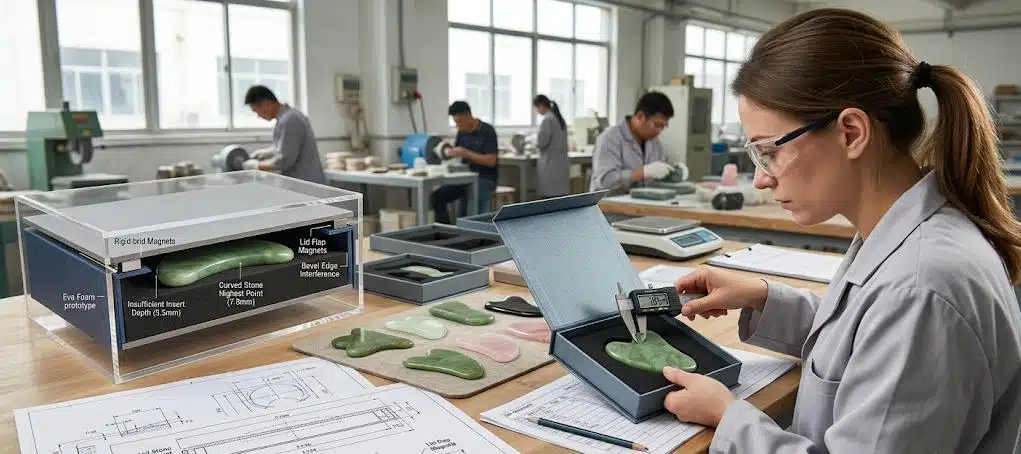
Here is the physical reality that most first-time buyers miss: a natural stone gua sha board is not a flat rectangle. It has thickness that typically runs 6–12mm, edges that are beveled rather than square, and in many designs a gentle curve across the working face. If the insert cavity inside your gua sha packaging is cut to a flat depth that ignores the bevel and the curve, the highest point of the board will be the point that touches the lid first — and it will touch before the lid ever reaches its fully closed position. This single measurement gap is the most common reason a gua sha packaging order fails inspection before it ever reaches a gua sha wholesale buyer’s warehouse.
The visible symptoms are consistent enough that you can diagnose the cause without opening a single extra box. A lid that needs downward pressure to click shut, a lid that stays very slightly lifted at one edge, magnets that never fully mate, and a box that pops open during transit all point back to the same measurement gap. On a premium gua sha box custom order, this reads to the end customer as a cheap product in an expensive shell — which is precisely the opposite of what a gift-tier package is supposed to communicate. A gua sha manufacturer that treats this as cosmetic rather than structural is setting up the next batch of gua sha shipping complaints.
Measuring Real Board Thickness Before You Finalize Gua Sha Packaging
So what should the measurement process actually capture? Not just the board’s maximum length and width, but three additional numbers: maximum thickness at the thickest cross-section, the height added by any curved or domed surface, and the height added by the beveled edge. A gua sha manufacturer who skips any of these three measurements is designing an insert around an incomplete model of the product, and the mismatch will not appear until the first full production run — not the sample. This means your development timeline should build in a physical fit test against the actual insert tooling, not a CAD drawing, before mass production is approved. Skipping this step is the fastest way for a gua sha factory to turn a clean sample approval into a failed gua sha box custom production run.
The depth correction itself follows a fairly simple rule once the numbers are in hand. For a thinner stone board, add 1–2mm above the measured product thickness to the insert depth. For a thicker jade board, add 2–3mm. For a board with a pronounced curved surface, measure from the product’s single highest point and add at least 3mm on top of that figure. Skip the shortcut of designing purely off the product’s length dimension; length tells you nothing about how the lid will interact with the board’s cross-section, and that cross-section is where every closure complaint actually originates. A gua sha manufacturer who designs from that cross-section, rather than the length dimension alone, catches this problem before tooling is ever cut.
Three Insert Fixes a Gua Sha Factory Should Apply
A deeper cavity solves most cases on its own, but a responsible gua sha factory has two additional tools worth knowing about. The first is a stepped insert design: rather than laying the entire board flat against one continuous surface, the insert holds the center in position while supporting the edges separately, which reduces the total contact area between board and tray and gives natural stone — which is never perfectly uniform — more tolerance for minor thickness variation. The second is a buffer layer at the top of the cavity, typically EVA foam, sponge, or flocked fabric, positioned specifically to absorb the last millimeter of clearance so the board never presses directly against the lid even if the fit is slightly tight. This means your finished gua sha packaging keeps its “soft close” feel even on boards that sit at the upper end of your thickness tolerance, and that feel is exactly what a gift buyer associates with a premium unboxing experience rather than a discount one. A gua sha manufacturer offering only one of these two fixes is solving half the problem on every custom order.
Magnetic Closure Failures: Strength, Alignment, and Bonding

Once the insert geometry is correct, the magnet system decides whether the box actually stays shut. Three separate failure modes hide inside what customers describe as “the magnet is weak,” and each one needs a different fix. Confusing them is the single most expensive mistake in gua sha wholesale production, because a factory that misdiagnoses a position problem as a strength problem ends up buying stronger magnets that still fail to solve the complaint. A gua sha manufacturer that treats this as three separate diagnostics, rather than one vague complaint, protects every reorder that follows.
Choosing Magnet Grade for Gua Sha Box Custom Projects
Start with weight. A natural jadeite or nephrite gua sha board commonly weighs 80–200g, which is heavy enough that a magnet sized for a lightweight plastic accessory box will not reliably hold it shut once the package is tilted, stacked, or jolted during gua sha shipping. Upgrading from an N35-grade magnet to N42, or from N42 to N52, meaningfully increases holding force for the same magnet footprint, and this is the correction most gua sha wholesale buyers should request when the board itself sits toward the heavier end of that range. Weight verification like this should happen before a gua sha manufacturer quotes magnet grade on any gua sha box custom proposal.
Stronger is not automatically better, though, and this is where a rhetorical question is worth asking directly: what happens if you simply specify the strongest magnet available for every gua sha box custom order? Excess magnetic force can warp thin box board under sustained pressure, make the lid feel unpleasantly stiff to open — which undercuts the unboxing experience you paid for — and in some cases crack the paperboard immediately surrounding the magnet cavity. For a double-board set or a high-value gift package, adding a second, correctly sized magnet is usually the better lever than jumping two grades on a single one, because it spreads holding force across two contact points instead of concentrating stress at one. A gua sha factory that defaults to the strongest available magnet on every gua sha custom order is usually solving the wrong variable. A careful gua sha manufacturer matches magnet grade to measured weight instead of reaching for the strongest option on the shelf.
The ≤1mm Alignment Rule Every Gua Sha Manufacturer Enforces
A magnet with plenty of rated strength can still fail to hold a lid shut, and the reason is almost always positional. If the magnet embedded in the lid and the magnet embedded in the base are not centered on the same axis, the effective distance between their poles increases, and magnetic attraction falls off sharply with distance — far more sharply than most buyers expect from a small offset. A gua sha manufacturer with tight process control holds center-to-center deviation at 1mm or less across the full production run, not just on the golden sample. This is the tolerance a gua sha manufacturer should state in writing on every packaging specification sheet.
Depth consistency matters just as much as lateral alignment, and it is easy to overlook. A magnet sitting 2mm below the paperboard surface on the lid side, paired with one sitting 5mm below the surface on the base side, still looks correctly positioned to the naked eye — yet the real working distance between the two poles has effectively grown by 3mm, and holding force drops accordingly. Locating magnets by hand with glue and a steady eye is where this error creeps in; pin-located jigs, dedicated molds, or press-fit tooling remove the human variability and are worth specifying by name in your gua sha custom production agreement rather than leaving positioning method unstated. Ask any gua sha factory how magnets are positioned before you approve a sample, and the answer tells you most of what you need to know about their process control.
Why Magnets Debond After Gua Sha Shipping
The fourth failure mode is the one that passes every inspection at the factory and still shows up as a return three weeks later. A magnet can be correctly sized and correctly positioned and still work loose after gua sha shipping exposes the package to vibration, humidity swings, and — inside a non-climate-controlled container — real heat. Three causes explain nearly all of these delayed failures. General-purpose white glue holds adequately on day one but loses grip strength over weeks under load. Oil, dust, or a light oxide layer on the magnet’s surface reduces how well any adhesive can bite into the metal in the first place. And a magnet fixed with only a couple of small glue dots, rather than a full contact bead, has far less bonded surface area to resist the shear forces that ocean freight and last-mile delivery both generate. This delayed failure mode is exactly why gua sha shipping stress needs to be part of pre-production testing, not just final inspection. A careful gua sha manufacturer treats this stage as a required checkpoint rather than an afterthought.
The fix is a short, three-part process rather than a single product swap. Wipe every magnet with alcohol before bonding to strip oil and residue, since this step alone measurably improves adhesion regardless of which glue is used afterward. Move up to a structural-grade adhesive — epoxy, structural adhesive, or a high-strength UV-cure resin — rather than a general-purpose glue rated for light paper bonding. And where the design allows it, cut a recessed magnet pocket into the tray so the magnet is mechanically retained by the surrounding material in addition to being glued, because a pocket plus adhesive consistently outperforms adhesive alone once you factor in six to eight weeks of transit and warehouse handling. A gua sha manufacturer that skips mechanical retention on a heavy order is relying on adhesive alone to survive the entire gua sha shipping cycle.
Material Deformation: When Greyboard Meets Humidity

Magnets and inserts get most of the attention, but the box material itself is a variable too, and it is the one most often left out of a closure-problem diagnosis. Greyboard is naturally hygroscopic, meaning it absorbs moisture from the air around it, and that absorption is not evenly distributed once a shipment moves from a controlled factory environment into a container that may sit in a humid port for days. A box that closed perfectly at the point of production can arrive with a lid that no longer sits flat, simply because the board expanded unevenly during transit. A gua sha manufacturer shipping into humid climates cannot treat this as a minor packaging detail on a wholesale contract.
The sequence is straightforward once you see it laid out: rising humidity is absorbed unevenly across the greyboard sheet, the sheet expands and the lid panel warps slightly out of plane, and a warped lid no longer meets the base or the magnet at the angle the design assumed. This means the closure failure you are troubleshooting may have nothing to do with the magnet system at all, and testing the magnets in isolation on a warped sample will not reproduce — or explain — the field complaint. Controlling paperboard moisture content before lamination, stabilizing the paperboard environment ahead of production, specifying a slightly thicker greyboard core for humid-climate destinations, and reinforcing the edge-banding process all reduce this risk, and a gua sha manufacturer shipping into tropical or coastal markets should treat this step as standard rather than optional. Building this tolerance into a gua sha custom specification up front costs far less than reworking an entire gua sha packaging run after a humidity-related return.
The Gua Sha Manufacturer‘s Pre-Production QC Checklist

Everything above becomes far more useful once it is turned into a repeatable inspection sequence rather than a list of things to remember under pressure. A gua sha manufacturer running a structured pre-production check moves through seven checkpoints in order, and the order matters because later checks are only meaningful once earlier ones pass. Confirming that the stone board’s actual height, including any curve, does not exceed the insert’s designed clearance comes first. Confirming the insert depth against a physically measured sample — not a drawing — comes second. Verifying that upper and lower magnets are fully aligned on the same axis comes third, followed by confirming the magnet grade is rated for the board’s real weight rather than an assumed weight. Buyers evaluating a new gua sha manufacturer should ask to see this checklist applied to an actual sample, not described in a slide deck.
Seven Checkpoints Before Gua Sha Box Custom Approval
The remaining checkpoints close out the sequence: confirming whether a single magnet or a double-magnet layout is appropriate for the package tier, physically testing for any looseness in the magnet bond, and inspecting box flatness for early signs of moisture-related warping. Running all seven in this order on every gua sha box custom approval sample, rather than sampling one or two at random, is what separates a factory that catches problems on paper from one that discovers them after a container has already sailed. None of these checks requires expensive equipment — most of them take a caliper, a scale, and a controlled open-close cycle — which means the cost of running them is trivial compared to the cost of a return shipment or a canceled reorder. Any gua sha factory unwilling to run these checks before a gua sha wholesale shipment is asking you to absorb the risk it should be catching. A gua sha manufacturer that runs this full sequence rarely needs a second round of corrections on the same order.
Acceptance Testing Standards for Gua Sha Wholesale Buyers

If you are sourcing at volume, the question that actually matters is not “did the sample close correctly” but “will the same design still close correctly after 5,000 units have been through a container.” A gua sha wholesale buyer who accepts a golden sample without stress-testing it is accepting a single data point as if it represented the whole order, and that gap is exactly where most large-batch complaints originate. Three tests, run in sequence, close that gap before goods ever leave the factory. Building this validation step into a gua sha custom agreement before gua sha shipping begins is far cheaper than discovering the gap after arrival.
How Much Does Closure Failure Cost a Gua Sha Wholesale Buyer?
Run the numbers before you run the tests, because the cost asymmetry is what justifies the extra week of validation. A pre-shipment inspection cycle covering these three tests typically adds a small, fixed cost to a gua sha custom order regardless of volume. A closure defect discovered after goods reach your warehouse, by contrast, carries the cost of returns processing, replacement units, express reshipment, and — for a gift-tier product specifically — a disproportionate hit to repeat purchase rate, since a customer who receives a gift box with a lid that won’t close rarely gives the brand a second chance. Weighed against that, a validation step that costs a fraction of a percent of order value is close to the cheapest insurance available in the entire supply chain. A gua sha manufacturer who cannot quote this inspection cost separately from unit price is not tracking it as a real step in their process.
A Step-by-Step Testing Protocol You Can Run Before Shipment
The first test is a repeated open-close cycle: close and reopen the box at least 50 times in a row, then check whether the magnets still hold with the same force and whether the lid has drifted out of alignment. The second is an inversion test — close the box, then turn it fully upside down and check that the lid does not release and that the product inside does not shift or rattle. The third is a transit simulation that reproduces vibration, compression from stacking, and temperature or humidity swings similar to what a real shipping route will apply. Running all three against a small batch pulled from actual production tooling, rather than against a hand-finished golden sample, is what prevents the common failure pattern where a sample passes cleanly and the bulk order does not. This protocol should be standard on every gua sha box custom order above a minimum volume threshold, not reserved for buyers who ask for it by name. A gua sha manufacturer that skips this step is trusting hope over data.
Compliance and Material Verification: What GIA, IGS, and SSEF Data Means for Gua Sha Custom Orders

Natural stone brings a variable that molded plastic never introduces: the material itself is not uniform, and that variability has documented physical roots worth understanding before you finalize a gua sha custom insert design. According to the Gemological Institute of America, jadeite typically measures 6.5 to 7 on the Mohs hardness scale while nephrite measures 6 to 6.5, and both stones are also noted for exceptional toughness and strong resistance to breaking or chipping despite that hardness range (GIA). The International Gem Society notes that nephrite’s comparatively lower hardness makes it more prone to surface scratching than jadeite, since jadeite’s hardness can approach that of household dust, one of the most common everyday abrasives a polished stone will encounter (IGS). This means an insert and buffer layer designed without accounting for hardness differences between stone types can leave one product line more exposed to surface wear during transit than another, even when both boards share the same outer dimensions. This is exactly the kind of verification a serious gua sha manufacturer should be able to walk a gua sha wholesale buyer through on request.
Specific gravity is the number that matters most for your magnet calculations, and it is where independent lab data becomes directly useful rather than academic. The Swiss Gemmological Institute SSEF documents jade material with measurable variation in specific gravity depending on origin and composition, which is precisely why two boards of identical size can carry noticeably different actual weight (SSEF). SSEF’s published reporting framework for jade also distinguishes natural, bleached-and-impregnated, and dyed material by classification type, and a gua sha manufacturer sourcing raw stone without verifying which classification applies is building weight and thickness assumptions on an unconfirmed foundation. This means the magnet grade calculation described earlier in this guide should be run against verified material data, not an assumed density figure — and a gua sha manufacturer working with graded, traceable stone can specify magnet strength with real confidence instead of a safety-margin guess. A gua sha factory sourcing stone without this verification is guessing at the density figures behind every magnet specification for gua sha custom orders.
Systemic Thinking: How a Reliable Gua Sha Manufacturer Approaches Gua Sha Packaging

Pull all five causes together and a pattern emerges that is worth stating plainly: a gua sha gift box that won’t close is almost never a single-component defect. It is a structural question, a magnetic-engineering question, and a materials-science question stacked on top of each other, and treating it as only the last of those three is why so many closure complaints get “fixed” with a magnet swap and then reappear on the next production run. Ranked by how often each cause actually shows up in the field, an undersized insert cavity leads, followed by magnet misalignment, then underrated magnet strength, then adhesive failure, then humidity-driven board deformation. A gua sha manufacturer who understands this stack diagnoses the real cause in one visit instead of three rounds of gua sha shipping complaints.
The Three Layers Every Gua Sha Manufacturer Controls
Structural design sets the baseline: get the insert depth and geometry wrong and no magnet configuration will fully compensate for it. The magnetic system then determines actual holding force, but only once the structural layer gives the lid a physically achievable closed position to reach. Process control — adhesive selection, jig-based positioning, and material moisture management — determines whether that holding force survives four, six, or eight weeks between a factory floor and your customer’s doorstep. For a natural jadeite, nephrite, or crystal board specifically, given the weight and per-unit value involved, dimension measurement, insert-height verification, and magnetic pull testing all belong at the design stage, not as a late-stage fix layered onto a box that was never built to accommodate the product in the first place. This is the standard a gua sha manufacturer should hold itself to on every gua sha packaging program, whether the order is a single sample or a full production container.