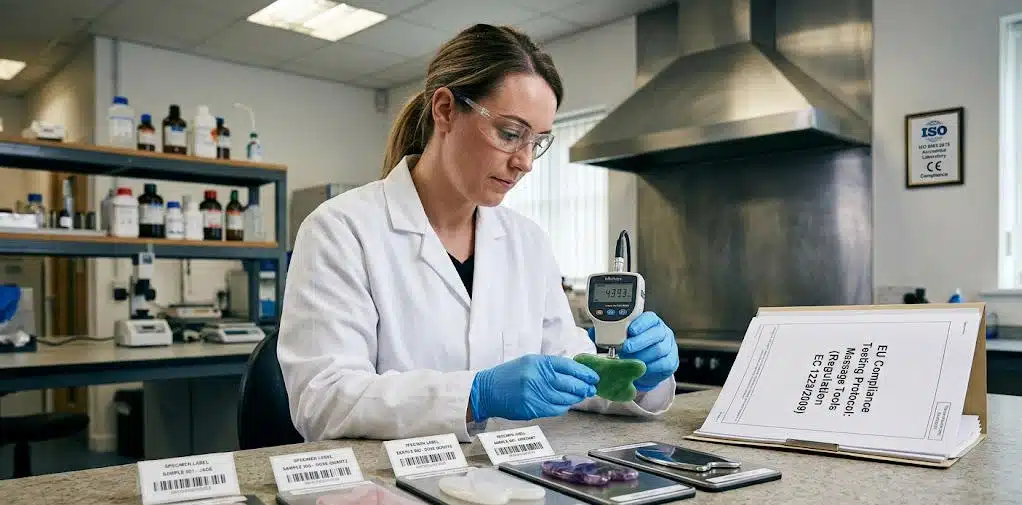
The Gua Sha Wholesale Buyer’s Guide to Material Testing and EU Compliance
If you have placed a gua sha wholesale order into the EU this year, you have probably noticed something new sitting in your inbox: a documentation request that has nothing to do with price or minimum order quantity. In 2025, the European Commission’s Safety Gate system logged 4,671 product safety alerts, the highest count since the system began in 2003 and a 13% increase over the previous year. China accounted for 2,006 of those notifications, more than any other single country of origin. That number is not a coincidence, and it is not going to shrink. It is the reason your buyer’s compliance team, your marketplace account manager, or your retail partner’s quality department is now asking for a gua sha certificate, a material breakdown, or a heavy-metal test result before they will confirm your next gua sha wholesale shipment. Why Gua Sha Wholesale Buyers Are Suddenly Asking for Paperwork, Not Just Photos Ask any experienced gua sha supplier who has shipped into Germany, France, or the Netherlands over the past eighteen months, and they will describe the same shift. A buyer used to close a deal after seeing a sample and a price sheet. Now the same buyer forwards a checklist that mentions REACH, GPSR, and sometimes a request for something called an “EU gua sha certificate,” a document that, strictly speaking, does not exist as a single unified stamp. What does exist is a set of overlapping legal obligations that fall on the importer, and increasingly, on whoever can prove the product was made responsibly in the first place. This shift is especially visible on gua sha wholesale EU routes, where marketplace compliance systems now flag missing documentation automatically, often before a listing ever goes live. This means you can no longer treat a gua sha wholesale inquiry as a conversation about stone color and polish finish alone. Buyers are asking a second question underneath the first one: can this factory produce evidence, not just claims, if a regulator or a marketplace ever asks. The Number Behind the New Scrutiny Cosmetics, toys, and electrical items made up more than half of the Safety Gate alerts filed in 2025, but skin-contact tools like gua sha boards sit in an adjacent category that inspectors watch closely, because the exposure pattern looks similar: repeated, direct, unsupervised use on bare skin. Chemical risk was cited as the leading hazard category across 2025 alerts, ahead of choking and mechanical injury combined. That single fact reframes what a gua sha wholesale order actually is from a compliance standpoint. It is not being evaluated as a decorative object. It is being evaluated closer to the way a skincare tool would be. So what does that mean in practice? It means a gua sha wholesale buyer who used to ask “what stone is this” now asks “what is inside this stone, and can you prove it.” A gua sha manufacturer who cannot answer the second question loses the gua sha wholesale order even when the first answer was correct. Buyers increasingly assume a product is not gua sha safe for their shelves until a factory proves otherwise, which quietly reverses who carries the burden of proof. What Missing Documentation Actually Costs a Gua Sha Wholesale Order A missing report rarely triggers an outright ban. What it triggers is friction: a stalled marketplace listing, a retailer audit that never closes, a customs hold that eats into a shipping window. For a gua sha wholesale buyer working on seasonal timing, a two-week documentation delay can cost more than the entire testing budget would have. This is the quiet math that most factories underestimate: the price of a heavy-metal test is small next to the cost of a shipment sitting at a bonded warehouse while someone tracks down paperwork after the fact. A guasha tools manufacturer who keeps this paperwork ready in advance is not spending extra money; it is avoiding a much larger, less predictable cost later. A gua sha certificate sitting in a shared drive, ready before the buyer even asks, quietly turns a potential two-week delay into a non-issue. GPSR and REACH: The Two Rules Behind Every Gua Sha Wholesale Compliance Request Two pieces of EU law sit behind almost every document request you will see attached to a gua sha wholesale contract, and neither one was written with gua sha tools in mind specifically. That is actually useful information, because it means the requirements are about risk logic, not about your product category being singled out. Skipping either one is why so many gua sha wholesale shipments, including plenty of gua sha wholesale EU orders specifically, stall at exactly the same review stage regardless of how good the product itself is. GPSR: Proving You Thought About Risk Before Someone Got Hurt The General Product Safety Regulation, formally Regulation (EU) 2023/988, has applied across all EU member states since 13 December 2024, and it replaced an older directive that had given national governments more room to interpret the rules differently (full regulation text, EUR-Lex). GPSR does not hand you a fixed checklist of tests for every product type. Instead, it asks the party placing a product on the EU market to run a risk assessment, keep technical documentation on file, and trace a batch back to its origin if something goes wrong later. That structure matters for a gua sha wholesale buyer because it shifts responsibility onto whoever can show their work. A factory that hands over only a photo and a price sheet is not GPSR-ready. A gua sha manufacturer that hands over a specification sheet, a risk assessment covering sharp edges and skin contact, and a batch reference number is. This means your import paperwork gets approved faster, and your product listing is less likely to get pulled during a routine marketplace sweep. A guasha tools manufacturer that treats this file as a standing document, rather than something assembled after a gua sha wholesale buyer asks, consistently ships faster, and this is the
The Gua Sha Wholesale Buyer’s Guide to Material Testing and EU Compliance Read More »
If you have placed a gua sha wholesale order into the EU this year, you have probably noticed something new sitting in your inbox: a documentation request that has nothing to do with price or minimum order quantity. In 2025, the European Commission’s Safety Gate system logged 4,671 product safety alerts, the highest count since the system began in 2003 and a 13% increase over the previous year. China accounted for 2,006 of those notifications, more than any other single country of origin. That number is not a coincidence, and it is not going to shrink. It is the reason your buyer’s compliance team, your marketplace account manager, or your retail partner’s quality department is now asking for a gua sha certificate, a material breakdown, or a heavy-metal test result before they will confirm your next gua sha wholesale shipment. Why Gua Sha Wholesale Buyers Are Suddenly Asking for Paperwork, Not Just Photos Ask any experienced gua sha supplier who has shipped into Germany, France, or the Netherlands over the past eighteen months, and they will describe the same shift. A buyer used to close a deal after seeing a sample and a price sheet. Now the same buyer forwards a checklist that mentions REACH, GPSR, and sometimes a request for something called an “EU gua sha certificate,” a document that, strictly speaking, does not exist as a single unified stamp. What does exist is a set of overlapping legal obligations that fall on the importer, and increasingly, on whoever can prove the product was made responsibly in the first place. This shift is especially visible on gua sha wholesale EU routes, where marketplace compliance systems now flag missing documentation automatically, often before a listing ever goes live. This means you can no longer treat a gua sha wholesale inquiry as a conversation about stone color and polish finish alone. Buyers are asking a second question underneath the first one: can this factory produce evidence, not just claims, if a regulator or a marketplace ever asks. The Number Behind the New Scrutiny Cosmetics, toys, and electrical items made up more than half of the Safety Gate alerts filed in 2025, but skin-contact tools like gua sha boards sit in an adjacent category that inspectors watch closely, because the exposure pattern looks similar: repeated, direct, unsupervised use on bare skin. Chemical risk was cited as the leading hazard category across 2025 alerts, ahead of choking and mechanical injury combined. That single fact reframes what a gua sha wholesale order actually is from a compliance standpoint. It is not being evaluated as a decorative object. It is being evaluated closer to the way a skincare tool would be. So what does that mean in practice? It means a gua sha wholesale buyer who used to ask “what stone is this” now asks “what is inside this stone, and can you prove it.” A gua sha manufacturer who cannot answer the second question loses the gua sha wholesale order even when the first answer was correct. Buyers increasingly assume a product is not gua sha safe for their shelves until a factory proves otherwise, which quietly reverses who carries the burden of proof. What Missing Documentation Actually Costs a Gua Sha Wholesale Order A missing report rarely triggers an outright ban. What it triggers is friction: a stalled marketplace listing, a retailer audit that never closes, a customs hold that eats into a shipping window. For a gua sha wholesale buyer working on seasonal timing, a two-week documentation delay can cost more than the entire testing budget would have. This is the quiet math that most factories underestimate: the price of a heavy-metal test is small next to the cost of a shipment sitting at a bonded warehouse while someone tracks down paperwork after the fact. A guasha tools manufacturer who keeps this paperwork ready in advance is not spending extra money; it is avoiding a much larger, less predictable cost later. A gua sha certificate sitting in a shared drive, ready before the buyer even asks, quietly turns a potential two-week delay into a non-issue. GPSR and REACH: The Two Rules Behind Every Gua Sha Wholesale Compliance Request Two pieces of EU law sit behind almost every document request you will see attached to a gua sha wholesale contract, and neither one was written with gua sha tools in mind specifically. That is actually useful information, because it means the requirements are about risk logic, not about your product category being singled out. Skipping either one is why so many gua sha wholesale shipments, including plenty of gua sha wholesale EU orders specifically, stall at exactly the same review stage regardless of how good the product itself is. GPSR: Proving You Thought About Risk Before Someone Got Hurt The General Product Safety Regulation, formally Regulation (EU) 2023/988, has applied across all EU member states since 13 December 2024, and it replaced an older directive that had given national governments more room to interpret the rules differently (full regulation text, EUR-Lex). GPSR does not hand you a fixed checklist of tests for every product type. Instead, it asks the party placing a product on the EU market to run a risk assessment, keep technical documentation on file, and trace a batch back to its origin if something goes wrong later. That structure matters for a gua sha wholesale buyer because it shifts responsibility onto whoever can show their work. A factory that hands over only a photo and a price sheet is not GPSR-ready. A gua sha manufacturer that hands over a specification sheet, a risk assessment covering sharp edges and skin contact, and a batch reference number is. This means your import paperwork gets approved faster, and your product listing is less likely to get pulled during a routine marketplace sweep. A guasha tools manufacturer that treats this file as a standing document, rather than something assembled after a gua sha wholesale buyer asks, consistently ships faster, and this is the