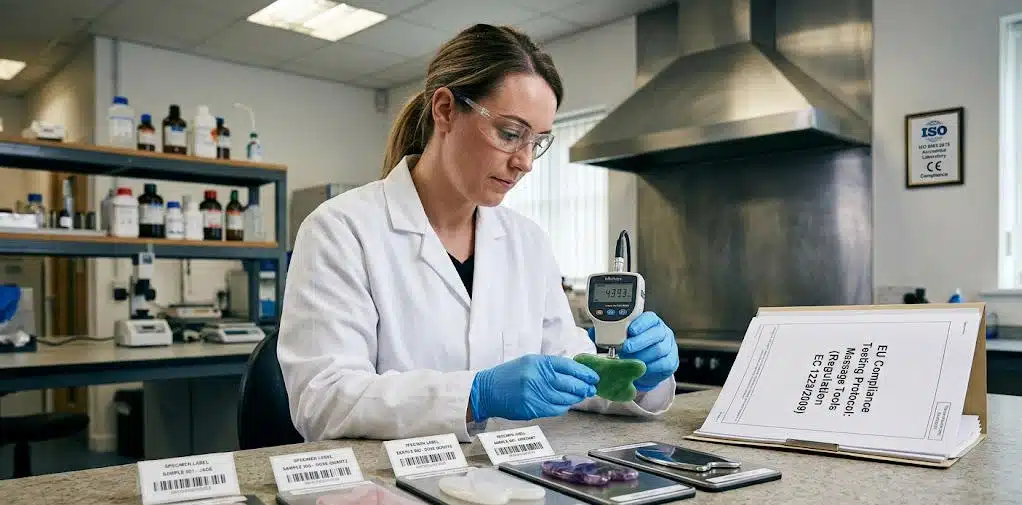
If you have placed a gua sha wholesale order into the EU this year, you have probably noticed something new sitting in your inbox: a documentation request that has nothing to do with price or minimum order quantity. In 2025, the European Commission’s Safety Gate system logged 4,671 product safety alerts, the highest count since the system began in 2003 and a 13% increase over the previous year. China accounted for 2,006 of those notifications, more than any other single country of origin. That number is not a coincidence, and it is not going to shrink. It is the reason your buyer’s compliance team, your marketplace account manager, or your retail partner’s quality department is now asking for a gua sha certificate, a material breakdown, or a heavy-metal test result before they will confirm your next gua sha wholesale shipment.
- Why Gua Sha Wholesale Buyers Are Suddenly Asking for Paperwork, Not Just Photos
- GPSR and REACH: The Two Rules Behind Every Gua Sha Wholesale Compliance Request
- Why Skin Contact Changes Everything About Gua Sha Wholesale Risk
- How to Read a Gua Sha Manufacturer's Paperwork Like a Buyer
- Stone by Stone, Alloy by Alloy: What Gets Tested in a Gua Sha Wholesale Shipment
- Matching Your Compliance Level to How You Actually Sell Gua Sha Wholesale
- Your Next Step Toward a Safer Gua Sha Wholesale Partnership
Why Gua Sha Wholesale Buyers Are Suddenly Asking for Paperwork, Not Just Photos

Ask any experienced gua sha supplier who has shipped into Germany, France, or the Netherlands over the past eighteen months, and they will describe the same shift. A buyer used to close a deal after seeing a sample and a price sheet. Now the same buyer forwards a checklist that mentions REACH, GPSR, and sometimes a request for something called an “EU gua sha certificate,” a document that, strictly speaking, does not exist as a single unified stamp. What does exist is a set of overlapping legal obligations that fall on the importer, and increasingly, on whoever can prove the product was made responsibly in the first place. This shift is especially visible on gua sha wholesale EU routes, where marketplace compliance systems now flag missing documentation automatically, often before a listing ever goes live.
This means you can no longer treat a gua sha wholesale inquiry as a conversation about stone color and polish finish alone. Buyers are asking a second question underneath the first one: can this factory produce evidence, not just claims, if a regulator or a marketplace ever asks.
The Number Behind the New Scrutiny
Cosmetics, toys, and electrical items made up more than half of the Safety Gate alerts filed in 2025, but skin-contact tools like gua sha boards sit in an adjacent category that inspectors watch closely, because the exposure pattern looks similar: repeated, direct, unsupervised use on bare skin. Chemical risk was cited as the leading hazard category across 2025 alerts, ahead of choking and mechanical injury combined. That single fact reframes what a gua sha wholesale order actually is from a compliance standpoint. It is not being evaluated as a decorative object. It is being evaluated closer to the way a skincare tool would be.
So what does that mean in practice? It means a gua sha wholesale buyer who used to ask “what stone is this” now asks “what is inside this stone, and can you prove it.” A gua sha manufacturer who cannot answer the second question loses the gua sha wholesale order even when the first answer was correct. Buyers increasingly assume a product is not gua sha safe for their shelves until a factory proves otherwise, which quietly reverses who carries the burden of proof.
What Missing Documentation Actually Costs a Gua Sha Wholesale Order
A missing report rarely triggers an outright ban. What it triggers is friction: a stalled marketplace listing, a retailer audit that never closes, a customs hold that eats into a shipping window. For a gua sha wholesale buyer working on seasonal timing, a two-week documentation delay can cost more than the entire testing budget would have. This is the quiet math that most factories underestimate: the price of a heavy-metal test is small next to the cost of a shipment sitting at a bonded warehouse while someone tracks down paperwork after the fact. A guasha tools manufacturer who keeps this paperwork ready in advance is not spending extra money; it is avoiding a much larger, less predictable cost later. A gua sha certificate sitting in a shared drive, ready before the buyer even asks, quietly turns a potential two-week delay into a non-issue.
GPSR and REACH: The Two Rules Behind Every Gua Sha Wholesale Compliance Request
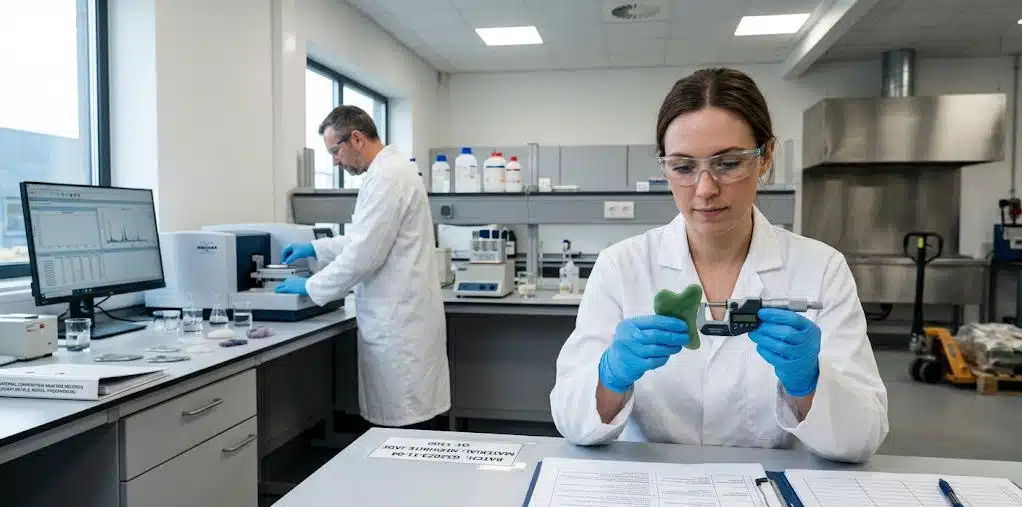
Two pieces of EU law sit behind almost every document request you will see attached to a gua sha wholesale contract, and neither one was written with gua sha tools in mind specifically. That is actually useful information, because it means the requirements are about risk logic, not about your product category being singled out. Skipping either one is why so many gua sha wholesale shipments, including plenty of gua sha wholesale EU orders specifically, stall at exactly the same review stage regardless of how good the product itself is.
GPSR: Proving You Thought About Risk Before Someone Got Hurt
The General Product Safety Regulation, formally Regulation (EU) 2023/988, has applied across all EU member states since 13 December 2024, and it replaced an older directive that had given national governments more room to interpret the rules differently (full regulation text, EUR-Lex). GPSR does not hand you a fixed checklist of tests for every product type. Instead, it asks the party placing a product on the EU market to run a risk assessment, keep technical documentation on file, and trace a batch back to its origin if something goes wrong later.
That structure matters for a gua sha wholesale buyer because it shifts responsibility onto whoever can show their work. A factory that hands over only a photo and a price sheet is not GPSR-ready. A gua sha manufacturer that hands over a specification sheet, a risk assessment covering sharp edges and skin contact, and a batch reference number is. This means your import paperwork gets approved faster, and your product listing is less likely to get pulled during a routine marketplace sweep. A guasha tools manufacturer that treats this file as a standing document, rather than something assembled after a gua sha wholesale buyer asks, consistently ships faster, and this is the paperwork most often requested on gua sha wholesale EU routes specifically, more than on shipments headed to less regulated markets.
REACH: The Rulebook Behind Every Heavy Metal Question
REACH, formally Regulation (EC) No 1907/2006, restricts how certain substances can be manufactured, sold, or used inside the EU, and it is the direct source of most heavy-metal testing requests you will receive (ECHA’s REACH overview). Chemicals of particular concern sit on the Substances of Very High Concern Candidate List, which the European Chemicals Agency updates several times a year; the list passed 253 entries in its most recent 2026 update (ECHA Candidate List). A buyer who asks for REACH-related information is not improvising a new requirement. They are asking you to confirm your product’s position against a list that changes on a fixed schedule, one they are legally required to track. This is also why a single, generic gua sha certificate printed once and reused for years does not hold up on its own; the underlying substance list it should reference keeps moving.
So what does that mean on the factory floor? It means the phrase “stainless steel” or “natural crystal” on a spec sheet is no longer enough by itself. A gua sha safe for EU retail shelves needs a paper trail connecting the raw material to a tested result, not just a material name typed onto an invoice.
Why Skin Contact Changes Everything About Gua Sha Wholesale Risk
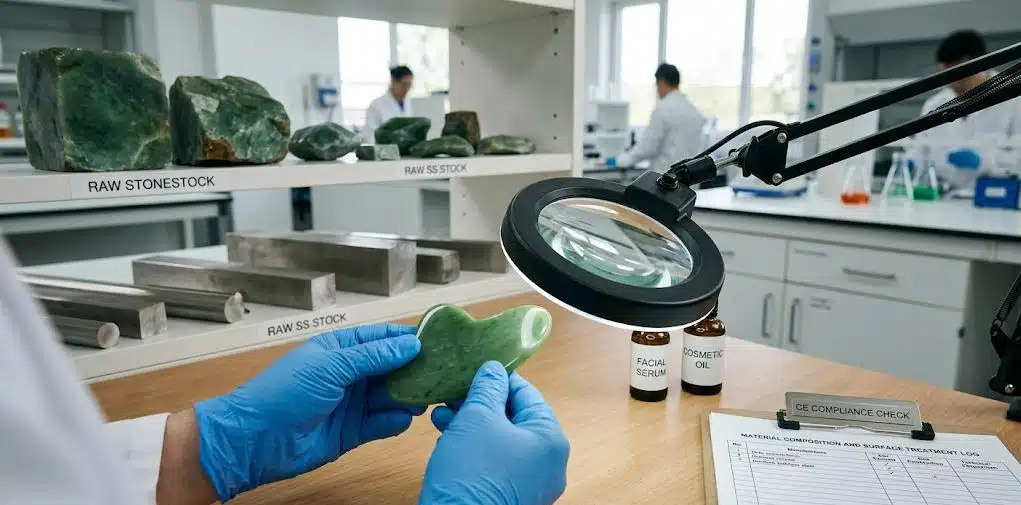
A gua sha board is not evaluated the same way a decorative paperweight is, and the difference comes down to one simple fact: skin contact. Most consumer safety frameworks scale their scrutiny to how a product is actually used, not how it is marketed on a product listing. That distinction is the entire reason gua sha wholesale buyers now ask different questions than buyers of ordinary crystal décor.
Face, Neck, Jawline: The Anatomy of Repeated Exposure
Consumers do not use a gua sha tool once and put it away. They run it across the jawline, cheekbones, neck, shoulders, and sometimes the arms and legs, often daily, sometimes multiple times a day for weeks at a stretch. That repetition is exactly the pattern consumer-safety regulators treat as higher risk, because low-level exposure that would be negligible in a single event becomes cumulative over months of use. A gua sha wholesale buyer selling into a skincare-literate market like Germany or France knows their customer will likely research the material before buying, and increasingly will ask a retailer directly whether the tool has been tested. A product that is technically legal to sell is not automatically gua sha safe in that buyer’s eyes if it cannot answer the question on the spot, and this scrutiny is especially visible on gua sha wholesale EU orders, where marketplace systems increasingly cross-check material declarations automatically.
This means a guasha tools manufacturer cannot lean on the same safety logic used for a decorative stone bookend or a paperweight. The use case sits closer to a cosmetic applicator than to home décor, and the documentation expectations follow that logic rather than the logic of ordinary giftware.
Oils and Serums Change the Equation Too
Gua sha is almost never used dry. Facial oil, serum, or moisturizer sits between the tool and the skin during nearly every use, and some of those formulations are mildly acidic or carry active ingredients that can interact with a metal or mineral surface over repeated contact. A gua sha certificate that only covers the raw material in isolation, without acknowledging how the product is actually used, tells a gua sha wholesale buyer less than they need to know. A supplier who understands this tests not just the base material, but the surface condition that actually reaches the customer’s skin: polished, coated, plated, or treated. A gua sha supplier who only tests the raw block before it ever meets a polishing wheel is effectively testing a different product than the one the customer eventually touches, and a claim of being gua sha safe should describe that finished, treated surface, not merely the raw material it started as.
That distinction is where a lot of low-cost competitors fall short. A factory can source a technically correct grade of stainless steel and still introduce risk through an untested electroplating or dye process layered on top. A gua sha wholesale partner who checks both the base material and the surface treatment is protecting you from a failure mode that a basic material declaration would never catch on its own. This is precisely where a careful guasha tools manufacturer earns its reputation, by testing the finished surface rather than only the starting block.
How to Read a Gua Sha Manufacturer’s Paperwork Like a Buyer

Two terms get used almost interchangeably in casual conversation, and mixing them up is the single most common misunderstanding buyers run into: material analysis and heavy-metal testing are not the same test, and they do not answer the same question. Every experienced gua sha wholesale buyer eventually learns to ask for both, by name, rather than accepting a single vague reassurance.
Material Analysis and Heavy Metal Testing Are Two Different Questions
Material Composition Analysis answers “what is this actually made of.” For a piece of stainless steel, that usually means an XRF or PMI scan confirming the ratio of chromium, nickel, iron, and manganese against the 304 or 316 grade the supplier claims. For a natural stone, it means confirming the mineral is genuinely rose quartz, jade, or amethyst rather than a dyed substitute, a question gemological references such as the International Gem Society’s testing guide and institutions like GIA have spent decades refining standardized methods to answer. A guasha tools manufacturer that sends this scan to an accredited outside lab, rather than eyeballing a spec sheet on the workshop floor, is the one whose numbers hold up later under a buyer’s own audit.
Heavy Metal or Restricted Substance Testing asks a different question entirely: given what the material is, does it contain lead, cadmium, arsenic, mercury, nickel, or chromium above the level considered acceptable for a product with this kind of skin contact. A gua sha wholesale shipment can pass material analysis and still fail this second test, particularly with lower-cost alloys where lead or cadmium can appear as an unlisted byproduct of the casting mix rather than a declared ingredient.
So what does that mean for how you read a lab report? It means one report covering only material identification is not the same thing as a compliance file, and a gua sha manufacturer who hands you only the first one has given you half the answer you actually need.
Five Documents a Reliable Gua Sha Supplier Should Hand You First
A gua sha supplier who treats compliance seriously will usually be able to produce, without much delay, five things: a product specification sheet naming the exact material grade and dimensions; a material identification report, ideally including XRF or PMI data for metals or a mineral identification for stones; a heavy-metal or restricted-substance test result scoped to the actual material family; REACH-related documentation, including SVHC status where relevant; and a written risk assessment covering sharp edges, breakage, surface coatings, and foreseeable misuse.
This means you can walk into a negotiation and ask for these five items by name, rather than requesting “certificates” in general and accepting whatever gets sent back. A gua sha certificate offered without these underlying documents is, in most cases, closer to a marketing claim than a compliance record you could actually rely on during an audit. For a gua sha wholesale EU shipment specifically, these five documents are usually what a marketplace compliance system or a customs broker asks for first.
Stone by Stone, Alloy by Alloy: What Gets Tested in a Gua Sha Wholesale Shipment

Natural material is not a single risk category, and neither is metal. Treating every gua sha wholesale order as one uniform testing checklist is where a lot of otherwise careful suppliers still go wrong. Assuming one test result makes an entire catalog gua sha safe is a shortcut that eventually catches up with everyone who takes it.
Natural Crystal and Jade: Where Batches Diverge
Rose quartz, clear quartz, and amethyst belong to the quartz family and tend to be chemically stable, but they are not chemically identical from mine to mine. Trace elements and inclusions vary by deposit, and amethyst’s purple color specifically comes from trace iron interacting with natural irradiation, a mechanism gemological researchers at institutions such as SSEF have documented in detail through decades of testing colored stones. Jade carries an additional identification step before testing even starts, because the trade name covers two distinct mineral species, jadeite and nephrite, and the International Gem Society’s reference on jade trade names notes that buyers frequently receive one when they believe they are buying the other. Obsidian, being volcanic glass, and fluorite, with its more variable trace mineral content, both warrant closer batch-level scrutiny than the comparatively stable quartz family.
So what does that mean for your test budget? It means a single gua sha certificate written for rose quartz cannot be stretched to cover jade, obsidian, or fluorite in the same order. Each mineral family earns its own line item, and a gua sha supplier who tries to save money by skipping that step is quietly shifting the risk onto you. A careful gua sha manufacturer keeps a separate test file for every mineral family it sources, even when several products travel in the same shipping container.
304, 316 Stainless Steel, and Zinc Alloy: Where the Real Risk Hides
304 stainless steel needs its chromium, nickel, iron, manganese, and silicon ratios confirmed against the declared grade, since the label alone proves nothing without an XRF or PMI reading behind it. 316 adds molybdenum to that list, which is what gives it better resistance in more demanding environments, and a gua sha manufacturer skipping molybdenum verification is effectively selling 304 at a 316 price. Zinc alloy is where lead and cadmium risk concentrates most heavily, particularly in lower-cost castings, and any plating, spraying, or coating applied afterward needs its own separate test rather than being assumed safe because the base metal passed. Any guasha tools manufacturer claiming a 316 grade without a molybdenum reading on file is asking you to take their word for a claim that costs more to fake convincingly than to simply test.
This means a gua sha wholesale buyer sourcing a mixed order, say rose quartz alongside 304 stainless steel, should expect two separate test reports rather than one shared document stretched across both materials. A gua sha safe enough to sell across the EU is one where every material family in the box carries its own paper trail, not a single certificate doing double duty. Asking to see a material-specific gua sha certificate for each item in a mixed carton, rather than one document covering the whole shipment, is a fast way to separate careful suppliers from careless ones.
Matching Your Compliance Level to How You Actually Sell Gua Sha Wholesale
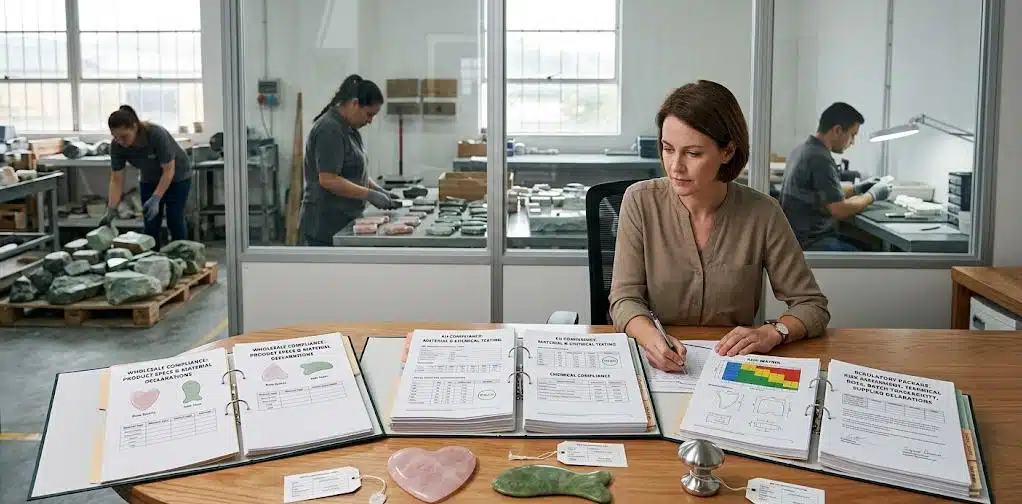
Not every gua sha wholesale buyer needs the same depth of paperwork, and asking for more than your business model requires just adds cost without adding protection. The useful way to think about it is in three tiers, matched to how and where you actually sell. Most gua sha wholesale relationships run into trouble not because the paperwork was wrong, but because the buyer asked for the wrong tier from the start.
Basic, EU Compliance, and Full Package Explained
A general wholesale buyer reselling through smaller channels can often work with a material declaration, a product specification sheet, and a basic QC report. A professional gua sha wholesale EU buyer, selling through more heavily scrutinized retail or platform channels, typically needs material composition analysis, heavy-metal testing, REACH assessment, and SVHC information layered on top of the basics. A brand, large retailer, or marketplace seller usually needs the full stack: material identification, chemical composition data, heavy-metal and restricted-substance testing, REACH and SVHC documentation, a GPSR risk assessment, complete technical documentation, batch traceability, and a supplier declaration.
So what does that mean when you are choosing a gua sha supplier? It means asking which tier they can actually produce evidence for, not which tier they claim to meet in a sales conversation. A gua sha manufacturer who offers Level 3 language but can only produce Level 1 paperwork is a bigger risk than one who is upfront about only covering the basics from the start. A gua sha supplier who asks which tier you actually need, instead of defaulting to the most expensive package, is usually the more trustworthy one over the long run.
Twelve Years at the Bench: What Building Gua Sha Wholesale Orders Has Taught Us
Deyi Gems has spent twelve years cutting and polishing crystal, jade, and stainless steel into tools people put against their own skin, and the clearest lesson from that time is that material honesty and paperwork discipline matter more than any single certificate. You are not buying a stamp. You are buying a factory’s willingness to test what it sells and stand behind the result when a regulator, a platform, or a customer asks a hard question. That habit shows up long before any lab report gets printed, in how consistently a workshop sources its raw stone, how carefully it separates material batches, and how honestly it labels a 304 part instead of quietly substituting a cheaper alloy to save a few cents per piece. That same discipline is what keeps a gua sha wholesale order moving when a gua sha wholesale buyer asks an unscheduled follow-up question mid-shipment.
For a gua sha wholesale EU partner, that discipline is not a marketing claim. It is a habit visible in batch records, in material substitution logs, and in how quickly a factory can pull the right test result when a gua sha wholesale buyer asks for it without warning. A guasha tools manufacturer that treats those records as routine paperwork, rather than as an emergency scramble, is the one that keeps your shipments moving.
Your Next Step Toward a Safer Gua Sha Wholesale Partnership
None of this is meant to scare you away from gua sha wholesale sourcing. It is meant to make sure the gua sha wholesale shipment you commit budget to actually clears the reviews it will face on the other end, whether that reviewer is a customs officer, a marketplace compliance system, or a retail buyer’s quality manager. None of it requires a single all-purpose gua sha certificate; it requires a habit of testing and documenting that holds up under a closer look.
A short, practical way to start: ask your current or prospective gua sha supplier for the five documents outlined earlier in this guide, scoped to the exact materials in your next order, not a generic catalog-wide certificate. If they can produce a material analysis and a heavy-metal test tied to a specific batch number within a reasonable timeframe, that responsiveness itself tells you something about how the rest of the gua sha wholesale relationship will run. If they cannot, treat that gap as useful information rather than an inconvenience to work around quietly.
Traceability matters just as much as the initial test result. A batch reference number that ties a specific shipment back to its raw material source and its test date means that if a regulator or retailer asks a question eighteen months from now, someone can actually answer it. Without that link, even a genuine, passed test becomes difficult to use as evidence, because there is no way to prove which shipment it actually covers. This means asking your supplier not just “do you test,” but “can you trace this exact carton back to a specific test result,” is often the more revealing question of the two. That one habit, more than any single test, is what separates a dependable gua sha wholesale relationship from one that quietly falls apart at the first serious audit.
So what does that mean for your next order? It means the real question is no longer “does this factory make a nice-looking gua sha board.” It is “can this factory prove, on paper, that the board is gua sha safe for the market I am selling into.” Buyers who start asking that second question consistently end up with fewer stalled shipments, fewer platform delistings, and fewer awkward conversations with a retail partner’s compliance team six months after the order shipped.
If you are evaluating a gua sha wholesale EU order right now, ask for the compliance file before you ask for the price break. A gua sha manufacturer that can produce both, in that order, without pushing back, is the one worth building a longer relationship with. In an industry where anyone can print any claim on a product page, documented proof is what actually separates one guasha tools manufacturer from the next.
This article is intended as general supply-chain and product-compliance guidance based on manufacturing experience and publicly available EU regulatory sources. It does not constitute legal advice for any specific product. Actual testing scope, regulatory limits, and required technical documentation should be confirmed against your product’s exact material, intended use, target country, and the current text of applicable EU regulations.