If you’re sourcing stainless steel gua sha wholesale right now, here’s the number that matters most before anything else: authentic 316 stainless steel sits at roughly 7.9–8.0 g/cm³, while the zinc alloy substitutes quietly flooding the market weigh in around 6.6–6.9 g/cm³. That’s a 15–18% weight gap on an identically sized tool, and you can often feel it the moment you pick up a sample. This single data point won’t tell you everything, but it’s usually the first crack in a fake product’s story. Before you sign a purchase order, you need a repeatable way to separate real 304/316 material from plated zinc — because once a container clears customs, the price of getting this wrong isn’t measured in dollars per piece. It’s measured in refunds, one-star reviews, and a stainless steel gua sha Authenticity claim you can no longer defend to your own customers.
- Why Stainless Steel Gua Sha Wholesale Buyers Keep Getting Fooled by Lookalikes
- 304, 316, and Zinc Alloy: What's Actually Inside Your Gua Sha Tool
- Three Tests You Can Run Before You Call a Stainless Steel Gua Sha Manufacturer
- Stainless Steel Gua Sha Wholesale Manufacturing: Real Metal vs. Real Plating
- 304 vs 316: The One Test That Actually Settles Stainless Steel Gua Sha Authenticity
- The Salt Water Test: Useful Signal, Not a Stainless Steel Gua Sha Wholesale Certificate
- OEM Quality Control for Stainless Steel Gua Sha Wholesale Orders: A Checklist Before You Pay a Deposit
- Matching Material Grade to Market: A Stainless Steel Gua Sha Wholesale Buying Guide
- About Deyi Gems: Your Stainless Steel Gua Sha Wholesale Manufacturing Partner
Why Stainless Steel Gua Sha Wholesale Buyers Keep Getting Fooled by Lookalikes

The appearance trap in every stainless steel gua sha wholesale order
Here’s the uncomfortable truth: a well-plated zinc alloy tool can look identical to real 304 stainless steel in a product photo, under a trade show light, or even in your hand for the first thirty seconds. Both can carry a bright, mirror-like finish. Both can feel cool and smooth against the skin. The surface tells you almost nothing on its own, which is exactly why so many buyers place a stainless steel gua sha wholesale order based on a sample that photographs well and later discover a very different story once the full shipment lands and gets used for a few months. So what does that mean for you? It means your inspection process can’t stop at “does it look shiny” — it has to move past the surface and into density, magnetism, and processing marks, which we’ll walk through below.
The reason this trap works so well comes down to how zinc alloy production is designed. Manufacturers producing zinc alloy gua sha tools rely almost entirely on electroplating — a thin layer of nickel-chromium deposited over a die-cast base metal — to create the “stainless steel” look. Real stainless steel doesn’t need that plating step at all; the corrosion resistance and shine come from the alloy itself, not a coating sprayed or dipped onto the surface afterward. That’s a fundamental difference in how the product achieves its appearance, and it’s also the reason plated products degrade in a way solid stainless steel does not. This means you can predict failure points before they happen: wherever a plated tool takes repeated contact — the working edge, the corners, the areas pressed against skin during a facial routine — is exactly where plating wears through first.
What’s actually at stake in your stainless steel gua sha wholesale decision
Is a small weight or price difference really worth worrying about at the sourcing stage? For a one-time gift purchase, maybe not. For a brand building repeat customers, it’s the whole game. A zinc alloy tool sold as “stainless steel” typically starts showing plating wear, dulling, or faint oxidation spots within months of regular use — and when that happens, the complaint doesn’t land on the factory that cut corners, it lands on your brand’s reviews page. According to the International Gem Society, professional material verification in adjacent industries like gemology never relies on a single visual check; it layers multiple tests — optical, physical, and elemental — before a material claim is confirmed (gemsociety.org). The same logic applies here. You’re not being paranoid by asking for more than a shiny sample — you’re applying the same due diligence standard that any serious materials industry already uses.
304, 316, and Zinc Alloy: What’s Actually Inside Your Gua Sha Tool

Reading the composition behind a stainless steel gua sha manufacturer’s claims
Three materials dominate this category, and their differences aren’t cosmetic — they’re chemical. 316 stainless steel is built from iron, chromium, and nickel, with an added 2–3% molybdenum, and that molybdenum is the single biggest reason 316 resists corrosion better than any other grade commonly used in beauty tools. The Specialty Steel Industry of North America confirms this directly: Type 316 contains 16–18% chromium, 10–14% nickel, and 2–3% molybdenum, while Type 304 carries 18–20% chromium and 8–10.5% nickel with no molybdenum at all (ssina.com). So what does that mean for your product line? It means 316 is the grade you reach for when a tool will meet sweat, humidity, or repeated skin contact over years, not months — which is exactly the environment a gua sha tool lives in.
304 stainless steel is the workhorse of this category. It’s the most widely used grade across the entire industry, it machines and polishes well, and its corrosion resistance easily covers normal beauty-tool use. It also costs less than 316, which is why the large majority of the mid-market runs on 304 rather than the premium grade. Zinc alloy sits in a completely different category — its base is zinc, it depends on electroplating for its appearance rather than the metal’s own properties, and its price advantage comes with a tradeoff: weaker long-term durability and a corrosion resistance profile that doesn’t come close to either stainless steel grade. This means you can match material to market position with real confidence instead of guessing: 304 for volume-driven beauty retail, 316 for anything marketed on skin-safety or premium longevity claims, and zinc alloy reserved for exactly nowhere in a stainless steel gua sha wholesale catalog that wants to keep that label honest.
Why a stainless steel gua sha manufacturer treats molybdenum as the deciding factor
You might reasonably ask: if 304 already resists corrosion well, why does 2–3% molybdenum matter enough to justify a price gap? The answer sits in how each grade behaves under the specific stress a gua sha tool actually experiences — repeated contact with facial oils, sweat, and skincare products containing salts and acids. ASTM International’s A240/A240M standard, the reference specification covering chromium-nickel stainless steel plate and sheet, formally separates these grades by exactly this chemistry, because composition — not appearance — is what determines how a material performs over years of contact (astm.org). A tool without molybdenum can still perform acceptably for most consumers. A tool marketed toward sensitive or acne-prone skin, or sold under a premium claim, is where that 2–3% starts to matter for real-world stainless steel gua sha Authenticity.
Three Tests You Can Run Before You Call a Stainless Steel Gua Sha Manufacturer

Weight: your first and fastest stainless steel gua sha wholesale screening tool
Start here, because it costs you nothing and takes five seconds. Place a sample on a kitchen scale, note the exact dimensions, and compare the reading against the expected range for stainless steel — roughly 7.9–8.0 g/cm³ against zinc alloy’s 6.6–6.9 g/cm³. A tool that reads noticeably lighter than expected for its size is very likely zinc alloy wearing a stainless steel label. That said, be careful not to over-trust this test: weight can tell you a sample probably isn’t stainless steel at all, but it cannot tell you whether a genuinely heavy sample is 304 or 316, since both grades sit in almost the same density range. So what does that mean for your sourcing checklist? It means weight earns a spot as your fast first filter, not your final verdict — treat a light sample as a hard stop, and treat a correctly weighted sample as “passed round one, not yet confirmed.”
Magnets: the test everyone trusts and almost nobody should
Here’s a warning worth repeating loudly: a magnet is not a reliable way to confirm real stainless steel, no matter how often this myth circulates in sourcing forums. Both 304 and 316 are typically non-magnetic or only weakly magnetic in their standard annealed state, but cold working during manufacturing — bending, stamping, forming — can introduce a slight magnetic response into genuinely authentic material. At the same time, zinc alloy generally shows no strong magnetic pull either, since zinc itself isn’t ferromagnetic. Put those two facts together and you get an uncomfortable conclusion: a magnet test can pass or fail on both real and fake material, which means it should never be your deciding factor. Use it only as a minor supporting data point alongside weight and surface inspection — never in isolation, and never as the test you tell your buyer settled the question.
Surface texture: what CNC processing leaves behind that plating can’t fake
This is where trained eyes and fingers start to outperform quick tricks. Genuine stainless steel gua sha tools typically show a natural metallic gray tone, clean and consistent edges from CNC cutting, and even, uniform polishing lines across the whole surface — the kind of consistency that comes from working the material itself rather than coating it. Zinc alloy tools depend on nickel-chromium electroplating for their bright finish, and that dependency shows up over time: plating wear, exposed base metal at edges and high-contact points, and faint oxidation spots after months of real use are classic signs of a plated fake, not a material flaw you’d ever see on solid stainless steel. This means you can build a simple visual checklist into your incoming inspection today — inconsistent edge sharpness, uneven polish lines, or any hint of a “coated” rather than “solid” look under close light are your cue to escalate a sample for lab-level testing before it becomes 10,000 units sitting in a warehouse with an authenticity problem you can’t undo.
Stainless Steel Gua Sha Wholesale Manufacturing: Real Metal vs. Real Plating

Inside a real stainless steel gua sha factory production line
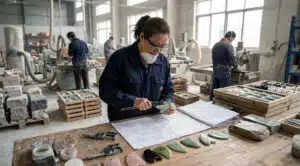
Watch how a genuine tool actually gets made and the authenticity question starts to answer itself. A real stainless steel gua sha tool moves through stainless steel plate, then laser cutting or CNC machining, then chamfering, then rough grinding, then fine grinding, then vibratory polishing, then mirror finishing, then washing, then packing. Every one of those steps is shaping the metal itself — removing material, refining an edge, building a finish into the surface rather than on top of it. That’s a long, multi-stage process, and it exists precisely because stainless steel’s value comes from the material’s own performance, not from a coating applied at the end. This means you can ask a very specific sourcing question and get a very revealing answer: request the process flow from any stainless steel gua sha manufacturer you’re vetting, and watch how quickly a factory that’s cutting corners struggles to describe steps it never actually performs.
Compare that against how a zinc alloy tool gets built: zinc alloy die-casting, deburring, polishing, electroplating, packing. Four or five steps instead of eight or nine, and the entire “stainless steel” appearance shows up in a single stage — electroplating — bolted onto a base metal that was never stainless to begin with. You don’t need a lab to understand why this matters. A process built around shaping a durable material behaves differently over time than a process built around dressing up a cheaper one. At Deyi Gems, walking a buyer through this exact production line — plate in, mirror-finished tool out — is usually the fastest way to settle a authenticity question that a photo alone could never answer.
What a zinc alloy die-casting line skips — and why it shows up later
Here’s a question worth sitting with: if a zinc alloy tool can look this convincing on day one, why does it ever fail later? The answer is that die-casting and electroplating were never designed to deliver long-term corrosion resistance in the first place — they were designed to deliver a fast, low-cost finish that photographs well. Genuine stainless steel resists corrosion because chromium in the alloy forms a passive oxide layer across the entire mass of the metal, not just the visible surface. Plated zinc alloy has no such internal defense; once the thin nickel-chromium layer wears through at an edge or a high-contact point, the base metal underneath is exposed and starts reacting with moisture, oils, and salts almost immediately. So what does that mean for your production requests? It means you should ask any gua sha factory you’re evaluating for photos or video of an in-progress batch — plate stock, CNC cutting, and polishing stages — rather than accepting a finished sample alone, since finished samples are exactly where plating and real metal look most alike.
304 vs 316: The One Test That Actually Settles Stainless Steel Gua Sha Authenticity

Why eyes and hands can’t tell 304 from 316
Here’s where even an experienced buyer runs out of road. 304 and 316 are close enough in appearance, color, polish, and hand-feel that no amount of visual inspection or touch testing will reliably separate them — and anyone who tells you otherwise by eye alone is guessing, not testing. Both grades take a mirror polish beautifully. Both feel identically smooth and cool against skin. Both pass the weight test in roughly the same range, since their densities sit close together. This isn’t a failure of your inspection skills; it’s a real limit of what the human eye and hand can detect, because the difference between these two grades isn’t visual at all — it’s a 2–3% shift in molybdenum content buried inside the alloy itself. This means you can stop blaming your team for missing something and start budgeting for the one tool that actually catches it.
XRF testing: the standard every stainless steel gua sha wholesale buyer should ask for
That tool is X-ray fluorescence, or XRF, spectroscopy — a non-destructive method that reads the elemental composition of a sample directly, rather than inferring it from appearance. This is the same underlying principle gemological labs rely on when authenticity can’t be settled by eye: the International Gem Society notes that reliable material identification depends on layering physical and instrumental tests rather than trusting a single visual read, and XRF-style elemental analysis sits at the center of that layered approach across serious materials industries (gemsociety.org). Applied to stainless steel, an XRF reading will show you molybdenum at roughly 2–3% for genuine 316 and effectively zero for 304 — a number, not an impression. So what does that mean for how you place a stainless steel gua sha wholesale order going forward? It means the sourcing conversation shouldn’t end with “does it look like 316” — it should end with a molybdenum reading you can put in a supplier file, especially on any order where your brand is charging a 316-level price and making a stainless steel gua sha Authenticity claim to your own customers.
The Salt Water Test: Useful Signal, Not a Stainless Steel Gua Sha Wholesale Certificate

What salt water exposure actually shows you
Placing a sample in a salt water environment and watching how it responds over days or weeks is a genuinely useful field test, and it costs almost nothing to run. Real 316 stainless steel typically performs best under this kind of exposure, holding its finish with little to no visible change; 304 usually comes in second, showing resistance but not quite matching 316’s performance under prolonged salt contact; electroplated zinc alloy tends to be where problems show up fastest, with surface corrosion, pitting, or visible finish changes appearing well before either genuine stainless grade shows comparable wear. The Nickel Institute’s technical guidance on stainless steel behavior in saline and naturally occurring water environments backs this pattern directly, tying molybdenum-bearing grades like 316 to measurably stronger resistance against localized corrosion in chloride-rich conditions (nickelinstitute.org). This means you can use a simple salt water trial as an early warning system on incoming samples — a batch that shows corrosion within days almost certainly isn’t the grade it was sold as.
Where this test falls short — and why it shouldn’t be your final word
But don’t mistake this test for a certification. It’s genuinely unable to reliably separate 304 from 316 with any precision, since both grades can perform acceptably over a short observation window, and results shift depending on water salinity, exposure time, and temperature — none of which are standardized the way a lab protocol would be. Should a supplier hand you salt water test results and call the material question closed? No — treat that offer as a good-faith gesture, not proof. This means you can accept a salt water demonstration as one data point in a bigger picture, but for any order where the material grade determines your price point, your marketing claims, or your brand’s stainless steel gua sha Authenticity promise to customers, XRF verification remains the only test that closes the question with a number instead of an impression.
OEM Quality Control for Stainless Steel Gua Sha Wholesale Orders: A Checklist Before You Pay a Deposit

Raw material certification: SUS304/SUS316 Mill Certificates
Before a single tool gets cut, ask for paper. Any supplier claiming SUS304 or SUS316 should be able to produce a Mill Certificate showing the actual chemical composition of the batch, not just a grade name printed on an invoice. This matters more than it sounds like it should: the Specialty Steel Industry of North America points out directly that marketing terms like “18/8” are sometimes applied loosely and should never be used as a substitute for real material certification when buying raw stock (ssina.com). So what does that mean for you? It means a grade name on a product listing is a claim, not proof — and the Mill Certificate is the document that turns it into one. If a supplier hesitates or stalls when you ask for it, that hesitation is itself useful information.
IQC incoming inspection: what to check before production starts
Once material arrives at the factory, incoming quality control (IQC) should verify the grade marking, sheet thickness, hardness, and surface condition against the purchase order before a single piece moves to cutting. This step exists because a Mill Certificate confirms what left the mill — it doesn’t confirm what actually showed up at the loading dock, and mismatches between paperwork and physical stock happen more often than most buyers assume. You don’t need to run this inspection yourself, but you do need to ask whether your supplier runs it as a standard step or only when a buyer specifically requests it. This means you can use one simple question during supplier vetting — “walk me through your IQC process for incoming stainless steel sheet” — to separate a factory with a real quality system from one that’s improvising.
Finished goods inspection: the stainless steel gua sha wholesale checkpoint before shipping
The last checkpoint, before anything ships, should cover appearance, dimensional accuracy, edge roundness, polish consistency, and — critically — sample-based XRF testing on the finished batch, not just the raw material. This is the point where a stainless steel gua sha wholesale buyer either catches a problem while it’s still sitting in a factory warehouse, or discovers it three months later in a customer’s return request. A finished-goods XRF pull doesn’t need to cover every unit; a statistically reasonable sample from each production run is enough to catch a batch that drifted from spec. This means you can build a simple non-negotiable into every purchase order: request a finished-goods XRF report alongside your shipping documents, every single order, regardless of how long you’ve worked with a supplier — because material substitution is far more often a supply-chain shortcut than a one-time mistake, and consistent checking is what keeps it from becoming your problem.
Matching Material Grade to Market: A Stainless Steel Gua Sha Wholesale Buying Guide

Mass-market beauty retail: 304 covers most needs
If your customers are buying a gua sha tool as an accessible self-care product rather than a clinical or luxury item, 304 stainless steel almost always covers what you need. It handles normal skin contact, facial oils, and regular cleaning without issue, and its lower cost compared to 316 protects your margin on volume orders. There’s no real upside in over-specifying 316 for this tier — you’d be paying for corrosion resistance your customers will likely never stress-test. This means you can standardize your mass-market stainless steel gua sha wholesale line on 304 with confidence, save the premium grade for products where it earns its price, and put that margin difference toward packaging, marketing, or a better price point instead.
Premium and clinical-adjacent brands: 316L earns its price
If your positioning leans toward sensitive-skin claims, clinical-adjacent marketing, or a premium price point, 316L is where you want to be. That extra 2–3% molybdenum translates into real resistance against sweat, oils, and the salts and acids found in skincare products over years of use, not just weeks — and for a brand charging a premium price and making a stainless steel gua sha Authenticity claim to justify it, that durability gap is the thing actually being sold. Ask yourself honestly: does your positioning promise longevity, or does it promise a low price? The answer should decide your grade, not the other way around. This means your material spec becomes part of your brand promise rather than a hidden manufacturing detail — and it’s worth stating that spec explicitly in your own product marketing, backed by the certification paperwork to prove it.
Why zinc alloy is a short-term save and a long-term cost
Here’s a direct warning worth sitting with before you chase the lowest quote: selling zinc alloy electroplated gua sha tools under a stainless steel label isn’t a pricing strategy, it’s a liability with a delayed trigger. Plating wear, dulling, and oxidation spots typically surface months after a batch ships — well past your return window with the supplier, but squarely inside your customer’s return window with you. Add in the reputational risk of a customer testing a tool with a magnet or a scale and posting the result publicly, and the short-term savings on a stainless steel gua sha wholesale order stop looking like savings at all. This means you can treat “why is this quote so much cheaper” as a question worth answering before signing, not after a support ticket answers it for you.
About Deyi Gems: Your Stainless Steel Gua Sha Wholesale Manufacturing Partner
Deyi Gems has spent 12 years processing, designing, and manufacturing crystal, jade, and stainless steel gua sha tools from a single source facility, which means your order doesn’t pass through a chain of subcontractors between raw material and finished product. As a direct stainless steel gua sha manufacturer, every stage described earlier in this piece — cutting, grinding, polishing, mirror finishing — happens under one roof, and that’s what makes it possible to hand a buyer full traceability from Mill Certificate to finished-goods XRF report on request. You get one point of contact and one accountable production line instead of a paperwork trail split across multiple vendors, which is exactly the setup that makes IQC and finished-goods verification straightforward rather than a chase.
Working with a single-source gua sha factory also changes what’s possible at the sample stage. You can request 304 and 316L samples side by side, run your own weight and magnet checks, and ask for XRF documentation before committing to a production run — all without the back-and-forth of a trading company relaying requests to a factory it doesn’t directly control. This means you can shorten your qualification timeline meaningfully: instead of waiting weeks for a middleman to source answers, you get direct access to the same production data this article just walked you through, from the people actually running the CNC line and the polishing stage.
Ready to Place a Stainless Steel Gua Sha Wholesale Order? Verify First
Before your next purchase order goes out, run the checklist this article laid out: weight as your first filter, magnet testing as a minor supporting signal only, surface inspection for plating tells, and XRF as the test that actually settles 304 versus 316. Ask any stainless steel gua sha manufacturer you’re evaluating for a Mill Certificate, an IQC process description, and a finished-goods XRF report — and treat hesitation on any of those three as your answer. If you want to see this process applied directly, Deyi Gems can provide 304 and 316L samples alongside material certification and XRF documentation for your own comparison, so your next stainless steel gua sha wholesale decision rests on a number, not a photo.