
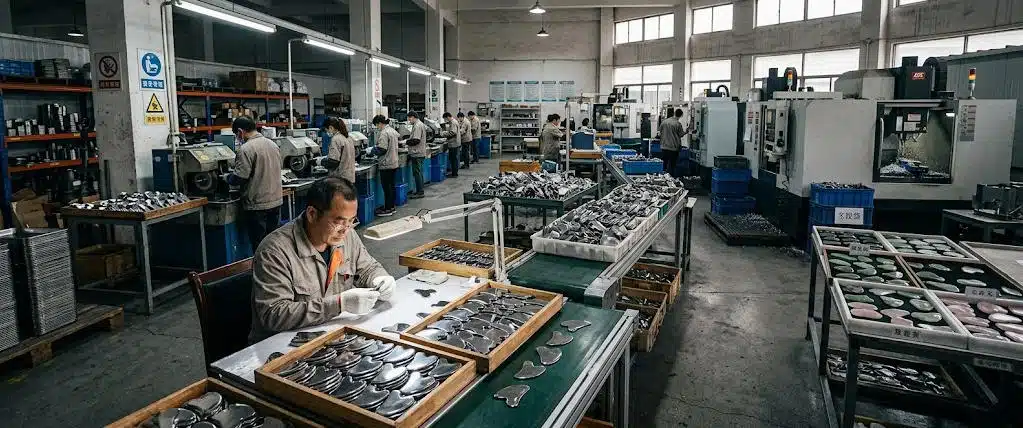
Is Stainless Steel Gua Sha Wholesale the Next Growth Category? A Manufacturer’s Data and Risk Disclosure
If you’re building a wholesale catalog around gua sha tools right now, one number should stop you before you finalize next year’s purchase orders: production tied to stainless steel gua sha wholesale lines grew by roughly 70,000 pieces year over year — a 23.5% increase — and stainless steel’s share of total gua sha wholesale output climbed from 24.5% in 2024 to 31.8% in 2025, then to 36.7% through the first half of 2026. Those figures aren’t projections pulled from a trend report. They come from actual factory order books, tracked month by month, material by material, the way a production planner tracks capacity rather than the way a marketer tracks buzz. This is not a claim that stainless steel is about to replace jade or crystal. It’s a disclosure of what the order data actually shows, what’s driving it, where the real risk sits, and what a stainless steel gua sha manufacturer actually has to get right before you shift your next gua sha wholesale order toward metal. The Short Answer: What the Order Data Shows About Stainless Steel Gua Sha Wholesale Year-over-Year Growth in Stainless Steel Gua Sha Wholesale Orders Between 2024 and 2025, stainless steel order volume increased by close to 70,000 pieces, pushing year-over-year growth to about 23.5%. Over the same period, stainless steel’s share of total gua sha wholesale output rose from 24.5% to 31.8% — a 7.3 percentage-point jump in a single year. That pace continued into 2026: by mid-year, stainless steel accounted for 36.7% of all gua sha units produced across material types tracked internally. None of these numbers describe a niche experiment; they describe a material category picking up close to one percentage point of total share every two months. This means your catalog mix from twelve months ago may already be out of step with where wholesale buyer demand is actually moving. Why One Factory’s Numbers Are Worth Reading Carefully — Or Skeptically A single guasha factory‘s order book is not a national market report, and it shouldn’t be treated as one. Is a 23.5% internal growth figure enough, by itself, to call stainless steel the industry’s next core material? On its own, no — internal order data can just as easily reflect one stainless steel gua sha manufacturer‘s client mix or a handful of large accounts shifting strategy as it can reflect a broad consumer trend, and that’s a fair challenge to raise. What makes the internal figures worth reading anyway is that they line up closely with independent, publicly observable marketplace data pulled from actual product listings rather than from any single supplier’s books. The next section walks through that public data directly, so the trend can be judged against a source with no reason to inflate it in either direction. What This Means for Your Next Purchase Order If you’re planning a catalog refresh six to twelve months out, the practical question isn’t whether stainless steel will eventually overtake stone — it’s whether your current SKU mix already lags where buyer demand sits today. A catalog still weighted 90% toward stone, built on assumptions from two or three years ago, is being compared by shoppers against listings that increasingly include a stainless steel option sitting right next to it. You don’t need to convert your whole line to test this; a single well-specified stainless steel SKU added alongside your existing stone catalog is a low-risk way to see whether your own customer base responds the way the broader marketplace data suggests it might. This means the immediate action item isn’t a strategic bet on one material winning outright — it’s a controlled test you can run within a single purchase order cycle, with the downside capped at one SKU’s tooling and sample cost. Amazon Marketplace Data: Stainless Steel Gua Sha Wholesale Has Left the Niche Stage Top SKU Performance and Category Rankings Independent Amazon marketplace tracking from July 2026 covers roughly 132 ASINs tied to the search term “stainless steel gua sha.” The top-ranked listing, a Kitsch stainless steel tool, sold an estimated 20,000 units per month, while several other stainless steel SKUs cleared roughly 10,000 units monthly in the same period. That top listing’s sales grew by about 100% month over month at the time of tracking — a sharp acceleration, not a slow drift. Across the top ten listings in that keyword segment, average monthly sales sat near 6,300 units at an average price of $9.68, and a comparable snapshot from April 2026 showed the same top SKU tracking around 30,000 units monthly with a top-ten keyword average near 7,800 units. A segment that produces multiple five-figure-per-month SKUs isn’t a side experiment a handful of sellers are testing; it behaves like a competitive tier with its own pricing and ranking dynamics. For a guasha tool manufacturer deciding where to point next quarter’s CNC capacity, that’s the kind of ranking data worth watching directly rather than taking on faith. The $9.68 average price point across the top ten listings also tells you something about margin structure: at that price band, unit economics reward a supplier who can hold tight tolerances at volume more than one who competes purely on raw material cost, since the material itself is a small fraction of landed cost once you’re ordering in the thousands. What These Numbers Mean for Your Stainless Steel Gua Sha Wholesale Order Size Zoom out from the keyword-specific data and the picture holds. In the broader “gua sha tool” category, that same Kitsch stainless steel listing ranked first overall in July 2026, at roughly 20,000 units per month and a 4.7-star rating, ahead of stone gua sha wholesale and jade competitors in the same category. The category’s top ten listings averaged about 13,800 units monthly. In other words, stainless steel isn’t winning a narrow side bracket — it’s sitting at the top of the entire gua sha tool category on the largest marketplace in the country. This means a wholesale buyer building a private-label line today has
If you’re building a wholesale catalog around gua sha tools right now, one number should stop you before you finalize next year’s purchase orders: production tied to stainless steel gua sha wholesale lines grew by roughly 70,000 pieces year over year — a 23.5% increase — and stainless steel’s share of total gua sha wholesale output climbed from 24.5% in 2024 to 31.8% in 2025, then to 36.7% through the first half of 2026. Those figures aren’t projections pulled from a trend report. They come from actual factory order books, tracked month by month, material by material, the way a production planner tracks capacity rather than the way a marketer tracks buzz. This is not a claim that stainless steel is about to replace jade or crystal. It’s a disclosure of what the order data actually shows, what’s driving it, where the real risk sits, and what a stainless steel gua sha manufacturer actually has to get right before you shift your next gua sha wholesale order toward metal. The Short Answer: What the Order Data Shows About Stainless Steel Gua Sha Wholesale Year-over-Year Growth in Stainless Steel Gua Sha Wholesale Orders Between 2024 and 2025, stainless steel order volume increased by close to 70,000 pieces, pushing year-over-year growth to about 23.5%. Over the same period, stainless steel’s share of total gua sha wholesale output rose from 24.5% to 31.8% — a 7.3 percentage-point jump in a single year. That pace continued into 2026: by mid-year, stainless steel accounted for 36.7% of all gua sha units produced across material types tracked internally. None of these numbers describe a niche experiment; they describe a material category picking up close to one percentage point of total share every two months. This means your catalog mix from twelve months ago may already be out of step with where wholesale buyer demand is actually moving. Why One Factory’s Numbers Are Worth Reading Carefully — Or Skeptically A single guasha factory‘s order book is not a national market report, and it shouldn’t be treated as one. Is a 23.5% internal growth figure enough, by itself, to call stainless steel the industry’s next core material? On its own, no — internal order data can just as easily reflect one stainless steel gua sha manufacturer‘s client mix or a handful of large accounts shifting strategy as it can reflect a broad consumer trend, and that’s a fair challenge to raise. What makes the internal figures worth reading anyway is that they line up closely with independent, publicly observable marketplace data pulled from actual product listings rather than from any single supplier’s books. The next section walks through that public data directly, so the trend can be judged against a source with no reason to inflate it in either direction. What This Means for Your Next Purchase Order If you’re planning a catalog refresh six to twelve months out, the practical question isn’t whether stainless steel will eventually overtake stone — it’s whether your current SKU mix already lags where buyer demand sits today. A catalog still weighted 90% toward stone, built on assumptions from two or three years ago, is being compared by shoppers against listings that increasingly include a stainless steel option sitting right next to it. You don’t need to convert your whole line to test this; a single well-specified stainless steel SKU added alongside your existing stone catalog is a low-risk way to see whether your own customer base responds the way the broader marketplace data suggests it might. This means the immediate action item isn’t a strategic bet on one material winning outright — it’s a controlled test you can run within a single purchase order cycle, with the downside capped at one SKU’s tooling and sample cost. Amazon Marketplace Data: Stainless Steel Gua Sha Wholesale Has Left the Niche Stage Top SKU Performance and Category Rankings Independent Amazon marketplace tracking from July 2026 covers roughly 132 ASINs tied to the search term “stainless steel gua sha.” The top-ranked listing, a Kitsch stainless steel tool, sold an estimated 20,000 units per month, while several other stainless steel SKUs cleared roughly 10,000 units monthly in the same period. That top listing’s sales grew by about 100% month over month at the time of tracking — a sharp acceleration, not a slow drift. Across the top ten listings in that keyword segment, average monthly sales sat near 6,300 units at an average price of $9.68, and a comparable snapshot from April 2026 showed the same top SKU tracking around 30,000 units monthly with a top-ten keyword average near 7,800 units. A segment that produces multiple five-figure-per-month SKUs isn’t a side experiment a handful of sellers are testing; it behaves like a competitive tier with its own pricing and ranking dynamics. For a guasha tool manufacturer deciding where to point next quarter’s CNC capacity, that’s the kind of ranking data worth watching directly rather than taking on faith. The $9.68 average price point across the top ten listings also tells you something about margin structure: at that price band, unit economics reward a supplier who can hold tight tolerances at volume more than one who competes purely on raw material cost, since the material itself is a small fraction of landed cost once you’re ordering in the thousands. What These Numbers Mean for Your Stainless Steel Gua Sha Wholesale Order Size Zoom out from the keyword-specific data and the picture holds. In the broader “gua sha tool” category, that same Kitsch stainless steel listing ranked first overall in July 2026, at roughly 20,000 units per month and a 4.7-star rating, ahead of stone gua sha wholesale and jade competitors in the same category. The category’s top ten listings averaged about 13,800 units monthly. In other words, stainless steel isn’t winning a narrow side bracket — it’s sitting at the top of the entire gua sha tool category on the largest marketplace in the country. This means a wholesale buyer building a private-label line today has