If you’re building a wholesale catalog around gua sha tools right now, one number should stop you before you finalize next year’s purchase orders: production tied to stainless steel gua sha wholesale lines grew by roughly 70,000 pieces year over year — a 23.5% increase — and stainless steel’s share of total gua sha wholesale output climbed from 24.5% in 2024 to 31.8% in 2025, then to 36.7% through the first half of 2026. Those figures aren’t projections pulled from a trend report. They come from actual factory order books, tracked month by month, material by material, the way a production planner tracks capacity rather than the way a marketer tracks buzz. This is not a claim that stainless steel is about to replace jade or crystal. It’s a disclosure of what the order data actually shows, what’s driving it, where the real risk sits, and what a stainless steel gua sha manufacturer actually has to get right before you shift your next gua sha wholesale order toward metal.
- The Short Answer: What the Order Data Shows About Stainless Steel Gua Sha Wholesale
- Amazon Marketplace Data: Stainless Steel Gua Sha Wholesale Has Left the Niche Stage
- Beyond Beauty: How Stainless Steel Gua Sha Wholesale Reaches Into Wellness and Massage
- Stainless Steel Gua Sha Wholesale Versus Stone Gua Sha Wholesale: Why Buyers Switch, and Why Some Don't
- Why a Guasha Factory Can Scale Stainless Steel Faster Than Stone
- Risk Disclosure: The Real Limitations of Stainless Steel Gua Sha Wholesale
- Compliance and Material Standards for Stainless Steel Gua Sha Wholesale Buyers
- Case Study: A Stainless Steel Gua Sha Wholesale Order Compared to a Stone Gua Sha Wholesale Order
- Market Maturity: Why Material Share Shift Is the Real Growth Story for Stainless Steel Gua Sha Wholesale
- How to Vet a Stainless Steel Gua Sha Wholesale Supplier Before You Place an Order
- Faqs About New Stainless Steel Gua Sha Wholesale Trends
The Short Answer: What the Order Data Shows About Stainless Steel Gua Sha Wholesale
Year-over-Year Growth in Stainless Steel Gua Sha Wholesale Orders
Between 2024 and 2025, stainless steel order volume increased by close to 70,000 pieces, pushing year-over-year growth to about 23.5%. Over the same period, stainless steel’s share of total gua sha wholesale output rose from 24.5% to 31.8% — a 7.3 percentage-point jump in a single year. That pace continued into 2026: by mid-year, stainless steel accounted for 36.7% of all gua sha units produced across material types tracked internally. None of these numbers describe a niche experiment; they describe a material category picking up close to one percentage point of total share every two months. This means your catalog mix from twelve months ago may already be out of step with where wholesale buyer demand is actually moving.
Why One Factory’s Numbers Are Worth Reading Carefully — Or Skeptically
A single guasha factory‘s order book is not a national market report, and it shouldn’t be treated as one. Is a 23.5% internal growth figure enough, by itself, to call stainless steel the industry’s next core material? On its own, no — internal order data can just as easily reflect one stainless steel gua sha manufacturer‘s client mix or a handful of large accounts shifting strategy as it can reflect a broad consumer trend, and that’s a fair challenge to raise. What makes the internal figures worth reading anyway is that they line up closely with independent, publicly observable marketplace data pulled from actual product listings rather than from any single supplier’s books. The next section walks through that public data directly, so the trend can be judged against a source with no reason to inflate it in either direction.
What This Means for Your Next Purchase Order
If you’re planning a catalog refresh six to twelve months out, the practical question isn’t whether stainless steel will eventually overtake stone — it’s whether your current SKU mix already lags where buyer demand sits today. A catalog still weighted 90% toward stone, built on assumptions from two or three years ago, is being compared by shoppers against listings that increasingly include a stainless steel option sitting right next to it. You don’t need to convert your whole line to test this; a single well-specified stainless steel SKU added alongside your existing stone catalog is a low-risk way to see whether your own customer base responds the way the broader marketplace data suggests it might. This means the immediate action item isn’t a strategic bet on one material winning outright — it’s a controlled test you can run within a single purchase order cycle, with the downside capped at one SKU’s tooling and sample cost.
Amazon Marketplace Data: Stainless Steel Gua Sha Wholesale Has Left the Niche Stage
Top SKU Performance and Category Rankings
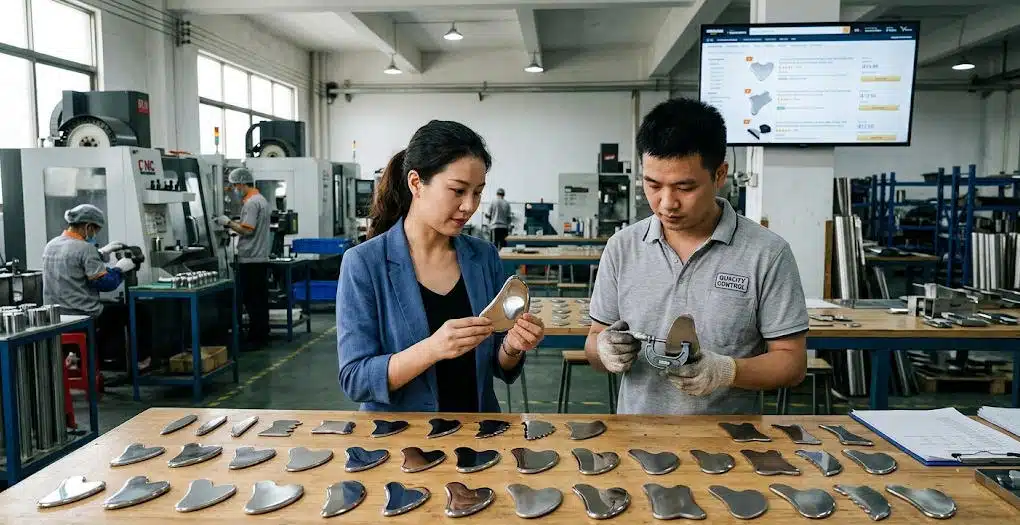
Independent Amazon marketplace tracking from July 2026 covers roughly 132 ASINs tied to the search term “stainless steel gua sha.” The top-ranked listing, a Kitsch stainless steel tool, sold an estimated 20,000 units per month, while several other stainless steel SKUs cleared roughly 10,000 units monthly in the same period. That top listing’s sales grew by about 100% month over month at the time of tracking — a sharp acceleration, not a slow drift. Across the top ten listings in that keyword segment, average monthly sales sat near 6,300 units at an average price of $9.68, and a comparable snapshot from April 2026 showed the same top SKU tracking around 30,000 units monthly with a top-ten keyword average near 7,800 units. A segment that produces multiple five-figure-per-month SKUs isn’t a side experiment a handful of sellers are testing; it behaves like a competitive tier with its own pricing and ranking dynamics. For a guasha tool manufacturer deciding where to point next quarter’s CNC capacity, that’s the kind of ranking data worth watching directly rather than taking on faith. The $9.68 average price point across the top ten listings also tells you something about margin structure: at that price band, unit economics reward a supplier who can hold tight tolerances at volume more than one who competes purely on raw material cost, since the material itself is a small fraction of landed cost once you’re ordering in the thousands.
What These Numbers Mean for Your Stainless Steel Gua Sha Wholesale Order Size
Zoom out from the keyword-specific data and the picture holds. In the broader “gua sha tool” category, that same Kitsch stainless steel listing ranked first overall in July 2026, at roughly 20,000 units per month and a 4.7-star rating, ahead of stone gua sha wholesale and jade competitors in the same category. The category’s top ten listings averaged about 13,800 units monthly. In other words, stainless steel isn’t winning a narrow side bracket — it’s sitting at the top of the entire gua sha tool category on the largest marketplace in the country. This means a wholesale buyer building a private-label line today has a documented, ranking-verified reason to treat stainless steel as a primary SKU rather than a secondary add-on bolted onto an existing stone catalog. It also changes how you should size your first purchase order: a category leader moving 20,000 units a month suggests headroom exists for more than one well-differentiated entrant, but it also means a poorly finished or thin-gauge competitor will get compared directly against listings that have already set the bar for surface quality and star rating.
Beyond Beauty: How Stainless Steel Gua Sha Wholesale Reaches Into Wellness and Massage

Category Crossover in Search and Sales Data
The same top-ranking Kitsch stainless steel tool also placed first in Amazon’s broader “Massage Tools” search results in July 2026, at an estimated 20,000 units per month and that same 100% month-over-month growth rate. That detail matters, because it shows the product isn’t confined to a beauty-only audience specifically searching for gua sha. Buyers are finding and purchasing it through a wellness and massage search intent that has little to do with traditional Chinese beauty framing. Natural stone tools — rose quartz, jade, amethyst — tend to stay anchored to a Beauty and Self-Care identity built around the stone itself, while stainless steel carries no single comparable identity, which is exactly what lets it stretch across Beauty, Wellness, Massage, Cooling, and Body Care without contradicting its own positioning.
The Practical Upside for Your Stainless Steel Gua Sha Wholesale Product Line
A wider addressable search intent translates into a wider set of listing categories, ad placements, and cross-sell opportunities for the same physical part. A single stainless steel tool can sit under skincare, under massage and relaxation, and under men’s grooming without rewriting its core story for each placement. That flexibility lowers the marginal cost of testing a new market segment, since the work involved is new photography and new copy rather than a new mold or a new stone grade. This means one well-made stainless steel SKU can carry more listing variations, and more efficient ad-testing budget, than an equivalent stone SKU tied to a single cultural or emotional narrative. It’s exactly the kind of flexibility a guasha tool manufacturer running both stone and steel tooling can offer a private-label brand testing several positioning angles at once.
A Caveat: Broader Positioning Isn’t Automatic
Does crossover potential mean any stainless steel SKU will rank in massage and wellness searches just because the material allows it? No — a listing has to actually be built, photographed, and worded for that audience before Amazon’s search algorithm or a shopper browsing “massage tools” ever sees it as relevant. The Kitsch listing’s crossover ranking reflects deliberate positioning across multiple search categories, not a passive side effect of using metal instead of stone. If your current stainless steel SKU is still photographed and titled exactly like your rose quartz line, with the same beauty-only keywords and the same gift-set framing, you’re leaving most of that wider addressable market untouched. This means the material gives you the option to expand positioning; it doesn’t do the expanding for you, and treating it as an automatic benefit is how a promising SKU underperforms its own category data.
Stainless Steel Gua Sha Wholesale Versus Stone Gua Sha Wholesale: Why Buyers Switch, and Why Some Don’t

Hygiene, Durability, and the Cooling Effect
Ask a returning wholesale buyer why they added a stainless steel SKU, and the answer rarely starts with aesthetics. A dense, well-polished stainless steel surface resists the buildup of oil, serum residue, and bacteria more predictably than a porous or micro-fissured stone surface, and it survives a drop onto a tile bathroom floor that would chip or crack a jade or rose quartz tool outright. That durability difference shows up directly in your return and warranty-claim rate rather than just in marketing copy — a cracked stone tool is a refund, and a dented metal one usually isn’t. Metal’s thermal conductivity is also simply higher than stone’s, so a stainless steel tool pulled from a refrigerator delivers a sharper, more immediate cooling sensation, which is why so many listings now lead with “Morning Depuffing” or “Cooling Facial Massage” rather than with material origin. This means your stainless steel SKU can carry a functional, benefit-first marketing angle that doesn’t depend on any cultural or emotional story the way a jade listing typically does. A guasha tool manufacturer running both material lines will usually tell you the two need entirely different QC sheets, not a shared one with a few extra rows added.
A Composite Case: One Skincare Brand’s Repositioning
Consider a pattern that shows up repeatedly across wholesale inquiries, described here as a composite rather than one named account. A mid-sized skincare brand launches with a rose quartz gua sha bundled into a skincare set, priced on emotional and gift appeal. Eighteen months later, the brand adds a stainless steel version marketed separately around “cooling morning depuffing,” aimed at a broader wellness and grooming audience rather than the original gift-set buyer. The stone SKU keeps its bundle and gift-channel sales largely intact, while the stainless steel SKU picks up standalone sales through massage and wellness search terms the original stone listing never ranked for. Reproducing that shift required the guasha factory behind both SKUs to hold separate tooling, separate finishing standards, and separate QC checkpoints — the manufacturing side of the story, covered next. The brand’s own numbers don’t show one SKU cannibalizing the other; they show two largely separate buyer pools responding to two separate value propositions built from the same underlying manufacturing relationship.
Why a Guasha Factory Can Scale Stainless Steel Faster Than Stone
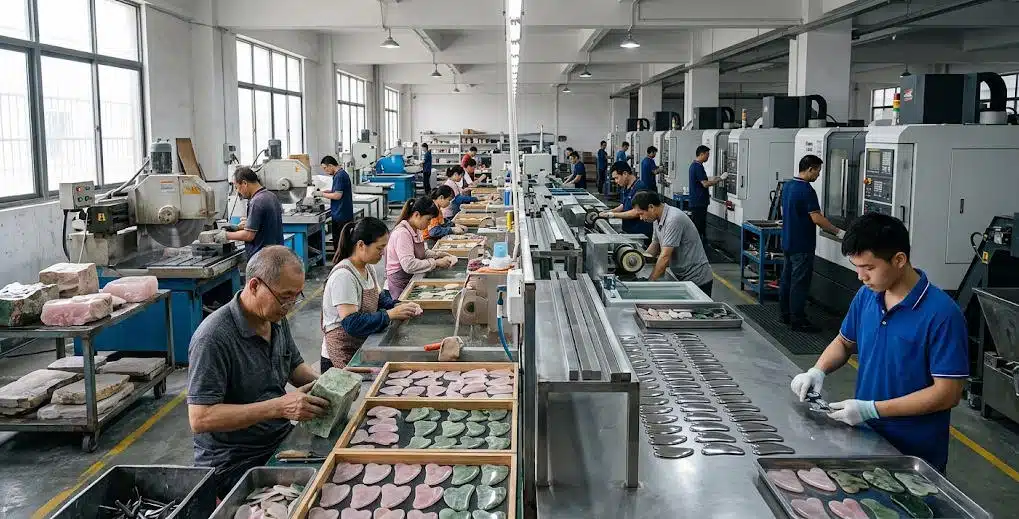
Comparing Two Production Flows
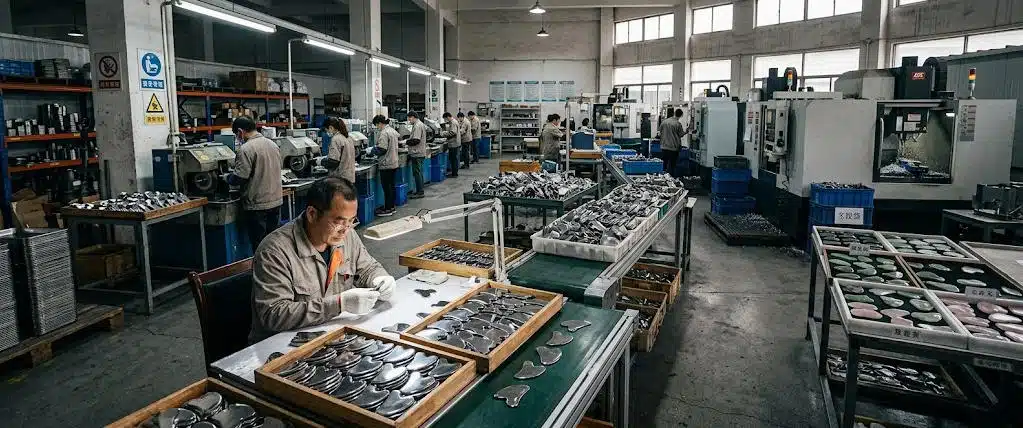
For any guasha factory, natural stone production runs through cutting, shaping, CNC profiling, grinding, polishing, sorting, and quality control, and at nearly every stage the raw material itself introduces variation. Color, veining, internal inclusions, and yield rate all shift from block to block, even within the same quarry lot, which is why two “identical” jade tools can still look slightly different side by side. A stainless steel production flow — sheet or bar stock, CNC machining or stamping and laser cutting, grinding, polishing, cleaning, and QC — runs on a raw material that starts out uniform by specification rather than by luck of the rock. The steel doesn’t have a grain pattern to match or a color band to avoid, so the same CNC program and the same surface-finish sequence produce the same result run after run. This means a guasha factory can commit to a fixed CNC program and finishing process for stainless steel and expect consistent output at 500 pieces, 5,000 pieces, or 50,000 pieces, without redesigning the process at each volume tier.
What Consistency Actually Buys You in a Stainless Steel Gua Sha Wholesale Order
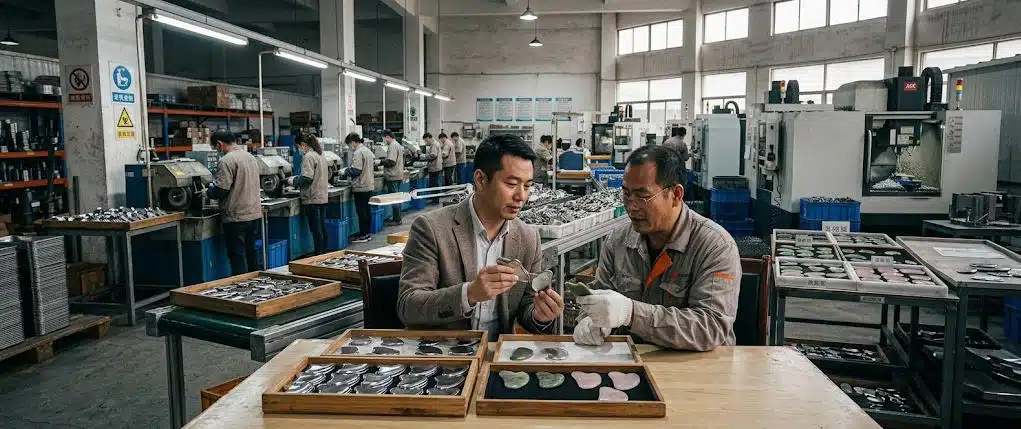
For a buyer placing a 10,000-piece order, consistency isn’t an abstract manufacturing virtue — it’s the difference between a container that matches your product photos and one that doesn’t. Stone orders at that volume are exposed to color variation, pattern variation, inclusion variation, and yield variation across a single production run, all of which can surface later as customer complaints about tools “looking different from the picture.” Stainless steel, held to the same material grade, thickness, CNC program, and surface finish across the run, doesn’t carry that same batch-to-batch drift. So what does that mean in practice? It means the larger and more standardized your SKU count gets, the more the supply-chain math favors stainless steel, and the more a stainless steel gua sha wholesale order behaves like a repeatable manufacturing process rather than a natural-material lottery. That’s also the argument you’ll hear from almost any stainless steel gua sha manufacturer pitching volume discounts — worth verifying against your own QC data rather than accepting at face value. One practical way to verify it: request a defect log from a completed run of comparable volume in each material, and compare pull rates directly instead of relying on a supplier’s summary claim.
Risk Disclosure: The Real Limitations of Stainless Steel Gua Sha Wholesale
Emotional Value Gap Versus Stone Gua Sha Wholesale
Here’s the trade-off that no amount of sales data erases: stainless steel doesn’t carry a built-in story the way rose quartz, jade, or amethyst do. A stone gua sha wholesale listing sells partly on the stone itself — its color, its cultural association, its perceived natural and luxury qualities — before a single marketing sentence gets written. Stainless steel starts as a functional tool, full stop, and any emotional positioning has to be built entirely through branding, packaging, and copywriting rather than borrowed from the material itself. If your brand’s identity rests heavily on natural materials and wellness ritual, a stainless steel line launched without deliberate positioning can feel like a mismatch to your existing customer base. That’s not a reason to avoid the material — it’s a reason to budget marketing effort for it that a stone gua sha wholesale SKU typically doesn’t require.
Surface Defects Are Harder to Hide on Metal
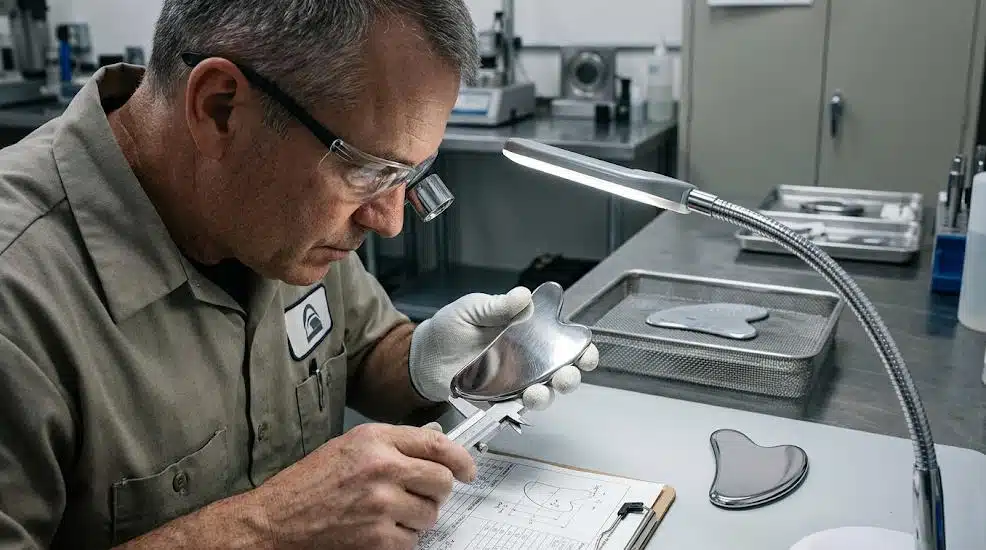
A mirror-polished stainless steel surface exposes flaws that a matte or textured stone surface simply absorbs. Scratches, dents, burrs, grinding lines, polishing marks, fingerprints, and early oxidation are all more visible on steel than on jade or quartz, which means your incoming QC standard has to be tighter, not looser, than whatever standard you’re used to applying to a stone order. Does that make stainless steel a riskier material overall? Not necessarily — but it is a reason to ask any guasha factory exactly what magnification and lighting conditions it uses for surface inspection, and to request inspection photos before shipment rather than after a customer complaint arrives. This means your quality-control checklist for a stainless steel SKU needs line items — surface finish grade, fingerprint resistance, oxidation resistance — that a stone-only QC sheet may never have included in the first place.
Edge Geometry, Comfort, and the Cooling Trade-Off
An edge radius that’s too small, or polishing that’s slightly under-spec, turns a stainless steel gua sha tool from a smooth facial tool into something that genuinely feels sharp against skin — a comfort failure that shows up in reviews as complaints of scraping or a cutting sensation. The same cooling effect that markets so well can also work against the product: metal pulled straight from a freezer or refrigerator can feel uncomfortably cold on sensitive areas like the under-eye or neck, which is a legitimate product-design problem rather than a marketing one. Addressing it usually means refining edge radius specifications and finish tolerances at the design stage, not after tooling has already been cut. This means the design brief sent to any guasha tool manufacturer for a stainless steel SKU should specify edge radius and finish grade explicitly, because leaving it unspecified is how comfort complaints end up in your review section instead of in a pre-production sample review.
Compliance and Material Standards for Stainless Steel Gua Sha Wholesale Buyers
Nickel Release Limits and What “Surgical Grade” Actually Means
Most stainless steel marketed as surgical grade for skin-contact products is 316 or 316L, an alloy that typically contains 10–14% nickel — not a nickel-free material, despite how the marketing term sometimes reads. What makes 316L behave differently on skin is that its nickel is bound tightly within a stable crystal structure and doesn’t easily migrate out to contact skin, which is why the same grade is used in surgical implants and body-piercing jewelry. In the European Union, that migration limit is a legal number, not a marketing claim: under REACH Annex XVII, Entry 27, articles intended for prolonged skin contact must release no more than 0.5 micrograms of nickel per square centimeter per week, verified using the EN 1811 test method. Is “stainless steel” on a spec sheet enough to confirm compliance on its own? No — the grade, the finish, and the lab test result are what actually confirm it, not the general material name alone. This means your purchase agreement should specify the steel grade by number, 316 or 316L rather than “stainless steel,” and should request the nickel-release test report itself, not just a mill certificate, before committing to an EU-bound order. A stainless steel gua sha manufacturer that hesitates to share that report before shipment is telling you something worth hearing.
Where Manual Tools Sit Under FDA and Quality System Rules
A non-electric stainless steel gua sha tool marketed for cosmetic massage, with no disease-treatment or therapeutic claim attached, generally falls outside the FDA’s medical device definition and doesn’t require 510(k) clearance. That changes the moment the product includes an active component such as an LED or heating element, or the moment marketing copy crosses into treating a medical condition. One recent FDA 510(k) filing for an LED-equipped gua sha device was classified as a Class II laser surgical instrument, requiring the same premarket clearance pathway as other dermatology lasers — a materially different compliance burden than a manual metal tool carries. That gap matters for marketing copy as much as for product design: claims like “reduces inflammation” or “treats rosacea” can push an otherwise unregulated manual tool into a regulatory category it was never built for. This means the safer compliance strategy for a manual stainless steel SKU is keeping claims cosmetic rather than medical — “temporarily reduces the appearance of puffiness” rather than “treats” any named condition.
Cost Implications of Getting Compliance Right the First Time
Nickel-release lab testing for a single SKU typically runs in the range of a couple hundred dollars per test, a cost that’s trivial next to a rejected customs shipment or a market recall. Budgeting that cost per SKU before the first production run, rather than after a retailer or customs authority requests documentation, is some of the cheapest insurance available anywhere in this supply chain. So what’s the real return-on-investment question here? It isn’t whether you can save roughly $200 by skipping the test; it’s what one blocked container, one delisted marketplace SKU, or one failed retailer compliance audit costs against that same $200. This means a wholesale buyer should treat compliance testing as a line item inside the initial cost-per-unit calculation, not as an afterthought added after the first shipment has already left port — no guasha factory can guarantee compliance for you without an actual lab report behind it.
Case Study: A Stainless Steel Gua Sha Wholesale Order Compared to a Stone Gua Sha Wholesale Order
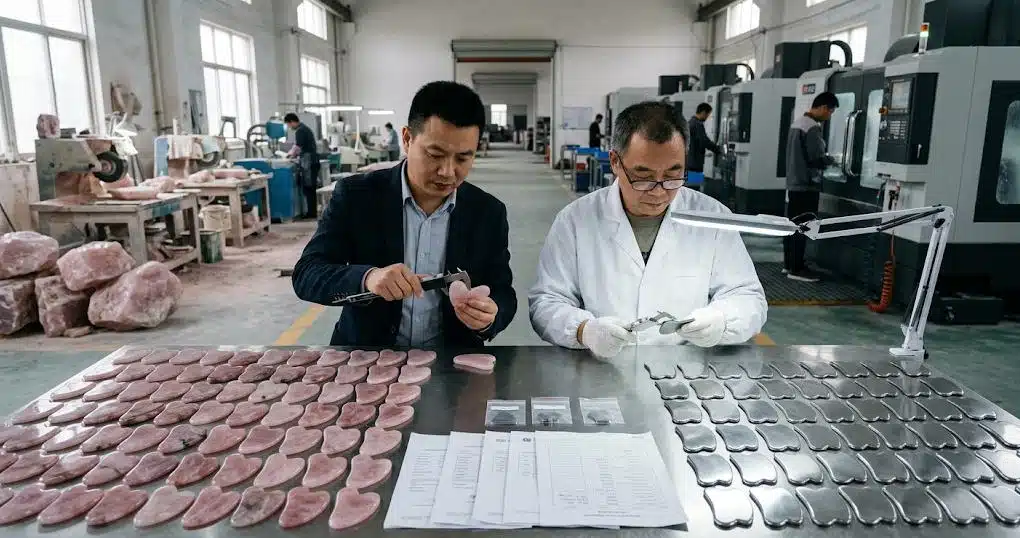
Picture two otherwise identical 5,000-piece wholesale purchase orders placed in the same quarter for the same private-label skincare brand — one in rose quartz, one in 316L stainless steel. On the stone order, roughly 3–5% of units typically get pulled during QC sorting for color mismatch, visible inclusions, or minor chips picked up during handling, a rate considered normal for natural material and priced into the quote from the start. On the stainless steel order, the pull rate tied to material variation drops close to zero, but the inspection focus shifts almost entirely to surface finish — scratches, polishing lines, and fingerprints that would never register as a defect on a matte stone surface in the first place.
The stone gua sha wholesale order ships with essentially no compliance documentation requirement beyond general product safety declarations, since natural minerals aren’t subject to nickel-release testing. The stainless steel order needs a steel-grade certificate and, for any EU-bound stock, a nickel-release test report before customs clearance — a step that can add one to two weeks to the pre-shipment timeline if it isn’t planned in from the design stage rather than requested at the last minute. Neither order is inherently harder to run than the other; they’re difficult in different places. This means the real sourcing question isn’t which material is easier — it’s which type of difficulty your team is actually set up to manage: natural variation on one side, or documented compliance and tighter surface QC on the other.
Market Maturity: Why Material Share Shift Is the Real Growth Story for Stainless Steel Gua Sha Wholesale
The broader U.S. gua sha market shows signs of settling into maturity rather than continuing to explode outward. July 2026 tracking put the category’s annual revenue near $4.9 million, annual search volume around 6.1 million, roughly 500,000–600,000 units sold per year, and an average price of about $9.44, with the top five brands holding a large share of that volume and 90-day search growth actually running negative, at roughly -9.2%. A shrinking search trend for a category as a whole would normally read as a warning sign for anyone about to enter it for the first time.
But that overall softening coexists with individual stainless steel SKUs still moving 10,000 to 30,000 units a month — figures that don’t fit a category in decline. The two facts together point to a specific mechanism rather than a contradiction: total category demand may be plateauing while stainless steel keeps taking share away from stone gua sha wholesale and other materials inside that same, roughly fixed pool of buyers. This means the growth opportunity over the next two to five years likely isn’t “the gua sha market gets bigger” so much as “stainless steel keeps winning share inside a market that has stopped growing” — a meaningfully different bet for a wholesale buyer, or a guasha tool manufacturer allocating its own tooling budget, to place than one built on chasing category-wide growth that the data doesn’t currently support.
How to Vet a Stainless Steel Gua Sha Wholesale Supplier Before You Place an Order
A Five-Step Verification Checklist for Any Stainless Steel Gua Sha Wholesale Supplier
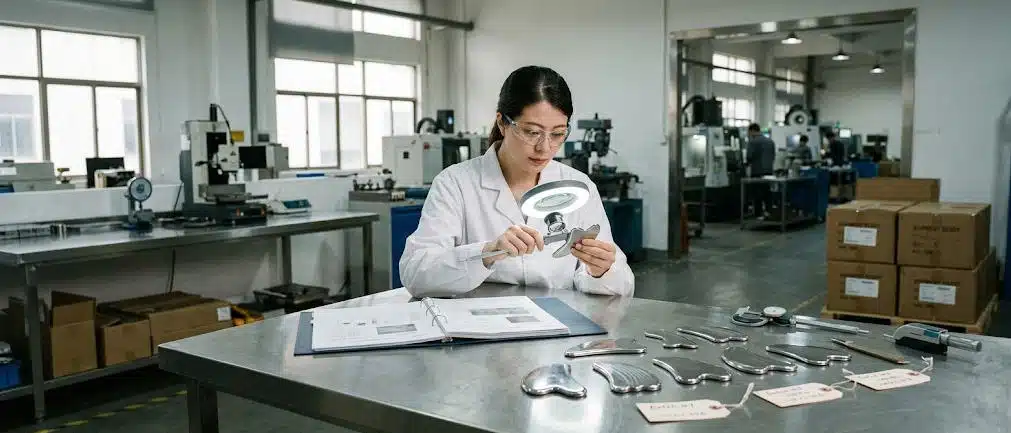
Start by asking for the exact steel grade in writing — 316 or 316L, not a vague “stainless steel” line item — since the grade determines both nickel-release compliance and long-term corrosion resistance. Next, request a pre-production sample built to the actual finish grade you intend to sell, because a mirror finish and a satin finish hide surface defects very differently, and a sample built to spec reveals more about a guasha tool manufacturer‘s real capability than any brochure ever will. Third, ask specifically how surface inspection is performed — under what lighting, at what magnification, and whether inspection photos are provided as standard practice — since this is exactly where stainless steel defects most often slip through undetected. Fourth, request the nickel-release test report if you’re shipping into the EU or a market with a similar rule, and confirm it’s tied to the actual production batch rather than a generic material certificate. Fifth, ask how the guasha tool manufacturer maintains CNC program and tooling consistency across repeat orders, since that answer reveals whether piece 50,001 in a reorder will actually match piece 1 from the original run.
None of these five checks require specialized technical knowledge on your part — they require asking direct questions and paying attention to the ones a supplier hesitates to answer clearly. A stainless steel gua sha manufacturer that answers all five without redirecting the conversation to marketing language is one you can reasonably trust with volume; one that can’t produce a steel-grade certificate or a real inspection photo on request is a signal worth taking seriously before deposit funds change hands. This means the real cost of vetting here is your time, not your money — and it’s far cheaper to spend that time before a purchase order than after a container of borderline-spec tools has already arrived at your warehouse.
Disclaimer and Methodology
This report was written and published by Deyi Gems, a stainless steel gua sha manufacturer that also produces natural stone, crystal, and massage tools. The internal order-volume figures cited here — the 23.5% year-over-year growth figure and the 24.5%–36.7% share progression — come from this manufacturer’s own production and sales records and have not been independently audited by a third party; they are disclosed as a data point rather than as a market-wide guarantee. The Amazon marketplace figures cited throughout — SKU rankings, monthly unit estimates, and category averages — come from third-party marketplace tracking current as of April and July 2026, and estimates of this kind carry an inherent margin of error since they are modeled from visible sales-rank data rather than confirmed order counts. Regulatory information on nickel-release limits and FDA device classification reflects publicly available sources at the time of writing and should not be treated as legal advice; you should confirm current requirements with a qualified compliance professional or legal counsel before finalizing any international shipment. The aim of this article is to disclose both the opportunity and the risk in stainless steel gua sha wholesale sourcing as accurately as the available data allows, not to promote any single material, supplier, or manufacturer over another.
Faqs About New Stainless Steel Gua Sha Wholesale Trends
1. Is stainless steel gua sha wholesale replacing stone gua sha wholesale?
Not entirely. Order data shows stainless steel gaining share fastest — up to 36.7% by mid-2026 — but natural stone keeps a strong emotional and gift-market appeal that stainless steel doesn’t replicate.
2. Why is stainless steel gua sha gaining wholesale market share?
Buyers cite hygiene, drop resistance, and a stronger cooling effect from higher thermal conductivity. It also crosses into wellness and massage categories beyond beauty, widening its addressable market.
3. What steel grade should a stainless steel gua sha wholesale order use?
Look for 316 or 316L, the grades typically used in surgical and skin-contact applications. Always request the actual nickel-release test report, not just a general “stainless steel” label.
4. What’s the biggest risk in a stainless steel gua sha wholesale order?
Surface defects are harder to hide than on stone — scratches, polishing lines, and fingerprints show clearly on mirror-polished metal. Tight QC and correct edge-radius design matter more here.
5. Is the overall gua sha market still growing?
Category-wide U.S. search growth was roughly -9.2% over 90 days as of mid-2026, suggesting maturity. Growth is now coming from material share shifting toward stainless steel.
References
- International Organization for Standardization. “ISO 9001:2015 — Quality Management Systems — Requirements.“
- Nickel Institute. “Nickel and Nickel Allergic Contact Dermatitis (NACD).“
- European Chemicals Agency. REACH Regulation (EC) No 1907/2006, Annex XVII, Entry 27 — Nickel Restriction.
- U.S. Food and Drug Administration. “Aesthetic (Cosmetic) Devices.“
- U.S. Food and Drug Administration. 510(k) Premarket Notification K252272, “ORA Method LED Gua Sha.“