How do Gua Sha Manufacturer Balance Quality and Efficiency?
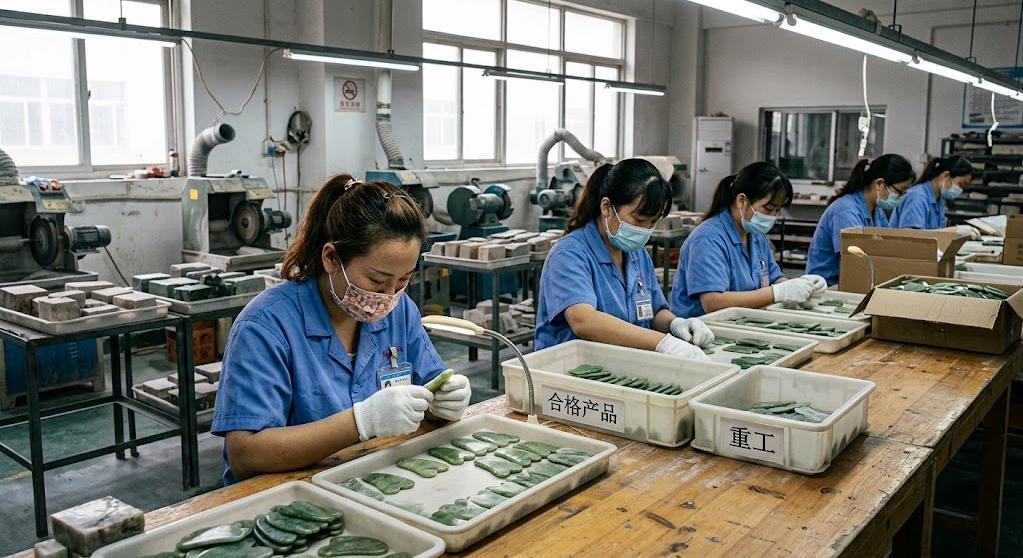
If you are ranking gua sha factories by daily output alone, you are reading the wrong number. A gua sha manufacturer running 10,000 pieces a day and shipping only 8,000 usable units is not actually faster than one producing 8,500 pieces a day and shipping 8,200. Once rework, scrap, customer complaints, and reshipment costs are counted, the slower line often finishes ahead in real terms. This is the first disclosure worth making plainly: manufacturing efficiency in gua sha production should be measured as qualified output divided by total input, not units produced per shift. You are not paying for speed. You are paying for the share of your order that reaches your customers without a return, a complaint, or a second freight bill, and that distinction should change how you read every gua sha wholesale quote from any gua sha manufacturer competing for your order. The Efficiency Number a Gua Sha Manufacturer Actually Tracks Why Daily Output Alone Can Mislead You Ask an experienced gua sha manufacturer what number matters most, and daily unit count should not be the answer. Output per day tells you how fast a line runs, but it says nothing about how much of that output survives inspection, packaging, and transit in a condition your customers will accept. A gua sha manufacturer quoting an aggressive daily capacity may be running its cutting and polishing stations faster than the material tolerates, and that shows up later as edge chipping, thickness variance, or surface haze. You should ask for a different figure instead: first-pass yield, meaning the percentage of pieces that pass quality control on the first check without rework. That single number tells you more about gua sha quality than any capacity claim printed on a factory sales sheet. Consider two suppliers again. One reports 10,000 pieces daily at an 80 percent first-pass yield; the other reports 8,500 pieces daily at a 96 percent yield. The second factory delivers 8,160 qualified pieces against 8,000 from the first, using less raw material, less labor time, and less rework capacity to get there. This means you can compare two gua sha wholesale quotes on equal footing simply by asking each supplier for their first-pass yield rate before you compare price per piece. That is the number a gua sha manufacturer should volunteer without being asked twice. The Formula That Protects Your Margin, Not Just the Deadline A fuller way to think about gua sha production efficiency multiplies four factors together: equipment capacity, first-pass yield rate, material utilization rate, and equipment uptime. A machine rated for 1,000 pieces a day rarely delivers that number in practice. If first-pass yield sits at 85 percent, material utilization at 90 percent, and uptime at 80 percent, real qualified output falls to roughly 612 pieces, well below the equipment’s rated capacity. This is not a flaw unique to one factory; it is the arithmetic every gua sha manufacturer faces, and any supplier quoting only the top-line 1,000-piece figure is quoting a number nobody actually receives. You deserve the full calculation, not the headline capacity number, before you tie a production schedule to your own retail launch date. You should ask any gua sha manufacturer to walk through this calculation using your actual order size, not a generic example built for a sales sheet. The Hidden Cost of Letting Final Inspection Do All the Work How One Missed Defect at Piece 4,000 Costs You More A common shortcut in gua sha production is to run a batch at full speed and inspect everything at the end. It looks efficient on a gua sha factory floor schedule, because nothing slows down until the final count is taken. The real cost shows up later, and it is larger than most buyers expect. Picture a run of 5,000 natural jade gua sha boards where a thickness deviation is not caught until piece 4,000 has already been cut. Thousands of pieces now need rework, some cannot be corrected at all, and your delivery date moves. If that same deviation is caught within the first 50 to 100 pieces, the loss is measured in dozens of units, not thousands. A gua sha manufacturer that waits for the final count to find this out is choosing convenience over your margin. The rule holds everywhere in manufacturing: the earlier a defect is found, the cheaper it is to fix. Is your current gua sha manufacturer catching problems at piece 50, or at piece 4,000? That single question, asked plainly, tells you more about their process discipline than any brochure describing their equipment ever will. What Full Process Control Looks Like Inside a Gua Sha Manufacturer’s Line A responsible gua sha manufacturer does not rely on one inspection at the end of the line. Checks happen at every stage instead: incoming raw material inspection, first-article confirmation before a run begins, small-batch verification, in-process quality checks during production, batch-level sampling, and a final outgoing check before packing. Each checkpoint exists to catch a problem before it multiplies downstream, rather than after. This means you can request a process-control report alongside your shipment, showing where and when each checkpoint occurred, instead of relying on a single final certificate that only proves the last sampled batch happened to pass. Ask your gua sha manufacturer a direct question: what share of defects are caught before final inspection, versus at it? A gua sha manufacturer who cannot answer that with real numbers is telling you, indirectly, that process control does not exist on their line yet, whatever their sales materials claim. A gua sha manufacturer willing to show you this number without hesitation is rare enough to be worth noting when you find one. Why Not Every Step in a Gua Sha Factory Should Run at the Same Speed Where a Gua Sha Manufacturer Should Slow Down on Purpose Not every station in a gua sha factory carries the same risk, and treating them identically wastes money in both directions. Rough-cutting a crystal blank, CNC shaping, drilling,
How do Gua Sha Manufacturer Balance Quality and Efficiency? Read More »
If you are ranking gua sha factories by daily output alone, you are reading the wrong number. A gua sha manufacturer running 10,000 pieces a day and shipping only 8,000 usable units is not actually faster than one producing 8,500 pieces a day and shipping 8,200. Once rework, scrap, customer complaints, and reshipment costs are counted, the slower line often finishes ahead in real terms. This is the first disclosure worth making plainly: manufacturing efficiency in gua sha production should be measured as qualified output divided by total input, not units produced per shift. You are not paying for speed. You are paying for the share of your order that reaches your customers without a return, a complaint, or a second freight bill, and that distinction should change how you read every gua sha wholesale quote from any gua sha manufacturer competing for your order. The Efficiency Number a Gua Sha Manufacturer Actually Tracks Why Daily Output Alone Can Mislead You Ask an experienced gua sha manufacturer what number matters most, and daily unit count should not be the answer. Output per day tells you how fast a line runs, but it says nothing about how much of that output survives inspection, packaging, and transit in a condition your customers will accept. A gua sha manufacturer quoting an aggressive daily capacity may be running its cutting and polishing stations faster than the material tolerates, and that shows up later as edge chipping, thickness variance, or surface haze. You should ask for a different figure instead: first-pass yield, meaning the percentage of pieces that pass quality control on the first check without rework. That single number tells you more about gua sha quality than any capacity claim printed on a factory sales sheet. Consider two suppliers again. One reports 10,000 pieces daily at an 80 percent first-pass yield; the other reports 8,500 pieces daily at a 96 percent yield. The second factory delivers 8,160 qualified pieces against 8,000 from the first, using less raw material, less labor time, and less rework capacity to get there. This means you can compare two gua sha wholesale quotes on equal footing simply by asking each supplier for their first-pass yield rate before you compare price per piece. That is the number a gua sha manufacturer should volunteer without being asked twice. The Formula That Protects Your Margin, Not Just the Deadline A fuller way to think about gua sha production efficiency multiplies four factors together: equipment capacity, first-pass yield rate, material utilization rate, and equipment uptime. A machine rated for 1,000 pieces a day rarely delivers that number in practice. If first-pass yield sits at 85 percent, material utilization at 90 percent, and uptime at 80 percent, real qualified output falls to roughly 612 pieces, well below the equipment’s rated capacity. This is not a flaw unique to one factory; it is the arithmetic every gua sha manufacturer faces, and any supplier quoting only the top-line 1,000-piece figure is quoting a number nobody actually receives. You deserve the full calculation, not the headline capacity number, before you tie a production schedule to your own retail launch date. You should ask any gua sha manufacturer to walk through this calculation using your actual order size, not a generic example built for a sales sheet. The Hidden Cost of Letting Final Inspection Do All the Work How One Missed Defect at Piece 4,000 Costs You More A common shortcut in gua sha production is to run a batch at full speed and inspect everything at the end. It looks efficient on a gua sha factory floor schedule, because nothing slows down until the final count is taken. The real cost shows up later, and it is larger than most buyers expect. Picture a run of 5,000 natural jade gua sha boards where a thickness deviation is not caught until piece 4,000 has already been cut. Thousands of pieces now need rework, some cannot be corrected at all, and your delivery date moves. If that same deviation is caught within the first 50 to 100 pieces, the loss is measured in dozens of units, not thousands. A gua sha manufacturer that waits for the final count to find this out is choosing convenience over your margin. The rule holds everywhere in manufacturing: the earlier a defect is found, the cheaper it is to fix. Is your current gua sha manufacturer catching problems at piece 50, or at piece 4,000? That single question, asked plainly, tells you more about their process discipline than any brochure describing their equipment ever will. What Full Process Control Looks Like Inside a Gua Sha Manufacturer’s Line A responsible gua sha manufacturer does not rely on one inspection at the end of the line. Checks happen at every stage instead: incoming raw material inspection, first-article confirmation before a run begins, small-batch verification, in-process quality checks during production, batch-level sampling, and a final outgoing check before packing. Each checkpoint exists to catch a problem before it multiplies downstream, rather than after. This means you can request a process-control report alongside your shipment, showing where and when each checkpoint occurred, instead of relying on a single final certificate that only proves the last sampled batch happened to pass. Ask your gua sha manufacturer a direct question: what share of defects are caught before final inspection, versus at it? A gua sha manufacturer who cannot answer that with real numbers is telling you, indirectly, that process control does not exist on their line yet, whatever their sales materials claim. A gua sha manufacturer willing to show you this number without hesitation is rare enough to be worth noting when you find one. Why Not Every Step in a Gua Sha Factory Should Run at the Same Speed Where a Gua Sha Manufacturer Should Slow Down on Purpose Not every station in a gua sha factory carries the same risk, and treating them identically wastes money in both directions. Rough-cutting a crystal blank, CNC shaping, drilling,