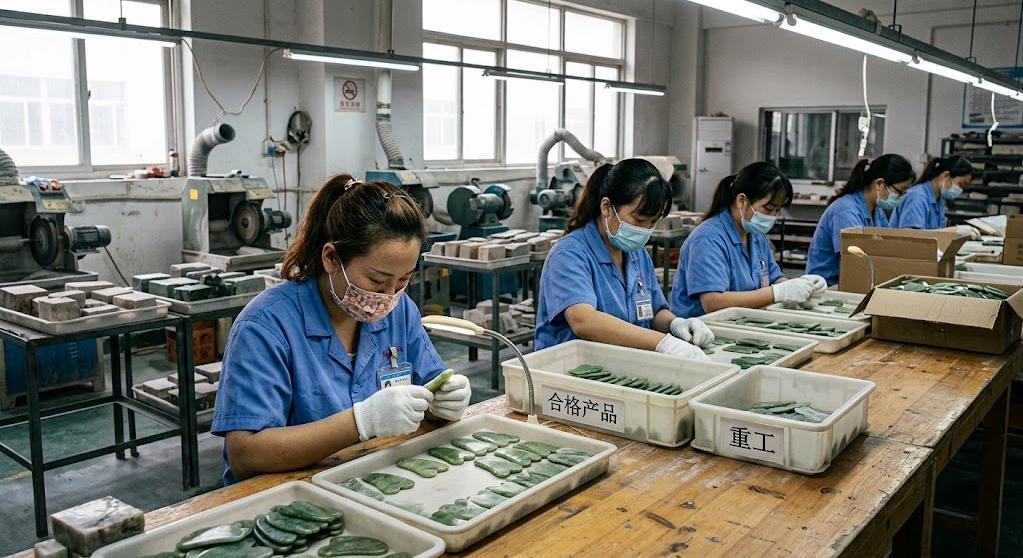
If you are ranking gua sha factories by daily output alone, you are reading the wrong number. A gua sha manufacturer running 10,000 pieces a day and shipping only 8,000 usable units is not actually faster than one producing 8,500 pieces a day and shipping 8,200. Once rework, scrap, customer complaints, and reshipment costs are counted, the slower line often finishes ahead in real terms. This is the first disclosure worth making plainly: manufacturing efficiency in gua sha production should be measured as qualified output divided by total input, not units produced per shift. You are not paying for speed. You are paying for the share of your order that reaches your customers without a return, a complaint, or a second freight bill, and that distinction should change how you read every gua sha wholesale quote from any gua sha manufacturer competing for your order.
- The Efficiency Number a Gua Sha Manufacturer Actually Tracks
- The Hidden Cost of Letting Final Inspection Do All the Work
- Why Not Every Step in a Gua Sha Factory Should Run at the Same Speed
- The Natural Stone Risk Most Buyers Never See Coming
- The Golden Sample: Your Real Protection Against Quality Disputes
- Why a Sudden Full-Speed Start Puts Your Bulk Order at Risk
- Reading the Data Behind Your Order: Where the Real Bottleneck Hides
- What a Gua Sha Manufacturer Should Confirm Before You Sign a Wholesale Purchase Order
- The Bottom Line for Buyers Sourcing From a Gua Sha Manufacturer
- Gua Sha Production Quality and Efficiency
The Efficiency Number a Gua Sha Manufacturer Actually Tracks
Why Daily Output Alone Can Mislead You
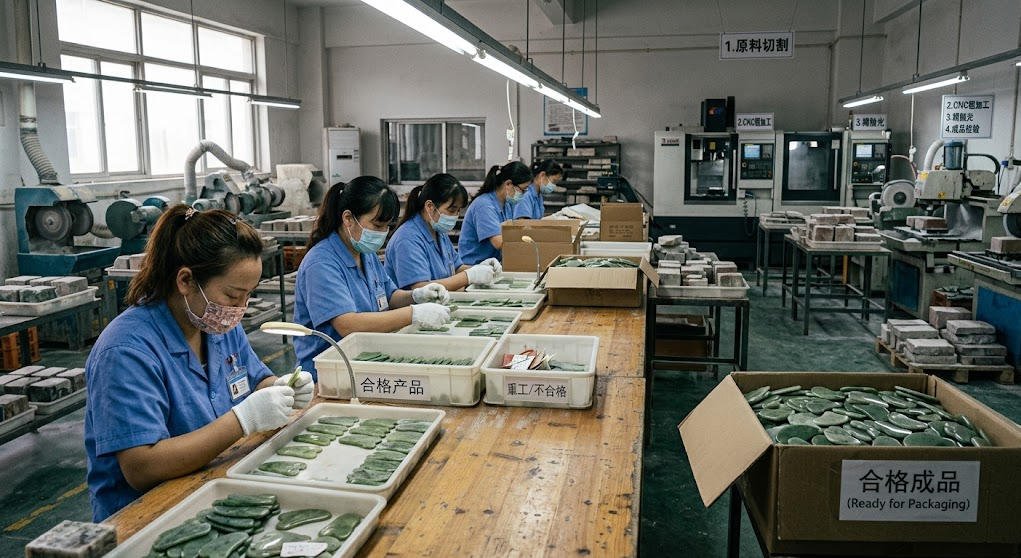
Ask an experienced gua sha manufacturer what number matters most, and daily unit count should not be the answer. Output per day tells you how fast a line runs, but it says nothing about how much of that output survives inspection, packaging, and transit in a condition your customers will accept. A gua sha manufacturer quoting an aggressive daily capacity may be running its cutting and polishing stations faster than the material tolerates, and that shows up later as edge chipping, thickness variance, or surface haze. You should ask for a different figure instead: first-pass yield, meaning the percentage of pieces that pass quality control on the first check without rework. That single number tells you more about gua sha quality than any capacity claim printed on a factory sales sheet.
Consider two suppliers again. One reports 10,000 pieces daily at an 80 percent first-pass yield; the other reports 8,500 pieces daily at a 96 percent yield. The second factory delivers 8,160 qualified pieces against 8,000 from the first, using less raw material, less labor time, and less rework capacity to get there. This means you can compare two gua sha wholesale quotes on equal footing simply by asking each supplier for their first-pass yield rate before you compare price per piece. That is the number a gua sha manufacturer should volunteer without being asked twice.
The Formula That Protects Your Margin, Not Just the Deadline
A fuller way to think about gua sha production efficiency multiplies four factors together: equipment capacity, first-pass yield rate, material utilization rate, and equipment uptime. A machine rated for 1,000 pieces a day rarely delivers that number in practice. If first-pass yield sits at 85 percent, material utilization at 90 percent, and uptime at 80 percent, real qualified output falls to roughly 612 pieces, well below the equipment’s rated capacity. This is not a flaw unique to one factory; it is the arithmetic every gua sha manufacturer faces, and any supplier quoting only the top-line 1,000-piece figure is quoting a number nobody actually receives. You deserve the full calculation, not the headline capacity number, before you tie a production schedule to your own retail launch date. You should ask any gua sha manufacturer to walk through this calculation using your actual order size, not a generic example built for a sales sheet.
The Hidden Cost of Letting Final Inspection Do All the Work
How One Missed Defect at Piece 4,000 Costs You More
A common shortcut in gua sha production is to run a batch at full speed and inspect everything at the end. It looks efficient on a gua sha factory floor schedule, because nothing slows down until the final count is taken. The real cost shows up later, and it is larger than most buyers expect. Picture a run of 5,000 natural jade gua sha boards where a thickness deviation is not caught until piece 4,000 has already been cut. Thousands of pieces now need rework, some cannot be corrected at all, and your delivery date moves. If that same deviation is caught within the first 50 to 100 pieces, the loss is measured in dozens of units, not thousands. A gua sha manufacturer that waits for the final count to find this out is choosing convenience over your margin.
The rule holds everywhere in manufacturing: the earlier a defect is found, the cheaper it is to fix. Is your current gua sha manufacturer catching problems at piece 50, or at piece 4,000? That single question, asked plainly, tells you more about their process discipline than any brochure describing their equipment ever will.
What Full Process Control Looks Like Inside a Gua Sha Manufacturer’s Line
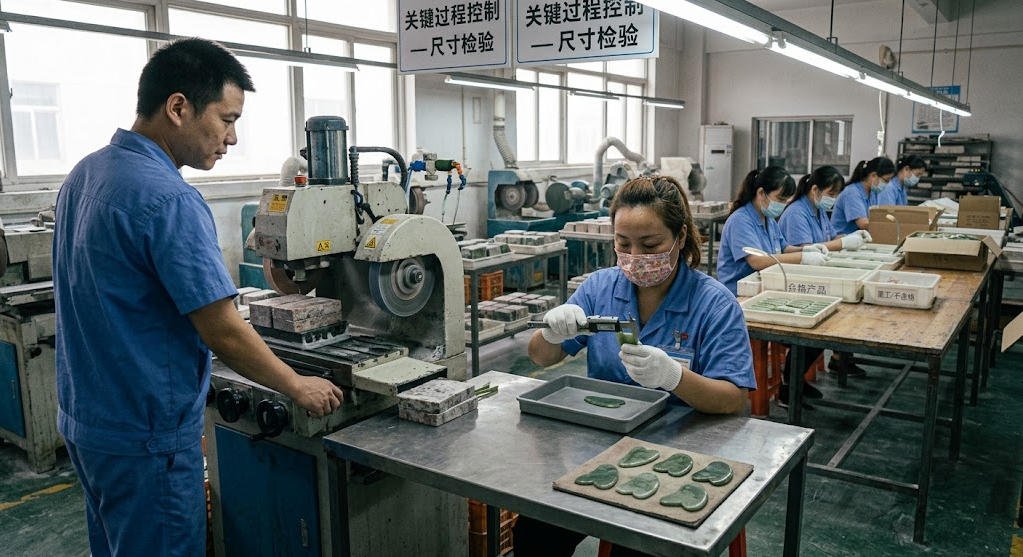
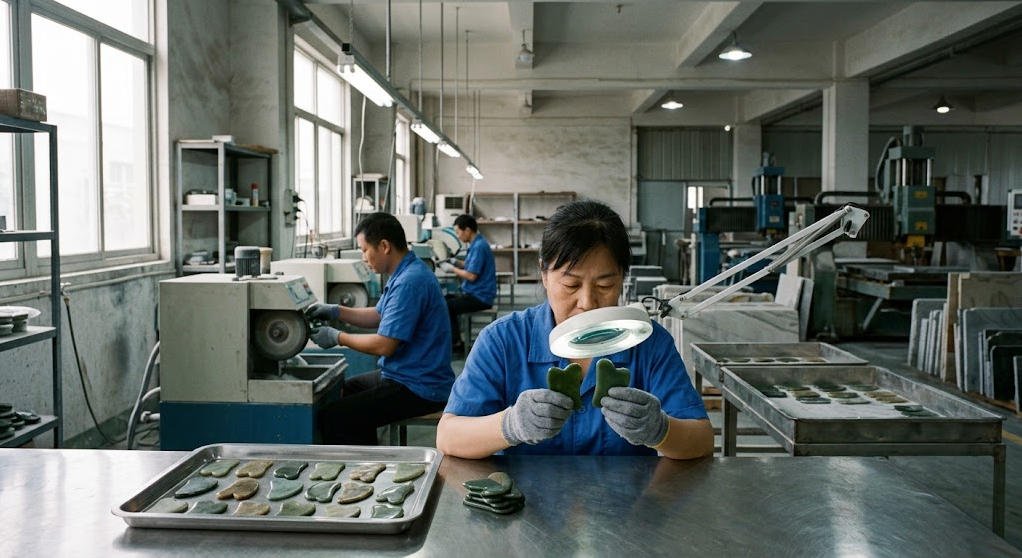
A responsible gua sha manufacturer does not rely on one inspection at the end of the line. Checks happen at every stage instead: incoming raw material inspection, first-article confirmation before a run begins, small-batch verification, in-process quality checks during production, batch-level sampling, and a final outgoing check before packing. Each checkpoint exists to catch a problem before it multiplies downstream, rather than after. This means you can request a process-control report alongside your shipment, showing where and when each checkpoint occurred, instead of relying on a single final certificate that only proves the last sampled batch happened to pass.
Ask your gua sha manufacturer a direct question: what share of defects are caught before final inspection, versus at it? A gua sha manufacturer who cannot answer that with real numbers is telling you, indirectly, that process control does not exist on their line yet, whatever their sales materials claim. A gua sha manufacturer willing to show you this number without hesitation is rare enough to be worth noting when you find one.
Why Not Every Step in a Gua Sha Factory Should Run at the Same Speed
Where a Gua Sha Manufacturer Should Slow Down on Purpose
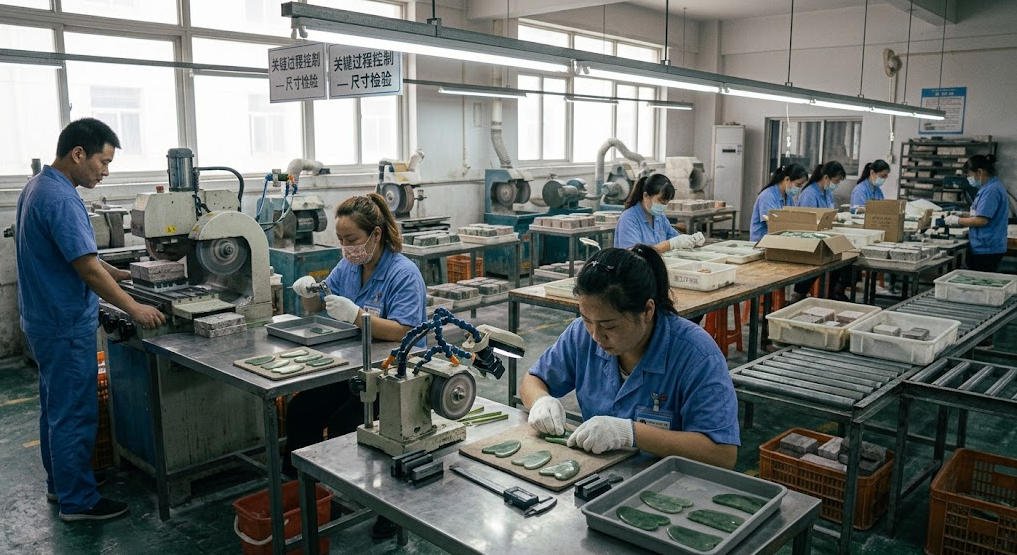
Not every station in a gua sha factory carries the same risk, and treating them identically wastes money in both directions. Rough-cutting a crystal blank, CNC shaping, drilling, thin-edge forming, precision beveling, and high-gloss polishing are all high-risk operations. Pushed too fast, these stages produce chipped edges, internal micro-cracks, dimensional drift, or surface burn from excess friction heat. Durability research published by the Gemological Institute of America explains gemstone durability as a function of hardness, toughness, and stability together, not hardness alone — which is exactly why a stone that seems hard enough to cut quickly can still crack under an aggressive feed rate, as GIA’s own materials describe.
A gua sha manufacturer who protects stability at these specific stations, even at a slower per-piece time, is protecting your finished-goods yield rather than padding a daily production report. This means you should expect a longer quoted cycle time for cutting and polishing specifically, and that extra time is often the reason your finished pieces arrive without the hairline cracks that only surface after a customer starts using the tool at home. This is precisely the discipline that separates a careful gua sha manufacturer from one simply chasing a faster quote.
Where Standardization Buys You Real Time
Other stations behave differently. Rough grinding, washing, basic shape trimming, labeling, and bagging are repetitive and considerably more forgiving of speed. These are the stations where automation, jigs, standard operating procedures, and multi-station parallel processing genuinely speed up gua sha production without adding risk to the finished piece. The same logic applies to inspection itself: quality control does not need to measure every single piece with identical precision instruments. A workable structure runs full inspection on the first article, sampling during the run, focused checking on the dimensions that matter most, and a final sampling pass before shipment. This keeps quality control from becoming the bottleneck of the entire line while still catching problems early enough to matter. None of this lowers the gua sha quality bar; it simply moves effort to where it earns the most return.
The Natural Stone Risk Most Buyers Never See Coming
Grading Questions Worth Asking Your Gua Sha Manufacturer
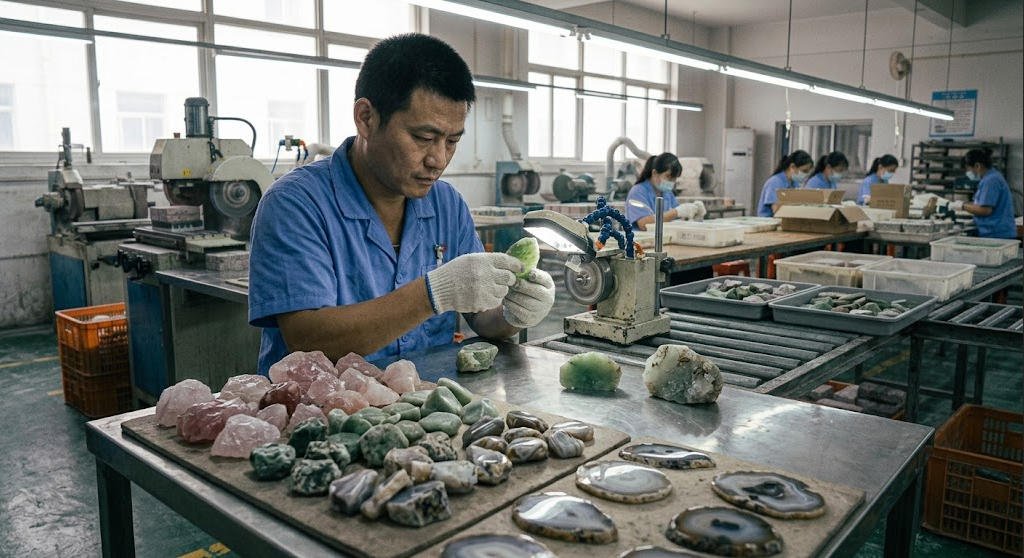
For natural crystal, jade, and agate products, a large share of efficiency loss has nothing to do with machines at all. It comes from raw material variation. A batch of rose quartz or jade with consistent color and few internal fractures runs through cutting and polishing with minimal loss. A batch with heavy fracturing, black inclusions, cotton, color banding, or structural inconsistency creates repeated scrap at cutting, again at shaping, and again after polishing when hidden flaws finally surface under a mirror finish. The International Gem Society notes that mineral hardness measures scratch resistance only, not overall toughness against impact, which is exactly why two pieces of the same stone type can behave very differently under identical cutting pressure depending on their internal structure, a distinction IGS documents in detail. This means you should ask your gua sha manufacturer how raw material is graded and sorted before cutting begins, not only what polish grade the finished piece carries, because upstream sorting often has more influence on your final defect rate than any single machine setting downstream.
Material sorting is, in practical terms, a skill rather than a machine setting. A gua sha manufacturer who spends time pre-sorting rough material by clarity, color band, and crack density before cutting will show a measurably lower scrap rate than one who cuts first and sorts problems out later.
Independent gemological laboratories exist for close to the same reason sorting matters on a factory floor. The Swiss Gemmological Institute, for example, has spent decades refining methods for verifying origin and treatment history in colored stones, precisely because visual grading alone leaves real room for disagreement between two honest observers looking at the same piece, as SSEF’s own testing history documents. A gua sha manufacturer sourcing rough material through unverified channels is quietly passing that same ambiguity on to you, several steps removed from where the stone was actually cut and long before it reaches your warehouse. The most reliable way to check is to simply ask your gua sha manufacturer which grading references its sorting staff are trained against, and whether that reference has been updated recently. If a gua sha manufacturer cannot describe their sorting process in specific terms, that gap is itself useful information about how consistent your next reorder is likely to be, and it costs you nothing to ask before you commit to a deposit. Sorting rough material well is, in the end, a gua sha quality decision made before a single cut happens. Ask any gua sha manufacturer directly how sorting is done on their floor, and listen closely to how specific the answer turns out to be.
The Golden Sample: Your Real Protection Against Quality Disputes
What a Responsible Gua Sha Manufacturer Puts in Writing Before You Order
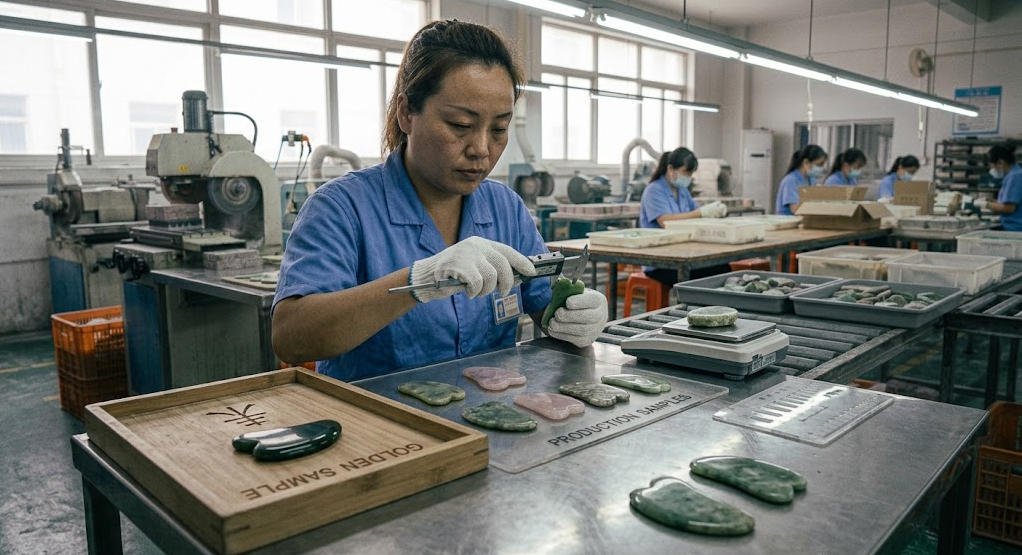
The phrase “premium rose quartz gua sha” means almost nothing inside a purchase contract, because a factory and a buyer can read that phrase in two entirely different ways once goods are already made. A written Golden Sample removes that ambiguity before production starts. It should specify exact dimension, thickness, and weight ranges; edge shape and profile; polish grade; the specific fractures and inclusions that are acceptable versus rejected; color range and texture variation; logo placement and engraving depth; and defined surface-defect limits. A gua sha manufacturer who insists on building this document with you before production begins is not adding a bureaucratic step — they are removing the single largest source of dispute in natural stone manufacturing, which is disagreement over what “acceptable” means once the product already exists. In short, the sample is where gua sha quality gets defined in numbers instead of adjectives.
This matters more than it sounds, because the real cost of vague standards is not the disagreement itself but the time it consumes on both sides. When acceptance criteria stay unclear, a gua sha manufacturer and a buyer can spend more hours arguing over borderline pieces than the factory spent producing them in the first place. Clear standards do not slow production down; they remove the argument entirely, which is why a properly built Golden Sample often shortens total order time even though it adds one extra step at the very start. This means you can treat a Golden Sample not as paperwork, but as the fastest route to a shipment you will not need to renegotiate after it lands at your warehouse. A gua sha manufacturer that resists writing this down before production is one worth asking why, before a deposit changes hands.
Keep a copy of the Golden Sample on your own side of the transaction, not only on the factory’s file server where it can be revised without your knowledge. When a shipment arrives and a handful of pieces sit near a boundary — a color slightly outside the stated range, a fracture slightly larger than the reference photo shows — the sample becomes the reference both sides consult before anyone raises their voice over email. That turns a subjective argument into a side-by-side comparison, which is normally resolved in minutes rather than the days a vague complaint can otherwise take to settle.
Why a Sudden Full-Speed Start Puts Your Bulk Order at Risk
The Three-Stage Release a Gua Sha Manufacturer Should Offer You
Running a new order at full volume from day one is one of the more common mistakes in gua sha wholesale production, and it is almost always made under deadline pressure rather than by deliberate choice. A more reliable approach releases volume in three stages. First, a small first-article run of roughly 10 to 50 pieces checks dimensions, shape, thickness, hole position, edge condition, polish, logo placement, and packaging fit before anything else moves forward. Second, a small batch of 100 to 300 pieces confirms that equipment and material behave consistently across a longer continuous run, not just across a handful of hand-picked samples. Third, full production begins only once yield rate, equipment settings, raw material behavior, and worker technique have all proven stable across those first two stages.
You are trading a short delay at the very start for a large reduction in risk across the full batch, and on any order above a few hundred units, that trade is almost always worth making. Would you rather lose two days at the start of a run, or lose two thousand pieces somewhere in the middle of it? A gua sha manufacturer who skips this staged release is gambling with your inventory, not just their own line. Every gua sha factory feels deadline pressure differently, but the ones worth ordering from resist cutting the ramp-up short even when a client is pushing for an earlier ship date.
The Compliance Risk of Redefining “Acceptable” to Hit a Deadline
There is a shortcut some factories take under schedule pressure: quietly loosening an inspection standard instead of fixing the process causing the defect in the first place. An edge specification that originally required no visible chipping gets revised to allow minor chipping so the yield number improves and the shipping date holds. Short term, this raises apparent output. Long term, it raises returns, complaints, and reorders, which typically costs more than the delay it was meant to avoid in the first place. None of that protects gua sha quality; it only postpones the cost of not having it, and it damages long-term gua sha wholesale relationships more than it protects a single shipping date. A shortcut in gua sha production standards rarely stays contained to one order. The standard to fix is the manufacturing process, not the inspection line that measures it.
This is also where regulatory exposure enters the picture for metal-edged or metal-accented tools. Articles intended for prolonged skin contact sold into the European Union fall under REACH Annex XVII, Entry 27, which caps nickel release at 0.5 micrograms per square centimeter per week, tested to method EN 1811, as set out by the European Chemicals Agency. A gua sha manufacturer shipping steel-edged tools into that market without current nickel-release test data on file is not offering you a shortcut on cost; they are quietly shifting a compliance risk onto your business and your brand. A documented quality management system, structured along the lines of the ISO 9001 framework for quality management requirements, is one practical way a factory can show that material testing, supplier qualification, and non-conformance handling are tracked rather than assumed.
Reading the Data Behind Your Order: Where the Real Bottleneck Hides
Why Crystal, Stainless Steel and Resin Can’t Share One Rule
Different materials need different efficiency strategies entirely, and a gua sha factory applying one production model across all of them is not optimizing anything for you. Natural crystal, jade, and agate depend on raw material sorting, yield stability, fracture control, and color consistency far more than on raw cutting speed. Stainless steel depends on CNC or stamping efficiency, tool life, surface finishing, and dimensional consistency, and tolerates automation and higher line speed reasonably well because the input material itself starts out uniform. Plastic and resin components depend on mold efficiency, injection cycle time, cosmetic defect rates, and post-processing, with automation advantages growing larger as order volume grows.
If your order mixes materials — a crystal head paired with a resin handle, for example — you should expect your gua sha manufacturer to quote different cycle times and different inspection intensity for each component. A single blended number across mixed materials usually means one material’s risk was quietly underweighted to make the average look better on paper. A gua sha manufacturer that quotes one flat rate across mixed materials is simplifying its paperwork, not your risk.
What the Station-Level Data From a Gua Sha Manufacturer Should Show
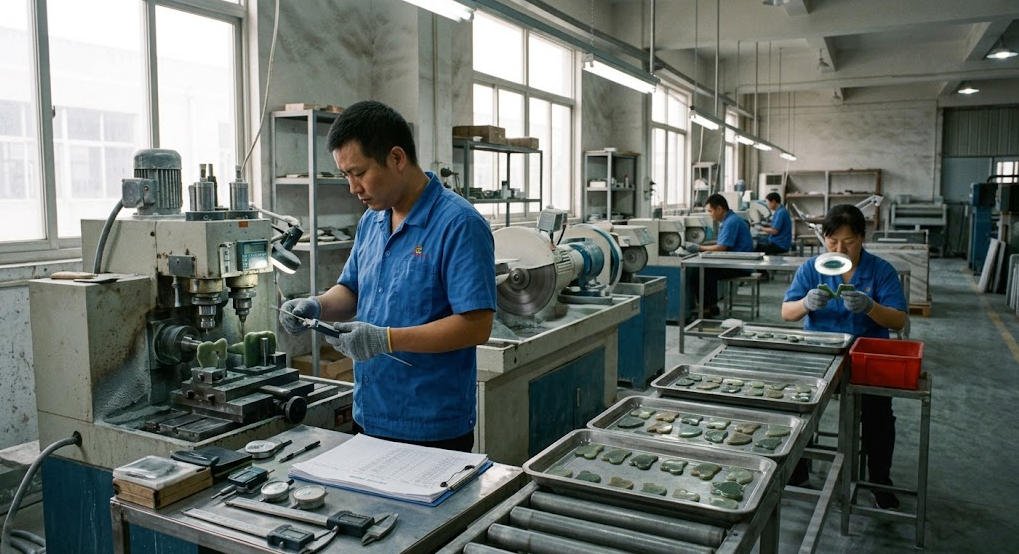
A typical gua sha production line, broken into stations, might show cutting averaging 8 minutes per piece with a 3 percent scrap rate, rough grinding at 5 minutes with 1 percent scrap, CNC shaping at 12 minutes with 4 percent scrap, fine grinding at 8 minutes with 2 percent scrap, polishing at 10 minutes with 5 percent scrap, washing at 3 minutes with roughly 0.5 percent scrap, and final quality control running about 4 minutes per piece. Laid out this way, the numbers tell a story that a single blended efficiency figure hides completely: polishing carries the highest scrap rate on the sheet, but it sits downstream of CNC shaping, the station with the second-highest defect rate and the longest cycle time on the floor.
This means a gua sha manufacturer reading this data correctly would investigate whether CNC shaping is leaving enough consistent material margin for polishing to work with, rather than simply assigning more staff to the polishing station and hoping the scrap rate falls on its own. You should expect this kind of station-level reasoning in any conversation about gua sha quality improvement, not a vague assurance that “we are working on it.”
The Formula a Gua Sha Manufacturer Should Be Able to Show You
Tracking time and defect rate by individual station, rather than for the line as a whole, usually reveals where money is actually being lost. If polishing shows a 5 percent scrap rate on a 10-minute cycle, the intuitive fix is to add polishing staff or slow that station down further. Often the real cause sits one or two stations earlier: if CNC shaping or grinding is not leaving consistent, sufficient material margin, polishing simply inherits a problem it did not create and cannot fix on its own no matter how carefully it is staffed.
This means you can ask your gua sha manufacturer for a station-by-station breakdown of cycle time and defect rate, not one blended efficiency figure, before accepting an explanation for a delay or a price increase on your next purchase order. As a working formula, real production efficiency equals equipment capacity multiplied by first-pass yield, multiplied by material utilization, multiplied by equipment uptime — and a serious gua sha manufacturer should be able to walk you through each of those four numbers for your specific order, not only the finished piece count printed at the bottom of an invoice. Every reputable gua sha manufacturer treats this formula as a working tool on the floor, not a slogan reserved for a homepage.
What a Gua Sha Manufacturer Should Confirm Before You Sign a Wholesale Purchase Order

Before you commit a deposit to any gua sha wholesale order, there are a small number of confirmations worth getting in writing, and none of them require a factory visit to obtain. Ask for the first-pass yield rate on a comparable past order, not an estimate for a future one. Ask whether raw material sorting happens before or after cutting begins, since that single detail predicts a large share of your eventual defect rate on natural stone items. Ask to see the Golden Sample document itself, not only a photograph of a sample piece, since the document is what actually gets referenced when a dispute arises later. Ask how volume will be ramped from first article to full production, and get the batch sizes for each stage in writing rather than a general assurance that first articles are always tested.
A gua sha manufacturer that answers these questions specifically, with numbers rather than reassurance, is showing you something a sales brochure cannot: that gua sha quality is measured and managed on their floor, not simply hoped for after the fact. A gua sha manufacturer‘s willingness to share this in writing is itself a signal worth weighing before you compare final pricing. A gua sha factory that treats these questions as unusual, or as a sign of distrust, is telling you something too — usually that the process behind their gua sha production numbers is thinner than the numbers themselves suggest. None of this needs to slow your sourcing process down; it typically takes one additional email exchange, and it is considerably cheaper than discovering the answers only after a gua sha wholesale shipment has already landed and a percentage of it does not meet the standard you thought you had agreed to.
It is also worth tying a portion of payment to inspection milestones rather than releasing full payment against a shipping date alone. A deposit at order confirmation, a second payment once small-batch verification passes, and a final balance after outgoing quality control gives both sides a reason to flag a problem early rather than discovering it after the goods are already loaded on a vessel. This structure costs nothing extra to set up, and it aligns your gua sha manufacturer‘s incentive with your own: get the order right the first time, rather than fast at any cost to the pieces that do not make the cut.
The Bottom Line for Buyers Sourcing From a Gua Sha Manufacturer
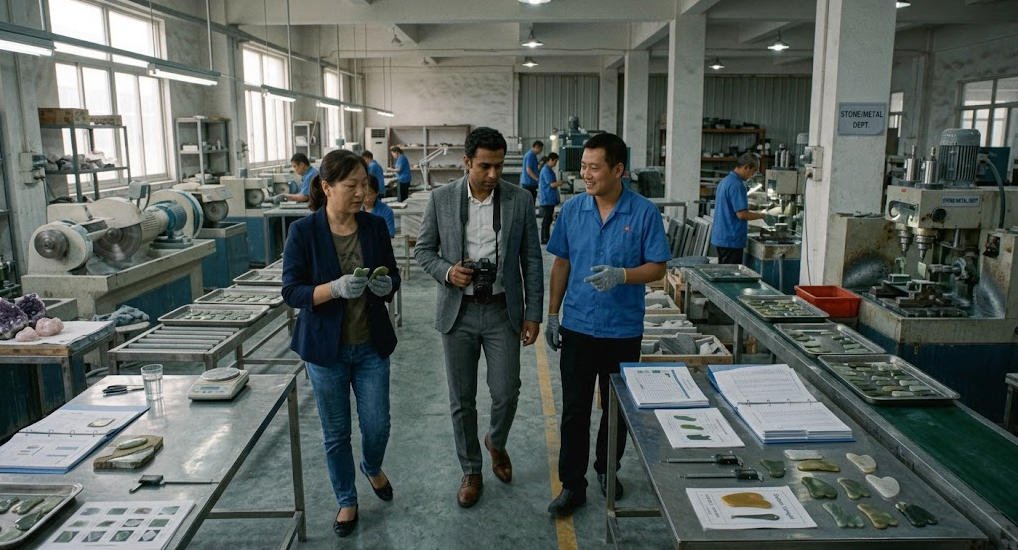
None of this is about finding the factory that quotes the fastest turnaround on paper. It is about finding a gua sha manufacturer willing to show you first-pass yield, process-control checkpoints, raw-material sorting practice, a written Golden Sample, a staged production ramp, and station-level data, rather than a single capacity number attached to a delivery date. Deyi Gems has built its production process around exactly these disclosures across more than twelve years of natural stone and metal gua sha manufacturing, and Deyi Gems would rather walk you through yield data on a call than promise a number that cannot be backed up with evidence.
If your current gua sha factory cannot answer the questions raised in this article with real figures attached, that gap is worth raising before your next gua sha wholesale purchase order is signed, not after the container has already shipped. Independent gemological references from organizations such as the Swiss Gemmological Institute SSEF exist precisely because “trust me” has never been a sufficient standard in stone grading, and it should not be a sufficient standard in gua sha manufacturer selection either.
This kind of disclosure is not standard practice across the industry, and it does not need to become standard for you to benefit from asking for it on your own next order. Your next conversation with any supplier is a reasonable place to start: ask for the four numbers behind the efficiency formula, ask to see a Golden Sample before a deposit is paid, and ask how a new run gets ramped from first article to full volume. A gua sha manufacturer confident in its own numbers will answer without hesitation, and that answer, more than any brochure or certificate, is what should guide your next purchase order.
Gua Sha Production Quality and Efficiency
1. What is the real measure of efficiency for a gua sha manufacturer?
Real efficiency is qualified output divided by total input, not units produced per day. A gua sha factory shipping 8,200 good pieces from 8,500 made outperforms one shipping only 8,000 from 10,000, once rework, scrap, and complaints are counted.
2. Why shouldn’t a gua sha manufacturer rely only on final inspection?
Catching a defect at piece 4,000 instead of piece 50 turns a loss of dozens into thousands. Full process control — raw material checks, first-article confirmation, in-process sampling, and final inspection — catches problems before they multiply downstream.
3. Why does raw material matter more than machine speed in gua sha production?
Crystal, jade, and agate vary in cracks, color, and inclusions batch to batch. Poor sorting causes repeated scrap at cutting and polishing, so improving material selection usually raises gua sha quality more than increasing machine speed does.
4. What is a Golden Sample, and why does it matter for gua sha wholesale orders?
A Golden Sample is a written reference specifying dimensions, polish grade, acceptable cracks, color range, and logo placement. It replaces vague terms like “quality” with measurable standards, preventing disputes once goods are already produced.
5. Should a gua sha manufacturer run a new order at full speed immediately?
No. A staged approach — a 10-50 piece first article, then a 100-300 piece small batch, then full production — confirms stability before committing the full order, trading a short delay for far lower rework risk.