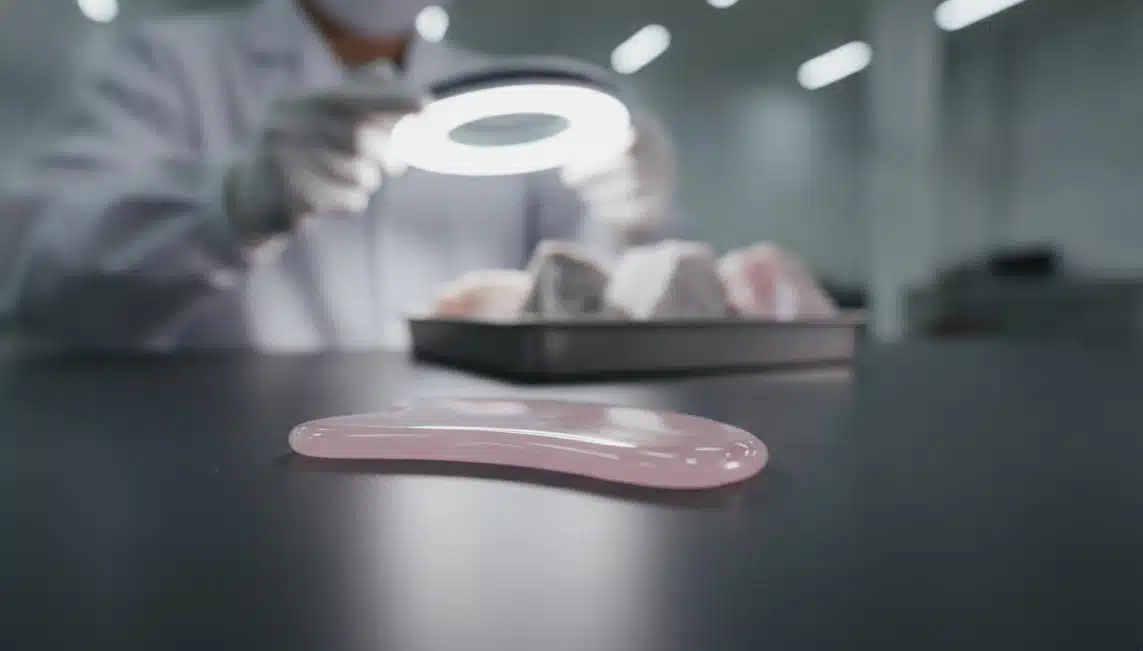
If you have ever placed a gua sha wholesale order only to receive chipped stones, inconsistent finishes, or cracked tools buried inside “compliant” packaging — you already understand why gua sha wholesale qc is not a checkbox exercise. It is the structural backbone that separates a reliable gua sha manufacturer from one that simply quotes low prices. Within the first production cycle alone, a factory running without a three-stage quality system can lose anywhere from 8% to 22% of its raw stone to preventable defects, according to manufacturing audit data routinely cited by industry consultants. That rejection rate does not stay inside the factory — it travels directly into your inventory, your return rate, and your customer reviews.
This article walks you through the three-stage quality control framework that a mature gua sha factory applies across every wholesale batch: IQC (Incoming Quality Control), IPQC (In-Process Quality Control), and OQC (Outgoing Quality Control). You will find specific inspection checklists, AQL standards, packaging protocols, and the exact points in production where defects are caught — or, in weaker operations, missed entirely. Whether you are evaluating a new supplier, auditing a current one, or building sourcing criteria for the first time, understanding gua sha wholesale qc from the inside gives you the leverage to ask the right questions before a shipment goes wrong.
Why QC Looks Different for Natural Stone Products?
Natural stone behaves differently from injection-molded plastic or die-cast metal. When you are sourcing gua sha material — whether that is nephrite jade, rose quartz, bian stone, or obsidian — you are working with a substrate that formed under geological pressure over millions of years. That process creates internal fracture planes, mineral inclusions, and moisture variations that no two blocks share identically. The Gemological Institute of America (GIA) has documented extensively how structural integrity in natural stone varies at the micro-crystal level, which is precisely why surface-level inspection at the finished product stage catches far less than most buyers assume.
A guasha tool manufacturer working with natural stone cannot rely solely on dimensional tolerances. Your quality system must start before a single stone enters the cutting line — and that is exactly where IQC begins.
- IQC: The First Gate Your Gua Sha Material Must Pass Before Production Begins
- IPQC: How a Gua Sha Factory Catches Problems Before They Become Batch-Level Disasters
- OQC: What Happens to Your Gua Sha Wholesale Order in the 48 Hours Before It Ships
- IQC vs. IPQC vs. OQC: A Practical Comparison for Gua Sha Wholesale Buyers
- What the QC Infrastructure of a Mature Gua Sha Manufacturer Actually Looks Like
- FAQs About Gua Sha Wholesale QC and Supplier Evaluation
IQC: The First Gate Your Gua Sha Material Must Pass Before Production Begins
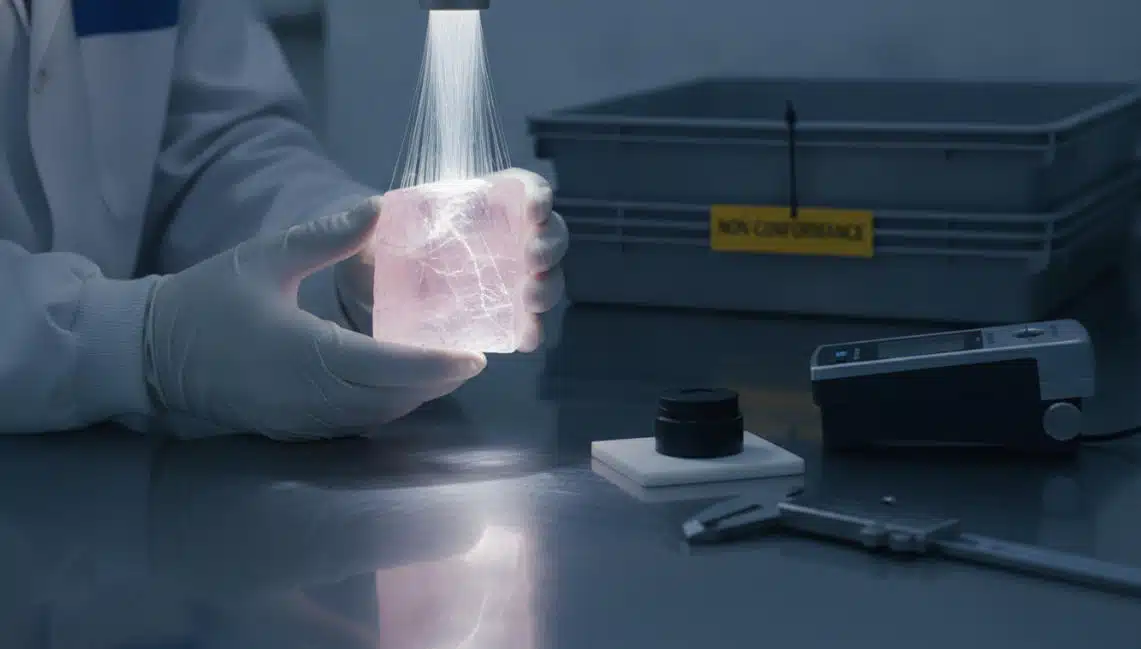
IQC, or Incoming Quality Control, is the inspection process applied to every raw material, semi-finished component, and packaging supply before it enters the production floor. For a gua sha factory, this stage is not administrative formality. It is the most cost-efficient quality intervention available, because defects caught at the raw material stage cost roughly 1x to correct, while the same defect discovered after polishing and engraving costs anywhere from 6x to 14x more to address — and defects found only after shipment can cost 20x or more once you factor in returns, re-shipment, and lost account value.
What a Rigorous Gua Sha Wholesale QC Incoming Inspection Actually Checks
A structured IQC process for gua sha material covers seven distinct inspection dimensions. The first is crack and hidden fracture detection, performed under strong transmitted light using fiber-optic illumination. Natural jade and quartz frequently carry micro-fractures that are invisible under ambient workshop lighting but propagate under mechanical stress during cutting or grinding. The International Gem Society (IGS) notes that internal fractures in gemstone materials can run perpendicular to the visible surface, making them impossible to detect without transmitted light or polarized inspection. You need a gua sha manufacturer who runs this test on every incoming lot, not on a sampled subset.
The second dimension is colorimetric verification. Natural stone batches from the same mine can vary in hue and saturation across individual pieces, and when those pieces end up in a finished product set, the visual inconsistency becomes the first thing your customer notices. A qualified guasha tool manufacturer uses a calibrated colorimeter — not just visual comparison — to verify that incoming stone falls within the agreed color tolerance band documented in the purchase specification.
Additional IQC Parameters That Most Buyers Never Ask About
Beyond cracks and color, a thorough IQC process checks hardness (using a Shore or Mohs-based instrument), moisture content (relevant particularly for porous stones like bian stone, where excess moisture causes surface bloom after polishing), dimensional conformity against drawing specifications (verified by digital caliper), and the print quality and dimensional accuracy of incoming packaging materials. This last point is frequently overlooked. Packaging defects discovered at the IQC stage — misaligned logos, incorrect color on boxes, undersized inserts — can delay an entire production batch by days if they are not caught until the OQC stage.
When incoming material fails any parameter, a disciplined gua sha factory follows a documented rejection workflow: physical quarantine with yellow non-conformance tags, photographic documentation of the defect type and quantity, supplier notification with deviation report, and batch-level traceability logging that feeds into supplier performance scoring. This is not bureaucratic overhead. This means you receive consistent quality lot after lot because your supplier has an accountability loop that creates real consequences for recurring material failures.
IPQC: How a Gua Sha Factory Catches Problems Before They Become Batch-Level Disasters
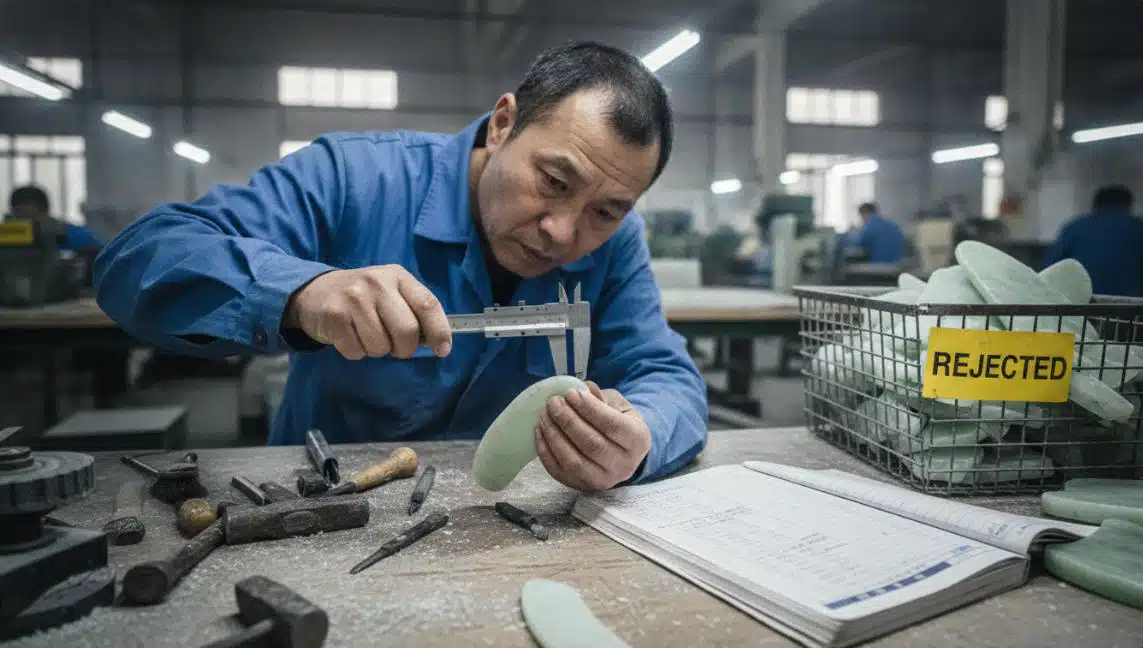
Once raw material clears IQC, it moves into production — and that is where the largest volume of quality risk lives. For a gua sha manufacturer working with natural stone, the production sequence typically spans six to eight major operations: primary cutting, profile shaping, edge grinding, surface polishing, logo engraving, optional electroplating or inlaying, and pre-packaging. Each of these operations introduces its own failure mode, and none of them can be fully controlled by inspecting the finished product. IPQC, or In-Process Quality Control, is the monitoring system that runs alongside production in real time to intercept defects at the operation where they originate.
The First-Piece Confirmation Protocol in Gua Sha Wholesale QC
The most critical IPQC mechanism for gua sha wholesale qc compliance is the first-piece confirmation, also called first-article inspection. Before any production run begins on a new batch, a verified first sample is produced, measured against the approved reference sample, and signed off by a quality engineer before the full run starts. This step sounds obvious, but it is the single most frequently skipped step in lower-tier factories, particularly when operators are under schedule pressure. If the cutting jig has drifted 0.3mm from the last production run, a first-piece check catches it before 5,000 pieces are cut to the wrong dimension. Without it, you may not discover the drift until OQC — at which point the entire batch is a rework or write-off problem.
A guasha tool manufacturer with genuine IPQC infrastructure will be able to show you signed first-piece confirmation records for your specific product, dated to the production start of each batch. If a supplier cannot produce these records during an audit, treat that as a significant risk signal.
Monitoring the Six High-Risk Operations That Define Your Final Product Quality
Cutting and profiling carries the highest fracture risk in the entire production sequence. Natural stone responds to blade pressure with micro-cracking along grain boundaries, particularly in materials like green aventurine or white jade where the crystal structure is directional. A proper IPQC protocol specifies blade speed, water cooling flow rate, and feed pressure for each stone type, and mandates dimensional sampling at defined intervals — typically every 50 to 100 pieces — with results logged against the specification tolerance.
Surface polishing is where cosmetic defects are either eliminated or locked in permanently. Pitting (called “ma dian” in workshop terminology), wave distortion on flat faces, and orange-peel texture in high-gloss finishes are all generated during polishing and are irreversible after the stage completes. A mature gua sha factory conducts polishing-stage inspection under raking light — a low-angle directed light source that reveals surface irregularities invisible under overhead ambient light. Without raking light inspection, pitting defects pass polishing undetected and are only discovered when a customer photographs their product under a ring light and posts the result online.
Logo engraving requires depth consistency and position accuracy within ±0.2mm. If your product carries a brand logo or a healing symbol, the engraving depth must be uniform across all pieces in a batch. Shallow areas of the engraving fill with polishing compound residue and look faded; over-deep areas can weaken the stone at that point. IPQC at the engraving station includes a depth gauge check on sampled pieces and position verification against a positioning template. This means your branded product arrives with consistent, professional-looking engraving that reflects your brand image accurately.
Electroplating and Surface Coating: The Hidden Risk in Gua Sha Wholesale QC
Not all gua sha tools are pure stone. An increasing segment of the market combines natural stone with metal-framed handles, gold-plated trims, or inlaid components — and these elements introduce electroplating quality risk that is separate from stone quality risk. The Swiss Gemmological Institute SSEF has published testing frameworks for coated and composite gem materials that underscore a key principle: adhesion failure in a plated coating is not always visible at the time of shipment. It becomes visible after exposure to moisture, skincare products, and the mechanical friction inherent in gua sha use.
A responsible gua sha manufacturer running IPQC on electroplated components performs adhesion tape tests (cross-hatch adhesion per ISO 2409), salt spray exposure checks on sampled pieces, and coating thickness measurement by X-ray fluorescence or magnetic gauge. If your product includes any plated element, you should ask your gua sha factory to provide IPQC records for these specific tests — not just a general “QC pass” notation. Weak adhesion means your customer experiences peeling within 60 to 90 days of use. That product lifecycle is shorter than a single review cycle on most e-commerce platforms, and the damage to your brand reputation compounds faster than the product cost.
Defect Isolation Management: How Good Factories Contain Damage During Production
One of the clearest markers of a mature gua sha wholesale qc system is how a factory handles non-conforming product discovered mid-production. In a weak system, defective pieces are set aside informally, sometimes re-entered into the flow later by mistake, or counted against the acceptable quantity in a way that is opaque to the buyer. In a mature system, every non-conforming piece is physically tagged with a red or yellow non-conformance label, moved to a designated quarantine area, logged with defect type and quantity, and held for disposition review before any decision is made about rework, downgrade, or scrap.
This discipline has a direct impact on your order. A guasha tool manufacturer with documented defect isolation management can tell you exactly how many pieces from your batch were quarantined, what defect was found, how it was resolved, and whether the resolution was rework or replacement. Without this system, you are relying on the factory’s verbal assurance that everything in your shipped quantity is conforming — and verbal assurances do not protect you when a customer dispute arrives.
OQC: What Happens to Your Gua Sha Wholesale Order in the 48 Hours Before It Ships
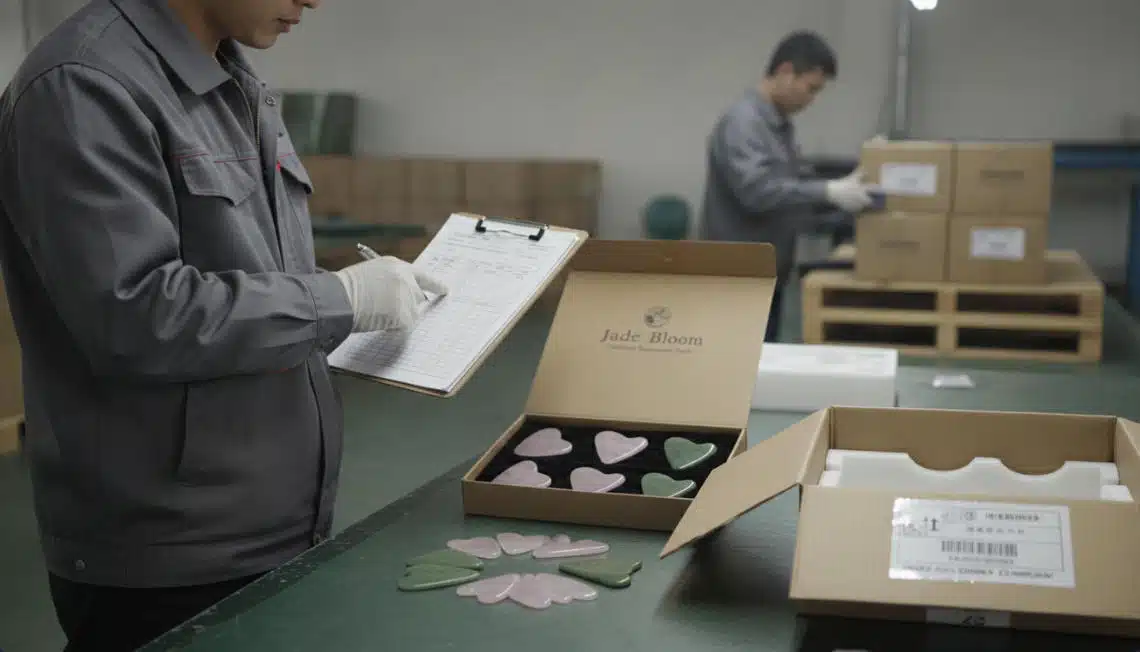
OQC, or Outgoing Quality Control, is the final structured quality gate before your order leaves the gua sha factory. It is also the inspection that most buyers picture when they think about “factory QC” — but if IQC and IPQC have been executed properly, OQC should largely confirm what those earlier stages already established, rather than serving as the primary defect-discovery mechanism. A factory that relies on OQC as its main quality filter is running a fundamentally reactive system, and the costs of that reaction are passed to you in the form of late discoveries, last-minute rework delays, and shipments that arrive at your warehouse with quality variation you did not expect.
Understanding AQL Standards in Gua Sha Wholesale QC
AQL stands for Acceptable Quality Limit, and it is the international sampling standard that governs how OQC inspections are structured. The most widely referenced framework is ISO 2859-1, which defines the relationship between lot size, inspection level, sample size, and the maximum number of defects that may be found before a lot is rejected. For gua sha wholesale qc purposes, most professional buyers specify AQL 2.5 for major defects (those that affect function or appearance significantly) and AQL 4.0 for minor defects (those that are cosmetically minor and unlikely to generate customer complaints).
What does this mean in practical terms? For a batch of 3,200 pieces, an AQL 2.5 inspection at General Inspection Level II requires a sample of 125 pieces. If more than 7 major defects are found in that sample, the entire batch is rejected and returned to the production floor. If your gua sha manufacturer cannot articulate the AQL level they apply and cannot produce the inspection sampling records to prove it, you are not receiving AQL-standard OQC. You are receiving a subjective visual walkthrough that provides no statistical basis for lot acceptance.
The Four Dimensions of a Complete OQC Check for Gua Sha Material
A complete OQC inspection for finished gua sha tools covers four structured areas. The first is appearance inspection, conducted under standardized lighting at a defined distance. Inspectors check for chipping (especially on the working edges that contact skin), pitting, polishing inconsistency, logo engraving quality, surface scratches introduced during packaging, and color conformity against the approved color limit sample. Every defect found is classified by type and severity using the factory’s defect classification guide — which in a mature gua sha factory is maintained as a photographic reference library rather than a text description.
The second dimension is dimensional verification. Even after IPQC dimensional sampling during production, a statistical sample of finished pieces is re-measured at OQC to confirm that downstream operations (particularly packaging, which can apply mechanical pressure to delicate profiles) have not introduced deformation. For curved gua sha profiles, the radius at the working edge is the critical measurement, since edge radius directly affects the pressure distribution during use — a point validated by ergonomic tool research, including work cited in therapeutic massage and myofascial release literature.
The third dimension is packaging inspection. This means verifying that inner cushioning meets the drop-test and compression-test specifications documented in the packaging standard, that product-to-package fit prevents movement during transit, that outer carton markings are accurate and legible, and that each unit’s label information — including material declaration and country of origin — is correct. Mislabeled country of origin on imported products is a compliance risk that can result in customs seizure or penalty in regulated markets. This means your shipment clears customs cleanly and reaches your customer without administrative delays.
The fourth dimension is functional testing. For gua sha material tools, this means edge smoothness verification (no burrs or micro-sharpness that could cause skin abrasion), surface coating adhesion check on any plated elements, and a final tactile check of the tool’s balance and grip comfort. These tests take fewer than 90 seconds per piece but are frequently omitted in factories that are rushing to meet shipping deadlines.
IQC vs. IPQC vs. OQC: A Practical Comparison for Gua Sha Wholesale Buyers
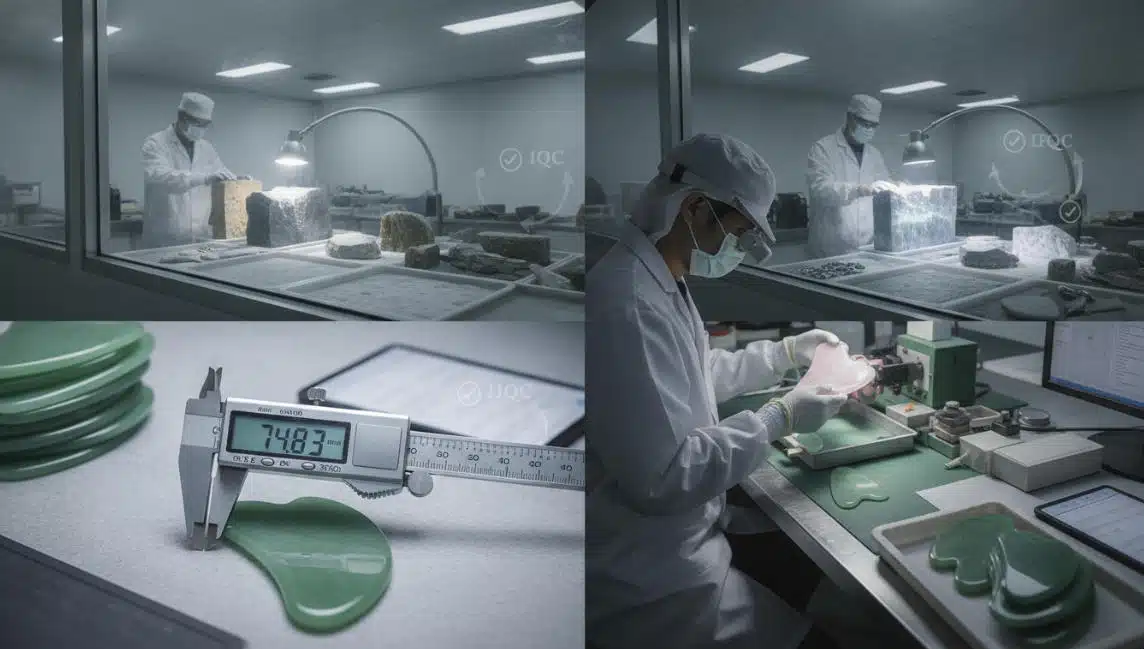
Understanding the three stages individually is useful. Understanding how they interact — and what happens when one stage is weak — is what allows you to evaluate a supplier’s quality system with precision. The table below summarizes the key differences, but the more important insight is this: the three stages are not interchangeable, and they do not compensate for each other. A strong OQC cannot recover the losses created by a failed IQC. A rigorous IPQC cannot correct a defect that was already present in the incoming gua sha material before production began.
IQC controls the quality of inputs, operating before production and catching defects that, if missed, propagate through every subsequent operation. IPQC controls process stability, operating in real time during production and catching deviations while they are still localized to a single operation rather than embedded in a finished product. OQC controls the quality of outputs, operating after production is complete and providing a statistical basis for lot-acceptance decisions before goods transfer to the buyer. Together, these three stages form a sequential risk-reduction system where each stage assumes the previous one has been executed. A gua sha factory that runs only OQC has collapsed a three-stage system into one stage — and the defect rates visible at that final gate will reflect the compounded risk of the two missing upstream stages.
Why Gua Sha Wholesale QC Demands More Than Standard Consumer Goods Inspection
Most wholesale goods categories — apparel, electronics accessories, household goods — tolerate a degree of batch variation that the gua sha material category structurally cannot. There are four reasons for this, and each one increases the cost of a quality failure disproportionately.
First, natural stone is irreversibly fragile. A textile can be re-dyed; a plastic component can be re-molded; a cracked jade stone is scrap. There is no rework path for a fracture in a finished gua sha material tool. This means the economics of defect detection are heavily skewed toward early intervention — which is precisely the economic logic behind IQC.
Second, the production process for gua sha tools is heavily manual. Cutting, grinding, polishing, and engraving are all performed by skilled craftspeople, not automated machinery. Human process variation is continuous, not occasional, and it cannot be controlled by a single end-of-line check. IPQC is the only mechanism that tracks process drift as it occurs rather than after it has accumulated across thousands of pieces.
Third, gua sha tools contact skin directly during use, often with applied pressure and in conjunction with facial oils and serums. The safety standard for surface finish is therefore not aesthetic — it is functional. A surface with micro-burrs or residual grinding media can cause skin irritation, microtearing, or sensitization reactions. A serious guasha tool manufacturer tests surface finish not just for appearance but for tactile safety, using both visual tools and fingertip verification against a reference sample.
Fourth, cross-border shipping subjects natural stone products to vibration, temperature cycling, and static pressure stresses that composites and polymers handle more easily. A packaging standard that protects injection-molded plastic may be wholly inadequate for nephrite jade. An OQC protocol for gua sha wholesale orders that does not include drop simulation and compression testing is not validating real-world transit survival — it is approving packaging that looks correct on the inspection table but has not been tested under field conditions.
What the QC Infrastructure of a Mature Gua Sha Manufacturer Actually Looks Like

A quality system is not just a checklist. It is a combination of documented standards, physical infrastructure, trained personnel, and data management that collectively make quality reproducible rather than accidental. When you visit or audit a gua sha factory, the quality infrastructure you should expect to see — and ask to review — falls into three categories.
SOP, SIP, and AQL Documentation: The Written Foundation of Gua Sha Wholesale QC
Standard Operating Procedures (SOPs) define how each production operation is performed. Inspection and Test Plans (ITPs) or Standard Inspection Procedures (SIPs) define how each quality check is performed — what tool is used, what measurement is taken, what the acceptance criteria are, and how the result is recorded. AQL sampling plans define the statistical framework for lot-level accept/reject decisions. A gua sha manufacturer with a complete documentation system should be able to hand you a binder — physical or digital — covering all three document types for your product category.
These documents serve a purpose beyond internal quality management. They are the evidence base for your own due diligence as a buyer. When you receive a shipment that does not conform to specification, your first question is whether the factory’s inspection records show that the defect was present at the time of OQC or whether it was caused by transit. Documented inspection records, keyed to the batch number of your shipment, make that determination possible. Without records, every dispute becomes a word-against-word negotiation.
The Defect Reference Library: How a Gua Sha Factory Trains Consistent Inspection
One of the practical differences between a quality system that functions and one that looks good on paper is the defect reference library. This is a physical or digital collection of images and samples showing the boundary between acceptable and rejectable for each defect type. For gua sha material products, a well-built defect library covers: edge chipping (with size threshold photography at 0.5mm, 1mm, and 2mm chip sizes), surface pitting under two lighting conditions, polishing wave distortion, engraving depth inconsistency, color deviation from the limit sample, and packaging damage classifications.
Without a reference library, “acceptable” and “rejectable” are defined differently by each inspector on each shift — which means your quality level varies with personnel rotation. With a reference library, every inspector applies the same standard, and disputes between inspector and production supervisor are resolved by reference to documented evidence rather than subjective argument. You receive consistent product quality regardless of which inspector was on shift the day your batch was checked.
Batch Traceability: The System That Protects You After Delivery
A batch traceability system assigns a unique identifier to each production lot that links raw material lot numbers, production dates, machine/operator records, IPQC sampling results, and OQC inspection findings to a single traceable record. For gua sha wholesale qc purposes, this means that if you receive a quality complaint from a downstream customer two months after delivery, you can work with your guasha tool manufacturer to identify whether the defect originated in a specific raw material lot, a specific production shift, or a specific packaging batch — and take targeted corrective action rather than conducting a blanket re-inspection of your entire inventory.
Batch traceability also protects you in regulated markets. The European Union’s General Product Safety Regulation (GPSR), which came fully into force in December 2024, requires economic operators to maintain product traceability information and make it available to market surveillance authorities on request. A gua sha factory without a batch traceability system cannot support your compliance obligations in the EU market — which means sourcing from such a factory creates a regulatory liability that extends beyond product quality into legal exposure.
FAQs About Gua Sha Wholesale QC and Supplier Evaluation
1. What AQL level should I specify for my gua sha wholesale orders?
For most gua sha wholesale programs targeting retail or professional spa markets, AQL 2.5 for major defects and AQL 4.0 for minor defects at General Inspection Level II is the standard specification. If your product is positioned at the premium end of the market — particularly if it carries a personal brand, is sold at high unit prices, or goes directly to professional practitioners — you may want to tighten major defect AQL to 1.5. A reliable gua sha manufacturer will not resist tighter AQL specifications; they will simply adjust their OQC sample size accordingly and price that additional labor into the unit cost transparently. A factory that pushes back against your AQL specification without offering a specific reason is signaling that their current reject rate would not survive the tighter standard.
2. Can I send a third-party inspector to the gua sha factory for pre-shipment inspection?
Yes, and if you are placing an order of more than 500 units with a new gua sha manufacturer for the first time, you should consider doing so. Third-party inspection services such as QIMA, Bureau Veritas, and SGS offer pre-shipment inspection (PSI) against your AQL specification, typically with a 24-to-48-hour turnaround from the day of inspection to report delivery. The cost is generally USD 250 to USD 350 per man-day. Against the risk of receiving a full batch of substandard gua sha material tools and the cost of returns, reshipment, and lost business, that investment has a clear positive ROI for any order value above approximately USD 3,000. Your gua sha factory should facilitate third-party inspection access without friction. If gaining access to your own production batch for inspection requires unusual negotiation, that is a significant operational red flag.
3. How does gua sha wholesale qc apply differently to different stone types?
Different gua sha material types carry different risk profiles, and a knowledgeable guasha tool manufacturer calibrates their IQC and IPQC parameters accordingly. Nephrite jade has high toughness but is susceptible to color variation and hidden veining that is invisible until the stone is cut. Rose quartz fractures along cleavage planes that run at predictable angles, making orientation-based cutting an IQC-stage concern. Bian stone (also known as泗滨砸石) is a microcrystalline mudstone with relatively high moisture absorption, making moisture content testing at IQC a critical parameter that softer stones do not require. Obsidian is volcanic glass with conchoidal fracture behavior — it can split along any plane under mechanical stress, which elevates IPQC monitoring requirements at the cutting and grinding stages. The GIA’s reference materials on gemstone properties provide detailed physical property data for each of these materials, including toughness, cleavage, and fracture characteristics that directly inform QC protocol design.
4. What should be in a QC report that a gua sha manufacturer provides with my shipment?
A complete OQC report for a gua sha wholesale batch should include: the batch or production order number, the inspection date, the inspector’s name or ID, the lot size and sample size inspected, the AQL level applied, a breakdown of defects found by type and classification (major/minor), the accept/reject decision, and photographic documentation of any defects found in the sample. It should also reference the version of the inspection standard used (for example, “inspected per ITP-GS-03 Rev 2”). An OQC report that contains only a single line such as “inspected and approved” with a stamp provides no usable information and offers no basis for dispute resolution. You should specify in your purchase order what the OQC report must contain, and confirm that the factory’s format meets that specification before production begins.
Risk Disclosure and Industry Context
The quality control standards described in this article represent practices implemented by serious manufacturers operating in the gua sha wholesale supply chain. However, buyers should be aware of several structural realities that affect quality outcomes regardless of supplier quality system maturity.
Natural stone is a geological product, and its variability cannot be entirely eliminated by any manufacturing quality system. Even with full IQC, IPQC, and OQC implementation, a small percentage of pieces in any large batch may carry latent defects — particularly micro-fractures — that only become visible after mechanical stress during shipping or use. A responsible gua sha manufacturer will document this inherent material risk in their product specifications and offer clear policies for defect claims that arise after delivery.
Quality system documentation, including SOPs, inspection records, and AQL reports, is only as reliable as the organizational culture that produces it. Document audits should be supplemented by production floor observation wherever possible. If you cannot visit the gua sha factory in person, third-party inspection provides the closest available alternative. Online platform certifications and self-reported quality data are useful signals but are not substitutes for independent verification.
The regulatory environment for imported natural stone personal care products is evolving. Markets including the United States, European Union, United Kingdom, and Australia have each implemented or are implementing product safety frameworks that impose traceability, labeling, and conformity documentation requirements on importers. Staying current with these requirements is the importer’s responsibility — your guasha tool manufacturer can support your compliance efforts, but cannot assume your regulatory obligations. Resources such as the EU Product Safety Database and the U.S. Consumer Product Safety Commission provide current regulatory reference material for the markets most relevant to gua sha wholesale importers.