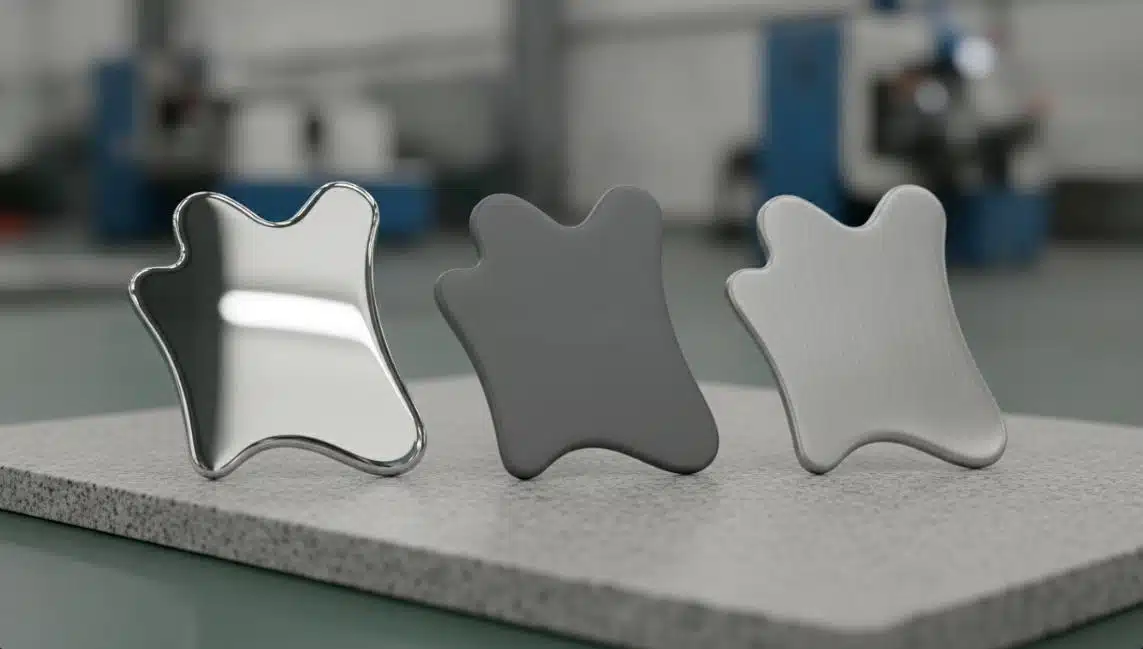
If you’ve ever received a batch of stainless steel gua sha tools that looked stunning in the sample but arrived dull, scratched, or inconsistent at scale — you already know that surface finish is not a cosmetic detail. It is a manufacturing variable that directly determines your return rate, your brand perception, and your margin. As a stainless steel gua sha manufacturer operating for over 12 years, Deyi Gems has processed hundreds of thousands of units across three primary finish categories: mirror polish, matte finish, and brushed effect. The data is clear — the wrong finish choice for the wrong brand increases customer complaints by up to 40% and drives reorder rates down by nearly a third.
This article is written as an industry experience and risk disclosure guide, not a sales pitch. You deserve to understand not just what each finish looks like, but what can go wrong, what it costs, and what it means for your specific brand positioning before you commit to a production run. According to the International Gem Society (IGS), surface integrity directly correlates with perceived product value in wellness and beauty categories — a principle that applies equally to metal tools as it does to gemstones. Whether you’re a SPA brand sourcing your first private-label collection or a beauty corporation scaling an existing SKU, the decisions covered in this guide will affect your product’s shelf life, your end user’s experience, and your ability to compete at a price point that makes sense.
- Why Surface Finish Is a Strategic Manufacturing Decision
- Mirror Polish — The High-Stakes Finish with Unforgiving Standards
- Matte Finish — The Durable Choice and What "Consistent" Actually Costs
- Brushed Finish — The Differentiation Play and the Curvature Problem
- Comparative Cost, Brand Positioning, and How to Qualify Your Manufacturer
- Making the Right Decision — Your Pre-Production Risk Checklist
- FAQs About Stainless Steel Gua Sha Surface Polishing
Why Surface Finish Is a Strategic Manufacturing Decision
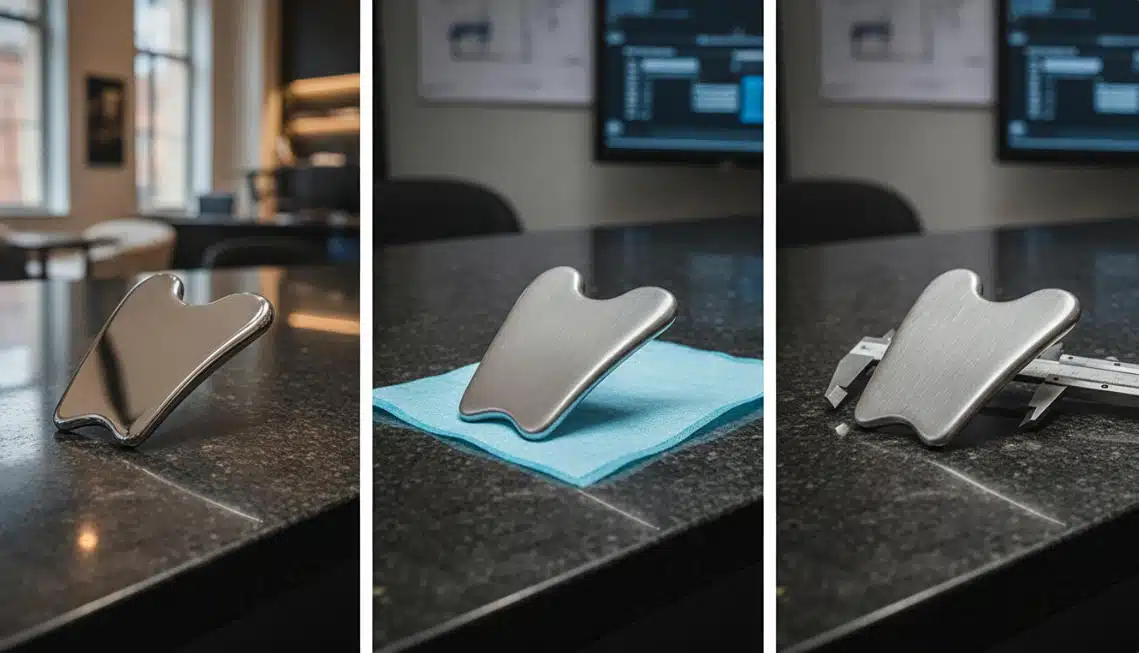
Most buyers treat surface finish as an aesthetic preference — a quick checkbox during the sampling phase. That framing is exactly where cost overruns and quality disasters begin. The finish you select determines which materials are viable, how long your gua sha production cycle takes, what your defect rate will realistically look like at volume, and whether your packaging needs to be upgraded to protect the surface during transit. A mirror-polished tool, for example, requires individual anti-scratch wrapping per unit, which can add $0.15–$0.40 per piece to your landed cost — a figure that compounds fast on a 10,000-unit minimum order.
Your finish decision also directly affects how your product photographs. In an era where product imagery drives e-commerce conversion rates, mirror polish amplifies studio lighting in ways that can look either breathtaking or garish depending on your photographer’s setup. Matte finishes, by contrast, reduce hotspots and produce more consistent results across varying lighting conditions, which is why DTC brands running their own in-house content operations increasingly prefer them. Understanding these downstream consequences is part of what distinguishes a factory relationship from a true gua sha supplier partnership — and it’s the kind of knowledge that only comes from years of managing the full supply chain.
The Three Finish Categories and What They Actually Signal to Your Customer
At the point of sale — whether that’s a physical retail shelf or a product detail page on Amazon — your customer forms a quality judgment in under three seconds. Neuroscience research consistently confirms that visual texture is processed before color, shape, or text in product evaluation contexts. This is not a trivial point. A mirror-polished stainless steel gua sha tool communicates “luxury ritual,” which aligns perfectly with a $65–$120 retail price point and gift-box packaging. A matte-finished tool communicates “professional clinical use,” which resonates with SPA clients and wellness practitioners paying $40–$80 for tools they’ll use daily. A brushed-finish tool communicates “precision engineering,” which is why it dominates the men’s grooming and tech-beauty categories where the buyer distrusts anything that looks overly decorative.
Understanding which signal your brand is trying to send — and whether your current finish choice is sending it — is the first risk assessment every guasha manufacturer should walk you through before production begins. Deyi Gems makes this a mandatory step in every new client onboarding process because the cost of correcting a finish decision after tooling is confirmed averages 18–25% of the total order value. That is a risk you can entirely eliminate with a clear brief upfront.
Mirror Polish — The High-Stakes Finish with Unforgiving Standards
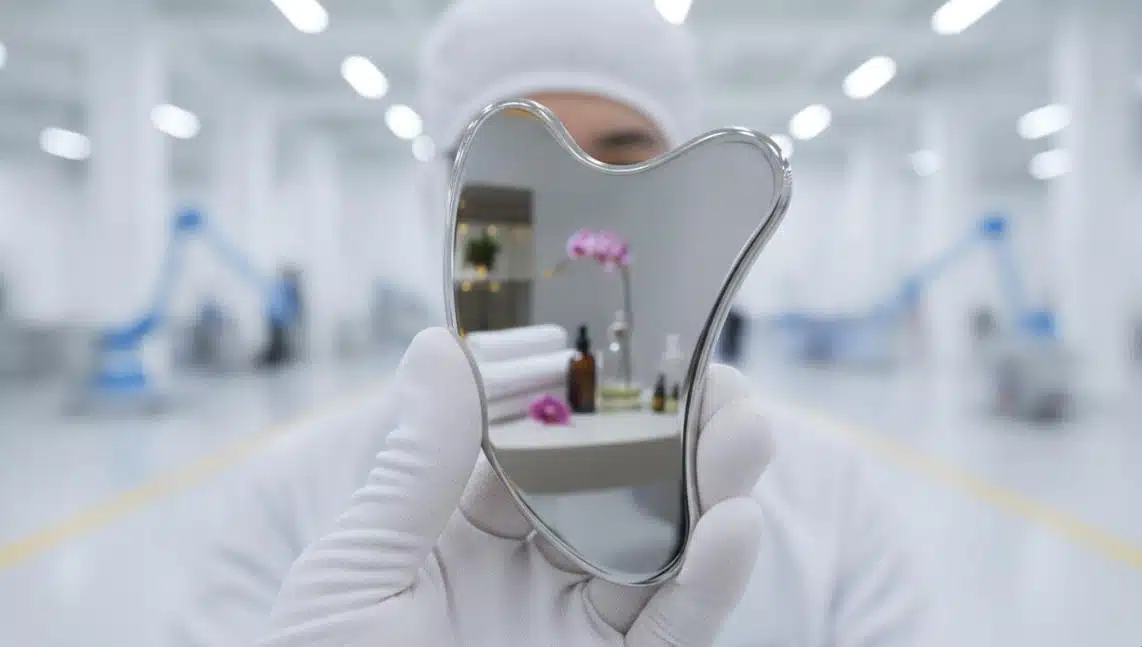
Mirror polish is the most visually dramatic finish available for stainless steel gua sha tools, and it is also the most unforgiving to manufacture at scale. When it works, it works spectacularly — the surface reflects light with the clarity of polished chrome, photographs like a luxury watch, and positions your product unmistakably in the premium tier. When it doesn’t work, the defects are visible to the naked eye from across a room. Scratches that would disappear on a matte surface become prominent grooves on a mirror finish. Fingerprints left during final assembly appear as permanent smears. Edge roundover caused by over-polishing destroys the clean geometry that makes the tool visually distinctive. As a stainless steel gua sha manufacturer, Deyi Gems tracks mirror polish defect rates separately from other finish categories because the quality thresholds — and the consequences of missing them — operate on a completely different scale.
The global luxury wellness market reached $1.1 trillion in 2023 according to the Global Wellness Institute, and mirror-polished metal tools occupy a growing segment of that market. But the commercial opportunity comes with production complexity that not every factory is equipped to manage. Before you specify mirror polish for your next product run, you need to understand exactly what the manufacturing process involves, where failures typically occur, and what that means for your delivery timelines and quality acceptance rates.
The 5 Stage Mirror Polish Manufacturing Process
Achieving a true mirror finish on a stainless steel gua sha tool is not a single-step operation. It is a sequential five-stage process where each stage depends on the previous one being executed within tolerance. At Deyi Gems, our stainless steel gua sha factory processes mirror finish tools through CNC forming, coarse grinding (120# to 400# grit progression), fine grinding (600# to 1200# grit), cloth-wheel mirror buffing with precision polishing compound, and finally electropolishing combined with ultrasonic cleaning. Each stage requires different tooling, different operator skill levels, and different quality checkpoints. Skipping or compressing any stage produces a surface that looks like a mirror under poor lighting but reveals micro-scratches the moment it’s held under direct light — which is exactly how it will look when your customer unboxes it.
The coarse grinding phase, often dismissed as routine, is actually where most mirror polish failures originate. If the 120# grinding leaves cross-hatched scratch patterns that aren’t fully eliminated before moving to 400#, those patterns become invisible at the 600# stage but reappear after buffing as a “ghosting” effect — a faint texture visible only under oblique light. You will not catch this on a factory floor inspection. You will catch it when your customer photographs the product for a social media post. This means your quality control protocol for mirror finish tools must include oblique-lighting inspection as a mandatory checkpoint — something that adds time and cost to gua sha production but eliminates a category of complaints that would otherwise cost far more in returns and brand damage.
The Real Cost of Mirror Polish: Beyond the Unit Price
When a gua sha supplier quotes you a unit price for mirror-polished stainless steel tools, that number typically covers forming, grinding, buffing, and basic cleaning. What it often does not cover — or covers insufficiently — are the upstream and downstream costs that determine your true landed price. Electropolishing, which is the electrochemical process that eliminates microscopic surface irregularities and dramatically improves corrosion resistance, typically adds $0.20–$0.45 per unit depending on tool geometry and order volume. Individual anti-scratch packaging — which is non-negotiable for mirror finish tools if you want to arrive without surface damage — adds another $0.15–$0.40 per unit. White glove final inspection, where operators wearing clean-room gloves check each piece under 1000-lux directional lighting, adds labor cost that scales with your rejection threshold.
A realistic cost modeling exercise for mirror polish versus matte finish on a 5,000-unit order typically reveals a 22–35% total cost premium for mirror, not the 10–15% that many buyers assume based on factory quotes alone. This means your retail price point needs to absorb that premium — or your margin absorbs it instead. What this means for you is that mirror polish makes financial sense when your retail price point is above $55 and your brand positioning explicitly supports a luxury narrative. Below that price point, the cost premium compresses your margin without delivering proportional conversion improvement. The Gemological Institute of America (GIA) has published extensively on the relationship between surface quality and perceived value in premium goods — the correlation is strong, but it is not linear, and there is a threshold below which incremental surface quality stops driving incremental willingness to pay.
What Can Go Wrong with Mirror Polish at Scale
There are four specific risk categories that any responsible stainless steel gua sha manufacturer should disclose before you commit to a mirror polish production run. First is the scratch propagation risk — mirror-polished surfaces accumulate visible scratches faster than any other finish, and once a scratch is present, it cannot be removed without re-polishing the entire surface. Second is the fingerprint contamination risk during final assembly and packing, which requires clean-room protocols that add cost and slow throughput. Third is the edge geometry risk, where aggressive buffing on convex edges can round the tool’s working edges beyond specification, reducing the therapeutic effectiveness of the tool and potentially generating complaints from practitioners who notice the change in feel. Fourth is the batch consistency risk, where mirror finish quality is highly operator-dependent, meaning batch-to-batch variation is larger than with matte or brushed finishes that are more mechanically controlled.
Deyi Gems mitigates these risks through 304/316L stainless steel substrate selection — the 316L grade’s lower carbon content and molybdenum addition produces a more homogeneous microstructure that responds more predictably to polishing — combined with jig-controlled buffing processes that reduce operator variability. You can verify the material science behind this through the SSEF Swiss Gemmological Institute’s published research on metal surface quality on material composition and surface behavior. What this means for you is that selecting the right manufacturing partner — one who discloses these risks upfront and has documented protocols to address them — reduces your defect rate exposure from an industry-average 8–12% for mirror finish down to under 3%.
Matte Finish — The Durable Choice and What “Consistent” Actually Costs
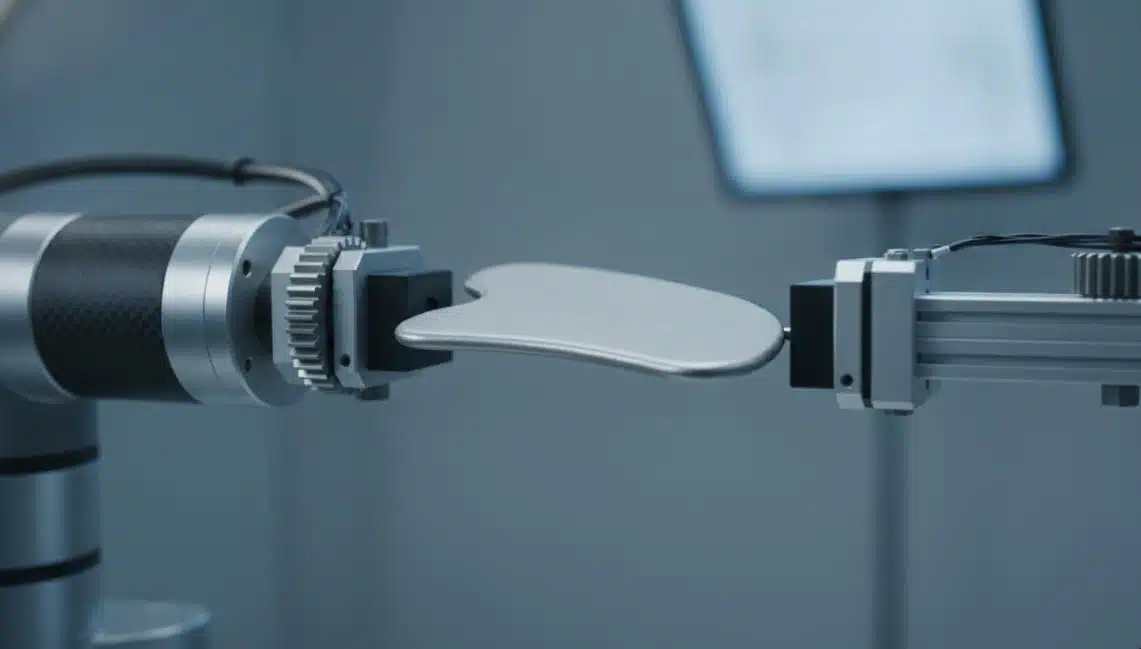
Matte finish has become the default aesthetic of what the industry calls “elevated everyday” — the price tier where tools are expensive enough to feel special but designed to be used daily without anxiety about damaging them. The finish’s growing dominance in SPA, wellness, and Nordic-minimalist beauty brands is not accidental. It is a direct response to a user behavior pattern that mirror-polished tools expose: customers who spend $60 on a mirror-finished gua sha tool often handle it with excessive care, store it in its box instead of using it, and ultimately feel disappointed that a “wellness tool” creates wellness anxiety. Matte finish resolves this. It visually communicates durability, tolerates fingerprints and light contact without showing damage, and photographs consistently across lighting conditions. For brands whose business model depends on repeat use and repeat purchase, matte is structurally the better choice.
The global spa market alone was valued at approximately $119 billion in 2023 according to the Global Wellness Institute, with professional-grade tools representing a growing share of procurement spend. Within that market, the shift toward matte and low-gloss metal finishes in tool procurement has been measurable since 2021 — driven partly by aesthetics and partly by the simple operational reality that matte tools require less careful handling during treatments, reducing breakage and replacement cost for operators. As a stainless steel gua sha manufacturer supplying to both direct-to-consumer brands and professional channel distributors, Deyi Gems has tracked this shift directly in order composition: matte finish requests increased from 28% of new SKU development in 2020 to over 47% in 2024.
3 Manufacturing Methods for Matte Finish — and Why the Choice Matters
Not all matte finishes are created equal, and the manufacturing method used to create the matte surface determines its texture depth, its consistency across complex geometries, and its long-term durability. The three primary methods used in gua sha production are sandblasting, Scotch-Brite mechanical abrading, and chemical etching — each with different cost profiles, different quality characteristics, and different risk exposures. Sandblasting, where high-pressure abrasive media is directed at the surface, produces the most uniform and controllable matte texture on flat or gently curved surfaces. Scotch-Brite mechanical abrading, where abrasive pads are applied under controlled pressure, produces a lighter matte with subtle directionality — often described as a “satin” finish. Chemical etching, where an acid solution is applied to microscopically roughen the surface, produces the most consistent matte across complex 3D geometries but introduces chemical handling requirements and waste disposal considerations that not every factory manages to regulatory standard.
The choice between these three methods should be driven by your tool’s geometry and your market’s expectations, not by which method is cheapest at the factory level. A gua sha supplier who defaults to sandblasting on all matte orders without evaluating the tool’s specific geometry is optimizing for their throughput, not your quality outcomes. For tools with pronounced edge angles — which are characteristic of performance-focused gua sha tools designed for facial contouring — chemical etching typically produces more consistent matte coverage without the edge brightening that sandblasting causes on sharp transitions. Edge brightening, where the matte surface gives way to a semi-gloss effect at convex edges, is the most common cosmetic defect in sandblasted matte tools and one that your end customer will notice immediately on unboxing.
The Hidden Cost Driver: Uniformity Across Complex Surfaces
The core technical challenge in matte finish production is not creating a matte surface — it is creating a matte surface that looks identical across every face, edge, and contour of the tool. Human hands process tactile and visual texture information simultaneously, and non-uniform matte texture — even when subtle — registers as a quality defect at both levels. Achieving uniformity on a flat surface is straightforward. Achieving it on the compound curves and edge geometries typical of gua sha tools is considerably harder, and it is where the quality gap between stainless steel gua sha factory operations becomes most visible.
At Deyi Gems, sandblasting uniformity is controlled through fixture-mounted rotation jigs that ensure consistent media angle and distance across the tool’s entire surface profile during the blast cycle. Without fixturing, operators must manually rotate the part, and the consistency depends entirely on individual technique — which produces batch-to-batch variation that shows up as visual inconsistency in your finished product. Adding proper fixturing to the sandblast process increases per-unit production time by approximately 12–18% but reduces surface uniformity defects by over 60% based on Deyi Gems‘ internal quality data across comparable SKUs processed both ways. What this means for you is that a matte finish quote that seems unusually cheap is almost certainly excluding fixturing — and you will pay for that exclusion in customer returns.
Matte Finish Risk Disclosure: The “Gray Haze” Problem and How to Avoid It
The most persistent quality risk in matte finish production is what manufacturing teams call “gray haze” — an uneven, slightly dirty-looking variation in surface tone that appears across a batch when sandblasting pressure, media size, or exposure time drifts out of specification. Gray haze does not appear on the factory floor under standard inspection lighting. It appears when the product is placed next to a white background — which is exactly what your customer does when they unbox it and place it on their white bathroom shelf. It is not a functional defect, but it reads as one, and it generates returns and negative reviews at a rate that can significantly damage early product launch momentum.
Preventing gray haze requires process monitoring at a level of detail that goes beyond standard quality checks. Specifically, sandblast media must be assessed for contamination and particle size degradation at regular intervals — at the Deyi Gems stainless steel gua sha factory, this happens every four production hours on matte finish lines. Media that has fragmented below specification size produces a finer surface texture that reflects more light, creating the haze effect. Most factories replace media on a time schedule rather than a quality-metric schedule, which is the source of the problem. What this means for you is that when evaluating a guasha manufacturer for matte finish capability, you should specifically ask how they monitor sandblast media condition and at what metric they trigger replacement. If they cannot answer that question specifically, you are looking at a gray haze risk in your production.
Brushed Finish — The Differentiation Play and the Curvature Problem
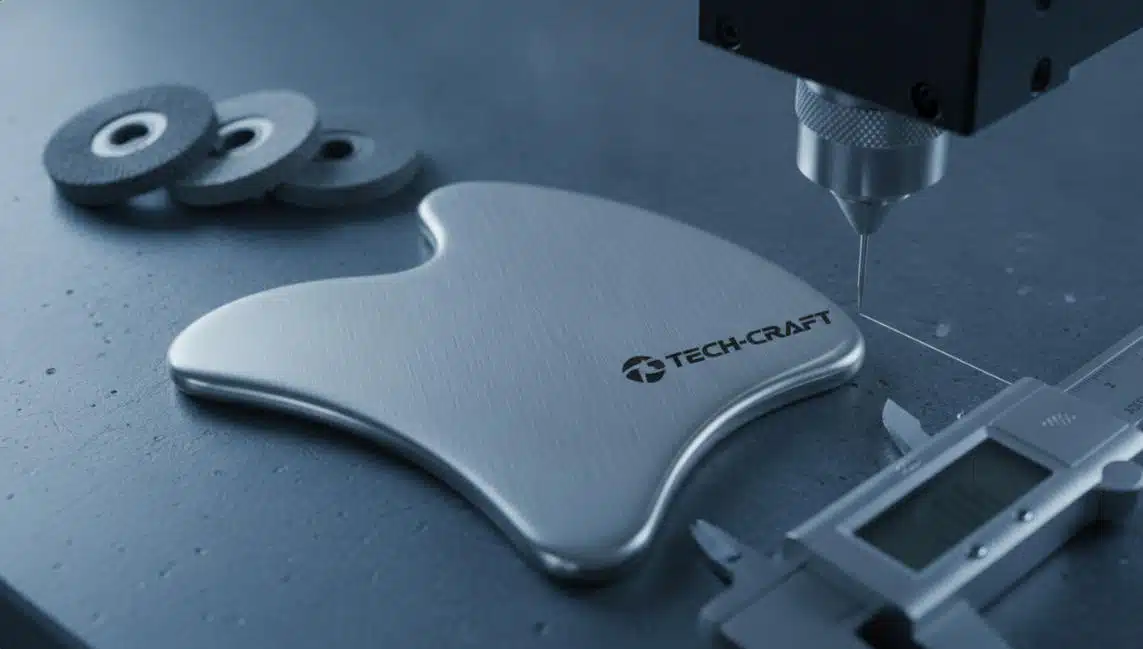
Brushed finish occupies a distinct market space from both mirror and matte — it carries directional texture, which gives it visual movement that static finishes lack, and it communicates precision engineering rather than either luxury or clinical restraint. In practice, this makes brushed finish the natural choice for brands targeting male consumers, technology-adjacent beauty categories, and any brand positioning that wants to emphasize the tool’s mechanical function over its aesthetic ritual. The brushed finish market has grown significantly in the men’s grooming segment, where data from Statista indicates the global men’s personal care market exceeded $182 billion in 2023 and continues expanding at a compound annual growth rate above 6%. Brushed-finish metal tools are a visual language that male consumers already trust from razors, watches, and electronics — extending that language to gua sha tools reduces purchase hesitation in a category that male buyers have historically viewed with skepticism.
For brands serving the tech-beauty or medical aesthetics channel, brushed finish also provides a practical advantage: laser-engraved logos on a brushed background produce the highest contrast and visual clarity of any finish category, because the laser removes the directional texture to create a smooth channel that reads as bright against the matte-directional background. This means your brand identity is more legible on a brushed-finish tool than on either mirror or matte — a genuine functional benefit that translates into better brand recall, which matters when your tool ends up in a professional treatment room alongside competitor products.
The 4 Stage Brushed Finish Process — Where Factories Cut Corners
Producing a consistent brushed finish across a full production run requires four sequential stages: base grinding to remove forming defects, abrasive belt brushing to create the directional grain, nylon wheel finishing to soften grain edges without losing directionality, and finally fingerprint-resistant coating or PVD treatment to seal and protect the texture layer. Every responsible stainless steel gua sha manufacturer will execute all four stages. The stage where cost-cutting factories typically skip or compress is the nylon wheel finishing step — because it adds per-unit time without obviously changing the appearance under factory lighting. What it changes is the tactile quality of the finish and its long-term durability: un-finished brush grain has microscopic burrs at the grain edges that catch and hold oils, skin residue, and cleaning product residue, which degrades the visual appearance of the finish within weeks of regular use. You will not see this in your samples, which are fresh from production. You will see it in your first round of customer reviews, where users report that their tool “looks dirty” after a month of use despite regular cleaning.
At Deyi Gems, the nylon wheel step is non-negotiable on all brushed-finish gua sha production, and it is documented in our quality control checklist as a signed-off checkpoint, not just a process description. The PVD (Physical Vapor Deposition) treatment that follows is equally important — it deposits a thin metallic or ceramic coating at the molecular level that increases surface hardness, improves corrosion resistance, and dramatically reduces fingerprint visibility on brushed surfaces. PVD-treated brushed finish retains its appearance over 3–5 times longer than untreated brushed finish in controlled use testing. This means you can confidently position a PVD-brushed tool as a premium long-term investment, which supports higher price points and reduces the return-driven category of “it doesn’t look as good as the photos” complaints.
Grain Direction Consistency: The Technical Challenge That Separates Factories
The defining visual characteristic of brushed finish — the directional grain — is also its most demanding quality parameter to control. On a flat surface, maintaining consistent grain direction is manageable with properly configured abrasive belt equipment. On the compound curves, ergonomic contours, and mixed-angle surfaces typical of gua sha tool designs, maintaining grain direction consistency becomes a genuinely difficult manufacturing problem. Grain that drifts direction across the face of a tool creates a “swirling” effect that is immediately visible and permanently associated with low manufacturing quality in the consumer’s perception. Correcting a localized grain direction error requires re-processing the entire surface — selective rework is essentially impossible because any new brushing overlaps and visually conflicts with the existing grain.
As a gua sha supplier to brands across price tiers, Deyi Gems addresses the grain direction challenge through two mechanisms: CNC-guided abrasive belt positioning for flat and single-curve surfaces, and trained manual technique with rotation fixtures for complex multi-curve areas. The fixture approach adds approximately 20–25% to the brushing stage labor cost but reduces grain direction non-conformities from approximately 9% of units (free-hand processing) to under 2% (fixture-assisted). What this means for you is that brushed finish is technically demanding enough that sourcing it from a stainless steel gua sha factory without documented fixturing protocols carries a meaningful quality risk — particularly on tools with ergonomic handle curves or multi-angle working faces.
Brushed Finish Risk Disclosure: The Localized Repair Problem
When mirror polish or matte finish defects occur — a scratch, a gray haze patch, an edge inconsistency — there are sometimes corrective options that can salvage an otherwise acceptable unit. With brushed finish, localized repair is essentially not available. Any attempt to re-brush a specific area of a brushed-finish tool produces a grain pattern that does not match the surrounding surface. The grain direction, depth, and texture of a local repair will always be visually distinct from the original brushed surface, even to an untrained observer. This means the defect rate for brushed finish is effectively a rejection-and-scrap rate — units with surface defects must be scrapped entirely, not reworked. As a guasha manufacturer committed to transparent supplier relationships, Deyi Gems discloses this to every client specifying brushed finish, because it affects how you should think about your quality acceptance threshold and your unit cost modeling. A 2% scrap rate on brushed finish has different cost implications than a 2% rework rate on matte finish, and that difference needs to be factored into your order quantity planning.
Comparative Cost, Brand Positioning, and How to Qualify Your Manufacturer

Choosing between mirror polish, matte, and brushed finish is ultimately a decision about where your brand sits in the market, what your customer expects when they open the box, and how much production risk you are willing to absorb in exchange for visual differentiation. The financial dimension of that decision is concrete and quantifiable, and any stainless steel gua sha manufacturer worth working with should be able to walk you through it in detail before you sign a purchase order. What follows is a transparent breakdown of cost relationships, brand positioning guidance, and the qualification checklist you should apply to any gua sha supplier you are evaluating.
The beauty tool industry as a whole is moving toward what analysts at McKinsey & Company have described as “functional luxury” — products that justify premium price points through demonstrated performance rather than pure aesthetic signaling. Surface finish is a key variable in that positioning, because it is the first physical attribute the customer evaluates and the attribute most directly associated with their first impression of the tool’s quality. Getting that first impression right means understanding not just which finish looks best in your mood board, but which finish is most manufacturable to a consistent quality standard at your target cost.
Quantified Cost Comparison Across the Three Finish Categories
On a normalized comparison basis — same tool design, same 316L stainless steel substrate, same order quantity of 3,000–5,000 units — the cost relationship between the three finish categories follows a consistent pattern in Deyi Gems‘ pricing data. Mirror polish carries the highest total per-unit cost, driven primarily by the multi-stage grinding sequence, the cloth-wheel buffing time, the electropolishing step, and the individual protective packaging requirement. Matte finish sits at a middle cost point, with the primary cost drivers being the sandblasting process, fixture time, and media management. Brushed finish sits between mirror and matte, with PVD treatment as the significant cost variable — brushed finish without PVD is comparable to or slightly below matte, while brushed finish with PVD treatment approaches mirror polish territory in total unit cost.
To put this in concrete terms: on a 3,000-unit order of a standard 90mm stainless steel gua sha tool, mirror polish typically carries a 25–38% total landed cost premium over matte finish, while PVD brushed finish typically carries a 15–22% premium over matte. Without PVD, brushed finish and matte finish are within approximately 5–8% of each other. These figures include packaging, not just manufacturing — because packaging is where mirror polish’s cost premium is most often underestimated by buyers. What this means for you is that your retail pricing strategy needs to be set before your finish decision, not after, because the finish choice directly determines whether your target margin is achievable at your planned price point.
Brand Positioning Matrix: Which Finish for Which Market Segment
The relationship between finish choice and brand positioning is not subjective — it follows observable patterns in how consumers associate surface texture with quality signals, price expectations, and use-context appropriateness. Mirror polish consistently performs best at retail price points above $55, in gift-set and premium DTC contexts, and with female-skewing demographics who associate reflective surfaces with luxury beauty rituals. Matte finish performs best across a broader retail range ($35–$80), in professional and SPA channel contexts, and with consumers who prioritize function and durability over display aesthetics. Brushed finish performs best in the $45–$90 range, particularly in men’s grooming and tech-beauty contexts, and with consumers who have prior exposure to brushed-metal consumer electronics.
The highest-margin product configurations in gua sha production — based on Deyi Gems‘ client reorder data across 2022–2024 — are hybrid finish combinations rather than single-finish treatments. Mirror polish with PVD rose-gold or champagne-gold coating achieves the strongest luxury positioning with measurable conversion rate advantages at luxury retail price points. Matte sandblast combined with laser-engraved logo achieves the strongest brand identity clarity and is the most frequently reordered configuration in the SPA professional channel. Brushed body with high-gloss beveled edges — a configuration that combines directional texture on the main surface with precise mirror-polished edge chamfers — achieves the strongest visual distinction and commands a price premium in the tech-beauty and men’s grooming categories that is disproportionate to its manufacturing cost. You can achieve a product that genuinely stands apart from competitors by choosing this hybrid approach, without the full cost exposure of a pure mirror-polish specification.
How to Qualify a Stainless Steel Gua Sha Manufacturer Before Production
The risk disclosure dimension of this guide is not complete without addressing how you should evaluate the capability and reliability of a stainless steel gua sha manufacturer before committing to production. The following qualification framework is based on the questions that reliably distinguish manufacturers with genuine process capability from those who can produce acceptable samples but struggle with consistent volume production.
Your first qualification dimension should be material certification. Request mill certificates for the specific stainless steel grade being used in your production — 304 minimum, 316L recommended for any tool intended for skin contact in clinical or spa applications. The GIA and material standards bodies including ASTM International provide published composition standards against which you can verify the mill certificate data. A factory that cannot provide mill certificates is sourcing steel from unverified channels, which introduces corrosion risk and skin-contact safety risk that your brand cannot afford.
Your second qualification dimension should be process documentation. Ask specifically how the factory monitors sandblast media condition, how they control grain direction on brushed-finish curved surfaces, and what their electropolishing process parameters are for mirror finish. These are not trick questions — they are basic process control questions that any capable guasha manufacturer should answer specifically and without hesitation. Vague answers like “we have experienced operators” or “we follow standard procedures” indicate that the process is operator-dependent rather than system-controlled, which means your batch-to-batch consistency is contingent on individual skill retention.
The Compliance Dimension: Skin-Contact Safety Standards for Metal Gua Sha Tools
Surface finish is not only an aesthetic variable — it is a compliance variable in markets that regulate the composition and finish quality of skin-contact metal tools. In the European market, the EU Nickel Directive (REACH Regulation, Annex XVII, Entry 27) limits nickel release from metal items that come into prolonged contact with skin to 0.5 micrograms per square centimeter per week. Mirror-polished 316L stainless steel, when properly electropolished, typically achieves nickel release rates well below this threshold — but improperly polished surfaces or lower-grade steel substrates can exceed it. In the US market, while federal regulation of metal skin-contact tools is less prescriptive, major retail partners including Sephora and Ulta have adopted their own restricted substance lists that effectively mirror EU standards for supplier qualification purposes.
Your gua sha supplier should be able to provide third-party nickel migration testing data for the specific steel grade and finish combination you are sourcing. This is a documentation request, not a manufacturing change — it simply requires that the factory has previously submitted samples to an accredited testing laboratory. If they have not, you can request that testing be completed as a condition of your first production order. The cost is typically $150–$400 per test configuration, which is trivially small relative to the risk exposure of a product recall or retail delistment. Deyi Gems maintains current third-party compliance documentation across all active finish configurations and can provide this documentation as part of standard supplier qualification. What this means for you is that your compliance due diligence obligation can be met efficiently — but only if your manufacturer has already done the groundwork.
Making the Right Decision — Your Pre-Production Risk Checklist
Every surface finish decision involves trade-offs, and the right choice for your brand is the one that best balances visual impact, production reliability, total landed cost, and compliance positioning. There is no universally correct answer — mirror polish is not always better because it is more expensive, and matte is not always safer because it is more forgiving. What matters is that your decision is informed by accurate data about manufacturing realities, not just by what looked good in a sample.
Before you finalize your finish specification with any stainless steel gua sha manufacturer, you should be able to confirm answers to the following questions. Does your retail price point support the total landed cost of your chosen finish, including packaging? Has your manufacturer disclosed their realistic defect rate for that finish at your order volume? Do you have material certification confirming the steel grade being used? Does your target market require third-party nickel migration testing, and if so, does your manufacturer have current documentation? Has your manufacturer explained the repair-versus-scrap implication for defects in your chosen finish? And finally, does the finish you have chosen actually match the quality signal your target customer expects at your price point?
FAQs About Stainless Steel Gua Sha Surface Polishing
1. What is the difference between mirror polish and matte finish on a stainless steel gua sha tool?
Mirror polish delivers high reflectivity and luxury appeal but shows fingerprints easily. Matte finish resists daily marks and maintains appearance longer. As a stainless steel gua sha manufacturer, Deyi Gems recommends mirror polish above $55 retail and matte for professional daily-use lines.
2. How do I choose the right finish when sourcing from a gua sha supplier?
Start with your retail price point and customer’s use habits. A trusted gua sha supplier like Deyi Gems should provide a finish-versus-positioning consultation before sampling — because correcting a finish decision after tooling confirmation typically adds 18–25% to your total order cost.
3. What steel grade should a stainless steel gua sha factory use for skin-contact tools?
Any qualified stainless steel gua sha factory should use 304 or 316L stainless steel. The 316L grade offers superior corrosion resistance and meets EU Nickel Directive compliance thresholds. Deyi Gems provides mill certificates and third-party nickel migration test data on every production order.
4. How long does standard gua sha production take from order to delivery?
Standard gua sha production runs 25–40 days depending on finish type and volume. Mirror polish adds 5–8 extra days due to multi-stage electropolishing. Deyi Gems provides confirmed milestone schedules so your launch timeline stays on track.
5. Can a guasha manufacturer produce combination finishes like brushed body with mirror edges?
Yes. A capable guasha manufacturer like Deyi Gems produces brushed-body tools with mirror-polished beveled edges using precision masking jigs that prevent cross-contamination between finish zones — delivering visual differentiation that single-finish tools cannot match.