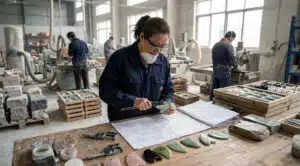
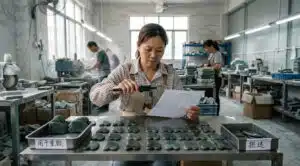
Here is what permanently changed the gua sha manufacturer landscape: in 2019, a controlled 400-sample production trial — conducted by Deyi Gems — directly compared automated tumble polishing against traditional hand-polishing methods across multiple stone types. The result required no interpretation. Automated vibration barrel polishing delivered a 400%+ efficiency gain over manual labor, and that advantage continued to grow as batch sizes increased. For any brand, retailer, or importer evaluating gua sha wholesale sourcing today, this single technological shift redefined what a responsible gua sha supplier can realistically commit to: compressed lead times, scalable production capacities, and — most critically — surface consistency across every unit in a large-volume order.
Does your current gua sha factory have the process infrastructure to back those promises with data? That is the question this article equips you to answer.
What follows is a complete technical breakdown of how automated tumble polishing works, why it performs differently across quartz and jade gua sha tools, which compounds produce measurable results on specific stone families, and what questions to bring to any gua sha supplier before committing to a bulk production run. Whether your priority is understanding gua sha production mechanics, evaluating supplier capability, or benchmarking the ROI of sourcing from a technically equipped gua sha manufacturer — the information here is structured to serve each of those objectives directly.
- The Pre-2020 Gua Sha Market and the Hidden Limits of Hand Polishing
- The Manufacturing Breakthrough — How Automated Tumble Polishing Entered Gua Sha Production
- Inside the 4-Stage Tumble Polishing Process Used by Professional Gua Sha Manufacturers
- Quartz vs. Jade Gua Sha Tools — Why Different Stones Require Entirely Different Polishing Protocols
- The Definitive Gua Sha Polishing Compound Guide — Matching Chemistry to Every Stone Type
- What Automated Gua Sha Polishing Means for Gua Sha Wholesale Buyers — Technology Translated Into Commercial Value
- About Deyi Gems — 12+ Years as a Source Gua Sha Manufacturer
- FAQs for Gua Sha Manufacturer Polishing
The Pre-2020 Gua Sha Market and the Hidden Limits of Hand Polishing

A Niche Industry Built on Manual Craftsmanship
Before 2020, gua sha production existed within a self-contained, regionally concentrated market. Google Trends data confirms that global search interest for “gua sha” remained modest through the late 2010s, with demand clustered predominantly in China and radiating outward into adjacent Southeast Asian markets. That limited geographic footprint meant that the industry’s structural reliance on hand polishing was not a liability — it was an appropriate match between production method and market scale. The two dominant materials of that era, buffalo horn and bian stone, each carry surface characteristics that respond exceptionally well to skilled manual finishing. When orders ran in the hundreds rather than the tens of thousands, experienced craftspeople could produce results that met — and sometimes exceeded — what mechanized alternatives offered.
The trade-off embedded in manual polishing was always present, even when it was not yet consequential. A craftsperson working their third consecutive hour of polishing does not produce the same surface quality as one beginning their first. Physical fatigue introduces micro-variations in pressure, angle, and abrasive contact time that accumulate into inconsistency across a batch. In a low-volume, regionally focused market, these variations were manageable — absorbed by tolerant buyers, invisible in small sample sizes, and rarely the subject of formal quality complaints. The conditions that would expose this structural weakness were building quietly. When they arrived, they arrived fast.
How the Global Boom Exposed the Breaking Point of Manual Gua Sha Production
Between 2020 and 2021, the gua sha production landscape underwent a structural transformation driven by consumer culture, not by the industry itself. Google Trends data shows global search volume for “gua sha” approximately tripling between late 2019 and peak interest in 2021, accelerated by wellness content proliferating across TikTok, Instagram, and YouTube simultaneously. This was not a regional category growing at an organic pace — it was a global beauty and wellness segment compressing years of expected development into 18 months.

The consequence for every gua sha factory still operating on manual polishing lines was immediate and structural. Order volumes scaled at a rate that skilled labor recruitment could not match. Craftspeople working extended hours to meet demand produced inconsistent results across batches — not because they lacked skill, but because human output degrades predictably under sustained physical repetition. Brand clients placing gua sha wholesale orders for the first time began receiving shipments where surface finish varied visibly between pieces in the same purchase order. For a consumer brand, that is not a production quality complaint. It is a customer trust event that generates returns, negative reviews, and damage to the brand equity being built around the product. The industry did not need more workers. It needed a different process.
The Manufacturing Breakthrough — How Automated Tumble Polishing Entered Gua Sha Production

Why Leading Gua Sha Manufacturers Invested in Automated Polishing Systems in 2019
The transition to automated vibration barrel polishing was not an industry-wide announcement. It began with a small number of gua sha manufacturers — those with sufficient production scale to run meaningful comparative trials and the technical curiosity to treat process design as a competitive variable — who recognized that the problem was architectural. Adding manual labor to a manual-polishing production floor does not solve a consistency problem; it scales an inconsistency problem. Addressing it required changing the process itself, not the headcount behind it.
In 2019, Deyi Gems conducted a structured 400-sample production trial, running identical stone blanks through manual polishing and automated tumble polishing in parallel, measuring throughput rate, surface consistency, and finish quality across both methods. The methodology was deliberately controlled: same material, same finishing specification, same quality benchmark. The output was not ambiguous. Automated tumble polishing exceeded 400% of the throughput produced by manual methods — and critically, did so while maintaining measurably higher surface uniformity across the full sample set. This means that the volume of finished, inspection-ready gua sha production output your brand requires can be delivered by an automated system in a fraction of the calendar time that manual methods would require for the same quantity.
The 400% Efficiency Gain — What It Actually Means for Your Gua Sha Order
A 400% efficiency improvement is a meaningful headline. Translating it into sourcing decisions requires understanding what it changes operationally. If your brand requires 2,000 polished units within a 15-day production window, a gua sha factory equipped with automated tumble polishing can fulfill that schedule without compressing quality control steps to hit the deadline. A manual-only operation cannot — not at that volume, not with that consistency, and not without absorbing the variability that fatigue introduces in the back half of the production run.
The efficiency advantage also compounds as batch size grows. Human output capacity has a ceiling defined by physiology. Automated barrel polishing systems do not fatigue. A gua sha manufacturer processing 500 units benefits from automation; one processing 5,000 or 50,000 units depends on it. This is the scaling logic that separates a factory capable of supporting a growing brand from one that can service early-stage sample volumes but bottlenecks as the relationship develops. For you as a buyer, this is not a technical detail — it is a direct indicator of whether a supplier can grow with your business.
The second dimension of this advantage is batch consistency. Automated vibration barrel polishing applies identical mechanical force and abrasive contact simultaneously to every piece in a production run. The physics of the process make uniform treatment inevitable, not aspirational. This is the property that hand polishing fundamentally cannot replicate at scale, regardless of skill level. For your brand, consistent surface finish across every unit in an order translates directly into lower return rates, stronger consumer product reviews, and a quality baseline that supports premium positioning. That commercial return is what a technically equipped gua sha manufacturer delivers in practical terms.
Inside the 4-Stage Tumble Polishing Process Used by Professional Gua Sha Manufacturers

The automated tumble polishing process used by technically disciplined gua sha manufacturers is not a single operation triggered by loading a barrel and switching on a machine. It is a four-stage progressive system — referred to in professional gua sha production environments as “起桶” (stage cycling) — in which each phase is dependent on the successful completion of the one before it. Skipping a stage does not accelerate production. It creates defects that compound through subsequent stages and produce finished goods that fail quality inspection at the end of the line. Understanding this sequence gives you a direct framework for evaluating whether any prospective gua sha supplier operates with genuine process rigor or is optimizing for throughput at the expense of output quality.
1 — Rough Grinding: Removing CNC Tool Marks Without Compromising Stone Geometry
Every piece of jade gua sha tools or quartz gua sha that enters the polishing barrel arrives from CNC machining with visible tool marks embedded in its surface. These micro-grooves are an unavoidable artifact of the cutting process and must be fully removed before subsequent polishing stages can be effective. Rough grinding applies appropriately hardened abrasive media at controlled vibration parameters to eliminate these marks systematically across the entire surface.
The critical variable is duration. Under-processing leaves residual tool marks that no later stage possesses the cutting capacity to remove — they will remain visible in the finished surface under direct light. Over-processing — referred to as “过抛” in industry terminology — begins to alter the physical geometry of the stone itself, softening edge profiles that should remain defined and reducing dimensional precision. A technically grounded gua sha manufacturer monitors rough grinding duration based on stone type, hardness rating, and batch quantity, rather than applying a fixed timer across all materials. This judgment-based approach is what produces dimensional consistency across different stone types in the same production portfolio. For you as a buyer, requesting a rough-ground sample before final polishing approval is a straightforward quality checkpoint that reveals whether this stage is being managed with precision.
2 — Medium Grinding: The Non-Skippable Step That Defines Final Surface Quality
Stage 2 is the phase where under-resourced gua sha factories most commonly compromise their output. Medium grinding must proceed through granular progressions — moving from coarser abrasives to progressively finer grades in sequence — without skipping intermediate steps. The physics underlying this requirement are not optional: each abrasive grade removes the scratch pattern left by the grade preceding it. Jumping from a coarse grade directly to a fine one leaves the fine-grade abrasive insufficient cutting capacity to eliminate the deeper coarse scratches. Those scratches then manifest during final polishing as ghost lines, optical haze, or uneven sheen — defects that are visible to consumers under natural light and that generate returns and negative reviews at the retail level.
For jade gua sha tools specifically, medium grinding requires a materially longer duration than equivalent quartz processing. Jade’s interlocked fibrous crystal microstructure — recognized by the Gemological Institute of America (GIA) as the primary factor in jade’s exceptional toughness — means that surface abrasion progresses more slowly and requires sustained mechanical contact to fully develop the intermediate surface condition that pre-polishing requires. This is not production time that can be recovered elsewhere in the schedule. It is a materials-science requirement. Any gua sha supplier who cannot provide a specific duration protocol for jade medium grinding — differentiated from quartz — is communicating, by omission, that their process is not calibrated to material differences.
3 — Pre-Polish: Achieving a Uniform Matte Surface Before Mirror Finishing
Pre-polishing is the transitional stage between mechanical abrasion and optical surface development. At this point in the process, the stone surface is free of visible scratches but presents as uniformly matte — showing no reflective quality yet. The objective is to bring every area of the surface to a state of micro-smoothness consistent enough for the final polishing stage to develop an even, high-clarity reflective finish across the entire piece without localized variation.
Media selection at this stage carries significant consequences for surface outcome. For quartz-family stones, softer and more compliant media — resin pellets or walnut shell — are preferred because they conform to curved surface profiles without applying concentrated abrasive force to specific contact points. This geometry-conforming property prevents the localized over-abrasion that creates flat spots or uneven reflectivity in the finished product. The International Gem Society (IGS) documents the matching logic between polishing compound selection and Mohs hardness as a fundamental principle of lapidary finishing — and a technically systematic gua sha manufacturer applies this logic to every material in their portfolio. This means that your order, regardless of stone type, is processed according to a compound selection protocol derived from mineralogical principles rather than guesswork.
4 — Final Polish: Mirror Finish, Material Limits, and Why Transparency Here Signals Supplier Quality
Final polishing develops the stone’s reflective surface — the visual characteristic that end consumers directly associate with premium-tier gua sha production. The compounds applied at this stage, primarily cerium oxide for silica-based materials and aluminum oxide variants for harder or compositionally complex minerals, operate at near-molecular interaction levels. They fill remaining micro-pores, elevate surface reflectivity to its theoretical maximum for the given material, and produce the optical clarity that differentiates a professionally finished product from a merely polished one.
One technically important transparency point belongs here: not every stone type is capable of achieving a true mirror finish, regardless of the quality or duration of gua sha polishing applied. This is a function of crystal structure and mineral composition, not process failure. Lapis lazuli, for instance, has a composite mineral structure whose varied hardness zones produce inherently different reflectivity across the same surface — a characteristic documented by the SSEF Swiss Gemmological Institute in its mineral analysis work. A technically honest gua sha supplier communicates material finish limitations before production begins, sets accurate expectations, and adjusts finish specifications accordingly. When a supplier guarantees mirror finish on every material without qualification, you are receiving a commercial claim rather than a technical one — and that distinction matters when the finished goods arrive.
Quartz vs. Jade Gua Sha Tools — Why Different Stones Require Entirely Different Polishing Protocols

One of the most consequential assumptions in gua sha wholesale sourcing is that polishing protocol is universal — that what produces a consistent result on rose quartz translates directly to nephrite jade. It does not. The mineralogical differences between stone families create fundamentally different abrasion behaviors, surface development rates, and compound chemistry requirements at every stage of the process. A gua sha manufacturer without differentiated protocols for quartz and jade types is not capable of producing consistent output across both — regardless of how the marketing materials describe the production capability.
Gua Sha Manufacturer Protocols for Quartz-Family Stones
Quartz-family stones — encompassing rose quartz, clear quartz, amethyst, aventurine, and their mineral relatives — share a Mohs hardness of approximately 7, a conchoidal fracture behavior, and a structurally uniform crystal matrix. These shared properties allow for a standardized processing approach within the family. Rough grinding uses medium-hardness abrasive media at moderate vibration energy, with processing windows calibrated to remove CNC tool marks without rounding the edge geometry that defines the gua sha tool’s ergonomic profile. Medium grinding progresses through granular grades sequentially, at durations benchmarked to quartz’s abrasion rate, without skipping intermediate grades.
Pre-polishing transitions to soft, compliant media — resin pellets or walnut shell — combined with fine aluminum oxide at controlled concentrations. This combination applies abrasive force in a geometry-conforming way, smoothing curved surface profiles without introducing localized flat zones or contact-point marks. Final polishing applies cerium oxide at low vibration amplitude. Cerium oxide is the compound of choice for quartz-family materials because its particle chemistry and reactivity profile are specifically optimized for silica-based mineral surfaces — a relationship supported by lapidary science literature published by the International Gem Society. When this protocol is applied with correct timing at each stage, the result is a high-clarity mirror finish with uniform reflectivity and no visible surface graining. This means that the quartz-family gua sha production you source carries a surface quality that holds up to consumer scrutiny at the point of unboxing and through product use.
Why Jade Gua Sha Tools Demand Extended Mid-Stage Processing — A Gua Sha Manufacturer‘s Perspective
Nephrite and jadeite — the two mineral families collectively referred to as jade — present a different polishing challenge at the physical level. Jade’s toughness, as distinct from its hardness, derives from its fibrous, interlocked crystal microstructure. GIA’s material science documentation on jade identifies this microstructure as the primary factor in jade’s exceptional resistance to fracture — the property that has made it a culturally valued material across millennia. That same microstructure means that surface abrasion during gua sha polishing progresses more slowly, less predictably, and with greater sensitivity to media selection than is the case with crystalline quartz.
The practical consequence for a gua sha manufacturer processing jade is that medium grinding duration must extend significantly beyond quartz equivalents — in practice, often two to three times longer — to develop the intermediate surface condition that pre-polishing requires to be effective. Truncating this stage produces a surface that appears visually smooth but retains sub-surface scratch architecture that emerges during final polishing as optical inconsistency: areas of differing reflectivity, haze zones, or fine line patterns visible under raking light. For jade gua sha tools, final polishing uses either cerium oxide or aluminum oxide compounds depending on the specific jade variety, with total processing time running materially longer than quartz equivalents. This is the specific technical question to bring to any gua sha factory you are evaluating: “What is your jade medium-grinding duration relative to your quartz baseline, and how does that vary by jade type?” A supplier with a defined, differentiated answer is demonstrating process discipline. A supplier who deflects or generalizes is telling you something equally useful.
The Definitive Gua Sha Polishing Compound Guide — Matching Chemistry to Every Stone Type

Compound selection is the variable most frequently mismanaged by under-equipped gua sha factories. Applying an incorrect compound does not simply produce a suboptimal surface — it can introduce micro-damage that is structurally invisible at the gua sha production floor but becomes apparent to end consumers within weeks of use, generating returns and brand-level quality concerns that trace back to a sourcing decision made months earlier. A process-disciplined gua sha manufacturer maintains compound protocols that are matched to each stone type in their production portfolio, documented in process specifications, and consistently applied across batches without ad hoc substitutions.
How a Gua Sha Manufacturer Selects the Right Polishing Compound for Each Material
The selection logic follows mineralogical principles, not preference. Cerium oxide is the standard compound for silica-based minerals — quartz-family gua sha and obsidian — because its particle chemistry creates a gentle chemical-mechanical interaction with silica surfaces that produces exceptional surface clarity without abrasive over-cutting. For standard jade varieties, aluminum oxide provides the appropriate combination of abrasive capacity and particle size distribution to address jade’s harder, denser surface structure effectively. High-purity aluminum oxide is the specified compound for agate processing: agate’s densely banded microstructure requires consistent, fine-particle abrasion force to develop a uniform finish across its natural color transition zones.
Lapis lazuli requires the most technically careful compound approach of any stone commonly used in gua sha production. Its composite mineral structure — incorporating lazurite, calcite, and pyrite inclusions in proportions that vary across individual stones — means that different areas of the same surface carry materially different hardness values. A standard-grade compound applied uniformly across this compositional variation produces differential abrasion: softer zones develop faster than harder ones, creating an uneven reflective finish that cannot be corrected in post-processing. Ultra-fine aluminum oxide or chromium oxide compounds are used to minimize this differential effect. The SSEF Swiss Gemmological Institute, one of the world’s leading laboratories for complex mineral identification and gemological analysis, has documented lapis lazuli’s compositional variability as a factor in its material behavior under surface treatment. For any gua sha wholesale buyer sourcing lapis lazuli products, confirming that your gua sha supplier specifies compound protocol by material type — rather than using a single all-purpose compound — is one of the most direct quality assurance questions available to you.
For reference, the compound matching framework applied in professional gua sha polishing operations maps as follows:
- Quartz-family gua sha → Cerium oxide (optimized for silica surface chemistry, low vibration amplitude at final stage)
- Standard jade → Aluminum oxide (hardness-appropriate abrasive capacity, extended processing duration)
- Agate → High-purity aluminum oxide (uniform particle size critical for banded microstructure)
- Obsidian → Cerium oxide (glass-phase surface structure responds to same chemistry as silica minerals)
- Lapis lazuli → Ultra-fine aluminum oxide or chromium oxide (composite mineral structure requires minimal differential abrasion)
This means that when you source from a gua sha manufacturer with material-matched compound protocols, every stone type in your product line is processed according to chemistry that is calibrated to its specific surface physics — not adapted from a protocol designed for a different mineral family.
What Automated Gua Sha Polishing Means for Gua Sha Wholesale Buyers — Technology Translated Into Commercial Value
Technical capability matters in gua sha manufacturing only to the degree that it translates into measurable commercial value for the buyer. The process infrastructure described in this article — four-stage tumble polishing, material-specific protocols, compound chemistry calibrated to stone type — is not valuable as a set of specifications. It is valuable because of what it produces for your brand: consistent surface quality at scale, predictable lead times, and a defect rate that supports rather than undermines your product positioning. Understanding how to evaluate whether a gua sha factory actually operates this way, rather than describes it, is the applied skill this section develops.
Three Questions Every Gua Sha Wholesale Buyer Should Ask Any Gua Sha Manufacturer
The first question is direct: “Do you use automated tumble polishing or manual polishing for bulk production orders?” The answer should be automated, unequivocally, for any order volume above several hundred units. A gua sha manufacturer still relying on hand polishing for large batches is not equipped to deliver the batch consistency a consumer brand requires. If the answer is qualified — “we use automated for some stages” or “we use both depending on the order” — probe for specifics. Partial automation produces partial consistency.
The second question tests process knowledge rather than equipment ownership: “What is your medium-grinding duration protocol for jade, and how does it differ from your quartz baseline?” A gua sha supplier who can answer with specific parameters — duration ranges, adjustment logic for different jade varieties, how batch size affects timing — is demonstrating that their process is defined, documented, and applied deliberately. A supplier who responds with approximations or deflects to output quality rather than process parameters likely does not have a defined protocol to reference.
The third question provides empirical evidence rather than claims: “Can you provide 10 pieces drawn randomly from a production batch of 100 or more?” Surface consistency across a randomly selected sample set is the most direct proxy for batch consistency at full production scale. Any gua sha factory that is confident in its gua sha polishing process should be able to provide this without hesitation. If a supplier offers to send their 10 best pieces rather than 10 random pieces, you have learned something important about what “consistent quality” means in their production context.
ROI of Automated Gua Sha Production — Quantifying the Value for Your Brand
The commercial logic of sourcing from an automated gua sha manufacturer is quantifiable at multiple levels. A 400%+ efficiency gain in gua sha polishing throughput translates into compressed lead times — your product reaches market faster, your inventory replenishment cycles accelerate, and your working capital efficiency improves. For a brand operating in a trend-driven wellness category where velocity matters, this is not a marginal operational benefit. It is a competitive positioning factor.
Batch consistency operates on a different ROI dimension — one tied to defect rates and return rates. Industry data on surface-finish complaints in personal care and wellness products consistently identifies visual inconsistency between pieces as one of the primary triggers for consumer-initiated returns. A measurable reduction in return rate — even a 2-3 percentage point improvement — delivers financial recovery that significantly exceeds the cost premium, if any, associated with sourcing from a technically equipped gua sha factory rather than a lower-specification alternative. The 2019 automation investment at Deyi Gems was justified, in part, by exactly this calculation: the downstream brand value of consistent surface quality outweighs the production investment required to achieve it, and the 400-sample trial data quantified that relationship in terms that held up to commercial scrutiny.
Deyi Gems has applied these principles across more than 12 years of gua sha production, serving gua sha wholesale clients across North America, Europe, and the Asia-Pacific region with material coverage spanning quartz, jade, agate, obsidian, and lapis lazuli. The production infrastructure described in this article is operational, documented, and available for verification through pre-production sample orders.
About Deyi Gems — 12+ Years as a Source Gua Sha Manufacturer
Deyi Gems has operated as a source-factory gua sha manufacturer for over 12 years, managing the complete production chain from raw stone procurement through CNC shaping, four-stage automated tumble polishing, multi-point quality inspection, and custom packaging configuration. This vertical integration means that every production decision — material selection, polishing protocol, compound specification, batch timing — is made and controlled within a single facility, without the quality variability that emerges when production steps are distributed across multiple subcontractors.
The product portfolio at Deyi Gems covers quartz-family stones, nephrite and jadeite jade, agate, obsidian, and lapis lazuli, along with additional materials based on client project specifications. This material breadth makes Deyi Gems a single-source gua sha supplier for brands that require product line diversity without the complexity of managing relationships with multiple specialized factories. Each material is processed according to the differentiated protocols described throughout this article — rough grinding parameters, medium grinding durations, pre-polish media selection, and compound chemistry — all calibrated to the specific mineralogical properties of that stone type.
The 2019 automation program that produced the 400-sample comparative data referenced in this article remains active and continuously refined. As new stone types enter the Deyi Gems production portfolio, polishing parameters are tested and documented before full production integration. Quality control is structured as a staged process: pre-production sample approval before batch manufacturing begins, in-process inspection at each of the four polishing stages, and final batch consistency verification — including random-draw sampling across the completed batch — before shipment.
Whether your brand is launching its first gua sha wholesale product line or scaling an established range that has outgrown its current gua sha factory‘s capacity and process standards, the practical starting point is a sample order. You can evaluate surface finish, dimensional consistency, and material quality directly, against your own benchmarks, before committing to full production volume. Documented polishing protocols, compound specifications, and production capacity data are available from the initial inquiry stage.
Contact Deyi Gems to request material samples, review gua sha production capability documentation, and begin the supplier evaluation process on the basis of verifiable evidence rather than marketing claims. That is how a technically grounded gua sha manufacturer earns your business.
FAQs for Gua Sha Manufacturer Polishing
1. What is the minimum order quantity for gua sha wholesale orders?
MOQ varies by stone type and product design. Most gua sha wholesale orders are accepted from 100 units per SKU. Contact Deyi Gems directly for project-specific MOQ confirmation and factory-direct pricing.
2. How does automated tumble polishing improve gua sha production consistency?
Unlike hand polishing, automated vibration barrel systems apply identical mechanical force to every piece simultaneously throughout the entire batch. This eliminates the surface variation caused by human fatigue, delivering measurably uniform finish quality across orders of any volume — a standard that manual gua sha production cannot replicate at scale.
3. Can a gua sha manufacturer polish different stone types in the same production run?
No. Each stone family — quartz, jade, agate, obsidian, lapis lazuli — requires its own abrasive media, compound chemistry, and stage duration protocol. A qualified gua sha manufacturer runs separate, material-specific polishing cycles for each stone type to prevent cross-contamination and ensure correct surface development.
4. How do I verify surface consistency before placing a bulk order with a gua sha factory?
Request 10 randomly selected pieces from a completed production batch of 100 or more units. Random sampling — not hand-picked samples — is the most reliable way to evaluate whether a gua sha factory‘s automated polishing system delivers real batch-level consistency rather than selectively showcased results.