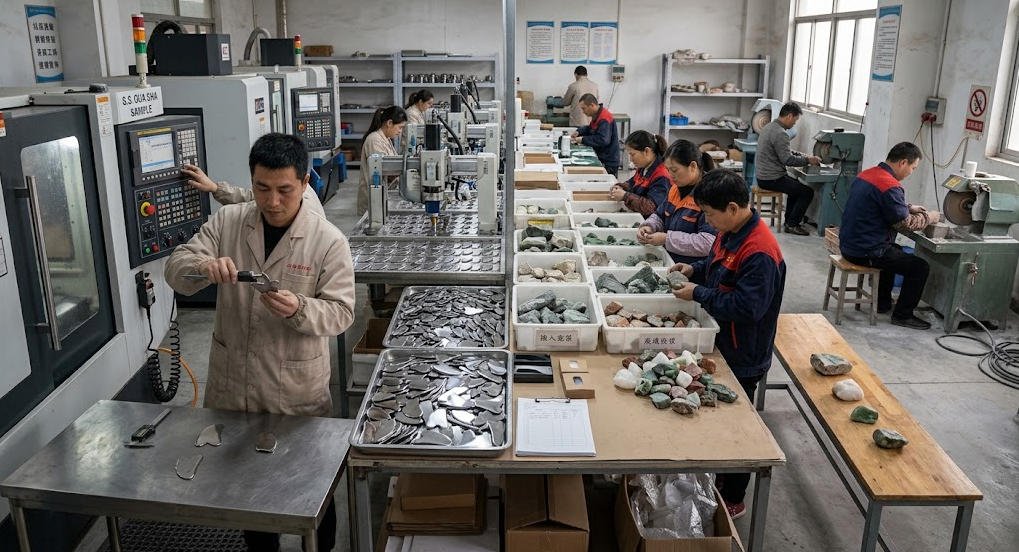
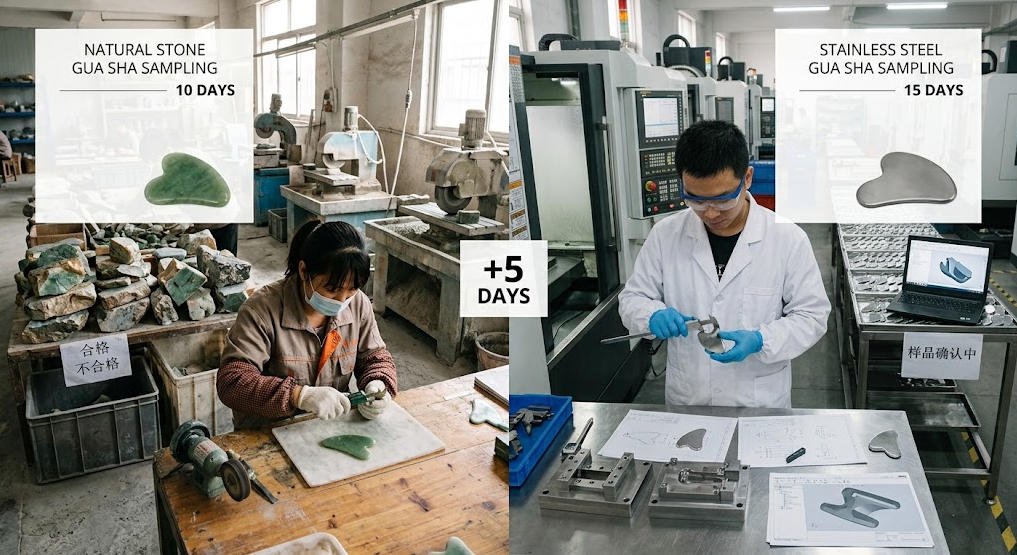
If you have ever waited on a gua sha custom sample, you already know the frustration: a stainless steel piece can take around 15 days to arrive, while a stone version shows up in roughly 10. On paper, that looks like stone wins the race. In practice, the opposite usually happens once the order grows from a handful of samples to a few thousand pieces, because a gua sha manufacturer working in stainless steel typically ships bulk orders faster than one working in natural stone — even though the sample took 50% longer to confirm. That gap is not a coincidence, and it is not poor planning on the factory’s side. It is a structural difference in how the two materials move through engineering, tooling, and production, and understanding it will change how you read every quote you receive from a gua sha supplier from now on.
- The 15-Day Reality Check: What a Longer Gua Sha Custom Sample Timeline Actually Tells You
- Why a Stainless Steel Gua Sha Custom Sample Needs More Engineering Time
- Two Different Questions Every Gua Sha Supplier Must Answer
- The Standardization Payoff: How Stainless Steel Gua Sha Custom Orders Scale Into Bulk Production
- Risk Disclosure: Why Stone Gua Sha Custom Bulk Orders Carry More Variables
- The Material Science Behind Your Gua Sha Custom Timeline: Hardness, Wear, and Real Tool Life
- How to Read a Gua Sha Manufacturer's Quote Before You Approve a Gua Sha Custom Sample
- Compliance and Material Standards for Gua Sha Wholesale Buyers
- Total Lead Time: The Number That Actually Predicts Your Delivery
- A Wider Pattern Beyond Gua Sha Custom: Manufacturing at Large
- What This Means for Your Next Gua Sha Custom Order
- About This Analysis
The 15-Day Reality Check: What a Longer Gua Sha Custom Sample Timeline Actually Tells You
Sample Speed and Bulk Speed Are Not the Same Number
When you request a custom gua sha sample, you are really asking two different factories to answer two different questions, even if you send the same drawing to both. A stone workshop is often answering “can we cut and polish this shape,” while a stainless steel workshop is answering “can we build a repeatable process that still works correctly on piece number 4,999.” That second question takes longer to answer the first time a design is new, and it shows up directly in your sample invoice — typically around 15 days for a first-run stainless steel design versus roughly 10 days for a stone piece that resembles something already in production. The gap feels backwards until you look at what each timeline is actually paying for, and once you do, it stops being confusing. This means you can stop treating sample lead time as a scorecard for the whole factory, and start treating it as a readout of how much new engineering your specific design required.
It also means the 15-day figure is not a fixed tax on stainless steel as a material — it is a one-time cost tied to a specific, new design. Once that design has been through the process once, the next stainless steel sample sharing similar geometry can move noticeably faster, because much of the groundwork is already sitting on file. A gua sha supplier quoting you 15 days on a shape close to something they already manufacture should, in most cases, be able to compress that timeline. If they cannot explain why, it is worth asking directly what part of the 15 days is genuinely new work versus habit.
The Data Point Most Buyers Get Wrong
So does a 10-day stone sample mean that particular gua sha supplier simply works faster? Not necessarily — and this is exactly where sourcing decisions go wrong. A stone sample can move quickly because the physical steps — cutting, rough shaping, grinding, polishing, cleaning — already exist as a proven sequence inside the workshop, and your design just slots into it. A stainless steel sample moves more slowly because several of those steps do not exist yet for your specific shape; they have to be built, tested, and locked in before anyone touches production material. Comparing the two numbers side by side, without asking what each one is actually measuring, is how buyers end up choosing a gua sha manufacturer based on the wrong signal entirely.
You are better served asking what happens after the sample is approved than asking how many days the sample itself took. A factory that can walk you through its post-approval process in detail — tooling handoff, material ordering, first-article inspection — is telling you far more about your real delivery date than a sample-day comparison ever could. Isn’t the actual delivery date the number you are trying to plan around in the first place?
Why a Stainless Steel Gua Sha Custom Sample Needs More Engineering Time
The Front-Loaded Engineering Behind Every Stainless Steel Gua Sha Custom Sample
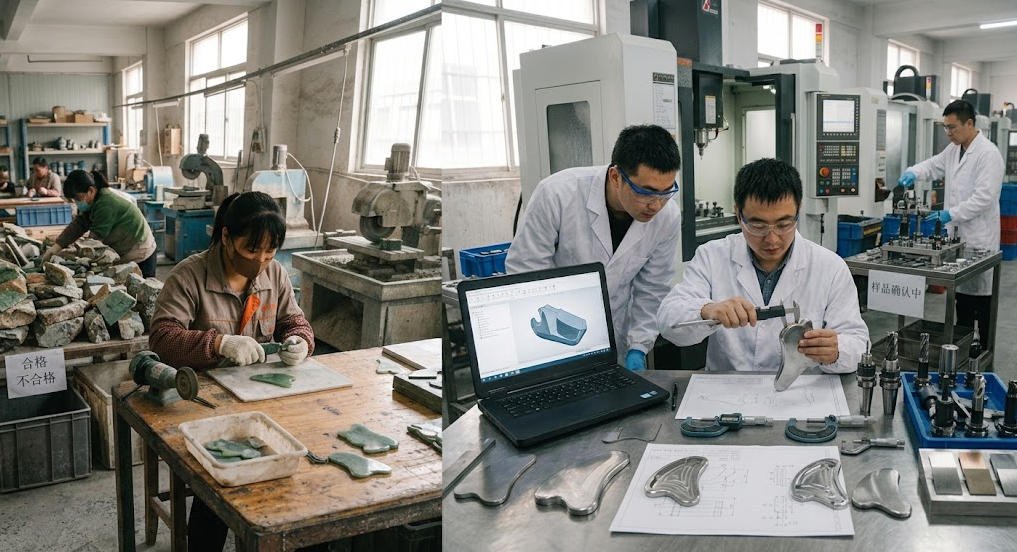
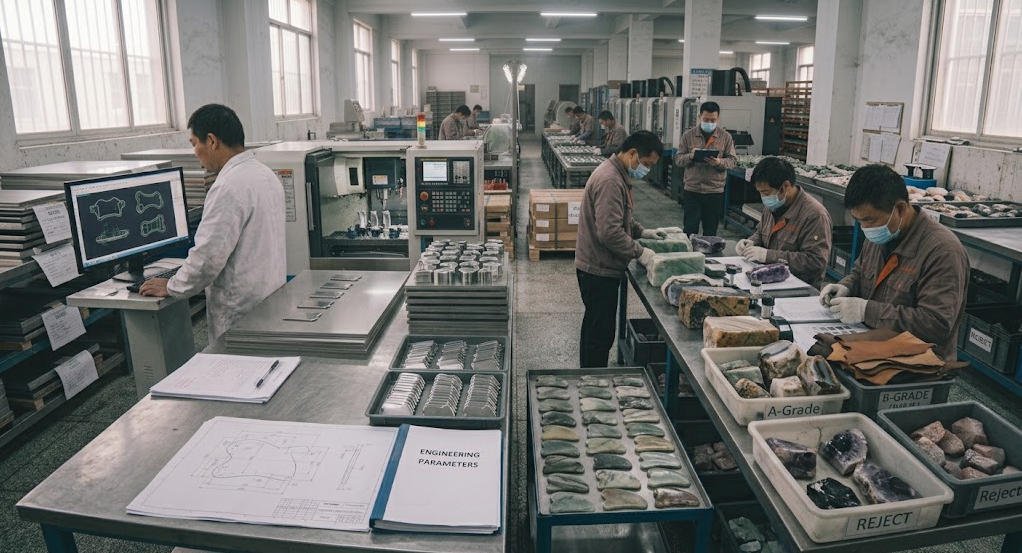
Before a single stainless steel blank gets cut for your project, a factory usually has to lock down a list of decisions that never show up on your invoice as separate line items. That list typically includes confirming the 3D/CAD structure and tolerances, building or adjusting the CNC program and tool paths, selecting cutting tools and feed rates, making or ordering jigs and fixtures, confirming raw billet specifications, validating how edges, holes, and curved surfaces will be machined, deciding on a deburring and surface-finishing method, fixing the logo process and placement, and setting the final inspection standard for appearance and dimensions. None of this is wasted time — it is the reason your stainless steel gua sha custom sample survives contact with a 5,000-piece order later without falling apart on the shop floor. This means your 15-day wait is buying you a tested, repeatable process rather than a one-off, hand-adjusted prototype that might not scale cleanly.
It is worth pausing on why this matters more for stainless steel than for most other metal products you might have sourced before. A gua sha tool has a compound curve, a polished skin-contact surface, and often a logo placed on a narrow edge — none of which are trivial to program correctly the first time. Get the tool path wrong on piece one and you catch it in the sample. Get it wrong on piece 3,000 of a bulk run and you are looking at scrap, rework, and a shipment delay you did not budget for. That is precisely why a careful gua sha manufacturer will not rush this stage, even when a buyer is pushing for a faster sample date.
Why a Stone Gua Sha Custom Sample Can Feel Faster
Natural stone is not simple to machine — cutting, rough grinding, shaping, fine polishing, cleaning, and inspection are all real, physical steps that take real time on their own. But when your requested shape is close to something the workshop already produces, most of that sequence is already proven, and the factory only needs to adjust size, edge profile, logo position, or material grade. That is why a stone gua sha custom sample can be finished in roughly 10 days even though its physical processing may involve more manual steps than a comparable stainless steel piece. Put simply: the stone sample’s physical work can be complex while its engineering work stays simple, and that combination is what makes it faster to confirm.
So what does that mean for you as a buyer? It means a fast stone sample is not proof of a faster factory overall — it is proof of a shape the factory has made before, on a material it already knows how to read. If you hand a stone gua sha custom supplier a genuinely unfamiliar shape, expect that 10-day number to stretch, because the same front-loaded work that stainless steel goes through does not disappear — it is simply less visible when it has already been done for a similar product in the past.
Two Different Questions Every Gua Sha Supplier Must Answer
What “How Should This Gua Sha Custom Piece Be Made” Really Costs
Every sample stage exists to answer one question: how should this specific product actually be made? That question covers geometry, tooling, material behavior, and finishing method, and it has to be answered from zero the first time a new design appears, regardless of which material you have chosen. A gua sha manufacturer that skips this step to save you a few days on the sample is usually just moving the risk downstream, where it becomes far more expensive to fix — inside a 5,000-piece production run instead of inside a single sample piece. This means the extra days spent confirming a stainless steel sample are days you are not paying for later, when an unverified tool path or a rushed fixture would otherwise scrap a percentage of your bulk order and push your ship date back by weeks, not days.
What “How Do We Make 5,000 of These” Really Costs
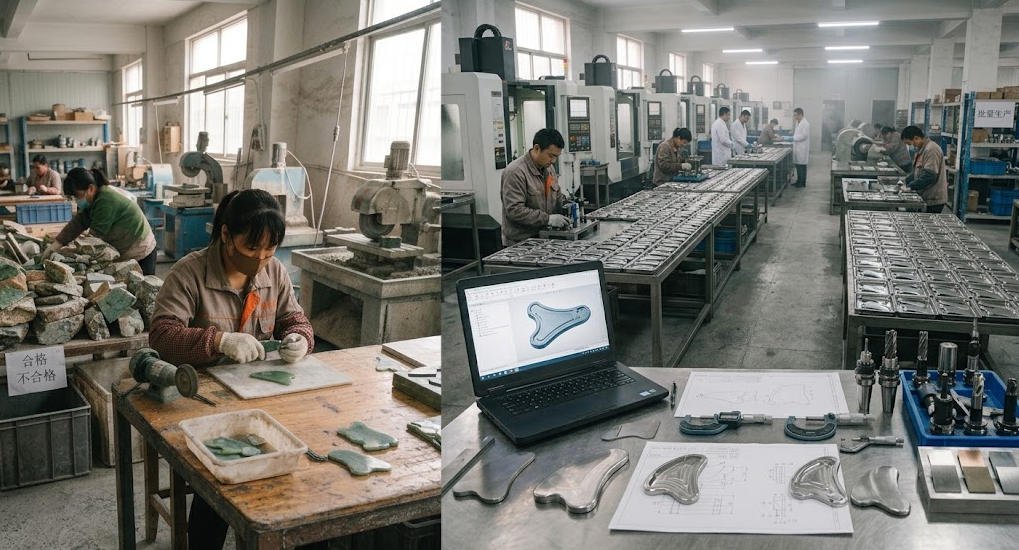
Once your sample is approved, the question changes completely. Nobody is asking whether the product can be made anymore — everyone is asking how to make thousands of them quickly, consistently, and without surprises along the way. This is where the one-time engineering work from the sample stage gets reused instead of repeated: the CNC program, the fixture, the tool paths, the finishing sequence, and the inspection checklist all carry forward as the standard operating condition for the entire run. A factory cannot skip the first question and jump straight to the second one, no matter how tempting a compressed timeline might look on a purchase order.
You should read a fast sample turnaround as one useful data point, not as a guarantee that the harder question — the bulk one — has already been solved. An order that sails through sampling but has never actually run at volume still carries unknowns that only show up once real production starts. Asking a gua sha supplier directly whether they have produced this exact shape at scale before, or only at sample quantity, is one of the more useful questions you can add to your next sourcing call.
Think of it this way: a five-day sample approval on a brand-new stainless steel edge profile tells you almost nothing about whether that edge can hold its finish through hour eight of a continuous production shift. The two questions look related on a project timeline, but they are tested at completely different points, under completely different conditions, and a factory that has only answered the first one honestly should say so rather than imply the second is already settled.
The Standardization Payoff: How Stainless Steel Gua Sha Custom Orders Scale Into Bulk Production
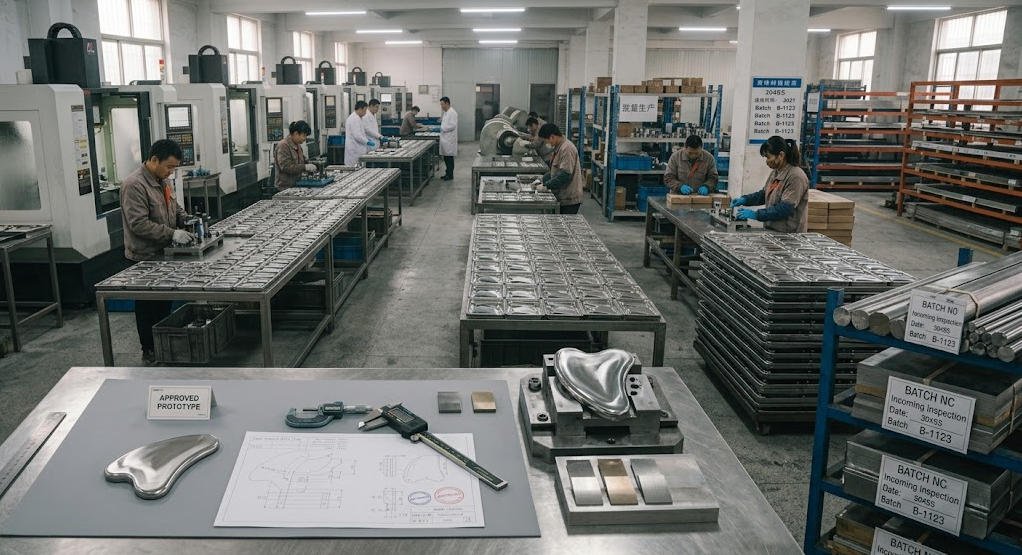
A Process You Can Predict, Run After Run
Once a stainless steel gua sha custom sample gets your sign-off, almost everything built during that 15-day window gets frozen into a standard: the CNC program, the cutting parameters, the fixture, the surface-finishing method, the logo position, and the inspection criteria. Production can then run as a fixed sequence — raw material intake, CNC machining, deburring, surface treatment, logo, quality control, and packing — with very little re-deciding along the way. If a single piece takes about 20 minutes to machine, that number holds whether the order is for 100 pieces, 1,000 pieces, or 5,000 pieces, because the process itself does not change shape with volume. This means your unit cost and your delivery date both become easier to predict as your order size grows, which is close to the opposite of what happens with a material that depends on manual sorting at every stage.
There is a second, quieter benefit here that buyers often miss. Because the process is fixed, a second production run six months later — for a repeat order, or for a new client asking for the same base design — starts from a known position instead of from zero. You are not paying for the 15-day engineering cycle twice. That single upfront investment is what makes reorders on stainless steel gua sha custom tools noticeably faster and more price-stable than a first-time order, and it is worth asking your supplier to confirm in writing before you plan a reorder schedule around it.
Material Consistency: Why 304 vs 316L Changes Your Timeline
Part of that predictability comes from the raw material itself. Stainless steel used in gua sha tools typically comes as 304 or 316L sheet, plate, or bar stock, produced to recognized specifications such as ASTM A240, which sets out chemical composition and mechanical property requirements for chromium and chromium-nickel stainless steel plate, sheet, and strip. That means the thickness, hardness, and machining behavior of the batch you receive next month should match the batch tested during sampling, within a documented tolerance, instead of shifting from lot to lot. A gua sha wholesale buyer benefits from this directly, because a supplier working from spec-controlled material does not need to re-sort or re-test each new coil the way a stone workshop has to re-sort each new block of rough material.
Ask yourself how much of your last shipment delay, on any product, actually came from the factory versus from unpredictable raw material arriving late or out of spec. For stainless steel gua sha tools, the honest answer is usually “very little,” and that is precisely the kind of predictability a gua sha wholesale program depends on when you are planning inventory months in advance.
Risk Disclosure: Why Stone Gua Sha Custom Bulk Orders Carry More Variables
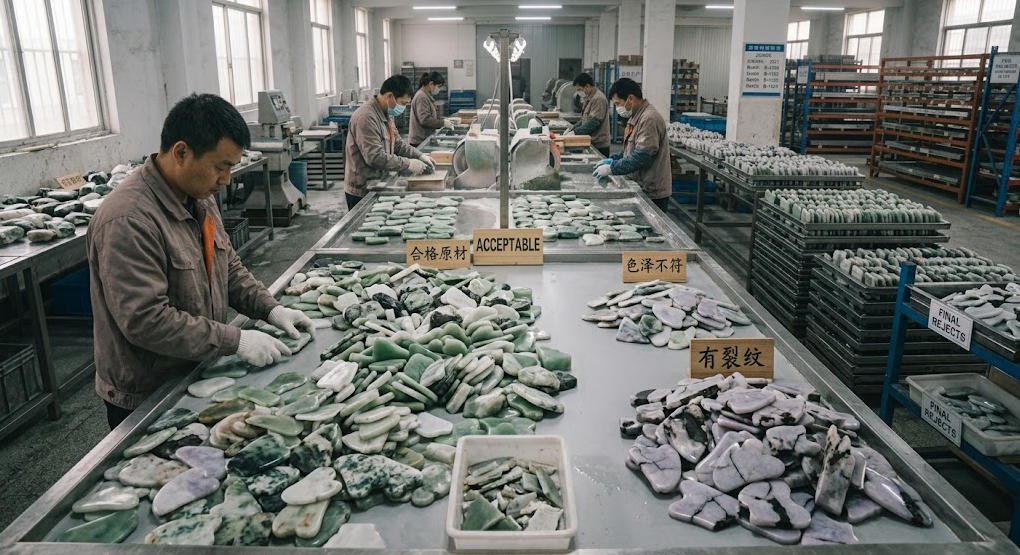
Natural Variation No Factory Can Fully Engineer Around
The biggest constraint in a stone gua sha custom bulk order is rarely the machining program — it is the stone itself. Even within a single named material, different batches of rough can show variation in tone, banding, cloudiness, small dark inclusions, hairline fractures, and translucency, and no amount of CNC precision changes what is already inside the block before it ever reaches a saw. Gemological organizations such as GIA and the International Gem Society document this kind of natural color zoning and inclusion behavior as a normal feature of how minerals form, not as a manufacturing defect, which is exactly why treating it as something a factory can eliminate on demand sets the wrong expectation before production even begins.
If your specification calls for tight color matching across the full order, expect the factory to spend real time sorting and comparing pieces side by side before they ever reach packing. This means your stone gua sha custom quote should already reflect that sorting time — and if it does not, the delay will show up later on your shipping schedule instead of upfront on paper where you can plan around it.
The Yield Math Behind Every Stone Order
Say you order 5,000 stone gua sha boards. A factory cannot simply set aside 5,000 pieces of rough and call the job done, because cracks, chipping, internal structural flaws, breakage during shaping, post-polish defects, and color mismatches will remove some pieces from the pool before final QC ever happens. In practice, that often means starting with something closer to 6,000 pieces of rough — sometimes more, depending on the stone type, grade, and how strict your acceptance standard is — to land on 5,000 finished, approved pieces at the end. The exact ratio moves with the material, but the underlying point does not change: natural stone production has to budget for loss in a way that stainless steel production largely does not.
Would you rather know that buffer exists before you sign the purchase order, or discover it when your shipment arrives short and your retail launch date is already fixed? A transparent gua sha supplier will tell you the expected yield range before production starts, not after the invoice is issued, and will price the order accordingly rather than quietly hoping the batch performs better than average.
The Material Science Behind Your Gua Sha Custom Timeline: Hardness, Wear, and Real Tool Life
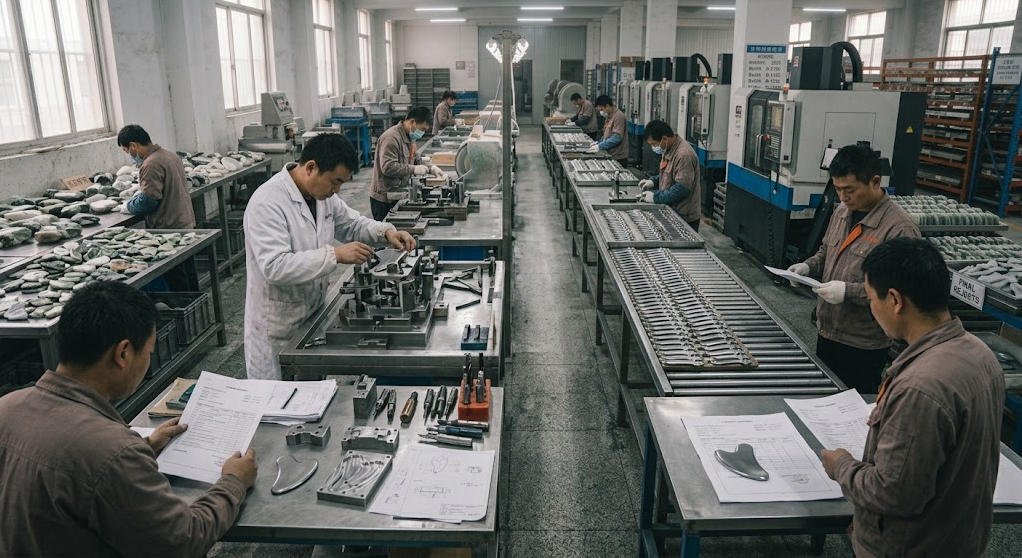
Why a Mohs Number Predicts More Than a Marketing Page Does
Every stone used in gua sha production sits at a different point on the Mohs hardness scale, and that single number quietly explains a lot of what happens on the factory floor before it ever reaches yours. Nephrite jade typically tests at 6 to 6.5 on the Mohs scale, a range documented in gemological references from GIA. Rose quartz, as a member of the quartz family, sits higher at roughly 7, which is part of why it takes longer to grind and polish to a mirror finish. Bian stone sits at the opposite end of that range: petrological studies of Sishui bian-stone describe it as a microcrystalline limestone made up of roughly 96% calcite, and calcite itself is a textbook Mohs-3 mineral — so bian stone carves faster, but it also scratches and chips more easily during both machining and years of home use afterward.
This means the hardness of the stone you specify is not a cosmetic detail on a spec sheet — it is a direct driver of machining time, tool wear, and how the finished piece holds its polish months after it leaves your factory. A stone gua sha custom order in rose quartz will typically take longer per piece to polish than the same shape in bian stone, but it will also resist surface scratching far better once it reaches an end customer’s bathroom shelf. If your return or complaint data tends to mention dulled or scratched surfaces after a few months of use, hardness — not workmanship — is usually the first variable worth checking.
What Stainless Steel Hardness Tells You About Long-Term Durability
Stainless steel behaves differently because its hardness is engineered rather than found underground. Austenitic grades like 304 and 316L typically test in the HRB 70s-to-90s range in the annealed condition used for gua sha tools, and — unlike a natural stone whose hardness can vary block to block — that number stays consistent across the entire coil or bar the mill supplies. This means a stainless steel gua sha custom tool keeps its edge geometry and its polish over years of repeated cleaning and use in a way you can write into a specification and actually hold a supplier to, because the hardness was set by a mill certificate rather than by geology.
How to Read a Gua Sha Manufacturer’s Quote Before You Approve a Gua Sha Custom Sample
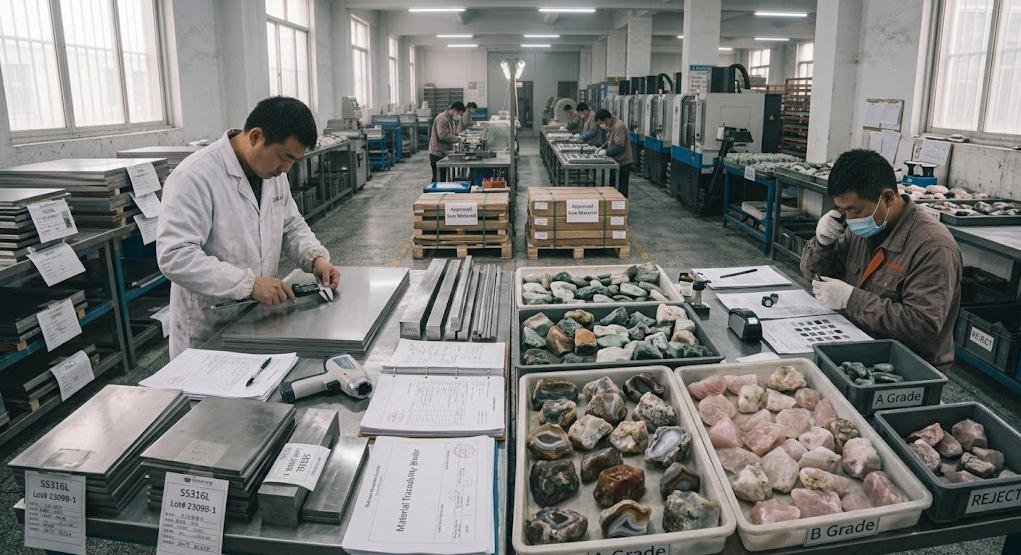
A Practical Checklist for Your Next RFQ
Before you sign off on any new sample, ask the factory to walk you through what happens between sample approval and shipment, not just how many days the sample itself took. Confirm whether the CNC program, fixtures, and inspection standard built during sampling will carry directly into bulk production, or whether more development work is still pending after your approval. Ask for the expected yield rate on stone orders and the expected cycle time per piece on stainless steel orders, since both numbers tell you more about your real delivery date than the sample timeline does on its own. Request a written breakdown of the production sequence, from raw material intake to final packing, so you can see exactly where time is actually spent along the way.
You will get a far more accurate delivery estimate from these four or five direct questions than from comparing two sample invoices side by side. A gua sha manufacturer who answers all of them clearly, with real numbers instead of general reassurance, is showing you something about how well they understand their own factory floor — and that clarity matters even more once you are placing a recurring gua sha wholesale order rather than a one-time trial run.
Cost Signals That Predict Your Landed Price
Your landed cost is shaped by the same factors that shape your lead time, so the two numbers usually move together whether you notice it or not. A gua sha manufacturer quoting a low price on a brand-new stainless steel shape without mentioning tooling or fixture costs is often underpricing the engineering work, and that gap tends to reappear later as delay, rework, or a mid-order price adjustment nobody enjoys. On the stone side, a quote that ignores yield loss and prices your order as if every piece of rough becomes a finished piece is doing the same thing in a different form, just harder to spot at first glance.
This means a quote that explicitly accounts for tooling investment or yield buffers is not more expensive for no reason — it is more accurate, and accuracy is what protects your ship date and your margin at the same time. If two quotes for the same order differ mainly because one includes these line items and the other does not, the cheaper number is not necessarily the better deal.
Compliance and Material Standards for Gua Sha Wholesale Buyers
Stainless Steel Grading and Skin-Contact Standards
Since gua sha tools sit directly on skin, the grade of stainless steel you specify is not a cosmetic detail — it determines corrosion resistance, nickel release behavior, and long-term durability under repeated contact and cleaning. Grades such as 304 and 316L are manufactured to composition and property requirements set out in standards like ASTM A240, and asking your gua sha manufacturer for mill test certificates against that standard is a reasonable, ordinary request rather than an unusual one to make. If you are shipping into the EU or UK, there is a second, more specific benchmark worth knowing: EN 1811, the harmonized test method referenced under Entry 27 of Annex XVII to the EU REACH Regulation, which caps nickel migration from items in prolonged skin contact at 0.5 micrograms per square centimeter per week. This matters most for gua sha wholesale buyers shipping into markets with skin-contact or consumer-safety regulations, where a missing certificate can hold a shipment at customs regardless of how well the product actually performs on the shelf.
This means you should request material certification before production starts, not after the container is already booked and your launch date is locked in. A gua sha supplier who can produce this documentation on request, without delay, is telling you something useful about how seriously they treat traceability across their gua sha wholesale supply chain more broadly.
Stone Sourcing, Grading, and Independent Verification
On the stone side, compliance looks less like a single certificate and more like documented sourcing and grading practices carried out consistently over time. Independent gemological labs such as SSEF and organizations like GIA exist specifically because natural material needs third-party evaluation to confirm identity, treatment history, and quality grade in a way that does not depend on one workshop’s internal judgment alone. A stone gua sha custom supplier does not need to send every batch out for formal lab testing, but they should be able to describe how rough material is sourced, graded, and matched internally, and point to the standard they are grading against when asked.
If a supplier cannot answer a direct question about where the rough comes from or how color grades get assigned, treat that as a warning sign rather than a minor gap in the conversation. It usually predicts inconsistency somewhere in your finished stone gua sha custom order, whether that shows up as color mismatch, unexpected inclusions, or a yield rate lower than what was originally quoted.
Total Lead Time: The Number That Actually Predicts Your Delivery
Building Your Own Total Lead Time Formula
Sample lead time is one input among several, and treating it as the whole answer is how “15 days versus 10 days” gets misread in the first place. A more complete picture adds together the sample development time to golden-sample approval, the raw material procurement time, the bulk production time, the expected yield rate, and the time typically lost to QC rework on defective or out-of-spec pieces. Add those together for a gua sha supplier working in stainless steel, and you often get a shorter total than the same math run for a stone supplier — even though the stone sample arrived on your desk first.
One useful lens for this is what you might call an Engineering-to-Scale Ratio: how much of a material’s total lead time is spent on one-time development work versus repeatable production work. Stainless steel skews heavily toward the second bucket once a sample is approved; natural stone keeps drawing on both buckets on every single order, because sorting and yield management never fully move into the “solved once” category the way a CNC program does. The table below shows illustrative, representative ranges for a 5,000-piece order — your actual numbers will move with design complexity, stone grade, and order size, so treat this as a framework for the conversation with your supplier rather than a quote:
| Stage | Stainless Steel (illustrative) | Natural Stone (illustrative) |
|---|---|---|
| Sample to golden-sample approval | ~15 days | ~10 days |
| Raw material procurement | ~7–10 days (mill-certified coil or bar) | ~10–20 days (rough sourcing plus initial sorting) |
| Bulk production, 5,000 pieces | ~10–15 days | ~20–30 days |
| Yield/rework buffer | ~1–3% scrap allowance | ~15–25% extra rough material |
| Approximate Total Lead Time | ~32–40 days | ~40–60 days |
This means the number worth writing into your project timeline is not “sample days.” It is Total Lead Time, and it is worth asking every gua sha manufacturer you evaluate to break that number down component by component rather than quoting it as one single figure on a proforma invoice. A supplier willing to walk you through that breakdown, and explain each part in plain terms, is telling you something important about how well they actually understand their own process — and that understanding is what keeps your launch date intact months from now.
For buyers weighing cost against speed, this same breakdown doubles as a rough return-on-investment check. A slightly higher stainless steel sample fee that buys you a validated, reusable process across five reorders over two years is a different financial decision than a low sample fee that has to be partly re-earned every single time you reorder stone. Running both scenarios against your actual order volume, rather than against the sample invoice alone, is usually what separates a good gua sha wholesale sourcing decision from a merely fast one.
Put a rough number on it and the comparison gets easier to defend internally. If a stainless steel sample costs more upfront but the resulting CNC program, fixture, and inspection standard carry unchanged through four reorders over eighteen months, that one-time cost is effectively divided across every unit you ever produce from that tool path. A stone program without that same standardization has to re-absorb part of its sorting and yield-management cost on every single reorder, which is why its per-unit economics improve more slowly as volume grows. Neither structure is wrong — they simply compound differently, and knowing which one you are buying into before you commit to a volume forecast is worth the extra ten minutes it takes to ask.
A Wider Pattern Beyond Gua Sha Custom: Manufacturing at Large
This front-loaded-versus-scaled pattern is not unique to gua sha production — it shows up anywhere a factory compares a highly engineered, standardized material against a naturally variable one. Industries working with cast metal parts, machined components, or engineered composites tend to see the same slow-sample, fast-bulk curve as stainless steel, because engineering investment made upfront gets reused at scale rather than repeated. Industries working with wood, leather, or natural stone tend to see the opposite curve, because raw material variation has to be managed order by order instead of solved once and carried forward.
None of this makes one material better than the other in an absolute sense — it simply means the two materials answer the question “how fast can you deliver 5,000 pieces” in structurally different ways, for structurally different reasons. Knowing which curve your project sits on before you place an order is worth more, in practical terms, than knowing which sample happened to arrive on your desk first.
You will see the same pattern if you ever source injection-molded parts alongside hand-finished wood components, or die-cast hardware alongside cut leather goods. The material that needs a tool, a mold, or a program built from scratch will almost always sample slower and scale faster; the material that skips that step will almost always sample faster and scale with more variability. Once you notice this curve in one product category, it becomes much easier to spot in every other sourcing conversation you have afterward.
What This Means for Your Next Gua Sha Custom Order
If you take one thing from all of this, let it be this: a longer sample lead time does not necessarily mean a longer production lead time, and a faster sample does not necessarily mean a faster factory overall. Sample timelines mostly measure development difficulty, while bulk timelines mostly measure standardization and scale — two different metrics quietly answering two different questions on the same quote sheet. For your next gua sha custom order, ask both a stainless steel and a stone gua sha manufacturer to give you a full breakdown of sample time, material lead time, production time, and expected yield, and compare those totals rather than the headline sample numbers alone.
You will end up with a delivery date you can actually plan a launch around, instead of one built on a single number that only tells part of the story. After more than a decade spent building both stainless steel and stone gua sha tools at factory scale, this is the pattern that shows up in project after project — and it is one you can now check for yourself in any quote that lands in your inbox.
About This Analysis
This breakdown draws on patterns observed across the factory floor of a source manufacturer producing both stainless steel and natural stone gua sha tools for more than a decade, rather than on a trading company’s secondhand view of the process. The material-science and regulatory references cited throughout — GIA, the International Gem Society, SSEF, ASTM A240, and the EU’s REACH Annex XVII nickel standard — are published, independently maintained sources you can verify directly rather than take on faith. The lead-time ranges in the table above are illustrative rather than pulled from one specific named order; if you are evaluating a real quote, ask your supplier to walk you through their own numbers stage by stage using this same structure.