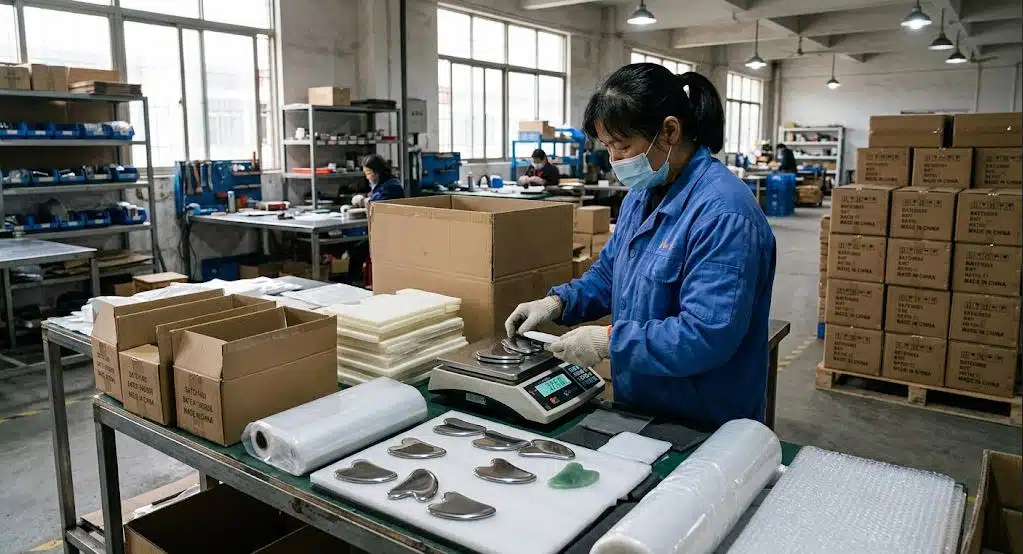
Why Stainless Steel Gua Sha Costs More to Pack and Ship: Real Data from a Stainless Steel Gua Sha Manufacturer
If you are comparing a stainless steel gua sha manufacturer with a stone supplier, one number matters most. 2,000 rose quartz pieces cost $630 to fly to the US, while 2,000 pieces of 304 stainless steel cost $1,200 at almost the same $6/kg rate. The rate did not change. The weight and the box count did. Steel pieces weigh 95 g against 50 g, so you move about 200 kg instead of 105 kg. Add the protection that polished metal needs, and your guasha shipping fee nearly doubles. This article shows why that happens, what it means for your stainless steel gua sha wholesale budget, and which numbers to request before you approve any quote. Think of this as a risk disclosure from the workshop floor. You will see the real orders first, then the physics, the packing logic and the buyer checklist. Two Real Orders From a Stainless Steel Gua Sha Manufacturer: 2,000 Pieces by Air to the US Real orders explain this faster than theory does, so start there. In April 2025 and October 2025, our factory shipped two orders of exactly 2,000 pieces each by air to the United States. One order was natural rose quartz and the other was 304 stainless steel. Both moved at roughly $6 per kg, so the rate is fixed and only the weight of the boxes can change your bill. Did the steel order cost more because of a higher rate? No, and the table shows why. The Side-by-Side Freight Numbers Item Rose Quartz (Apr 2025) 304 Stainless Steel (Oct 2025) Quantity 2,000 pcs 2,000 pcs Thickness / weight per piece 6 mm / 50 g 4.5 mm / 95 g Pieces per carton 200 100 Number of cartons 10 20 Gross weight per carton 10.5 kg 10 kg Total gross weight 105 kg ~200 kg Air freight rate ~$6/kg ~$6/kg Total freight $630 $1,200 Read the table from the bottom up. The freight rate is identical, so the entire $570 gap sits in the gross weight line. Per piece, you pay about $0.32 to fly a rose quartz tool and $0.60 to fly a stainless steel one. That is a 90% increase on the same route, with the same method and the same rate. This means you can stop asking whether steel carries a “higher freight rate” and start asking how many kilograms your order will weigh once it is boxed. Where the Extra Weight Comes From Start with the pieces themselves. At 95 g each, 2,000 steel tools weigh 190 kg before a single carton is closed, while 2,000 rose quartz tools at 50 g weigh 100 kg. Subtract net weight from gross weight and the packing side appears. The quartz order carried about 5 kg of cartons and cushioning, and the steel order carried about 10 kg. The steel tools are thinner, 4.5 mm against 6 mm, yet they still weigh almost twice as much. The International Gem Society lists quartz at a specific gravity of about 2.65, and stainless steel sits near 7.9, roughly three times denser. This means you can predict most of your freight increase from piece weight alone, before anyone quotes you a single box. What This Means for Your Stainless Steel Gua Sha Manufacturer Quote Here is the risk worth spotting early. A quote that lists only a unit price and a unit weight hides the two figures that drive your landed cost, which are carton count and gross weight. A stone gua sha factory packing 200 pieces per carton and a metal workshop packing 100 pieces per carton are describing different logistics, even when both write “standard export packing” on the quotation. The failure modes differ too. GIA notes that rose quartz often carries internal fractures, so stone cartons are built to absorb shock. Steel cartons are built to keep polished surfaces from touching each other. Keeping steel tools scratch-free means a gua sha packaging safe plan built around separation, not cushioning alone. You can check any quote in five minutes. First, ask for the gross weight per carton and the number of cartons in writing. Second, multiply cartons by gross weight by the freight rate. For the steel order that gives 20 × 10 kg × $6 = $1,200. Third, divide by piece count to get freight per piece, then add it to the unit price before you compare suppliers. When a stainless steel gua sha wholesale quote survives that test, the number on your invoice will match the number on your airway bill. Why a Stainless Steel Gua Sha Manufacturer Cannot Escape Density: Weight, Scale and Freight Freight is priced by the kilogram, so the story of your guasha shipping fee starts with one physical property. Density is mass per unit of volume, and gemologists measure it as specific gravity, a ratio against water. The International Gem Society explains how that test works. Two tools with the same outline and thickness will still differ in weight if one material is denser, and steel is denser by a wide margin. This means you can estimate the direction of your freight bill from a material table before you see a quotation. 7.9 Against 2.6: The Density Gap 304 stainless steel has a density of 7.93 g/cm³. Quartz and agate sit near 2.6, and nephrite jade measures 3.01 to 3.05 on the IGS listing. Even against the heavier jade, steel is about 2.6 times denser, and against quartz it is about three times denser. A steel tool and a stone tool with the same outline and thickness therefore differ in mass by a factor of 2.6 to 3. A stone gua sha factory that quotes weight from a stone template will understate a steel order by a wide margin. This means you should never carry a stone weight into a steel quotation, because the same design lands in a different freight bracket. Thinner Steel Helps, but Not Enough In our workshop, steel tools are usually cut to about 4.5 mm, against 6
If you are comparing a stainless steel gua sha manufacturer with a stone supplier, one number matters most. 2,000 rose quartz pieces cost $630 to fly to the US, while 2,000 pieces of 304 stainless steel cost $1,200 at almost the same $6/kg rate. The rate did not change. The weight and the box count did. Steel pieces weigh 95 g against 50 g, so you move about 200 kg instead of 105 kg. Add the protection that polished metal needs, and your guasha shipping fee nearly doubles. This article shows why that happens, what it means for your stainless steel gua sha wholesale budget, and which numbers to request before you approve any quote. Think of this as a risk disclosure from the workshop floor. You will see the real orders first, then the physics, the packing logic and the buyer checklist. Two Real Orders From a Stainless Steel Gua Sha Manufacturer: 2,000 Pieces by Air to the US Real orders explain this faster than theory does, so start there. In April 2025 and October 2025, our factory shipped two orders of exactly 2,000 pieces each by air to the United States. One order was natural rose quartz and the other was 304 stainless steel. Both moved at roughly $6 per kg, so the rate is fixed and only the weight of the boxes can change your bill. Did the steel order cost more because of a higher rate? No, and the table shows why. The Side-by-Side Freight Numbers Item Rose Quartz (Apr 2025) 304 Stainless Steel (Oct 2025) Quantity 2,000 pcs 2,000 pcs Thickness / weight per piece 6 mm / 50 g 4.5 mm / 95 g Pieces per carton 200 100 Number of cartons 10 20 Gross weight per carton 10.5 kg 10 kg Total gross weight 105 kg ~200 kg Air freight rate ~$6/kg ~$6/kg Total freight $630 $1,200 Read the table from the bottom up. The freight rate is identical, so the entire $570 gap sits in the gross weight line. Per piece, you pay about $0.32 to fly a rose quartz tool and $0.60 to fly a stainless steel one. That is a 90% increase on the same route, with the same method and the same rate. This means you can stop asking whether steel carries a “higher freight rate” and start asking how many kilograms your order will weigh once it is boxed. Where the Extra Weight Comes From Start with the pieces themselves. At 95 g each, 2,000 steel tools weigh 190 kg before a single carton is closed, while 2,000 rose quartz tools at 50 g weigh 100 kg. Subtract net weight from gross weight and the packing side appears. The quartz order carried about 5 kg of cartons and cushioning, and the steel order carried about 10 kg. The steel tools are thinner, 4.5 mm against 6 mm, yet they still weigh almost twice as much. The International Gem Society lists quartz at a specific gravity of about 2.65, and stainless steel sits near 7.9, roughly three times denser. This means you can predict most of your freight increase from piece weight alone, before anyone quotes you a single box. What This Means for Your Stainless Steel Gua Sha Manufacturer Quote Here is the risk worth spotting early. A quote that lists only a unit price and a unit weight hides the two figures that drive your landed cost, which are carton count and gross weight. A stone gua sha factory packing 200 pieces per carton and a metal workshop packing 100 pieces per carton are describing different logistics, even when both write “standard export packing” on the quotation. The failure modes differ too. GIA notes that rose quartz often carries internal fractures, so stone cartons are built to absorb shock. Steel cartons are built to keep polished surfaces from touching each other. Keeping steel tools scratch-free means a gua sha packaging safe plan built around separation, not cushioning alone. You can check any quote in five minutes. First, ask for the gross weight per carton and the number of cartons in writing. Second, multiply cartons by gross weight by the freight rate. For the steel order that gives 20 × 10 kg × $6 = $1,200. Third, divide by piece count to get freight per piece, then add it to the unit price before you compare suppliers. When a stainless steel gua sha wholesale quote survives that test, the number on your invoice will match the number on your airway bill. Why a Stainless Steel Gua Sha Manufacturer Cannot Escape Density: Weight, Scale and Freight Freight is priced by the kilogram, so the story of your guasha shipping fee starts with one physical property. Density is mass per unit of volume, and gemologists measure it as specific gravity, a ratio against water. The International Gem Society explains how that test works. Two tools with the same outline and thickness will still differ in weight if one material is denser, and steel is denser by a wide margin. This means you can estimate the direction of your freight bill from a material table before you see a quotation. 7.9 Against 2.6: The Density Gap 304 stainless steel has a density of 7.93 g/cm³. Quartz and agate sit near 2.6, and nephrite jade measures 3.01 to 3.05 on the IGS listing. Even against the heavier jade, steel is about 2.6 times denser, and against quartz it is about three times denser. A steel tool and a stone tool with the same outline and thickness therefore differ in mass by a factor of 2.6 to 3. A stone gua sha factory that quotes weight from a stone template will understate a steel order by a wide margin. This means you should never carry a stone weight into a steel quotation, because the same design lands in a different freight bracket. Thinner Steel Helps, but Not Enough In our workshop, steel tools are usually cut to about 4.5 mm, against 6