If you are comparing a stainless steel gua sha manufacturer with a stone supplier, one number matters most. 2,000 rose quartz pieces cost $630 to fly to the US, while 2,000 pieces of 304 stainless steel cost $1,200 at almost the same $6/kg rate. The rate did not change. The weight and the box count did. Steel pieces weigh 95 g against 50 g, so you move about 200 kg instead of 105 kg. Add the protection that polished metal needs, and your guasha shipping fee nearly doubles. This article shows why that happens, what it means for your stainless steel gua sha wholesale budget, and which numbers to request before you approve any quote.
Think of this as a risk disclosure from the workshop floor. You will see the real orders first, then the physics, the packing logic and the buyer checklist.
Two Real Orders From a Stainless Steel Gua Sha Manufacturer: 2,000 Pieces by Air to the US

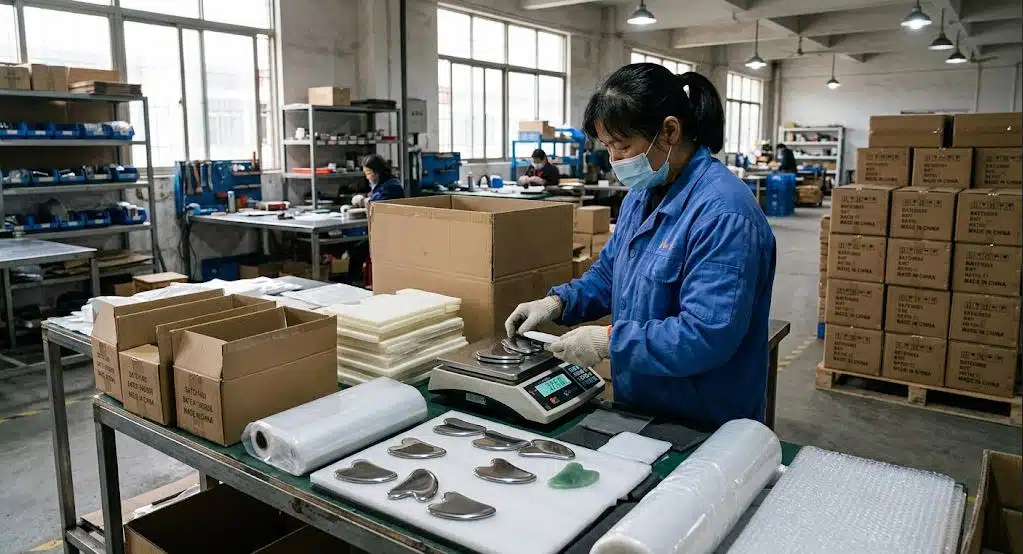
Real orders explain this faster than theory does, so start there. In April 2025 and October 2025, our factory shipped two orders of exactly 2,000 pieces each by air to the United States. One order was natural rose quartz and the other was 304 stainless steel. Both moved at roughly $6 per kg, so the rate is fixed and only the weight of the boxes can change your bill. Did the steel order cost more because of a higher rate? No, and the table shows why.
The Side-by-Side Freight Numbers
| Item | Rose Quartz (Apr 2025) | 304 Stainless Steel (Oct 2025) |
|---|---|---|
| Quantity | 2,000 pcs | 2,000 pcs |
| Thickness / weight per piece | 6 mm / 50 g | 4.5 mm / 95 g |
| Pieces per carton | 200 | 100 |
| Number of cartons | 10 | 20 |
| Gross weight per carton | 10.5 kg | 10 kg |
| Total gross weight | 105 kg | ~200 kg |
| Air freight rate | ~$6/kg | ~$6/kg |
| Total freight | $630 | $1,200 |
Read the table from the bottom up. The freight rate is identical, so the entire $570 gap sits in the gross weight line. Per piece, you pay about $0.32 to fly a rose quartz tool and $0.60 to fly a stainless steel one. That is a 90% increase on the same route, with the same method and the same rate. This means you can stop asking whether steel carries a “higher freight rate” and start asking how many kilograms your order will weigh once it is boxed.
Where the Extra Weight Comes From
Start with the pieces themselves. At 95 g each, 2,000 steel tools weigh 190 kg before a single carton is closed, while 2,000 rose quartz tools at 50 g weigh 100 kg. Subtract net weight from gross weight and the packing side appears. The quartz order carried about 5 kg of cartons and cushioning, and the steel order carried about 10 kg.
The steel tools are thinner, 4.5 mm against 6 mm, yet they still weigh almost twice as much. The International Gem Society lists quartz at a specific gravity of about 2.65, and stainless steel sits near 7.9, roughly three times denser. This means you can predict most of your freight increase from piece weight alone, before anyone quotes you a single box.
What This Means for Your Stainless Steel Gua Sha Manufacturer Quote
Here is the risk worth spotting early. A quote that lists only a unit price and a unit weight hides the two figures that drive your landed cost, which are carton count and gross weight. A stone gua sha factory packing 200 pieces per carton and a metal workshop packing 100 pieces per carton are describing different logistics, even when both write “standard export packing” on the quotation.
The failure modes differ too. GIA notes that rose quartz often carries internal fractures, so stone cartons are built to absorb shock. Steel cartons are built to keep polished surfaces from touching each other. Keeping steel tools scratch-free means a gua sha packaging safe plan built around separation, not cushioning alone.
You can check any quote in five minutes. First, ask for the gross weight per carton and the number of cartons in writing. Second, multiply cartons by gross weight by the freight rate. For the steel order that gives 20 × 10 kg × $6 = $1,200. Third, divide by piece count to get freight per piece, then add it to the unit price before you compare suppliers. When a stainless steel gua sha wholesale quote survives that test, the number on your invoice will match the number on your airway bill.
Why a Stainless Steel Gua Sha Manufacturer Cannot Escape Density: Weight, Scale and Freight

Freight is priced by the kilogram, so the story of your guasha shipping fee starts with one physical property. Density is mass per unit of volume, and gemologists measure it as specific gravity, a ratio against water. The International Gem Society explains how that test works. Two tools with the same outline and thickness will still differ in weight if one material is denser, and steel is denser by a wide margin. This means you can estimate the direction of your freight bill from a material table before you see a quotation.
7.9 Against 2.6: The Density Gap
304 stainless steel has a density of 7.93 g/cm³. Quartz and agate sit near 2.6, and nephrite jade measures 3.01 to 3.05 on the IGS listing. Even against the heavier jade, steel is about 2.6 times denser, and against quartz it is about three times denser. A steel tool and a stone tool with the same outline and thickness therefore differ in mass by a factor of 2.6 to 3.
A stone gua sha factory that quotes weight from a stone template will understate a steel order by a wide margin. This means you should never carry a stone weight into a steel quotation, because the same design lands in a different freight bracket.
Thinner Steel Helps, but Not Enough
In our workshop, steel tools are usually cut to about 4.5 mm, against 6 to 7 mm for stone. If both shared one outline, 4.5 mm steel would still weigh about 2.2 times a 6 mm quartz tool (2.99 × 0.75). The real pair in the table came in at 1.9 times, because outline and edge shape also change volume.
Thickness is the one lever you control. Trimming 0.5 mm from a 4.5 mm design removes about 11% of its weight. On a 2,000-piece order, that is roughly 21 kg, or about $126 at $6 per kg. That only works if the feel and rigidity of the tool survive the cut. Ask your stainless steel gua sha manufacturer for a sample at the thinner gauge before you commit. This means you can see the freight saving and the handling trade-off side by side, before you approve production.
What a Stainless Steel Gua Sha Manufacturer Sees at 5,000 Pieces
Small per-piece differences look harmless until volume arrives. At the real weights, 5,000 rose quartz pieces weigh 250 kg and 5,000 steel pieces weigh 475 kg. That is a 225 kg gap, worth about $1,350 at $6 per kg, before a single carton is counted. A heavier design shows the scaling more clearly:
| Order size | 150 g stone tool | 300 g steel tool | Extra freight at ~$6/kg |
|---|---|---|---|
| 1,000 pcs | 150 kg | 300 kg | $900 |
| 5,000 pcs | 750 kg | 1,500 kg | $4,500 |
| 10,000 pcs | 1,500 kg | 3,000 kg | $9,000 |
Illustrative figures, net product weight only. Packaging adds to both columns.
Your rate stays flat while the gap grows in step with piece count. Are you budgeting freight per piece or per kilogram? Per kilogram stays accurate when your order size changes. For stainless steel gua sha wholesale volumes, this means you can size your freight budget by multiplying net weight by rate, before anyone has designed the box. The gua sha packaging safe plan for steel then adds its own kilograms on top, which is the subject of the next chapter.
Why a Stainless Steel Gua Sha Manufacturer Packs Heavier Than a Stone Supplier

Weight explains your freight, and hardness explains your packaging. Stone tools fear a drop, because quartz and jade can crack, chip or extend natural fissures. Steel tools survive most drops but fear each other, because polished and brushed surfaces mark easily and one loose corner can scar a mirror finish. That difference in failure mode is why a gua sha packaging safe for steel looks nothing like a plan for stone. This means you cannot reuse a stone carton spec and expect scratch-free steel at the other end.
Steel Scratches Steel
Picture 100 steel tools in one carton with nothing between them. Every bump in transit turns the load into 100 hard pieces sliding against one another, with polished faces, sharp edges and laser-marked logos all exposed. A scratch on a mirror polish shows under a single lamp, and a rubbed logo is a return waiting to happen.
Each tool therefore needs its own barrier. The usual stack is a PE bag, then a divider such as pearl cotton, paper sheets, honeycomb paper or a paper tray, then an inner box or bag, then the outer carton. Bubble wrap fills the remaining gaps. This means you can expect an unblemished finish only when no two steel surfaces ever touch.
The Carton Has to Carry the Weight
Weight raises the standard for the box as well. Rose quartz at about 50 g packs 200 pieces to a carton at roughly 10 to 11 kg gross. Pack steel at about 95 g the same way and the carton holds 19 kg of metal before any cushioning, which lands near 20 kg gross. On a long international route, that is where seams split, corners crush and the carton bottom gives way.
For that reason, steel cartons are capped at around 100 pieces and rarely exceed 120. A 5,000-piece stone order fills 25 cartons at 200 pieces each. The same count in steel fills 50 cartons at 100 pieces each. Thicker corrugated board, stronger inner boxes, deeper cushioning, strapping, stretch film and pallets all follow from that step. Every added carton also lifts your guasha shipping fee, because it brings its own board, tape and labour along with it. This means you can read the carton count as a direct signal of how much protection your order receives, and budget for it as a real line item.
How to Check a Stainless Steel Gua Sha Manufacturer’s Packing Plan
You can test a packing plan without visiting the factory. Start by asking which layer separates one tool from the next, because “export carton” alone tells you nothing. Then ask for pieces per carton and gross weight, and confirm the carton sits near 10 kg rather than 20 kg. Next, ask whether the carton has been drop and compression tested. The ISTA 3A procedure is a common reference, since it simulates handling stresses such as drops and vibration for parcels up to 70 kg. Finally, ask for a photo of the packed carton opened from the top.
A stone gua sha factory will show you cushioning. A metal workshop should show you separation. This means you can spot a plan that saves cost by skipping layers before you sign a stainless steel gua sha wholesale order, and decide whether that saving is worth the scratch risk.
Chargeable Weight Explained by a Stainless Steel Gua Sha Manufacturer: Why Heavy Steel Can Ship for Less Than You Expect

Air carriers do not simply weigh your boxes. They compare two numbers, actual weight and volumetric weight, and bill the higher one. IATA describes this rule, and Maersk’s chargeable weight guide gives the standard formula: length × width × height in centimetres, divided by 6,000. Express couriers often divide by 5,000 instead, which makes the same box cost more. Two quotes with identical weights can therefore produce different guasha shipping fee totals. This means you cannot judge a quote until you know which divisor and which carton size sit behind it.
Actual Weight Versus Volumetric Weight
Steel is dense, so a carton of steel tools is heavy for its size. Take an illustrative carton of 40 × 30 × 25 cm holding 100 pieces at 10 kg gross. Its volume is 30,000 cm³, and dividing by 6,000 gives 5 kg of volumetric weight. Actual weight wins at 10 kg, so you pay for 10 kg and the box dimensions add nothing.
That is why heavy steel can ship for less than you feared. Compact cartons are billed on kilograms alone. Lighter goods packed in bulky cushioning can be lifted by volume, which narrows the gap between materials. This means you can expect a compact steel order to be billed close to its true weight.
When Protection Layers Flip the Bill
Now add colour boxes, foam trays and an oversized outer carton to keep every tool apart. Suppose the carton grows to 60 × 40 × 40 cm, or 96,000 cm³. Volumetric weight becomes 16 kg while actual weight stays at 10 kg, so the carrier bills 16 kg. Across 20 cartons that is 320 kg instead of 200 kg. At $6 per kg, your freight moves from $1,200 to $1,920.
That is $720 more, or $0.36 per piece on a 2,000-piece order, with no extra product inside. (Carton sizes here are illustrative, not measurements from the two orders above.) Packing that protects the finish but wastes space costs you twice. This means you can compare two steel quotes with the same net weight and still see very different freight, purely from carton size.
How a Stainless Steel Gua Sha Manufacturer Keeps Cartons Under the Line
The fix is layout, not fewer layers. Flat-packed paper dividers and trays hold tools apart using less volume than loose foam fill. Right-sized cartons keep the outer box close to the stack. Colour boxes can sit inside a carton cut to their footprint instead of floating in extra space.
Then check the result with the formula. Divide volume in cm³ by 6,000 and compare it with gross weight. If volumetric weight is higher, the box has too much air in it. Do not remove separation to hit the number, because the gua sha packaging safe rule for steel is that polished surfaces never touch. A stone gua sha factory that packs light stone in generous foam should run the same check.
Before you place an order, ask your stainless steel gua sha manufacturer for the carton size and the volumetric weight in writing. This means you can see whether your freight is billed on product or on air, and you can compare stainless steel gua sha wholesale quotes on equal terms.
What to Ask a Stainless Steel Gua Sha Manufacturer Before You Compare Quotes

Comparing per-piece prices is the fastest way to misjudge a steel order. A unit price says nothing about how many cartons your goods fill, how much they weigh once packed, or how much air rides along inside each box. Those three facts decide your guasha shipping fee, and they appear on a quotation only if you ask for them. Treat the request as a short data sheet, not a negotiation. This means you can put two suppliers on the same footing in a single email.
1. The Numbers Every Stainless Steel Gua Sha Manufacturer Quote Should Contain?
Ask for seven figures: net weight, gross weight, pieces per carton, carton size, total cartons, total gross weight and total volume in CBM. A complete line reads like this: 5,000 pcs; 100 pcs/carton; 50 cartons; carton size XX × XX × XX cm; net weight XXX kg; gross weight XXX kg; total volume XXX CBM.
If any field is blank, the supplier is asking you to carry the risk of the missing number. Blank fields tend to fill themselves in later, on your freight invoice. This means you can treat an incomplete data sheet as an unpriced cost, not a saving.
2. A Worked Example You Can Copy?
Use the real weights from earlier. Steel first. 5,000 pieces at 95 g weigh 475 kg net. At 100 pieces and about 10 kg per carton, you get 50 cartons and roughly 500 kg gross. Air freight at $6 per kg comes to about $3,000, or $0.60 per piece.
Now stone. 5,000 pieces at 50 g, packed 200 to a 10.5 kg carton, give 25 cartons and 262.5 kg gross. That costs $1,575, or about $0.32 per piece.
The method takes three steps. Cartons equal pieces divided by pieces per carton. Gross weight equals cartons times carton weight. Freight equals the higher of gross and volumetric weight, times the rate. This means you can rebuild any supplier’s freight figure in under two minutes and catch a mismatch before you pay a deposit.
3. How a Stainless Steel Gua Sha Manufacturer’s Carton Plan Changes Your Landed Cost?
Landed cost is unit price plus freight per piece, and the cheaper unit price does not always win. Take two illustrative steel quotes for 2,000 pieces.
- Supplier A charges $4.00 per piece but ships in oversized cartons that bill at 320 kg. That is $1,920 in freight, or $0.96 per piece, so $4.96 landed.
- Supplier B charges $4.20 per piece and ships compact cartons billed at 200 kg. That is $1,200 in freight, or $0.60 per piece, so $4.80 landed.
Supplier B costs $0.16 less per piece, or $320 across the order. The unit prices are invented for this illustration, and the freight figures follow the carton examples in the previous chapter. This means you can save money by choosing the carton plan, not only by negotiating the unit price.
The same logic applies whether you buy from a stone gua sha factory or a metal workshop. If a supplier cuts separation layers to shrink the carton, ask what happens to the finish, because a plan that is not gua sha packaging safe moves the cost into your returns. When you request a stainless steel gua sha wholesale quote from Deyi Gems, you can ask for this full data sheet on any design and see it before you commit to a deposit.
Shape, Stacking and Compliance: What a Stainless Steel Gua Sha Manufacturer Should Disclose About Risk

Weight and carton count are only part of the risk picture. The shape of the tool changes how tightly it packs, and the material changes which documents you should ask for. A supplier who names both up front is giving you a complete quote. This means you can spot missing information before it becomes a claim.
Why Shape Changes Your Carton Count
Bare steel blanks stack like plates, but finished tools do not. CNC-cut, stamped, curved or hollowed designs with thick edges and contoured faces cannot nest flat, and each one needs a small gap so nothing rubs. A hundred bare blanks may form a tight pile. The same hundred bagged, divided and boxed occupy visibly more space. That extra volume can push a carton from actual-weight billing into volumetric billing, as the previous chapter showed. This means you should ask for total CBM alongside weight, so you can see how much of your freight comes from the design and how much is empty space.
Stone Risk Versus Steel Risk
The two materials fail in different ways, so the same carton spec cannot serve both. The International Gem Society lists rose quartz at Mohs hardness 7 with no cleavage, so a stone tool resists scratches but can still chip or crack on impact. Steel does the opposite: it shrugs off drops and marks easily.
| Matter | Stone gua sha | Steel gua sha |
|---|---|---|
| Main transit risk | Chipping, cracking, natural fractures widening | Scratches, edge dings, rubbed logos, heavy cartons |
| Packing focus | Cushioning and shock absorption | Separation, anti-friction, load-bearing |
| Document to ask for | Gemstone identification report | Mill certificate and nickel-release report |
A stone gua sha factory and a steel workshop should therefore quote different packing plans, and a gua sha packaging safe plan for one is not automatically safe for the other. This means you can use the table as a checklist when a supplier offers both materials.
Compliance Checks a Stainless Steel Gua Sha Manufacturer Should Show You
Steel gua sha tools touch skin, so many buyers request nickel-release data. Grade 304 contains roughly 8 to 10.5% nickel bound inside the alloy, and finished tools generally release little of it, but a test result is better than an assumption. In the EU, REACH Annex XVII entry 27 caps nickel release at 0.5 µg/cm²/week for articles in direct and prolonged skin contact, measured with EN 1811, as SGS explains for the 2023 revision. The Nickel Institute notes that China’s GB 28480-2012 sets the same limit for skin-contact articles.
Gua sha contact is brief, so whether entry 27 applies to your tool depends on how it is classified and marketed. Confirm that with your compliance advisor, since this is general information and not legal advice.
You can run a simple document check. First, ask for a mill certificate that shows the 304 grade. Second, ask for a nickel-release report on the finished tool, not on a raw sheet, and check that the report names the test method. Third, for stone lots, request an identification report, since labs such as SSEF and GIA issue these for gemstones. Ask for the same set before any stainless steel gua sha wholesale order leaves the workshop. This means you can enter your destination market with paperwork already in hand.