Why a Gua Sha Lymphatic Brush Manufacturer Quotes Higher Prices and Longer Lead Times: Industry Experience and Risk Disclosure
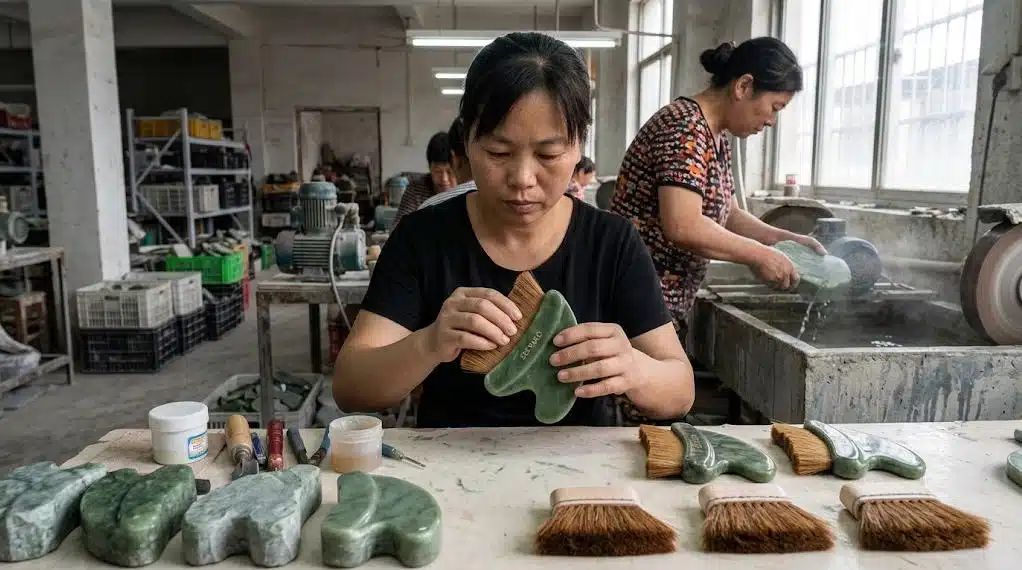
A Gua Sha Lymphatic Brush manufacturer runs two production chains for one product. That is why a jade-and-bristle brush often needs about 35 days where a standard jade gua sha board needs about 25 (example figures, for illustration only). Deyi Gems has spent more than 12 years working with jade and crystal tools, and buyers regularly put the two quotes side by side and ask where the extra cost hides. You will find the answer in the process, not in the price per kilogram of stone. A lymphatic brush asks you to pay for stone shaping, bristle preparation, bonding, curing, trimming, and a second round of inspection. This guide walks you through each step in plain language, shows where gua sha risks concentrate, and gives you the numbers you need to judge any quotation. Ready to see what your money actually buys? How a Gua Sha Lymphatic Brush Manufacturer Splits One Product Into Two Chains A standard jade gua sha board follows a single road: raw stone, cutting, shaping, CNC or hand trimming, several grinding passes, polishing, and inspection. Once the polish is done, the product is essentially finished. A lymphatic brush does not work that way. After the stone steps, it still needs bristle preparation, tufting or fixing, trimming, cleaning, assembly, and a final check. This means you are buying a composite product, so you should compare it to a finished tool with moving quality variables, not to a plain board with a little extra fluff. The Standard Jade Board Route Most gua sha production lines are built around one material and one set of skills. A workshop cuts the stone, shapes the outline, grinds the surface in stages, and polishes until the edge feels smooth against skin. Inspection focuses on size, edge condition, surface finish, and natural pattern. The stone itself is forgiving in one respect. GIA notes that nephrite scores 6 to 6.5 on the Mohs scale and jadeite 6.5 to 7, yet both have exceptional toughness and resist breaking or chipping. That toughness is what lets a gua sha factory grind a board thin and still ship it safely. It also explains why many buyers assume any jade product is simple to make. This means you can expect a plain board to be predictable, but you should not expect the same predictability once more parts enter the product. The Gua Sha Lymphatic Brush Manufacturer Route: Two Chains Meeting at Assembly A lymphatic brush needs two separate workflows that must finish at the same time. The first chain turns raw stone into a polished jade body, often with thinner edges, a larger flat area, or holes and grooves for the bristles. The second chain prepares the bristles, fixes them in place, cures the bond, and trims the tufts into an even surface. Only then can assembly begin. Here is the catch. If the jade body is polished but the bristle component is still waiting for its turn, your whole order sits idle, and the same is true in reverse. A Gua Sha Lymphatic Brush manufacturer therefore spends as much time coordinating the two chains as running either one. This means you should ask any supplier for two timelines, one for the stone and one for the bristle component, instead of accepting a single delivery date. What This Changes for Your Purchase Order Picture a 500-piece guasha custom order (for illustration). The stone may finish early, the bristle supplier may be late, or the tufting station may have a queue. Any one of those delays pushes the final date. This means you will get a more accurate schedule when you confirm bristle specifications and approve a Golden Sample before the stone is cut, because a Gua Sha Lymphatic Brush manufacturer can then start both chains on day one. Cost Per Acceptable Piece: The Number a Gua Sha Lymphatic Brush Manufacturer Should Show You Raw jade is priced per kilogram, but you do not sell kilograms. You sell finished pieces that pass inspection, so the figure that matters is cost per acceptable finished piece. A Gua Sha Lymphatic Brush manufacturer who quotes only the stone price per kilogram is hiding the largest variable in your order. This means you can compare two suppliers fairly only when both tell you how many sellable pieces come out of each kilogram. Why Jade Bodies for Brushes Lose More Stone A lymphatic brush body is often thinner, wider, and more detailed than a standard board. It may carry bristle holes or grooves, a more complex outline, or a larger flat face. Natural jade is not uniform: GIA describes jade as a group of natural materials with varied color, translucency, and structure, which includes internal fissures and texture changes you cannot see on the rough surface. Once the body gets thin or gets drilled, those hidden features turn into chipped edges and cracks. That is where gua sha risks start to show up in the numbers. Every cracked blank is a loss the factory has already paid for in stone, labor, and machine time. This means the more complex your design, the more you should expect the quote to reflect rejected pieces, not only the pieces you receive. A Worked Example of Yield and Cost Consider a simple illustration, using made-up round numbers to show the logic. Say a batch of blanks costs 100 units of money in stone and processing for each standard board attempt. If 80 out of 100 boards pass inspection, each acceptable board carries a cost of 1.25 units (100 divided by 80). A thinner brush body with a drilled groove might pass at 65 out of 100, which puts each acceptable body at about 1.54 units. The stone price did not change, yet the cost per acceptable body is roughly 23% higher. In gua sha production, that gap appears before a single bristle is added. This means you should ask every gua sha factory for an expected pass rate on your exact design, because a 15-point yield difference
A Gua Sha Lymphatic Brush manufacturer runs two production chains for one product. That is why a jade-and-bristle brush often needs about 35 days where a standard jade gua sha board needs about 25 (example figures, for illustration only). Deyi Gems has spent more than 12 years working with jade and crystal tools, and buyers regularly put the two quotes side by side and ask where the extra cost hides. You will find the answer in the process, not in the price per kilogram of stone. A lymphatic brush asks you to pay for stone shaping, bristle preparation, bonding, curing, trimming, and a second round of inspection. This guide walks you through each step in plain language, shows where gua sha risks concentrate, and gives you the numbers you need to judge any quotation. Ready to see what your money actually buys? How a Gua Sha Lymphatic Brush Manufacturer Splits One Product Into Two Chains A standard jade gua sha board follows a single road: raw stone, cutting, shaping, CNC or hand trimming, several grinding passes, polishing, and inspection. Once the polish is done, the product is essentially finished. A lymphatic brush does not work that way. After the stone steps, it still needs bristle preparation, tufting or fixing, trimming, cleaning, assembly, and a final check. This means you are buying a composite product, so you should compare it to a finished tool with moving quality variables, not to a plain board with a little extra fluff. The Standard Jade Board Route Most gua sha production lines are built around one material and one set of skills. A workshop cuts the stone, shapes the outline, grinds the surface in stages, and polishes until the edge feels smooth against skin. Inspection focuses on size, edge condition, surface finish, and natural pattern. The stone itself is forgiving in one respect. GIA notes that nephrite scores 6 to 6.5 on the Mohs scale and jadeite 6.5 to 7, yet both have exceptional toughness and resist breaking or chipping. That toughness is what lets a gua sha factory grind a board thin and still ship it safely. It also explains why many buyers assume any jade product is simple to make. This means you can expect a plain board to be predictable, but you should not expect the same predictability once more parts enter the product. The Gua Sha Lymphatic Brush Manufacturer Route: Two Chains Meeting at Assembly A lymphatic brush needs two separate workflows that must finish at the same time. The first chain turns raw stone into a polished jade body, often with thinner edges, a larger flat area, or holes and grooves for the bristles. The second chain prepares the bristles, fixes them in place, cures the bond, and trims the tufts into an even surface. Only then can assembly begin. Here is the catch. If the jade body is polished but the bristle component is still waiting for its turn, your whole order sits idle, and the same is true in reverse. A Gua Sha Lymphatic Brush manufacturer therefore spends as much time coordinating the two chains as running either one. This means you should ask any supplier for two timelines, one for the stone and one for the bristle component, instead of accepting a single delivery date. What This Changes for Your Purchase Order Picture a 500-piece guasha custom order (for illustration). The stone may finish early, the bristle supplier may be late, or the tufting station may have a queue. Any one of those delays pushes the final date. This means you will get a more accurate schedule when you confirm bristle specifications and approve a Golden Sample before the stone is cut, because a Gua Sha Lymphatic Brush manufacturer can then start both chains on day one. Cost Per Acceptable Piece: The Number a Gua Sha Lymphatic Brush Manufacturer Should Show You Raw jade is priced per kilogram, but you do not sell kilograms. You sell finished pieces that pass inspection, so the figure that matters is cost per acceptable finished piece. A Gua Sha Lymphatic Brush manufacturer who quotes only the stone price per kilogram is hiding the largest variable in your order. This means you can compare two suppliers fairly only when both tell you how many sellable pieces come out of each kilogram. Why Jade Bodies for Brushes Lose More Stone A lymphatic brush body is often thinner, wider, and more detailed than a standard board. It may carry bristle holes or grooves, a more complex outline, or a larger flat face. Natural jade is not uniform: GIA describes jade as a group of natural materials with varied color, translucency, and structure, which includes internal fissures and texture changes you cannot see on the rough surface. Once the body gets thin or gets drilled, those hidden features turn into chipped edges and cracks. That is where gua sha risks start to show up in the numbers. Every cracked blank is a loss the factory has already paid for in stone, labor, and machine time. This means the more complex your design, the more you should expect the quote to reflect rejected pieces, not only the pieces you receive. A Worked Example of Yield and Cost Consider a simple illustration, using made-up round numbers to show the logic. Say a batch of blanks costs 100 units of money in stone and processing for each standard board attempt. If 80 out of 100 boards pass inspection, each acceptable board carries a cost of 1.25 units (100 divided by 80). A thinner brush body with a drilled groove might pass at 65 out of 100, which puts each acceptable body at about 1.54 units. The stone price did not change, yet the cost per acceptable body is roughly 23% higher. In gua sha production, that gap appears before a single bristle is added. This means you should ask every gua sha factory for an expected pass rate on your exact design, because a 15-point yield difference