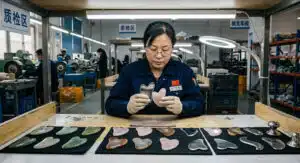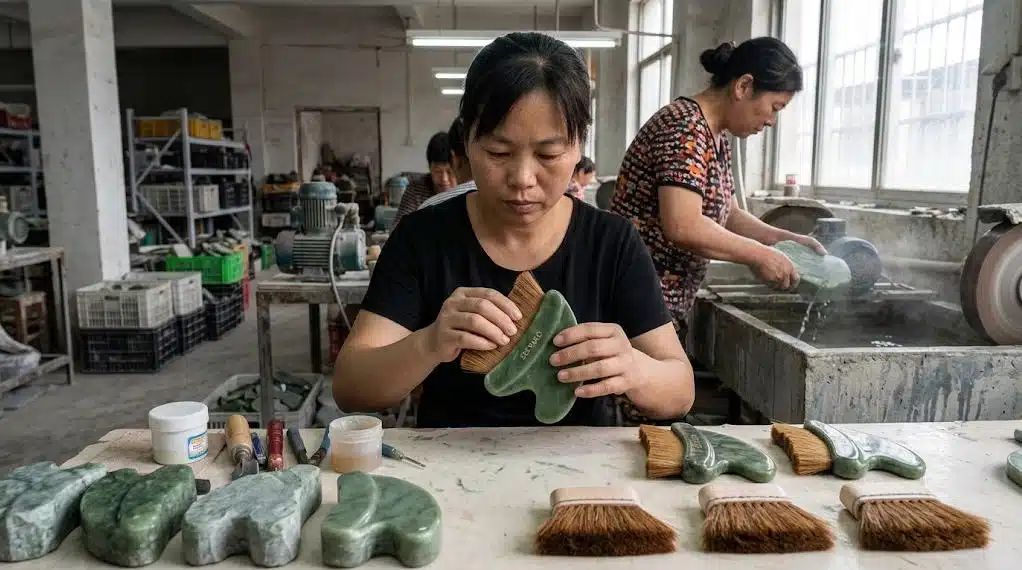
A Gua Sha Lymphatic Brush manufacturer runs two production chains for one product. That is why a jade-and-bristle brush often needs about 35 days where a standard jade gua sha board needs about 25 (example figures, for illustration only). Deyi Gems has spent more than 12 years working with jade and crystal tools, and buyers regularly put the two quotes side by side and ask where the extra cost hides. You will find the answer in the process, not in the price per kilogram of stone. A lymphatic brush asks you to pay for stone shaping, bristle preparation, bonding, curing, trimming, and a second round of inspection. This guide walks you through each step in plain language, shows where gua sha risks concentrate, and gives you the numbers you need to judge any quotation. Ready to see what your money actually buys?
- How a Gua Sha Lymphatic Brush Manufacturer Splits One Product Into Two Chains
- Cost Per Acceptable Piece: The Number a Gua Sha Lymphatic Brush Manufacturer Should Show You
- Bonding Soft Bristles to Hard Jade: The Step Every Gua Sha Lymphatic Brush Manufacturer Must Get Right
- Two Quality Systems in One Product: How a Gua Sha Lymphatic Brush Manufacturer Inspects and Documents
- Why Lead Times Stretch at a Gua Sha Lymphatic Brush Manufacturer: The Slowest Chain Decides
- Small Batches and Custom Orders: Where a Gua Sha Lymphatic Brush Manufacturer's Fixed Costs Show Up
- Packaging, Risk Disclosure, and Your Next Step With a Gua Sha Lymphatic Brush Manufacturer
How a Gua Sha Lymphatic Brush Manufacturer Splits One Product Into Two Chains
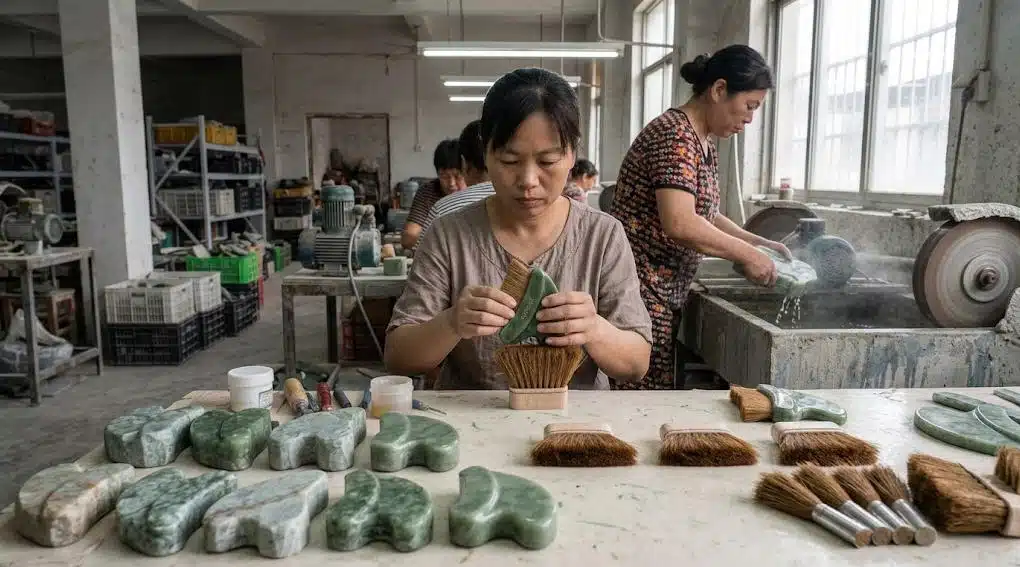
A standard jade gua sha board follows a single road: raw stone, cutting, shaping, CNC or hand trimming, several grinding passes, polishing, and inspection. Once the polish is done, the product is essentially finished. A lymphatic brush does not work that way. After the stone steps, it still needs bristle preparation, tufting or fixing, trimming, cleaning, assembly, and a final check. This means you are buying a composite product, so you should compare it to a finished tool with moving quality variables, not to a plain board with a little extra fluff.
The Standard Jade Board Route
Most gua sha production lines are built around one material and one set of skills. A workshop cuts the stone, shapes the outline, grinds the surface in stages, and polishes until the edge feels smooth against skin. Inspection focuses on size, edge condition, surface finish, and natural pattern.
The stone itself is forgiving in one respect. GIA notes that nephrite scores 6 to 6.5 on the Mohs scale and jadeite 6.5 to 7, yet both have exceptional toughness and resist breaking or chipping. That toughness is what lets a gua sha factory grind a board thin and still ship it safely. It also explains why many buyers assume any jade product is simple to make. This means you can expect a plain board to be predictable, but you should not expect the same predictability once more parts enter the product.
The Gua Sha Lymphatic Brush Manufacturer Route: Two Chains Meeting at Assembly
A lymphatic brush needs two separate workflows that must finish at the same time. The first chain turns raw stone into a polished jade body, often with thinner edges, a larger flat area, or holes and grooves for the bristles. The second chain prepares the bristles, fixes them in place, cures the bond, and trims the tufts into an even surface. Only then can assembly begin.
Here is the catch. If the jade body is polished but the bristle component is still waiting for its turn, your whole order sits idle, and the same is true in reverse. A Gua Sha Lymphatic Brush manufacturer therefore spends as much time coordinating the two chains as running either one. This means you should ask any supplier for two timelines, one for the stone and one for the bristle component, instead of accepting a single delivery date.
What This Changes for Your Purchase Order
Picture a 500-piece guasha custom order (for illustration). The stone may finish early, the bristle supplier may be late, or the tufting station may have a queue. Any one of those delays pushes the final date. This means you will get a more accurate schedule when you confirm bristle specifications and approve a Golden Sample before the stone is cut, because a Gua Sha Lymphatic Brush manufacturer can then start both chains on day one.
Cost Per Acceptable Piece: The Number a Gua Sha Lymphatic Brush Manufacturer Should Show You
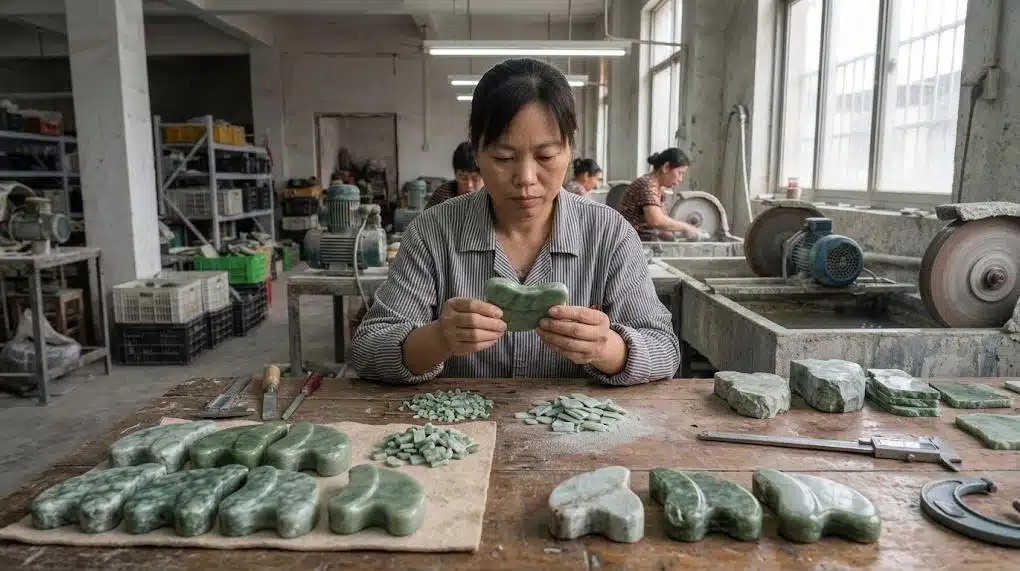
Raw jade is priced per kilogram, but you do not sell kilograms. You sell finished pieces that pass inspection, so the figure that matters is cost per acceptable finished piece. A Gua Sha Lymphatic Brush manufacturer who quotes only the stone price per kilogram is hiding the largest variable in your order. This means you can compare two suppliers fairly only when both tell you how many sellable pieces come out of each kilogram.
Why Jade Bodies for Brushes Lose More Stone
A lymphatic brush body is often thinner, wider, and more detailed than a standard board. It may carry bristle holes or grooves, a more complex outline, or a larger flat face. Natural jade is not uniform: GIA describes jade as a group of natural materials with varied color, translucency, and structure, which includes internal fissures and texture changes you cannot see on the rough surface. Once the body gets thin or gets drilled, those hidden features turn into chipped edges and cracks.
That is where gua sha risks start to show up in the numbers. Every cracked blank is a loss the factory has already paid for in stone, labor, and machine time. This means the more complex your design, the more you should expect the quote to reflect rejected pieces, not only the pieces you receive.
A Worked Example of Yield and Cost
Consider a simple illustration, using made-up round numbers to show the logic. Say a batch of blanks costs 100 units of money in stone and processing for each standard board attempt. If 80 out of 100 boards pass inspection, each acceptable board carries a cost of 1.25 units (100 divided by 80). A thinner brush body with a drilled groove might pass at 65 out of 100, which puts each acceptable body at about 1.54 units.
The stone price did not change, yet the cost per acceptable body is roughly 23% higher. In gua sha production, that gap appears before a single bristle is added. This means you should ask every gua sha factory for an expected pass rate on your exact design, because a 15-point yield difference moves your unit cost more than a small change in the stone price.
How a Gua Sha Lymphatic Brush Manufacturer Controls Gua Sha Risks in the Stone
You can reduce stone losses with three practical choices. First, select blanks by inspecting the slab for visible fissures before cutting, since SSEF and other gem laboratories treat internal features as a core part of identifying and grading natural stone. Second, adjust the thickness and corner radius of the design so edges are less likely to chip during grinding. Third, keep drilled areas away from visible veins when your design allows it.
A guasha custom project gives you room to make these choices before tooling starts. A gua sha manufacturer who reviews your drawing for stress points can lift the pass rate without changing how the product looks. This means you can often trim your unit cost by adjusting one measurement on the drawing, as long as you raise the question before the first blank is cut.
Bonding Soft Bristles to Hard Jade: The Step Every Gua Sha Lymphatic Brush Manufacturer Must Get Right
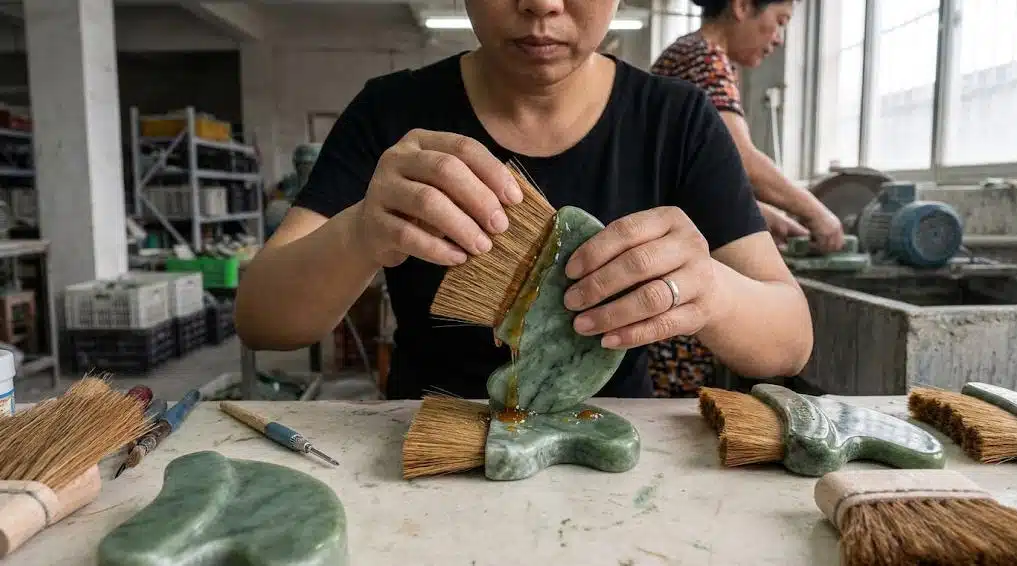
A jade board is finished when it is polished. A lymphatic brush is not, because someone still has to fix hundreds of soft bristles onto a hard, smooth, naturally varied stone. Plastic parts can be molded in one shot, but jade cannot, so the stone and the bristle system must be built to fit each other. This means you are paying for a precision assembly step, and you should treat it as the main difference between a brush and a board.
Inside the Bristle Workflow of a Gua Sha Lymphatic Brush Manufacturer
The bristle chain begins with the stone. The body needs holes, slots, or grooves cut to a set depth and spacing, and those cuts must sit inside the stone without weakening it. Then the bristles are sorted and bundled into tufts, placed into the openings, and fixed with adhesive or another method. After curing, the surface is trimmed to a consistent height, cleaned, and checked.
Every one of those steps adds labor and machine time that a plain board never needs. Gua sha production for a brush therefore includes a second set of skills, closer to brush making than to stone cutting. This means you get a product that feels uniform in the hand, as long as the supplier measures bristle length and density against an approved sample instead of by eye.
Where Gua Sha Risks Appear in Bristle Fixing
Three problems come up most often. The first is loose tufts, which show up as shedding after a few weeks of use. The second is uneven density, where one corner of the brush feels sparse. The third is adhesive overflow, leaving a hard residue on the stone or between bristles.
GIA points out that heat can damage jade, and warm acids can affect it, so the curing method and cleaning products are part of the design decision, not an afterthought. Any gua sha factory that bonds bristles to stone should be able to tell you what it uses and why. This means you can ask a direct question, such as “What cures this adhesive, and at what temperature?”, and a reliable supplier will answer without hesitation.
How to Check Bonding Quality Before You Approve a Run
You do not need a lab to protect your order. Four steps cover most of the exposure:
- Ask for a written bristle specification covering length, density, and softness range.
- Request a pull test on sample pieces, where tufts are tugged with a set force and the loose count is recorded.
- Inspect the joint between bristle and stone under good light for residue or gaps.
- Compare two random units from the same batch against the Golden Sample.
If you place a guasha custom order, put these four checks into your purchase agreement so the gua sha manufacturer knows what will be measured. A brush that passes a pull test on 20 sample pieces tells you far more than a verbal promise. This means you can reject a weak batch with documents in hand, instead of arguing about feel after the goods have shipped.
Why a Gua Sha Lymphatic Brush Manufacturer Cannot Rush This Stage
Curing takes time, trimming takes patience, and the stone body must be ready before the bristles can go in. If you push a Gua Sha Lymphatic Brush manufacturer to cut a day from this stage, the loss shows up later as returned product. Plan for the extra days up front, and you will likely save both the replacement cost and the review damage that comes with shedding bristles.
Two Quality Systems in One Product: How a Gua Sha Lymphatic Brush Manufacturer Inspects and Documents
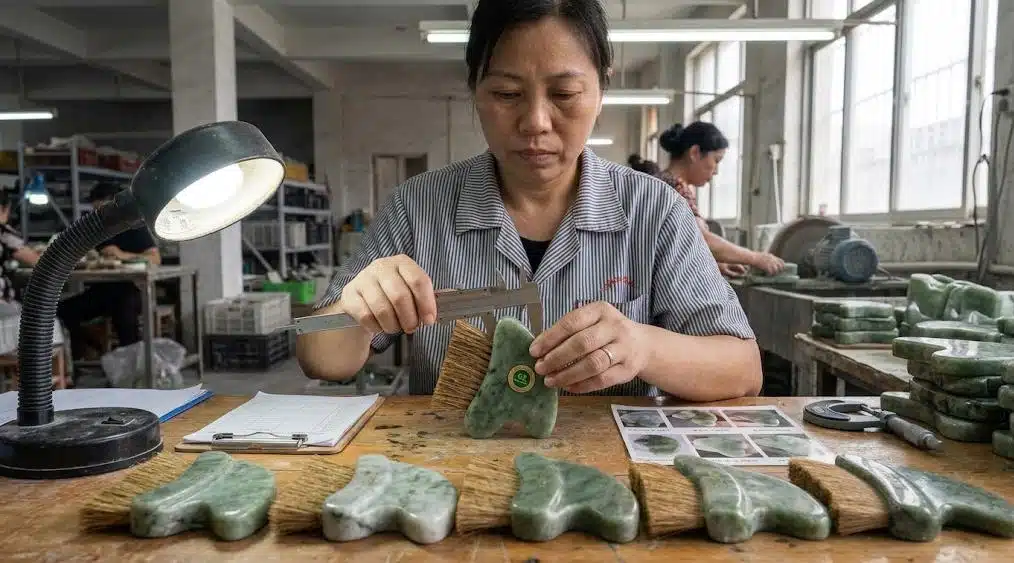
A jade board is judged by what you can measure with calipers and a good light. A lymphatic brush adds a second test that no caliper can run: how it feels on skin. Two brushes can share an identical stone body and still feel different, because one carries soft, dense bristles and the other carries stiff, sparse ones. This means a Gua Sha Lymphatic Brush manufacturer must run two quality systems side by side, and you should expect both to appear on your inspection report.
The Golden Sample Rules for a Gua Sha Lymphatic Brush Manufacturer
The Golden Sample is the approved piece that every production unit gets measured against. For a brush, it has to cover seven things at once: stone color and pattern, stone size and structure, bristle length, bristle density, bristle softness, surface evenness, and fixing strength. Natural stone will never match perfectly from piece to piece, so the sample sets an accepted range for color and pattern instead of a single exact shade.
That range is where most disputes begin. GIA reminds buyers that jade comes in many colors and translucency levels, so two pieces from the same lot will not be twins. A written range, with photos of the lightest and darkest acceptable pieces, gives both sides a fair rule. This means you can approve or reject a shipment against paper evidence, not against memory.
What Inspection Costs Compared With Returns
Quality checks look like an expense until you compare them with the alternative. Take a 500-piece guasha custom order with a unit cost of 10 money units (for illustration). Suppose a return costs roughly three times the unit price once you count shipping both ways, replacement, and lost sales. If 4% of the batch reaches customers with loose bristles, that is 20 pieces, or about 600 units of loss. A full inspection adds perhaps 2% to the unit cost, which is 100 units across the batch.
In this example, the inspection returns six times what it costs. A gua sha factory that offers pull tests and density checks is therefore selling you protection against gua sha risks, not extra paperwork. This means you can justify a higher quote to your own finance team by showing the expected cost of returns without the checks.
Compliance Questions Buyers Ask a Gua Sha Manufacturer
Many buyers ask whether a bristle brush needs extra approvals compared with a plain stone board. The answer depends on where you sell, and you should confirm details with a testing lab or legal adviser before shipping. In the EU, the General Product Safety Regulation has applied since 13 December 2024, and the EUR-Lex summary of the regulation explains that each covered product needs a responsible economic operator established in the EU. Manufacturers also have to keep technical documentation, which describes the product, its materials, and its safety features.
Adhesives and bristle materials are the parts most likely to raise questions, since they touch skin. A gua sha manufacturer should be able to give you a material description for the bristle and the bonding agent, along with batch identification you can print on the packaging. This means you can answer a customs officer, a marketplace reviewer, or an EU responsible person with documents already in your folder.
Why Lead Times Stretch at a Gua Sha Lymphatic Brush Manufacturer: The Slowest Chain Decides
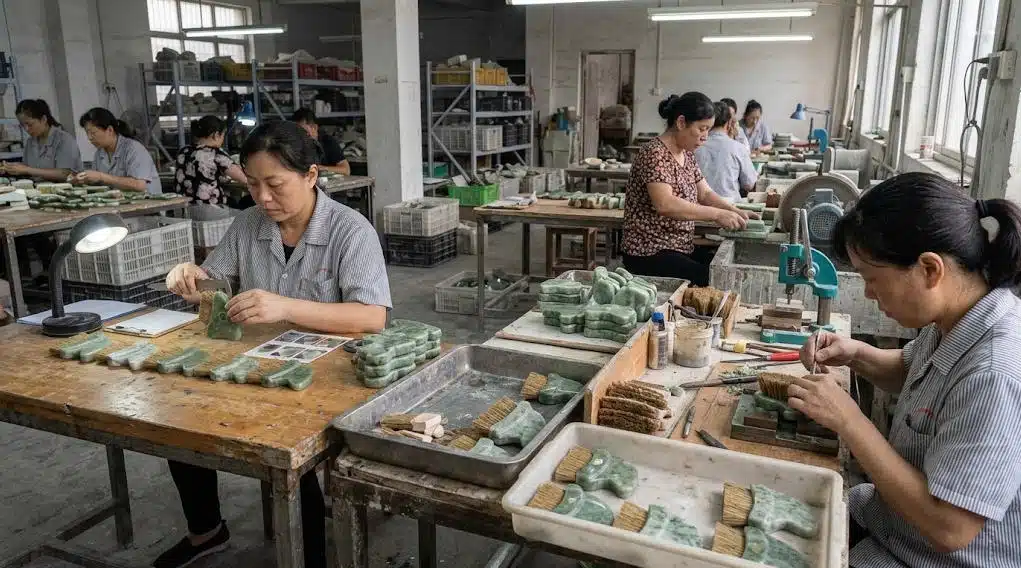
Buyers often read a lead time as a simple sum: stone days plus bristle days. In practice, the delivery date is set by whichever chain finishes last, and every handoff between chains can add waiting time. A stone body that is ready on day 22 does you no good if the bristle component is still in a queue. This means you should read any lead time as a schedule with dependencies, not as a count of working days.
Reading the 25-Day vs 35-Day Gap
Here is a simple illustration, using round numbers rather than a promise. A standard jade gua sha board might take 20 days for stone work and 5 days for inspection and packing, which adds up to 25. A lymphatic brush body is thinner and often drilled, so stone work may stretch to 22 days. Bristle fixing and curing add about 5 days, trimming and assembly add 3, and the longer inspection plus protective packing adds 5, which lands at 35.
That is 10 extra days, or 40% longer than the board. The extra time comes from a full new set of steps rather than one slow step, and any gua sha factory that runs both product types will show a similar pattern. This means you should plan your launch calendar with the brush’s own timeline and avoid borrowing the board’s.
Where Gua Sha Production Delays Hide
Three delays show up again and again. The first is the bristle supply, since a late delivery of bristle material stops tufting no matter how ready the stone is. The second is the tufting station, which can have a queue just like any other shared workstation. The third is the cure and trim stage, because adhesive needs set time and trimming needs a stable surface.
Rework is the fourth, and it hurts most. If a Gua Sha Lymphatic Brush manufacturer finds uneven density against the Golden Sample after trimming, the affected pieces go back through fixing, and the date moves. Gua sha production schedules without a rework margin look neat on paper and fail in the first real batch. This means you should ask what buffer is built into the quote, and treat a quote with zero buffer as a warning sign.
How to Shorten Lead Time With Your Gua Sha Lymphatic Brush Manufacturer
You have more control over the calendar than you might think. Five steps usually recover several days:
- Approve the bristle specification and the Golden Sample before any stone is cut.
- Ask for two dates, one for the stone body and one for the bristle component.
- Release bristle material orders on the same day as the stone order.
- Book the tufting and curing slot early, especially before peak seasons.
- Add a rework buffer of 5 to 7 days to your own internal deadline.
A gua sha manufacturer that sees these inputs on day one can run both chains in parallel from the start. Late changes to bristle length or density, by contrast, restart the second chain and can cost you a week or more. This means you can save real calendar days by finalizing the specification once, in writing, before production begins.
Why a Guasha Custom Order Needs Early Decisions
A guasha custom project adds one more dependency: your approval. Samples take days to make and days to review, and each revision loops back through the chain. If you approve a sample within 48 hours instead of ten days, you give your Gua Sha Lymphatic Brush manufacturer a full week back for production. Treat your own response time as part of the schedule, because it is.
Small Batches and Custom Orders: Where a Gua Sha Lymphatic Brush Manufacturer’s Fixed Costs Show Up
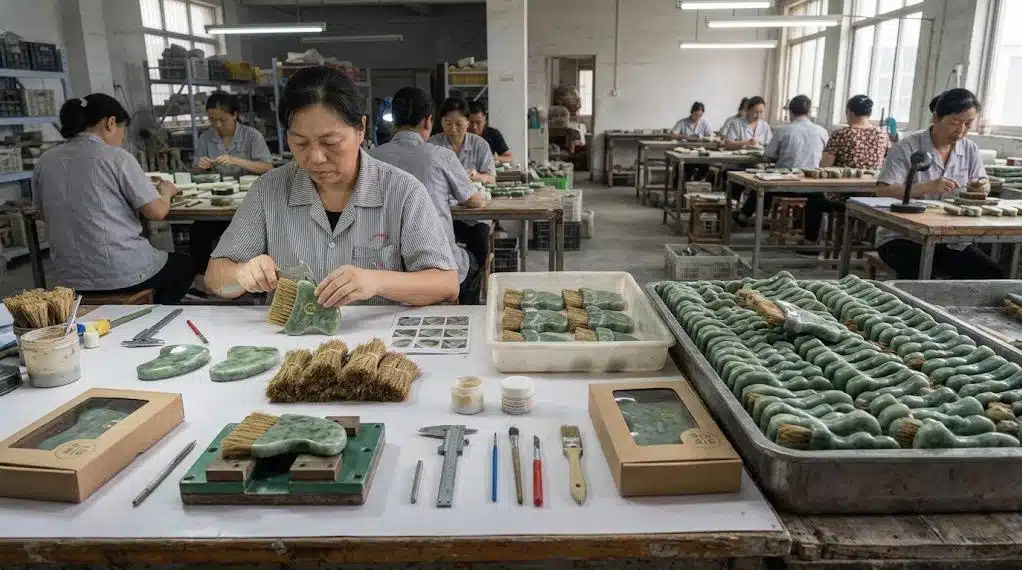
A small order feels cheaper because the total invoice is smaller. The price per piece usually tells the opposite story, because setup work costs about the same whether the factory makes 500 brushes or 2,000. A lymphatic brush carries more of that setup work than a plain board, so batch size changes its unit price more sharply. This means you should compare quotes by price per piece at several quantities, not by the total on the first page.
The Fixed Costs a Gua Sha Lymphatic Brush Manufacturer Cannot Spread Thin
Seven cost items stay almost flat no matter how many pieces you order: bristle sourcing and preparation, tufting equipment and operator time, assembly labor, custom fixtures that hold the stone during fixing, sample making, inspection setup, and packaging development. None of these shrink when the order shrinks. A board needs a few of them, while a brush needs all of them.
Here is where buyers get surprised. A gua sha factory can price a 500-piece brush order at a much higher unit cost than a 500-piece board order, and still earn a modest margin. The reason is simple, because the brush order carries a heavier fixed load. This means you should never read a small-batch brush quote as stone cost plus bristle cost, since the setup share is often the biggest piece.
A Worked Example of Batch Size and Unit Price
Take a simple illustration with round numbers. Suppose variable cost per brush is 10 money units, covering stone, bristles, and direct labor. Suppose fixed setup cost is 1,500 units for fixtures, samples, and packaging development. At 500 pieces, each brush carries 3.00 units of setup, which gives a unit cost of 13.00. At 2,000 pieces, each brush carries 0.75 units, which gives 10.75.
The larger order is 17% cheaper per piece, even though nothing about the product changed. If you expect to reorder, a Gua Sha Lymphatic Brush manufacturer can often reuse fixtures and specifications, so your second run skips most of the setup bill. This means you can cut your unit cost by committing to a repeat schedule up front, even if you split deliveries into smaller shipments.
How to Read a Gua Sha Production Quote Line by Line
Ask your gua sha manufacturer for a breakdown with at least five lines: stone and processing, bristle material, fixing and assembly, inspection, and packaging. Then ask which lines are one-time and which repeat on every order. A one-time fixture fee that appears again on your second purchase order is a sign the supplier is not tracking your project properly.
You should also ask what happens to the price if you change one specification. A shift in bristle length or density can restart sampling, and a change in stone thickness can alter the pass rate. Gua sha risks often grow when specifications change after sampling, because the Golden Sample no longer matches the process.
Cost Control Moves for a Guasha Custom Project
You can lower the cost of a guasha custom brush without lowering what it does. Choose one bristle specification instead of three variants, keep the stone outline simple enough for a reliable pass rate, and order the quantity you will actually sell within two seasons. Packaging that fits more units per carton also trims freight, which matters when the brush’s bristle protection already adds bulk. Each of these choices means you pay less per piece while keeping the features your customers notice.
Packaging, Risk Disclosure, and Your Next Step With a Gua Sha Lymphatic Brush Manufacturer
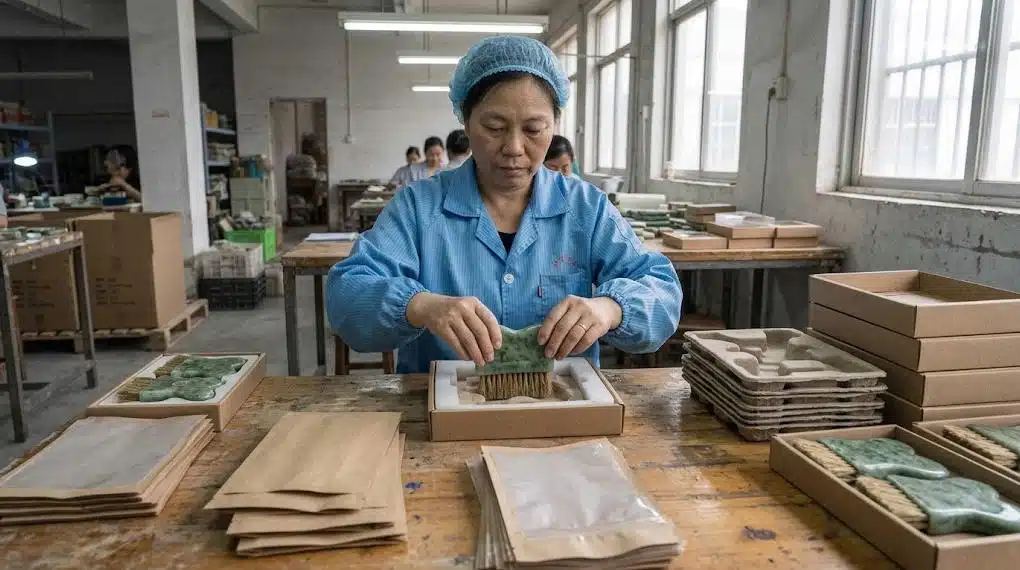
Packaging is the last place a lymphatic brush can lose money. The stone is hard and heavy, so it chips when pieces knock together. The bristles are soft, so they bend and flatten under pressure or pick up dust. A box built for a plain board protects only half of a brush, which means you should price packaging as part of the product and not as an afterthought.
Protecting Jade and Bristles at the Same Time
Each material needs its own protection. The stone needs padding around the edges and corners, plus a separator so two bodies never touch. The bristles need a cavity or card tray that keeps the tufts from touching the lid, and a sleeve or bag that blocks dust and oil from handling. GIA advises that jade can be affected by warm acids and heat, so any adhesive label, foam, or sealing film that sits close to the stone should be checked for compatibility before you approve it.
A Gua Sha Lymphatic Brush manufacturer usually adds an inner liner, an individual bag, a bristle guard, and a paper or molded tray. These parts take more material and more assembly time than a board’s single pouch. This means you should budget more per unit for packaging, and you should test the finished carton with a drop from desk height before the full run starts.
How Packaging Changes Freight and Cost
Brush packaging is bulkier. If a board carton holds 200 pieces and a brush carton holds 120 (for illustration), your freight cost per piece rises by about 67% on the same shipping rate. A gua sha factory that designs the tray around the brush shape can often recover several slots per carton, which pulls that increase back down.
Ask for the carton count and gross weight on every quote. A gua sha manufacturer who gives you those two numbers lets you calculate landed cost before you commit. This means you can compare suppliers on delivered price, which is the number your customers eventually pay for.
Risk Disclosure: What You Should Weigh Before You Order
Honest suppliers tell you where things can go wrong. The stone can crack at thin sections, and the pass rate drops as designs get more detailed. The bristles can shed if the fixing method or curing time is cut short. Color and pattern vary because the material is natural, and the feel can drift if bristle density is not measured. Lead times can slip when two chains must meet. Those are the main gua sha risks in this product, and none of them disappear with a lower price.
Compliance adds one more layer, because rules differ by market and change over time. Confirm requirements with a testing lab or legal adviser for each region you sell in, and ask for material declarations from your supplier early. No article can replace that check.
Your Checklist Before You Request a Quote
Prepare these six items so your guasha custom quote arrives complete the first time:
- Target quantity for the first order and likely reorder volume.
- Stone or crystal type, color range, and thickness.
- Bristle length, density, and softness expectations.
- Target markets, for compliance planning.
- Packaging style and carton limits.
- Required delivery date, with your sample approval window.
Where to Go From Here
You now know what drives price and lead time on a Gua Sha Lymphatic Brush manufacturer’s quote: two production chains, a lower stone yield, a bonding step, two quality systems, and heavier packaging. Send your specification and target quantity to Deyi Gems, and you will receive a quote that shows each cost line separately, so you can see exactly what you are paying for. Which of these six items is still undecided in your project?