Gua Sha Lymphatic Brush Manufacturer Risk Disclosure: 9 Steps, 3 Danger Zones, and What to Check Before You Order
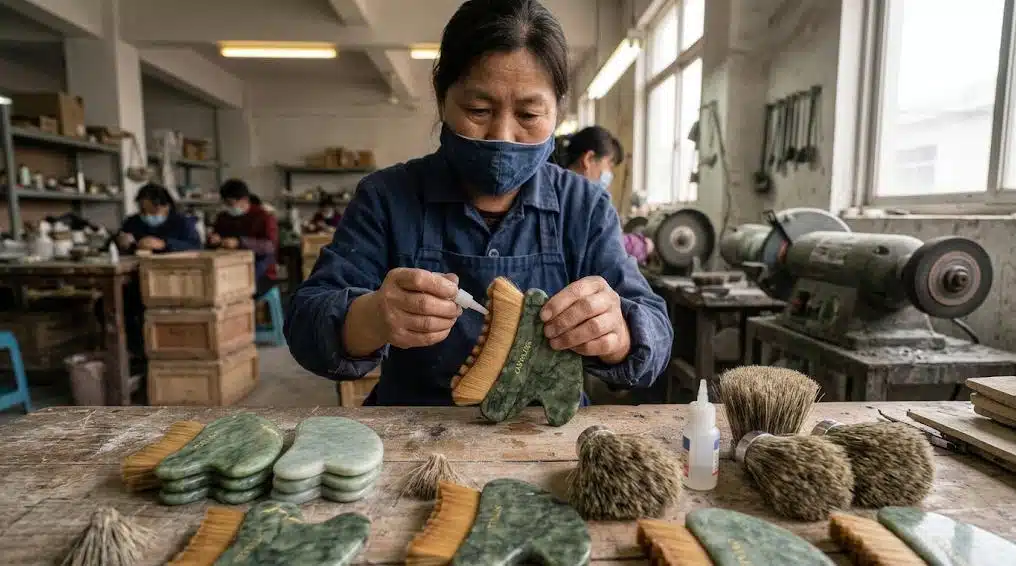
A Gua Sha Lymphatic Brush manufacturer runs 9 production steps to turn raw stone into a finished two-in-one tool, and 3 of those steps decide whether your order arrives intact or comes back as a claim. Those three are slotting, brush bonding, and final inspection. This article is a plain-spoken risk disclosure from a team with 12+ years of experience making jade and crystal gua sha tools. It shows you where things go wrong before they cost you money. You will learn where gua sha risks concentrate, why the brush version costs more than a standard board, and what to confirm before you approve a guasha custom order. Think of it as the conversation you would have with a friend who has stood on the factory floor, minus the sales pitch. Ready to see what a supplier may not volunteer? Where Gua Sha Risks Concentrate Inside a Gua Sha Lymphatic Brush Manufacturer‘s Workflow Stone work and brush work run on separate clocks, and that gap is where trouble starts. A plain stone board needs a sound stone, a clean outline, and a smooth edge. A lymphatic brush adds a second component, a glue joint, and a curing window, so your order picks up new ways to fail. Of the 9 steps in gua sha production, three carry most of the gua sha risks: slotting (step 06), brush bonding (step 08), and final inspection (step 09). Here is the uncomfortable part. A gua sha factory can select, cut, shape, and polish the stone correctly and still ship a failed product, because the failure often lives at the joint rather than in the stone. That means you should judge a Gua Sha Lymphatic Brush manufacturer by how it handles the joint, not by how good the stone looks in a photo. The three danger zones below show where to look. Slot Fit: Where a Gua Sha Lymphatic Brush Manufacturer Wins or Loses Your Order The slot holds the brush base, so when you brief a Gua Sha Lymphatic Brush manufacturer, send the real component, not a drawing. If the slot is too wide, the glue layer turns thick and the brush sits unevenly. If it is too narrow, the part gets forced in and the stone absorbs extra stress. If it is too deep, the remaining wall thins out and can crack under load. The International Gem Society points out that even tough jade is not indestructible, and a thin wall beside a slot is exactly where that limit shows up. Each slot gets checked on five points: size, position, edge condition, remaining wall thickness, and surface cleanliness. This means you can ask your gua sha manufacturer to trial-fit a real brush before bulk cutting, so one bad slot never multiplies into a whole batch of them. Glue Bond and Curing: The Quiet Gua Sha Risks An assembled brush can look fine on the bench and still fail on a truck. Bonding is a six-part sequence: clean the stone surface, prepare the adhesive, apply the right amount, position the part, hold it through curing, and tidy any overflow. Weaken one of those six and the joint ends up weaker than it looks. Curing is the part that gets squeezed when a ship date is close, and a part moved or packed before the adhesive reaches its specified cure can shift or loosen later. Would you rather wait a little longer now or process a wave of returns later? A careful Gua Sha Lymphatic Brush manufacturer treats cure time as non-negotiable. This means you can put curing conditions in writing and refuse a shipment that was packed before they were met. Inspection Gaps That Let Defects Reach Your Customers Soft bristles and firmly rooted bristles are two different properties, and a quick squeeze only tests the first one. A sound inspection from a Gua Sha Lymphatic Brush manufacturer covers three zones: the stone body, the brush component, and the joint between them. On top of the visual review, the joint needs sampled pull testing under a standard agreed before production starts. An appearance pass is not a bond-strength pass, which is why many gua sha risks only show up after delivery. This means you can write the sampling method and acceptance limits into your guasha custom order and hold the factory to them. What a Gua Sha Lymphatic Brush Manufacturer Charges For: Cost Drivers and ROI If you have compared quotes, you have seen that the brush version costs more than a plain stone board. The reason is specific, not vague. The first seven steps, from selection through polishing, largely overlap between the two products, so the price gap comes from what gets added after the stone is finished. No honest Gua Sha Lymphatic Brush manufacturer can hand you one universal markup, because the real figure depends on structure, order quantity, component supply, equipment, and the actual process. 5 Cost Drivers a Gua Sha Lymphatic Brush Manufacturer Adds to a Plain Board Five items account for what a Gua Sha Lymphatic Brush manufacturer adds to the bill. Brush components and fixing materials have to be sourced or made separately. Assembly labor covers positioning, gluing, holding, and tidying each part. Curing adds waiting time that cannot be shortened without risk. Extra inspection checks the bristles, brush position, bond strength, and finished look. Packaging has to protect hard stone and crushable bristles at the same time, which a standard board’s packing method rarely does. This means you can ask your gua sha manufacturer to itemize those five lines instead of accepting one blended price, and you will see exactly where your money goes. A Simple ROI Formula You Can Run Yourself Quality control is a cost, but it is also insurance, and you can test whether it pays. The formula is: net saving = (failure rate without testing − failure rate with testing) × units × cost per failed unit − added testing cost. Here is a worked example with placeholder numbers, not a
A Gua Sha Lymphatic Brush manufacturer runs 9 production steps to turn raw stone into a finished two-in-one tool, and 3 of those steps decide whether your order arrives intact or comes back as a claim. Those three are slotting, brush bonding, and final inspection. This article is a plain-spoken risk disclosure from a team with 12+ years of experience making jade and crystal gua sha tools. It shows you where things go wrong before they cost you money. You will learn where gua sha risks concentrate, why the brush version costs more than a standard board, and what to confirm before you approve a guasha custom order. Think of it as the conversation you would have with a friend who has stood on the factory floor, minus the sales pitch. Ready to see what a supplier may not volunteer? Where Gua Sha Risks Concentrate Inside a Gua Sha Lymphatic Brush Manufacturer‘s Workflow Stone work and brush work run on separate clocks, and that gap is where trouble starts. A plain stone board needs a sound stone, a clean outline, and a smooth edge. A lymphatic brush adds a second component, a glue joint, and a curing window, so your order picks up new ways to fail. Of the 9 steps in gua sha production, three carry most of the gua sha risks: slotting (step 06), brush bonding (step 08), and final inspection (step 09). Here is the uncomfortable part. A gua sha factory can select, cut, shape, and polish the stone correctly and still ship a failed product, because the failure often lives at the joint rather than in the stone. That means you should judge a Gua Sha Lymphatic Brush manufacturer by how it handles the joint, not by how good the stone looks in a photo. The three danger zones below show where to look. Slot Fit: Where a Gua Sha Lymphatic Brush Manufacturer Wins or Loses Your Order The slot holds the brush base, so when you brief a Gua Sha Lymphatic Brush manufacturer, send the real component, not a drawing. If the slot is too wide, the glue layer turns thick and the brush sits unevenly. If it is too narrow, the part gets forced in and the stone absorbs extra stress. If it is too deep, the remaining wall thins out and can crack under load. The International Gem Society points out that even tough jade is not indestructible, and a thin wall beside a slot is exactly where that limit shows up. Each slot gets checked on five points: size, position, edge condition, remaining wall thickness, and surface cleanliness. This means you can ask your gua sha manufacturer to trial-fit a real brush before bulk cutting, so one bad slot never multiplies into a whole batch of them. Glue Bond and Curing: The Quiet Gua Sha Risks An assembled brush can look fine on the bench and still fail on a truck. Bonding is a six-part sequence: clean the stone surface, prepare the adhesive, apply the right amount, position the part, hold it through curing, and tidy any overflow. Weaken one of those six and the joint ends up weaker than it looks. Curing is the part that gets squeezed when a ship date is close, and a part moved or packed before the adhesive reaches its specified cure can shift or loosen later. Would you rather wait a little longer now or process a wave of returns later? A careful Gua Sha Lymphatic Brush manufacturer treats cure time as non-negotiable. This means you can put curing conditions in writing and refuse a shipment that was packed before they were met. Inspection Gaps That Let Defects Reach Your Customers Soft bristles and firmly rooted bristles are two different properties, and a quick squeeze only tests the first one. A sound inspection from a Gua Sha Lymphatic Brush manufacturer covers three zones: the stone body, the brush component, and the joint between them. On top of the visual review, the joint needs sampled pull testing under a standard agreed before production starts. An appearance pass is not a bond-strength pass, which is why many gua sha risks only show up after delivery. This means you can write the sampling method and acceptance limits into your guasha custom order and hold the factory to them. What a Gua Sha Lymphatic Brush Manufacturer Charges For: Cost Drivers and ROI If you have compared quotes, you have seen that the brush version costs more than a plain stone board. The reason is specific, not vague. The first seven steps, from selection through polishing, largely overlap between the two products, so the price gap comes from what gets added after the stone is finished. No honest Gua Sha Lymphatic Brush manufacturer can hand you one universal markup, because the real figure depends on structure, order quantity, component supply, equipment, and the actual process. 5 Cost Drivers a Gua Sha Lymphatic Brush Manufacturer Adds to a Plain Board Five items account for what a Gua Sha Lymphatic Brush manufacturer adds to the bill. Brush components and fixing materials have to be sourced or made separately. Assembly labor covers positioning, gluing, holding, and tidying each part. Curing adds waiting time that cannot be shortened without risk. Extra inspection checks the bristles, brush position, bond strength, and finished look. Packaging has to protect hard stone and crushable bristles at the same time, which a standard board’s packing method rarely does. This means you can ask your gua sha manufacturer to itemize those five lines instead of accepting one blended price, and you will see exactly where your money goes. A Simple ROI Formula You Can Run Yourself Quality control is a cost, but it is also insurance, and you can test whether it pays. The formula is: net saving = (failure rate without testing − failure rate with testing) × units × cost per failed unit − added testing cost. Here is a worked example with placeholder numbers, not a