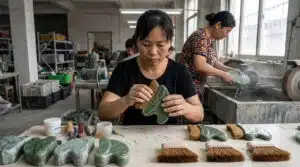
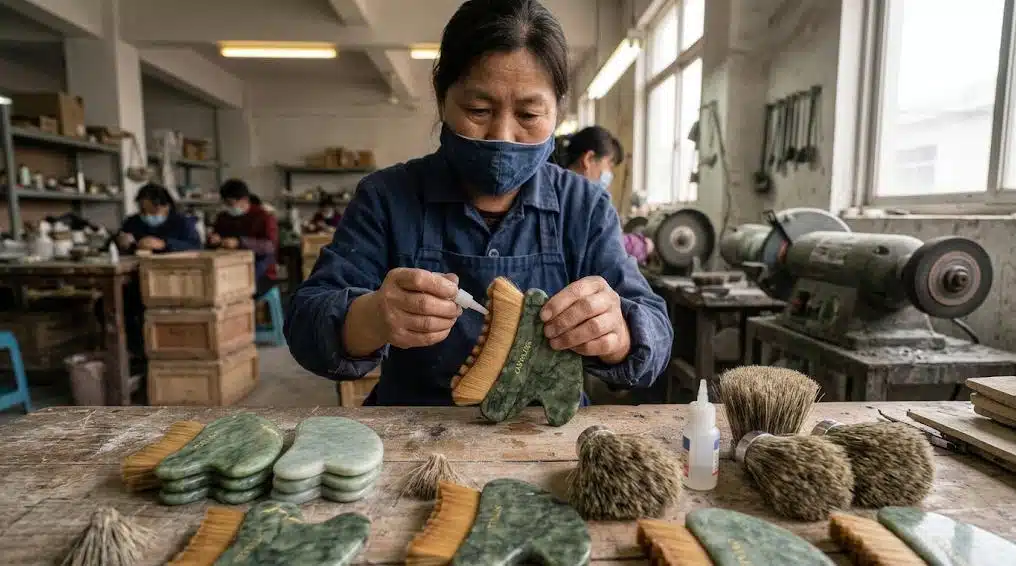
A Gua Sha Lymphatic Brush manufacturer runs 9 production steps to turn raw stone into a finished two-in-one tool, and 3 of those steps decide whether your order arrives intact or comes back as a claim. Those three are slotting, brush bonding, and final inspection. This article is a plain-spoken risk disclosure from a team with 12+ years of experience making jade and crystal gua sha tools. It shows you where things go wrong before they cost you money. You will learn where gua sha risks concentrate, why the brush version costs more than a standard board, and what to confirm before you approve a guasha custom order. Think of it as the conversation you would have with a friend who has stood on the factory floor, minus the sales pitch. Ready to see what a supplier may not volunteer?
- Where Gua Sha Risks Concentrate Inside a Gua Sha Lymphatic Brush Manufacturer's Workflow
- What a Gua Sha Lymphatic Brush Manufacturer Charges For: Cost Drivers and ROI
- How a Gua Sha Lymphatic Brush Manufacturer Builds Your Product, Step by Step
- Stone Choices and Treatment Disclosure for Your Gua Sha Lymphatic Brush Manufacturer Order
- Compliance Basics: What You Can Claim and Label When a Gua Sha Lymphatic Brush Manufacturer Ships Your Product
- Ordering Guasha Custom From a Gua Sha Lymphatic Brush Manufacturer: A Step-by-Step Plan
- How to Vet a Gua Sha Lymphatic Brush Manufacturer Before You Sign
- FAQs About Gua Sha Lymphatic Brush Manufacturer Production Process
Where Gua Sha Risks Concentrate Inside a Gua Sha Lymphatic Brush Manufacturer‘s Workflow
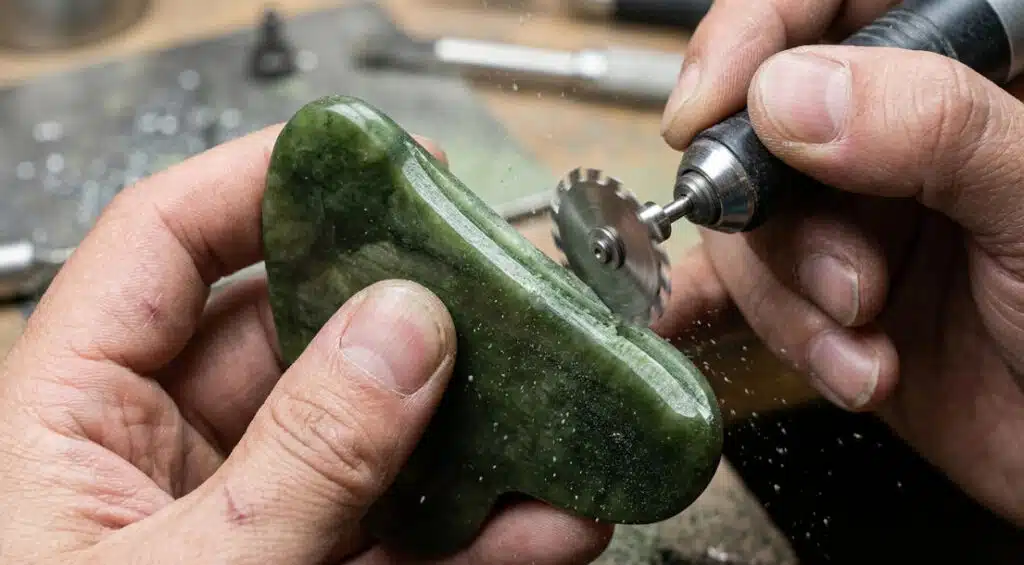
Stone work and brush work run on separate clocks, and that gap is where trouble starts. A plain stone board needs a sound stone, a clean outline, and a smooth edge. A lymphatic brush adds a second component, a glue joint, and a curing window, so your order picks up new ways to fail. Of the 9 steps in gua sha production, three carry most of the gua sha risks: slotting (step 06), brush bonding (step 08), and final inspection (step 09).
Here is the uncomfortable part. A gua sha factory can select, cut, shape, and polish the stone correctly and still ship a failed product, because the failure often lives at the joint rather than in the stone. That means you should judge a Gua Sha Lymphatic Brush manufacturer by how it handles the joint, not by how good the stone looks in a photo. The three danger zones below show where to look.
Slot Fit: Where a Gua Sha Lymphatic Brush Manufacturer Wins or Loses Your Order
The slot holds the brush base, so when you brief a Gua Sha Lymphatic Brush manufacturer, send the real component, not a drawing. If the slot is too wide, the glue layer turns thick and the brush sits unevenly. If it is too narrow, the part gets forced in and the stone absorbs extra stress. If it is too deep, the remaining wall thins out and can crack under load. The International Gem Society points out that even tough jade is not indestructible, and a thin wall beside a slot is exactly where that limit shows up. Each slot gets checked on five points: size, position, edge condition, remaining wall thickness, and surface cleanliness. This means you can ask your gua sha manufacturer to trial-fit a real brush before bulk cutting, so one bad slot never multiplies into a whole batch of them.
Glue Bond and Curing: The Quiet Gua Sha Risks
An assembled brush can look fine on the bench and still fail on a truck. Bonding is a six-part sequence: clean the stone surface, prepare the adhesive, apply the right amount, position the part, hold it through curing, and tidy any overflow. Weaken one of those six and the joint ends up weaker than it looks. Curing is the part that gets squeezed when a ship date is close, and a part moved or packed before the adhesive reaches its specified cure can shift or loosen later. Would you rather wait a little longer now or process a wave of returns later? A careful Gua Sha Lymphatic Brush manufacturer treats cure time as non-negotiable. This means you can put curing conditions in writing and refuse a shipment that was packed before they were met.
Inspection Gaps That Let Defects Reach Your Customers
Soft bristles and firmly rooted bristles are two different properties, and a quick squeeze only tests the first one. A sound inspection from a Gua Sha Lymphatic Brush manufacturer covers three zones: the stone body, the brush component, and the joint between them. On top of the visual review, the joint needs sampled pull testing under a standard agreed before production starts. An appearance pass is not a bond-strength pass, which is why many gua sha risks only show up after delivery. This means you can write the sampling method and acceptance limits into your guasha custom order and hold the factory to them.
What a Gua Sha Lymphatic Brush Manufacturer Charges For: Cost Drivers and ROI
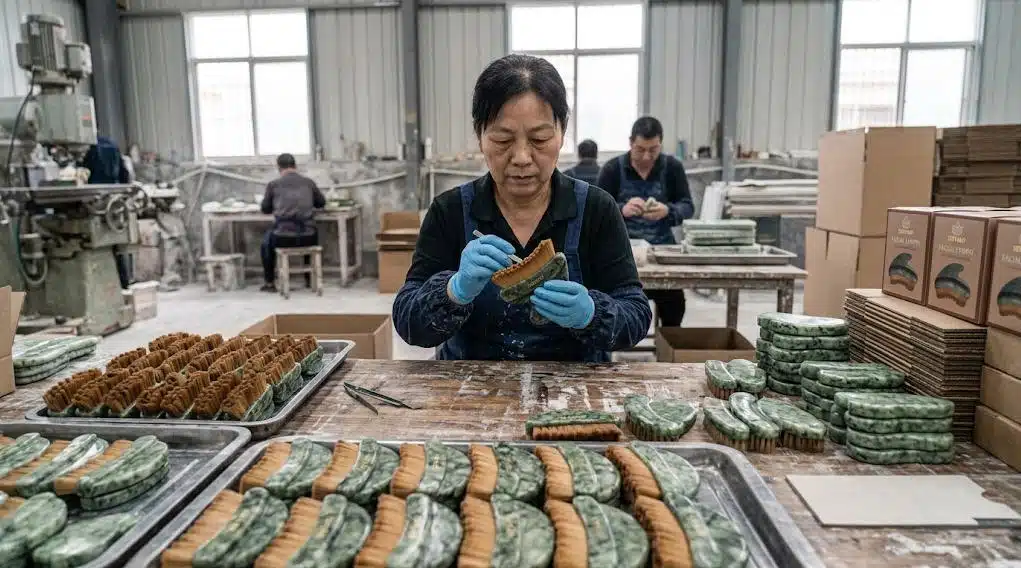
If you have compared quotes, you have seen that the brush version costs more than a plain stone board. The reason is specific, not vague. The first seven steps, from selection through polishing, largely overlap between the two products, so the price gap comes from what gets added after the stone is finished. No honest Gua Sha Lymphatic Brush manufacturer can hand you one universal markup, because the real figure depends on structure, order quantity, component supply, equipment, and the actual process.
5 Cost Drivers a Gua Sha Lymphatic Brush Manufacturer Adds to a Plain Board
Five items account for what a Gua Sha Lymphatic Brush manufacturer adds to the bill. Brush components and fixing materials have to be sourced or made separately. Assembly labor covers positioning, gluing, holding, and tidying each part. Curing adds waiting time that cannot be shortened without risk. Extra inspection checks the bristles, brush position, bond strength, and finished look. Packaging has to protect hard stone and crushable bristles at the same time, which a standard board’s packing method rarely does. This means you can ask your gua sha manufacturer to itemize those five lines instead of accepting one blended price, and you will see exactly where your money goes.
A Simple ROI Formula You Can Run Yourself
Quality control is a cost, but it is also insurance, and you can test whether it pays. The formula is: net saving = (failure rate without testing − failure rate with testing) × units × cost per failed unit − added testing cost. Here is a worked example with placeholder numbers, not a quote. Take 2,000 units and $15 per failed unit once you count the refund, return shipping, and replacement. If sampled pull testing and curing control cut failures from 4% to 1%, that is 60 fewer failures, or $900 saved. If the added testing costs $0.25 per unit, or $500, your net saving is $400, an 80% return on that spend.
Swap in your own return rate and your own cost per failure, and the result moves quickly. A Gua Sha Lymphatic Brush manufacturer with real process control can show you its pull-test records, which turns your failure-rate assumption into a number you can verify. This means you can decide with arithmetic, not instinct, whether a stricter inspection standard belongs in your guasha custom order.
Watch out for the Gua Sha Lymphatic Brush manufacturer quote that sits far below the rest. A gua sha factory can reach that price by trimming exactly the lines above: cure time, inspection, and packaging. Those cuts do not disappear; they move into your return rate. This means you can treat an unusually low quote as a question to ask, not a bargain to grab.
How a Gua Sha Lymphatic Brush Manufacturer Builds Your Product, Step by Step
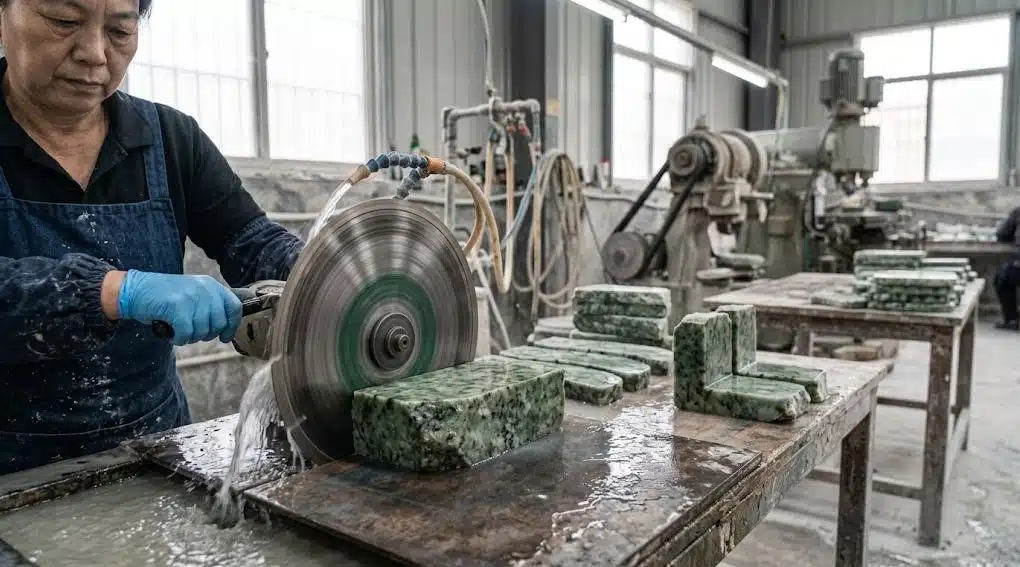
You can learn more about a supplier in ten minutes of process questions than in an hour of price talk. The sequence below follows a real gua sha production line, and each step ends with something you can check or request. Steps 06, 08, and 09 were covered above, so this chapter walks through the other six. It also gives you the questions to put to any Gua Sha Lymphatic Brush manufacturer on your shortlist.
Steps 01–03: Selecting, Cutting, and Slicing the Stone
Selection starts with five checks. Does the color and texture match your approved range? Is the interior free of cracks that could spread? Does the transparency suit the product? Is there enough material for the target size? And how much of the block will become sellable pieces? That last check drives cost, because two blocks of equal weight can yield different numbers of good pieces. The spot where the brush will sit gets checked too, since a crack there makes a beautiful stone unusable.
Cutting comes next. The raw stone is cut into blocks, with the direction chosen to maximize usable area and to steer around known cracks. Blade condition and feed speed change cut quality, so block sizes are planned with spare allowance. Slicing then sets thickness from the final thickness plus grinding allowance. Too thin, and polishing leaves too little stone for slotting; too thick, and you pay for extra material and grinding time. This means you can ask a gua sha factory for its yield estimate and slice-thickness plan before you approve a quote.
Steps 04–05: How a Gua Sha Lymphatic Brush Manufacturer Draws and Shapes the Body
Outline drawing transfers the design onto the slice with a template, hand tracing, or positioning aids, and batch runs use fixtures or a CNC program to remove human variation. The layout also fixes the brush mounting area and leaves a safety margin from the edge, because a mounting position too close to the edge invites chipping during slotting and use. Cutting then forms the body and curves while leaving allowance for slotting, trimming, and polishing. Each blank is checked for chips, cracks, and size deviation, and a blank that fails should stop right there. This means you can request a confirmed template or program for repeat orders, so your second batch matches your first.
Step 07: Polishing Without Spoiling the Glue Surface
Polishing runs in four moves. Coarse grinding removes cutting marks, fine grinding smooths edges and curves, final polishing sets gloss and feel, and a cleaning check looks for scratches, pits, and slot condition. The skin-contact zone must be smooth, with no sharp burrs. The slot and bonding area is different, because not every glue surface should be mirror-polished, so its finish has to match the adhesive and fixing method. Stone dust left inside the slot weakens the bond, which is one more way gua sha risks hide inside a product that looks finished. A careful Gua Sha Lymphatic Brush manufacturer cleans the slot after polishing and can describe how. This means you can ask any gua sha manufacturer about slot cleaning, not just surface shine.
A Four-Request Audit for Any Gua Sha Lymphatic Brush Manufacturer
Turn the steps above into four requests you can send in one email: the yield estimate and slice plan, the confirmed template or program, a trial-fit sample using your real brush, and the slot-cleaning method after polishing. A Gua Sha Lymphatic Brush manufacturer with controlled processes answers these quickly and in specifics. Vague replies tell you something too. Does that sound like a lot to ask? It is one email, and it protects every guasha custom repeat order that follows.
Stone Choices and Treatment Disclosure for Your Gua Sha Lymphatic Brush Manufacturer Order
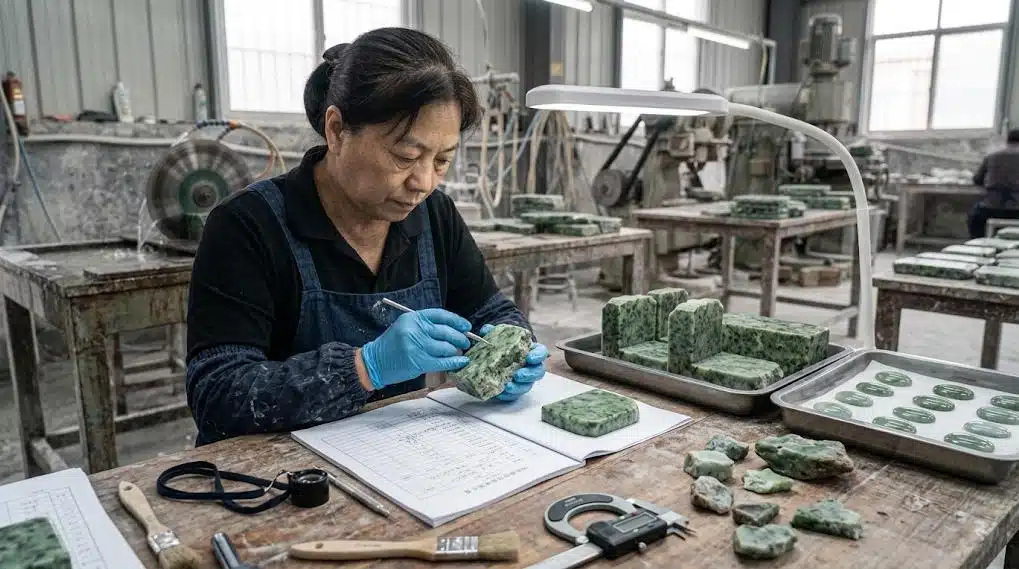
The stone is the first thing your customer sees, so it is also where vague wording does the most damage. Before you approve a sample, get three answers in writing: what the material is called, whether it has been treated, and how much natural variation you will accept. Any Gua Sha Lymphatic Brush manufacturer worth shortlisting gives you all three without hesitation.
What “Jade” Means to a Gua Sha Lymphatic Brush Manufacturer
Jade is a trade term, not a single mineral. The Gemological Institute of America (GIA) explains that the word covers nephrite, jadeite, and, under certain conditions, green omphacite. Hardness differs as well: the International Gem Society (IGS) lists jadeite at 6.5–7 and nephrite at 6–6.5 on the Mohs scale, so nephrite scratches more easily. Those differences can shape how a Gua Sha Lymphatic Brush manufacturer plans grinding and how you word care instructions for your customers. This means you can ask for the exact mineral name on every spec sheet, rather than accepting a product listed only as “jade.”
Treatment Questions to Put to Your Gua Sha Lymphatic Brush Manufacturer
GIA’s buyer’s guide notes that jade can be dyed, bleached, heated, waxed, and impregnated. In the Chinese trade system it describes, “B” jade is jadeite bleached with acid and filled with polymer resin, “A” is natural or wax-polished only, and “C” is dyed. That matters for a skin-contact tool. One industry source reports skin burns from residual acid in B-treated jade, plus discoloration of the resin over time. These are the gua sha risks that never show up in a factory photo. To verify treatment status, you can turn to labs such as the Swiss Gemmological Institute (SSEF), a non-profit foundation focused on gemstone testing and training whose jade course covers treatments and testing science. This means you can require a written treatment statement for every material and send a sample to a lab for higher-value lines.
Natural Color Variation: Agree on the Range Before Production
Natural stone varies, and variation is not a defect. GIA’s jade quality guide notes that color and texture are the most important factors when matching jadeite pieces, which is why you should agree on an approved sample and a written range of acceptable color and texture before gua sha production starts. Without that range, every batch becomes an argument. In a guasha custom project, the approved sample and the range become your reference at final inspection. Put the range in your purchase agreement so you and the Gua Sha Lymphatic Brush manufacturer inspect against the same reference. A gua sha factory that photographs the approved sample beside each finished batch makes that check simple. This means you can reject a true defect, such as a crack or chip, and still accept honest natural variation without a dispute over which is which.
Compliance Basics: What You Can Claim and Label When a Gua Sha Lymphatic Brush Manufacturer Ships Your Product
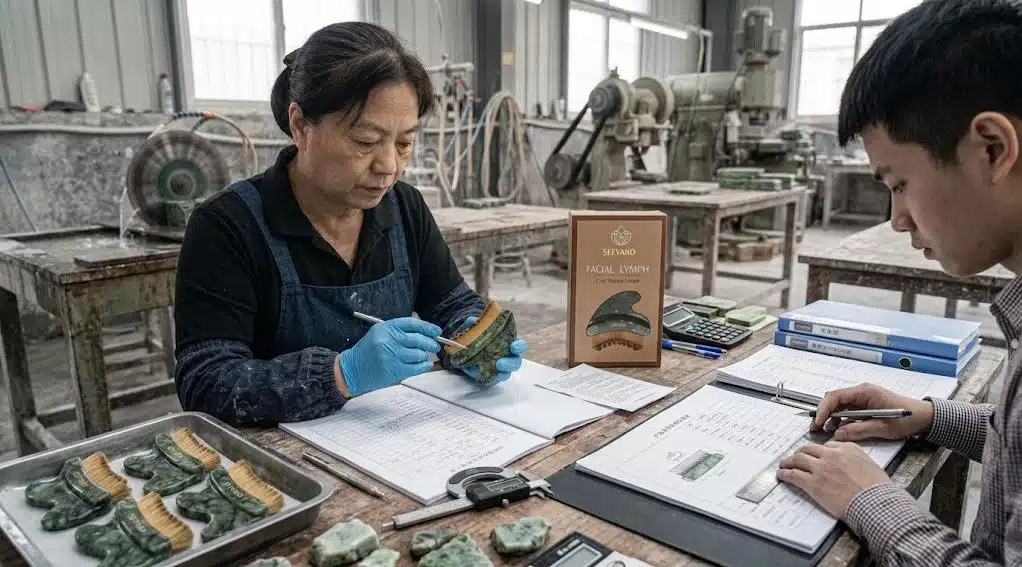
A finished product can pass every inspection and still cause you trouble if the listing says the wrong thing. Compliance starts before gua sha production begins, not after, and it comes down to two questions: what you claim, and what the product could expose a buyer to. Three U.S. frameworks matter most here: FDA’s wellness policy, FTC’s claim-substantiation rules, and California’s Proposition 65. What follows is an orientation for buyers, not legal advice, so confirm the details with a qualified attorney before you publish.
FDA General Wellness: Keep Your Claims Inside the Lane
FDA’s General Wellness guidance, reissued in January 2026, covers products that are intended only for general wellness use and present a low risk to safety. Among the claims it treats as general wellness are those about promoting relaxation or managing stress, while claims tied to a specific disease or condition fall outside that lane. FDA also states that coverage by the policy does not show a product has been proven safe or effective. One point deserves attention: if your guasha custom design carries the word “lymphatic” in its name or ad copy, that word can read as a health claim, so have a reviewer check your wording. This means you can build listings around routine, ritual, and self-care, and leave out words like treat, cure, or detox.
FTC Substantiation: Proof Behind Every Health Benefit
The FTC’s Health Products Compliance Guidance applies to all health-related products, and it expects claims to be truthful and backed by evidence. According to a law-firm summary of the guidance, substantiation of health benefits generally needs randomized, controlled human clinical testing, and the FTC treats consumer survey results as anecdotal rather than as proof. FTC staff have since said that they focus on the most serious health claims. A five-star review, in other words, is not evidence. No Gua Sha Lymphatic Brush manufacturer can substantiate your claims for you, because the burden sits with whoever makes them. This means you can skip the cost of a clinical trial by sticking to claims you can verify yourself: material, size, bristle type, and finish.
Proposition 65: Labels, Packaging, and Online Listings
California voters approved Proposition 65 in 1986, and the state’s Office of Environmental Health Hazard Assessment (OEHHA) runs the program. In December 2025, OEHHA published a letter stating that safe-harbor warnings apply to items that accompany a purchase, including packaging, labels, and instructions, whether bought in person or online. Whether your product needs a warning depends on its materials, adhesive, and dyes, not on its category. Because a gua sha factory often sources or prints packaging for you, ask your Gua Sha Lymphatic Brush manufacturer for material, adhesive, and dye details early, and read the format rules on the state’s warnings site. This means you can avoid reprinting a whole packaging run after the fact.
Compliance Questions to Ask Your Gua Sha Lymphatic Brush Manufacturer
Ask for four items before launch: a written material name with a treatment statement, specifications for the adhesive and brush component, any test reports the supplier holds, and a clear answer on who is responsible for printing labels. A gua sha manufacturer that keeps these records can answer quickly. A Gua Sha Lymphatic Brush manufacturer that shrugs at them is telling you how it handles gua sha risks in general. This means you can build a compliance file before your first listing goes live and hand your reviewer one complete folder.
Ordering Guasha Custom From a Gua Sha Lymphatic Brush Manufacturer: A Step-by-Step Plan
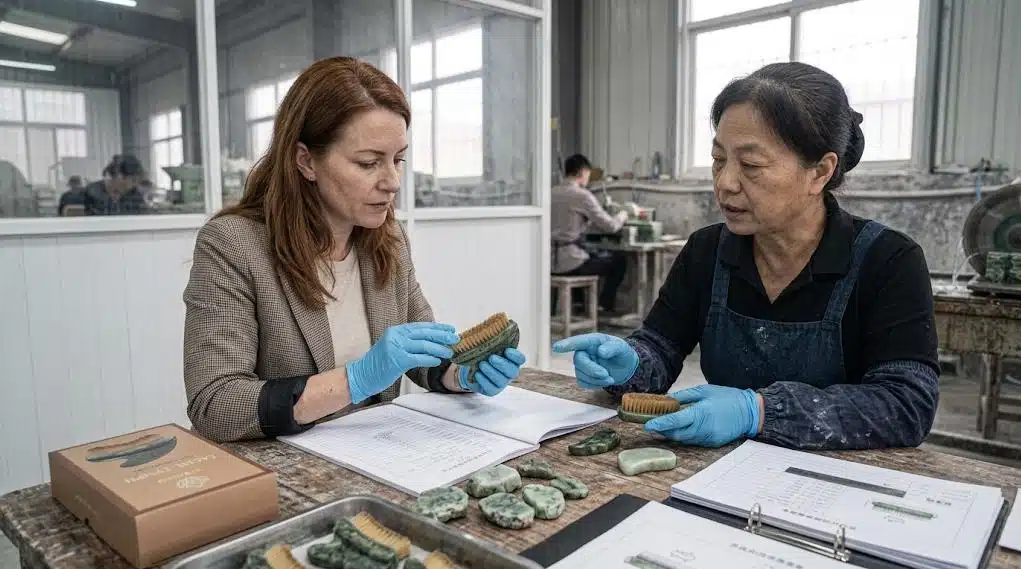
A custom order goes smoothly when decisions come in the right order. Five stages cover it: brief, sample, trial fit, bulk run, and shipment check. Each stage targets one or more of the three danger zones from Chapter 1, and each ends with something you can verify. The right Gua Sha Lymphatic Brush manufacturer will welcome every stage as a check on its own work. Lead times and prices depend on structure, quantity, and component supply, so ask for a written schedule instead of relying on a general promise.
Stages 1 and 2: Brief and Sample
Start with a brief that lists the outline and dimensions, stone type, accepted color and texture range, brush length, density and softness, order quantity, and packaging needs. Send the real brush component along with it. The Gua Sha Lymphatic Brush manufacturer then makes a sample in your target stone, and you approve it in writing with photos. For any guasha custom order, that approved sample becomes the reference for every inspection that follows. This means you can settle color and shape disputes in advance, when settling them costs nothing.
Stage 3: Trial Fit Before a Gua Sha Lymphatic Brush Manufacturer Cuts Your Batch
This stage targets the slot and bond risks. Ask for a trial fit with the real brush component or a confirmed sample piece, and check whether the part seats evenly, sits straight, and leaves enough wall around the slot. Then ask for a cured sample and have it pull-tested under the method you agreed. Only after both pass should the template or CNC program be locked for gua sha production. A gua sha manufacturer that agrees to this order of work is protecting the whole batch. This means you can catch a fit problem on one piece instead of finding it on a pallet.
Stages 4 and 5: Bulk Run and Shipment Check
During the bulk run, curing conditions are honored, inspection follows the agreed sampling standard, and rejects are logged. Packaging deserves its own attention, because it is often an afterthought at a gua sha factory that mostly ships plain boards. Stone and accessories need separation, bristles must not be compressed, and labels, counts, and carton marks should match your order. For long-distance shipping, ask for a transport simulation or drop test on the actual packaging. A Gua Sha Lymphatic Brush manufacturer that records its rejects can show you the numbers. This means you can open one carton on arrival, compare it with the approved sample, and report any gap within the window your agreement sets.
Your Pre-Approval Checklist for a Guasha Custom Order
Before you sign with any Gua Sha Lymphatic Brush manufacturer, confirm these five items:
- A signed sample approval with photos and an accepted color range
- A trial-fit result using your real brush
- Written curing conditions
- A pull-test sampling method with acceptance limits
- A packaging test plan and a receiving window
If any of the five is missing, you are accepting gua sha risks that you could have priced in. This means you can sign the purchase order knowing exactly what you agreed to.
How to Vet a Gua Sha Lymphatic Brush Manufacturer Before You Sign
Everything above comes down to one habit: ask for evidence before you pay for volume. The 9 steps and 3 danger zones give you a frame, and a short list of questions turns that frame into a comparison you can run on every gua sha manufacturer you contact. A supplier’s answers will tell you more than a brochure, a price sheet, or a polished factory video. A Gua Sha Lymphatic Brush manufacturer with real process control welcomes that comparison.
Nine Questions to Ask Any Gua Sha Lymphatic Brush Manufacturer
Start with the joint. Ask whether the factory trial-fits your real brush before bulk cutting, how long the adhesive cures, and who signs off before packing. Ask what the pull-test method is and what counts as a pass. Then move to the stone: request the written material name, the treatment statement, and the plan for handling color variation against your approved sample. Finish with logistics, asking what packaging tests cover stone and bristles together and who is responsible for labels and listing wording. Send the same list to every gua sha manufacturer on your shortlist, and note who answers in specifics. A Gua Sha Lymphatic Brush manufacturer with working systems answers each question quickly, often with a photo or a record. This means you can score every supplier on the same nine lines and choose on evidence rather than charm.
Red Flags a Gua Sha Lymphatic Brush Manufacturer Cannot Hide
Some signals show up fast. A supplier that will not state the stone’s treatment status either hides something or does not know. A quote with no itemized lines points to trimmed curing or inspection. A gua sha factory that refuses to trial-fit with your brush suggests its gua sha production line has never been tested against real parts. A promise of identical color across natural stone ignores how the material behaves. And a Gua Sha Lymphatic Brush manufacturer that answers every question with “everything is handled” tells you nothing about gua sha risks at all. This means you can walk away early, before a deposit makes leaving expensive.
The Short Version for Your Next Order With a Gua Sha Lymphatic Brush Manufacturer
Nine steps build the product, three of them hold most of the risk, and five cost lines explain the price gap. The placeholder example showed an 80% return on testing spend, which is why inspection belongs in your quote and not on your wish list. Before you sign with any gua sha manufacturer, you need a signed sample, a trial-fit result, written curing conditions, a pull-test standard, and a packaging plan. Keep your claims to material, size, bristle type, and finish, and keep an eye on every stage of gua sha production that touches the slot or the joint. A Gua Sha Lymphatic Brush manufacturer earns your order at the slot, at the joint, and at final inspection, and your job is to ask for proof at each one. Which of the nine questions will you send first?
FAQs About Gua Sha Lymphatic Brush Manufacturer Production Process
1. What are the highest-risk steps at a Gua Sha Lymphatic Brush manufacturer?
Three of the 9 production steps carry most of the risk: slotting (step 06), brush bonding (step 08), and final inspection (step 09). A stone can be cut and polished correctly and still fail at the joint. This means you can focus your supplier questions on those three steps first.
2. Why does a lymphatic brush cost more than a plain stone board?
Five lines explain the gap: brush components and fixing materials, assembly labor, adhesive curing time, extra inspection, and packaging that protects both stone and bristles. The exact markup depends on structure, quantity, component supply, and process. This means you can ask your gua sha manufacturer to itemize those five lines in the quote.
3. How long does production take?
There is no fixed number, because lead time depends on order size, component supply, and equipment. One part of the schedule cannot be shortened: the adhesive must reach its specified cure before parts are moved or packed. This means you can ask for a written schedule that shows the curing window.
4. Can I customize both the stone and the brush?
Yes. Send a brief with the outline, dimensions, stone type, accepted color range, and brush specifications, plus the real brush component. A good Gua Sha Lymphatic Brush manufacturer will make a sample, run a trial fit, and wait for your written approval before cutting the batch.
5. How do I check that the brush is bonded securely?
A quick squeeze only tests softness, not bond strength. Agree on a sampled pull-test method and acceptance limits before production starts, and write them into your order. This means you can hold the gua sha factory to a standard you both signed.
6. Is natural color variation a defect?
No. Natural stone varies, so agree on an approved sample and a written color and texture range before gua sha production begins. Cracks, chips, and a loose brush are defects; honest variation inside the agreed range is not.
7. Which claims should I avoid in my product listing?
Stay with what you can verify: material, size, bristle type, and finish. Health claims need evidence, and a word like “lymphatic” in a product name can read as a health claim, so have a qualified reviewer check your wording. This is general information, not legal advice.