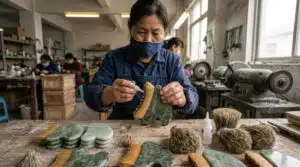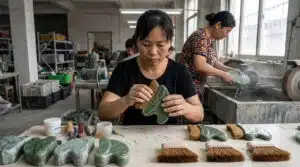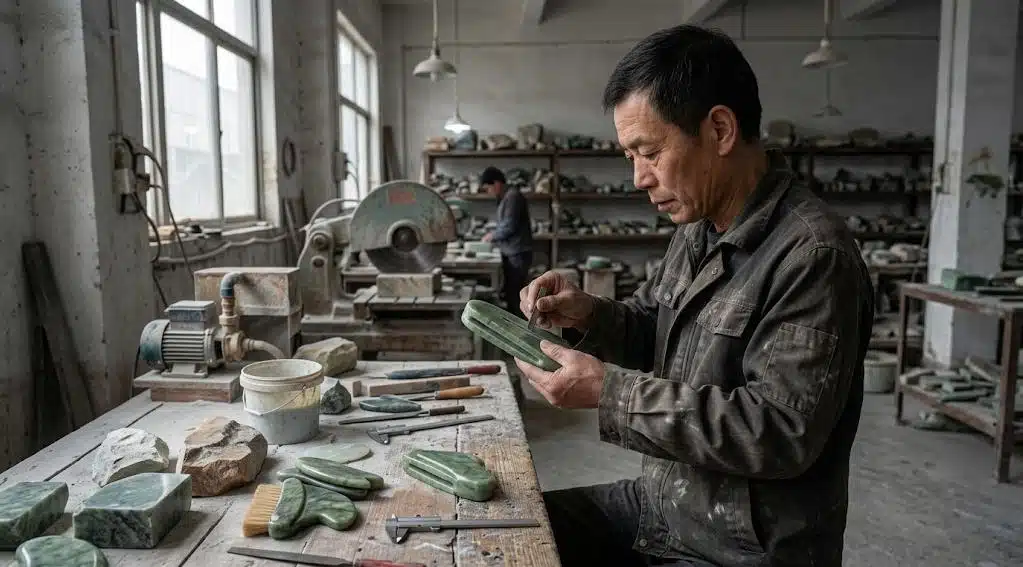
After 12 years of cutting, slotting and polishing stone tools, one step stands out as the hardest in a Gua Sha Lymphatic Brush manufacturer‘s workflow: carving a precise slot into a thick section of nephrite that rates 6.0 to 6.5 on the Mohs scale, according to GIA’s jade overview. Hardness is not the real issue, since GIA also notes that both jadeite and nephrite resist breaking and chipping well. The risk starts when a thin scraping edge and a thick brush-head zone have to live in one block of stone. You probably want to know where that risk sits before you sign a purchase order, so this page names it plainly. That means you can ask any gua sha manufacturer sharper questions on day one, instead of finding out in your first failed batch.
- What Twelve Years on the Floor Teach a Gua Sha Lymphatic Brush Manufacturer
- Dual-Thickness Cutting: The First Test of a Gua Sha Lymphatic Brush Manufacturer
- Slotting Risks Every Gua Sha Lymphatic Brush Manufacturer Must Control
- Bristle Bonding and Final Inspection: What a Gua Sha Lymphatic Brush Manufacturer Should Prove to You
- Compliance Questions to Put to Any Gua Sha Lymphatic Brush Manufacturer
- What a Gua Sha Lymphatic Brush Manufacturer Quote Really Costs You
- Questions to Ask a Gua Sha Factory Before You Compare Prices
What Twelve Years on the Floor Teach a Gua Sha Lymphatic Brush Manufacturer

Why Thickness Is the First Risk a Gua Sha Lymphatic Brush Manufacturer Checks
A traditional jade board has one smooth, even thickness, so the work is mostly shaping, edge finishing and polishing. A lymphatic brush asks for more. The scraping area stays thin, while the brush-head area stays thick enough to hold a mounting slot and still leave a solid floor under it. Cutting both zones from one stone means the cutter has to plan the final shape before the first pass, not after it.
That planning changes the production sequence. Rough cutting leaves allowance for fine grinding and polishing, slotting happens before the final polish, and every transition between thick and thin gets checked for cracks and chipped edges. A gua sha production line set up only for flat boards may not have these checks in place. This means you can expect a different quote, lead time and inspection plan from a brush supplier, and those differences show you who understands the job.
Where Material Choice Adds Gua Sha Risks
Natural stone carries internal cracks and texture shifts that can stay invisible until the slotting pass exposes them. Treatment adds a second question. GIA’s buyers guide explains that jade can be dyed, bleached, heated, waxed and impregnated, and that these processes are not always obvious to the buyer. Ask your supplier to state in writing whether the stone is untreated, and how they screen for hidden cracks before cutting. This means you can request a material statement and a screening method before you approve any sample.
The chapters ahead follow the order in which problems show up on a real order: cutting, slotting, bristle bonding, inspection, compliance and cost. Each one tells you what to ask, what to measure and what a straight answer sounds like. If your project needs guasha custom shapes or a specific bristle feel, you will see exactly where those choices raise or lower gua sha risks. And if you are comparing one gua sha factory against another, you will have a checklist that does not depend on anyone’s sales pitch. That means you can finish this guide ready to request a sample with clear acceptance criteria.
Dual-Thickness Cutting: The First Test of a Gua Sha Lymphatic Brush Manufacturer

When a stone reaches the cutting table, the outline on your drawing is only half the instruction. The other half is the thickness map: how thin the scraping zone stays, how thick the brush-head zone stays, and how the stone steps between them. A flat board can be judged by outline and edge alone, while a brush has to be judged by outline, thickness and transition at the same time. This means you can spot a weak supplier early, because a capable one will ask for your thickness requirements and not only your outline.
How a Gua Sha Lymphatic Brush Manufacturer Plans the Cut
Four problems come up again and again in dual-thickness work. The cutting path is more complex because each zone has its own contour and depth. Thickness control cuts both ways: a scraping area that is too thick spoils the shape and feel, one that is too thin loses local strength, and a head zone that is too thin cannot hold the slot depth plus a solid floor under it. The transition between the two is where chipped edges, uneven walls and accidental thin spots tend to appear. Finally, the cut has to leave enough stone for grinding and polishing, or the last polishing pass can push a part below spec. This means you can ask your supplier how much allowance they leave for polishing and whether that figure appears in the work order.
Natural stone makes the plan harder. GIA’s buyers guide notes that jadeite’s texture can be fine, medium or coarse depending on crystal size and hardness, and the same logic applies to any natural block you send through a saw. Two blocks cut from the same drawing can behave differently, with one giving a clean transition and the other cracking at the step. That is why gua sha production for brushes works better when rough stone is sorted by texture and visible flaws before cutting begins. This means you can expect steadier results and fewer surprise rejects at final inspection when your supplier sorts stone first.
Three Checks to Run Before Cutting Starts
You can turn all of this into a short routine. First, send a drawing with thickness values for each zone, not just the outline, and ask the supplier to mark the transition area. Second, ask for a cut sample of the transition, have it measured at several points, and agree the allowed tolerance in writing before the batch begins. Third, ask what happens to a stone that shows a crack after cutting: is it scrapped, reworked or shipped? These three questions expose most of the gua sha risks tied to cutting, and they work on any gua sha factory, so you can compare quotes on equal terms. This means you can sign off on a process before you commit to a volume.
If your project involves guasha custom shapes, add a fourth check: request a manufacturability review before you finalize the template. A curve that looks elegant on screen can leave a transition too thin once the polishing allowance is subtracted. A gua sha manufacturer who works with you will point that out before the first cut, not after the first loss. A block that cracks during cutting also wastes every earlier cost in that stone. This means you can protect both your material budget and your delivery date by fixing the design on paper first.
Slotting Risks Every Gua Sha Lymphatic Brush Manufacturer Must Control

Slotting is the step that turns a board into a brush. In gua sha production, the cutter removes stone from a thick section to make a seat for the bristle assembly, and that cut creates a new mouth, new walls and a new floor that the stone never had. A flat tool never needs this. This means you can treat the slot as its own process with its own approval, not as a line item hidden inside “cutting.”
Slot Dimensions a Gua Sha Lymphatic Brush Manufacturer Must Hold
Five numbers decide whether the head fits: slot width, depth, length, position, and the thickness left under the floor. A slot that is too narrow stops the bristle assembly from seating or forces extra trimming. Too wide, and the gap grows, which makes bonding harder and the joint less tidy. Too shallow, and the head never reaches its design position, while too deep thins the floor and weakens the stone. A slot shifted off center throws off both the look and the assembly. This means you can write all five numbers, with tolerances, into your purchase order and measure them at incoming inspection.
Why Chips and Cracks Appear During Slotting
Natural stone is not uniform, so the same cutting settings can behave differently from block to block. Slotting adds local stress at the mouth and floor of the slot, and a flaw that stayed hidden during rough cutting may open up there. GIA’s care guide points out that the Mohs scale measures scratch resistance and that its steps are not evenly spaced, which is a reminder that a hardness figure alone cannot tell you how one particular block will chip. A blank that looks sound can still fail in the slot, and when it does, the stone carries every hour of shaping already spent on it. This means you can ask your supplier for the scrap rate at the slotting step and check whether that cost is built into your quote.
A slot passes only when two things are true. The dimensions match the drawing, and the structure is intact, with no chipped mouth, no crack in the floor and no damage that would affect assembly. Some suppliers may check only the first. A slot that measures perfectly but has a chipped corner can still accept a bristle head and then fail in use. A careful gua sha factory records both results for each batch, ideally with a photo of the slot mouth. This means you can request those records and see exactly how your batch was judged.
How to Reduce Gua Sha Risks at the Slotting Step
You can lower the risk with a short sequence. Ask for a slotting trial on three to five blanks taken from the same stone lot as your order. Have the slots measured, then inspect the mouth and floor under strong light or magnification. Agree on a minimum floor thickness for your design, and ask the supplier to explain how that value was chosen. A gua sha manufacturer who has done this before will answer without hesitation.
If your guasha custom design calls for a deeper slot, ask whether the head zone can be made thicker, because a deeper slot in the same thickness leaves less stone under it. This means you can lock the slot specification before mass cutting begins and keep rework costs predictable.
Bristle Bonding and Final Inspection: What a Gua Sha Lymphatic Brush Manufacturer Should Prove to You

Once the stone is cut, slotted and polished, the job is only half done. The bristle assembly still has to be chosen, fitted, glued and cured, and each of those steps can fail even when the stone is perfect. Many buyers only look at the polished surface of a sample, which is the part that matters least to long-term use. This means you can save yourself a costly reorder by judging the bonded joint and the bristles as carefully as the jade.
Bristles Are Not a Case of Softer Is Better
Bristle material, length, diameter, density, layout and fixing structure all change how the brush feels on skin. A bristle that is too stiff feels harsh. One that is too long or unevenly packed gives an unstable shape, and bristles that are crushed in a carton may bend and fail to spring back. Batch differences in length, color and density are another quiet source of complaints, because they only show up when you line ten units side by side. Turn each of these into a measurable acceptance point, for example a length range in millimeters, a density reference against your approved sample, and a visual standard for color. This means you can reject a bad bristle lot at incoming inspection and not after assembly.
Where Bonding Goes Wrong and What You Can Ask For
Stone and a bristle assembly are different materials, so the joint must hold tightly, look clean and stay stable through use. The common problems are a head that does not match the slot size, the wrong adhesive or the wrong amount of it, uneven spreading, a tilted head, glue squeezing out of the seam, and a cure that is rushed or done in the wrong conditions. A joint that feels firm when you tug it by hand is not proof of anything, because a light pull cannot show how the bond behaves after repeated use.
A better approach is to ask for a written fixing test that suits your design. Standards bodies set an example here: ASTM D903 for adhesive peel strength specifies standard-sized specimens and defined pretreatment, temperature and testing speed. You will not copy that method unchanged onto a brush, but you can borrow its logic. Ask the supplier to record the test conditions, the number of samples pulled from each batch and the pass or fail rule, and avoid anyone who offers a single universal number without explaining where it comes from. This means you can compare two suppliers on how they test and not on how confident they sound.
Golden Samples, Batch Records and Gua Sha Production Consistency
A great sample does not guarantee a stable batch. Raw stone shifts, operators change, and bristle lots arrive with small differences, so the first sample often shows the best-case result. Fix this with a sealed golden sample that records stone color and pattern, dimensions, bristle length, density, softness, head position and bond strength result. Both sides keep a copy, and every shipment is checked against it.
A gua sha factory that runs staged inspection, covering stone checks, incoming bristle checks, assembly checks and final inspection, can trace a defect back to its step. Ask for those batch records, because they let you see where gua sha risks were caught and where they slipped through. If you plan guasha custom work, build the golden sample into your first sample round so the standard exists before volume production starts. A reliable gua sha manufacturer will welcome this step, since it protects both parties. This means you can place repeat orders with a clear reference for what “approved” looks like.
Compliance Questions to Put to Any Gua Sha Lymphatic Brush Manufacturer

No single certificate says “compliant gua sha brush,” so the useful question is which rules apply to the way you plan to sell the product. The answer depends on your target market, on the claims printed on your packaging and on the materials you choose. A supplier who cannot discuss these three points is not ready for export orders. This section is general information and not legal advice, so you should confirm the final position with a compliance consultant in each market. This means you can walk into that conversation with the right questions already written down.
United States: Your Claims Decide the Category
In the US, the biggest lever is the wording of your marketing. FDA’s general wellness guidance, updated in January 2026, says low-risk general wellness products are not regulated as devices under the federal Food, Drug, and Cosmetic Act. A product counts as low risk when it is not invasive, not implanted and does not use technology that creates a safety risk. A hand-held jade tool with a bristle head fits that profile comfortably, as long as the packaging does not promise to treat or cure a disease.
Claims are where sellers get into trouble. Phrases about relaxing, caring for skin or encouraging a healthy routine sit on the general wellness side. Phrases about treating swelling, a medical condition or a lymphatic disorder move the product toward medical device territory, whatever the tool is made of. This means you can keep your listing, packaging and website copy within general wellness language and avoid turning a simple tool into a regulatory problem.
European Union: Safety, Traceability and Labels
For the EU market, the main framework for a product like this is the General Product Safety Regulation, Regulation (EU) 2023/988, which has applied since 13 December 2024. According to the U.S. International Trade Administration’s summary, it requires a risk assessment that considers foreseeable use and misuse, and it requires identifying information such as batch numbers and manufacturer details so that unsafe items can be traced and pulled quickly. Products also need contact details for an EU-based responsible person when the seller sits outside the EU.
In practical terms, your gua sha factory needs to give you batch records, a clear production date or lot code, and enough material information to support your own risk assessment. A bristle brush adds a small-parts question and an adhesive question that a plain stone board never raised. Each of these is among the gua sha risks you should discuss before you print packaging. This means you can ask for lot codes and material data at the sample stage, which is much cheaper than relabeling a finished shipment.
Materials, Origin and Documents to Request
Material compliance starts with the stone. GIA’s buyers guide explains that jade can be dyed, bleached or impregnated and discusses whether jadeite from Myanmar can enter the United States, which shows how much origin and treatment questions matter to importers. Ask your supplier to state the mineral type, whether the stone is untreated, and where it was sourced, then check the origin against current import rules in your market before you place an order.
For the bristle head and adhesive, request a materials list, the supplier’s own test records and a statement describing the cure conditions. Keep these papers together with the golden sample from the previous chapter. If your project involves guasha custom designs, ask whether changes to bristle type or adhesive trigger a fresh review, because a small material swap can change the answer. A dependable gua sha manufacturer keeps this paper trail without being asked twice, and a gua sha production partner who cannot produce it is telling you something. This means you can build a compliance file during sampling and hand it to your importer or marketplace on request.
What a Gua Sha Lymphatic Brush Manufacturer Quote Really Costs You

A lower price per kilogram on a quotation sheet tells you very little about what you will pay per sellable brush. The number that matters is the material cost of each good unit after breakage, rework and failed bonds are counted. GIA’s jade overview notes that jadeite is generally sold by the piece rather than by weight, a useful reminder that the price of a block and the cost of a finished tool are different things. This means you can compare suppliers fairly only when you ask each one for a yield-adjusted price.
Why Yield Beats Stone Price for a Gua Sha Lymphatic Brush Manufacturer
Deyi Gems’ internal production records show that the price gap between stone grades is small. Take rose quartz rough: B grade costs 12 RMB per kilogram and A grade costs 13.5 RMB. One kilogram of rough makes about three finished tools when every blank survives, so the raw-material cost per piece is 4.00 RMB for B grade and 4.50 RMB for A grade, a ratio of 1 : 1.125.
Now lower the yield to 66.67%, which means two finished pieces from the same kilogram. A grade rises to 6.75 RMB per piece, which is 1.5 times its own cost at full yield and about 1.7 times the B grade cost at full yield. The table below shows all four cases side by side.
| Scenario | Rough price (RMB/kg) | Finished pieces per kg | Material cost per piece (RMB) |
| B grade, full yield | 12.00 | 3 | 4.00 |
| A grade, full yield | 13.50 | 3 | 4.50 |
| B grade, 66.67% yield | 12.00 | 2 | 6.00 |
| A grade, 66.67% yield | 13.50 | 2 | 6.75 |
Look at the third row: cheaper B-grade stone at low yield costs more per piece than A-grade stone at full yield. These figures also leave out labor, machine time and polishing, all of which are spent on blanks that later break. This means you can stop negotiating over a 1.5 RMB difference per kilogram and start asking how many pieces each kilogram actually produces.
What Low Yield Does to Your Purchasing Budget
Yield also decides how much stone must be bought for your order. For 10,000 A-grade pieces, a full yield needs about 3,333 kg of rough, or roughly 45,000 RMB. At 66.67% yield the same order needs 5,000 kg, or 67,500 RMB, which is 22,500 RMB more and a 50% increase before any processing begins. More stone also means more sorting, storage and cutting time. This means you can ask your supplier for the kilograms of rough needed per 1,000 finished pieces and use that figure to check any quotation.
Testing pays back in a similar way. As an illustration with assumed numbers, suppose 5,000 units ship, 3% fail at the bond, and each return costs you 100 RMB in refund, freight and replacement, so returns cost 15,000 RMB. A 2,000 RMB testing program that brings failures down to 1% leaves 5,000 RMB in return costs, saving 10,000 RMB and returning 400% on the spend. This means you can justify a written fixing test as a purchase that earns its cost back.
Questions to Ask a Gua Sha Factory Before You Compare Prices

Ask each supplier for five numbers: expected yield from stone to finished unit, scrap rate at slotting, rework rate at assembly, final inspection sampling plan and minimum order quantity. A gua sha factory that answers with ranges from past batches is showing you real data. One that offers a single flat price with no yield figure is asking you to carry the gua sha risks yourself.
If you order guasha custom shapes, ask which design features add scrap, since a deeper slot or a thinner transition changes the numbers above. A transparent gua sha manufacturer will show you where the cost sits and help you trim it. Good gua sha production planning also keeps the stone work and the bristle preparation running in parallel, so lead time depends more on capacity, rework and cure time than on step count. This means you can negotiate on design details that cut real cost, not just push for a lower headline price.
Your Step-by-Step Plan From First Inquiry to Delivered Order
Everything in the earlier chapters comes down to one sequence you can run with any supplier. The sequence has seven steps, and you can start the first one today with a single email. Running it in order keeps cost, quality and compliance questions from piling up at the end, when changes are most expensive. This means you can treat the plan below as a checklist that you tick off before each payment milestone.
Seven Steps You Can Run Right Now
- Send a drawing with outline, thickness for each zone, slot width, depth, length, position and minimum floor thickness.
- Ask for a written material statement covering stone type, treatment status and origin.
- Request a cut-and-slotted sample, then measure it and inspect the slot mouth and floor.
- Request a finished sample and agree on a fixing test with conditions, sample count and pass rule.
- Sign off a golden sample and a compliance file that holds material lists and batch coding.
- Approve a pilot batch, check it against the golden sample, then place the volume order.
- Verify packaging with a drop or compression check that fits your shipping route, and inspect bristles after transit.
How to Use Each Step Without Slowing Down
Steps one and two cost you almost nothing and filter out most weak suppliers. A gua sha manufacturer who replies with questions about your thickness map is already thinking like a production team. The stone question deserves attention, because SSEF’s Introduction to Jade course lists jade sources, treatments and the science of jade testing as core topics, a sign that origin and treatment are everyday issues for gemologists and not obscure details. If an order is large or your market asks for proof, you can send a sample to a gem laboratory for a report. This means you can back up a supplier’s material statement with independent evidence when the order justifies it.
Steps three to five are where you spend the most effort, and they also protect you the most. Keep every measurement, photo and test record in one shared folder so that both sides argue from the same data. Good gua sha production depends on repeatable settings, so ask the supplier to record the cutting, slotting and curing parameters used for the approved sample. If you plan guasha custom work, finish the design review before step three, because changes after a slotted sample cost real stone. This means you can lock your specification once and avoid paying for the same sample twice.
Steps six and seven turn a sample into a shipment. A pilot batch of a few hundred units shows you whether a gua sha factory can hold the golden sample standard when more than one operator touches the product. Check bristles after a real transit test, since packing that looks tidy at the factory can still crush a head by the time cartons reach your warehouse. Done in this order, the plan cuts the gua sha risks this series described to a short list you can name and measure. This means you can scale an order with a clear record of what “approved” means.
About Deyi Gems
Deyi Gems has processed, designed, manufactured and sold jade and crystal gua sha tools for more than 12 years. We built this guide from our own production experience, and you are welcome to send us your drawing for a manufacturability review. You will get a written reply that follows the same seven steps above, so you can compare it directly with any other supplier.