
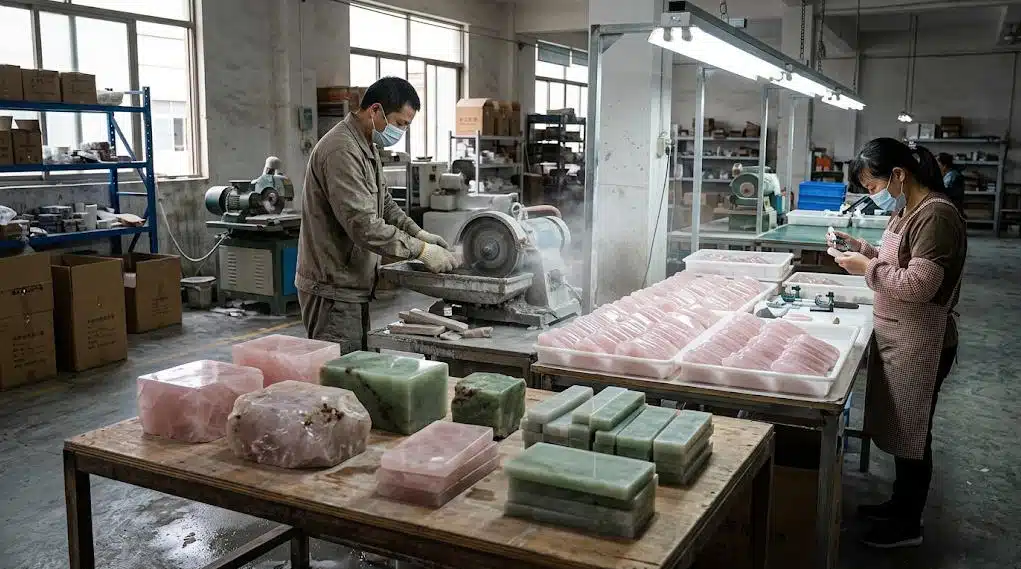
Gua Sha Wholesale Price Explained: Industry Experience and Risk Disclosure for Buyers
Gua sha wholesale quotes for identical-looking pieces can differ by 70% on raw material cost alone: 2.20 RMB per piece from a B-grade, 5-pieces-per-kilogram process, versus 3.75 RMB from an A-grade, 4-pieces-per-kilogram process. Those numbers come from rose quartz purchasing records at a Dongguan workshop, and they explain why two suppliers can quote the same shape so differently. As a gua sha manufacturer with 12+ years in jade and crystal production, we lay out the cost drivers and the risks here so you can judge any gua sha price before you sign. One more figure matters for your order size: CNC production only beats hand carving on unit cost once a single batch passes 8,000 pieces. A higher quote does not guarantee high quality gua sha, and a lower one does not guarantee a problem. This means you can stop guessing from the price tag and start checking the assumptions behind it. Why Gua Sha Wholesale Quotes Differ for the Same Product The Three Layers Behind Any Gua Sha Wholesale Price Price gaps for look-alike products are not unique to this category. They show up in almost every market, and you will notice them in gua sha wholesale too. If you source in both China and overseas channels, you may even find that one factory sells the same piece at two different wholesale prices, one for domestic buyers and one for export buyers. That split in the guasha wholesale price has nothing to do with the stone. Three layers sit underneath every gua sha wholesale quote. The first is factory cost: stone, labor, machine time, and the pieces that fail inspection. The second is channel cost: platform fees, advertising, and the sales team that answers your inquiry. The third is market transparency, which decides how much margin buyers in a given market will accept. Why does this matter to you? Because each layer moves independently. A factory with cheap stone can still quote high if it pays for expensive advertising, and a factory with a tight production line can still quote low if its market is highly price-aware. This means you can break any single number into three questions, which is far easier to negotiate than one unexplained total. What a Gua Sha Price Quote Does Not Tell You A single gua sha price line hides at least four assumptions: the stone grade, the yield per kilogram, the pass rate, and the batch size. Two suppliers can both write 1.80 USD on a quotation sheet while running completely different processes behind it. One might use selected stone and inspect every piece. The other might use mixed stone and sample-check 10% of the batch. Here is the uncomfortable part of this industry: a low quote can signal weaker material or looser inspection, but it can also signal an efficient line or a small advertising budget. A high quote can signal careful sorting, but it can also signal heavy platform fees. The number alone cannot tell you which story you are looking at. This means you can protect your order by ranking suppliers on what they disclose, not on what they charge, and that habit makes every gua sha wholesale comparison fairer. How to Read a Gua Sha Price Quote in Five Minutes You do not need a lab to screen a quotation. Send these five questions to any gua sha manufacturer before you compare two suppliers: Suppliers who answer in numbers are usually the ones who track their costs. Suppliers who answer with adjectives usually are not. This means you can sort your shortlist in one afternoon and spend your sample budget only on the factories that passed. Raw Material Risk in Gua Sha Wholesale: Grade, Season, and Yield Rose Quartz Grade A vs. Grade B: A 36.36% Gap Raw stone is the biggest single variable in gua sha wholesale pricing, so it deserves the first look. In the first half of 2025, A-grade rose quartz rough cost 15 RMB per kilogram at our regular raw material exchange. A B-grade lot at the same exchange cost 11 RMB per kilogram. That is a 36.36% difference between two stones that, once polished, can look alike at arm’s length. Turn that into piece cost. At 5 pieces per kilogram, A-grade stone costs 3.00 RMB per piece and B-grade costs 2.20 RMB. On a 10,000-piece order, the stone alone differs by 8,000 RMB before a single worker touches it. This means you can calculate how much of a quote gap grade explains, and challenge only the part that grade cannot explain. Why a Grade Label Is Not a Standard Here is a risk most buyers miss. According to the GIA rose quartz buyer’s guide, GIA evaluates rose quartz but does not grade it. So there is no universal A or B scale for the stone. When a supplier writes “A grade,” that label comes from their own sorting rules, and one supplier’s A may be another supplier’s B. In gua sha wholesale, that single letter can hide a wide range of stone. The same GIA page notes that rose quartz is occasionally irradiated to intensify its color, and the GIA rose quartz overview explains that microscopic mineral inclusions give the stone its cloudy translucence. Those facts matter for your purchase order. Color that looks deeper than the stone’s natural range deserves a question about treatment. This means you can write “treatment disclosure required” into your contract and ask for rough-stone photos, so a claim of high quality gua sha rests on evidence you can see. Season Timing and Gua Sha Wholesale Cost Timing changes cost even when the grade stays the same. After August 2025, the same rose quartz at the same exchange rose by roughly 20%. A-grade stone moved from about 15 RMB to about 18 RMB per kilogram, which lifts piece cost from 3.00 RMB to 3.60 RMB at 5 pieces per kilogram. Across 10,000 pieces, that is 6,000 RMB of extra stone cost. So two factories using identical A-grade material […]
Gua Sha Wholesale Price Explained: Industry Experience and Risk Disclosure for Buyers Read More »
Gua sha wholesale quotes for identical-looking pieces can differ by 70% on raw material cost alone: 2.20 RMB per piece from a B-grade, 5-pieces-per-kilogram process, versus 3.75 RMB from an A-grade, 4-pieces-per-kilogram process. Those numbers come from rose quartz purchasing records at a Dongguan workshop, and they explain why two suppliers can quote the same shape so differently. As a gua sha manufacturer with 12+ years in jade and crystal production, we lay out the cost drivers and the risks here so you can judge any gua sha price before you sign. One more figure matters for your order size: CNC production only beats hand carving on unit cost once a single batch passes 8,000 pieces. A higher quote does not guarantee high quality gua sha, and a lower one does not guarantee a problem. This means you can stop guessing from the price tag and start checking the assumptions behind it. Why Gua Sha Wholesale Quotes Differ for the Same Product The Three Layers Behind Any Gua Sha Wholesale Price Price gaps for look-alike products are not unique to this category. They show up in almost every market, and you will notice them in gua sha wholesale too. If you source in both China and overseas channels, you may even find that one factory sells the same piece at two different wholesale prices, one for domestic buyers and one for export buyers. That split in the guasha wholesale price has nothing to do with the stone. Three layers sit underneath every gua sha wholesale quote. The first is factory cost: stone, labor, machine time, and the pieces that fail inspection. The second is channel cost: platform fees, advertising, and the sales team that answers your inquiry. The third is market transparency, which decides how much margin buyers in a given market will accept. Why does this matter to you? Because each layer moves independently. A factory with cheap stone can still quote high if it pays for expensive advertising, and a factory with a tight production line can still quote low if its market is highly price-aware. This means you can break any single number into three questions, which is far easier to negotiate than one unexplained total. What a Gua Sha Price Quote Does Not Tell You A single gua sha price line hides at least four assumptions: the stone grade, the yield per kilogram, the pass rate, and the batch size. Two suppliers can both write 1.80 USD on a quotation sheet while running completely different processes behind it. One might use selected stone and inspect every piece. The other might use mixed stone and sample-check 10% of the batch. Here is the uncomfortable part of this industry: a low quote can signal weaker material or looser inspection, but it can also signal an efficient line or a small advertising budget. A high quote can signal careful sorting, but it can also signal heavy platform fees. The number alone cannot tell you which story you are looking at. This means you can protect your order by ranking suppliers on what they disclose, not on what they charge, and that habit makes every gua sha wholesale comparison fairer. How to Read a Gua Sha Price Quote in Five Minutes You do not need a lab to screen a quotation. Send these five questions to any gua sha manufacturer before you compare two suppliers: Suppliers who answer in numbers are usually the ones who track their costs. Suppliers who answer with adjectives usually are not. This means you can sort your shortlist in one afternoon and spend your sample budget only on the factories that passed. Raw Material Risk in Gua Sha Wholesale: Grade, Season, and Yield Rose Quartz Grade A vs. Grade B: A 36.36% Gap Raw stone is the biggest single variable in gua sha wholesale pricing, so it deserves the first look. In the first half of 2025, A-grade rose quartz rough cost 15 RMB per kilogram at our regular raw material exchange. A B-grade lot at the same exchange cost 11 RMB per kilogram. That is a 36.36% difference between two stones that, once polished, can look alike at arm’s length. Turn that into piece cost. At 5 pieces per kilogram, A-grade stone costs 3.00 RMB per piece and B-grade costs 2.20 RMB. On a 10,000-piece order, the stone alone differs by 8,000 RMB before a single worker touches it. This means you can calculate how much of a quote gap grade explains, and challenge only the part that grade cannot explain. Why a Grade Label Is Not a Standard Here is a risk most buyers miss. According to the GIA rose quartz buyer’s guide, GIA evaluates rose quartz but does not grade it. So there is no universal A or B scale for the stone. When a supplier writes “A grade,” that label comes from their own sorting rules, and one supplier’s A may be another supplier’s B. In gua sha wholesale, that single letter can hide a wide range of stone. The same GIA page notes that rose quartz is occasionally irradiated to intensify its color, and the GIA rose quartz overview explains that microscopic mineral inclusions give the stone its cloudy translucence. Those facts matter for your purchase order. Color that looks deeper than the stone’s natural range deserves a question about treatment. This means you can write “treatment disclosure required” into your contract and ask for rough-stone photos, so a claim of high quality gua sha rests on evidence you can see. Season Timing and Gua Sha Wholesale Cost Timing changes cost even when the grade stays the same. After August 2025, the same rose quartz at the same exchange rose by roughly 20%. A-grade stone moved from about 15 RMB to about 18 RMB per kilogram, which lifts piece cost from 3.00 RMB to 3.60 RMB at 5 pieces per kilogram. Across 10,000 pieces, that is 6,000 RMB of extra stone cost. So two factories using identical A-grade material […]