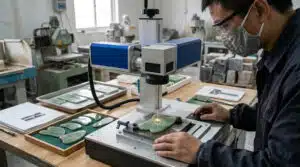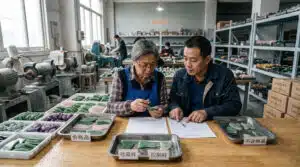
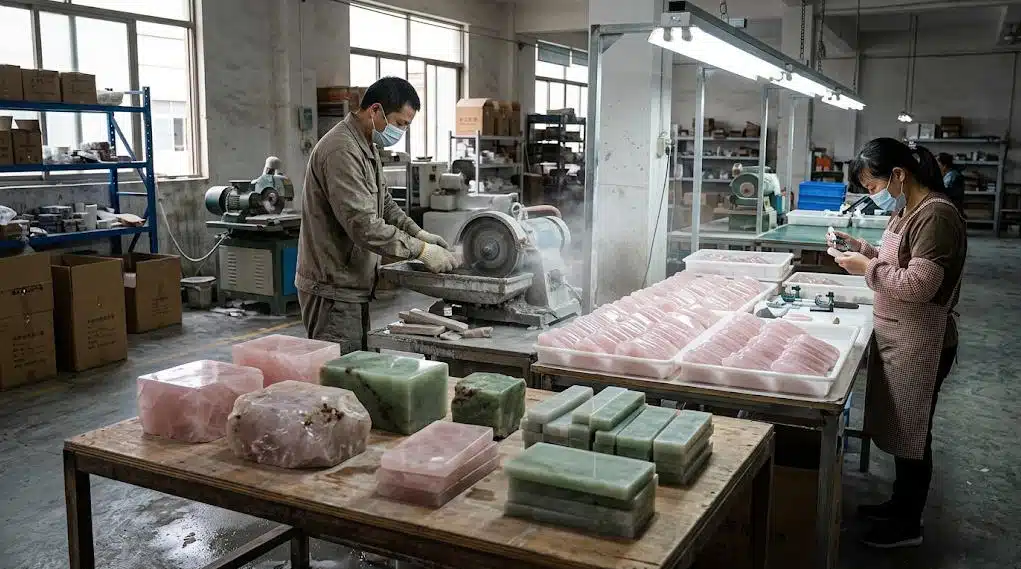
Gua sha wholesale quotes for identical-looking pieces can differ by 70% on raw material cost alone: 2.20 RMB per piece from a B-grade, 5-pieces-per-kilogram process, versus 3.75 RMB from an A-grade, 4-pieces-per-kilogram process. Those numbers come from rose quartz purchasing records at a Dongguan workshop, and they explain why two suppliers can quote the same shape so differently. As a gua sha manufacturer with 12+ years in jade and crystal production, we lay out the cost drivers and the risks here so you can judge any gua sha price before you sign. One more figure matters for your order size: CNC production only beats hand carving on unit cost once a single batch passes 8,000 pieces. A higher quote does not guarantee high quality gua sha, and a lower one does not guarantee a problem. This means you can stop guessing from the price tag and start checking the assumptions behind it.
- Why Gua Sha Wholesale Quotes Differ for the Same Product
- Raw Material Risk in Gua Sha Wholesale: Grade, Season, and Yield
- How Production Method Shapes Gua Sha Wholesale Pricing
- Hidden Channel and Operating Costs Inside Gua Sha Wholesale Quotes
- Verifying High Quality Gua Sha Before a Gua Sha Wholesale Order
- Getting a Fair Guasha Wholesale Price From a Gua Sha Manufacturer
Why Gua Sha Wholesale Quotes Differ for the Same Product
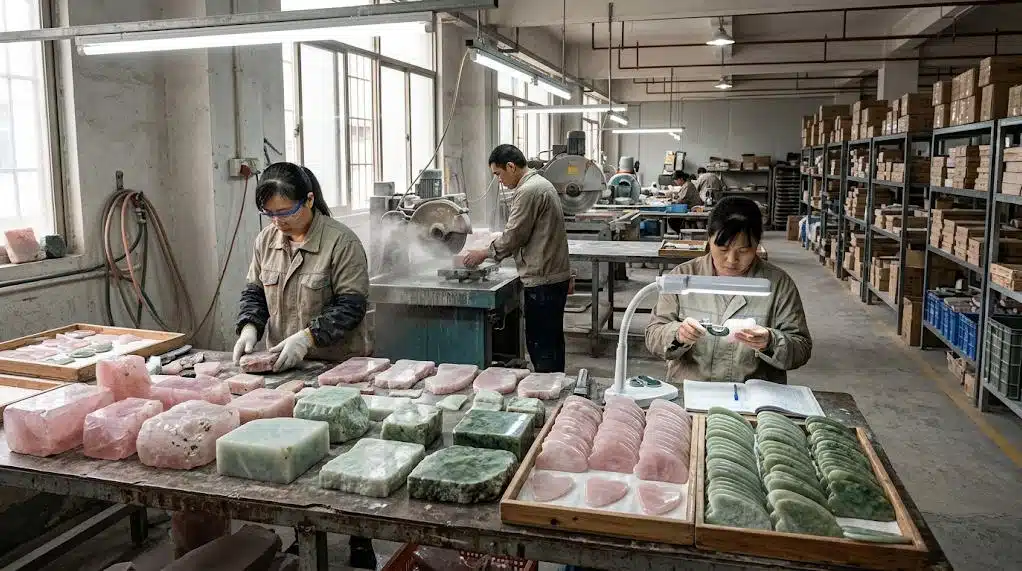
The Three Layers Behind Any Gua Sha Wholesale Price
Price gaps for look-alike products are not unique to this category. They show up in almost every market, and you will notice them in gua sha wholesale too. If you source in both China and overseas channels, you may even find that one factory sells the same piece at two different wholesale prices, one for domestic buyers and one for export buyers. That split in the guasha wholesale price has nothing to do with the stone.
Three layers sit underneath every gua sha wholesale quote. The first is factory cost: stone, labor, machine time, and the pieces that fail inspection. The second is channel cost: platform fees, advertising, and the sales team that answers your inquiry. The third is market transparency, which decides how much margin buyers in a given market will accept.
Why does this matter to you? Because each layer moves independently. A factory with cheap stone can still quote high if it pays for expensive advertising, and a factory with a tight production line can still quote low if its market is highly price-aware. This means you can break any single number into three questions, which is far easier to negotiate than one unexplained total.
What a Gua Sha Price Quote Does Not Tell You
A single gua sha price line hides at least four assumptions: the stone grade, the yield per kilogram, the pass rate, and the batch size. Two suppliers can both write 1.80 USD on a quotation sheet while running completely different processes behind it. One might use selected stone and inspect every piece. The other might use mixed stone and sample-check 10% of the batch.
Here is the uncomfortable part of this industry: a low quote can signal weaker material or looser inspection, but it can also signal an efficient line or a small advertising budget. A high quote can signal careful sorting, but it can also signal heavy platform fees. The number alone cannot tell you which story you are looking at. This means you can protect your order by ranking suppliers on what they disclose, not on what they charge, and that habit makes every gua sha wholesale comparison fairer.
How to Read a Gua Sha Price Quote in Five Minutes
You do not need a lab to screen a quotation. Send these five questions to any gua sha manufacturer before you compare two suppliers:
- Which stone grade and which source, and who defines “A grade”?
- How many finished pieces does one kilogram of stone produce?
- What is the final inspection pass rate over the last three batches?
- Is this price for CNC or hand carving, and at what batch size does the method change?
- Is this quote from a domestic platform, an export platform, or direct?
Suppliers who answer in numbers are usually the ones who track their costs. Suppliers who answer with adjectives usually are not. This means you can sort your shortlist in one afternoon and spend your sample budget only on the factories that passed.
Raw Material Risk in Gua Sha Wholesale: Grade, Season, and Yield
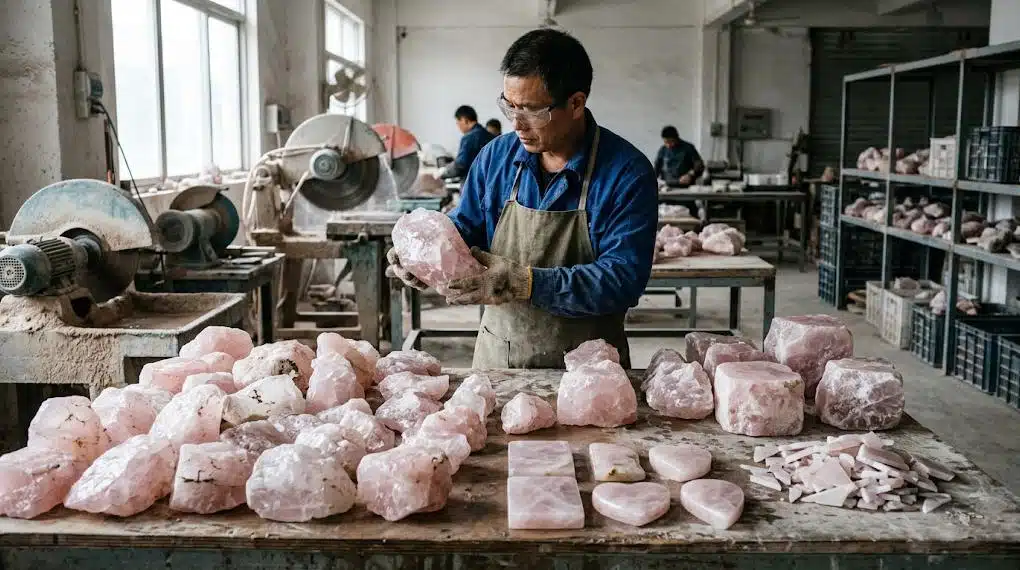
Rose Quartz Grade A vs. Grade B: A 36.36% Gap
Raw stone is the biggest single variable in gua sha wholesale pricing, so it deserves the first look. In the first half of 2025, A-grade rose quartz rough cost 15 RMB per kilogram at our regular raw material exchange. A B-grade lot at the same exchange cost 11 RMB per kilogram. That is a 36.36% difference between two stones that, once polished, can look alike at arm’s length.
Turn that into piece cost. At 5 pieces per kilogram, A-grade stone costs 3.00 RMB per piece and B-grade costs 2.20 RMB. On a 10,000-piece order, the stone alone differs by 8,000 RMB before a single worker touches it. This means you can calculate how much of a quote gap grade explains, and challenge only the part that grade cannot explain.
Why a Grade Label Is Not a Standard
Here is a risk most buyers miss. According to the GIA rose quartz buyer’s guide, GIA evaluates rose quartz but does not grade it. So there is no universal A or B scale for the stone. When a supplier writes “A grade,” that label comes from their own sorting rules, and one supplier’s A may be another supplier’s B. In gua sha wholesale, that single letter can hide a wide range of stone.
The same GIA page notes that rose quartz is occasionally irradiated to intensify its color, and the GIA rose quartz overview explains that microscopic mineral inclusions give the stone its cloudy translucence. Those facts matter for your purchase order. Color that looks deeper than the stone’s natural range deserves a question about treatment. This means you can write “treatment disclosure required” into your contract and ask for rough-stone photos, so a claim of high quality gua sha rests on evidence you can see.
Season Timing and Gua Sha Wholesale Cost
Timing changes cost even when the grade stays the same. After August 2025, the same rose quartz at the same exchange rose by roughly 20%. A-grade stone moved from about 15 RMB to about 18 RMB per kilogram, which lifts piece cost from 3.00 RMB to 3.60 RMB at 5 pieces per kilogram. Across 10,000 pieces, that is 6,000 RMB of extra stone cost.
So two factories using identical A-grade material can still disagree on gua sha wholesale pricing, simply because one bought in spring and the other bought in autumn. Ask every supplier two things: when the stone in your order was purchased, and how long the quoted price stays valid. A short validity window is a fair request in a rising market. This means you can lock your gua sha price with a deposit before the next purchasing cycle moves the cost.
Yield per Kilogram: Where Guasha Wholesale Price Quietly Rises
Yield is the cost nobody puts on a gua sha wholesale quotation sheet. One factory cuts 5 finished pieces from a kilogram of rough stone. Another gets 4 from the same kilogram. The second factory spends 25% more stone on every piece, and at 15 RMB per kilogram that means 3.75 RMB per piece instead of 3.00 RMB.
Stack the two effects and the gap widens. A B-grade, 5-piece process costs 2.20 RMB per piece in stone. An A-grade, 4-piece process costs 3.75 RMB. That is the 70% spread from the opening of this article, and it appears before labor, machines, or fees enter the picture. Yield depends on cutting plans, saw loss, and how many stones crack or show internal fractures during cutting.
So when you compare a guasha wholesale price from two suppliers, ask for their pieces-per-kilogram figure, not just their stone grade. A factory that can show its cutting plan is a factory that measures its waste. This means you can ask for the yield number in writing and use it to explain, line by line, why one quote sits above another.
How Production Method Shapes Gua Sha Wholesale Pricing
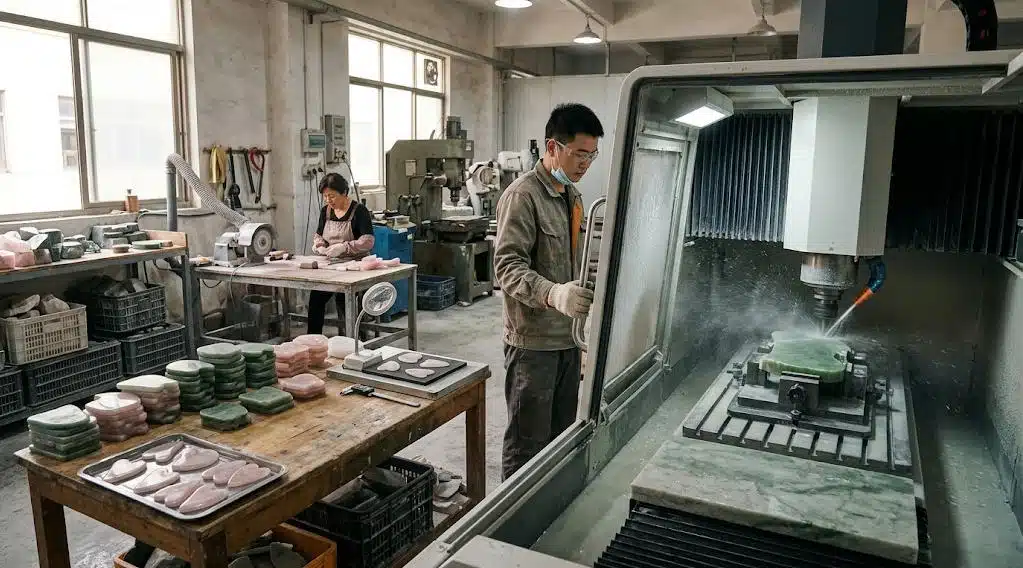
CNC vs. Handmade Gua Sha Wholesale: The 8,000-Piece Break-Even
Raw stone sets the starting line, and the production method decides how fast cost climbs from there. In gua sha wholesale orders, the real question is not “CNC or hand?” but “at what batch size does each one win?” Our internal production records give a clear answer: once a single batch reaches 8,000 pieces, CNC unit cost drops below hand carving. Below that number, skilled hand work stays cheaper.
The reason is setup. A CNC line needs programming, fixtures, and test cuts before it produces a good piece, and those fixed costs only pay off when spread over thousands of units. Hand carving has almost no setup cost, so a 1,000-piece run barely feels the difference. Once the run grows, machines never get tired and their cycle time stays flat, which pulls the unit cost down.
Now put it to work for your budget. If you plan 3,000 pieces per SKU, asking a gua sha manufacturer for a CNC quote may lock you into a setup charge you never earn back. If you plan 10,000 pieces of one shape, hand carving will likely cost you more per piece than the machine, so gua sha wholesale economics favor the machine at that size. This means you can match your SKU volume to the method and avoid paying for a process that does not fit your batch.
Why Labor Cost Differs by Region and Worker Experience
Wages explain a lot of the remaining gap. A gua sha manufacturer in Dongguan, a developed manufacturing region, pays more per hour than an inland workshop, and our carvers have years of industry experience, which raises that cost further. That is a real cost, and it shows up in our quotes.
Is the higher wage worth it? It depends on what you buy. Experienced workers usually crack fewer stones, hold edge angles more consistently, and need less rework. A lower wage can be a fair saving on gua sha wholesale orders of simple, flat-edged shapes, but it can become expensive on a shape with a tight curve. If you want high quality gua sha in a complex shape, pay for experience where the shape punishes mistakes. This means you can decide wage level by product complexity and accept lower labor cost only where it does not hurt the result.
Hourly Output and Pass Rate: The Hidden Unit Cost Drivers
Two numbers rarely appear on a quotation, yet they move your gua sha price more than most buyers expect. The first is hourly output. A line producing 500 pieces per hour spreads its fixed hourly cost over 25% more units than a line producing 400. If both lines cost 600 RMB per hour to run (an assumed figure for illustration), the faster line costs 1.20 RMB per piece and the slower one costs 1.50 RMB.
The second number is pass rate. A factory passing 95% of its pieces needs about 1.05 starts per good piece. A factory passing 80% needs 1.25 starts per good piece, so each sellable piece carries 18.75% more cost. Stack both gaps and the slower, lower-yield factory sits about 48% above the faster one before profit or fees are added.
Rework hides here too. A piece with a chipped edge can sometimes be re-polished, but that costs labor, and not every supplier counts it. These two figures sit behind many unexplained gaps between gua sha wholesale quotes. This means you can ask for pass rate and hourly output together, and use the pair to tell whether a low quote reflects a tight line or a rejected-piece cost that gets shifted into your shipment.
How to Choose a Production Method by Order Size
You can apply all of this in four moves:
- Count the pieces per SKU, not the total order. The 8,000-piece line applies to one batch of one shape.
- Ask for both quotes, CNC and hand, when you sit within 6,000 to 10,000 pieces per SKU.
- Request a pass-rate figure from the last three batches.
- Inspect one pre-production sample from the method you pick, not from the other one.
Do this once and your guasha wholesale price comparison becomes a comparison of methods rather than a comparison of promises. This means you can pick the method with the lowest verified cost at your batch size, and avoid paying a premium for a process your order does not need.
Hidden Channel and Operating Costs Inside Gua Sha Wholesale Quotes
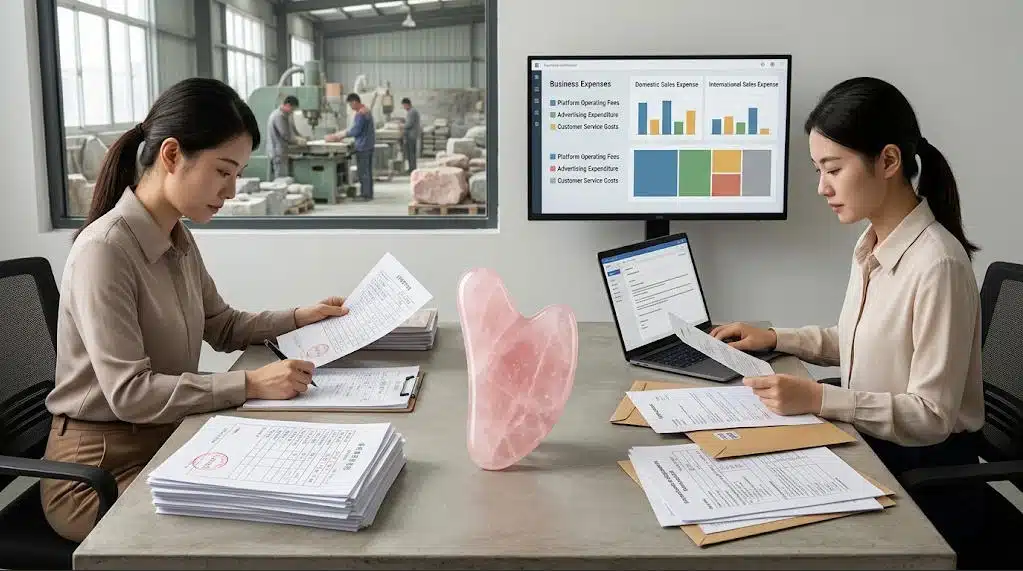
1688 vs. Alibaba.com: Why One Factory Quotes Two Prices
Stone and labor are the costs everyone expects. The costs sellers rarely explain are the ones that keep the inquiries coming. Every supplier pays to be found, and that expense flows into gua sha wholesale pricing. Our company runs a domestic trade team and a foreign trade team, so we see the difference from the inside.
Alibaba Group operates two platforms with very different price tags. Listing on the domestic 1688.com platform costs roughly 10,000 RMB per year. Listing on the export-facing Alibaba.com starts around 30,000 RMB per year, and higher tiers reach 100,000 RMB. Advertising budgets differ by a similar margin.
Spread those fees over volume and the effect is easy to see. If a factory ships 300,000 pieces per year through a channel (an assumed figure), a 30,000 RMB fee adds 0.10 RMB per piece, and a 100,000 RMB fee adds about 0.33 RMB. The 10,000 RMB domestic fee adds about 0.03 RMB. This is why the same gua sha wholesale product can carry two honest prices. This means you can expect an export quote to carry channel cost that a domestic quote does not, and you can ask which platform your price is built on.
Operating and Sales Team Costs in Your Gua Sha Wholesale Quote
Operating cost is the price of serving you. It covers the salespeople who answer your messages, the staff who arrange samples, and the time spent on video calls across time zones. Export buyers of gua sha wholesale usually want more samples, more documentation, and more communication than domestic buyers, so a supplier with an export team carries a larger service load.
None of this is hidden in a bad sense. Service is real work, and a supplier who answers quickly and ships samples on time is doing something that saves you money elsewhere. The risk appears when the service cost is large and the product cost is thin. This means you can ask what the quote includes in service terms, such as sample policy and after-sales handling, and judge whether the premium buys something you will use.
Market Transparency and Overseas Margin
The last factor is information. Domestic buyers in China usually know stone cost, labor cost, and typical margin closely, so a factory there competes mostly on gua sha price and has little room to add margin. Overseas buyers often cannot see those inputs, so quotes have more room to carry margin. That is a market mechanism in gua sha wholesale, not a statement about any single supplier.
You can close that information gap yourself. Asking for pieces per kilogram, pass rate, and stone purchase date turns a vague number into a checkable one. This means you can negotiate from cost evidence instead of from instinct, and you can recognize when a quote sits above what its disclosed inputs support.
How to Negotiate a Gua Sha Wholesale Price Without Cutting Quality
Push on the layers that do not touch the product. Ask for a quote built on a larger batch to lower setup cost per piece. Ask whether a different payment term or a longer lead time reduces cost. Ask whether a repeat-order commitment lowers service cost. Those requests trim price without trimming material, inspection, or finishing.
Avoid pushing on the layers that do. Cutting stone grade, pass-rate checks, or polishing time lowers the quote and also lowers what arrives at your door. Many buyers of gua sha wholesale learn this after a bad shipment, not before. Say it plainly to your gua sha manufacturer: you will accept a longer lead time in exchange for a fixed stone price, but not a shorter inspection. This means you can protect high quality gua sha in your order by negotiating on batch size and terms, and by keeping material and inspection standards in writing in every gua sha wholesale contract.
Verifying High Quality Gua Sha Before a Gua Sha Wholesale Order
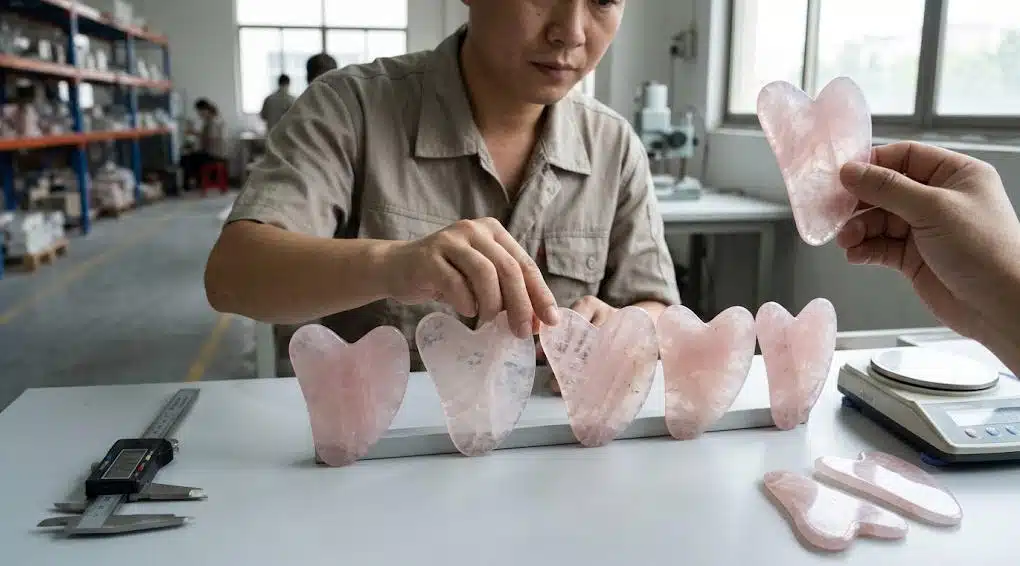
Why a Higher Quote Does Not Prove High Quality Gua Sha
Price and quality overlap, but they are not the same thing. Labor cost, platform fees, and sales staff all lift a quote without touching the stone. A supplier in a developed region with an export team can charge more for the same gua sha wholesale piece than an inland workshop with a domestic-only team. A low quote, on the other hand, may come from a line that skips a polishing pass. Neither direction proves anything about high quality gua sha.
The only comparison you can trust is the physical one. Order samples from your top three suppliers in the same shape and the same stone, then compare them on one table under one light. Two or three hours of handling costs far less than a single rejected container. This means you can build your gua sha wholesale shortlist from what you hold in your hand instead of what you read on a quotation.
Four Hands-On Checks for High Quality Gua Sha Samples
Start with color. According to the GIA rose quartz overview, rose quartz ranges from very light pink, almost white, to medium-dark pink. So a pale piece is not a defect, and a piece that looks unusually deep and perfectly even deserves a question about treatment or material.
Next, look at translucence. The same GIA page explains that microscopic mineral inclusions give the stone a cloudy translucence, so a milky look is normal. A glassy, fully clear piece is the one to question, because GIA also points out that any gem can be imitated by manmade materials or by other natural materials.
Third, run a fingertip along every edge and curve. A catch, a micro-chip, or a rough patch near the notch means the polishing pass was short. Fourth, weigh ten pieces of the same SKU on a gram scale and measure their length. A wide spread in weight within one SKU tells you the cutting is not repeatable, which will show up later as uneven feel in your customers’ hands. This means you can reject a sample in ten minutes, before you pay for a full gua sha wholesale production run.
What GIA, IGS, and SSEF Can and Cannot Do for Gua Sha Wholesale Buyers
Gem labs are useful references, but each one has limits you should know about. As noted earlier, the GIA rose quartz buyer’s guide states that GIA evaluates rose quartz but does not grade it. That is why “A grade” has no universal meaning in gua sha wholesale.
Treatment is where references differ in emphasis. The International Gem Society’s rose quartz article says rose quartz typically receives no treatments, and it also describes pink quartz created by adding aluminum or phosphorus to synthetic quartz and applying gamma radiation. GIA, for its part, says rose quartz is occasionally irradiated to intensify color. Two respectable sources, two different emphases, which is exactly why you should ask your supplier for a written treatment statement.
Finally, the Swiss Gemmological Institute (SSEF) makes a point every buyer should keep in mind. As National Jeweler reported, an SSEF report describes the stone only at the time of testing and makes no promise about its later condition, and the lab noted the same risks apply to any gemstone with fissures. A report on one stone is not a guarantee for 10,000 pieces. This means you can spend your testing budget on a small random draw from your own gua sha wholesale shipment instead of relying on an old certificate.
Gua Sha Wholesale Compliance: Claims, Materials, and Paperwork
Compliance in gua sha wholesale depends on two things: where you sell and how you describe the product. In the United States, the FDA’s general wellness policy covers low-risk products meant to support a healthy lifestyle rather than diagnose or treat a disease, and relaxation or stress claims appear among its examples. Words such as “treats” or “cures” move you out of that comfort zone, so keep your listing language modest.
Features matter as well. In October 2025, an LED-equipped gua sha device received an FDA 510(k) decision of substantial equivalence for over-the-counter wrinkle reduction, as shown in the FDA 510(k) database. A plain stone tool sold with relaxation wording is a different case, but your wording can change its category.
For material safety, ISO 20308:2017 covers Gua Sha instruments, and the Saudi FDA’s adoption document lists topics such as biocompatibility and radionuclide activity. Request four items from any gua sha manufacturer: the stone name, a treatment disclosure, a batch test report if your market asks for one, and country-of-origin labeling. This article is not legal advice, so confirm requirements with your customs broker. This means you can arrive at customs with paperwork that matches the claims on your packaging.
Getting a Fair Guasha Wholesale Price From a Gua Sha Manufacturer
5 Questions to Ask Before Accepting a Guasha Wholesale Price
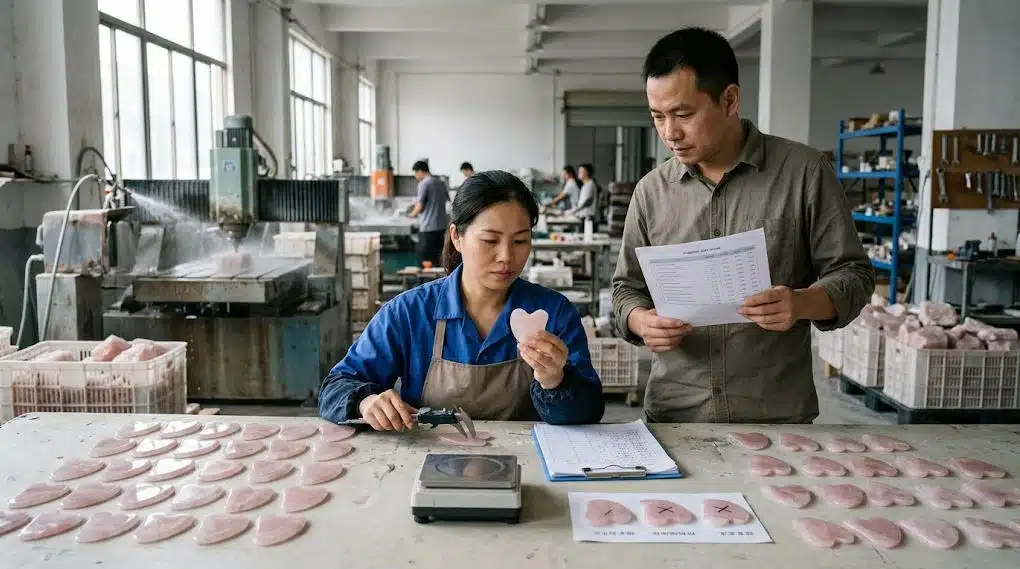
Send these five questions in one email to every gua sha wholesale supplier you are considering, and compare the answers side by side. How many finished pieces does one kilogram of stone produce? What was the pass rate on the last three batches? Is the quote for CNC or hand carving, and at what batch size does that change? When was the stone bought, and how long is the price valid? Which platform or channel is this price built on?
Pay attention to the format of the reply, not only the numbers. Suppliers who track cost reply with figures within a day. Those who reply with adjectives probably do not track it. This means you can sort a shortlist of ten guasha wholesale price quotes down to three using nothing more than one email thread.
Calculating ROI on Gua Sha Wholesale Orders: The Cheaper Quote Can Cost More
Price per piece is the wrong number to compare in gua sha wholesale. Cost per sellable piece is the right one. Take two assumed quotes for 10,000 pieces. Quote A is 1.10 USD with a 2% defect and return rate. Quote B is 1.00 USD with a 12% defect and return rate.
Divide each price by its sellable share. Quote A gives 1.10 ÷ 0.98 = 1.12 USD per sellable piece. Quote B gives 1.00 ÷ 0.88 = 1.14 USD. The cheaper quote costs about 1.2% more per sellable piece, and that is before you count refunds, replacement shipping, and review damage. These figures are an illustration, so replace them with your own return data.
Run the same arithmetic on every gua sha wholesale offer you receive. This means you can justify a higher gua sha price to your finance team with a calculation, and you can walk away from a low one that fails the same test.
Risk Disclosure: What No Gua Sha Wholesale Supplier Can Promise You
In gua sha wholesale, honesty serves you better than a smooth pitch, so here are the limits. Nobody can promise a universal stone grade, because GIA itself does not grade rose quartz. Nobody can promise a fixed price all year, because stone cost rose about 20% within a single season in 2025. Nobody can promise identical yield on every lot, because cracks and internal fractures vary from stone to stone.
Treatment detection is another limit. A visual check will not reliably show every enhancement, and a lab report covers only the stone that was tested. So the best protection is layered: written grade definitions, a treatment statement, a price validity date, sample approval before production, and a random batch check on arrival.
Do these five things and your gua sha wholesale order carries far less risk than the average one. As a gua sha manufacturer based in Dongguan with 12+ years in jade and crystal production, we are glad to share yield, pass-rate, and cost-breakdown figures on request, because buyers who understand the numbers place steadier repeat gua sha wholesale orders. You can ask for a sample set and a cost sheet whenever you are ready to compare.