Much of the white jade gua sha sold at scale is not nephrite. A gua sha manufacturer with 12 years of jade and crystal processing will tell you the three stones you meet most often: white quartzite, white quartz, and white marble sold as “Afghan white jade.” Marble sits at Mohs 3, nephrite is a far tougher fibrous rock, and the Wyoming State Geological Survey reports that only about 10% of most nephrite deposits reach gem grade. That yield gap explains why genuine nephrite rarely fits a standard white jade gua sha wholesale order. Does that make the other stones fake? No, but it does mean the real material belongs in your quote and contract.
Use this guide as a pre-order check. You will see what your guasha supplier should disclose, how a gua sha factory prices raw stone, and when gua sha custom work in real white jade is worth your budget. Each section closes with what the finding means for your orders.
What Is a White Jade Gua Sha Really Made Of? Materials Your Gua Sha Manufacturer Can Use

Start with the labels, because “white jade” on a product page is often a color and style description rather than a mineral name. The jade family contains two separate minerals, nephrite and jadeite, and GIA’s The Jade Enigma points out that jade has more simulants than most gems. The International Gem Society notes that white nephrite, the “mutton fat” type, is the most popular nephrite variety in Chinese markets. Every other white stone on the shelf is a different material with a different job. This means you can treat “white jade” as a style cue and ask for a mineral name instead.
How a Gua Sha Manufacturer Tells Nephrite from Quartzite and Marble
Nephrite is a dense, fibrous silicate rock from the tremolite-actinolite series. White quartzite and white quartz are silica, which sits around Mohs 7. White marble is calcite, which sits at Mohs 3 and etches under weak acid. Three stones have three different compositions, and white is the only thing they share. This means you can request the base mineral on every quote and compare offers on equal terms.
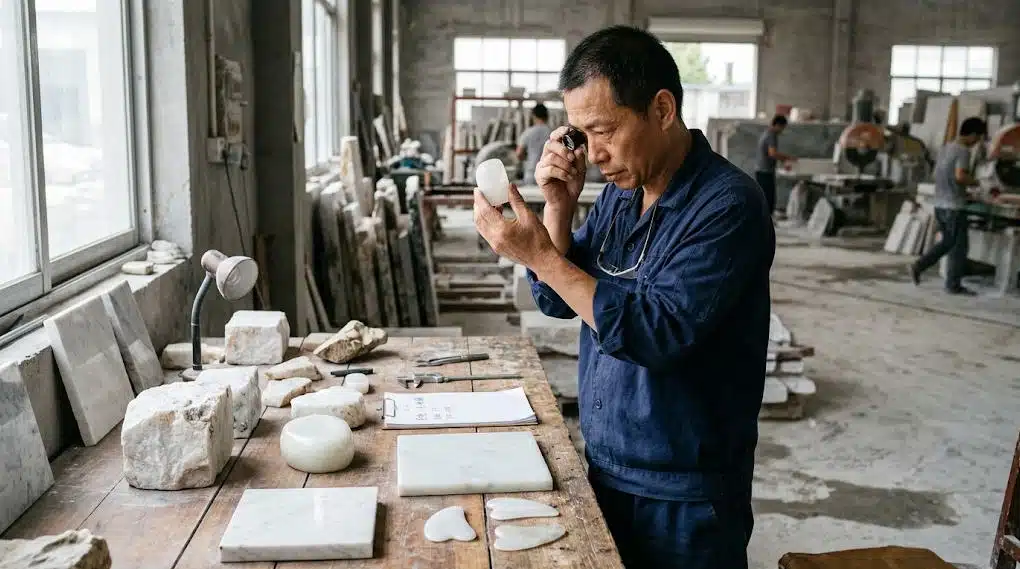
Quartzite is not one tidy mineral name either. “Quartzite-type white stone” describes a family, and grain structure, cracks and polish response change from one source to the next. A short sample run at a gua sha factory tells you more than a label does. Why trust a name when a test cut costs you only a few pieces? This means you can approve a stone on sample performance before you commit to a full run.
Is “Afghan White Jade” Real Jade? Marble Gua Sha, Acid and Cleaning
“Afghan white jade” is a trade name. The stone behind it is usually white marble, which means calcite, and calcite dulls under acidic cleaners. If your customers wipe a marble piece with a lemon-based cleaner every day, the polish will fade. This means you can print a “wipe clean, avoid acids” line on your insert card and head off surface complaints before they reach your inbox.
None of this makes marble a poor choice. At Mohs 3 it cuts and polishes easily and gives a soft, milky finish that suits price-led lines. It also scratches more readily than nephrite, so a separate pouch for each piece matters. This means you can pick marble for budget collections and add the pouch to protect the finish in transit.
Are Substitutes Fake? What a Guasha Supplier Must Disclose
A fake stone is one sold under the wrong name. Real quartz sold as quartz is not fake, and real marble sold as marble is not fake. The trouble starts when marble is described as nephrite in a contract, on packaging or in a test file. A transparent guasha supplier puts four items on your quote: base material, source type, any treatment, and the quality standard you agreed.
Ask for those four lines before sampling, and ask again before shipment. If your packaging says “real jade,” can your paperwork prove it? This means you can protect your brand from a mislabel claim by keeping every material statement matched to a document.
Why Does a Gua Sha Manufacturer Rarely Use Genuine White Nephrite for White Jade Gua Sha Wholesale?

Genuine white nephrite can be carved into a gua sha tool, and that is not the debate. The debate is whether it fits a standard order of several thousand pieces at a fixed target price. Buyers see the raw stone price per kilogram, but yield decides the number that matters. The Wyoming State Geological Survey states that only about 10% of most nephrite deposits are gem quality, so selection starts with a thin slice of the rock. This means you can read most price gaps between quotes as yield gaps rather than markup.
Cost per Qualified Piece: The Formula Every Gua Sha Manufacturer Uses
The formula is short: cost per qualified piece equals total raw material cost divided by the number of pieces that pass inspection. Cutting loss, hidden cracks, color rejects and polishing breakage all shrink the denominator. Take an illustrative case, not a quote: $4,000 of stone that yields 800 passing pieces costs $5.00 per piece, while the same $4,000 yielding 400 passing pieces costs $10.00. This means you can see a 100% jump in material cost from yield alone, with no change in the stone price.
Now scale the gap to an order. At 5,000 pieces, a $5.00 difference per piece moves your material bill by $25,000. A gua sha manufacturer who quotes only the raw stone price per kilogram is leaving that number out. Why accept a quote that skips the yield assumption? This means you can ask for the assumed pass rate and compare it across quotes before you compare unit prices.
When a Gua Sha Factory Should Decline Your Target Price
A target price that cannot cover the pass rate leaves three honest options: raise the price, change the design, or switch material. Thinner edges and curved outlines raise breakage, so a simpler shape can lift the pass rate without changing the stone. A gua sha factory that cannot reach your price and quality together should say so and decline the order rather than ship a weaker stone under the same name. This means you can treat a clear refusal as a sign that the quote rests on real numbers.
You can test any quote in four steps:
- Ask for the base mineral name.
- Ask for the assumed pass rate.
- Ask what happens to rejected blanks.
- Ask for a sample cut from the actual batch.
Gem-quality nephrite comes mainly from Canada, China and Russia, according to the International Gem Society, so also ask where your stone originates and whether the same source can be reordered. If your budget is fixed, a gua sha custom project in genuine nephrite is worth pricing as a limited run, while your standard line uses a stone that fits the cost model. A guasha supplier who explains both routes gives you room to run two price tiers. This means you can offer a limited nephrite edition and a standard white-stone line from one source.
Can Your Guasha Supplier Keep Material and Color Consistent for Reorders?

A flawless sample proves little about your fifth reorder. Most reorder problems come from drifting color and changing raw stone, not from weak polishing. Can your guasha supplier buy the same stone again in six months? This means you can judge a supplier by its reorder plan before you judge its sample.
Three Levels of Raw Material Supply
Supply has three levels, and each one is a different promise. A mineral can exist in nature, it can be purchasable today, or it can be purchasable at your exact spec for the next two years. The International Gem Society notes that nephrite occurs more abundantly worldwide than jadeite, yet abundance of the mineral says nothing about white blocks at your size, color and price. This means you can stop asking whether white jade exists and start asking whether your spec can be bought again.
| Level | What it means | What to ask |
| Exists | The mineral is found in nature | Nothing, this is not a supply promise |
| Purchasable | Blocks can be bought today | How many pieces can one lot yield? |
| Sustainable | Your spec can be bought again | Who is the second source? |
Put numbers on it. An illustrative lot of 1,200 blanks might cover a 1,000-piece order today, but a 3,000-piece reorder three months later needs three times the stone from sources that may not match. Ask for a written reorder window and an approved color range. This means you can build your forecasts on a supply plan instead of a guess.
How a Gua Sha Manufacturer Controls Batch Color and Texture
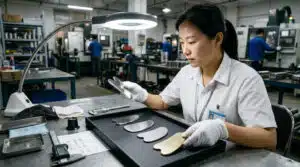
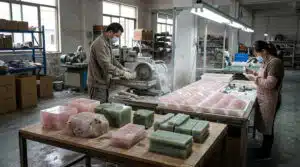
Natural stone varies, even inside one lot. Color, grain and translucency shift from block to block, so the factory’s job is to set a range and sort every piece to it. A gua sha manufacturer can sort pieces under the same lamp against a master sample into approved and rejected piles. Keep a sealed approved sample at your own desk as well. This means you can settle a color dispute by comparing two reference pieces rather than arguing over photos.
Which Shapes Chip Easily? Edges, Curves and Polish by Material
Shape decides breakage as much as stone does. Thin edges, deep curves and long narrow tips chip during cutting and grinding, and calcite at Mohs 3 abrades faster under the polisher than the silica stones near Mohs 7. A gua sha factory should cut a test batch of your actual shape in your actual stone before it quotes. This means you can avoid paying for a thin-edge design that loses blanks at the grinding stage.
Hardness alone does not predict fitness. Hidden fissures, edge finish and cleaning needs matter just as much, and a harder stone can still crack along a flaw. Ask for a 20-piece trial per shape (an illustrative size) and read the reject log. If a design wins on looks but fails the trial, why order it at full volume? This means you can change the shape before stone and tooling money is committed.
When Does Gua Sha Custom Work in Real White Jade Make Sense?

Custom work in real white jade is possible, and it is a different business from catalog wholesale. The question is not whether it can be done, but whether your volume, price and reorder needs fit it. A gua sha custom project in genuine nephrite calls for a project plan, not a price list. This means you can decide early which product belongs in a limited tier and which belongs in a standard tier.
What a Gua Sha Manufacturer Will Quote for Small-Batch Nephrite
A small nephrite run adds line items that wholesale quotes hide. Raw stone is sorted for your color, blanks are cut with spare allowance, and sample pieces are polished before you see a final price. Because only about 10% of nephrite deposits reach gem grade, as the Wyoming survey figure above shows, selection time becomes part of the cost. This means you can expect a gua sha custom quote to carry sorting and sampling lines.
Spread those fixed costs over your quantity and the effect is easy to see. An illustrative $300 sampling fee adds $0.60 per piece across a 500-piece run, but $3.00 per piece across 100 pieces. The usual path looks like this:
- Send a drawing and your target quantity.
- Agree on the base mineral and color range in writing.
- Approve one polished sample.
- Fix the price after a trial lot shows the real pass rate.
- Sign reorder terms before the full run.
This means you can lock cost and color before the full run starts, rather than discovering both afterward.
Which Material Fits Which Market?
No single stone fits every line, so match the material to the channel. Prices overlap in practice, so treat the table as a starting map rather than a rule.
| Market | Material focus | What drives the choice |
| Mass wholesale | White marble or quartzite | Target cost, pass rate |
| Mid-range brand | White quartz, quartzite | Color match, reorder supply |
| Natural jade line | White nephrite with test report | Mineral ID, source record |
| Limited edition | Selected white nephrite | Sorting cost, sample fees |
Buyers of white jade gua sha wholesale usually care about cost and supply, while a natural jade line cares about the test report. If you run two tiers, label each by its true mineral so neither tier borrows the other’s claim. Why pay nephrite prices for a line your customers buy on price? This means you can hold your margin on the mass tier and charge for proof on the nephrite tier.
Is “White Jade Gua Sha” a Material Name or a Product Name? What a Compliant Gua Sha Manufacturer Puts in Writing

Buyers who search for white jade gua sha wholesale are usually shopping a look, and sellers answer with the same phrase. The trouble is that a look is not a mineral. A product name can describe style, but your contract, packaging and test file have to describe stone. This means you can keep a familiar product name in your catalog as long as the material statement next to it is accurate.
Why the Name “White Jade Gua Sha” Stays in Use
Shoppers link “white jade” with a clean, warm, natural look, and a short name is easy to list and easy to search. That recognition keeps the phrase in catalogs and in white jade gua sha wholesale searches even when the stone is quartzite or marble. This article does not claim to know when the term first appeared, because that would need trade archives to prove. It explains why the name persists, which is the part you can act on. This means you can use the phrase as a style label without treating it as proof of the mineral.
A name that sells is not a name that certifies. If a listing says “white jade” and the stone is marble, a buyer can feel misled even when nobody lied outright. Why risk a refund dispute over a phrase you can qualify in a few words? Add the mineral beside the style name, for example “white jade style, marble.” This means you can keep your search traffic and keep your claim accurate.
What Your Contract Should Say: A Compliant Gua Sha Manufacturer Checklist
In the United States, the closest benchmark is the FTC’s Jewelry Guides, 16 CFR Part 23. They cover gemstones and their imitation substitutes and aim to help marketers avoid claims that are unfair or deceptive under Section 5 of the FTC Act. A gua sha tool is not jewelry, so treat the Guides as a reference point rather than a ruling on your product, and ask your own counsel which rules apply in your market. The Guides also say that qualifications and disclosures should be sufficiently clear and prominent, so a material note buried in fine print will not protect you. This means you can use the Guides as a drafting standard while your lawyer confirms the legal fit.
| Document | What to write |
| Quote and contract | Base mineral, any treatment, agreed quality standard |
| Packaging and listing | Mineral beside the style name, with no wording that implies a different stone |
| Test report | Only the name that the test result supports |
If you want to claim nephrite, back it with a lab report. SSEF’s introduction to jade course describes jade as a rock and covers the science of jade testing, which is why a visual check is not enough. A gua sha factory should hand over the report or the material record before you print “nephrite” on a box. This means you can replace “trust me” with a document you can show a customer, a marketplace or a regulator.
Pre-Order Checklist: Six Questions for Your Guasha Supplier
Before you place the order, ask six things: what the base mineral is, whether it has been treated, what pass rate the price assumes, whether the same stone can be reordered, which wording will appear on the packaging, and which document supports that wording. Write the answers into the purchase order, not into a chat thread. A guasha supplier who answers all six in writing has already done the hardest part of compliance with you. If an answer comes back vague, is that a risk you want to carry into your launch? This means you can enter production with material, cost and wording agreed on paper, and a gua sha custom order is no exception.
Final Take: How to Choose a Gua Sha Manufacturer Before You Order

Most buying mistakes in this category come from skipping the same few questions, and the answers sit in numbers you can check. The Wyoming State Geological Survey puts gem-grade yield at about 10% for most nephrite deposits. White marble sits at Mohs 3. Cost per qualified piece moves with the pass rate, as the illustrative $5.00 versus $10.00 case showed. This means you can read any offer as a stone, a yield and a name, rather than a single unit price.
The Four Rules Behind Every White Jade Gua Sha Wholesale Decision
First, genuine white nephrite works for gua sha, but its cost and yield suit limited runs better than standard volume. Second, white quartzite, white quartz and white marble are different stones, so one “white jade” label cannot describe all of them. Third, material choice follows your target price, reorder supply, shape and market rather than the stone’s reputation. Fourth, a product name never replaces a material statement. This means you can run two lines from one source: a standard line on a stone that fits your cost model, and a limited nephrite line backed by a lab report.
A gua sha manufacturer who explains these four rules in a quote is handing you a decision, not a sales pitch. Does your current supplier do that? If the quote shows only a unit price, you are comparing numbers that hide the real variables. This means you can ask for the mineral name, pass rate and reorder window, and compare offers on matching terms.
How to Start Your Next Order Without Guesswork
Begin with a brief that includes your drawing, target quantity, target price and sales market. Ask for two quotes: one in the stone that meets your cost target and one in genuine nephrite. A gua sha factory can then show you the cost gap line by line, and a guasha supplier who has already cut your shape can attach the trial reject log. If the nephrite quote is out of range, a gua sha custom limited run lets you test demand before you commit to volume. This means you can choose between the two routes with numbers on the table.
Before you sign, check that the purchase order carries the base mineral, any treatment, the quality standard, the reorder terms and the exact packaging wording. Keep a sealed approved sample for color checks, and ask counsel in your market to review the claims on the box. This means you can launch with paperwork that supports every word on your packaging.
FAQs About White Jade Gua Sha and Material Disclosure
1. Is a white jade gua sha always made of real jade?
No. “White jade” is often a color and style name. The stone can be white nephrite, white quartzite, white quartz or white marble. Only nephrite belongs to the jade family in the strict sense. This means you can ask for the base mineral name instead of relying on the product title.
2. Is “Afghan white jade” real jade?
It is a trade name. The stone is usually white marble, which is calcite. Marble sits at Mohs 3 and reacts to weak acid, so it needs gentler cleaning than silica stones. This means you can add a “no acidic cleaners” line to your insert card.
3. How can I confirm that a gua sha is genuine nephrite?
Appearance alone cannot settle it. Ask for a gemological lab report or a material record that names nephrite, and check that the wording on your packaging matches the report. Labs such as GIA and SSEF publish material on jade testing. This means you can show a customer or marketplace a document instead of a promise.
4. How much more does genuine white nephrite cost?
It depends on the stone and the yield. Cost per qualified piece equals total raw material cost divided by passing pieces, so a lower pass rate raises the price even when the stone price stays flat. In the illustrative case above, halving the yield doubled the material cost. This means you can compare quotes by asking for the assumed pass rate.
5. Can a gua sha manufacturer make a small custom batch in real nephrite?
Yes, if the stone, budget and design allow it. Expect extra lines for stone sorting, spare blanks, sample polishing and development fees. Fixed fees weigh more on small runs, since $300 across 100 pieces is $3.00 each. This means you can request a trial lot first and fix the price after you see the real pass rate.