
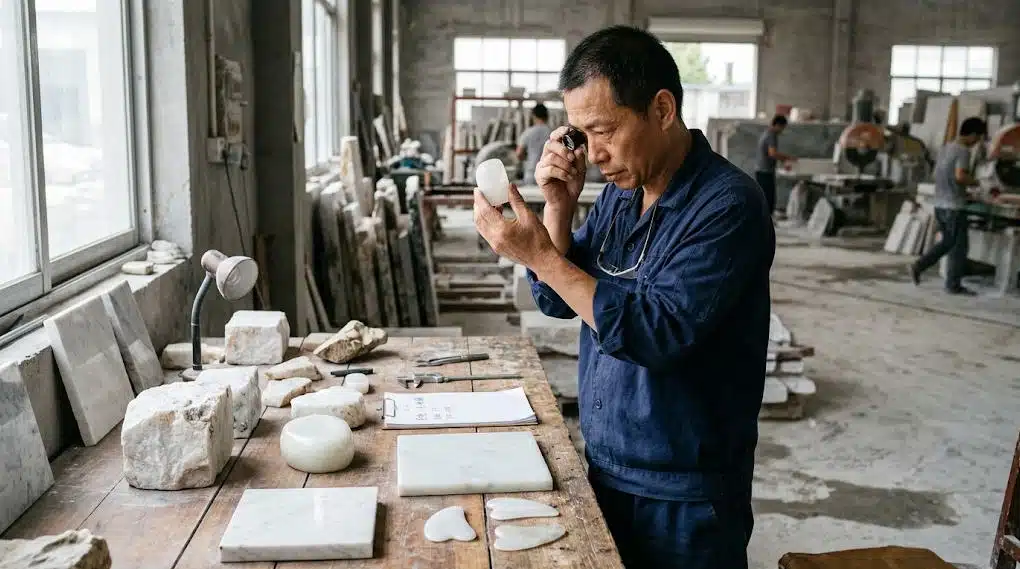
White Jade Gua Sha Wholesale: What a Gua Sha Manufacturer Actually Uses
Much of the white jade gua sha sold at scale is not nephrite. A gua sha manufacturer with 12 years of jade and crystal processing will tell you the three stones you meet most often: white quartzite, white quartz, and white marble sold as “Afghan white jade.” Marble sits at Mohs 3, nephrite is a far tougher fibrous rock, and the Wyoming State Geological Survey reports that only about 10% of most nephrite deposits reach gem grade. That yield gap explains why genuine nephrite rarely fits a standard white jade gua sha wholesale order. Does that make the other stones fake? No, but it does mean the real material belongs in your quote and contract. Use this guide as a pre-order check. You will see what your guasha supplier should disclose, how a gua sha factory prices raw stone, and when gua sha custom work in real white jade is worth your budget. Each section closes with what the finding means for your orders. What Is a White Jade Gua Sha Really Made Of? Materials Your Gua Sha Manufacturer Can Use Start with the labels, because “white jade” on a product page is often a color and style description rather than a mineral name. The jade family contains two separate minerals, nephrite and jadeite, and GIA’s The Jade Enigma points out that jade has more simulants than most gems. The International Gem Society notes that white nephrite, the “mutton fat” type, is the most popular nephrite variety in Chinese markets. Every other white stone on the shelf is a different material with a different job. This means you can treat “white jade” as a style cue and ask for a mineral name instead. How a Gua Sha Manufacturer Tells Nephrite from Quartzite and Marble Nephrite is a dense, fibrous silicate rock from the tremolite-actinolite series. White quartzite and white quartz are silica, which sits around Mohs 7. White marble is calcite, which sits at Mohs 3 and etches under weak acid. Three stones have three different compositions, and white is the only thing they share. This means you can request the base mineral on every quote and compare offers on equal terms. Quartzite is not one tidy mineral name either. “Quartzite-type white stone” describes a family, and grain structure, cracks and polish response change from one source to the next. A short sample run at a gua sha factory tells you more than a label does. Why trust a name when a test cut costs you only a few pieces? This means you can approve a stone on sample performance before you commit to a full run. Is “Afghan White Jade” Real Jade? Marble Gua Sha, Acid and Cleaning “Afghan white jade” is a trade name. The stone behind it is usually white marble, which means calcite, and calcite dulls under acidic cleaners. If your customers wipe a marble piece with a lemon-based cleaner every day, the polish will fade. This means you can print a “wipe clean, avoid acids” line on your insert card and head off surface complaints before they reach your inbox. None of this makes marble a poor choice. At Mohs 3 it cuts and polishes easily and gives a soft, milky finish that suits price-led lines. It also scratches more readily than nephrite, so a separate pouch for each piece matters. This means you can pick marble for budget collections and add the pouch to protect the finish in transit. Are Substitutes Fake? What a Guasha Supplier Must Disclose A fake stone is one sold under the wrong name. Real quartz sold as quartz is not fake, and real marble sold as marble is not fake. The trouble starts when marble is described as nephrite in a contract, on packaging or in a test file. A transparent guasha supplier puts four items on your quote: base material, source type, any treatment, and the quality standard you agreed. Ask for those four lines before sampling, and ask again before shipment. If your packaging says “real jade,” can your paperwork prove it? This means you can protect your brand from a mislabel claim by keeping every material statement matched to a document. Why Does a Gua Sha Manufacturer Rarely Use Genuine White Nephrite for White Jade Gua Sha Wholesale? Genuine white nephrite can be carved into a gua sha tool, and that is not the debate. The debate is whether it fits a standard order of several thousand pieces at a fixed target price. Buyers see the raw stone price per kilogram, but yield decides the number that matters. The Wyoming State Geological Survey states that only about 10% of most nephrite deposits are gem quality, so selection starts with a thin slice of the rock. This means you can read most price gaps between quotes as yield gaps rather than markup. Cost per Qualified Piece: The Formula Every Gua Sha Manufacturer Uses The formula is short: cost per qualified piece equals total raw material cost divided by the number of pieces that pass inspection. Cutting loss, hidden cracks, color rejects and polishing breakage all shrink the denominator. Take an illustrative case, not a quote: $4,000 of stone that yields 800 passing pieces costs $5.00 per piece, while the same $4,000 yielding 400 passing pieces costs $10.00. This means you can see a 100% jump in material cost from yield alone, with no change in the stone price. Now scale the gap to an order. At 5,000 pieces, a $5.00 difference per piece moves your material bill by $25,000. A gua sha manufacturer who quotes only the raw stone price per kilogram is leaving that number out. Why accept a quote that skips the yield assumption? This means you can ask for the assumed pass rate and compare it across quotes before you compare unit prices. When a Gua Sha Factory Should Decline Your Target Price A target price that cannot cover the pass rate leaves three honest options: raise the price, change the design, or switch material. Thinner edges and curved outlines raise breakage, so a simpler shape can lift the pass […]
White Jade Gua Sha Wholesale: What a Gua Sha Manufacturer Actually Uses Read More »
Much of the white jade gua sha sold at scale is not nephrite. A gua sha manufacturer with 12 years of jade and crystal processing will tell you the three stones you meet most often: white quartzite, white quartz, and white marble sold as “Afghan white jade.” Marble sits at Mohs 3, nephrite is a far tougher fibrous rock, and the Wyoming State Geological Survey reports that only about 10% of most nephrite deposits reach gem grade. That yield gap explains why genuine nephrite rarely fits a standard white jade gua sha wholesale order. Does that make the other stones fake? No, but it does mean the real material belongs in your quote and contract. Use this guide as a pre-order check. You will see what your guasha supplier should disclose, how a gua sha factory prices raw stone, and when gua sha custom work in real white jade is worth your budget. Each section closes with what the finding means for your orders. What Is a White Jade Gua Sha Really Made Of? Materials Your Gua Sha Manufacturer Can Use Start with the labels, because “white jade” on a product page is often a color and style description rather than a mineral name. The jade family contains two separate minerals, nephrite and jadeite, and GIA’s The Jade Enigma points out that jade has more simulants than most gems. The International Gem Society notes that white nephrite, the “mutton fat” type, is the most popular nephrite variety in Chinese markets. Every other white stone on the shelf is a different material with a different job. This means you can treat “white jade” as a style cue and ask for a mineral name instead. How a Gua Sha Manufacturer Tells Nephrite from Quartzite and Marble Nephrite is a dense, fibrous silicate rock from the tremolite-actinolite series. White quartzite and white quartz are silica, which sits around Mohs 7. White marble is calcite, which sits at Mohs 3 and etches under weak acid. Three stones have three different compositions, and white is the only thing they share. This means you can request the base mineral on every quote and compare offers on equal terms. Quartzite is not one tidy mineral name either. “Quartzite-type white stone” describes a family, and grain structure, cracks and polish response change from one source to the next. A short sample run at a gua sha factory tells you more than a label does. Why trust a name when a test cut costs you only a few pieces? This means you can approve a stone on sample performance before you commit to a full run. Is “Afghan White Jade” Real Jade? Marble Gua Sha, Acid and Cleaning “Afghan white jade” is a trade name. The stone behind it is usually white marble, which means calcite, and calcite dulls under acidic cleaners. If your customers wipe a marble piece with a lemon-based cleaner every day, the polish will fade. This means you can print a “wipe clean, avoid acids” line on your insert card and head off surface complaints before they reach your inbox. None of this makes marble a poor choice. At Mohs 3 it cuts and polishes easily and gives a soft, milky finish that suits price-led lines. It also scratches more readily than nephrite, so a separate pouch for each piece matters. This means you can pick marble for budget collections and add the pouch to protect the finish in transit. Are Substitutes Fake? What a Guasha Supplier Must Disclose A fake stone is one sold under the wrong name. Real quartz sold as quartz is not fake, and real marble sold as marble is not fake. The trouble starts when marble is described as nephrite in a contract, on packaging or in a test file. A transparent guasha supplier puts four items on your quote: base material, source type, any treatment, and the quality standard you agreed. Ask for those four lines before sampling, and ask again before shipment. If your packaging says “real jade,” can your paperwork prove it? This means you can protect your brand from a mislabel claim by keeping every material statement matched to a document. Why Does a Gua Sha Manufacturer Rarely Use Genuine White Nephrite for White Jade Gua Sha Wholesale? Genuine white nephrite can be carved into a gua sha tool, and that is not the debate. The debate is whether it fits a standard order of several thousand pieces at a fixed target price. Buyers see the raw stone price per kilogram, but yield decides the number that matters. The Wyoming State Geological Survey states that only about 10% of most nephrite deposits are gem quality, so selection starts with a thin slice of the rock. This means you can read most price gaps between quotes as yield gaps rather than markup. Cost per Qualified Piece: The Formula Every Gua Sha Manufacturer Uses The formula is short: cost per qualified piece equals total raw material cost divided by the number of pieces that pass inspection. Cutting loss, hidden cracks, color rejects and polishing breakage all shrink the denominator. Take an illustrative case, not a quote: $4,000 of stone that yields 800 passing pieces costs $5.00 per piece, while the same $4,000 yielding 400 passing pieces costs $10.00. This means you can see a 100% jump in material cost from yield alone, with no change in the stone price. Now scale the gap to an order. At 5,000 pieces, a $5.00 difference per piece moves your material bill by $25,000. A gua sha manufacturer who quotes only the raw stone price per kilogram is leaving that number out. Why accept a quote that skips the yield assumption? This means you can ask for the assumed pass rate and compare it across quotes before you compare unit prices. When a Gua Sha Factory Should Decline Your Target Price A target price that cannot cover the pass rate leaves three honest options: raise the price, change the design, or switch material. Thinner edges and curved outlines raise breakage, so a simpler shape can lift the pass […]