
When a carton of natural crystal gua sha boards arrives with a chipped edge or a hairline crack running through the handle, the packing tape is rarely the real problem. After more than a decade spent preparing gua sha wholesale shipments for sea and air freight, one pattern shows up over and over: a standard 20- to 45-day ocean voyage delivers tens of thousands of low-amplitude vibrations to every carton stacked inside a container, and it is that slow accumulation — not one dramatic drop on a dock — that produces most of the cracked edges buyers report. That single fact should change how you plan your next guasha wholesale order.
You don’t need thicker foam. You need a shipping system, and the difference between the two shows up the moment a container gets opened three weeks later.
This matters for gua sha shipping safety because natural stone behaves differently from plastic or resin tools once it’s sealed inside a box for a month. A crystal board with an invisible internal flaw can travel a thousand kilometers by truck without issue, then fail on the last leg of a sea voyage simply because cumulative vibration finally reached the flaw’s breaking point. Below is the system a working gua sha manufacturer actually uses on the factory floor, broken into the parts you can control before your next container leaves the dock.
- Why Gua Sha Wholesale Shipping Damage Is a System Problem, Not a Packaging Afterthought
- Sea Freight vs. Air Freight for Gua Sha Wholesale Orders: Matching the Method to the Risk
- Shock-Absorbing Materials for Gua Sha Tools Wholesale Shipments: EVA, EPE, and Bubble Wrap Compared
- Single-Unit Packaging in Gua Sha Wholesale: Stopping Collisions Inside the Carton
- Pallet Fixation and Corrugated Box Grade: The Outer Half of Gua Sha Shipping Safety
- Compliance Testing Every Gua Sha Wholesale Buyer Should Request Before Shipment
- Recommended Packaging Systems for Gua Sha Wholesale: Small-Batch Air vs. Bulk Sea, and What Each Actually Costs You
- The Gua Sha Wholesale Pre-Shipment Checklist
- What This Means for Your Gua Sha Wholesale Sourcing Decisions
Why Gua Sha Wholesale Shipping Damage Is a System Problem, Not a Packaging Afterthought

Here’s a question worth sitting with for a second: if your supplier just adds another centimeter of foam, does your breakage rate actually go down? Often it doesn’t, and that’s the part most buyers find counterintuitive.
Packaging engineering runs on one principle that matters more than any single material choice. The product will always move a little inside its packaging, and the job of that packaging isn’t to stop the movement completely — it’s to absorb the force so it never reaches the product at a level that exceeds the material’s own breaking point. For natural stone, that breaking point is lower than most people assume. A gua sha board carved from nephrite jade — the material most gua sha manufacturer workshops treat as the standard for durability — carries a measured toughness value of roughly 225,000 in comparative fracture-resistance testing published by the Gemological Institute of America, compared with about 120,000 for jadeite and around 600 for corundum minerals like ruby and sapphire, according to GIA’s research on gemstone durability. This means jade is genuinely one of the tougher materials a gua sha tool can be built from — but that toughness only protects the bulk of the stone, not a microscopic flaw sitting at the surface where a saw cut or a polishing pass left a stress point behind.
So what does this mean for you? It means your breakage risk isn’t really about “is jade strong enough.” It’s about whether any single piece already carries a small, invisible weakness before it ever reaches the carton — and whether the packaging system around it is designed to keep repeated shipping stress away from that exact point.
The same logic applies to hardness, which buyers often confuse with impact resistance. Jadeite sits at roughly 6.5 to 7 on the Mohs scale and nephrite at roughly 6 to 6.5, according to hardness data compiled by the International Gem Society. Hardness tells you how well a surface resists scratching. It tells you almost nothing about whether the stone will crack under the sustained, low-level vibration of a six-week sea voyage, and that distinction is exactly why a workshop that only checks for scratch resistance can still ship a container that arrives with several percent of boards showing edge damage, while a workshop that engineers for vibration fatigue can hold that number close to zero using the same raw material.
This is also why treating gua sha wholesale packaging as a single line item — “just add bubble wrap” — misses the point. Five separate variables interact on every shipment: freight method, cushioning structure, unit-to-unit isolation, pallet stabilization, and outer carton strength. Weakness in any one of them can undo strength in the other four. The rest of this guide walks through each variable in the order that actually matters to your breakage rate, starting with the decision that shapes everything downstream — how the product travels in the first place.
Sea Freight vs. Air Freight for Gua Sha Wholesale Orders: Matching the Method to the Risk
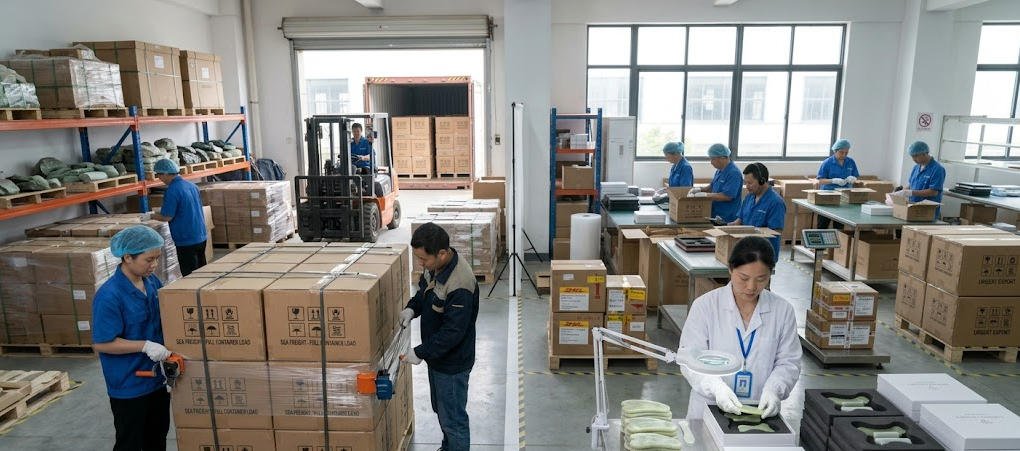
Before any packaging decision gets made, you have to answer a more basic question: how is this order actually traveling? Sea and air freight expose a gua sha wholesale shipment to almost opposite categories of physical stress, and a packaging structure optimized for one can genuinely underperform on the other.
Sea Freight and Gua Sha Wholesale: Controlling Long-Term Vibration and Stacking Pressure
Ocean freight typically takes 20 to 45 days port to port, and during that window your cartons get handled multiple times — loaded onto a truck, transferred through a port yard, lifted onto the vessel, unloaded again at destination. Each handling event adds mechanical stress, but the bigger contributor is simpler and less visible: the container itself vibrates continuously for weeks, and humidity inside that steel box swings with ambient temperature at sea.
For natural stone gua sha shipping, this creates two compounding risks. First, any existing micro-fracture in a crystal board — invisible during a normal quality check — has weeks to propagate under repeated low-amplitude shock, which is exactly how a board that passed inspection at the factory can arrive with a visibly larger crack or a missing corner. Second, cartons near the bottom of a stacked pallet carry real compressive load from everything stacked above them for the full length of the voyage, so an outer box that looks perfectly fine sitting on a shelf can still deform under sustained pressure it was never actually tested against.
The sea freight structure that holds up in practice follows a specific order, and skipping a layer in that order is where most damage claims originate: individual unit protection, then an inner box, then a five-layer corrugated outer carton, then pallet fixation, then loading into the container. This means that if a supplier quotes you a price that skips pallet fixation to save cost, you’re not actually saving money — you’re just moving the compression risk onto whichever cartons happen to end up at the bottom of the stack. Sea freight suits large-volume orders, heavier products, and packaging designs that have already been validated on a previous shipment, which is exactly why first-time guasha wholesale buyers often benefit from a smaller air-freight test run before committing to a full container. That test run is also the cheapest way to validate your gua sha shipping structure before scaling it across a full container’s worth of product.
Air Freight and Gua Sha Wholesale: Controlling Sudden Impact, Not Sustained Vibration
Air freight flips the risk profile entirely. Transit time drops to a matter of days rather than weeks, so long-term vibration fatigue and humidity cycling stop being the dominant concern. What replaces them is blunt, sudden force: cargo gets moved quickly between aircraft, trucks, and sorting facilities, and that speed increases the odds of a carton being dropped, tossed onto a conveyor, or stacked carelessly during a tight transfer window.
For a gua sha manufacturer preparing a small-batch or sample order, this changes where the packaging budget should go. Instead of spreading protection evenly across a five-layer structure built for weeks of vibration, air shipments need concentrated cushioning around each individual unit and secure internal fixation, so a product can’t shift and gain momentum inside its own box before an impact happens. This means a sample order flown out to a new buyer for evaluation should get more single-unit cushioning per piece than the same product would receive in a bulk sea shipment, even though its total transit stress is lower overall. Air freight is the right call for high-value pieces, first-sample evaluations, and small OEM batches, where speed and individual-unit protection matter more than economy of scale. Getting this method-specific detail right is a core part of gua sha shipping safety, not a separate concern from it.
Shock-Absorbing Materials for Gua Sha Tools Wholesale Shipments: EVA, EPE, and Bubble Wrap Compared
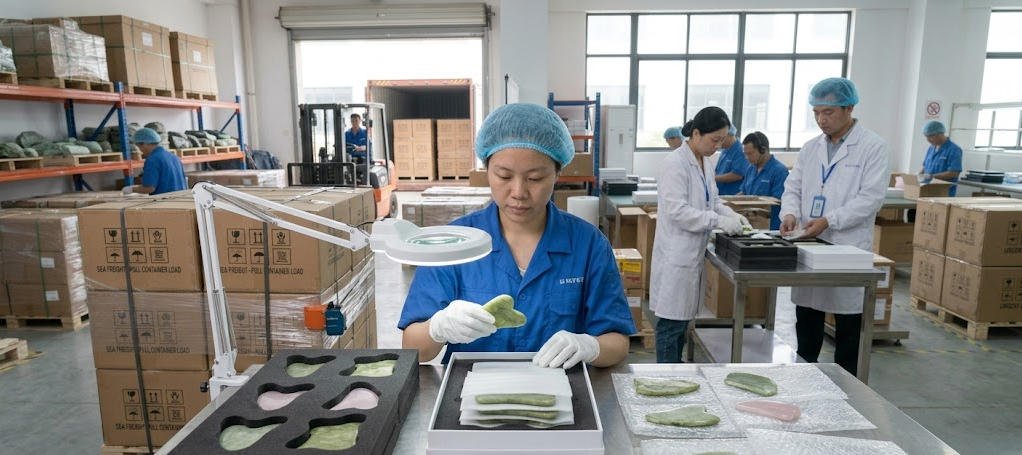
Once you’ve matched your freight method to your order, the next decision is what actually sits between the product and the outer box. This is where most of the visible cost difference in a gua sha tools wholesale quote comes from, and it’s also where buyers most often overpay for the wrong material or underpay for a material that can’t do the job it’s being asked to do.
Three materials cover almost every scenario a factory floor deals with, and each one solves a different problem rather than being a “better” or “worse” version of the others. Get this layer wrong and no amount of freight-method planning or box-grade upgrading will fully protect gua sha shipping safety, since this is the layer sitting closest to the product itself.
EVA Foam Trays in Gua Sha Tools Wholesale Packaging
EVA foam gets die-cut into a tray with a cavity shaped precisely to the outline of each product, so a crystal board or a metal-handled tool sits in a fixed position and cannot shift, rotate, or knock against the box wall during transit. That fixed positioning is the entire value proposition — it converts random movement inside a carton into zero movement, which is the single most effective way to prevent the edge chips and scuff marks that show up after a long sea voyage.
This construction also happens to look genuinely good when a customer opens the box, since the product sits centered and visible rather than buried in loose fill. The tradeoff is cost: die-cutting a custom EVA tray requires tooling for each product shape, so it makes the most sense for higher-value pieces in a gua sha wholesale order — natural crystal boards, engraved jade pieces, and metal gua sha tools — where the cost per unit can absorb a more precise packaging structure. So what does this mean for your sourcing decision? It means you should ask your gua sha manufacturer for EVA trays specifically on your higher-margin SKUs, not across an entire product line, since spreading that cost evenly usually just inflates your blended unit price without adding protection where you actually need it.
EPE Pearl Cotton for Bulk Gua Sha Wholesale Orders
Expandable polyethylene, commonly called EPE or pearl cotton, trades precision for economy. It’s typically specified in a 20 to 30 kg/m³ density range for shipping applications, light enough that it barely adds to your freight weight, and cheap enough that it makes sense as an inner-carton divider or a wrap layer across an entire bulk order rather than being reserved for a handful of high-ticket pieces.
You lose the exact-fit positioning that EVA provides, but you gain flexibility — the same roll of EPE can wrap products of slightly different shapes and sizes without needing new tooling for every SKU change. For a large guasha wholesale shipment made up of dozens of product variants, that flexibility often matters more than perfect fit, because it means your supplier isn’t tooling up a new foam tray every time you adjust an order. This means EPE earns its place in your packaging spec through volume economics, not through being a lesser material — it’s simply solving a different problem than EVA solves.
Bubble Wrap: A Secondary Layer, Not a Gua Sha Shipping Solution on Its Own
Bubble wrap deserves a specific warning here, because it’s the material buyers most often assume is sufficient by itself when it isn’t. Under sustained pressure over a multi-week sea voyage, the trapped air pockets inside bubble wrap gradually compress and lose their cushioning capacity, so a layer that performed well in a single drop test can still leave a product under-protected by the time a container reaches its destination weeks later. Should you drop it from your packaging spec entirely? No — but it should sit as a secondary layer inside a structure that includes something with sustained load-bearing capacity, not as the only barrier between a product and a hard outer box.
A working structure that reflects this looks like: product, bubble wrap, a soft protective pouch, an inner presentation box, then the outer carton. Used this way, bubble wrap absorbs the sharper, shorter-duration shocks — a bump during loading, a jolt during a forklift transfer — while the pouch and inner box handle the longer, lower-level stress that accumulates over the full length of gua sha shipping. This means the real question for your supplier isn’t “do you use bubble wrap,” it’s “what sits underneath it,” and that second question is the one that actually predicts your breakage rate.
Single-Unit Packaging in Gua Sha Wholesale: Stopping Collisions Inside the Carton
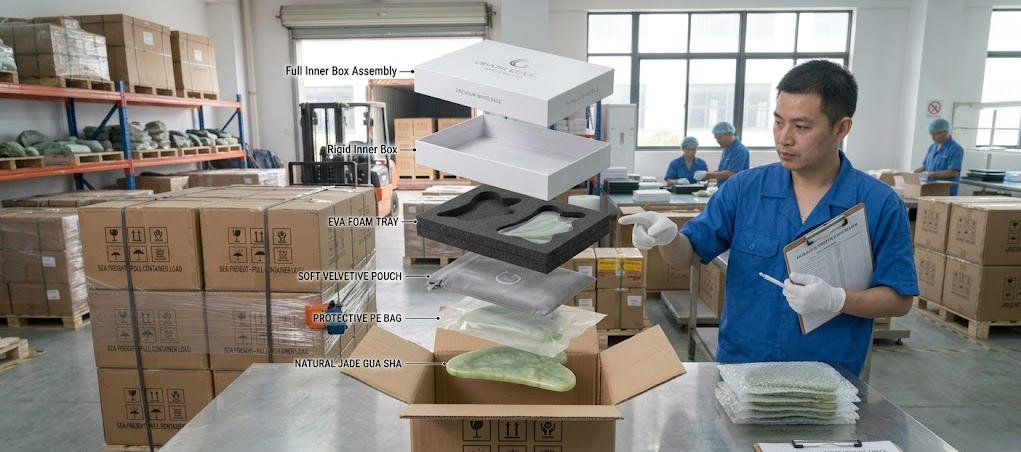
Here’s a detail that surprises a lot of first-time buyers: a meaningful share of shipping damage never involves the outer box at all. It happens because multiple pieces inside the same carton knock against each other during transit, and nothing in the packaging design kept them apart.
Natural stone is the material where this shows up most visibly in a guasha wholesale container, more than in almost any other product category shipped this way. If several jade or crystal pieces sit loose in the same inner box without a divider between them, weeks of container vibration will grind edges against edges, and what arrives is a set of pieces with fresh scuffing or small chips that weren’t there when the box was sealed at the factory — damage that has nothing to do with how strong the outer carton was. Two packaging tiers handle this depending on product value. Standard pieces typically travel well in a PE bag plus a foam layer inside a presentation box, which keeps surfaces from touching directly while staying cost-efficient across large volumes. Higher-value pieces justify a step up: a soft flannel pouch, an EVA inner tray, and a rigid box before the outer carton, which is the structure most gua sha manufacturer workshops reserve for engraved or larger jade tools where a single scuff meaningfully affects resale value.
So what does this mean for how you should evaluate a quote? It means “packaging included” is not a specification — you need to ask specifically whether each unit is individually bagged, whether there’s a divider between units in the same carton, and whether natural stone pieces are kept from direct contact with each other. A gua sha wholesale quote that’s silent on these three points is a quote where you’re absorbing the collision risk yourself, even if the outer box looks completely standard for a typical gua sha tools wholesale order.
Pallet Fixation and Corrugated Box Grade: The Outer Half of Gua Sha Shipping Safety
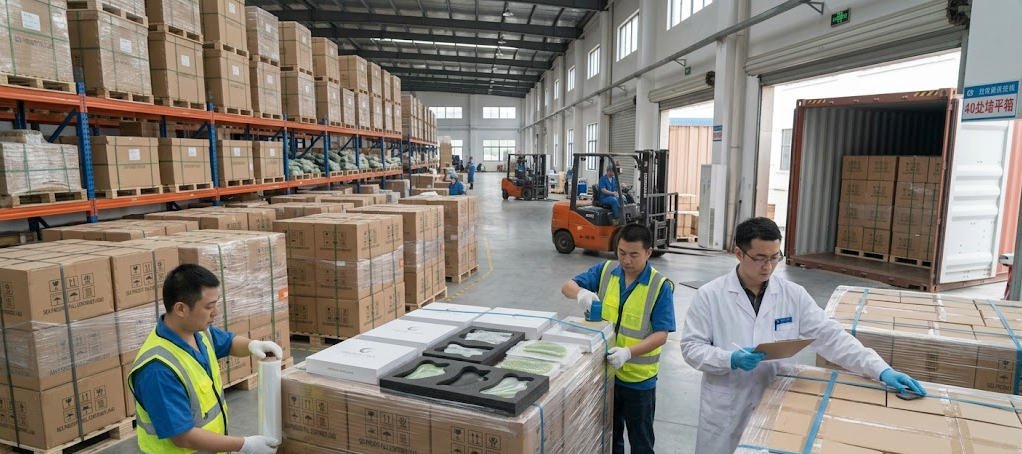
Everything covered so far protects the product from the inside out — cushioning, unit isolation, tray fixation. But gua sha shipping safety also depends on what happens outside the inner box: whether the carton stays put on its pallet, and whether the carton itself can bear the load stacked on top of it for weeks at sea. Get this half wrong and even a perfectly cushioned product can still arrive damaged, because the outer structure failed before the inner protection ever got tested.
Pallet Fixation: Why Movement Is the Real Enemy
A carton that isn’t secured to its pallet doesn’t just sit still during a 20- to 45-day voyage — it shifts, slides, and re-settles every time the vessel rolls or a forklift makes a sharp turn, and each of those small movements re-applies impact stress to whatever is inside. Three elements typically handle this: stretch film wrapped around the full pallet load to prevent lateral movement and keep out dust and moisture, strapping for long-haul sea routes and heavier cargo, and cardboard corner protectors that stop the outer edges of stacked cartons from being crushed under strapping tension or adjacent pallet pressure. None of these is optional for a gua sha wholesale order traveling by sea — skipping any one of them just shifts the failure point to wherever the load is weakest, which is usually the corners and the bottom layer of the stack.
Corrugated Box Grade: Matching Wall Strength to the Journey
Corrugated board comes in three common configurations for export packaging, and the difference between them isn’t cosmetic. Three-layer board works for light products on short domestic routes, but it lacks the reserve strength for a multi-week ocean voyage. Five-layer board — face paper, flute, core paper, flute, liner — is the practical standard for gua sha tools wholesale exports, because it combines meaningfully higher compression resistance with better moisture resistance than three-layer board, without the added weight and cost of seven-layer construction. Seven-layer board earns its place only for genuinely heavy or high-value cargo, where the extra stacking strength justifies the extra freight weight it adds.
This means the box grade on your packing list isn’t a minor spec detail — it’s a direct predictor of whether the bottom layer of your container survives the trip. A gua sha manufacturer quoting three-layer board for a full-container sea shipment is quietly transferring compression risk onto you, even if every other part of the packaging looks correct on paper.
Compliance Testing Every Gua Sha Wholesale Buyer Should Request Before Shipment

If you’ve ever wondered what actually separates a packaging claim from a packaging fact, the answer is testing data — and this is the section worth bookmarking if your sourcing team needs to justify a supplier choice internally. Three tests, run before a shipment leaves the factory, cover the physical risks a gua sha wholesale order faces between the workshop and your warehouse door — and every one of them applies just as directly to a gua sha tools wholesale shipment moving by air as it does to a full sea container.
Box Compression Testing: ECT and BCT
The Edge Crush Test (ECT) measures how much force a small sample of corrugated board can withstand at its edge before it buckles, expressed in kilonewtons per meter, and it’s a core input into predicting how a full carton will behave under stacking load, as documented in standard packaging test methodology. The Box Compression Test (BCT) goes a step further and tests the complete assembled carton — seams, folds, and closures included — under a vertical load that simulates real stacking pressure inside a container. Ask your supplier for both numbers rather than one, because a board can score well on ECT while a poorly executed box design still fails the BCT under real stacking conditions. Both figures belong on the same page as any other gua sha shipping safety documentation your supplier provides.
Drop and Vibration Testing: What ISTA Protocols Actually Simulate
The International Safe Transit Association designs laboratory procedures that reproduce the shocks, drops, and vibration a package experiences across real transport routes, and its test series scale from basic integrity checks up to full-route simulations that combine vibration, temperature conditioning, and repeated drop sequences, according to ISTA’s published test procedures. A drop test alone tells you whether a box survives a single bad moment on a loading dock. A vibration test tells you something a drop test can’t — whether weeks of continuous low-amplitude shock will loosen an EVA tray, compress a bubble-wrap layer, or fatigue a stress point inside a natural stone piece. This means requesting vibration test results specifically, not just drop test results, is the single most useful question you can ask when evaluating gua sha shipping documentation from a new supplier.
Material-Level Risk: What Gemological Testing Bodies Say About Natural Stone
Independent of packaging entirely, the raw material itself carries risk that testing bodies outside the packaging industry have already quantified. Species identification for jade — confirming whether a piece is genuinely jadeite or nephrite rather than a treated substitute — relies on microscopic and spectroscopic analysis of the kind the Swiss Gemmological Institute SSEF performs on jade submissions, and that identification matters for shipping risk because jadeite and nephrite respond differently to sustained vibration due to their differing internal fiber structure. This isn’t a certification you need on every carton — it’s context that explains why two boards that look identical on the outside can have meaningfully different breakage tolerance once they’re inside a container for six weeks. It’s also a useful reminder for any guasha wholesale buyer that material risk and packaging risk are two separate conversations, not one.
So what does this mean for your due diligence process? It means a gua sha wholesale supplier who can produce ECT/BCT figures, ISTA-aligned vibration test results, and clear material sourcing information isn’t just checking a compliance box — they’re giving you the actual data your import team needs to defend a sourcing decision if a customs inspector, a retail buyer, or your own quality department ever asks for it.
Recommended Packaging Systems for Gua Sha Wholesale: Small-Batch Air vs. Bulk Sea, and What Each Actually Costs You

Everything in the sections above is a variable you can mix and match. In practice, though, two structures cover the overwhelming majority of real orders, and knowing which one applies to your situation saves you from over-engineering a sample shipment or under-engineering a full container.
For a small-batch air shipment — the kind you’d use for a first sample run or a limited OEM order — the structure that holds up looks like this: natural crystal board, flannel pouch, EVA foam box, five-layer corrugated outer carton, moisture-proof bag. Each layer earns its place for a specific reason: the pouch prevents surface scuffing during handling, the EVA box locks the piece in position so it can’t gain momentum before an impact, and the moisture-proof bag protects against condensation during rapid altitude and temperature changes in air cargo holds. This structure costs more per unit than a bulk sea equivalent, but for a sample order where a single damaged piece can cost you a new buyer relationship, that added cost is close to negligible next to what it protects. This is the structure worth requesting by name the first time you test a new gua sha tools wholesale supplier before committing to a full container.
For a bulk sea shipment, the structure shifts toward volume efficiency without sacrificing the fundamentals: single-unit wrap, inner presentation box, divider layer between units, five-layer export carton, pallet, and stretch-wrap fixation. This is where gua sha tools wholesale buyers most often try to cut cost by skipping the divider layer or the pallet fixation step, and it’s also where that cost-cutting shows up most visibly in a claims report three months later. A rough industry rule of thumb is useful here: correctly specified export packaging typically adds somewhere in the range of 3 to 8 percent to landed unit cost, while unresolved breakage claims, replacement shipments, and the administrative time spent processing them commonly run several times higher than that per affected unit — before accounting for the reputational cost of a buyer who received a damaged shipment on their first order.
So what does this mean for how you should read a guasha wholesale quote? It means the cheapest packaging line item on a quote sheet is rarely the cheapest option once you account for what happens after a container is opened. A gua sha shipping budget that treats packaging as a cost to minimize will eventually pay for that decision somewhere else in the supply chain — usually in a place that’s harder to trace back to the original packaging choice.
The Gua Sha Wholesale Pre-Shipment Checklist
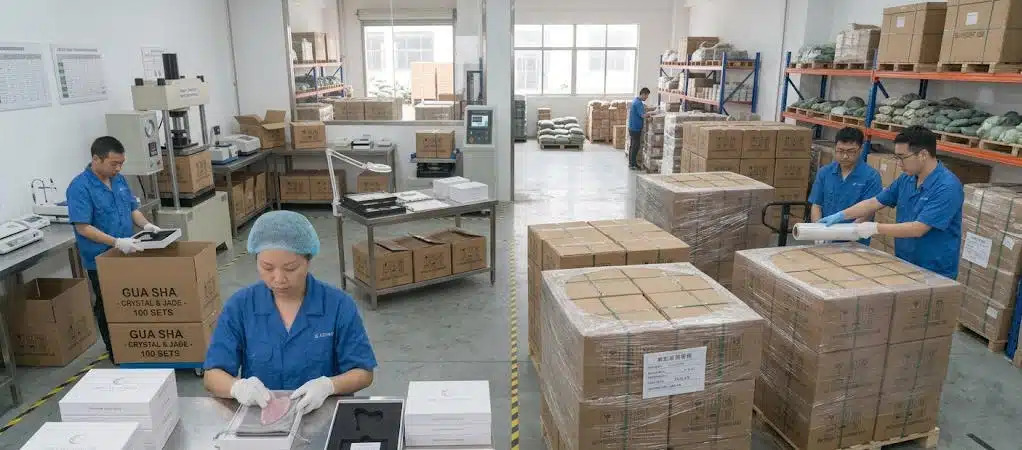
Before a container or air shipment leaves the factory, seven checkpoints determine whether the packaging system will actually hold up in transit. Rather than treating this as a formality, it’s worth walking through each one with your supplier directly and asking for evidence, not just a verbal confirmation. Together, these seven checkpoints are essentially what gua sha shipping safety looks like in practice, reduced to something you can actually verify.
| Checkpoint | What You’re Actually Verifying |
|---|---|
| Product fixation | Whether the product can shift or rotate inside its inner packaging during handling |
| Cushioning material | Whether the material still absorbs impact after simulated compression, not just on day one |
| Unit isolation | Whether natural stone pieces are kept from direct contact with each other inside the same carton |
| Outer carton grade | Whether the corrugated board matches the export standard for the freight method used |
| Moisture protection | Whether the packaging accounts for humidity swings typical of a sea voyage |
| Pallet fixation | Whether stretch film, strapping, and corner protection prevent movement during transit |
| Drop and vibration testing | Whether test results exist for this specific packaging design, not a generic industry claim |
This means a gua sha manufacturer who can walk you through all seven points with actual test data, rather than a general assurance that “our packaging is safe,” is giving you something you can actually act on if a shipment ever underperforms — a specific point in the system to investigate rather than a vague sense that something went wrong.
What This Means for Your Gua Sha Wholesale Sourcing Decisions
Reducing breakage in international shipping isn’t really a packaging question — it’s a systems question, and treating it that way is what separates suppliers whose claims rates stay low from suppliers who keep discovering new reasons for damage after every shipment. Sea freight asks you to control long-term vibration and stacking pressure. Air freight asks you to control sudden impact. Unit isolation stops products from damaging each other before anything external touches the box. Pallet fixation keeps the whole load from moving. Box grade determines whether the outer structure holds under real compressive load, not just in a showroom.
None of these five variables compensates for weakness in another, which is why the most useful question you can ask a gua sha shipping supplier isn’t “is your packaging good” — it’s “walk me through how each of these five variables is handled for my specific order.” Whether you’re placing a small guasha wholesale sample order or negotiating a full-container contract, the gua sha manufacturer on the other end of that conversation should be able to answer it in specifics, not generalities. For natural crystal, jade, and metal gua sha tools specifically, the goal was never simply adding more material. It’s finding the point where protection performance, freight cost, and the customer’s first impression opening the box all land in the same place at once.