Is the most expensive option the safest choice for your gua sha wholesale order? Usually it is not. Before recommending anything, a gua sha manufacturer checks three numbers: your cost-to-retail ratio (a $2.00 piece sold at $19.99 costs 10.0% of retail, while a $4.00 piece costs 20.0%), your finished-piece yield (96% versus 82% means 1,779 extra pieces on a 10,000-piece order), and your unsold-stock exposure ($10,000 versus $25,000 on 5,000 pieces). Yan Cheng uses the same three checks to decide which stone, finish and process to put in front of you. The sections below show you how to run each check yourself, so your gua sha wholesale budget works as a boundary rather than a target.
Risk disclosure: every cost, yield and inventory figure in this article is an illustrative assumption, not a price quote or a market forecast. Your real numbers will depend on stone, design, order size and supplier, so treat the formulas as the useful part and the dollar values as examples.
Commercial interest disclosure: this article is published by Yan Cheng, a manufacturer that sells the kind of products discussed here, so it has a financial interest in your gua sha wholesale purchasing decision. Every check below works on any supplier’s quote, and you should run each one on Yan Cheng‘s quote as well.
- How Much Does a Higher-Priced Gua Sha Wholesale Order Really Cost You?
- Yield Rate: The Hidden Number Inside Every Gua Sha Wholesale Quote
- How to Avoid Dead Inventory in a Gua Sha Wholesale Order
- Which Tier Fits Your Market? Mass, Mid-to-High-End and Luxury in Gua Sha Wholesale
- Is It Really Jade? Material Authenticity and Compliance Risks in Gua Sha Wholesale
- Raw Material Stability: Why Repeat Gua Sha Wholesale Orders Depend on It
- Which Option Should You Choose? Three Tiers of Gua Sha Custom Solutions for Gua Sha Wholesale Buyers
- Your Pre-Quote Checklist and Common Questions About Gua Sha Wholesale Recommendations
How Much Does a Higher-Priced Gua Sha Wholesale Order Really Cost You?

Most buyers compare quotes line by line, and the bigger number looks like the bigger risk. That is only half the picture, because the cost that matters is what each piece earns after it reaches your customer. The math below takes about five minutes, and it can keep a gua sha wholesale order from turning into a five-figure mistake.
Gua Sha Wholesale ROI: Why Cost-to-Retail Ratio Beats Unit Price
Picture a gua sha you plan to sell at $19.99. At a $2.00 manufacturing cost, the piece takes 10.0% of its retail price, and at $4.00 it takes 20.0%. Those percentages cover production only, so shipping, platform commissions, advertising, returns and taxes all land on top. If your other costs already eat half of your retail price, a 20% production share leaves your gua sha wholesale margin very little room.
Now hold your dollar margin steady and the numbers get blunt. Raising unit cost from $2.00 to $4.00 forces your retail price up by at least $2.00, about 10%, just to earn the same dollars per piece, and by roughly $20 if you want to keep the 10.0% ratio. Would your shoppers pay $40 for a stone they cannot tell apart from the $19.99 version? This means you can treat any gua sha wholesale upgrade as a retail-price question first and a sourcing question second.
How to Decide Where an Extra $1 Should Go on a Gua Sha Custom Order
Say you want to move from $2.00 to $3.00 per piece. Before you approve it, ask where that dollar lands: a more carefully selected stone, finer polishing, a logo process, or better packaging. A gua sha custom project can absorb all four, which is exactly why you need to pick one on purpose. Here is a simple way to do it:
- Name the one change your customer will notice first, whether that is colour, feel or unboxing.
- Ask your supplier to quote the extra $1.00 against that single change.
- Put both samples in front of five to ten real customers before you sign off.
A small panel like this costs you very little time. This means you can spend the extra dollar of your gua sha wholesale budget on something shoppers see and feel, instead of on a stone grade that never shows up in a product photo.
Budget, Target Cost and Target Retail: Three Numbers Gua Sha Wholesale Buyers Mix Up
“My budget is flexible” tells a supplier how much you can spend, but it says nothing about how much you should spend. Three separate numbers do the real work: your purchasing budget (the total cash you can commit), your target manufacturing cost (the price per piece) and your target retail price. The first sets your boundary, while the other two set your direction.
Repeat volume widens the gap. A price of $4.00 may feel comfortable on a first order of 5,000 pieces, yet the same price feels very different when your next gua sha wholesale reorder reaches 30,000 pieces and your cash sits in stock for months. This means you can give your supplier a target cost range now and get a recommendation that still works on your third order.
Yield Rate: The Hidden Number Inside Every Gua Sha Wholesale Quote
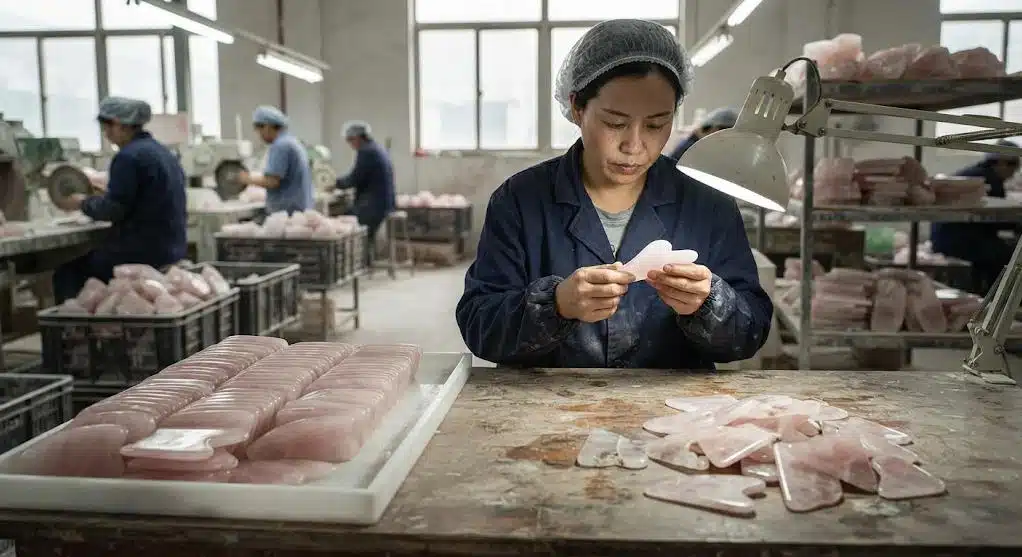
A quote tells you what a started piece costs. Yield tells you what a sellable piece costs, and the two are rarely the same number. Every cracked blank, uneven polish and out-of-tolerance edge that fails inspection is paid for by somebody, and in a gua sha wholesale run that somebody is usually you.
How to Calculate Your Real Cost per Sellable Piece in Gua Sha Wholesale
The formula fits on one line: pieces to start = pieces you need ÷ final yield. For 10,000 sellable pieces, a product with a 96% final pass rate needs about 10,417 pieces started, while a product with an 82% pass rate needs about 12,196. That gap of 1,779 pieces costs $3,558 if every piece starts at $2.00, and it excludes rework, extra sorting and the longer lead time. Why pay for 1,779 pieces you cannot sell?
Turn the gap into a per-piece figure and it sharpens. A $2.00 started piece at 96% yield costs about $2.08 per sellable piece, while the same $2.00 at 82% costs about $2.44, a difference of roughly 17%. A quote with a lower unit price and a weaker yield can therefore cost you more per sellable piece than a quote that looks higher on paper. This means you can compare two suppliers on cost per sellable piece and stop choosing by the price line alone.
Which Quality Metrics Should You Ask a Gua Sha Manufacturer to Report?
Ask for seven numbers: raw-material pass rate, CNC pass rate, polishing pass rate, dimensional tolerance, visible-defect rate, final inspection pass rate and batch-to-batch consistency. Each one points at a different stage, so a weak result shows you where the money leaks. A gua sha factory that records these figures by batch can show you whether a good sample result survives a 5,000-piece run.
Request that final inspection follows a recognised sampling scheme. ISO 2859-1 defines acceptance sampling indexed by acceptance quality limit (AQL), and it includes switching rules that tighten inspection when defects start to rise. This means you can write an AQL level into your gua sha wholesale purchase order and hold your supplier to a number instead of a promise.
Why Mature Designs Protect Your Gua Sha Wholesale Margin at 5,000 Pieces
A sample that looks perfect in a batch of twenty can behave differently in a gua sha wholesale batch of 5,000. A mature design arrives with verified drawings, tested CNC parameters, stable fixtures and a polishing routine that operators have repeated many times. A new custom shape needs extra process steps, tighter stone requirements and more test rounds before output settles, and Yan Cheng asks the same questions about any new shape before quoting it.
The stone adds its own variation. According to GIA’s rose quartz description, rose quartz is found in massive form and owes its pink colour to microscopic inclusions of aligned silicate mineral fibres, so tone can shift from one block to the next. That variation is why colour matching takes selection time at the gua sha factory, and why a tight colour specification raises your cost. This means you can choose a looser colour range when your customers will not notice it, and keep the savings.
How to Avoid Dead Inventory in a Gua Sha Wholesale Order
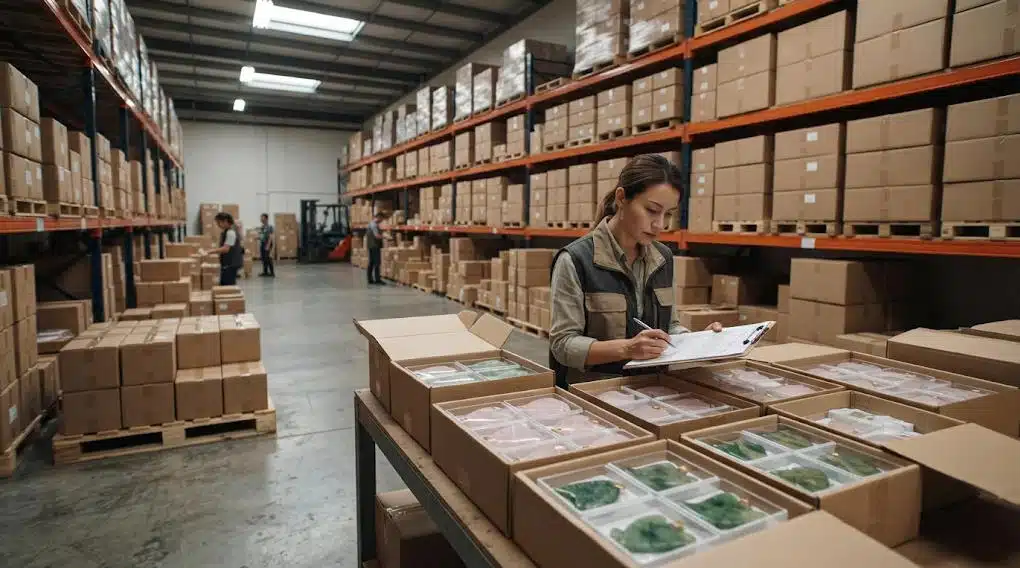
A product that looks perfect on the factory table can still sit in your warehouse for a year. Dead stock is the quietest risk in a gua sha wholesale order, because it never appears on a quote. The fix takes a little arithmetic and one disciplined test.
5,000 Pieces at $2 versus $5: How Much Cash Does Your Gua Sha Wholesale Order Lock Up?
Compare two 5,000-piece orders. A $2.00 standard piece costs you $10,000, while a $5.00 custom piece costs you $25,000, so the higher-priced order ties up $15,000 more before a single unit reaches a customer. Sold at $19.99, the cheaper order carries about $89,950 in gross margin before other costs, and the dearer one about $74,950. If both sell 400 pieces a month, 5,000 pieces last 12.5 months, so your $25,000 sits in stock for more than a year.
Slow sell-through also adds costs that no quote lists, such as storage space and the risk that a design goes out of style. A gua sha factory can finish a new shape quickly, yet only your sales data can tell you whether it will sell. This means you can size your first gua sha wholesale order to the evidence you already hold, instead of to the cash you happen to have.
How to Run a Gua Sha Custom Pilot Batch Before You Scale
A pilot batch turns a guess into data. Start with a small run, for example 300 to 500 pieces, made in the exact stone, shape and finish you plan to scale. Track sell-through for 30 to 45 days, and record returns, reviews that mention colour or feel, and the number of pieces you reject at receiving. These figures are examples, so adjust them to your channel before a full gua sha wholesale run.
Set your decision rule before the batch arrives. You might reorder above 60% sell-through within 45 days, rework the design between 30% and 60%, and drop the product below 30%. Writing the rule down first stops you from explaining away a weak result once the stock is sitting in your storeroom. This means you can move from a pilot to a full gua sha custom order with a number behind your decision.
Which Materials Hold Steady Demand in Gua Sha Wholesale?
Four materials cover most gua sha wholesale requests: rose quartz, green jade or serpentine, amethyst and stainless steel. Rose quartz has a pink look that shoppers recognise, so it fits many brand positions. Green stone suits shoppers who expect a traditional jade appearance, and stainless steel suits a modern line with a different feel in the hand. Amethyst stands out for colour, but its purchase cost is usually higher.
Amethyst also brings a sorting task. According to GIA’s amethyst description, amethyst commonly shows colour zoning, usually angular zones that run from darker to lighter purple, so tone can differ across a single crystal. A batch that needs matched colour therefore costs more selection time and more rejected blanks, and a gua sha factory prices that time into your unit cost. This means you can expect amethyst to suit a brand built on visible stone character, while a mass-market gua sha wholesale line usually does better on a stone that matches itself from piece to piece.
Which Tier Fits Your Market? Mass, Mid-to-High-End and Luxury in Gua Sha Wholesale
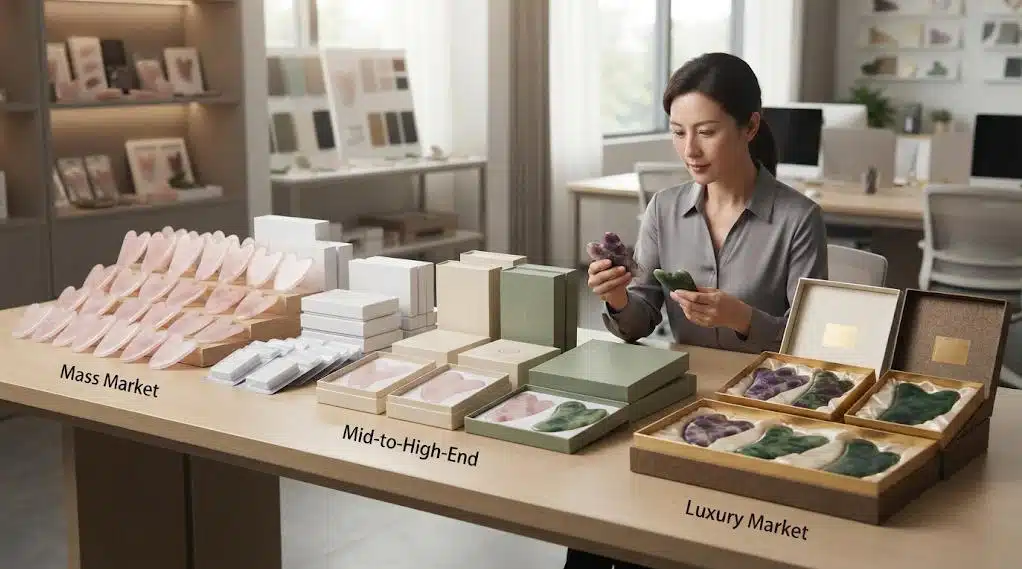
Your market position decides the right gua sha wholesale product more reliably than your budget does. Shoppers in different segments expect different things from a stone, a finish and a box. A supplier who ignores that gap will either overbuild your product or undersell your brand.
Why Two Buyers With the Same $5 Budget Get Different Gua Sha Manufacturer Advice
Imagine two gua sha wholesale buyers who can each accept a $5.00 production cost. Buyer A runs a mass-market beauty brand that sells through online marketplaces. Buyer B runs a high-end skincare brand that sells through its own website and boutique retailers.
For Buyer A, a sensible gua sha manufacturer points to standard rose quartz in a proven mould, because it ships consistently, repeats easily and matches a marketplace price. For Buyer B, the advice shifts to selected natural stone, distinctive texture and a finer surface finish, because shoppers in that channel judge the object up close. Same $5.00 limit, two different products. This is why Yan Cheng asks about your channel and your shoppers before it discusses stone grades, which means you can expect questions about your market before any talk of budget.
A luxury brand moves the target again. Rarity of material, a distinctive design and a brand story carry the price, so higher-grade natural jade, complex tooling and gift boxes become reasonable choices there.
Does a More Expensive Stone Raise Your Retail Price? A Gua Sha Wholesale Cost Table
The table below shows three illustrative options. The figures are examples for planning, not a price list.
| Option | Production cost | Likely market advantage |
|---|---|---|
| Standard rose quartz | $2.00 | Wide acceptance in the mass market |
| Selected rose quartz | $3.00 | Better colour and texture |
| Higher-grade natural amethyst | $5.00 | Material difference and brand display |
If your shoppers cannot tell standard rose quartz from selected rose quartz, the extra $1.00 per piece may return nothing. On 5,000 pieces that is $5,000, and at an unchanged $19.99 retail price your margin per piece falls from $17.99 to $16.99. To win that money back through volume alone, the better-looking stone must lift your sales by about 294 pieces, a 5.9% increase. This means a gua sha wholesale buyer can ask one clear question before paying for a grade upgrade: will it lift my sales by about 6%, or my price by $1.00?
The same logic applies to amethyst at $5.00. Without an established high-end reputation, a brand may find that shoppers read the stone as colourful rather than rare, and the extra $3.00 over standard rose quartz, $15,000 on 5,000 pieces, is slow to recover. This means you can hold amethyst out of your gua sha wholesale range until your brand has earned the price.
How to Match Your Channel to a Tier Before Requesting a Gua Sha Custom Quote
Start with where shoppers first meet your product. If the first contact is a marketplace thumbnail, colour consistency and a clean edge matter more than rare texture. If it is a boutique shelf or your own website, surface finish, weight in the hand and packaging do more of the selling.
Then pick one tier, brief your supplier on it, and test it with a pilot batch before you place a gua sha wholesale order at scale. A gua sha custom quote that names your channel, your target retail price and your target cost range lets a supplier propose one product instead of three. A good supplier builds its quote from those three inputs, which means you can receive a recommendation sized to your plan rather than to your budget ceiling.
Is It Really Jade? Material Authenticity and Compliance Risks in Gua Sha Wholesale

In gua sha wholesale, a stone name on a spec sheet is a promise you repeat to every customer. If the promise is wrong, the cost lands on your brand, not on whoever cut the stone. This chapter shows you how to check a material before you pay, and which rules sit behind your claims.
How to Verify Your Gua Sha Wholesale Stone Before You Pay
Start with the name. Ask your supplier to write the exact species on your order, such as nephrite, jadeite, serpentine, rose quartz or amethyst, instead of a trade nickname. The Laboratory Manual Harmonisation Committee, whose members include GIA and SSEF, updated its jade information sheet in May 2025 so that the trade name “jade” covers aggregates made mainly of jadeite, omphacite, kosmochlor or nephrite. A serpentine stone sold under that word falls outside that scope. This means you can catch a naming problem in writing, before 5,000 gua sha wholesale pieces carry it on the box.
Next, ask about treatment. According to the International Gem Society, jadeite is much more porous than nephrite, so dye and polymer enhancement are more common in jadeite, although they also occur in nephrite. GIA’s amethyst quality guide adds that heat can lighten very dark amethyst and that light-coloured quartz has been dyed purple. A treatment is not automatically a problem, but an undeclared treatment in a gua sha wholesale lot is a risk to your brand.
For higher-value lots, send a sample from each lot to an independent laboratory such as SSEF or GIA, and ask for the species and treatment status in the report. Compare the report fee with what is at stake: a gua sha wholesale lot of 5,000 pieces at $5.00 is $25,000 of stone. SSEF points out that a laboratory statement describes the stone at the time of testing, which is why you should test lot by lot rather than once a year. This means you can prove what you are selling with a paper trail instead of a supplier’s word.
What Do FTC Rules and Prop 65 Mean for a Gua Sha Manufacturer and Your Brand?
The summary below is background, not legal advice, so confirm your own case with counsel. In the United States, the FTC’s Jewelry Guides are the closest reference for gemstone claims, and they include provisions on disclosing gemstone treatments and on words such as “natural” and “genuine.” Gua sha tools are not clearly jewelry, so check how the Guides apply to your product. The Guides are administrative interpretations rather than independently enforceable rules, yet the FTC may take action under the FTC Act when a marketer makes a claim inconsistent with them. This means you can treat “natural” and “jade” on your product page as claims you must be able to support.
California’s Proposition 65 works differently. According to the state’s business FAQ, it applies to businesses with ten or more employees that do business in California, and it puts primary responsibility for warnings on manufacturers, producers, packagers, importers, suppliers and distributors. The same FAQ says businesses must decide for themselves whether a warning is required, and online sales call for the warning before checkout is completed. If you sell gua sha wholesale to retailers in California, ask your supplier for material information on every part of the product, including stone, metal fittings and packaging. A gua sha factory that can supply those records helps you decide on a warning with data instead of learning about it from a legal notice.
How to Write a Compliant Gua Sha Custom Specification Sheet
A written specification turns everything above into a purchase condition. Include six items: species name, treatment status (none, dyed, heated or irradiated), colour range with reference photos, dimensional tolerance, finish standard, and the AQL level for final inspection. Add a line that lists which marketing words, such as “natural,” “jade” or “untreated,” your supplier’s documents can support.
Ask your supplier to sign the sheet, and keep the signed copy with each lot’s inspection record. Ask any supplier, Yan Cheng included, to build this sheet with you at the quoting stage, so every gua sha wholesale purchase order carries the same terms. This means you can settle a dispute against a page instead of a memory.
Raw Material Stability: Why Repeat Gua Sha Wholesale Orders Depend on It
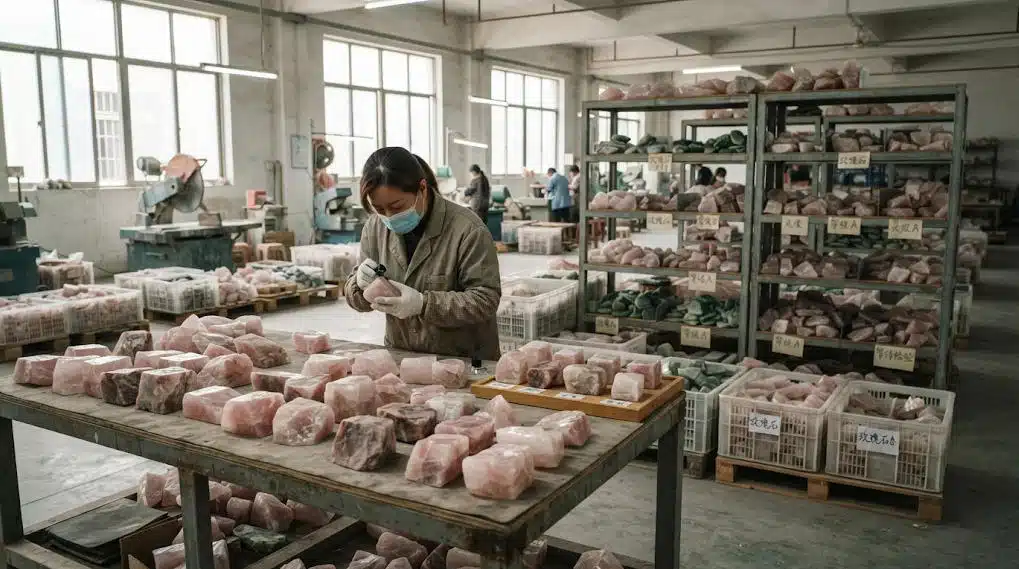
Your first order proves the design. Your tenth order proves the supply chain. A stone that looks right in a pilot batch can still disappoint you on reorder if the next blocks differ in colour, size or internal flaws, and repeat gua sha wholesale orders live or die on that difference.
Can Your Gua Sha Manufacturer Supply the Same Grade Every Month?
Ask three questions about every stone in your gua sha wholesale order: where the rough comes from, how large the blocks are, and what share of them passes selection. Rose quartz comes from a mature supply chain but needs screening for cracks and impurities. Amethyst depends heavily on grade and shows strong colour and crystal variation, as GIA’s note on colour zoning describes earlier in this article. Jade depends on the specific variety and deposit.
Picture a gua sha wholesale buyer who needs 10,000 pieces every month. A supplier who can lock the same grade for six months protects that buyer’s colour consistency, while a supplier who only promises “the best available grade” protects nothing, because the next shipment may sit in a different colour band. This means you can ask for a written grade and colour range per delivery, and reject any shipment that falls outside it.
What Changes When Your Gua Sha Wholesale Order Grows From 5,000 to 30,000 Pieces?
Volume turns small cost changes into large ones. A gua sha wholesale order at $4.00 per piece costs $20,000 at 5,000 pieces and $120,000 at 30,000 pieces. A $0.50 swing in unit cost is $2,500 on the first order and $15,000 on the larger one. At 2,500 sales a month, 30,000 pieces last 12 months, so $120,000 stays in stock for a full year unless you stage the deliveries.
That is why a supplier who quoted $4.00 for 5,000 pieces may recommend a mature $3.00 design for 30,000. Releasing the volume in four quarterly lots of 7,500 pieces gives you four chances to adjust colour, shape and price, and experienced suppliers often suggest staged releases for this reason. This means you can scale in steps, with each release tied to the sales data from the one before.
How Do Cracks, Colour Variation and Material Loss Affect Gua Sha Wholesale Pricing?
Every unusable blank is paid for by the usable ones. If a blank costs $1.50 and 90% of blanks pass selection, each usable blank costs about $1.67. If only 80% pass, it costs about $1.88, a 12.5% increase before a single cut is made. Cracks, inclusions and colour outliers are the usual reasons for rejection, and the arithmetic works on any gua sha wholesale quote, whatever the stone.
Tell your supplier which flaws your gua sha wholesale market tolerates. A hairline inclusion that shoppers never see on a marketplace thumbnail does not need to cost you a rejected blank, while a colour outlier on a boutique shelf does. A gua sha factory can widen or tighten selection on request, which means you can pay for strictness only where your customers will notice it.
Which Option Should You Choose? Three Tiers of Gua Sha Custom Solutions for Gua Sha Wholesale Buyers
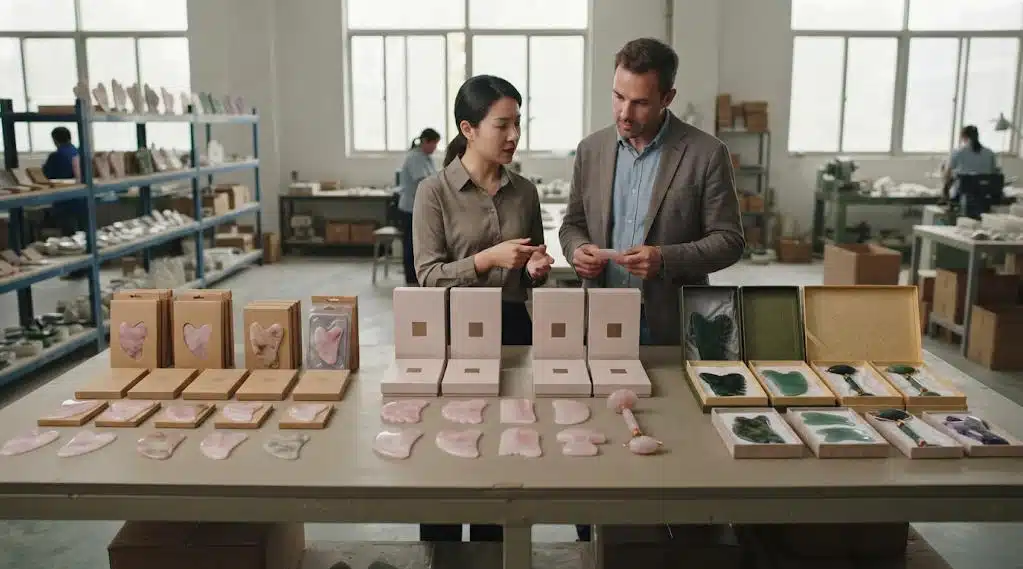
No tier wins on its own. The right one is the tier that matches your channel, your cash and your repeat volume, and the three options below show how that looks in practice. Each one lists what you get, what it costs you in risk, and who it fits, so your gua sha wholesale plan starts from a clear choice.
A: Best Value With Standard Rose Quartz in Gua Sha Wholesale
Option A uses standard-grade rose quartz, a proven design and a mature production routine. At an illustrative $2.00 per piece and a 96% final yield, it costs about $2.08 per sellable piece and takes only 10% of a $19.99 retail price. It suits mass-market sellers, marketplace channels and first-time pilot batches. This means you can enter the market with $10,000 of stock on 5,000 pieces instead of $25,000, and learn from real gua sha wholesale sales before you commit more.
B: Brand Upgrade With Selected Stone and Gua Sha Custom Branding
Option B adds selected natural stone, stricter appearance screening, finer polishing, and branded logo and packaging. At an illustrative $3.00 per piece, it needs about a 6% sales lift or a $1.00 price rise to repay the upgrade, as the break-even math earlier in this article showed. It suits brands that sell through their own website or boutique shelves and can show shoppers the difference. This means you can pay for the details your customers see, and skip the ones they do not.
C: Luxury Gua Sha Wholesale Projects With Rare Stone and Complex Craft
Option C uses higher-grade or special stone, individual design, complex tooling and gift packaging. At an illustrative $5.00 per piece, 5,000 pieces tie up $25,000 and take 25% of a $19.99 retail price, so a luxury positioning needs a higher retail price to carry that cost. It suits brands with an established high-end reputation and a pilot result that already shows demand. This means you can reserve Option C for the moment your brand has earned it, rather than starting there.
Option A is not a lesser product than Option C, and Option C is not a better one than Option A. The choice depends on your business goal, and Yan Cheng suggests starting from Option A on most first orders, because a verified sell-through result makes every later upgrade cheaper to justify.
How to Pick Your Tier in Five Minutes Before a Gua Sha Wholesale Quote
Write down your target retail price, then decide what share of it you can give to production. At $19.99, a 10% share points to about $2.00 per piece (Option A), 15% to about $3.00 (Option B), and 25% to about $5.00 (Option C). Pick the highest tier whose cost still fits your share, then test it with a pilot batch.
If your result lands between two tiers, take the lower one and put the difference into one visible upgrade, as the earlier $1 test describes. This means you can reach a tier decision with one multiplication and one sample, instead of a week of back-and-forth quotes.
Your Pre-Quote Checklist and Common Questions About Gua Sha Wholesale Recommendations
A supplier can only recommend what you describe. The checklist and answers below are the shortest route from a vague budget to a quote you can compare with confidence.
Six Things to Tell a Gua Sha Manufacturer Before You Request a Quote
Send six items with your first message: your target market, your sales channel, your target retail price, your target cost per piece, your first-order and expected reorder volume, and how consistent the colour must be from piece to piece. Add your tolerance for visible inclusions and any claims you plan to print on the box. This means you can receive a recommendation for your gua sha wholesale plan in one round, instead of three.
Five Principles to Take Away
Position comes first, so your product should match your shopper and not your highest available grade. Your gua sha wholesale budget is a boundary, not a spending target. Market demand counts for more than stone price, and production feasibility, meaning yield, loss and inspection results, decides your real cost. A 14-point yield gap (96% versus 82%) moved the cost per sellable piece by roughly 17% earlier in this article, and long-term consistency beats a one-time impressive batch. This means you can judge any future quote against the same five tests.
Common Questions About Gua Sha Wholesale Buying
Is a gua sha factory trying to upsell me when it suggests a higher grade? Not necessarily. A fair upgrade comes with a reason you can measure: a yield gain, a visible quality change, or a price lift your shoppers accept. If the only reason is that your budget allows it, ask for the cost-to-retail math before you agree, and compare it with the gua sha factory yield data.
Can I still order higher-grade stone if my budget allows it? Yes. Run a pilot batch first, then scale once sell-through meets the rule you wrote in advance. A budget that allows $25,000 of stock does not mean your sales can clear it within a year, and a gua sha wholesale order that sits unsold costs you twice.
What does a gua sha custom order need to start? You need your six checklist items, a logo file if you want branding, and a written specification sheet. Minimum order quantities depend on the stone and the process, so ask for the figure that applies to your design.
How do I test a new material without risking a large order? Order 300 to 500 pieces, track 30 to 45 days of sales, and apply the reorder rule you set before the batch arrived. A small test costs you a few hundred pieces, while a wrong bulk order costs you the whole lot.
About Yan Cheng
Yan Cheng is a source gua sha manufacturer with more than 12 years of experience in processing, designing, manufacturing and selling jade and crystal gua sha tools. Send your market, channel, target retail price and target cost, and you will receive one recommended tier with the reasoning behind it, so your next gua sha wholesale order starts from numbers you can check.