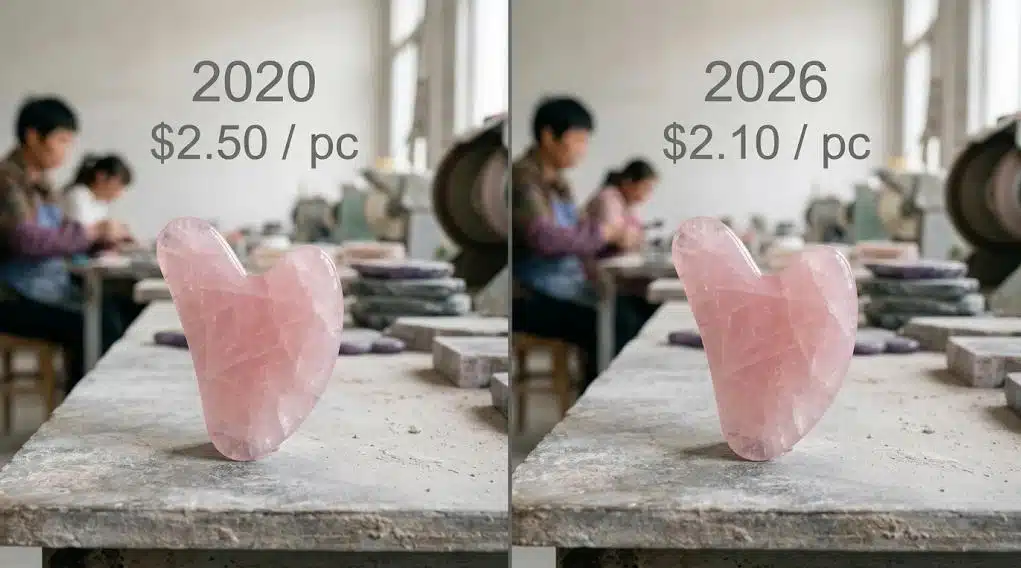
The gua sha wholesale price of an identical design can rise 17% in six months or fall 16% over six years, and neither move has to mean something is wrong. Our factory records show amethyst gua sha climbing from $3.85 to $4.50 per piece between early and late 2022, while the GS-001 V-shaped finger gua sha dropped from $2.50 to $2.10 between 2020 and 2026. If you buy from a gua sha manufacturer on a recurring basis, you have probably opened a quote that looked “wrong” next to last year’s. Three layers sit behind every number: raw stone cost, factory cost, and the maker’s pricing room. This article walks through each layer, shows you where guasha production efficiency helps you and where a shifting gua sha material price works against you, and gives you a way to tell a fair adjustment from a quiet downgrade. This means you can walk into your next negotiation with a cost map instead of a hunch.
- How Is a Gua Sha Wholesale Price Built? Three Cost Layers Behind Every Quote
- Why Did Your Gua Sha Wholesale Price Jump 17% in Six Months? An Amethyst Case Study
- Why Did the GS-001 Gua Sha Wholesale Price Fall from $2.50 to $2.10? A 2020 vs 2026 Cost Sheet
- How to Check Why a Gua Sha Wholesale Price Changed: A Four-Step Method
- What Compliance Does to Your Gua Sha Wholesale Price: Natural Claims, Treatments and Labels
- How Guasha Production Efficiency Lowers Cost: What Reaches Your Gua Sha Wholesale Price
- Risk Disclosure and Takeaways: Reading Any Gua Sha Wholesale Price Change Honestly
How Is a Gua Sha Wholesale Price Built? Three Cost Layers Behind Every Quote

Before you compare this year’s quote with last year’s, it helps to know what a quote is made of. Most of the confusion between buyers and factories comes from treating one number as if it were one thing. In practice it is three numbers added together, and each one moves for different reasons. Once you can see them separately, a price change stops feeling like a mystery and starts looking like a puzzle you can solve.
Material, Manufacturing Cost and Pricing Margin Explained
Every quote stacks three layers. The first is material cost: what the factory pays for rough stone, adjusted for how much of that stone ends up as sellable pieces. The second is manufacturing cost, which covers cutting, grinding, polishing, labor, machine time, packing and rejects, so it reflects how well guasha production is run. The third is the pricing margin, the gap between total cost and the number on your quote. That gap also has to pay for management, sales and operations, so it is not pure profit. Our GS-001 shows the stack clearly: in 2020 it sold at $2.50, with $1.80 of total production cost (including $1.00 of stone) and a $0.70 gap. This means you can ask any supplier for those three numbers and compare quotes layer by layer instead of guessing from a single line.
The stone layer deserves extra attention because it is the one the factory controls least. GIA’s amethyst description notes that amethyst commonly shows angular zones of darker and lighter color, and zoning like that can reduce how much of a rough piece cuts into an even-colored tool. So the gua sha material price on paper reflects more than the word “amethyst”; it reflects the grade, color and crack-free yield behind it. The International Gem Society adds a useful caution: its Gem Price Guide is only a guide, and gems sell outside the listed ranges every day. This means you can use published references as a rough starting range, then ask your supplier which grade the quoted stone actually is.
Which Layer Moves Your Gua Sha Wholesale Price Fastest?
The three layers run on different clocks. Stone can jump within a few months, factory cost drifts down over years as routines improve, and margin responds to how many other suppliers are chasing your order.
| Layer | Real example from our records | Time scale |
|---|---|---|
| Material | Amethyst gua sha quote $3.85 → $4.50 (+$0.65, about 17%) after rough stone became scarce | About 6 months, 2022 |
| Manufacturing cost | GS-001 total production cost $1.80 → $1.60 (−$0.20) | 2020 to 2026 |
| Pricing margin | GS-001 gap $0.70 → $0.50 (−$0.20) | 2020 to 2026 |
Only the first move can cost you money without giving you anything back, because a stone shortage raises the price while the grade of available rough can slip at the same time. The other two tend to push quotes down. A gua sha manufacturer that can show you which layer moved is handing you what you need to judge fairness; one that only says “costs went up” is not. So the next time a quote surprises you, why not ask one simple question: which of the three layers changed? This means you can sort price changes into “fair adjustment” and “needs a closer look” in a single email.
Why Did Your Gua Sha Wholesale Price Jump 17% in Six Months? An Amethyst Case Study

In early 2022, an amethyst gua sha in the same design as a standard rose quartz style sold for $3.85 per piece. Six months later, the identical design quoted at about $4.50, an increase of $0.65, or roughly 17%. Nothing about the tool had changed. What changed was the stone arriving at the factory, because usable amethyst rough had gone from plentiful to scarce. If you have ever been tempted to blame a supplier for a jump like that, this case is worth a slow read.
How a Stone Shortage Lifts Gua Sha Material Price
Natural stone does not behave like steel or plastic. A mill can add a shift and make more of those materials, but a mine cannot dig more amethyst just because orders went up. A factory also does not buy “all the amethyst.” It buys rough that fits a gua sha: even color, few internal cracks, enough thickness, and a size that can be cut without wasting half the block. When that narrow slice dries up, every buyer in the chain bids for the same pieces and the stone price climbs, even though the market still technically has amethyst. This means you can read a sudden increase on a natural-stone item as a supply signal first and a margin grab second.
Color is a big reason the usable slice is small. IGS’s amethyst gemstone guide explains that trade names describe different shades of amethyst, and GIA’s amethyst quality notes point out that cutting one crystal tends to produce a few deep purple stones and many lighter ones. When even color is the target, thin supply hurts twice: you pay more per kilogram, and each kilogram yields fewer sellable pieces. Even a well-run guasha production line cannot cut a stone that never arrived. This means you can expect a shortage to hit your unit cost harder than the raw price chart suggests.
What a $0.65 Increase Costs You, and What It Does Not Buy
Run the numbers on a 5,000-piece reorder. At $3.85, that order costs $19,250; at $4.50, it costs $22,500, a $3,250 gap. If you resell each piece at $12 (an assumption for illustration, before freight and duties), your gross margin per piece slides from $8.15 to $7.50, or from about 68% to 62.5%. A buyer who had locked a six-month order at the early-2022 quote would have kept that $3,250, which is why price validity windows deserve a line in every purchase agreement. This means you can protect your margin by placing scheduled, larger orders on stone-dependent items before a shortage shows up, instead of reacting after it does.
Here is the uncomfortable part. In the factory’s records, the later $4.50 batches were weaker in stone grade than the early-2022 batches. A higher quote during a shortage often pays for the difficulty of finding any qualifying rough, not for better stone. So when a gua sha manufacturer sends you an increase, ask for the grade, color range and crack tolerance behind it, and compare those against the batch you originally approved. Would you accept 17% more for a weaker batch without knowing? This means you can turn “prices went up” into a documented spec comparison that protects your product page and your return rate.
Why Did the GS-001 Gua Sha Wholesale Price Fall from $2.50 to $2.10? A 2020 vs 2026 Cost Sheet

The amethyst case showed you a price moving up because of stone. GS-001 shows the opposite move, and the reason is different. This V-shaped finger gua sha sold for $2.50 in 2020 and sells for $2.10 in 2026, a drop of $0.40, or 16%. The design is the same, and the stone cost stayed at about $1.00 per piece in both years. So where did the $0.40 go?
Reading the Cost Sheet: $0.20 From Efficiency, $0.20 From Margin
| Item | 2020 | 2026 | Change |
|---|---|---|---|
| Price per piece | $2.50 | $2.10 | −$0.40 |
| Total production cost (including stone) | $1.80 | $1.60 | −$0.20 |
| Stone cost | $1.00 | $1.00 | $0.00 |
| Price minus production cost | $0.70 | $0.50 | −$0.20 |
Start with the stone line. Because the gua sha material price for GS-001 held at about $1.00, the drop cannot be blamed on cheaper material, which rules out the most worrying explanation. Total production cost fell from $1.80 to $1.60 as the factory’s routines matured: fewer reworks, shorter machining time, less waste. Researchers call this the experience curve, and a U.S. Army analysis of the experience curve describes unit costs falling by a steady percentage each time cumulative output doubles. GS-001’s 11% cost reduction ($0.20 on $1.80) is the same kind of effect, spread over six years of steady output. This means you can reasonably ask for a cost-down on a design you have ordered steadily for years.
The other $0.20 is the part buyers rarely see. The gap between price and production cost shrank from $0.70 to $0.50, which is 28% of the price in 2020 and about 24% in 2026. As more factories started making the same item, buyers could collect competing quotes, and the supplier narrowed its own room to keep orders. Half of the $0.40 drop came from better production; the other half came from the supplier accepting less. This means you can credit part of every long-run price drop to competition among suppliers, not to a cheaper way of making the tool.
How to Use These Numbers When You Negotiate a Repeat Order
Put it in order terms. On 10,000 pieces a year, a $0.40 drop is worth $4,000 annually, and $2,000 of that came from real efficiency while the other $2,000 came from margin the supplier gave up. That split matters, because efficiency gains tend to repeat and margin concessions do not. A supplier’s remaining room also has a floor, since the $0.50 gap still has to pay for management, sales and operations, so it is not pure profit. Push a gua sha manufacturer from $0.50 toward $0.30 on a mature item and you are no longer asking for a discount; you are asking where the missing $0.20 will come from. This means you can negotiate for efficiency-based savings with confidence and treat deeper cuts as a quality risk that needs testing.
Stable, well-practiced guasha production is what makes the first $0.20 possible, and it depends on orders arriving at a steady rhythm. If you split one design across five suppliers, you may collect a cheaper first quote while slowing the learning that brings every supplier’s cost down. So which would you rather have: the lowest quote this quarter, or a price that keeps drifting down for six years? This means that, in many cases, you can save more by keeping a repeat design with one or two producers than by rotating suppliers every season, as long as you keep inspecting quality.
How to Check Why a Gua Sha Wholesale Price Changed: A Four-Step Method

Two real quotes moved in opposite directions: amethyst up $0.65, GS-001 down $0.40. Each deserves a different reaction, and you can tell which one you are looking at in about an afternoon. The method below needs only your old quote, the new quote, and four things you are entitled to ask.
Four Steps to Trace a Price Change to Its Source
Step one: line up the specs. Put the old and new quotes side by side and confirm that size, stone type, finish, packaging and minimum order quantity are identical. A change in any one of those can explain a price move by itself, so rule that out before you ask about costs. Ask for the current spec sheet in writing. This means you can be sure you are comparing like with like before anyone starts talking about cost increases.
Step two: ask the three layer questions. Has the process changed? Has the stone cost changed for the same grade? Has the supplier’s margin changed? For natural stone, go one level deeper and ask for the grade, color range, crack tolerance and usable yield, because the gua sha material price attached to a grade can move even when the stone name stays the same. This means you can collect answers you can write down, instead of reassurance you cannot.
Step three: do the arithmetic. Every price change equals the change in stone cost, plus the change in production cost, plus the change in the supplier’s margin. GS-001 works out as $0.00 + (−$0.20) + (−$0.20) = −$0.40, with nothing left unexplained. If a supplier’s story leaves a gap, that gap is your next question. This means you can check any quote with a calculator in under five minutes.
Step four: test the goods. Ask for a pre-production sample and compare it with the batch you originally approved: thickness, edge finish, color range and visible cracks. For bulk lots, agree on an inspection standard before shipping. ISO 2859 defines an acceptance quality limit as the worst tolerable process average for a continuing series of lots, and iSixSigma’s AQL reference explains how buyers use it to set pass-or-fail rules for a batch. This means you can turn “it looks fine” into a rule that both sides agreed on in advance.
Red Flags: When a Lower Price Is Really a Downgrade
A falling price is not automatically good news. Use the GS-001 cost sheet as a yardstick: a $1.70 quote would sit only $0.10 above a $1.60 production cost, against the $0.50 gap the item carries today. Either that supplier has found $0.40 of savings you deserve to hear about, or the saving is coming out of your product. The usual hiding places are a lower stone grade, fewer finishing steps, or looser inspection. This means you can treat any discount larger than a supplier’s explainable savings as a question, not a gift.
Check three places first. Look at the stone: is the color range wider than the approved sample? Look at the finish: were polishing or edge-rounding steps removed from guasha production? Look at the paperwork: did the inspection standard quietly change? A gua sha manufacturer that works with you will answer each of those in writing, and a supplier who goes vague on all three has told you something. Wouldn’t you rather learn that from a sample than from a customer review? This means you can screen out downgraded quotes before they reach your shelves.
What Compliance Does to Your Gua Sha Wholesale Price: Natural Claims, Treatments and Labels

Compliance is part of the price. Two quotes for “amethyst gua sha” at $4.50 are not the same product if only one comes with a written natural-origin statement. This section is general information for buyers, not legal advice, and it focuses on the United States.
Natural, Synthetic or Treated? What the FTC Jewelry Guides Say
The FTC’s Jewelry Guides, 16 CFR Part 23 address claims made about gemstone products, and two habits from them matter here. A synthetic stone should carry a qualifier such as “laboratory-grown” or “synthetic” instead of the bare stone name, and a treatment should be disclosed when it is not permanent, requires special care, or significantly affects value. The Guides are administrative interpretations rather than statutes, yet marketing that departs from them can draw attention as a deceptive practice, and whether a gua sha counts as a gemstone product in your market is a question for your own counsel. This means you can use the Guides as a checklist for your product pages even before a lawyer weighs in.
Amethyst is a color you can change. GIA’s amethyst gem guide shows heated green quartz and heated, irradiated violet quartz from the same Brazilian mine next to untreated amethyst, and it notes that merchants are required to tell you whether a gem is natural or synthetic. Synthetic quartz is a bigger concern than most buyers expect: GIA’s Gems & Gemology report on synthetic quartz says it is increasingly sold online as natural, and that once it is polished, inexperienced buyers can misidentify it. GIA researchers have also shown that infrared spectroscopy can separate natural from synthetic amethyst, so your eyes are not the right instrument. When a gua sha material price for amethyst looks too low, wouldn’t you want to know why? This means you can treat an unusually low stone price as a reason to ask for origin proof.
Documents and Marks to Request Before You Pay
Ask your gua sha manufacturer for three things in writing: a natural-origin statement for each stone type, a treatment statement covering heating, irradiation and dyeing, and, for lots where the claim carries your brand, a lab report on a sample. Any heating, irradiation or dyeing step in guasha production belongs on that paperwork. The Swiss Gemmological Institute describes what a laboratory report answers in its SSEF Facette 2019 publication: what the gemstone is, and whether it formed naturally or was produced synthetically. This means you can build a file that proves what you sold, which protects you if a customer, a marketplace or a regulator ever asks.
Origin marking is the second paperwork risk, and it has a price tag. U.S. rules under 19 CFR Part 134 require imported articles to be marked with their country of origin, and unmarked articles face an additional duty of 10% of the final appraised value unless they are exported or destroyed before liquidation. On a 5,000-piece amethyst order at $4.50, that is up to $2,250 if the appraised value matches the order value. Confirm marking with your supplier before the goods ship, and ask your customs broker whether your packaging satisfies the rule. This means you can avoid a surprise 10% charge by fixing a label before production instead of after arrival.
How Guasha Production Efficiency Lowers Cost: What Reaches Your Gua Sha Wholesale Price

Efficiency is the quiet part of a price drop. It does not change how a gua sha looks or feels, yet it moved GS-001’s production cost by $0.20, from $1.80 to $1.60, over six years. Here is where savings like that usually come from, and how much of them can show up in your quote.
CNC Programs, Toolpaths and Fewer Reworks
A stone gua sha starts as a block and ends as a smooth, edge-rounded tool, and every minute of that journey costs machine time and labor. Early on, much of the outline trimming, edge grinding and polishing is done by hand. As guasha production moves to CNC machines and tuned programs, the same shape takes fewer passes, the toolpath stops repeating cuts, and pieces spend less time waiting between stations. Operators who have run a design for years also make fewer mistakes, which means fewer pieces sent back for rework. This means you can expect repeat designs to get cheaper to make even when their appearance never changes.
These savings have limits. Automation shortens the machined steps, but a design that needs heavy hand finishing will see smaller gains than one that a machine can complete almost on its own. So when you choose between two shapes for a new line, ask which one suits the factory’s equipment. This means you can lower your own cost at the design stage, before a single block is cut.
Yield Math: Why 900 Pieces per 100 kg Changes Your Gua Sha Wholesale Price
Yield is the share of the rough stone that ends up as sellable pieces, and the International Gem Society’s yield guide notes that it depends heavily on the finished size and shape you need to cut. Take an illustration: 100 kg of rough yields 800 good pieces under early routines and 900 after cutting layouts and parameters improve. If that 100 kg costs $800, stone cost per piece falls from $1.00 to about $0.89, a saving of $0.11, or 11%, with no change in the gua sha material price per kilogram. On 10,000 pieces a year, that is roughly $1,100. These figures are illustrative, and GS-001’s own stone cost stayed at $1.00, so its $0.20 saving came from other places. This means you can see a price drop that has nothing to do with cheaper stone and everything to do with less waste.
Volume helps in a similar way, with a catch. Steady, larger runs spread setup and changeover time over more pieces, which lowers cost per piece. But scale does not work automatically: small orders, unchanged yield or heavy hand work can leave the savings close to zero. Would a supplier who promises a big discount on a small order be telling you the whole story? Ask for the batch size where changeover cost stops falling, then order in multiples of it. This means you can capture volume savings by planning your order sizes instead of bargaining for them.
Risk Disclosure and Takeaways: Reading Any Gua Sha Wholesale Price Change Honestly

Here is the short version of everything above. A price change comes from stone, from production cost, or from the supplier’s margin, and the three move at different speeds: amethyst stone pushed quotes up $0.65 in six months, while efficiency and competition together pulled GS-001 down $0.40 over six years. If you can name which layer moved, you can tell a fair adjustment from a downgrade. This last section tells you how far these numbers can carry you, and where they stop.
What This Data Can and Cannot Tell You
Be careful with the evidence. Both price histories come from one factory’s internal records, cover two products, and reflect specific periods: 2022 for amethyst and 2020 to 2026 for GS-001. Your supplier, your stone and your order size may behave differently. The yield table, the 5,000-piece and 10,000-piece orders and the $12 resale price are illustrations built to show the arithmetic, not statistics or forecasts. This means you can borrow the method freely, but you should rerun it with your own numbers before you rely on a result.
Three risks deserve a direct warning. First, stone markets can swing again: a six-month jump like amethyst’s can repeat for any natural material, and past stability does not guarantee future prices. Second, a price drop has a floor, because a supplier’s remaining gap still has to pay for management, sales and operations. Third, compliance is your responsibility as the seller, since origin statements, treatment disclosure and country-of-origin marking can change what a shipment costs, and the rules covered in this article are US-focused general information, not legal advice. Which of those three would hurt your margin most if it hit next quarter? This means you can set aside a buffer and written terms for the one you pick.
Your Next Step: Ask for the Three-Layer Breakdown
Before your next order, ask for the layers behind any gua sha wholesale price you are quoted: stone grade and cost, total production cost, and the gap between them and the price. Request the natural-origin and treatment statements for stone items, agree on an inspection standard, and confirm origin marking before shipment. Then compare the new sheet against the last one you approved, line by line. A gua sha manufacturer that welcomes that comparison is easier to plan around than one that resists it, and a clear gua sha material price line keeps stone surprises out of your margin. Yan Cheng, a stone gua sha maker with more than 12 years of processing and production experience, can supply that breakdown for your spec if you send the size, stone and quantity. This means you can reorder with a cost map instead of a hunch, and explain your own pricing to your customers with evidence.
Historical pricing examples are based on internal factory records.