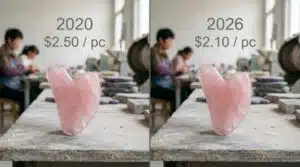

If you choose a gua sha manufacturer on unit price alone, you are measuring the smallest part of your cost. In 2026, one buyer sent the same 6,000pcs stainless steel enquiry to several makers, split the first order 3,000pcs and 3,000pcs between two of them, and about two months later placed a 30,000pcs reorder with one. That is five times the trial volume, and the lowest quote did not win it. This article is an industry experience and risk disclosure for buyers of gua sha wholesale orders. It shows where costs hide, how to test a gua sha factory before you scale, and what we cannot prove from a single case.
- Is the Lowest Quote From a Gua Sha Manufacturer Really the Lowest Total Cost?
- How Can You Confirm a Gua Sha Manufacturer’s Bulk Goods Match the Approved Sample?
- What Happens When Bulk Goods Don’t Match? How to Judge a Gua Sha Manufacturer’s After-Sales Ability
- Can a Trial Order Expose a Weak Gua Sha Factory? A 6,000pcs Split Order That Became a 30,000pcs Reorder
- How Far Can Guasha Custom Go Beyond Logo Engraving?
- Can Your Gua Sha Manufacturer Scale From 3,000pcs to 30,000pcs Without Quality Drift?
- What Should a Gua Sha Manufacturer Evaluation Checklist Include Before You Place the Order?
- Frequently Asked Questions About Sourcing Gua Sha on Price Alone
Is the Lowest Quote From a Gua Sha Manufacturer Really the Lowest Total Cost?

Unit price is the one number you can compare in five minutes, which is why it dominates most RFQ spreadsheets. It is also the number that tells you least about what the order will cost once the goods land. A gua sha manufacturer who quotes honestly builds material grade, tolerance control and inspection into the price, while a very low quote often leaves those items out. So ask what sits inside the number before you ask how low it can go.
How a Gua Sha Manufacturer’s Quote Becomes Total Procurement Cost (10,000pcs Gua Sha Wholesale Example)
Use a simple formula: total cost equals direct purchase cost plus quality risk cost, delay cost and management cost. Suppose one gua sha manufacturer quotes $1.80 per piece and another quotes $1.65 for 10,000pcs of stainless steel gua sha. Your order value is $18,000 against $16,500, so the cheaper quote saves you $1,500, or 8.3%. This is a hypothetical example that shows the logic; it is not cost data from the 2026 case.
Now test that saving. If the cheaper batch has a 9.1% defect rate and you must replace 910 pieces at $1.65 each, the $1,500 is gone before you add freight, re-inspection hours or a missed sales date. Nine bad pieces in every hundred is the break-even point, and anything above it turns the cheaper quote into the more expensive gua sha wholesale order. This means you can calculate a break-even defect rate for every quote before you sign, and use it to decide whether a $0.15 discount is worth the risk.
Which Hidden Costs Does a Low-Price Gua Sha Supplier Push Back to You?
Cost does not disappear when a quote drops; it moves to your side of the table. A low-price gua sha supplier may skip batch inspection, use thinner stock than you specified, or rush edge finishing on the last shift, and each choice reaches you as returns, complaints and re-checking. Late shipments add a further charge, because a missed window can cost you a sales season. This means you can protect your margin by asking every supplier to list the material grade, thickness tolerance and inspection steps behind its price.
If your range includes jade or crystal, the risk is different but just as concrete. A GIA study of jade identification compares jade with the 10 most common green simulants, and a jewelry-trade lab report describes a stone sold as jade that proved to be dyed quartzite, with a refractive index of 1.55 against 1.61 for nephrite. The International Gem Society also advises you to obtain a laboratory report for any significant jade purchase. This means you can ask for a written material declaration, and a lab report on high-value lots, before production starts.
Here is a quick way to apply all of this. Send the same written specification to three suppliers and ask each one to state the material grade, thickness tolerance, inspection method and replacement terms. Put the answers in one sheet and add a risk line to each quote. A gua sha factory that answers in detail is giving you evidence, while one that answers “standard quality” is giving you a slogan, and your guasha custom project will be harder to run with it.
How Can You Confirm a Gua Sha Manufacturer’s Bulk Goods Match the Approved Sample?

An approved sample proves one thing: the factory can make one acceptable piece. It does not prove that piece 8,000 in a 10,000pcs gua sha wholesale run will match piece one, because cost pressure, tool wear and inspection gaps show up at volume. A gua sha manufacturer who has run repeat batches knows where drift starts and can tell you before you ask. This means you can treat the sample as the start of a control process rather than the end of your due diligence.
Which Material Specs Should a Gua Sha Manufacturer Fix in Writing Before Production?
Ask your gua sha manufacturer to put five items into the purchase agreement: material grade (304 or 316L), thickness with tolerance, length and width, surface finish (mirror, brushed or matte), and edge radius with a burr-free requirement. For stone products, name the mineral. GIA describes “jade” as a generic term covering nephrite, jadeite and, under certain conditions, green omphacite, and the Swiss Gemmological Institute SSEF notes in its Facette 2012 issue that the term is quite vaguely defined. A spec that says “nephrite, polished, rounded edge” leaves far less room for substitution than one that says “jade”. This means you can reject a non-matching batch on documented grounds instead of arguing over opinions.
Back the spec with a retained reference. Both sides keep a sealed approved sample, and the gua sha manufacturer photographs and measures the first production pieces against it. Ask for five measurements per piece (length, width, thickness, edge radius and surface gloss) on a sample size you agree in advance. This means you can catch drift in the first hour of production, when a correction costs a few pieces instead of a full lot.
What Does Nickel Compliance Mean for Stainless Steel Gua Sha Sold in the EU?
Both 304 and 316L are austenitic stainless steels that contain nickel, so EU buyers ask about nickel release rather than nickel content. Entry 27 of REACH Annex XVII sets a limit of 0.5 µg/cm²/week for articles in direct and prolonged contact with skin, as the ECHA text of the restriction shows. Nickel release is commonly measured under EN 1811, a one-week artificial sweat test. ECHA has also published a definition of “prolonged contact with the skin” that you should read.
Whether a gua sha tool used for a few minutes counts as prolonged contact is a classification decision for your compliance adviser, and a factory cannot settle it for you. Other markets have their own rules, so confirm each destination before you print labels. This means you can ask for an EN 1811 test report on production-grade samples and let your adviser decide how to label the product, instead of guessing.
How Can You Request Batch Evidence From a Gua Sha Factory?
Ask for three records on every lot: a first-article measurement sheet, an in-process inspection log and a final inspection report with photos. A gua sha factory that keeps these as routine will send them within a day, while one that must build them after your request is showing you how its process runs. Request the same records from every gua sha supplier on your shortlist, so you compare like with like.
Repeat the check on your second order, too, because new guasha custom shapes change tooling and can change results. This means you can compare lot-to-lot numbers side by side and spot drift before it reaches your customers.
What Happens When Bulk Goods Don’t Match? How to Judge a Gua Sha Manufacturer’s After-Sales Ability

Every factory ships a few pieces that miss the mark, so the difference between suppliers lies in the ten days that follow. Defects usually appear as a surface scratch, uneven polish, a thickness deviation, damaged packaging or a batch that departs from the approved sample. A gua sha manufacturer that has handled these cases has a routine, and you can see it in how it answers your first complaint. This means you can judge after-sales ability from the response before you ever file a claim.
How Do Response, Root-Cause Analysis and Solution Separate a Gua Sha Manufacturer’s Attitude From Its Capability?
Treat after-sales as three layers. Response means the supplier replies quickly and takes the problem seriously. Analysis means it finds the cause, shows evidence and states how many pieces are affected. Solution means it proposes rework, replacement or compensation that you can execute. Attitude covers the first layer, and capability covers the other two, so a gua sha supplier that stops at the first layer leaves you carrying the loss behind a polite apology. This means you can score each gua sha manufacturer on all three layers instead of rewarding friendliness alone.
How Should You Agree Rework, Replacement and Compensation Before a Gua Sha Wholesale Order?
Write the remedy rules into the contract before money moves on a gua sha wholesale order. Specify the inspection window after delivery, the evidence you will send (photos, measurements, the retained sample), the response deadline, and the order of remedies: rework first, then replacement, then price reduction or refund. The CISG Advisory Council’s Opinion No. 21 notes that the default remedy rules in the UN sales convention can be changed by the parties, that replacement requires a fundamental breach, and that repair is available unless it is unreasonable. Whether the CISG applies to your contract depends on the countries involved and on any exclusion clause, and this is general information, not legal advice. Ask your gua sha manufacturer to sign explicit terms, because your own wording will carry more weight than a default rule. This means you can avoid a dispute over what “fix it” means when 3,000 pieces are already in your warehouse.
Test the process before you need it. Send a photo of a scratched piece to your shortlisted gua sha factory and ask how it would handle 180 affected pieces in a 3,000pcs lot, which is a 6% defect rate. Note who replies, whether they ask for batch numbers, and whether the plan has dates attached. The answers show whether your guasha custom order would be handled by a process or by whoever happens to be on shift. This means you can see the after-sales system before it costs you anything.
The 2026 case shows why this matters. According to the buyer’s own feedback, its reorder with one gua sha manufacturer followed disagreement with the cheaper gua sha supplier over product quality and over the remedy offered. That is one buyer’s account, and it does not prove that every low-price supplier fails; it shows that after-sales behaviour entered the reorder decision. This means you can put the remedy discussion in your supplier comparison, right next to price.
Can a Trial Order Expose a Weak Gua Sha Factory? A 6,000pcs Split Order That Became a 30,000pcs Reorder

Early in 2026, a buyer of stainless steel gua sha contacted a gua sha factory through its website and sent the same 6,000pcs enquiry to several suppliers at once. The quote from this factory was not the lowest, and the buyer said so directly. Even so, the buyer valued the communication and service it received, and split the first order into two 3,000pcs lots: one for the lowest bidder and one for this factory. This means you can read a split order as a deliberate test, where two suppliers make the same product under the same buyer’s eyes.
How Did Two 3,000pcs Orders Separate One Gua Sha Manufacturer From Another?
About two months later, the buyer came back with feedback on both lots. According to the buyer, the lower-priced manufacturer delivered goods that missed the quality requirement, and its after-sales attitude and proposed solution did not satisfy the buyer. That gap was invisible at the quoting stage and surfaced only in production, delivery and problem handling. This means you can expect the real difference between each gua sha manufacturer on your shortlist to appear after the order, so build your checks into that period.
| Stage | Volume | Allocation |
|---|---|---|
| First order | 6,000pcs | 3,000pcs to the lowest quote; 3,000pcs to this factory |
| Second order, about two months later | 30,000pcs | All to this factory |
What Does the 30,000pcs Reorder Prove About a Gua Sha Manufacturer, and What Does It Not?
The reorder was five times the trial volume, and none of it went to the cheaper supplier. It supports one conclusion: after real production, this buyer trusted the observed quality, service and problem handling of one gua sha manufacturer over the original price ranking. It does not show that every gua sha supplier with a low quote delivers poor goods, because low price and poor quality are separate things. It also does not prove this gua sha factory’s capacity at 30,000pcs or its long-term supply stability, which need production records, quality data and delivery history. Because this article comes from the manufacturer that received the reorder, treat the case as one buyer’s account and not as a ranking. This means you can use the case to design your own test, but you should not use it to skip that test.
How Should You Design a Trial Order With a Gua Sha Manufacturer Before You Scale?
Set the rules before the first lot ships. Give each gua sha supplier the same drawing, the same material and finish requirements, and the same acceptance standard, so the comparison stays fair. An AQL-indexed sampling plan, such as the schemes described in ISO 2859-1, lets you agree in advance how many pieces get checked and how many defects fail a lot, and its switching rules move you to tighter inspection when results worsen. Record dimension data, defect counts, delivery dates and response times in one sheet. This means you can compare suppliers on evidence and defend the decision to your own team.
Passing a trial does not clear the next step. Before you move from 3,000pcs to 30,000pcs, ask the gua sha manufacturer to confirm available capacity, production schedule and bulk inspection plan in writing, because a small lot can be finished through hand coordination that a large lot cannot. Apply the same caution to any guasha custom shape, since new tooling resets the risk. This means you can scale in steps, with each volume increase backed by a fresh check.
How Far Can Guasha Custom Go Beyond Logo Engraving?

Custom work is where quotes drift furthest apart, because two suppliers can price the word “custom” on different assumptions. One means a laser-engraved logo, while another means reshaping the product and reworking the process behind it. A gua sha wholesale brand that wants its own silhouette needs the second meaning. This means you can ask each supplier which level it is quoting before you compare a single price.
Which Three Levels of Guasha Custom Does a Gua Sha Manufacturer Offer?
Basic customization covers logo engraving, packaging, surface finish and colour. Product customization changes shape, size, thickness, structure and material grade, or copies and adjusts a sample you supply. Development goes further: a gua sha manufacturer at this level suggests designs for your market, tests whether they can run at volume, and tunes the process and cost before the first cut. You do not need the most complex level, only the one that fits your budget, target market and price point. This means you can match the service to your product plan and avoid paying for work you will not use.
Material grade belongs in the same conversation. According to Metal Supermarkets, 316 typically contains 10% to 14% nickel and 2% to 3% molybdenum, while 304 carries only trace molybdenum. Ask your gua sha manufacturer to state the grade in the brief, because it affects both cost and the nickel questions covered in Chapter 2. This means you can choose the grade for your market and price tier on purpose, not by default.
Stone products have different limits. The International Gem Society notes that jade’s toughness is legendary but not absolute, so thin tips and tight curves need a minimum thickness set before cutting. This means you can request the thinnest-point dimension in writing and avoid learning about breakage from your carrier’s claim form.
How Does a Gua Sha Manufacturer Check Manufacturability Before Sampling?
Before a sample is cut, a gua sha manufacturer should review your drawing for machining difficulty, thickness, edge treatment, material loss and batch efficiency. A complex outline can be made once by hand and still be costly at 10,000pcs, because tight curves slow cutting, lengthen finishing and raise the reject rate. If a supplier says yes to every drawing without asking a question, treat that as a warning, since a real review always produces questions. This means you can fix design problems on paper and save a sampling round, with its cost and days.
What Should Your Guasha Custom Brief Contain?
Send a reference drawing or sample, the material grade, target dimensions with tolerance, surface finish, edge requirement, logo file and position, packaging and your target market. Add quantity tiers such as 3,000pcs, 10,000pcs and 30,000pcs, because process planning differs at each level. A gua sha factory that sees the tiers can quote tooling and workflow for the volume you will actually reach. Your guasha custom brief then gives each gua sha supplier the same facts. This means you can compare quotes that rest on identical assumptions, not three different guesses.
Can Your Gua Sha Manufacturer Scale From 3,000pcs to 30,000pcs Without Quality Drift?

Moving a gua sha wholesale order from 3,000pcs to 30,000pcs changes the job, not just the number. A 3,000pcs lot can be finished through hand coordination, while 30,000pcs needs sequenced work, enough staff, bulk inspection and a steady material supply. A gua sha manufacturer that has run both sizes will show you the difference in its schedule. This means you can test scaling ability with questions before you commit a large order.
How Do You Separate a Gua Sha Manufacturer’s Theoretical Capacity From the Capacity Allocated to Your Order?
Theoretical capacity is what the equipment could produce if nothing else were running. Allocated capacity is what remains after existing orders, and what the scheduler is willing to commit to you in writing. Here is a hypothetical example: a line that makes 10,000pcs per month on paper, with 60% already booked, leaves 4,000pcs per month, so your 30,000pcs order needs 7.5 months, not three. Ask for monthly output, the share already booked, your start date and your finish date. This means you can turn a promised lead time into a number you can check against the production schedule.
Which Raw Material, Scheduling and Replenishment Questions Should a Gua Sha Manufacturer Answer?
Any gua sha manufacturer quoting a large order should answer four things. Where does the material come from, and how exposed is the plant to shortages or price swings? Is your slot booked in advance, or arranged after the order lands? Can the workshop run replenishment orders without a long restart? Will the second batch match the first on spec and finish? Get the answers as a written timeline with milestones, because a missed restock can cost you a sales season, and that loss can exceed the unit saving you negotiated. This means you can plan reorders before stock runs out instead of after.
Certificates deserve the same scrutiny. If a gua sha supplier cites ISO 9001, ask for the certificate, its scope and its edition. ISO published ISO 9001:2026 on 16 September 2026, and DQS reports that certificates to the 2015 edition are expected to stay valid until 30 September 2029, subject to a final determination by the accreditation body. This means you can confirm that a certificate is current and covers the product line you are buying, rather than accepting a logo on a brochure.
Which Communication Signals Warn You Before a Small Spec Error Becomes a Large Loss?
Communication runs through every stage. At enquiry, a reliable supplier asks for missing information; at quotation, it explains material, specification and process differences; at sampling, it gives prompt feedback; during production, it reports progress and flags exceptions; at delivery, it confirms dates and logistics. Speed alone does not count, because a fast reply that misses a flaw in your drawing is slow in effect. For a guasha custom stainless shape, a gua sha manufacturer should raise machining or edge problems before sampling, not after the bulk order is cut. This means you can judge communication by the questions a supplier asks you, and not by how quickly it says yes.
What Should a Gua Sha Manufacturer Evaluation Checklist Include Before You Place the Order?

Everything above fits on one sheet. Before you sign with any gua sha manufacturer, score each candidate on the same seven categories, and keep the answers in writing so you can compare them side by side. This means you can see which supplier is strong where, instead of relying on whichever quote arrived first.
| Category | Questions to ask |
|---|---|
| Product quality | Can you see a physical sample, the material grade, dimension tolerances and the inspection standard? |
| Production capacity | Does the plant have experience with this product, and can it handle this order plus your next one? |
| Supply stability | What is the normal lead time, how stable is the material source, and how are reorders scheduled? |
| Delivery management | How is progress reported, and will you be told about a delay before it happens? |
| After-sales | If bulk goods differ from the approved sample, how is the cause found and what remedy follows? |
| Customization | Can the guasha custom brief, covering shape, size, logo, finish and packaging, be reviewed before sampling? |
| Communication | Does the team ask clarifying questions and report exceptions without being chased? |
How Do You Run a Trial Order That Matches Future Bulk Standards?
Start with a quantity you can absorb, such as 3,000pcs, but hold it to the same quality standard and acceptance rules you will use at 30,000pcs. Ask the gua sha manufacturer to deliver measurement records, defect counts and delivery dates, and log how quickly each question gets a useful answer. A trial that uses looser rules tells you nothing about the real order. This means you can read the result as evidence about bulk production, and not as a favour on a small lot.
Passing the trial still leaves one question open. Before you scale, confirm available capacity, schedule and bulk inspection in writing, because a good small lot does not prove a large one.
What Risks Does This Gua Sha Manufacturer Guide Not Cover?
This guide rests on one buyer’s account from 2026, one hypothetical cost model and public standards, so test every claim from a gua sha manufacturer, including the ones here, against your own records. Price still matters: a low quote does not mean poor quality, and a high quote does not guarantee good quality, so the task is to compare what sits behind each number. Compliance depends on your destination market, and the nickel rules in Chapter 2 are an EU example, so confirm requirements with a compliance adviser or an accredited laboratory before every gua sha wholesale launch. For stone products, ask for a laboratory report on high-value lots. Nothing here is legal or financial advice. This means you can use the guide to structure your checks, and rely on your advisers for the final decision on each gua sha supplier.
Gua Sha Factory Background
Yan Cheng is a manufacturer of crystal, jade and stainless steel gua sha tools with more than 12 years of experience in processing, design, manufacturing and sales. The business takes bulk and custom orders and supplies product specifications on request.
Frequently Asked Questions About Sourcing Gua Sha on Price Alone
1. Is the cheapest quote always the lowest total cost?
Not necessarily. Total cost equals direct purchase cost plus quality risk, delay and management costs. In the hypothetical 10,000pcs example, a $1.65 quote saves $1,500 against $1.80, but a 9.1% defect rate, or 910 pieces replaced at $1.65, removes that saving before freight, re-inspection or lost sales are counted. This means you can set a break-even defect rate for every quote before you sign.
2. How do I confirm bulk goods will match the approved sample?
Fix material grade, thickness tolerance, dimensions, surface finish and edge radius in the purchase agreement. Keep a sealed approved sample on both sides, and ask for a first-article measurement sheet, an in-process inspection log and a final inspection report with photos for every lot. This means you can reject a non-matching batch on documented grounds.
3. Does stainless steel gua sha need nickel testing for the EU?
Entry 27 of REACH Annex XVII limits nickel release to 0.5 µg/cm²/week for articles in direct and prolonged contact with skin, and EN 1811 is the commonly used test method. Whether a gua sha tool counts as prolonged contact is a classification question for your compliance adviser. This means you can request a test report on production-grade samples and confirm the rules for each destination market.
4. How should I run a trial order before scaling up?
Give each supplier the same drawing, material requirements and acceptance standard, and agree a sampling plan in advance, such as an AQL-indexed plan under ISO 2859-1. Record dimensions, defect counts, delivery dates and response times. This means you can compare suppliers on evidence, and confirm capacity, schedule and bulk inspection in writing before moving from 3,000pcs to 30,000pcs.
5. What should a custom order brief contain?
Include a reference drawing or sample, material grade, target dimensions with tolerance, surface finish, edge requirement, logo file and position, packaging, target market and quantity tiers such as 3,000pcs, 10,000pcs and 30,000pcs. This means you can compare quotes that rest on identical assumptions.