
Before we dive into the technical details, we must address that confusing moment after gua sha, only to be hit by a wave of tears, a surge of emotion without warning, or fatigue so deep that getting off the table feels like an exhausting effort. If this has happened to you, here is the conclusion before anything else: This is not a common reaction, but it is a physiologically explainable one. Gua Sha is not merely a local skin treatment; it produces a whole-body biological response that can occasionally express itself through your emotional and nervous systems.
Most Gua Sha guides focus exclusively on aspirational benefits like improved circulation, muscle recovery, and skin tone. While accurate, this creates a knowledge gap for those who experience the other end of the spectrum—feeling emotionally flooded or physically depleted. You deserve a complete picture, not a curated one. The following sections provide a structured, four-dimension framework to help you determine whether your body is processing stimulation appropriately or whether you have crossed a threshold that requires a meaningful change in your approach
- Is Feeling Like Crying After Gua Sha Actually Normal?
- How to Evaluate Your Reaction After Gua Sha: A 4-Dimension Assessment
- The Science Behind Feeling Gua Sha Tired or Emotionally Overwhelmed
- Who Is Most Likely to Feel Gua Sha Tired or Emotionally Overwhelmed? 5 Risk Profiles
- What to Do After Gua Sha: A Tiered Recovery Protocol Based on Your Reaction
- After Gua Sha Reaction Reference: Your Decision Framework at a Glance
- Faqs about Tired and Crying After Gua Sha
Is Feeling Like Crying After Gua Sha Actually Normal?
After gua sha, some people experience something they didn’t expect: a wave of emotion that arrives without warning, tears that have no obvious origin, or a fatigue so deep it makes getting off the table feel like an effort. If that’s happened to you, here is the conclusion before anything else—because this guide prioritizes what you need most, first. This is not a common reaction, but it is a physiologically explainable one. Whether it signals something beneficial or something concerning depends on four specific, measurable dimensions that you can evaluate yourself within 6 to 24 hours after your session.
Data from the National Center for Complementary and Integrative Health (NCCIH) confirms that gua sha modifies local microcirculation and activates the autonomic nervous system at a systemic level—which means atypical physical and emotional responses after gua sha are not impossible. A landmark 2011 study published in Pain Medicine (Nielsen et al.) documented that gua sha significantly upregulates heme oxygenase-1 (HO-1), an anti-inflammatory enzyme, within hours of a single session. This tells you something important: gua sha is not a local treatment. It produces a whole-body biological response, and that response can occasionally express itself through your emotional and nervous systems.
What this guide is not is a catalog of reassurances. Feeling like crying after gua sha, or feeling gua sha tired to the point of dysfunction, is not something to simply accept or ignore. It is information—specific, interpretable, and actionable information—and this article gives you the framework to read it correctly.
What the Data Actually Says About Emotional Reactions After Gua Sha
Emotional release following bodywork is documented across multiple therapeutic modalities, but its occurrence specifically after gua sha is classified as a low-frequency phenomenon. That classification is important. It means this reaction is not a design feature of gua sha—it is a response that emerges under specific physiological conditions. And because it reflects a specific condition rather than a universal pattern, it requires a specific analysis rather than a generic answer.
The reason most people never encounter content that addresses this honestly is that most gua sha content focuses exclusively on gua sha benefits: improved circulation, muscle recovery, lymphatic drainage, and skin tone. That content is accurate. But it creates a knowledge gap for the minority of users who experience the other end of the response spectrum—those who feel gua sha tired, emotionally flooded, or physically depleted after a session they expected to find restorative. You deserve a complete picture, not a curated one.
Why Most Gua Sha Guides Skip This Entirely
The gap in available content on gua sha risks is not malicious—it reflects a bias toward what’s aspirational rather than what’s complete. Understanding how to use gua sha correctly includes understanding the conditions under which gua sha can over-stimulate your system, and those conditions are specific enough to identify in advance. Knowing them doesn’t make gua sha more dangerous. It makes your practice safer, more calibrated, and ultimately more effective over time. A therapy you can sustain is always more valuable than one that produces short-term results followed by a crash you don’t know how to interpret.
How to Evaluate Your Reaction After Gua Sha: A 4-Dimension Assessment

The difference between a healthy response and a harmful one after gua sha is not always visible from the outside—and it cannot be determined from a single symptom. It requires tracking four specific dimensions: how quickly you recover, how your emotional state evolves, what physical sensations accompany the fatigue, and whether the pattern is improving or intensifying over multiple sessions. These four dimensions work as a system. Used together, they give you a structured way to determine whether your body is processing stimulation appropriately—or whether it has crossed a threshold that requires a meaningful change in your approach.
Dimension 1 — Recovery Speed After Gua Sha: The 6–24 Hour Diagnostic Window
If you feel emotionally drained or physically exhausted after gua sha, the most diagnostically important variable is how long that state lasts. Recovery contained within 6 to 24 hours is consistent with normal physiological processing. Your nervous system received a strong input—through skin and fascial stimulation—and it is running its recalibration cycle. The fatigue or emotional heaviness you feel during that window is not a sign that something is wrong. It is a sign that your body is doing the integration work that gua sha is designed to initiate.
If the fatigue or emotional flatness extends beyond 24 hours without meaningful improvement, the interpretation changes. At that point, your body is communicating that the stimulation exceeded its current recovery capacity—and continuing without adjusting your practice will compound the problem rather than allow it to resolve. The 24-hour mark is not a soft guideline. It is the data point that separates a healthy response from one that warrants intervention. Treat it as your first decision point after every session.
Dimension 2 — Emotional Trajectory After Gua Sha: Relief vs. Prolonged Distress
Feeling like crying after gua sha, or actually crying during or shortly after a session, is not inherently negative. The variable that determines its clinical significance is what your emotional state looks like in the hour or two that follow. Research in somatic therapy and fascial bodywork consistently documents that mechanical release of connective tissue can trigger cathartic emotional responses—responses characterized by a sense of release, relief, and a lightening of emotional weight. If that is your experience, the crying is a signal of integration, not disruption.
If, however, your emotional state after gua sha is one of sustained low mood, persistent anxiety, or an emotional flatness that wasn’t present before your session, that is a different signal entirely. You are not experiencing a release. You are experiencing a destabilization of your nervous system’s regulatory baseline—and the recovery protocol for this state is substantially different from the one that applies to healthy cathartic release. Tracking your emotional trajectory for 2 to 4 hours after every session is one of the most practical habits you can build into your gua sha practice.
Dimension 3 — Physical Sensations After Gua Sha: Reading the Right Signals
Physical responses after gua sha occupy a spectrum. Localized muscle relaxation in the treated area, a mild sense of warmth or pleasant heaviness, and measurably improved sleep quality that night are all consistent with a beneficial session. Your circulation has been enhanced, your tissue has received mechanical stimulation, and your body is performing the repair work that generates the gua sha benefits you’re looking for.
The warning signals are qualitatively different: dizziness that persists when you lie down, heart palpitations, a generalized weakness that extends well beyond the treated area, or cognitive fog that is notably worse than your baseline. If you experience any of these, they represent your body communicating—as clearly as it can—that the session exceeded your current physiological tolerance. These are not gua sha risks you should normalize or wait out. They require an immediate reduction in session intensity, duration, and frequency. Monitoring your physical sensations in the 2 hours after a session gives you the feedback loop your practice needs to stay safe and effective.
Dimension 4 — Frequency Patterns: Is the Response Improving or Accumulating?
A single occurrence of emotional release or notable fatigue after gua sha, followed by gradual reduction in that response over subsequent sessions, is consistent with a nervous system that is adapting appropriately to regular stimulation. Your body is learning to process the input more efficiently with each session. This is the pattern that allows gua sha benefits to accumulate over time.
A pattern in which the emotional or physical response recurs at the same intensity or worsens with each session is a sign of cumulative physiological debt. You are stimulating your system faster than it can complete its recovery cycle. Practitioners trained in traditional Chinese medicine generally recommend a minimum of 5 to 7 days between sessions for most individuals—and for those managing chronic stress, poor sleep, or low energy baseline, a 10 to 14-day interval is more appropriate. Keeping a simple session log—date, pressure level, and a 1 to 10 rating of how you felt 24 hours later—is the most efficient way to detect a worsening pattern before it becomes a problem.
The Science Behind Feeling Gua Sha Tired or Emotionally Overwhelmed

Understanding why your body responds to gua sha with fatigue or emotional flooding requires three overlapping scientific explanations: nervous system physiology, fascial biology, and metabolic load. Each of these has a documented research basis, and none of them is speculative. Together, they form the most complete account currently available of why some individuals feel gua sha tired or emotionally triggered after a session—and why that response, while low in frequency, is fully consistent with known human physiology.
How Gua Sha Triggers a Nervous System Reset—and Why That Can Produce Exhaustion
Gua sha applies controlled friction and pressure to the skin and underlying fascia. This mechanical input activates a class of cutaneous mechanoreceptors—including Ruffini endings and Pacinian corpuscles—that transmit signals directly to the autonomic nervous system. For individuals whose nervous system is chronically operating in a sympathetic-dominant state (the physiological posture of sustained stress), gua sha can trigger a rapid shift toward parasympathetic activation: the body moves out of high-alert mode and into rest-and-repair mode.
This shift is one of the documented gua sha benefits in terms of systemic stress reduction. But for a nervous system that has been running at elevated tension for months or years, the sudden parasympathetic drop can register as a crash rather than a gentle landing. The gua sha tired sensation in this scenario is physiologically real, temporary, and diagnostically useful—because it tells you that your baseline stress load is high enough that your body’s response to relief is collapse rather than ease. This means the fatigue is not just a side effect. It is data about your underlying physiological state that exists independently of the gua sha session itself.
Fascia and Stored Emotional Tension: Why You Might Feel Like Crying After Gua Sha
Fascia is the continuous connective tissue network that surrounds muscles, organs, and nerves throughout the body. Research by Dr. Robert Schleip and colleagues at the Fascia Research Society has established that fascia contains a high density of sensory nerve endings—including proprioceptors, nociceptors, and autonomic nerve fibers—and may function as an independent sensory system rather than simply a structural one. Crucially, fascial tissue is hypothesized to serve as a substrate for the storage of chronic mechanical and emotional tension patterns.
When gua sha physically releases fascial restrictions, the neurological signals associated with that release can include emotional discharge. This phenomenon is not unique to gua sha: myofascial release, structural integration therapy, and other connective tissue modalities document similar cathartic responses in a subset of clients. Feeling like crying after gua sha, in this context, is not a sign that something has gone wrong. It is evidence that physical tissue release has produced a corresponding neurological event. The clinical concern arises only when the emotional response is disproportionate in intensity or duration relative to what your nervous system can integrate—which is where the 24-hour recovery rule and emotional trajectory tracking become critical.
The Metabolic Demand of Gua Sha After a Session: Why the Fatigue Is Real
Gua sha creates the characteristic petechiae—the red or purple marks that appear on the skin—by mechanically disrupting small capillaries near the surface. This is not tissue damage in a pathological sense. It is a controlled provocation of the body’s inflammatory repair cascade. Research published in the Journal of Traditional Chinese Medicine documents that this cascade involves local immune activation, increased production of HO-1, and enhanced microcirculatory flow—all of which constitute measurable biological work.
For individuals with adequate sleep, nutrition, and manageable baseline stress, the metabolic cost of this repair process is absorbed without significant conscious fatigue. For those operating with depleted physiological reserves, that same process generates noticeable and sometimes substantial exhaustion. This is one of the most important things to understand about how to use gua sha effectively: the technique itself is only half the equation. The other half is the physiological state you bring to the session. Knowing how to use gua sha correctly includes knowing when your body has the resources to respond well—and when it doesn’t.
What Research Institutions Say About Gua Sha’s Systemic Effects After Treatment
The NCCIH classifies gua sha as a traditional East Asian healing practice with documented physiological effects including anti-inflammatory activity and immune modulation. This institutional classification is relevant because it confirms that gua sha is not a surface-level cosmetic treatment—it produces systemic biological changes that extend well beyond the skin. When you understand gua sha at this level, the possibility of systemic responses—including emotional and neurological ones—becomes not only plausible but expected in susceptible individuals. This understanding is the foundation of any honest assessment of gua sha risks and gua sha benefits in the same clinical breath.
Who Is Most Likely to Feel Gua Sha Tired or Emotionally Overwhelmed? 5 Risk Profiles

Gua sha risks are not distributed equally across all users. Five specific physiological and lifestyle profiles substantially increase the likelihood that you will experience intense fatigue or emotional reaction after gua sha. Recognizing whether you belong to one or more of these profiles is not a reason to stop your practice—it is a reason to calibrate your approach with data rather than assumption. The difference between a session that produces recovery and one that produces depletion is often a function of matching technique intensity to your current biological state.
Profile 1 — Chronically Stressed Individuals: When Your Nervous System Is Already at Capacity
If you are operating under sustained occupational, relational, or psychological stress, your autonomic nervous system is likely in a prolonged sympathetic-dominant state. Research on allostatic load—the cumulative physiological cost of chronic stress—demonstrates that a highly stressed nervous system responds more dramatically to physiological interventions than a rested one, because its regulatory reserve is already depleted. When gua sha delivers a strong parasympathetic trigger to a system like this, the resulting shift can feel like a sudden collapse of the tension that was holding everything together.
The practical implication is clear: if you are in a high-stress period, your sessions should be shorter, lighter, and more widely spaced than your baseline practice. You can still access gua sha benefits—enhanced circulation, reduced muscle tension, nervous system support—without triggering the overstimulation that produces the crash. The calibration is everything.
Profile 2 — Sleep-Deprived Users: Operating Without Recovery Infrastructure
Your body’s ability to absorb and integrate any physiological stimulus—whether exercise, bodywork, or gua sha—depends fundamentally on the recovery capacity that quality sleep provides. When sleep is consistently inadequate, defined by the American Academy of Sleep Medicine as fewer than 7 hours for most adults, your body’s repair systems are already running behind schedule before your gua sha session begins. The metabolic demand that gua sha places on your system compounds an existing deficit rather than initiating a fresh recovery cycle.
If you regularly feel gua sha tired after sessions, and your sleep quality is chronically poor, improving sleep is not a secondary consideration to your gua sha practice—it is the primary prerequisite for gua sha to function as intended. No adjustment to your technique will fully compensate for a nervous system that cannot complete its overnight repair cycle.
Profile 3 — Low Baseline Energy and Nutritional Reserves
Gua sha initiates a metabolic response that requires cellular resources to process. If your baseline energy is reduced—due to nutritional deficiencies, recent illness, post-viral recovery, or a sustained period of high physical output—your system has less buffer capacity to absorb that metabolic demand. Traditional Chinese medicine describes this state as Qi deficiency, but the underlying physiological mechanism aligns directly with what sports science calls “training load tolerance”: your body can process external stimulation only up to the limit of its current resource base.
If you are eating consistently, sleeping adequately, and still experiencing notable fatigue after gua sha, a targeted blood panel—checking ferritin, vitamin D, B12, and thyroid function—may reveal a specific deficiency that is reducing your physiological buffer. Addressing that deficiency is likely to produce more meaningful improvement in your gua sha response than any modification to your technique.
Profile 4 — Excessive Session Frequency: When Recovery Can’t Keep Pace with Stimulation
There is a recovery interval that gua sha physiologically requires. During that interval, the inflammatory cascade initiated by your session completes its repair cycle, metabolic byproducts are cleared, and the nervous system re-establishes its baseline tone. Scheduling another session before that cycle is complete means you are layering new stimulation on a system that has not yet processed the previous one. The gua sha risks associated with this pattern are cumulative rather than immediately apparent—each session adds to a deficit that only becomes visible when it crosses a critical threshold.
For most users, the appropriate interval between sessions is 5 to 7 days. For those with depleted energy reserves, elevated stress, or poor sleep, a 10 to 14-day interval is more appropriate. Understanding how to use gua sha sustainably means accepting that frequency and benefit are not linearly related—and that less frequent, well-timed sessions consistently outperform more frequent ones that exceed your body’s recovery bandwidth.
Profile 5 — Excessive Pressure on the Face and Neck After Gua Sha
The face and neck are the highest-risk anatomical regions for overstimulation in gua sha, for a specific and well-documented reason: these areas contain the highest concentration of autonomic nerve structures in the upper body. The vagus nerve, the carotid sinus, and multiple branches of the cranial nerves pass through or adjacent to the neck—and aggressive mechanical stimulation in this region can produce systemic autonomic effects including sudden blood pressure fluctuations, emotional flooding, and vagal activation responses.
This is not a reason to avoid facial or cervical gua sha. It is a reason to use substantially less pressure in these areas than you would apply to the back, legs, or shoulders—and to use a tool whose edge geometry is specifically suited to facial anatomy. The curvature and edge radius of your gua sha board determine how applied force is distributed across the contact surface. A poorly designed edge concentrates pressure on a narrow contact area, producing localized tissue stress rather than the distributed fascial stimulation that generates gua sha benefits. You can achieve the full documented circulation and lymphatic drainage benefits of facial gua sha with significantly less pressure than most users apply—and doing so eliminates the primary mechanism by which facial gua sha produces overstimulation.
What to Do After Gua Sha: A Tiered Recovery Protocol Based on Your Reaction
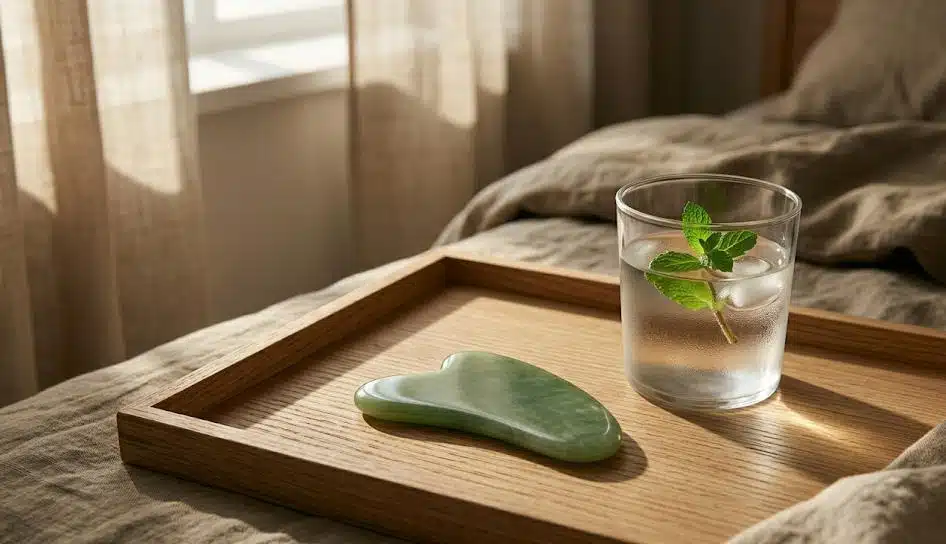
Accurately identifying your reaction type is useful only if you know what action to take in response. The protocol below is structured in two tracks—one for normal physiological responses after gua sha, and one for excessive reactions that require active and specific adjustment. Which track applies to you is determined by the four-dimension assessment in Section 2. Apply the protocol that matches your evaluation, not the one that matches your preference.
After Gua Sha — Normal Reaction: The Three Recovery Priorities
If your response falls within the 6 to 24-hour recovery window, produces a sense of emotional relief rather than ongoing distress, and leaves you feeling measurably better afterward—your body is processing the session appropriately. Three actions will help you consolidate that response and maximize the gua sha benefits you’ve initiated.
Deliberate hydration is the first priority. Gua sha accelerates lymphatic movement and increases the local clearance of metabolic byproducts. Consuming 500 to 750ml of water in the two hours following your session supports that clearance process and reduces the duration and intensity of any post-session fatigue. Your cells are doing active repair work; they need the transport medium to do it efficiently.
Protecting your rest window is the second priority. The 4 to 8 hours following a gua sha session represent the window during which your nervous system completes its recalibration. High-stimulation activities during this period—intense exercise, caffeinated beverages, emotionally demanding interactions—interrupt the process. Treating this window as protected time is not indulgence. It is the behavior that converts a gua sha session into lasting benefit rather than a one-day effect.
Avoiding therapy stacking is the third priority. Combining gua sha with cupping, intensive stretching, or heavy resistance training on the same day multiplies the metabolic and neurological demand placed on your system. The gua sha benefits you are building compound over time and across sessions—not through maximum intensity on any single day. Spacing your therapeutic inputs is the structural decision that makes each one more effective.
If Your Reaction After Gua Sha Was Excessive: A Four-Point Adjustment Framework
If your response exceeded the 24-hour window, produced emotional distress that hasn’t resolved, or included physical symptoms such as dizziness, palpitations, or systemic weakness—adjusting your practice is not optional. It is the only responsible next step. Continuing at the same intensity and frequency is not a form of commitment to your practice; it is a compounding of the problem.
Reduce session pressure by at least 40 to 50 percent, calibrated by your skin’s visible response. In an adjusted session, you should produce little to no petechiae—the goal is tissue stimulation without inflammatory provocation. Extend your recovery interval to a minimum of 10 days, and to 14 days if your energy baseline is significantly depleted. Temporarily eliminate the face, neck, and upper chest from your treatment areas—these three zones carry the highest autonomic nerve density in the upper body, and removing them from rotation reduces your systemic neurological load substantially. In parallel, prioritize the three recovery inputs that determine how much gua sha stimulation your system can absorb: sleep quality, nutritional adequacy, and active stress reduction. These are not peripheral concerns. They are the physiological infrastructure that makes your gua sha practice sustainable rather than intermittently harmful.
Why Your Gua Sha Tool Directly Affects Both Risk and Benefit After Every Session
The gua sha risks associated with most sessions are not purely a function of technique—they are also a function of tool design, and specifically of edge geometry and material composition. The edge radius of a gua sha board determines the distribution of mechanical force across the skin surface during each stroke. A tool with an overly narrow or irregular edge concentrates that force on a small contact area, producing localized tissue stress that exceeds the optimal threshold for fascial release. A tool with an appropriately curved edge—smoothly matched to the contour of the body area being treated—distributes the same applied force across a wider surface, producing the mechanoreceptor activation that generates gua sha benefits without the tissue trauma that generates gua sha risks.
Material is the second design variable with direct functional consequences. According to the Gemological Institute of America (GIA), natural jade—both nephrite and jadeite—has a surface hardness of 6 to 7 on the Mohs scale and a microcrystalline structure that produces a characteristically smooth surface contact. Unlike synthetic alternatives or low-grade stone substitutes, natural jade’s molecular surface is free of the microscopic irregularities that create uneven pressure distribution during a stroke. The International Gem Society (IGS) further documents that natural jade’s thermal properties—its capacity to remain cool to the touch even with sustained skin contact—make it functionally advantageous for facial gua sha applications where managing local inflammation is a clinical priority.
Natural rose quartz presents a complementary material profile. With a Mohs hardness of 7 and a trigonal crystal structure, rose quartz provides a firm yet smooth contact surface well-suited to body and facial applications. The Swiss Gemmological Institute (SSEF) maintains standards for gemstone identification and quality assessment that distinguish authentic natural stones from synthetic or treated alternatives—a distinction that matters in gua sha tool selection because the structural properties of authentic stones are not replicated by synthetic manufacturing processes.
This means that your tool is not an aesthetic preference within your gua sha practice. It is a functional variable that directly determines the pressure distribution, surface contact quality, and thermal properties of every stroke—and those variables are the proximate mechanisms through which gua sha generates either benefit or risk. You can select a tool that consistently distributes force optimally, or one that introduces variability and excess pressure into every session. That choice is within your control, and it matters every time you use it.
After Gua Sha Reaction Reference: Your Decision Framework at a Glance
The four-dimension assessment framework in this guide can be condensed into a practical reference table. Use it after every session until pattern evaluation becomes intuitive. The goal is not to memorize rules—it is to develop the habit of asking four specific questions within 24 hours of any session, and using the answers to inform your next decision.
| Assessment Dimension | Healthy Response ✅ | Adjustment Required ⚠️ |
|---|---|---|
| Recovery Speed | Full resolution within 6–24 hours | Persists beyond 24 hours |
| Emotional Trajectory | Release followed by relief and lightness | Prolonged low mood, anxiety, or emotional numbness |
| Physical Sensations | Local relaxation, improved sleep quality | Dizziness, palpitations, generalized weakness |
| Frequency Pattern | Occasional response, improving each session | Recurring or intensifying across sessions |
When two or more dimensions fall in the “adjustment required” column simultaneously, that is a clear signal to reduce intensity, extend your recovery interval, and reassess your baseline physiological state before resuming a full-intensity practice.
What Feeling Like Crying After Gua Sha Is Actually Telling You
The emotional and physical reactions that occur after gua sha are not arbitrary events. They are communications from your nervous system, your fascial network, and your metabolic infrastructure—each expressing the current state of its resources in the only language available to it. Feeling like crying after gua sha, or feeling gua sha tired to a significant degree, means your body received a stimulus that was large relative to its current capacity. That disparity is not inherently dangerous, but it is information—and information requires a response.
The framework in this guide gives you the structure to replace uncertainty with a specific evaluation process. You do not need to guess whether what you experienced was beneficial or concerning. You have four measurable dimensions, a tiered recovery protocol matched to each outcome, and a defined set of warning signals that tell you precisely when to adjust. That is the toolkit this guide was built to provide.
Understanding Gua Sha Risks Is What Makes Gua Sha Benefits Sustainable Over Time
Every therapeutic intervention operates within a dose-response relationship. Below the effective threshold, it produces no meaningful benefit. Above the tolerance ceiling, it produces harm. Gua sha is no different. The documented gua sha benefits—enhanced microcirculation, fascial tissue release, lymphatic support, and nervous system regulation—are real, reproducible, and well-supported by existing research. But they require that your sessions remain within your body’s current processing capacity, and that capacity is not fixed. It changes based on your sleep quality, your baseline stress level, your nutritional state, and the interval between sessions.
If you have experienced emotional reactions or significant fatigue after gua sha, you now have three things you didn’t have before reading this guide: a framework for interpreting what happened, a scientific account of why it happened, and a concrete protocol for adjusting your approach. The goal of this information is not to make you cautious about gua sha. It is to make you precise about it. A practice that is calibrated to your actual physiological state generates consistent recovery. One that isn’t generates inconsistent results—and occasionally, the kind of crash that sends people searching for answers online.
How to Use Gua Sha as a Long-Term Practice: The Core Principle
Knowing how to use gua sha effectively over the long term comes down to one foundational principle: match your session intensity to your body’s current recovery capacity, not to an idealized routine. That capacity varies across weeks, months, and seasons. A session intensity that was perfectly calibrated for you in a rested, well-nourished state may be excessive during a period of high stress and poor sleep—not because gua sha has changed, but because your physiological buffer has. Tracking your sessions, monitoring your 24-hour response, and adjusting your approach based on actual data rather than habit or assumption is what distinguishes a sustainable gua sha practice from an unpredictable one.
The gua sha risks documented in this guide are not reasons to avoid the practice. They are the parameters within which a safe and effective practice operates. And the gua sha benefits that draw millions of people to this technique globally are fully accessible to you—when you understand the conditions under which your body is prepared to receive them.
Faqs about Tired and Crying After Gua Sha
1. Why do I feel like crying after a Gua Sha session?
This is often caused by the release of “stored emotional tension” within the fascia, which serves as a sensory system for chronic stress. When Gua Sha physically releases these fascial restrictions, it can trigger a neurological event resulting in an emotional discharge or “cathartic release”.
2. Is it normal to feel “Gua Sha tired” or exhausted afterward?
physiological response to a sudden shift in the autonomic nervous system. For those in a high-stress state, Gua Sha can trigger a rapid drop from “fight-or-flight” mode into “rest-and-repair” mode, which the body may register as a crash or collapse rather than gentle relaxation. Additionally, the metabolic work required to process the inflammatory repair cascade consumes physical energy.
3. How can I tell if my reaction is a “healthy release” or a “warning sign”?
The primary diagnostic tool is the 6–24 hour recovery window. A healthy response should fully resolve within 24 hours and leave you feeling lighter or relieved. If fatigue, low mood, dizziness, or palpitations persist beyond 24 hours, your body is communicating that the session intensity exceeded its current recovery capacity.
4. How often should I perform Gua Sha for best results?
The body requires a recovery interval for the inflammatory repair cycle to complete. For most individuals, a minimum of 5 to 7 days between sessions is recommended. However, if you are managing chronic stress, poor sleep, or low energy, you should extend this interval to 10 to 14 days to avoid cumulative physiological debt.
5. Does the material of my Gua Sha tool actually affect my recovery?
Yes, tool design is a functional variable that directly determines risk and benefit. Authentic stones like natural jade have a microcrystalline structure that produces a smooth surface contact, distributing pressure evenly. Synthetic or low-grade alternatives often have microscopic irregularities that concentrate force on narrow areas, increasing the risk of overstimulation and tissue trauma.