If your gua sha wholesale catalog treats gift orders as a side category, you are leaving your largest single-order revenue stream on the table. An internal review of 4,536 confirmed orders processed between 2023 and 2025 at Deyi Gems reveals a decisive performance gap: gua sha gift orders average 5,236 pieces per transaction, compared to 2,369 pieces for standard replenishment orders — a 221% volume premium on a per-order basis. Gift orders simultaneously account for approximately 15% of total order volume across the same dataset, making this segment both structurally significant and commercially consistent year over year.
The data below quantifies the performance gap and establishes why building a dedicated gua sha gift line is a higher-leverage wholesale strategy than expanding your standard SKU count.
| Metric | Gua Sha Gift Orders | Gua Sha Standard Orders | Difference |
| Avg. Units / Transaction | 5,236 pcs | 2,369 pcs | +221% |
| Share of Total Order Volume | ~15% | ~85% | — |
| Typical Buyer Profile | Corporate / Event / Brand | Retail / Clinical Restock | — |
| Order Frequency Pattern | Budget-cycle driven (annual/quarterly) | Demand-driven (monthly) | More predictable |
Corporate buyers — spa chains, wellness brands, and enterprise HR departments sourcing employee and client gifts — operate on annual procurement budgets rather than on-demand restock cycles. When they place an order, they place it for an event, a quarter, or a client list. That structural difference is what drives per-order volume well beyond what any standard retail replenishment cycle could generate. This means prioritizing the gift channel in your wholesale strategy is not a niche play — it is a volume optimization decision backed by two years of production data.
Why Gua Sha Gift Orders Outperform Standard Wholesale Orders by 2X
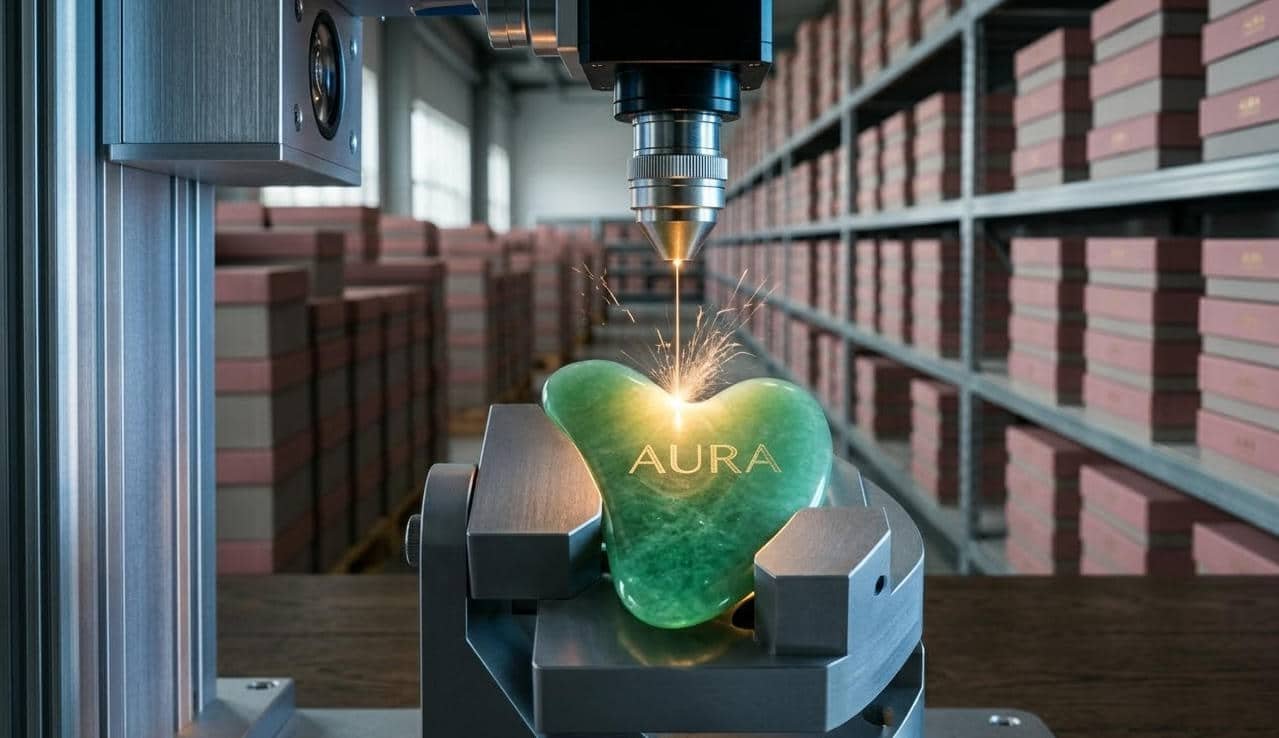
Order Volume Data: What the Numbers Show
The 221% volume premium is not driven by a single outlier account. Across the full 4,536-order dataset, gift-format orders consistently exceed 5,000 pieces while standard replenishment orders cluster between 2,300 and 2,400 pieces. This pattern holds across buyer profiles ranging from boutique spa distributors to multinational wellness brand operators.
Order size is the single most important variable determining your unit cost bracket, production scheduling priority, and customization leverage with any gua sha manufacturer. A gua sha gift order at 5,000-plus pieces unlocks cost tiers that a 2,000-piece standard order structurally cannot reach — and positions you as a priority account in your factory’s production calendar.
Corporate Procurement Cycles Amplify the Volume Effect
According to the Global Wellness Institute, corporate wellness spending reached $61 billion globally in 2023, with physical wellness gifting representing a growing sub-category. When a company allocates budget for employee appreciation or client retention packages, the selection criteria favor items that are visually distinctive, carry a wellness narrative, stay within a defined per-unit budget, and support brand customization. Natural crystal and jade gua sha tools satisfy all four criteria simultaneously — which is why the corporate gift channel generates a disproportionate share of high-volume orders in this product category.
The procurement cycle further compounds the volume effect: corporate buyers place gift orders tied to a calendar trigger — an annual wellness program, a product launch event, or a holiday gifting window. Your order intake from a single corporate account arrives as one placement rather than being distributed across monthly replenishment cycles. This means you can negotiate unit pricing, plan production windows, and manage logistics with a precision that standard wholesale rarely affords.
Why Natural Stone Makes Gua Sha Tools Unusually Effective as Corporate Gifts
Material Authenticity Communicates Value Before the Packaging Is Read
Most corporate gift categories suffer from the same positioning problem: the item is either too generic to be memorable or too expensive to scale. Natural crystal and jade gua sha tools occupy a rare middle position that resolves both constraints simultaneously. Jade has been associated with health, longevity, and prosperity across East Asian cultural traditions for over 5,000 years. Rose quartz carries widely recognized wellness associations in Western markets. When a recipient opens a gift box containing a natural stone tool, the material communicates a value story before the brand messaging on the packaging is even read. The Gemological Institute of America (GIA) documents the physical and optical properties — cool weight, translucency variation, and surface temperature differential — that distinguish natural nephrite and jadeite from simulants. Those properties translate directly into tactile consumer perception that synthetic alternatives cannot replicate. This means the material selection in your gift product specification is simultaneously a brand credibility decision on behalf of every corporate buyer you supply.
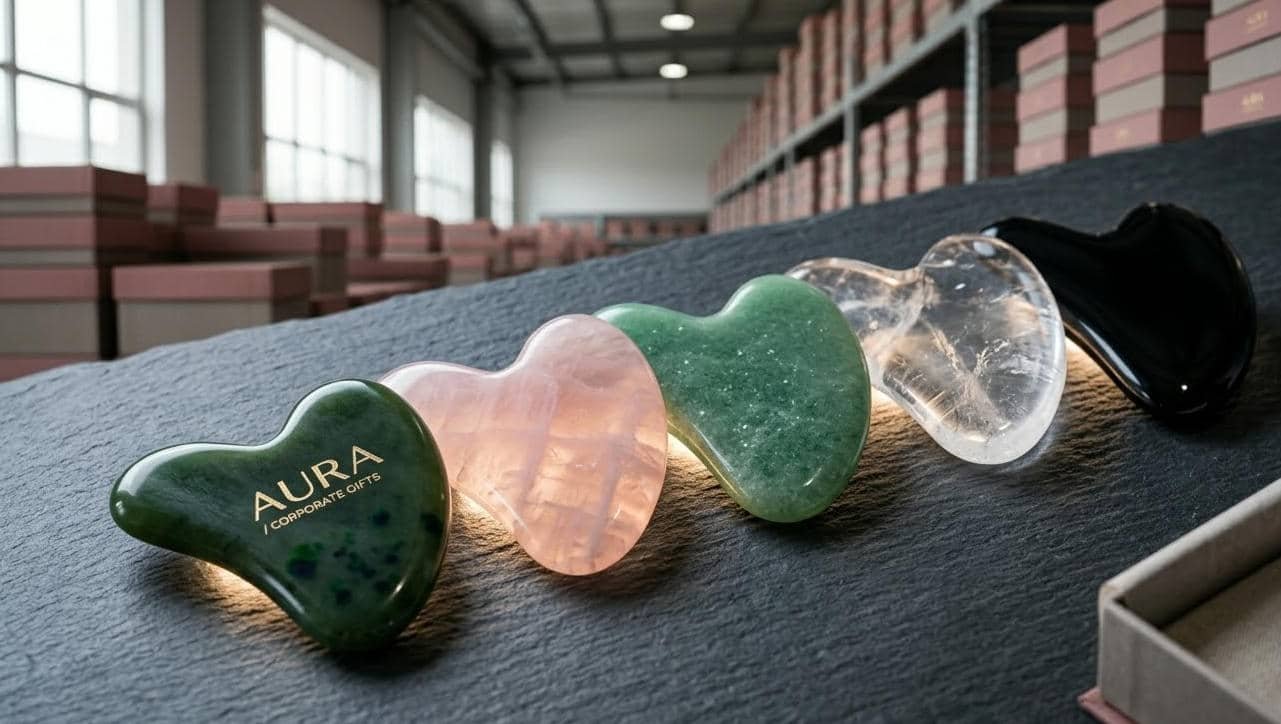
The table below maps the five most commonly used gift-format stone types against their cultural associations, wholesale price ranges, and optimal gift use cases — giving you a direct reference framework for advising corporate buyers on stone selection.
| Stone Type | Cultural Association | Wholesale Price Range (3K+ pcs) | Best Gift Use Case |
| Nephrite Jade | Longevity, prosperity (5,000yr tradition) | $5.50–$7.80 / pc | VIP client gifting, spa programs |
| Rose Quartz | Wellness, emotional balance | $4.20–$6.00 / pc | Health brand loyalty gifts |
| Green Aventurine | Growth, vitality | $3.20–$4.80 / pc | Corporate event giveaways |
| Clear Quartz | Clarity, amplification | $4.50–$6.50 / pc | Subscription box inclusion |
| Black Obsidian | Protection, grounding | $3.80–$5.20 / pc | Trade show premium giveaways |
The Affordable Luxury Price Band: Where Natural Stone Gua Sha Tools Live
Corporate gift budgets in the wellness and beauty sector cluster around three tiers: under $5 per unit for high-volume event giveaways, $8–$20 for client appreciation programs, and $25–$60 for VIP account gifting. Natural crystal and jade gift-format tools sit across the $8–$25 range at wholesale depending on stone type, size, and customization scope. According to research published by the Advertising Specialty Institute (ASI), recipients retain promotional products with high perceived utility and material quality for an average of 13 months — compared to 5 months for generic printed items. A natural stone gua sha tool, incorporated into a daily skincare routine, achieves both criteria. This means your buyer’s brand generates passive logo exposure every morning for over a year, at a cost-per-impression that no digital advertising channel approaches.
For material verification at production scale, the International Gem Society (IGS) provides standardized evaluation frameworks for color consistency, inclusion tolerance, and surface quality across gemstone categories — directly applicable to production-grade gua sha tool manufacturing. The Swiss Gemmological Institute (SSEF) additionally publishes identification standards for distinguishing natural nephrite and jadeite from simulants and polymer-impregnated materials. A qualified gua sha factory will reference these frameworks as a routine operational standard — not as a premium service tier.
The Cost Advantage of Gua Sha Gift Wholesale — Custom, Compact, and Economical
Logo Customization Costs Less Than $1 Per Unit — Here Is the Full Breakdown
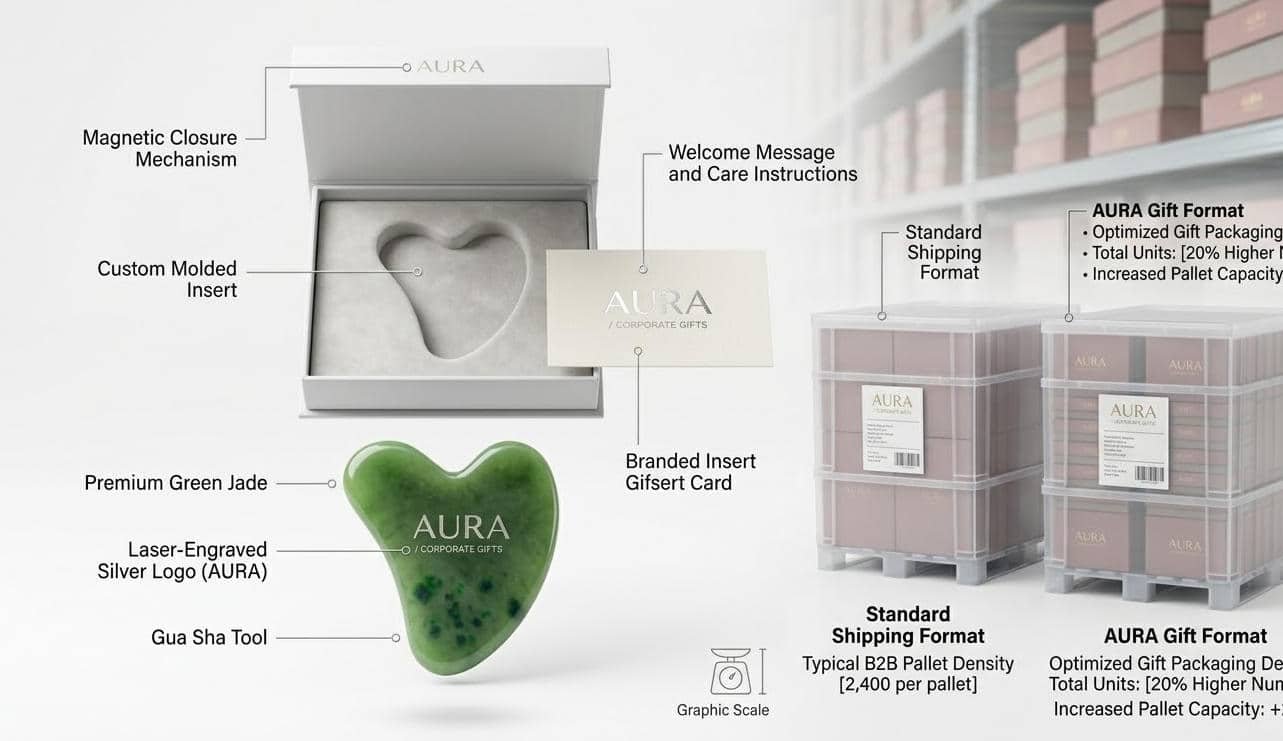
One of the most persistent misconceptions among buyers evaluating the gua sha custom market is that branding a natural stone product carries a significant per-unit premium. At gift-program order volumes, the reality is structurally different. Logo customization via laser engraving, UV printing, or sandblasting adds less than $1 to the per-unit cost at volumes above 1,000 pieces — and falls below $0.50 at 3,000 pieces and above. For a corporate buyer allocating a $15 per-unit gift budget, branding represents under 7% of total spend.
The table below details the full customization and packaging cost architecture across three tiers, allowing you to advise your corporate buyers on the specification that optimizes budget allocation for their stated gifting objective.
| Customization Element | MOQ Trigger | Added Cost / Unit (3K pcs) | Included In |
| Laser Logo Engraving (1-position) | 1,000 pcs | < $0.50 | Standard tier |
| UV Print Logo (color) | 1,000 pcs | $0.60–$0.90 | Standard tier |
| Velvet Pouch + Heat-Transfer Logo | 1,000 pcs | $0.40–$0.70 | Entry packaging |
| 2-Piece Rigid Gift Box + Insert Card | 2,000 pcs | $1.50–$2.20 | Mid-tier packaging |
| Magnetic-Closure Box + Foil Stamp + Booklet | 2,000 pcs | $3.00–$4.50 | Premium packaging |
A fully branded gift set — natural stone gua sha tool, mid-tier custom rigid box, and branded insert card — lands at a total cost well within $12–$18 at standard gift-program volumes (3,000+ pieces), leaving meaningful margin before the $25–$35 retail price point where these sets consistently trade. This means a well-specified gift program delivers a margin profile that is competitive with, and often superior to, standard wholesale SKU economics on a per-order revenue basis.
The 75% Volume Factor: How Compact Format Tools Cut Your Freight Cost
Gift-format gua sha tools are structurally smaller than standard retail or clinical tools. Internal order data shows gift-format pieces average approximately 75% of the volume of standard tools — driven by corporate gift buyers’ preference for tools that are portable, visually elegant, and appropriately scaled for gift presentation. A standard facial gua sha board typically measures 70–80mm in length; a gift-format equivalent runs 55–65mm, with stone weight reducing from 60–80 grams to 40–55 grams.
| Dimension | Standard Format Tool | Gift Format Tool | Advantage |
| Avg. Length | 70–80 mm | 55–65 mm | ~18% smaller |
| Avg. Weight (stone) | 60–80 g | 40–55 g | ~31% lighter |
| Relative Volume | 100% (baseline) | ~75% | 25% volume saving |
| Units per Carton (5,000-unit order) | Baseline | +18–22% more units | Fewer cartons needed |
| Est. Freight Saving / Unit (Asia → US) | — | $0.35–$0.80 / pc | Direct landed cost saving |
At current rates tracked by the Freightos Baltic Index for Asia-to-US ocean freight, the volume reduction from standard to gift format translates to a per-unit shipping saving of $0.35–$0.80 depending on the trade lane and carrier. This means the compact form factor is not merely an aesthetic preference — it is a measurable freight cost advantage that improves your landed cost calculation before any volume discount negotiation begins.
How to Source Gua Sha Gift — A Buyer’s Qualification Framework
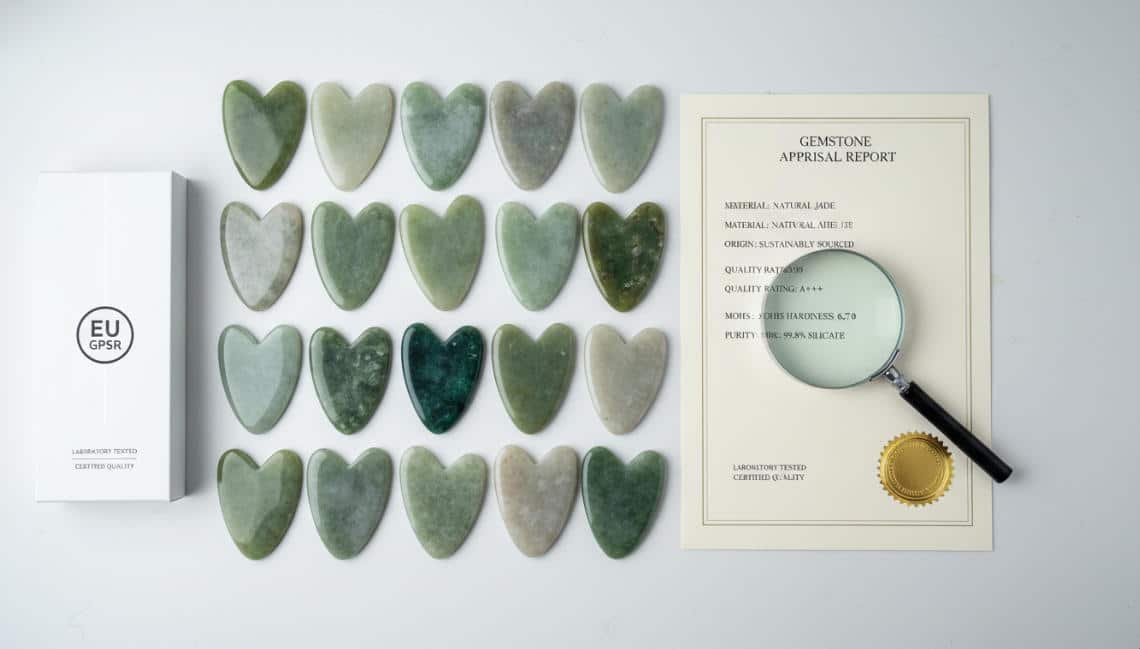
1: Verify Material Authenticity Before Price, Lead Time, or Anything Else
The natural stone tool market contains documented volumes of dyed, treated, or synthetic-simulant material marketed under premium stone names. Dyed quartzite sold as rose quartz, glass sold as clear crystal, and polymer composite sold as jade are all active sourcing risks at the lower end of the wholesale price spectrum. A qualified gua sha manufacturer sourcing genuine natural stone will provide a material origin declaration and, for jade-category materials, a third-party test report from an accredited gemological laboratory referencing GIA or SSEF identification standards. If a prospective supplier is unable to provide material documentation at the sampling stage, that is a definitive disqualification signal — not a negotiating point.
2: Test Production Consistency, Not Just Sample Quality
Material authenticity establishes the floor of your qualification criteria. Production consistency across a 3,000–6,000-piece gift batch establishes the ceiling. Request a production sample set of 20–30 pieces cut from the stone lot proposed for your order — not a cherry-picked single sample — and evaluate the color variance range against IGS color grading reference standards. Ask your prospective gua sha factory to specify their dimensional tolerance range and request a measurement report from a recent comparable production run. Engraving consistency — depth uniformity, edge sharpness, and positional accuracy — should be evaluated across the full sample set. A manufacturer who cannot provide this production documentation is likely operating without the process controls required for consistent gift-program output.
3: Confirm Compliance with Destination Market Import Regulations
For natural stone gua sha tools exported to the United States, verify compliance with US Customs and Border Protection (CBP) country-of-origin marking requirements under 19 CFR Part 134. For EU-bound shipments, the applicable framework is the EU General Product Safety Regulation (GPSR), which came into full effect in December 2024 and requires traceable manufacturer or importer contact information on the product or packaging. Gua sha gift set packaging components destined for the EU must additionally comply with REACH regulation restrictions on hazardous substances in printing inks and dyes, administered by the European Chemicals Agency (ECHA). A gua sha manufacturer with documented export experience to your target market maintains standing compliance documentation as a routine operational matter — if your prospective supplier is unfamiliar with these requirements, the compliance burden falls entirely on you as the importer of record.
4: Invest in a Full-Workflow Sample Order
A sample order for a gift program should test the complete production and delivery workflow, not merely the product quality in isolation. Request 30–50 units produced from the actual proposed stone lot, packaged in your custom specification, with your logo applied at the documented engraving position. This typically costs $150–$400 depending on packaging complexity. Third-party pre-shipment inspection services — including Bureau Veritas and SGS — offer inspection services for natural stone and consumer product categories at $250–$400 per inspection day, providing quality assurance documentation that protects your commercial credibility with your corporate buyer clients.
Real Gua Sha Gift Order Use Cases — What Wholesale Buyers Are Actually Ordering
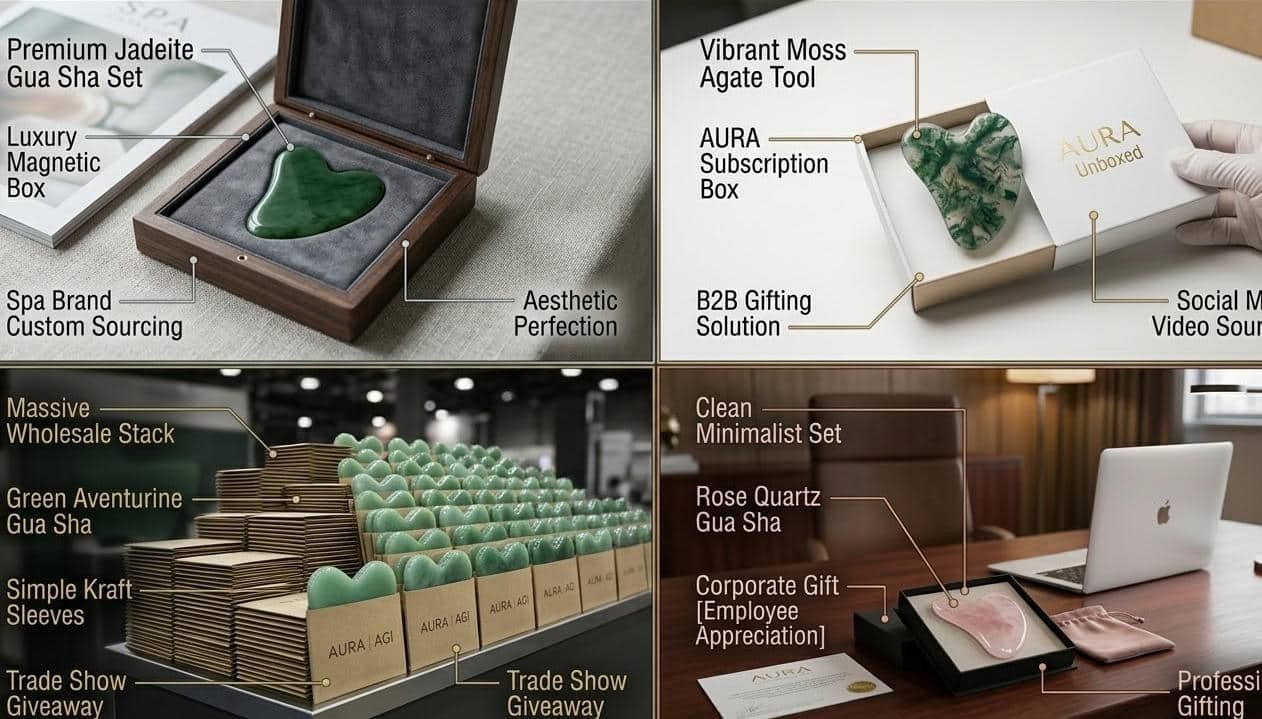
Corporate gift buyers do not begin with a product specification — they begin with a business problem. The use case matrix below maps the four most common gift-program buyer profiles in the gua sha wholesale market to their typical product specifications, packaging tiers, order volumes, and per-unit budget parameters. If your buyer’s profile matches one of these cases, the corresponding specification row provides a direct starting point for your supplier conversation.
| Use Case | Stone Type | Tool Format | Packaging Tier | Typical Order Volume | Budget / Unit |
| Corporate Wellness Gift | Rose Quartz / Aventurine | Compact board 58–65mm | Mid-tier rigid box | 3,000–8,000 pcs | $12–$18 |
| Spa Brand Gift Set | Jade / Clear Quartz | 2-piece set (board + eye tool) | Premium magnetic box | 1,500–5,000 pcs | $18–$28 |
| Trade Show Giveaway | Aventurine / Tiger’s Eye | Palm-size single piece | Entry sleeve + pouch | 3,000–10,000 pcs | $8–$14 |
| Subscription Box Inclusion | Moss Agate / Labradorite | Compact single tool | Minimal branded card | 5,000–15,000 pcs | $10–$16 |
Corporate Wellness Gifting: Health and Supplement Brands
Health supplement companies and nutraceutical brands have increasingly adopted physical wellness tools as client retention assets. The commercial logic is direct: a supplement brand’s customer relationship is built on the narrative of investing in one’s health, and a natural stone gua sha tool extends that narrative into the tactile, daily-use domain. According to the Promotional Products Association International (PPAI), wellness-category promotional products generate a brand recall rate of 85% among recipients — significantly above the 67% average across all promotional product categories. Rose quartz and green aventurine are the preferred stone types in this segment, with compact facial board formats in the 58–65mm range and mid-tier rigid box packaging. Order volumes cluster between 3,000 and 8,000 pieces per placement, timed to product launch windows or Q4 holiday gifting cycles.
Trade Show Giveaways: Standing Out on the Exhibition Floor
Trade show gifting represents the highest-volume, shortest-decision-window segment of the gua sha gift wholesale market. Per-unit budgets are lower — typically $8–$14 total landed cost — but order volumes frequently reach 5,000–10,000 pieces per event. According to the Event Marketing Institute, 74% of event attendees report a more positive brand impression after receiving a branded experiential gift compared to standard printed materials. A natural stone gua sha tool — tactile, visually distinctive, and wellness-positioned — delivers that experiential quality at cost economics that branded apparel or technology accessories cannot match at comparable volumes. Aventurine and tiger’s eye in palm-size formats, packaged in a branded kraft sleeve with velvet pouch, consistently achieve the visual impact-to-cost ratio that event gift budgets require.
Subscription Box Inclusion: The Recurring Volume Channel
Subscription box operators in the wellness and self-care sectors represent a structurally recurring gift-category buyer — one that is frequently underweighted in wholesale targeting strategies relative to its actual volume potential. A mid-size subscription box operator with 8,000–15,000 active subscribers places a single inclusion order that exceeds the average gift-program volume, with a predictable repeat cycle tied directly to subscriber count growth. Stones with strong visual character — moss agate, labradorite, banded obsidian — generate disproportionately high subscriber-driven unboxing content on social platforms, creating organic marketing exposure that the box operator values beyond the direct retail contribution. This means the subscription channel is not merely a volume opportunity — it is a brand amplification mechanism that your corporate buyer will actively seek to replicate in subsequent gifting cycles.
Sourcing from a Manufacturer vs. a Trading Company — Why It Matters for Gift Programs
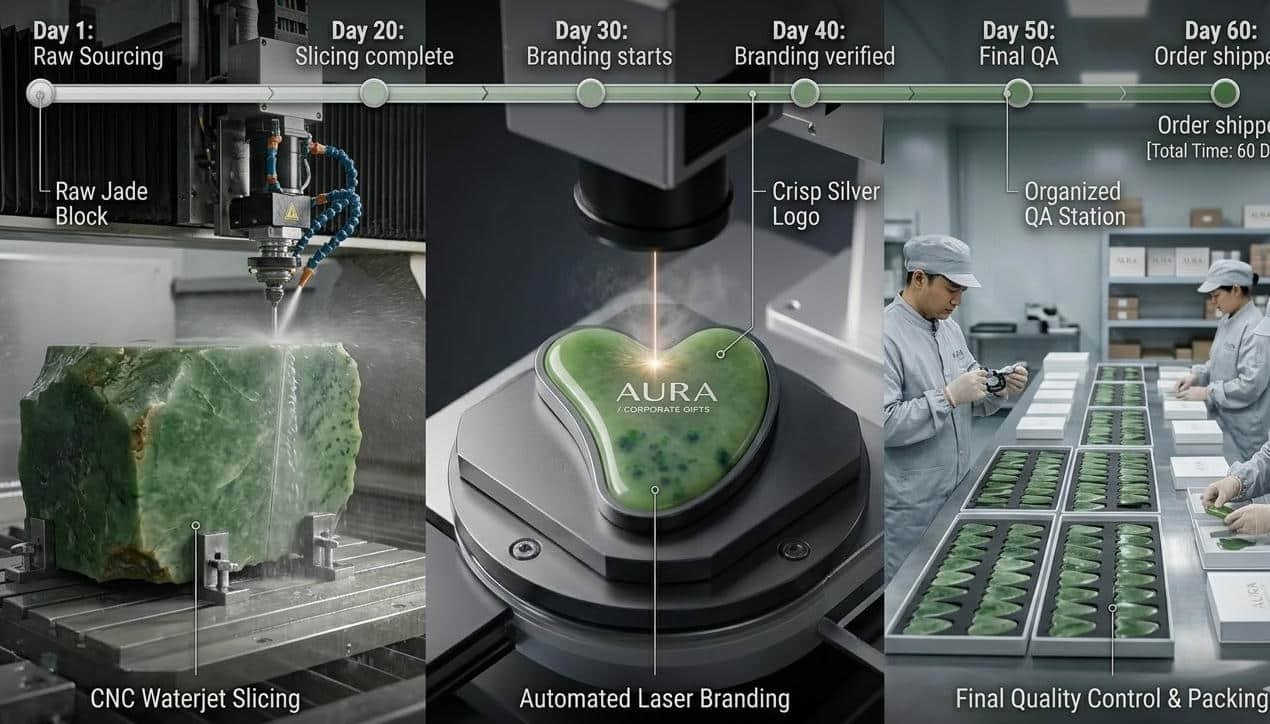
The Control Gap a Trading Company Cannot Bridge
When you are placing a 5,000-piece branded gift order for a corporate client, the entity you are sourcing from is not a neutral variable. A trading company purchasing from multiple factories introduces a quality control gap that is invisible at the sample stage and fully visible in production — because the trading company does not control the cutting floor, the stone lot selection, or the engraving process. For a standard replenishment order, this arrangement may deliver acceptable results. For a gift program order — where batch consistency across every single piece determines whether your corporate buyer’s brand event succeeds or fails — the absence of direct factory control is a structural risk that no contractual arrangement fully mitigates.
Sourcing directly from a gua sha manufacturer with vertically integrated stone processing and finishing capability eliminates that control gap. When the entity you are negotiating with is also the entity cutting the stone, applying the engraving, assembling the packaging, and releasing the shipment, every quality variable in the production chain is directly addressable. You can specify the stone lot before cutting begins, review engraving calibration before the full batch runs, and receive mid-production quality documentation without information passing through an intermediary.
The Production Timeline You Need to Plan Around
Understanding the full production timeline before committing to a delivery date with your corporate buyer is one of the most operationally important steps in managing a gift program order. For a customized gua sha gift wholesale order in the 3,000–6,000-piece range, the standard workflow runs as follows: specification consultation (2–5 business days), branded sample production and shipping (10–17 business days including courier transit), sample review and approval (3–7 business days), full production with mid-production quality checkpoint (18–28 business days), and pre-shipment inspection plus shipment release (5–8 business days). Total timeline from initial inquiry to shipment release: 35–50 business days. Building a 60-business-day buffer between your client’s event date and your order placement date gives you adequate margin to accommodate sample revision cycles, production adjustments, and shipping transit without entering crisis management territory.
How to Initiate a Gua Sha Gift Wholesale Inquiry
The most efficient starting point for a gift program sourcing inquiry is a specification brief covering five elements: your target stone type, approximate tool dimensions, logo artwork (vector format preferred), packaging tier preference, required quantity, and delivery deadline. You do not need a finalized specification to begin the conversation — a preliminary brief with your best current estimate of these parameters is sufficient to receive a production timeline, a unit cost range, and a sample cost quote. With those three data points, you have everything required to assess feasibility before committing to a corporate buyer proposal. The distance between reading this article and having a submittable gift program proposal in front of your client is, in practical terms, one specification brief and one week of supplier response time — a gap worth closing today if your buyer’s gifting window falls within the next 90 days.
Gua Sha Gift Wholesale Faqs
1. What is the minimum order quantity (MOQ) for gua sha gift wholesale with custom logo?
Logo customization typically triggers an MOQ of 1,000 pieces. At this volume, laser engraving or UV print adds less than $1 per unit to your cost. For full custom packaging (rigid gift box + branded insert), the MOQ rises to 2,000 pieces. Standard non-customized gift-format tools generally follow the same MOQ as regular wholesale SKUs — commonly 300–500 pieces per stone type.
2. How much does it cost to customize a gua sha tool as a corporate gift?
At 3,000+ pieces, logo engraving costs under $0.50 per unit. A complete branded gift set — natural stone gua sha tool, mid-tier rigid box, and printed insert card — typically lands between $12–$18 per unit total at standard gift-program volumes, with a retail price point of $25–$35. That leaves meaningful margin while keeping the per-unit branding cost under 7% of total spend.
3. Which natural stone is best for corporate gua sha gifts?
It depends on your buyer’s budget and brand narrative. Rose quartz ($4.20–$6.00/pc at 3K+ pcs) suits health and wellness brands due to its widely recognized self-care associations. Green aventurine ($3.20–$4.80/pc) is the most cost-efficient option for large-scale event giveaways. Nephrite jade ($5.50–$7.80/pc) is preferred for VIP client gifting where material prestige matters. All natural stone types should be verified against GIA or IGS identification standards before production.
4. How long does production take for a gua sha gift wholesale order?
For a customized order of 3,000–6,000 pieces, the full workflow from initial inquiry to shipment release runs 35–50 business days: specification consultation (2–5 days), branded sample production and delivery (10–17 days), sample approval (3–7 days), full production (18–28 days), and pre-shipment inspection (5–8 days). Plan for a 60-business-day buffer from your client’s event date to your order placement date to comfortably absorb any revision cycles.
5. What compliance requirements apply to gua sha gift sets exported to the US and EU?
For US-bound shipments, US Customs and Border Protection (CBP) requires country-of-origin marking under 19 CFR Part 134.11 & 134.14 on the product or immediate packaging. For EU-bound shipments, the EU General Product Safety Regulation (GPSR, Regulation (EU) 2023/988, Articles 9 & 19, fully effective 13 December 2024) requires traceable manufacturer or importer contact information. Packaging inks and dyes must additionally comply with REACH Regulation (EC) 1907/2006, SVHC candidate list v.24 (updated June 2024). Request standing compliance documentation from your gua sha manufacturer before placing a gift program order.
Data Source Note:
Order volume statistics cited in this article (average units per transaction, gift order share of total volume, gift-format tool dimensional data) are derived from an internal analysis of 4,536 confirmed orders processed at Deyi Gems between January 2023 and December 2025. External market data sources are linked in-text.