If you are about to buy new gua sha wholesale, look at one number before you open any sample photo: the gap between expected yield and pilot yield. Picture a design forecast at 95% yield that lands at 82% in its first pilot run. Since you pay for every stone that cracks along the way, the cost of each sellable piece rises by up to 16% (95 ÷ 82), and no quote negotiation wins that back. A gua sha manufacturer who hides this gap hands you the risk. After 12 years of cutting jade and crystal tools, the lesson that repeats is simple: designs that clear three decision gates and a 100-point score reach mass production calmly, while designs that skip them do not. This guide walks you through those gates, the material and cost risks behind them, and the compliance questions to ask before you place guasha custom or private gua sha wholesale orders. Read it like a chat over coffee, with the uncomfortable parts left in.
- What Risks Should You Know Before Ordering New Gua Sha Wholesale?
- Why Does Material Choice Decide Yield in New Gua Sha Wholesale Production?
- How Much Does New Gua Sha Wholesale Really Cost Beyond the Unit Price?
- How Do You Verify Stone Identity and Treatments Before a New Gua Sha Wholesale Order?
- Is Your New Gua Sha Wholesale Order Compliant in the EU and US?
- How Do You Run Samples and Pilot Production for a New Gua Sha Wholesale Order?
- How Do You Protect Repeat Orders of New Gua Sha Wholesale After Approval?
What Risks Should You Know Before Ordering New Gua Sha Wholesale?

Most problems with new gua sha wholesale orders do not begin on the factory floor. They begin the day someone approves a sample because it looked right under a desk lamp. A gua sha manufacturer who runs every project through decision gates can say “stop” while a change still costs a drawing revision instead of a production batch. This means you can learn whether a new gua sha wholesale design is viable before your budget is committed, not after.
Gate 1: Is This New Gua Sha Wholesale Design Worth Developing?
The first gate asks a plain question: does anyone want this new gua sha wholesale item, and can it be made at a price that works? You should expect four inputs at this stage: evidence of demand, a clear difference from products already on the market, a rough cost estimate and a first technical check. Evidence beats enthusiasm here, so ask for inquiry records, trial orders or competitor price ranges rather than a trend report. The output is either project approval or a clean stop. This means you can walk away in week one, with a few drawings spent instead of a few hundred stones.
Material naming belongs in this gate as well. GIA treats jade as an umbrella label that covers nephrite, jadeite and some green omphacite, so a new gua sha wholesale listing that only says “jade” tells you very little. Ask which mineral your design uses, because that choice sets hardness, price and breakage behavior from day one. This means you can compare quotes on the same material instead of the same word.
Gate 2 and Gate 3: When Is a Guasha Custom Order Ready for Mass Production?
Gate 2 reviews the sample. It checks fit and finish, hand feel, material verification and a cost check, and it ends with a design sign-off, a golden sample and permission to run a pilot. Gate 3 reviews the pilot itself: yield, real cost, process stability, batch consistency and delivery capacity decide whether gua sha production can start for your new gua sha wholesale order. Breakage deserves a careful eye at both gates, because the International Gem Society describes jade toughness as legendary but not indestructible, and thin cuts with deep grooves are exactly where that limit shows up. This means you can hold your guasha custom project at Gate 2 until a golden sample exists, and at Gate 3 until pilot numbers, not photos, say yes.
How Does a 100-Point Score Protect Your New Gua Sha Wholesale Budget?
Scoring replaces gut feeling with a number you can question. Market potential carries 25 points, technical feasibility 25, product quality 20, commercial feasibility 20 and strategic fit 10. A total of 85 to 100 means “develop first”, 70 to 84 means “develop with conditions”, 60 to 69 means “pause”, and anything under 60 means “drop”. These bands are internal management guidelines rather than an industry standard, so a private gua sha wholesale project with thin margins may deserve a stricter cutoff. This means you can ask any supplier for the score sheet and see exactly why your design ranked where it did.
One rule overrides the arithmetic. A high score never excuses an unacceptable material-safety risk, a serious structural flaw or a failure to meet the rules that apply to new gua sha wholesale in your market. Would you want a 90-point design that cracks in your customer’s hand? This means you can treat the score as a ranking tool and the quality floor as a hard stop.
Why Does Material Choice Decide Yield in New Gua Sha Wholesale Production?

Material is where yield is won or lost in new gua sha wholesale projects, and it is also where buyers receive the least information. A sample proves that one stone behaved; yield proves that hundreds did. Because natural stone varies from block to block, a gua sha manufacturer has to treat every new thickness, curve or groove as a fresh test rather than a repeat of last season. This means you can judge a quote by asking which yield it assumes, instead of reading only the unit price.
How Do Thickness and Hidden Cracks Break Your New Gua Sha Wholesale Margin?
Hardness numbers mislead people. GIA lists jadeite at 6.5 to 7 and nephrite at 6 to 6.5 on the Mohs scale, yet both resist breaking far better than those figures suggest, and the International Gem Society credits their interlocking crystal structure for that toughness. Toughness belongs to sound stone, though, and a new gua sha wholesale batch is only as sound as its weakest block. A hairline crack, a mineral inclusion or a section cut too thin can fail long before the material’s reputation predicts. Thin cross-sections raise breakage risk, while thick ones add weight, raw material and machining time, so each design has a narrow thickness window. This means you can ask your supplier for the window behind your new gua sha wholesale design and the breakage rate expected at its thin end.
Which Process Steps Lose the Most Stones?
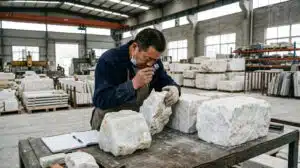
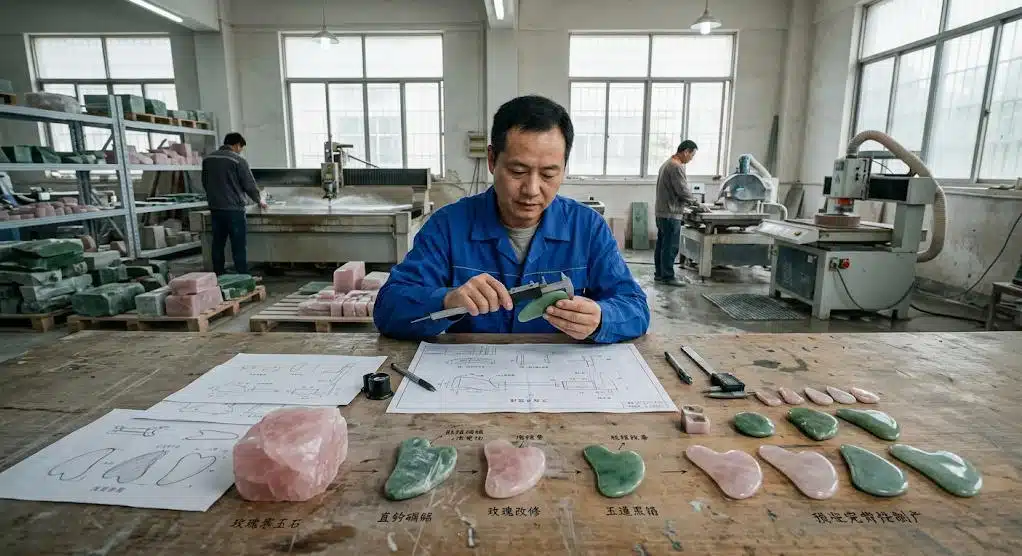
A natural stone tool passes through raw stone selection, slicing, outline cutting, CNC shaping, edge trimming, fine grinding, polishing and inspection. Stones are rejected at selection, snap during slicing, chip at CNC corners and crack during grinding or polishing, so losses hide in more than one place. Return to the 95% versus 82% case: the useful response is to check raw-stone cracks, thickness design, CNC parameters, polishing breakage and operator differences one by one, fix the cause, and run a second pilot. A pilot that logs loss at every step shows where money disappears, while a pilot that logs only the final count does not. This means you can request step-by-step loss data and see whether gua sha production for your new gua sha wholesale order is stable or merely lucky.
What Changes When You Choose Stainless Steel or Add Grooves?
Stainless steel changes the question rather than removing it. You need the steel grade, size, strength and corrosion resistance confirmed, and any PVD coating needs a check for adhesion and wear. On stone, grooves, complex curves and thinner walls lengthen processing time, raise cracking risk and make polishing harder, so yield must be re-estimated every time a new gua sha wholesale design moves. This means you can expect a revised yield and price when you ask for a deeper groove, and you can budget for it before sample approval. Does a design that looks only slightly different really deserve the old quote? A private gua sha wholesale line often grows through small tweaks, and each tweak deserves its own yield estimate, which keeps gua sha production costs honest as your range expands.
How Much Does New Gua Sha Wholesale Really Cost Beyond the Unit Price?

A unit price tells you what one finished piece costs on paper, but a new gua sha wholesale project is paid for in more places than that. Samples, drawings, fixtures and test pieces sit upstream of the first invoice, and breakage sits downstream of it. Before a gua sha manufacturer prints a quote, a cost model should already exist, otherwise the first sample succeeds and the price shock arrives afterward. This means you can ask about the model’s structure early and avoid paying for a sample of something you cannot afford to build.
What Belongs in a Real Cost Model for New Gua Sha Wholesale?
A usable model carries seven lines: raw material, material loss, processing, labor, logo work, packaging and development investment. The loss line deserves your attention because it hides inside the material price. Take illustrative numbers: stone and machining cost $2.00 per started piece, which becomes $2.11 per sellable piece at 95% yield and $2.44 at 82%, a 16% jump on that line alone. Theoretical material cost never shows this jump, which is why quotes built on it drift upward after the pilot. This means you can compare two new gua sha wholesale quotes properly by asking each supplier for its yield assumption and its loss line.
How Many Units Does It Take to Break Even?
The break-even formula is short: fixed development investment ÷ (unit price − variable cost per unit). For a new gua sha wholesale design, suppose development costs $3,000, the wholesale price is $4.00, and labor, packaging and logo add $0.70 per piece on top of the stone cost above. At 95% yield each piece leaves a margin of about $1.19, so break-even arrives at roughly 2,511 pieces. At 82% yield the margin shrinks to about $0.86 and break-even moves to roughly 3,485 pieces, about 39% more volume. On a 5,000-piece new gua sha wholesale order, net profit after recovering development falls from about $2,974 to about $1,305, a 56% drop. These figures are illustrative rather than a quote, yet the pattern holds for any design. This means you can test your own order size against the formula before you sign and see what one yield mistake costs.
How Does MOQ Change Private Gua Sha Wholesale Pricing?
MOQ is where the formula meets your new gua sha wholesale order size. If an MOQ sits below the break-even volume, someone absorbs the gap: the supplier through a loss, or you through a higher unit price. A private gua sha wholesale order with custom logo and packaging carries more fixed cost per design, and a guasha custom shape adds drawings and fixtures on top, so these projects often need higher MOQs than stock items. Gua sha production also spreads setup time across the run, which is why a 500-piece batch rarely costs the same per piece as a 3,000-piece one.
Hitting a target price can tempt a supplier to downgrade the stone grade, shorten polishing or thin out the inspection plan, and each of those moves returns later as complaints. Would you rather pay $0.30 more per piece now, or refund a batch later? This means you can negotiate MOQ and price for your new gua sha wholesale line as a pair, and refuse any trade that cuts polishing or inspection to save pennies.
How Do You Verify Stone Identity and Treatments Before a New Gua Sha Wholesale Order?

Stone identity is the one risk you can shrink with paperwork and a few phone calls. The word on the listing, the mineral in your hand and the documents behind both should agree, and when they do not, you want to learn it before the first batch ships. A gua sha manufacturer that buys rough stone by lot can usually name the mineral and origin of that lot, while one that cannot is asking you to trust a label. This means you can screen suppliers on traceability alone before you compare a single price for your new gua sha wholesale project.
Which Stone Names Should You Question in New Gua Sha Wholesale Listings?
“Jade” can mean different things in different markets. GIA’s jade overview names jadeite and nephrite as the materials that carry the word, plus green omphacite under certain conditions, yet trade usage in some regions stretches it to other carvable stones such as serpentine. A buyer in the United States or Europe may therefore read a new gua sha wholesale label very differently from a supplier in Asia. Ask for the mineral name in writing for every material in your range, and ask what the stone would be called if the word “jade” disappeared from the page. This means you can print a precise name on your product page and avoid arguments about what “jade” was supposed to mean.
Do Treatments Change Durability in Gua Sha Production?
According to the same GIA overview, treatments exist to alter color, improve apparent clarity or change durability. For jadeite, the trade sorts them into Type A, B and C: Type B is bleached and polymer-filled, and Type C adds dye on top. The International Gem Society warns that acid-treated stone may be less durable than untreated stone, and durability matters twice in gua sha production: once when the stone is machined and again when your customer presses it against skin every day. Is a color that looks perfect today worth a wave of returns next year? This means you can request a written treatment statement, then either choose untreated stone for your new gua sha wholesale range or accept a treated one knowingly and price it that way.
What Is a Four-Step Check for Your New Gua Sha Wholesale Samples?
You do not need a laboratory report on every piece of a new gua sha wholesale order. A short routine gives you evidence without a test bill on every shipment:
- Get the mineral name, rough-stone origin and treatment statement in writing for each material.
- Send three to five reference pieces to a laboratory such as SSEF or GIA, after asking whether they accept your item type and what report they would issue.
- Write the lot number on the report, since SSEF reminds clients that a report describes the situation at the time of testing.
- Keep a retained sample from every approved batch so later deliveries can be compared with it.
The report proves the reference pieces, and lot traceability plus a retained sample stretches that proof across the batch. This means you can defend your new gua sha wholesale product claims to a customer, a marketplace or a regulator with documents instead of promises. A private gua sha wholesale brand needs this most, because your name, not the factory’s, sits on the box.
Is Your New Gua Sha Wholesale Order Compliant in the EU and US?

No single rulebook covers every gua sha tool. Which rules apply to your new gua sha wholesale order depends on the material, any added features, the claims on the box and the market you ship to. A gua sha manufacturer can test and document the product, but you decide where it is sold and what it promises. This means you can build a short compliance file for each new gua sha wholesale market instead of hoping one certificate covers everything. What follows is a map, not legal advice, so confirm the details with a qualified adviser.
Does Nickel Release Apply to Stainless Steel in New Gua Sha Wholesale Lines?
In the EU, entry 27 of REACH Annex XVII limits nickel release to 0.5 µg/cm² per week for articles intended for direct and prolonged skin contact, as the ECHA text of the restriction shows. The same ECHA document proposes reading “prolonged” as more than 10 minutes on three or more occasions within two weeks, or 30 minutes at least once. A stainless steel tool used in a ten-minute daily routine can cross that line within a week. Whether your tool falls inside the restriction is a question for your test lab or adviser, yet a nickel release test under EN 1811 ends the argument with data. This means you can request that report for any metal new gua sha wholesale item before the first shipment, and natural stone pieces with no metal parts avoid the question.
What Does the EU General Product Safety Regulation Require From Gua Sha Production?
Regulation (EU) 2023/988 has applied since 13 December 2024, and the U.S. Department of Commerce notes that it requires a responsible person inside the EU as the contact for product compliance and safety. That person can be the manufacturer, an authorized representative, an importer or a fulfillment provider established in the EU. The regulation also expects labeling and traceability for every new gua sha wholesale product, so each unit or its packaging should carry manufacturer details and a batch reference. Would you ship a pallet to Hamburg without knowing who holds that role? This means you can ask your supplier how gua sha production records connect each batch number to a lot of stone, and you can name your EU responsible person for the new gua sha wholesale shipment before the goods leave port.
How Do US Claims and Prop 65 Affect Your Private Gua Sha Wholesale Labels?
In the United States, claims often decide the category. The FDA cleared an LED-equipped gua sha for wrinkle treatment in October 2025 under 510(k) number K252272, which shows how energy-emitting features and treatment language move a product toward device rules. A plain stone or steel tool sold for facial massage sits in a different place, so wording such as “treats” or “reduces wrinkles” deserves caution. This means you can keep the label of your new gua sha wholesale product focused on what the tool is and how it is used, and avoid claims you cannot support.
California adds another layer. According to the state’s Proposition 65 business FAQ, businesses must determine whether a warning is required, responsibility is shared along the chain of commerce, and companies with fewer than ten employees are exempt. A private gua sha wholesale brand puts its own name on the box, so you share that duty with your supplier. This means you can ask which listed chemicals could plausibly appear in your materials, coatings and packaging, and request test data for a guasha custom finish before the label is printed.
How Do You Run Samples and Pilot Production for a New Gua Sha Wholesale Order?

Samples and pilots are where a new gua sha wholesale design stops being a drawing and becomes evidence. Used well, they cost a few dozen pieces; skipped, they cost a whole batch. A gua sha manufacturer who works in stages can show you what each stage proves and what it still leaves open. This means you can pay for each step of your new gua sha wholesale project knowing exactly which risk it retires.
How Should You Approve Guasha Custom Samples in Three Rounds?
Round one checks shape, size, color and texture, and it answers one question: does the drawing look right? Round two checks weight, hand feel and curve, ideally with people who will actually use the tool, and it asks whether the piece feels right. Round three uses the planned production material, machines and process, and it asks whether the piece can be made this way every time. Only round three counts as an approval sample for a guasha custom project, because rounds one and two are conversations rather than contracts. This means you can treat early samples as drafts and keep your approval for the piece that mirrors mass production.
Keep two ideas apart as you review. Verification asks whether the piece matches the drawing and its tolerances, while validation asks whether it works for the person holding it. On a new gua sha wholesale piece, a length that matches the drawing says nothing about whether the curve, weight and edge suit a tired hand at the end of a facial. This means you can sign off round three only when all three questions carry a written yes, and the golden sample is sealed and stored.
How Many Pieces Does a New Gua Sha Wholesale Pilot Need?
For a new gua sha wholesale pilot, a common internal rule is 30 to 50 pieces for a process run and 100 to 300 pieces for batch verification, scaled to the complexity of the design. These figures are internal management suggestions, not an industry standard. The first run asks whether the process works at all, and the second asks whether it stays stable at volume. Before either run, write down targets for yield, cycle time per piece, material loss, size and finish consistency, and delivery capacity, then log actual results against each one. A pilot with no pre-set targets cannot fail, which makes it useless. This means you can read the pilot report for your new gua sha wholesale order like a scoreboard instead of a story.
What Should You Do When Pilot Yield Falls Short?
Imagine the pilot returns 82% against a 95% target. The right move is to stop, find the cause, fix it and run a smaller second pilot. Sort the losses by process step: raw-stone cracks, thickness design, CNC settings, polishing breakage and operator differences. When most of the loss sits in one step, a single change such as a thicker section or a gentler polishing cycle often solves it. When losses are spread across every step, the design itself may be too fragile and should return to the sample gate. The cost math earlier showed what happens if you push ahead on hope: that 13-point gap becomes the unit cost of your new gua sha wholesale line. This means you can ask for a second pilot report before you release a private gua sha wholesale production deposit, and gua sha production should not start until the numbers clear the target.
Which Guasha Custom Records Should You Keep From Sampling?
Keep four records for each round: measured dimensions against the drawing and its tolerance, weight, photos taken under the same lighting, and the testers’ hand-feel notes. Store the signed round-three sample beside them. When a repeat new gua sha wholesale order arrives, those records give you a baseline for comparison, and without them “same as last time” has no meaning. This means you can settle a quality dispute by measuring the piece instead of arguing about it.
How Do You Protect Repeat Orders of New Gua Sha Wholesale After Approval?

Approval is not the finish line. Repeat orders fail quietly, because the drawing stays the same while the stone, the thickness or the polishing method drifts. A new gua sha wholesale line stays consistent only when paperwork holds the product steady between batches. This means you can treat the project file as the real product, with the stone and steel as its physical copy.
Which Eight Documents Should Sit in Your New Gua Sha Wholesale Project File?
A complete file holds eight documents: the new product proposal, the market research report, the product design specification, the material and process feasibility report, the cost analysis, the sample test report, the pilot report, and the approval and QC standard. Number them under one project code so design, purchasing, production and quality all read the same facts. The approval document should point to the golden sample, the bill of materials, the standard process, the key inspection criteria, the packaging specification and the batch traceability record. If a supplier can show you only photos and a quotation, the other six documents probably do not exist. This means you can ask for the file index before your first new gua sha wholesale order and see at a glance what is missing.
What Does Change Control Mean for Private Gua Sha Wholesale Repeat Orders?
Five changes cause most repeat-order surprises: a new stone supplier, a different material grade, a revised thickness, a new polishing method and a changed surface treatment. Each one needs a short assessment before it ships, because the earlier sample approval does not carry over to a changed new gua sha wholesale product. ISO publishes ISO 9001 as its quality management system standard, and the 2015 edition set out controlled design and development changes in clause 8.3.6; ISO now lists a 2026 edition, so check current clause numbers before you quote it. You do not need certification to borrow the idea. A one-page notice naming what changed, why, which tests were repeated and who approved it is enough. This means you can require written notice from your gua sha manufacturer before any material or process change, and keep the right to re-approve a sample for your range.
What Should You Prepare Before Requesting Guasha Custom Samples?
Gather six items before you ask for a sample: your target customer, the material, a size and thickness window, a target price, your expected MOQ, and your logo and packaging needs. With those six, a supplier can run Gate 1 for your new gua sha wholesale idea, produce a first cost model and state the yield it assumes. Yan Cheng, a jade and crystal gua sha manufacturer with more than 12 years of experience, works through these gates with each brief, so a complete brief lets you start at Gate 1 instead of a blank page.
Before you sign anything for new gua sha wholesale, carry three questions into the conversation. What yield does the quote assume? What would the price be at the pilot’s actual yield? What keeps batch two identical to batch one? Would you rather hear honest answers now or discover them in a returns pile? This means you can judge any supplier by the quality of those answers, and place your next new gua sha wholesale order with evidence in hand.