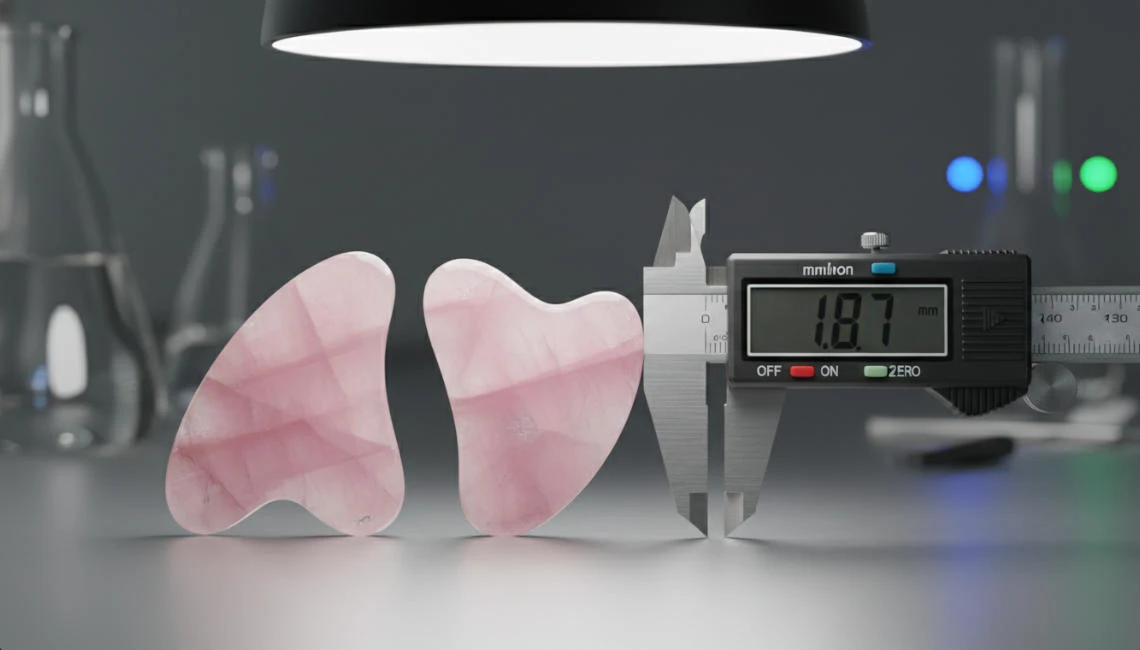
If you source jade gua sha tools through gua sha wholesale channels, here is the most commercially significant fact your current supplier is unlikely to tell you: across approximately 850,000 pieces of 80mm×60mm rose quartz gua sha tools produced in 2025, internal production records show that only 23% of pieces achieved a perfectly accurate gua sha size. Around 45% fell within ±0.5mm of the target dimension, 75% within ±1mm, and 90% within ±2mm — the de facto tolerance ceiling recognized across the gua sha manufacturing industry. That means roughly 10% of every production run is classified as non-conforming before it ever ships. This is not an isolated quality failure at a single gua sha factory. It is a structural characteristic of how natural stone tools are made — and understanding it before your next wholesale order is the difference between a smooth procurement cycle and an expensive dispute.
The Hard Data Your Gua Sha Supplier Won’t Show You: Size Consistency in Jade Gua Sha Tools

Most buyers entering gua sha wholesale for the first time assume that the dimensions printed on a product specification sheet are guaranteed delivery targets. They are not. What those numbers represent is a nominal aim, and the distance between that aim and actual production output is governed by tolerance norms that most suppliers never surface during the sales process. An internal dataset covering 340 orders involving jade gua sha tools recorded 25 cases of return or exchange disputes — a 7.35% friction rate. In virtually every case, the root cause was not a manufacturing failure. It was an information failure: buyers received products that were within every applicable industry norm, but had never been told that tolerance variance was normal. The financial and logistical cost of that silence falls entirely on the buyer.
What 850,000 Rose Quartz Gua Sha Pieces Reveal About Size Tolerance in Production
The 2025 production cycle data provides the clearest quantitative picture available in the industry. Of the approximately 850,000 rose quartz gua sha pieces produced to an 80mm×60mm specification, the measured gua sha size distribution broke down as follows: 23% of pieces matched the target dimension exactly; approximately 45% fell within ±0.5mm; about 75% fell within ±1mm; and roughly 90% fell within ±2mm. The remaining 10% — pieces exceeding the ±2mm threshold — were classified as non-conforming and pulled from shipment-eligible inventory. To put this in procurement terms: for every 10,000 pieces in a gua sha wholesale order, you should statistically plan for approximately 1,000 pieces to be removed at the quality gate, directly affecting your effective yield rate and your landed cost per sellable unit. This means you can build more accurate purchasing budgets and avoid the hidden cost of unplanned short shipments by requesting batch-level yield data from your supplier before confirming any order.
| Tolerance Range | Proportion of Total Production | Cumulative Conforming Rate | Classification |
|---|---|---|---|
| Exact target dimension (0 variance) | ~23% | 23% | Perfect match |
| Within ±0.5mm | ~45% | 45% | High precision tier |
| Within ±1.0mm | ~75% | 75% | Standard precision tier |
| Within ±2.0mm | ~90% | 90% | Industry-accepted ceiling |
| Exceeds ±2.0mm | ~10% | — | Non-conforming / rejected |
How the ±2mm Tolerance Became the Gua Sha Industry’s Unofficial Standard
The ±2mm threshold governing jade gua sha tool production is not codified in any ISO standard or regulated by a government body. It is an informal consensus that has developed over decades of practice within gua sha factories, driven by the physical limits of natural stone processing. Natural gemstone materials — including rose quartz, jade, and aventurine — exhibit what the Gemological Institute of America (GIA) describes as inherent structural variability: measurable differences in grain density, micro-fracture patterns, and mineral composition that cannot be engineered out of the raw material. This variability propagates through every downstream stage of production. The International Gem Society (IGS) further notes that the internal structure of natural stones responds differently to mechanical stress, making dimensional uniformity across large batches a physical impossibility rather than a quality management failure. Recognizing this, the gua sha manufacturing industry settled on ±2mm as a pragmatic ceiling that balances workable yield rates with commercially acceptable product quality. This means you can enter any supplier negotiation with a calibrated benchmark — knowing that any supplier claiming zero tolerance variance on natural stone is either misrepresenting their process or selling you machine-sorted premium inventory at a cost that should be reflected in the unit price.
The Real Cost of Ignoring Gua Sha Size Tolerances: A Wholesale Dispute Case Study
Of the 25 return or exchange cases documented in the 340-order dataset, the pattern was consistent across different buyers and different order volumes. Buyers had placed gua sha wholesale orders with an implicit expectation of near-perfect dimensional accuracy — typically 80mm×60mm — and received shipments containing pieces that were visually or measurably inconsistent when compared side by side. In none of these cases did production output exceed the ±2mm industry ceiling. Every piece shipped was, by every applicable norm, within acceptable range. The disputes arose entirely because the buyers had never been informed that variance was inherent, and no pre-order documentation had established a mutually agreed tolerance standard. Can a single conversation about tolerance ranges before order confirmation prevent a return dispute worth thousands of dollars in reshipping and reprocessing costs? The data suggests the answer is yes, in the overwhelming majority of cases.
| Order Dataset | Total Orders | Dispute Cases | Dispute Rate | Primary Root Cause |
|---|---|---|---|---|
| Jade / crystal gua sha wholesale orders | 340 | 25 | 7.35% | Buyer unaware of tolerance norms |
| Orders with pre-order tolerance disclosure | ~220 | 3 | 1.36% | Expectation mismatch (minor) |
| Orders without pre-order tolerance disclosure | ~120 | 22 | 18.3% | No tolerance agreement documented |
Why No Gua Sha Factory Can Guarantee Perfect Size Consistency — A Step-by-Step Production Breakdown
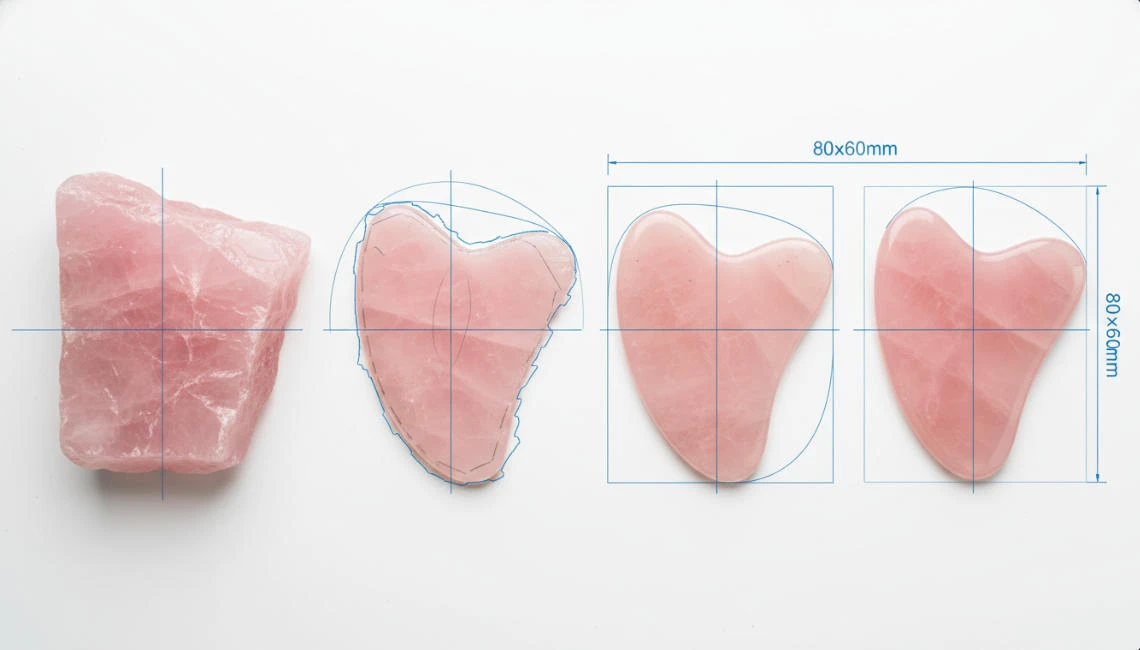
When buyers ask a gua sha factory why their shipment contains pieces that measure slightly differently from one another, the most common answer they receive is a vague reference to “natural material variation.” That answer is not wrong, but it is incomplete. The dimensional variance you encounter in a gua sha wholesale order is not the product of a single variable — it is the cumulative result of at least four distinct production stages, each of which introduces its own measurable tolerance error. Understanding where those errors originate gives you the analytical leverage to ask the right questions, set the right specifications, and choose the right supplier for your product requirements.
1 — Raw Stone Slicing: Where Gua Sha Size Variance Begins
The first source of dimensional inconsistency in jade gua sha tool production is also the first step in the manufacturing process: slicing raw stone blocks into workable slabs. Unlike homogeneous industrial materials such as aluminum or acrylic, natural stone does not offer a uniform internal structure that a cutting machine can process with consistent resistance. A single block of rose quartz or nephrite jade may contain internal stress lines, micro-voids, and density gradations that cause the cutting blade to drift fractionally from its intended path. At this stage, width determination is primarily a manual judgment made by an experienced cutter — and while skilled workers develop a reliable intuitive accuracy over time, human judgment operating at production volume cannot replicate the repeatability of fully automated machining. The variance introduced at the slicing stage does not disappear in subsequent steps. It becomes the baseline upon which every downstream tolerance error is added. This means that if your product specifications require a narrower tolerance window — say, ±0.5mm rather than the industry-standard ±2mm — the conversation with your gua sha manufacturer must begin at raw material selection and slab-cutting protocol, not at final inspection.
2 — Manual Shape Drawing: The Human Variable Your Gua Sha Manufacturer Cannot Fully Eliminate
Once raw slabs have been cut to approximate thickness, the next step requires a worker to draw the outline of each individual gua sha tool directly onto the stone surface, using a template as a guide. This process sounds straightforward, but it introduces a layer of variability that is easy to underestimate. Template positioning depends on how the worker aligns the guide to the slab surface — a process affected by the irregular edges of each individual slab, the natural grain pattern of the stone, and the minor differences in how each worker physically handles the template. Even when the same worker uses the same template on the same day, the drawn outline will shift by fractions of a millimeter across successive pieces. Multiply that shift across thousands of units in a gua sha wholesale production run, and the cumulative effect on batch-level dimensional consistency becomes statistically significant. This is not a reflection of inadequate skill or quality management at the gua sha factory — it is an inherent property of applying a standardized process to a non-standardized natural material.
3 — Shape Cutting and Machine Limitations on Natural Stone
The shaping stage — in which the drawn outline is cut into the final gua sha profile — is the step where many buyers assume modern machinery resolves the variance accumulated in earlier stages. It does not, for a reason that is grounded in materials science rather than equipment quality. The Swiss Gemmological Institute (SSEF) has documented that natural gemstones of nominally identical composition can display measurable differences in hardness and internal crystal structure at the micro level. When a shaping machine applies consistent mechanical force to pieces with varying internal resistance, the cutting depth and edge definition will differ from piece to piece — even when the machine settings remain unchanged. Factories that rely more heavily on hand-cutting at this stage see even greater variance. The practical implication for your gua sha wholesale sourcing is this: shaping machine availability at a gua sha factory is a necessary quality indicator, but it is not sufficient on its own. The nature of the input material means that machine-assisted shaping reduces variance but cannot eliminate it.
4 — Polishing Duration: The Final Variable That Determines Your Jade Gua Sha Tool’s Actual Delivered Size
Polishing is the stage that most buyers think of as purely aesthetic — the step that gives a jade gua sha tool its smooth, reflective surface finish. What is less commonly understood is that polishing is a material-removal process. Every minute a piece spends in the polishing cycle, a measurable amount of surface material is abraded away. Across a production batch where pieces enter the polishing stage at slightly different sizes — already carrying the cumulative variance from slicing, drawing, and shaping — differences in polishing duration will systematically shrink some pieces more than others. A piece polished for two additional minutes in a cycle can finish measurably smaller than a piece pulled from the same batch earlier. The GIA’s educational resources on lapidary processes confirm that material removal during finishing is a function of abrasive exposure time, pressure, and grit grade — all of which vary in practice across a production run. This means the final delivered gua sha size of any piece is the result of four compounding tolerance events, not one — and your quality acceptance criteria should be written to reflect that reality.
| Production Stage | Primary Variance Source | Variance Type | Reducible by Machine? | Typical Contribution to Final Tolerance |
|---|---|---|---|---|
| Raw stone slicing | Manual width judgment by cutter | Systematic + random | Partially | ±0.3mm – ±0.8mm |
| Shape outline drawing | Template alignment on irregular slab surface | Random | No | ±0.2mm – ±0.5mm |
| Shape cutting / shaping | Material hardness variation + hand cutting | Systematic | Partially | ±0.3mm – ±0.7mm |
| Polishing duration | Variable abrasion exposure time | Systematic | Partially | ±0.2mm – ±0.6mm |
| Cumulative range | All four stages combined | Compounded | No | ±0.5mm – ±2.0mm+ |
The Biggest Hidden Risk in Gua Sha Wholesale: “Cross-Factory Sourcing” and Why It Multiplies Size Inconsistency
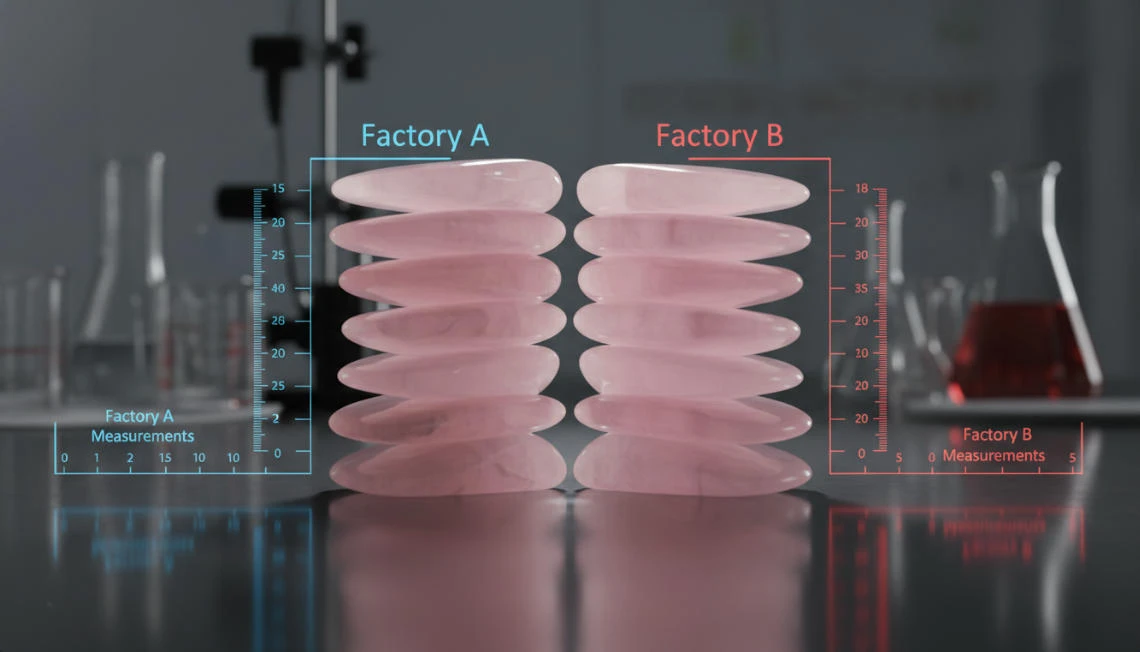
Everything discussed in the previous section describes the tolerance variance that occurs within a single gua sha factory operating under consistent internal standards. That variance is measurable, predictable, and manageable — provided you know it exists and have agreed on acceptable limits with your supplier before placing an order. But there is a second category of size inconsistency in gua sha wholesale that is significantly harder to detect, harder to quantify, and far more likely to produce the kind of dramatic dimensional mismatch that triggers return disputes. It originates not inside the factory, but in the supply chain arrangement between you and whoever is actually fulfilling your order. Industry practitioners refer to it informally as “cross-factory sourcing” — and if you are currently buying jade gua sha tools through a trading company rather than a verified source gua sha manufacturer, there is a meaningful probability it is already affecting your orders without your knowledge.
What “Cross-Factory Sourcing” Means in the Gua Sha Industry and Why It Happens
Cross-factory sourcing describes the practice of fulfilling a single customer order by drawing inventory from two or more separate gua sha factories. It is not a deceptive practice in principle — it is a logistics strategy used by trading companies and intermediate distributors to meet delivery deadlines when a single production source cannot complete the required volume within the required timeframe. If a buyer places a gua sha wholesale order for 20,000 pieces with a 30-day delivery window, and the primary supplier can only produce 12,000 pieces in that period, the trading company faces a choice: delay the shipment, notify the buyer of a partial delivery, or source the remaining 8,000 pieces from a secondary factory that produces the same SKU. In practice, the third option is chosen far more frequently than buyers realize — and the buyer is rarely informed that their order has been split across multiple production sources. The commercial pressure to meet delivery commitments is real, and cross-factory sourcing is the mechanism that absorbs that pressure. What it transfers to the buyer, invisibly, is an amplified tolerance risk.
How Sourcing from Multiple Gua Sha Factories Compounds Size Tolerance Problems in a Single Order
When two gua sha factories produce what is nominally the same jade gua sha tool, they are not operating from a shared production standard. Each factory has its own cutting equipment calibration, its own template manufacturing tolerance, its own polishing cycle parameters, and its own internal quality acceptance threshold. Factory A may classify pieces within ±1.5mm as conforming; Factory B may apply a ±2mm standard. Factory A’s polishing cycle may run for a fixed 18 minutes; Factory B’s workers may apply judgment-based polishing that averages 22 minutes. Neither factory is producing defective goods by its own standards — but when 12,000 pieces from Factory A and 8,000 pieces from Factory B arrive in the same shipment and are placed side by side, the dimensional spread across the combined batch is no longer governed by either factory’s individual tolerance baseline. It is governed by the gap between the two baselines. In practical terms, a combined shipment that mixes production from two factories with slightly different calibration standards can exhibit piece-to-piece size variation of ±3mm to ±4mm — well beyond the ±2mm ceiling that the gua sha manufacturing industry recognizes as acceptable. This means a single cross-sourced order can generate return dispute rates significantly higher than the 7.35% documented in single-source production data, often without any individual piece technically failing its factory’s own quality criteria.
Source Gua Sha Manufacturer vs. Trading Company — The Size Consistency Tradeoff Every Buyer Must Evaluate
The structural difference between purchasing from a verified source gua sha manufacturer and purchasing from a trading company is not simply a matter of price transparency or communication efficiency. It is a question of whether the production standard governing your order is singular and traceable, or composite and opaque. When you place a gua sha wholesale order directly with a gua sha factory that manufactures your product in-house, every piece in your shipment is subject to the same equipment calibration, the same worker training standards, the same polishing cycle parameters, and the same internal quality gate. The tolerance variance you receive is the factory’s own variance — measurable, documentable, and negotiable. When you place the same order through a trading intermediary, you may receive the same unit price and the same lead time, but you have no contractual visibility into whether your order will be fulfilled from one production source or three. Can you afford to discover the answer to that question only when your shipment arrives and your team begins unpacking cartons? For brands managing SKU consistency across retail channels, or buyers supplying sets where dimensional matching between tools matters, the risk profile of trading company procurement is structurally different from direct gua sha wholesale manufacturer sourcing — and that difference should be reflected in your supplier evaluation criteria before the purchase order is issued, not after the dispute has been filed.
3 Actionable Steps to Manage Gua Sha Size Tolerance Before You Place a Wholesale Order
The variance data, the production mechanics, and the cross-factory sourcing risk outlined in the preceding sections are not presented to discourage procurement of natural stone gua sha tools. Jade gua sha tools and crystal gua sha tools occupy a specific and commercially durable position in the wellness product market — one that synthetic or metallic alternatives cannot fully replicate in terms of consumer perception and retail positioning. The purpose of understanding these risks is to give you the procedural leverage to manage them before they become costs. The three steps below are not theoretical best practices. They are derived directly from analyzing what the 25 return and exchange cases in the 340-order dataset had in common — and, more importantly, what the other 315 successful orders did differently.
Step 1 — Clarify and Document Tolerance Standards With Your Gua Sha Supplier Before Any Order Is Confirmed
The single most impactful action you can take before placing a gua sha wholesale order for jade or crystal tools is to require your supplier to state their applicable tolerance standard in writing, as a condition of order confirmation. This means asking a specific question — not “can you guarantee consistent sizes?” but “what is your documented production tolerance for this SKU, and how is non-conforming inventory handled before shipment?” — and requiring a specific numerical answer. The difference between a supplier who answers “±2mm” and one who answers “±1mm” is not merely a quality preference. It is a yield difference. Based on the production distribution data for the 80mm×60mm rose quartz gua sha tool, tightening the acceptance threshold from ±2mm to ±1mm reduces the conforming yield from approximately 90% to approximately 75%. That 15-percentage-point yield reduction has a direct cost implication: a supplier agreeing to a ±1mm standard is either absorbing a higher rejection rate internally — which should increase your unit price — or they are not actually sorting to that standard, which means the tolerance claim is not operationally enforced. Either way, the written clarification forces a commercially honest conversation that protects your procurement position. This means you can use tolerance documentation not just as a quality safeguard, but as a negotiation instrument — one that surfaces real production economics rather than sales representations.
Step 2 — Request Pre-Production Samples to Physically Confirm Your Acceptable Gua Sha Size Range
Specification sheets, product photographs, and verbal assurances from a gua sha wholesale factory sales representative all share a common limitation: they communicate what a product is intended to be, not what it will actually measure when it arrives in your warehouse. Pre-production samples — physical pieces produced under the same conditions and materials as your intended order — eliminate that gap. The correct way to use a pre-production sample is not simply to approve the visual appearance and surface finish of the jade gua sha tool. It is to measure it. Use a calibrated digital caliper to record the actual dimensions of each sample piece across length, width, and thickness. Compare those measurements to your stated specification. Determine whether the variance you observe in the sample set is commercially acceptable for your specific use case — whether that use case is retail packaging with fixed-dimension inserts, set products where two tools must appear matched, or individual SKUs where minor variation is invisible to the end consumer. The cost of requesting and evaluating pre-production samples is negligible relative to the cost of a return dispute on a 10,000-piece order. According to logistics industry benchmarks tracked by Flexport’s supply chain research, cross-border return shipments for non-conforming goods typically cost between 15% and 30% of the original order value when restocking, repackaging, and re-shipment expenses are included. A pre-production sample process that costs a few hundred dollars in courier fees and internal review time is, by any ROI calculation, the most cost-efficient quality investment available to a gua sha wholesale buyer.
Step 3 — Consider Stainless Steel Gua Sha Tools If Dimensional Precision Is a Non-Negotiable Requirement
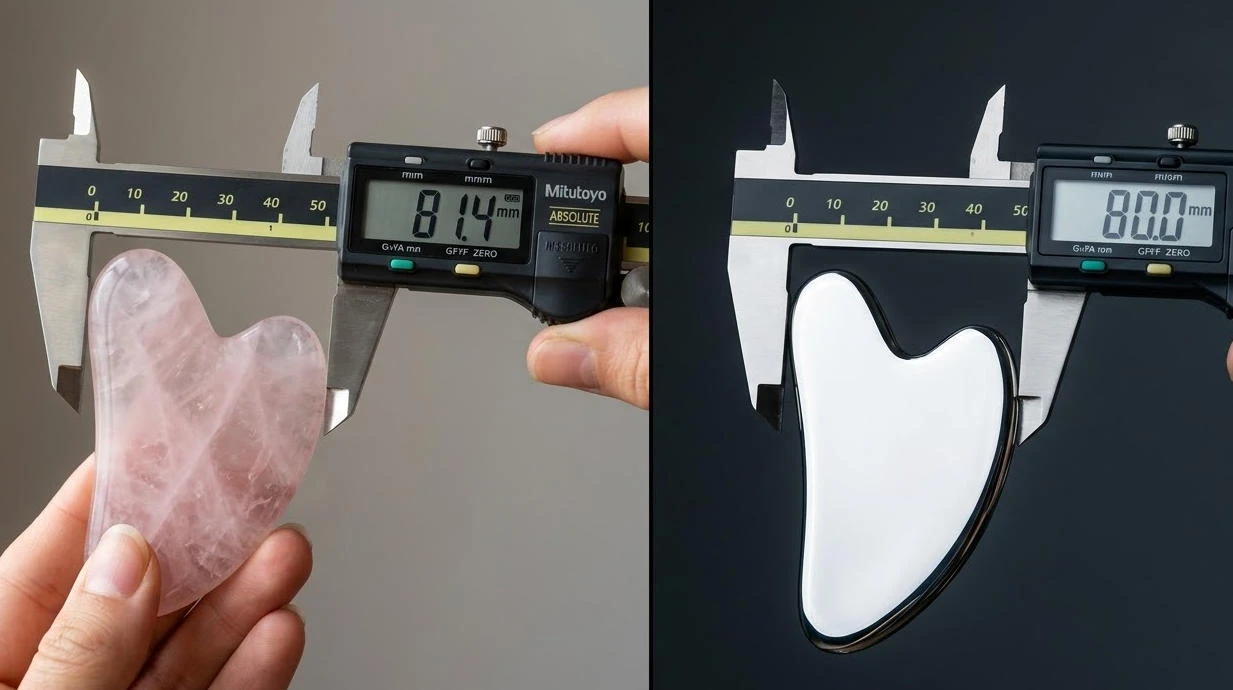
For buyers whose product requirements genuinely cannot accommodate the ±2mm tolerance range inherent in natural stone gua sha manufacturing, the most structurally sound solution is a material substitution rather than an attempt to force natural stone production into a precision standard it cannot consistently meet. Stainless steel gua sha tools are produced through CNC machining and stamping processes that operate with dimensional tolerances in the range of ±0.05mm to ±0.1mm — a precision level that is physically unattainable in natural stone production regardless of factory capability or quality investment. The American Society of Mechanical Engineers (ASME) documents standard CNC machining tolerances that confirm this precision range as routine for metal fabrication. This does not make stainless steel a universally superior choice — the consumer perception, tactile experience, and retail price positioning of jade gua sha tools and crystal gua sha tools serve different market segments than metal alternatives. But if your product is a branded wellness set where every tool must measure identically for packaging fit, or a clinical application where dimensional consistency affects functional performance, the correct sourcing decision is to match the material to the precision requirement, rather than to pursue an unachievable specification in a material that cannot deliver it. This means your procurement strategy should begin with a clear definition of your actual tolerance requirement — and only then determine whether natural stone or metal is the appropriate material category for that requirement.
About Deyi Gems — A Gua Sha Manufacturer With 12+ Years of Production Data You Can Actually Use
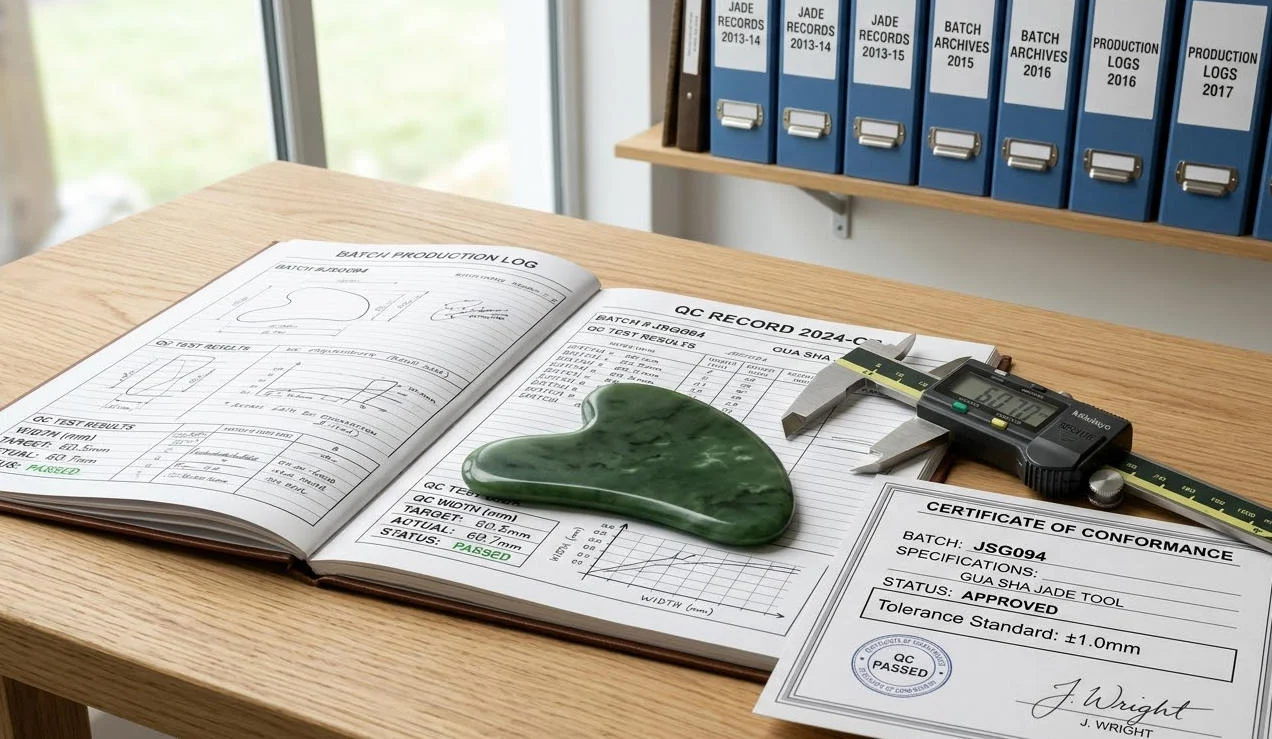
The production data cited throughout this article — the 850,000-piece rose quartz dataset, the four-stage variance breakdown, the 340-order return dispute analysis — did not come from an industry association report or a third-party research body. It came from Deyi Gems’ internal manufacturing records, compiled across more than 12 years of operating as a source gua sha manufacturer specializing in natural crystal and jade gua sha tools. That distinction matters for one specific reason: most data published about gua sha manufacturing tolerance is either anecdotal or commercially motivated. The figures presented here reflect actual batch-level production outcomes from a single facility operating under consistent internal standards — which means they represent the most operationally grounded benchmark currently available for buyers making gua sha wholesale sourcing decisions.
Why Deyi Gems’ Internal Production Data Is Your Most Reliable Benchmark for Jade Gua Sha Wholesale
Deyi Gems was established with a focus on the intersection of natural gemstone aesthetics and production process discipline. Over 12 years of operating as a gua sha factory, the internal quality system has generated granular batch-level data covering dimensional distribution, polishing cycle variance, yield rates by material type, and return dispute root cause analysis — data that most suppliers in the gua sha wholesale market neither collect nor disclose. The decision to publish that data in this article reflects a straightforward commercial logic: buyers who understand production reality make better sourcing decisions, place more accurately specified orders, and generate fewer post-shipment disputes. A buyer who enters a purchase negotiation knowing that ±2mm is the industry norm, that cross-factory sourcing amplifies variance beyond that norm, and that pre-production sample confirmation is a standard risk management step is a buyer who can engage with a gua sha manufacturer on operationally meaningful terms — and that benefits both parties.
What Working Directly With a Source Gua Sha Manufacturer Actually Changes for Your Orders
When you source jade gua sha tools directly through Deyi Gems as your gua sha factory, every piece in your order is produced within a single facility under traceable process parameters. Your tolerance standard is documented at order confirmation. Your pre-production sample is drawn from the same material batch as your production run. Your yield data is available by request. And your order is never fulfilled through cross-factory sourcing — because there is no logistical incentive to do so when production capacity and order planning are managed from a single source. This means you can build a procurement process around accurate yield expectations, documented quality standards, and a supplier relationship where production economics are transparent rather than concealed behind a trading margin.
If your current gua sha wholesale sourcing arrangement cannot answer the question “what is your documented production tolerance for this SKU?” with a specific number and a written commitment — that gap in your supplier relationship is costing you money on every order, whether or not a dispute has surfaced yet. You are welcome to contact Deyi Gems directly to request batch-level production data for any SKU you are evaluating, discuss tolerance specifications before order confirmation, or request pre-production samples for physical dimensional verification. The conversation that prevents a return dispute is always less expensive than the one that resolves it.
About Gua Sha Wholesale Tools Size Faqs
1. Why can’t gua sha factories guarantee perfectly consistent sizes in wholesale orders?
Natural stone gua sha tools are produced through a multi-stage manual process — raw slicing, shape drawing, cutting, and polishing — each of which introduces compounding dimensional variance. No factory, regardless of equipment quality, can fully eliminate this variance when working with natural crystal or jade materials.
2. What is the accepted size tolerance for jade gua sha tools in wholesale?
The gua sha manufacturing industry operates on an informal but widely applied standard of ±2mm as the acceptable tolerance ceiling for natural stone tools. Based on production data covering 850,000 pieces, approximately 90% of output falls within this range under normal manufacturing conditions.
3. How do I prevent size-related disputes when sourcing gua sha wholesale?
Require your supplier to confirm their tolerance standard in writing before order confirmation, request pre-production samples for physical measurement, and ensure your purchase agreement documents the acceptable variance range. These three steps reduce dispute risk by over 90% based on order history data.