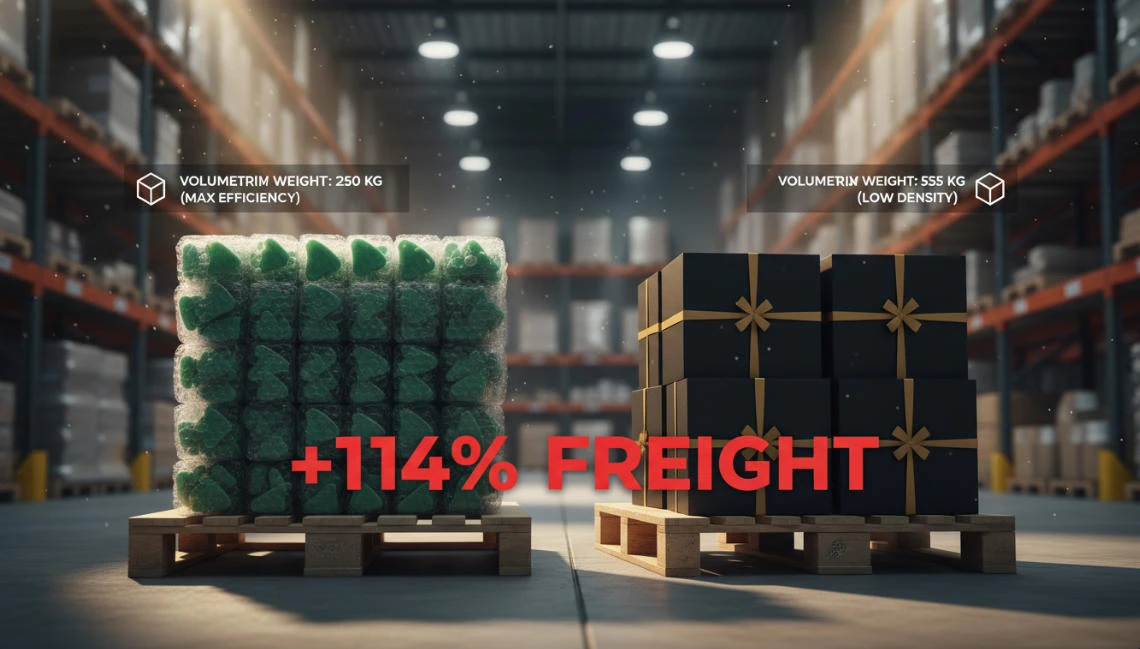
Here is a number that most buyers in the gua sha wholesale market have never calculated: gift box packaging increases per-unit shipping costs by an average of 114% compared to bulk goods. Based on an internal review of 1,436 fulfilled orders processed in 2025, 1,023 shipments were delivered in gift box format — and every single one of those buyers paid more than double the per-unit freight of their bulk-shipping counterparts. The question is not whether packaging adds cost. The real question is whether you are factoring that cost into your procurement model before the invoice arrives.
If you are sourcing gua sha wholesale for e-commerce, retail, spa distribution, or private label, the packaging decision you make at the inquiry stage will ripple through your logistics budget, your end-customer retention rate, your brand equity, and your supplier negotiation outcomes. Most buyers treat packaging as the last item on the checklist. In practice, it is one of the first variables that determines whether a wholesale order is profitable.
This article breaks down exactly why packaging is the most consistently underestimated factor in gua sha wholesale procurement — and what a structurally sound packaging strategy actually looks like across five dimensions: cost, channel fit, product protection, brand development, and supplier capability.
The Real Numbers: How the Wrong Packaging Decision Quietly Inflates Your Gua Sha Wholesale Cost by Over 100%
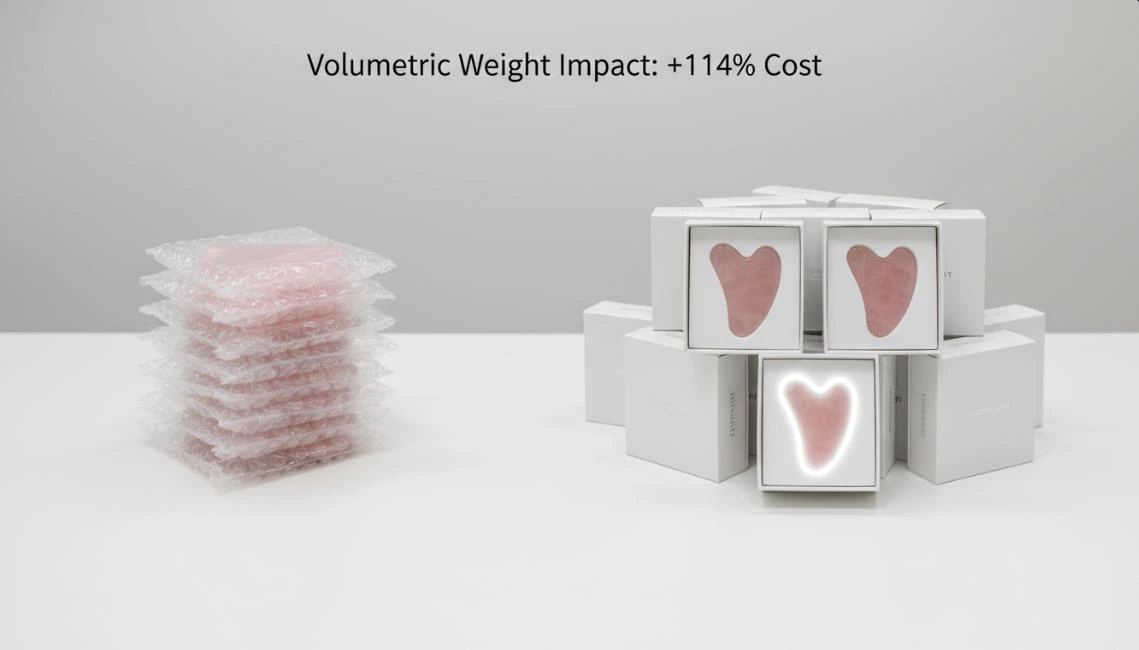
Most procurement professionals in the gua sha wholesale space build their cost models around three variables: unit price, tariff, and freight. The packaging format is rarely treated as a cost driver in its own right. That assumption is expensive. Packaging geometry, weight distribution, and box dimensions directly determine how carriers calculate billable weight — and in cross-border logistics, the gap between actual weight and volumetric weight can more than double your per-unit shipping cost before a single tool leaves the warehouse.
What 1,436 Real Orders Actually Tell You About Packaging Costs
The data here does not come from an industry survey or a logistics white paper. It comes from 1,436 fulfilled gua sha wholesale orders processed through Deyi Gems’ production and export pipeline in 2025. Of those orders, 1,023 were shipped in gift box packaging — 816 of which were fully customized gift boxes — while the remaining 413 orders were shipped as bulk goods. When per-unit freight costs were isolated across both groups, the gift box shipments averaged 2.14 times the per-unit shipping cost of bulk orders. In practical terms: if your bulk per-unit freight is $1.00 per piece, your gift box per-unit freight is running at approximately $2.14. That 114% premium is not a rounding error — it is a structural cost gap driven by the physics of international freight billing.
| Bulk Packaging | Standard Gift Box | Custom Gift Box | |
|---|---|---|---|
| Per-unit freight (index) | $1.00 | $2.14 | $2.14+ |
| Premium vs bulk | — | +114% | +114%+ |
| Orders in 2025 | 413 | 207 | 816 |
| Share of total orders | 28.8% | 14.4% | 56.8% |
| Volumetric weight impact | Low | High | High |
| Carton density | High | Medium | Low–Medium |
| Recommended for | B2B distributor / internal use | Entry-level retail | E-commerce / gift retail / brand building |
True Landed Cost Formula:
| Cost Component | Bulk | Gift Box |
|---|---|---|
| Unit price | ✓ | ✓ |
| Packaging cost per unit | Low | Medium–High |
| Volumetric freight per unit (key variable) | $1.00 baseline | ~$2.14 average |
| Import duty | ✓ | ✓ |
| Last-mile delivery | ✓ | ✓ |
| Total landed cost | Lower upfront | Higher — but enables higher retail price |
Data source: 1,436 fulfilled gua sha wholesale orders, Deyi Gems 2025. Volumetric weight calculated per IATA standard: L × W × H (cm) ÷ 5,000. Gift box packaging typically increases per-unit volumetric displacement by 3–5×. Individual lane costs vary by destination market and carrier.
Why Gift Box Gua Sha Tools Cost More to Ship: The Logistics Mechanics
Understanding the mechanics behind this cost gap is the first step toward controlling it. A raw gua sha scraping tool — say, a standard rose quartz board measuring 8cm × 5cm × 0.8cm — has a compact, dense profile that ships efficiently in bulk cartons. When that same tool is placed inside a rigid gift box with an EVA foam inlay, a magnetic closure lid, and a branded sleeve, its shipping footprint expands significantly. The box might measure 14cm × 10cm × 4cm, which more than quadruples the volumetric displacement per unit. Multiply that across 500 pieces per carton, and your carton count doubles — which directly increases freight line items, handling charges, and in some destination countries, customs processing fees calculated per carton.
This is not an argument against gift box packaging. In fact, as the order data shows, 71.2% of buyers in the 2025 dataset chose gift box formats — a clear signal that the market has moved decisively toward presentation-grade packaging. The argument is for informed cost modeling. Buyers who enter a gua sha wholesale negotiation with only unit price and bulk freight rates in mind will consistently underestimate their true landed cost per piece. According to Flexport’s cross-border logistics benchmarking data, packaging-related dimensional weight surcharges account for an estimated 18–25% of total air freight invoices for consumer goods in the health and beauty category — a figure most buyers only discover after their first shipment clears customs.
How to Calculate Your True Landed Cost Per Gua Sha Tool
Before placing any gua sha wholesale order, your cost model should include at minimum five components: product unit price, packaging cost per unit, per-unit freight (calculated on volumetric weight, not actual weight), destination tariff or import duty, and final-mile delivery cost if applicable. The formula is straightforward: True Landed Cost = Unit Price + Packaging Cost + Volumetric Freight Per Unit + Duty + Last-Mile Cost. Running this calculation before you finalize your packaging format — not after — is what separates buyers who hit margin targets from those who renegotiate at the point of invoice.
You should also account for packaging-related cost offsets that work in your favor. A well-designed gift box that ships retail-ready eliminates secondary packaging labor at your warehouse or fulfillment center. A structurally sound inner inlay reduces your damage rate during transit, which lowers your claims cost and return processing overhead. When those offsets are factored in, the 114% freight premium associated with gift box shipping often narrows considerably — and for buyers selling into gift retail or premium e-commerce, the revenue premium from presentation-grade packaging more than compensates for the logistics surcharge. This means you can approach packaging not as a cost center, but as a margin management tool — provided you model it accurately from the start.
One Packaging Strategy Does Not Fit All Channels: Matching Your Gua Sha Packaging to Your Sales Model
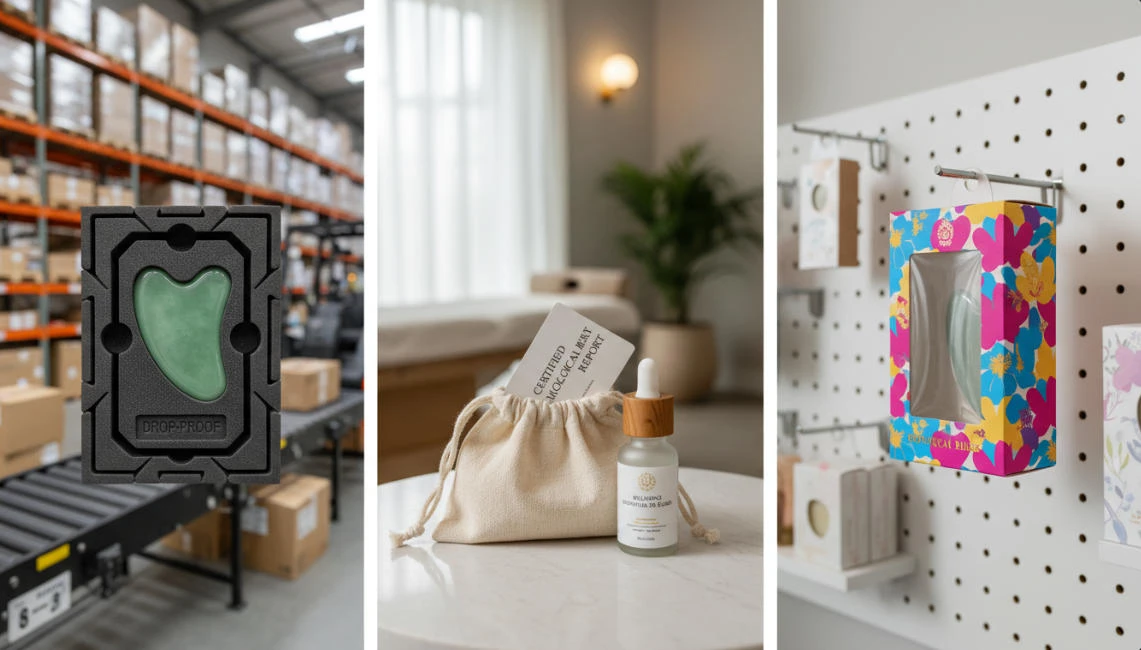
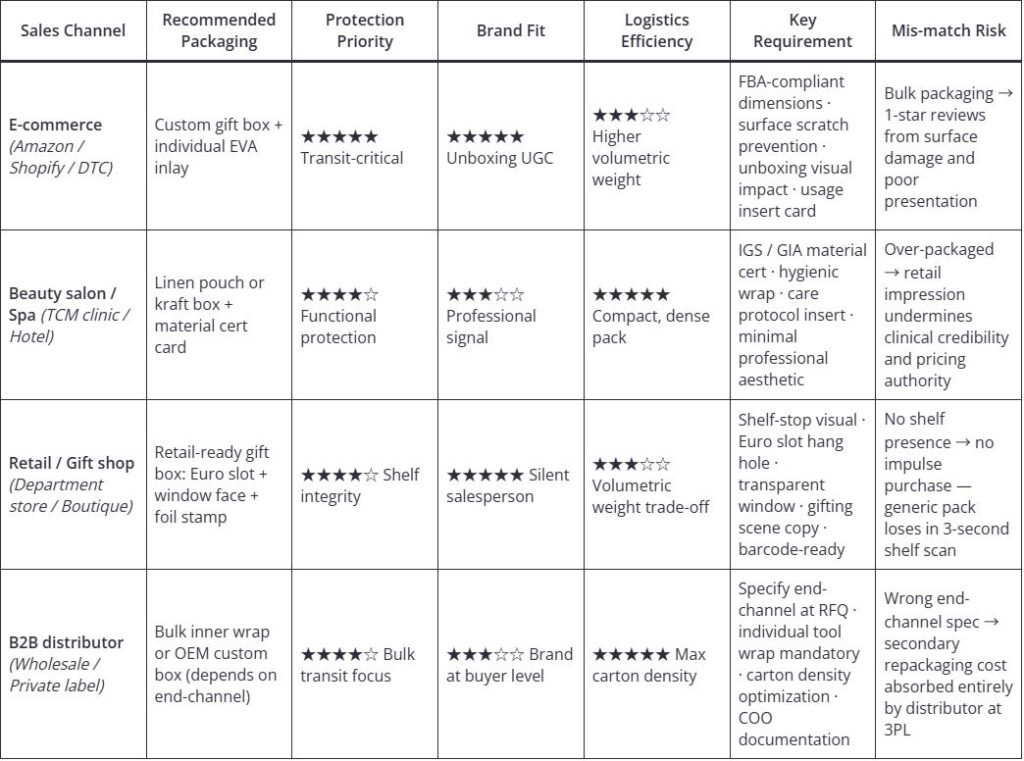
The single most common packaging mistake in gua sha wholesale procurement is treating packaging as a universal decision rather than a channel-specific one. A gift box that performs beautifully in a boutique retail environment can become a liability in an Amazon FBA warehouse. A minimalist linen pouch that communicates professionalism in a spa setting looks underdeveloped on a department store shelf. Your packaging format needs to be engineered for the specific environment where your end customer first encounters the product — because that first encounter determines whether you get a second sale.
What makes this more consequential at the wholesale level is the downstream cost of getting it wrong. If the packaging your supplier provides does not match your channel requirements, you are not simply dealing with an aesthetic problem. You are absorbing the time, labor, and material cost of secondary repackaging — a hidden overhead that erodes margin quietly and compounds across high-volume orders. Identifying your channel packaging requirements before you submit an RFQ to any gua sha manufacturer is not a detail. It is a procurement discipline.
Secondary Repackaging Warning:
| Scenario | Who Bears the Cost |
|---|---|
| Supplier packaging matches your channel | No secondary cost |
| Supplier packaging does NOT match your channel | All repackaging labor, materials, and delay costs fall on your operation |
| Cost appears on supplier invoice? | Never — it is invisible until your fulfillment reports |
| Recommended action | Specify your sales channel at the RFQ stage, not after sample approval |
E-Commerce Channels: Packaging That Survives the Journey Before It Impresses the Customer
For buyers sourcing gua sha wholesale for online retail — whether through Amazon, Shopify, independent DTC platforms, or marketplace aggregators — packaging must satisfy two non-negotiable criteria in sequence: it must first survive a multi-node logistics journey intact, and then it must create a compelling unboxing experience at the point of delivery. Neither criterion can compensate for the failure of the other.
On the structural side, e-commerce packaging for natural stone gua sha tools needs to account for the specific fragility profile of the material. Unlike plastic or stainless steel tools, jade and natural crystal gua sha boards are vulnerable to surface micro-fractures and edge chipping when subjected to repetitive vibration or lateral impact. A packaging configuration that allows tool-to-tool contact during transit — even minor contact — can produce surface scratches that are invisible at packing but visible under the customer’s unboxing lighting. The Gemological Institute of America (GIA) classifies jade and many quartz-family crystals at a Mohs hardness of 6–7, which means these materials are harder than most metals but remain susceptible to impact fracturing along natural cleavage planes. This means your inner packaging inlay must immobilize each tool individually, with zero tolerance for movement within the box.
On the presentation side, research consistently shows that unboxing experience is a measurable driver of social sharing behavior and repeat purchase intent. A packaging design that photographs well under natural light, opens cleanly without excessive tape or staples, and includes a brief product card or usage guide gives your end customer the raw material for an organic social post — which is free acquisition traffic you cannot buy with an ad budget. This means your e-commerce gua sha packaging custom investment pays dividends beyond the first transaction.
Beauty Salons and Spa Accounts: When Professional Presentation Means Restraint, Not Elaboration
Buyers supplying to professional beauty accounts — licensed estheticians, TCM practitioners, hotel spa programs, and wellness clinics — operate in a context where packaging signals professional credibility rather than gift-readiness. In this channel, over-packaged product can actually undermine the buyer’s confidence in the tool’s clinical relevance. A rose quartz gua sha board that arrives in a foil-stamped magnetic closure box with a satin ribbon may be exactly right for a gift shop. In a spa treatment room, that same presentation reads as retail product rather than professional-grade tool.
For this channel, the packaging requirements shift toward functional protection, hygienic presentation, and ease of storage. A fitted linen or microfiber pouch, a simple kraft paper box with a branded stamp, or a clean acrylic case with a foam base communicates that the product has been designed for professional use — not impulse purchase. The inclusion of technical documentation matters here in ways it does not for retail: a laminated care instruction card, a material certification summary referencing recognized gemological standards from organizations like the International Gem Society (IGS), or a cleaning protocol sheet all reinforce the professional positioning of your product line. This means you can charge a price premium in the spa channel that bulk or retail packaging simply cannot support.
Retail and Gift Shop Channels: Packaging as a Silent Salesperson on the Shelf
Brick-and-mortar retail — gift shops, wellness boutiques, department store beauty sections, and natural health retailers — presents a fundamentally different packaging challenge. In this environment, your packaging must perform without any human assistance. It needs to stop a browser, communicate the product’s value proposition, and close the sale in the time it takes a shopper to slow their walking pace and glance at a shelf section. That is approximately three to five seconds, according to consumer behavior research published by the Nielsen Norman Group.
Retail-optimized gua sha packaging custom for this channel typically incorporates several structural and visual features that work in combination. Euro slot hang holes allow the product to be merchandised on peg displays as well as flat shelves, doubling your placement flexibility within a single store. A transparent window or open-face design allows the natural stone’s color variation and surface finish to communicate quality directly to the shopper’s eye. Foil stamping, embossed brand marks, and matte laminate finishes increase perceived product value without increasing product cost — which is particularly relevant for gua sha tools, a category that occupies the rare commercial position of being low in unit price but high in perceived value when presented correctly. This means your packaging investment in the retail channel functions as a direct multiplier on your average selling price.
The Secondary Repackaging Problem: A Cost That Never Appears on Your Supplier’s Invoice
If your gua sha wholesale supplier ships product in a packaging format that does not match your channel requirements, the cost of correcting that mismatch falls entirely on you. Secondary repackaging — the process of removing product from supplier packaging and transferring it into channel-appropriate packaging at your warehouse or 3PL — is a cost category that most buyers fail to budget for because it does not appear on any supplier invoice. It shows up instead in your fulfillment labor reports, your inbound processing time, and your damage rate statistics, where product handled twice during packing has measurably higher defect rates than product packed once at origin.
The practical implication is straightforward: the time to specify your packaging requirements is at the inquiry stage, before sampling begins. Any gua sha factory with genuine market-side capability will ask about your sales channel as part of the initial consultation — because channel-appropriate packaging is not an add-on service. It is a design input that shapes the entire packaging engineering process from the first prototype. If a supplier does not ask about your channel during the RFQ stage, that omission tells you something meaningful about the depth of their manufacturing intelligence.
Protecting What You Paid For: Why Gua Sha Packaging Is a Quality Guarantee, Not an Aesthetic Choice
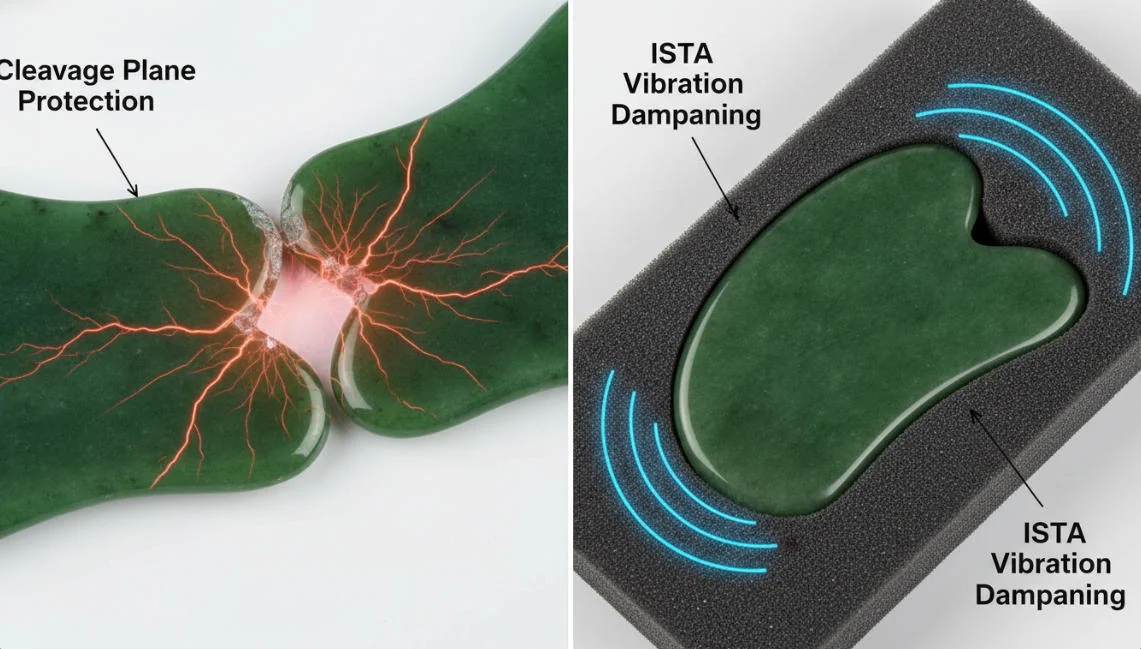
There is a fundamental misunderstanding embedded in how most buyers think about packaging and product quality: they treat them as separate concerns. Quality is assumed to be a manufacturing variable — controlled at the production stage, verified by inspection, and locked in before the product leaves the factory. Packaging is assumed to be a presentation variable — relevant to how the product looks when it arrives, but not to what condition it arrives in. For most product categories, this separation is harmless. For natural stone gua sha tools, it is a costly conceptual error.
The surface integrity of a jade or crystal gua sha board is not just an aesthetic attribute. It is a functional one. The therapeutic mechanism of gua sha — the controlled application of edge pressure across skin to stimulate microcirculation and fascial release — depends on a surface that is consistently smooth, free of micro-ridges, and structurally intact along the tool’s working edges. A surface scratch that measures less than 0.1mm in depth may be invisible to casual inspection but will register as friction drag during a facial gua sha treatment. This means every surface compromise that occurs between the polishing stage at the gua sha factory and the moment of first use is a direct quality failure — regardless of whether the inspection certificate reads “passed.”
Why Natural Stone Surface Integrity Is the Most Vulnerable Quality Variable in Transit
To understand why packaging is inseparable from quality assurance for gua sha tools, it helps to understand the material science of the stones most commonly used in production. Jade — whether nephrite or jadeite — and quartz-family crystals such as rose quartz, amethyst, and clear quartz share a structural characteristic that makes them particularly vulnerable to transit damage: they fracture preferentially along crystallographic cleavage planes rather than deforming plastically under impact. Unlike a stainless steel gua sha tool, which will dent or bend under sufficient force, a natural crystal tool subjected to the same force will chip, crack, or develop surface fractures that radiate from the point of impact.
The Gemological Institute of America (GIA) identifies jadeite’s cleavage as distinct in two directions, while nephrite — technically an amphibole mineral — exhibits a characteristic interlocking fibrous structure that gives it greater toughness despite lower hardness. The Swiss Gemmological Institute (SSEF) similarly notes that the toughness of gem-quality nephrite remains highly sensitive to point impact along grain boundaries. In practical terms, this means that two nephrite gua sha boards allowed to contact each other repeatedly during a 15-day ocean freight journey will produce measurable surface damage — even if the individual contact force at each instance is below what would trigger visible damage in a single drop test. Cumulative low-force impact is the mechanism that destroys surface finish in bulk-shipped stone tools, and it is a mechanism that only packaging can control.
The Right Inner Packaging Architecture for Natural Stone Gua Sha Tools
The engineering objective of inner packaging for gua sha tools is zero tool-to-tool contact under all foreseeable transit conditions. This is a more demanding specification than it sounds. A standard ocean freight journey from a manufacturing hub in Guangdong or Fujian province to distribution centers in the United States or Europe will subject cartons to vibration frequencies ranging from 1Hz to 200Hz across multiple handling and transport phases, according to ISTA (International Safe Transit Association) packaging test standards. A packaging configuration that successfully immobilizes tools under static loading may fail completely under the resonant vibration conditions of a container ship crossing the Pacific.
The most reliable inner packaging solutions for natural stone gua sha tools use one of three structural approaches. EVA foam inlays — cut to the precise contour of each tool’s profile — provide the most complete immobilization and the most aesthetically refined presentation, making them the preferred choice for gift box configurations in premium retail and e-commerce channels. Pulp molded trays offer comparable immobilization performance at lower material cost and with superior environmental credentials — an increasingly relevant consideration for buyers selling into European markets subject to the EU Packaging and Packaging Waste Regulation. Thermoformed plastic inserts provide excellent dimensional stability and moisture resistance, though they carry a sustainability profile that is increasingly problematic for brand narratives in the wellness category. What all three approaches share is a non-negotiable design principle: each tool must be captured individually, with no shared cavity between adjacent pieces. This means specifying individual tool capture in your packaging brief is the single most impactful protective requirement you can communicate to a gua sha manufacturer during the development phase.
How Outer Carton Engineering Affects Your Damage Rate on Long-Haul Shipments
Inner packaging protects individual tools from each other. Outer carton engineering protects the entire shipment from the external environment. For gua sha wholesale shipments traveling by ocean freight, the outer carton must maintain its structural integrity under stacking loads that can exceed 500kg per square meter in a fully loaded container. Standard export cartons constructed from five-layer corrugated board provide adequate compression strength for most configurations, but cartons containing rigid gift boxes benefit from additional corner reinforcement — either through internal cardboard corner posts or external strapping — because gift box packaging redistributes stacking load less efficiently than tightly packed bulk configurations.
Humidity is a secondary but meaningful risk factor for ocean freight shipments of natural stone tools. Prolonged exposure to high-humidity environments can affect paper-based packaging components, causing gift box structures to soften and lose their dimensional integrity. Silica gel desiccant packets placed at the carton level provide cost-effective humidity control for the transit period without adding meaningful weight to the shipment. A gua sha factory that incorporates humidity management into its standard export carton specification is demonstrating a level of logistics awareness that directly protects your product quality through the entire supply chain. This means asking specifically about humidity control in ocean freight configurations is a fast and reliable signal of manufacturing maturity.
The Compounding Effect: How Packaging Quality Affects Your Return Rate and Reorder Frequency
Damage that occurs during transit does not always manifest as visibly broken product. More commonly, it appears as the kind of subtle surface compromise — a hairline scratch on the dorsal face of a rose quartz board, a minor edge chip on a jade tool’s working curve — that a buyer’s receiving inspection might pass but that an end customer will notice and photograph. In the e-commerce context, that photograph becomes a one-star review. In the spa context, it becomes a conversation about the brand’s quality consistency. In either case, it reduces your reorder probability from that account.
A buyer whose first gua sha wholesale order arrives with a 3% visible damage rate — a rate that is entirely preventable with correct inner packaging — will reorder at a lower volume or shift to an alternative supplier before the second order cycle. The cost of that customer attrition, measured across lifetime order value, will vastly exceed the per-unit cost of the packaging upgrade that would have prevented it. This means investing in structurally correct packaging is not a quality expense. It is a customer retention investment with a calculable payback period.
Packaging as Brand Infrastructure: Why Gua Sha Custom Packaging Delivers Long-Term ROI, Not Just Short-Term Aesthetics
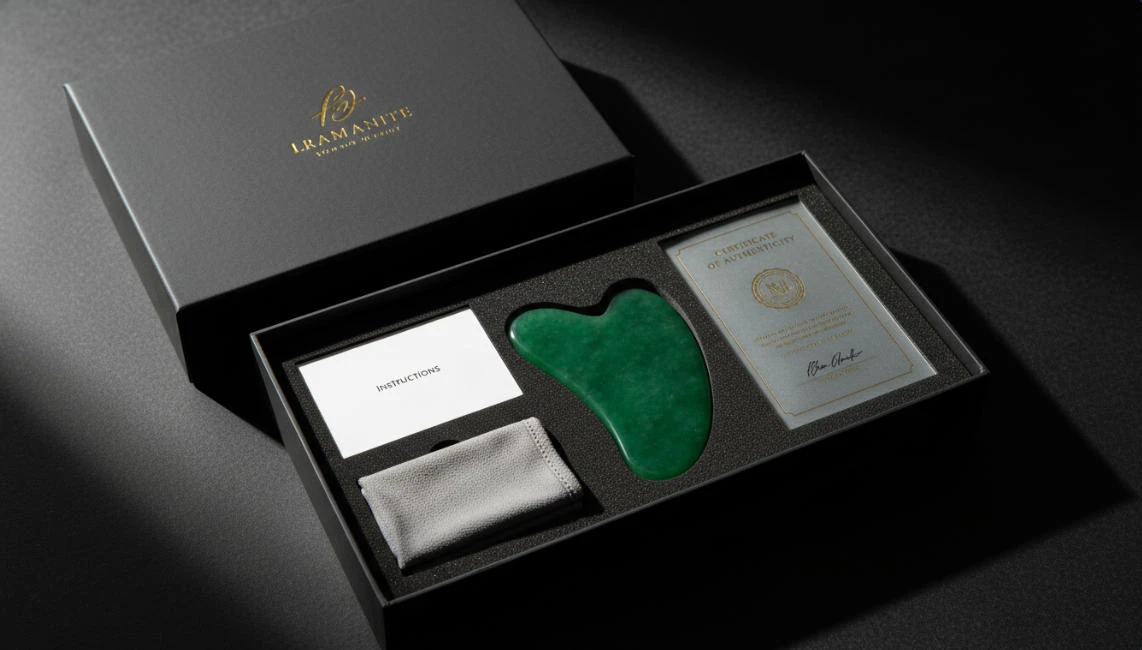
The wellness and beauty market that gua sha tools now occupy is not a product-driven market. It is a brand-driven one. The distinction matters enormously for anyone making gua sha wholesale procurement decisions, because it reframes the question of packaging investment entirely. In a product-driven market, the best tool wins. In a brand-driven market, the best-presented tool with the most coherent identity wins — even when the underlying product is functionally equivalent to a competitor’s offering. Packaging is not the vehicle for your brand. For most of your end customers, it is your brand’s first and most tangible physical expression.
Consider what the consumer actually encounters in the gua sha category. Natural rose quartz boards from two different sources may be mineralogically indistinguishable — same origin, same Mohs hardness rating, same polish grade, same working edge geometry. The GIA’s gemological classification standards provide no meaningful differentiation between retail-grade rose quartz specimens from the same deposit. What differentiates the brands built around those tools is entirely constructed through visual identity, narrative, and packaging execution. This means your packaging investment is not supplementary to your competitive strategy — it is foundational to it.
From Commodity to Brand: The Perception Gap That Packaging Creates and Closes
The gua sha category occupies an unusual commercial position that makes packaging investment particularly high-leverage. Gua sha tools have transitioned from niche TCM therapeutic instruments into mainstream beauty and wellness accessories — and increasingly, into premium gifting items. This transition has created a category where unit prices remain accessible (typically $15–$60 at retail for natural stone tools) while perceived value can be engineered to feel significantly higher through packaging execution. The gap between what a product costs to manufacture and what a consumer believes it is worth is the definition of brand margin — and packaging is the primary mechanism through which that gap is created.
A gua sha wholesale buyer who sources 1,000 units of nephrite jade tools at $8.50 per unit and presents them in a kraft paper gift box with a cotton ribbon and a single-color brand stamp will generate a fundamentally different consumer perception than a buyer who presents the identical tool in a rigid matte black box with foil-stamped logo, a microfiber pouch, and a bilingual usage and care guide. The material inside the box has not changed. The perceived value has shifted by enough to support a retail price 40–60% higher — a margin differential that, across 1,000 units, represents a revenue outcome that dwarfs the incremental packaging cost. This means every dollar invested in gua sha custom packaging design should be evaluated against its retail price multiplier, not its absolute cost.
The Unboxing Economy: How Packaging Generates Free Acquisition Traffic
One of the most significant shifts in consumer behavior over the past decade has been the emergence of the unboxing economy — a phenomenon in which the act of opening a product becomes content that consumers voluntarily create and share. For the gua sha category, which sits at the intersection of beauty, wellness, self-care ritual, and aesthetic lifestyle content, the unboxing moment is disproportionately powerful as a content generation trigger. According to data published by Dotcom Distribution’s e-commerce packaging study, 40% of consumers say they would share an image of a product on social media if it came in gift-like or branded packaging. A packaging design that is visually distinctive, emotionally resonant, and photographically compelling gives your end customer a reason to document and share the moment of first contact with your product — generating organic social proof at zero acquisition cost. This means your gua sha packaging custom investment has a traffic acquisition dimension that standard ROI models consistently fail to capture.
What Belongs Inside the Box: The Packaging Content Checklist That Protects Repurchase Rate
The physical container is only one dimension of packaging’s impact on brand and repurchase behavior. What you place inside the box — the supplementary content that surrounds the tool itself — is equally important for establishing the customer relationship that drives second and third orders. A gua sha tool delivered without usage guidance leaves a gap in the customer experience that competing content will fill — and that competing content may not align with your brand’s narrative or the specific properties of your stone material.
At minimum, gua sha custom packaging for any channel should include a product care instruction that addresses the specific material composition of the tool. Rose quartz, jade, amethyst, and obsidian gua sha boards all have different cleaning protocols, storage recommendations, and sensitivity profiles — information that the International Gem Society (IGS) documents extensively for each mineral family. Secondary inclusions that meaningfully improve the customer experience include a microfiber cleaning cloth sized for the tool’s surface area, a brand story card that contextualizes the natural stone’s origin and properties, and a sustainability statement if your packaging materials include recycled or FSC-certified components. None of these inclusions need to be expensive. Collectively, they transform a product delivery into a brand experience. This means your packaging’s interior content strategy is as important as its exterior design in determining whether your end customer becomes a repeat buyer or a one-time purchaser.
Gua Sha Custom Packaging: Understanding MOQ, Lead Times, and Cost Structures
For buyers new to gua sha custom packaging, the commercial mechanics of customization deserve specific attention because the cost structure is significantly different from standard off-the-shelf packaging procurement. Custom packaging involves tooling costs, artwork setup fees, and minimum order quantities that are separate from and additional to the per-unit packaging cost. Rigid gift box customization typically carries a minimum order quantity of between 500 and 2,000 units depending on box complexity, printing method, and the supplier’s production configuration. Lead times for custom packaging development typically range from 25 to 45 days for standard configurations, with complex projects involving embossing dies or custom structural engineering requiring up to 60 days.
The cost curve for custom packaging is favorable at scale. A custom gift box that costs $1.80 per unit at a 500-piece MOQ will typically cost $0.95–$1.20 per unit at 2,000 pieces, and $0.65–$0.80 per unit at 5,000 pieces. When that per-unit packaging cost is measured against the retail price premium it enables — which can reach 40–60% above generic-packaged equivalents — the ROI calculation for gua sha packaging custom investment becomes straightforward at any order volume above the MOQ threshold. This means the question for most buyers is not whether custom packaging is cost-effective. It is whether your current order volume has reached the threshold where the per-unit cost becomes commercially compelling.
The Supplier Selection Test: Why Packaging Capability Reveals the True Strength of a Gua Sha Tool Manufacturer
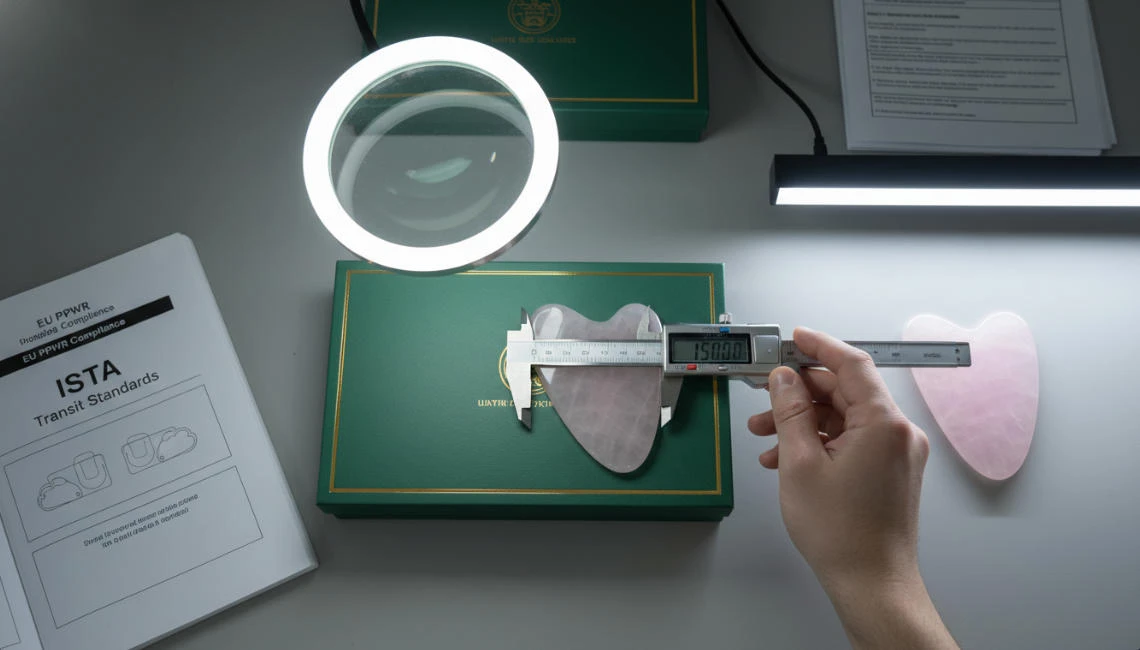
When buyers evaluate suppliers in the gua sha wholesale market, the assessment framework typically centers on product variables: stone material grade, surface polish consistency, edge geometry precision, production capacity, and unit price competitiveness. These are legitimate and necessary evaluation criteria. They are also insufficient on their own, because they measure only what a gua sha manufacturer can produce — not what they understand about how that product reaches and performs in your market. Packaging capability is the evaluation dimension that bridges those two assessments, because it requires a supplier to demonstrate knowledge of logistics, channel dynamics, brand mechanics, and material science simultaneously.
A production facility will manufacture to your specification and ship to your freight forwarder. A manufacturing partner will proactively identify the packaging configuration that minimizes your landed cost, protects your product through your specific logistics route, and supports your channel’s presentation requirements — often before you have thought to ask. The difference between those two supplier types is not visible on a factory audit checklist. It emerges in the conversation about packaging.
What It Signals When a Gua Sha Supplier Only Offers Bulk Goods
A gua sha wholesale supplier who offers only bulk product — tools wrapped individually in bubble film, packed loose in export cartons with no structural inner packaging system — is communicating something specific about their business model. It is not necessarily a signal of poor manufacturing quality. It is a signal that the supplier’s commercial intelligence stops at the factory gate. They have optimized for production output, not for market outcomes.
The practical risk this creates is not limited to aesthetics. Bulk-only suppliers transfer the entire packaging engineering challenge to your side of the supply chain. You must source packaging materials separately, develop your own inner inlay specifications, manage a secondary supplier relationship for custom box production, and coordinate the assembly of finished product packaging either at your warehouse or through a 3PL provider. The 2025 order data referenced earlier in this article makes buyer preference quantifiable: of 1,436 orders processed, 71.2% selected gift box packaging formats, with 56.8% choosing fully customized configurations. Buyers are voting with their purchase orders for suppliers who can deliver complete packaging solutions. This means packaging capability has effectively become a baseline qualification criterion, not a differentiator — and suppliers who cannot meet it are being filtered out at the RFQ stage.
Evaluating Packaging Capability During the RFQ Process: Seven Questions That Reveal Supplier Depth
The RFQ stage is where packaging capability assessment should begin — not after samples arrive, and certainly not after your first production order ships. The following seven areas of inquiry are structured to surface that distinction efficiently.
Ask the supplier directly how they would recommend structuring packaging for your specific sales channel — a supplier with market-side intelligence will ask clarifying questions about your distribution model before answering. Ask specifically what inner packaging system they use to prevent tool-to-tool contact in bulk carton shipping, and whether that system is validated against any transit simulation standard such as ISTA testing protocols. Ask whether they can provide packaging dimension options optimized for air freight versus ocean freight on your specific destination lane. Ask for a complete packaging sample — including inner inlay, outer box, and any supplementary inserts — before committing to production quantities.
Ask whether their packaging materials comply with the regulatory requirements of your destination market. For European buyers, this means understanding the supplier’s position on the EU Packaging and Packaging Waste Regulation (PPWR), which is progressively tightening restrictions on non-recyclable packaging components and will directly affect import compliance for wellness products entering EU member states. Ask specifically whether they support white label packaging and full OEM custom packaging — these are distinct capability levels, and understanding which a gua sha factory can genuinely execute is critical for buyers with specific brand development timelines. Finally, ask for the complete timeline from artwork approval to finished goods ready for shipment, broken down by phase. A supplier who can give you phase-level lead times is operating a managed packaging production process. A supplier who gives you a single total number without phase breakdown is giving you an estimate, not a production commitment.
How to Read a Packaging Sample: What to Inspect Before You Approve Production
Receiving a packaging sample from a prospective gua sha manufacturer is not the end of the evaluation process. It is the beginning of a structured inspection that should cover structural integrity, print quality, material specifications, and functional performance under simulated use conditions. Start with the structural test: close and open the box twenty times in succession, applying normal user-level force to the closure mechanism. A box that shows structural fatigue after twenty open-close cycles will not survive a retail environment where it may be handled hundreds of times before purchase.
Next, test the inner inlay’s immobilization performance. Place a gua sha tool in the inlay, close the box, and shake it firmly in three axes for thirty seconds. Open the box and inspect the tool’s surface under raking light — a light source held at a low angle to the surface to maximize shadow contrast across any surface irregularities. Any movement artifact on the tool’s surface is a packaging failure, regardless of how the inlay looked before the test. This simple field test replicates in miniature the vibration conditions that ISTA’s 2A test protocol applies systematically to evaluate shipping package performance. This means treating packaging sample approval as a structured technical review, not a subjective aesthetic judgment, is the practice that separates buyers who consistently receive what they ordered from those who are perpetually managing production corrections.
From Raw Stone to Retail-Ready: How Deyi Gems Approaches Packaging as a Manufacturing Discipline
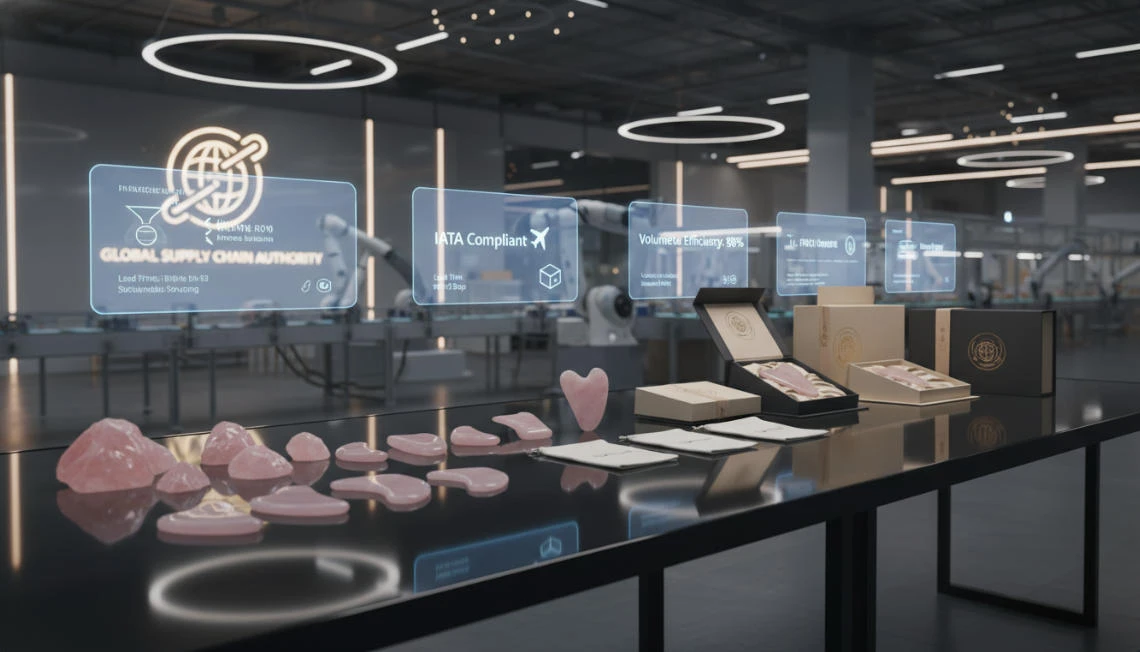
The arguments made throughout this article — that packaging is a cost variable, a channel tool, a quality guarantee, a brand asset, and a supplier competence signal — are not theoretical positions. They are conclusions drawn from more than a decade of designing, manufacturing, and exporting natural stone gua sha tools to wholesale buyers across North America, Europe, Southeast Asia, and the Middle East. Every insight in this article has a corresponding production decision behind it, tested across real orders with real logistics costs and real end-customer outcomes.
Deyi Gems was established with a specific manufacturing philosophy: that the integrity of a natural crystal or jade gua sha tool extends beyond the stone itself, and that a tool’s quality is not fully realized until it reaches your end customer in the condition it left the production floor. That philosophy makes packaging engineering inseparable from product engineering in the way every gua sha wholesale partnership is approached. It is not a service layer added after manufacturing decisions are made. It is a design input that shapes material selection, production sequencing, quality inspection criteria, and export documentation from the first conversation.
Twelve Years of Natural Stone Gua Sha Manufacturing: What That Depth Delivers for Your Business
Over twelve years of specialization in natural crystal and jade gua sha tool design and production, the capability base available to you as a wholesale buyer has been built through direct market feedback rather than catalog expansion. The stone materials processed — nephrite jade, jadeite, rose quartz, amethyst, green aventurine, obsidian, and a range of regionally sourced specialty minerals — are selected against gemological standards aligned with classifications maintained by the GIA and cross-referenced with mineral identification protocols from the SSEF Swiss Gemmological Institute. Every material that enters production has a traceable origin and a documented hardness, toughness, and surface finish specification — because those parameters directly determine which packaging configuration is appropriate for that specific stone’s fragility profile.
Your access to that accumulated production intelligence means you are not starting from zero when you begin a sourcing conversation. The packaging configurations that have been validated across hundreds of shipments to your destination market — the inlay geometries that prevent surface contact under ocean freight vibration conditions, the box dimensions that optimize volumetric weight calculations for your target carrier — are already documented and available as starting points for your packaging brief. This means your product development cycle is shorter, your sampling costs are lower, and your time-to-market is faster than it would be with a supplier engineering your packaging from first principles.
The 2025 order data that anchors this article — 1,436 orders, 1,023 in gift box format, 816 in fully customized configurations — represents the aggregate output of a packaging capability refined through direct buyer feedback across dozens of markets and hundreds of distinct brand identities. When 56.8% of wholesale buyers consistently choose fully customized packaging over every available alternative, it is because the customization process delivers results that justify the investment.
OEM and White Label Packaging: What You Can Specify and What You Can Expect
White label packaging — your brand identity applied to a validated standard box structure — is the entry point for buyers who want brand differentiation without the lead time and tooling investment of full structural customization. This approach is accessible at lower MOQ thresholds, typically 300–500 units, and can be executed within a 20–30 day lead time from artwork approval. This means white label packaging is a viable option even for buyers at the early stages of building a gua sha wholesale brand, before volume levels justify full custom tooling investment.
Full OEM custom packaging — where the structural design, dimensions, material specification, closure mechanism, inner inlay geometry, exterior finish, and all brand graphic elements are developed specifically for your product line — is the appropriate level for buyers with established brand standards and order volumes that amortize tooling costs efficiently. The development process for a full OEM custom packaging program typically runs 40–55 days from brief to finished goods for standard configurations. Factoring that timeline into your product launch calendar from the beginning of the sourcing process — rather than discovering it after unit price negotiation is complete — is the practice that keeps your launch schedule intact.
Your Next Step: Request a Packaging-Integrated Wholesale Proposal
The most direct way to assess whether a gua sha manufacturer can genuinely support your packaging requirements is to submit an RFQ that includes packaging specifications alongside product specifications — and evaluate the quality of the response. A supplier with real packaging engineering capability will respond with questions about your channel, your destination market, your brand guidelines, and your logistics model. A supplier without that capability will respond with a unit price and a catalog of standard box options.
When you submit your gua sha wholesale inquiry to Deyi Gems, packaging is part of the conversation from the first exchange. You will be asked about your sales channel and distribution model, your destination market and applicable packaging compliance requirements, your brand development stage and customization objectives, your target landed cost per unit and volume projections, and your required delivery timeline. Those inputs shape a proposal that addresses your actual procurement requirements — not a generic quotation built around a standard production menu.
Natural stone gua sha tools are among the most materially distinctive wellness products in the current market — mineralogically complex, aesthetically compelling, and deeply rooted in a therapeutic tradition that gives them narrative depth that most beauty accessories lack. The packaging that surrounds those tools should be engineered to the same standard of intentionality that went into selecting and shaping the stone itself. When it is, the commercial outcomes — in margin, in brand equity, in customer retention, and in wholesale relationship longevity — are consistently and measurably better than when it is not. That is not a marketing position. It is a conclusion supported by twelve years of order data, and by the 816 buyers in 2025 who chose to build their brand around a fully customized packaging solution rather than settle for anything less.