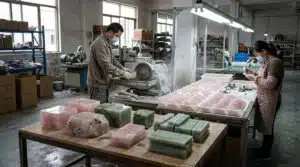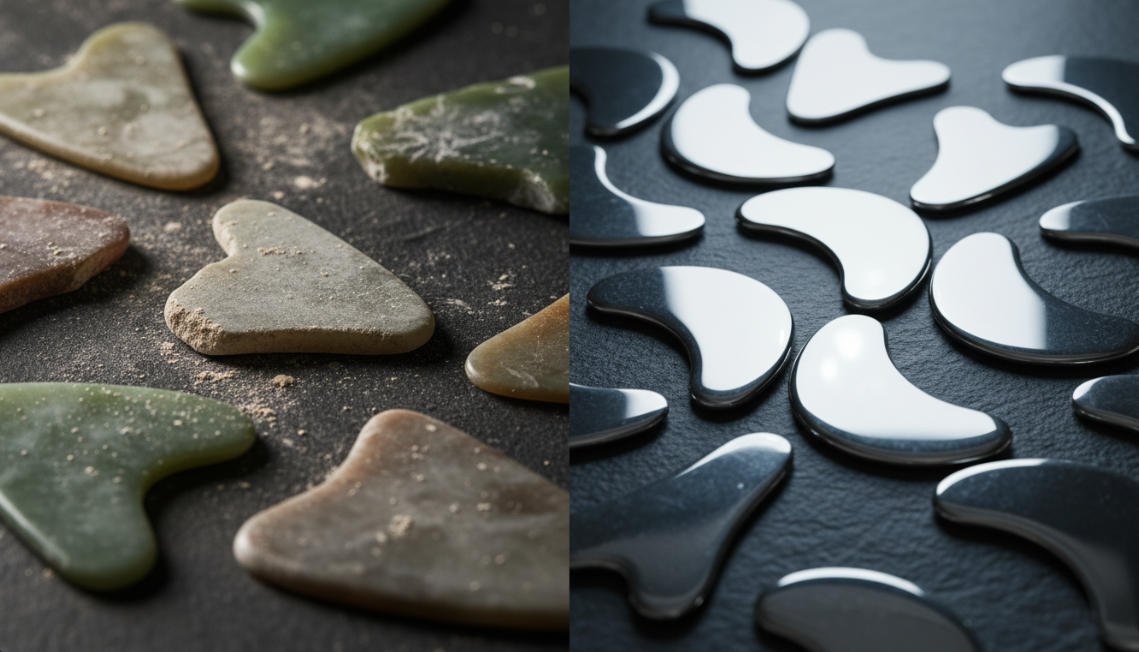
Right now, if your supply chain depends on jade gua sha tools sourced from Guangdong province, you are already exposed to a risk that has materialized. In March 2026, the Huizhou municipal government — the production epicenter of China’s gua sha manufacturing industry — launched a post-Chinese-New-Year environmental compliance enforcement campaign targeting stone and crystal processing facilities. The result was immediate: jade and crystal gua sha production capacity across the Guangdong region dropped by approximately 52% within one to two months, and average lead times extended by more than 60%. These figures come from Deyi Gems’ direct supplier network and peer-manufacturer data collected on the ground in Huizhou in March 2026. Stainless steel gua sha tools were entirely unaffected. If you are evaluating your gua sha wholesale sourcing strategy — whether as a distributor, private-label brand, or importer — the manufacturing data in this article gives you the factual foundation to make a decision you can defend.
Data Methodology and Transparency Note
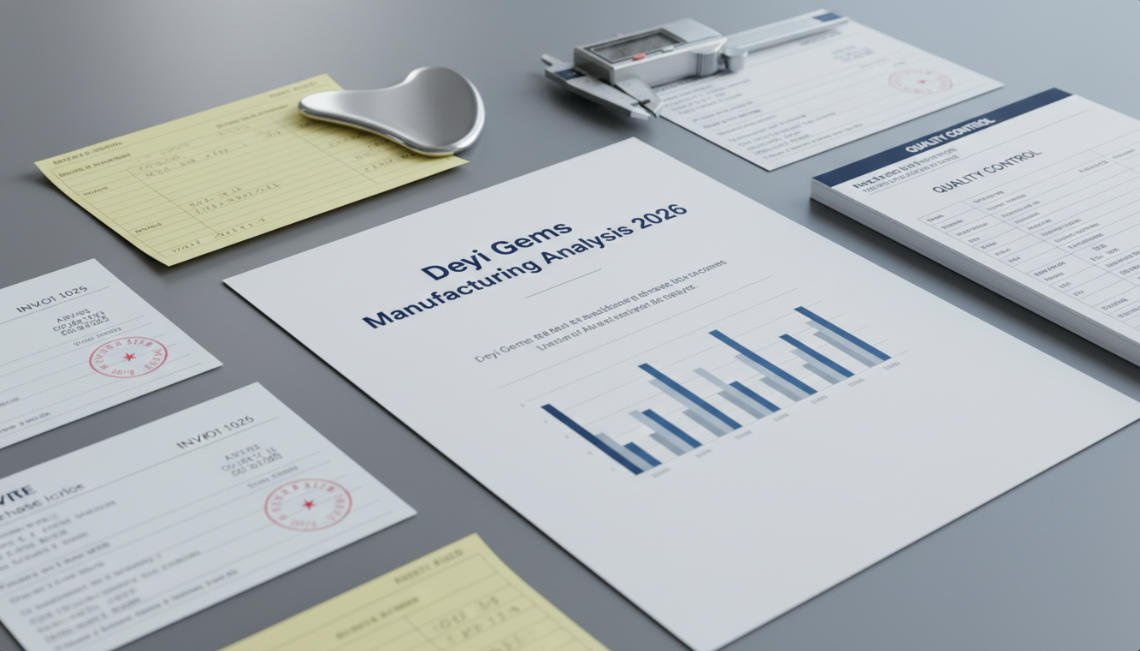
Before presenting the manufacturing comparison in this article, it is important to be explicit about where the data comes from, how it was collected, and what its limitations are. Every data point cited below should be read with this context in mind — and you are actively encouraged to cross-reference each figure against your own supplier contacts.
How the Production and Capacity Data Was Collected
The production capacity, yield rate, lead time, and price volatility figures cited throughout this article are derived from two primary internal sources at Deyi Gems. The first is Deyi Gems’ own manufacturing records, covering production runs from January 2024 through December 2025, encompassing monthly output logs, quality control rejection records, material purchasing invoices, and delivery confirmation timestamps across a representative sample of wholesale orders. The second source is a structured informal survey of peer manufacturers conducted through direct contact with more than twelve independent gua sha production operations in the Huizhou and surrounding Guangdong region during Q1 2026. Survey respondents were asked to report current production capacity, recent lead time changes, and yield rate ranges for their primary product categories. Responses were aggregated anonymously, and the capacity decline figure of approximately 52% represents a weighted average across respondents who reported enforcement-related output disruption in March 2026.
What This Data Cannot Tell You — and What It Can
This is proprietary and peer-network data — it is not a statistically representative industry census, and it has not been independently audited or published in a peer-reviewed trade journal. The figures should be treated as directional indicators grounded in direct manufacturing experience, not as regulatory-grade statistics. What this data can tell you is whether the directional claim — that stainless steel gua sha tools outperform jade gua sha tools on supply reliability, throughput, yield, and price stability — is consistent across independent manufacturing operations. The answer, across all data points collected, is yes. You are encouraged to run the same questions past your own current suppliers and compare. The verification steps at the end of this article give you a concrete framework for doing so.
The Huizhou Enforcement Crisis: Why Jade Gua Sha Supply Just Became Significantly Riskier
The Regulatory Framework Behind the Enforcement Action
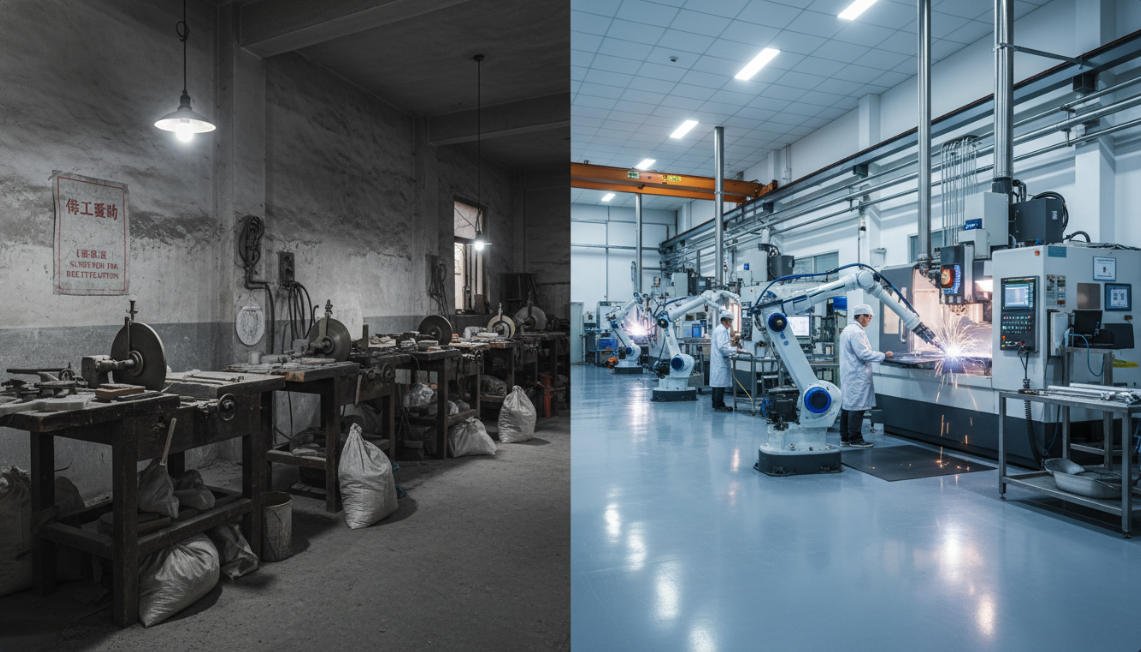
The March 2026 enforcement campaign did not emerge without regulatory precedent. China’s Ministry of Ecology and Environment (MEE) — the national authority responsible for environmental compliance enforcement — has progressively tightened industrial pollution controls across manufacturing regions since the revision of China’s Environmental Protection Law in 2015. Stone cutting, crystal grinding, and jade processing operations generate wastewater containing fine silica particulate, stone-cutting slurry, and chemical polishing residues that require compliant treatment systems to manage within regulated discharge standards. Small-scale workshops — the predominant facility type among jade gua sha producers — frequently lack the capital investment required to build and maintain compliant wastewater and dust-control infrastructure. When Huizhou municipal authorities conducted their post-CNY 2026 inspection sweep, these operations were the most structurally exposed. The enforcement action was consistent with the MEE’s documented pattern of intensifying compliance activity in the weeks following the Chinese New Year holiday period, when manufacturing resumes and inspection teams deploy.
What Actually Happened — and Why Most Jade Factories Were Unprepared
The Huizhou district of Guangdong province is not merely one of several jade gua sha production regions — it is the dominant one. A disproportionate share of the world’s jade gua sha tools, crystal gua sha tools, and related stone wellness products are manufactured within a tightly concentrated cluster of operations in this region. The structural problem is this: a large portion of these operations are small-scale workshops — artisan units that expanded organically alongside demand for stone gua sha products without formalizing their environmental infrastructure. When inspections began in March 2026, facilities lacking compliant wastewater treatment systems, dust-suppression equipment, and proper stone-cutting effluent management were ordered to halt or curtail production. Only manufacturers operating within designated industrial parks — where environmental infrastructure meets regulated government standards — were permitted to continue at full output capacity. This means you cannot assume your jade gua sha supplier is among the unaffected minority without explicitly verifying their facility classification. Can your current supplier document their industrial park registration and most recent environmental compliance certificate? If not, your lead times are already longer than they were three months ago — and you may not have been told.
The Numbers: 52% Capacity Decline and 60%+ Longer Lead Times
Based on supplier-network and peer-manufacturer data aggregated by Deyi Gems in March 2026, jade and crystal gua sha production capacity in Guangdong fell by approximately 52% within the first one to two months of enforcement activity. Lead times — which were already longer than those of stainless steel gua sha tools under normal operating conditions — extended by more than 60% on average across affected suppliers. To translate this into practical terms: if your jade gua sha supplier previously quoted a four-week production window, you should now plan for six to seven weeks at minimum — if they can fulfill the order at all. Several amethyst and rare-stone gua sha categories became effectively un-quotable during this period, with suppliers unable to commit to any delivery timeline. The consistency of this pattern across more than twelve independent manufacturing contacts in the region suggests the disruption is systemic, not isolated to a single facility or subregion.
Why Stainless Steel Gua Sha Tools Manufacturers Were Entirely Unaffected
The contrast is structurally significant — and it is not coincidental. Stainless steel gua sha manufacturers operate at an industrial scale, with formalized facility infrastructure embedded in compliant industrial estates from the outset of their operations. They employ standardized waste management processes, respond to regulatory changes through established compliance protocols, and are not organized around the small-workshop model that the March 2026 enforcement campaign disproportionately targeted. The environmental footprint of stainless steel fabrication — primarily metalworking coolants and cutting fluid management — is addressed through industrial-grade closed-loop treatment systems that small-scale jade workshops cannot replicate without substantial capital investment. This is a permanent structural difference in how stainless steel gua sha manufacturing and jade gua sha manufacturing are organized at the production level — not a temporary circumstance. For you as a wholesale buyer, this means sourcing from a stainless steel gua sha factory carries a materially lower regulatory disruption risk than sourcing from jade or crystal operations — and that risk differential belongs explicitly in your supplier evaluation framework.
Baseline Production Capacity: Stainless Steel Gua Sha Tools Outputs 225% of Jade Under Normal Conditions

The Automation Gap: Industrial Fabrication vs. Artisan Handcraft
Even before the March 2026 enforcement crisis, stainless steel gua sha tools held a decisive throughput advantage over jade gua sha tools at the manufacturing level. According to Deyi Gems’ internal production data from 2024 to 2025, stainless steel gua sha monthly output capacity runs at approximately 225% of jade gua sha output under normal operating conditions — with no regulatory disruption factored in. The driver is fundamental: stainless steel gua sha manufacturing is an industrial process. Tools are produced through automated CNC machining, stamping, and pressing operations where a single programmed production run yields thousands of dimensionally consistent units with minimal operator intervention per piece. Jade and crystal gua sha tools, by contrast, are produced through a handcraft process — skilled artisans cut, shape, grind, and hand-finish individual stones. This is genuinely skilled work that produces genuinely individual objects. But it is artisan production — not industrial production — and the throughput ceiling of artisan production is inherently lower, less scalable, and more sensitive to labor availability, raw material variability, and individual worker output rates. What does a 2.25x monthly output differential mean for your business? Your inventory replenishment cycle is faster, your buffer stock requirements are lower, and the working capital tied up in safety stock is reduced.
Steel as a Global Industrial Material — the Supply Infrastructure Advantage
The throughput advantage of stainless steel gua sha manufacturing is not merely a function of automation — it is also a function of raw material supply infrastructure. The World Steel Association reports that the global steel recycling rate exceeds 85%, making steel the most recycled industrial material on earth by volume. This continuous recycling loop means stainless steel raw material supply is not geographically constrained, seasonally variable, or dependent on the output of any single extraction site. A stainless steel gua sha factory can source material reliably from a global network of mill suppliers, maintain consistent input quality, and scale production rapidly when demand increases. This is a supply infrastructure advantage that no jade or crystal operation can replicate, because the raw material supply chains for geological resources simply do not function this way.
Lead Time as a Competitive Advantage in Gua Sha Wholesale
Lead time predictability is not simply an operational convenience in gua sha wholesale — it is a competitive advantage in markets where retail buyers increasingly impose replenishment timelines as a condition of account maintenance. The combination of automated production and higher baseline capacity allows stainless steel gua sha suppliers to commit to shorter, more reliable production windows. Surge orders — triggered by a seasonal campaign, an unexpected viral moment, or a large retail account activation — are far more absorbable by a stainless steel gua sha manufacturer than by a jade or crystal operation constrained by artisan capacity and raw material preparation timelines. If your current jade gua sha supplier is among the affected Huizhou operations, your lead time situation has deteriorated by over 60% in the past quarter alone. Even if they are among the industrial-park manufacturers who continued operating, their baseline lead times under normal conditions are structurally longer than those of a comparable stainless steel gua sha factory.
Price Stability: Why Stainless Steel Gua Sha Tools Pricing Is Predictable and Jade Is Not
Six-Month Price Volatility — The Data Comparison
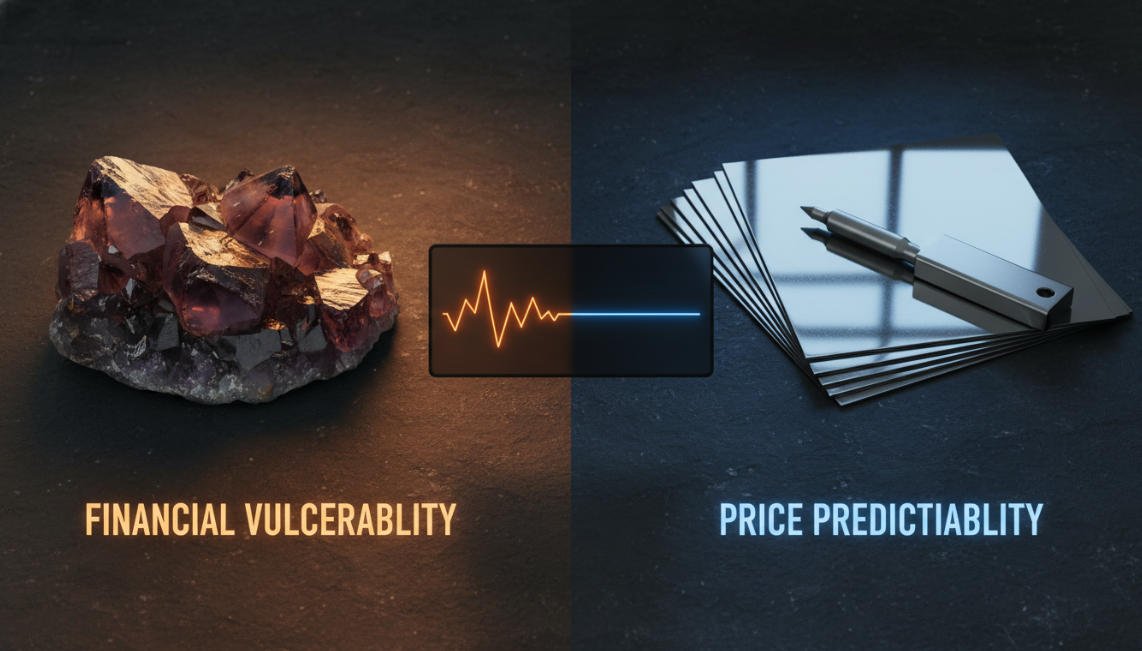
For wholesale buyers, price stability is not a secondary concern — it is a margin-protection issue that compounds across every purchase order you place. Deyi Gems’ internal pricing records from 2024 to 2025 show that stainless steel gua sha tools prices fluctuate by less than 5% over any given six-month period. Jade gua sha tools and crystal variants show typical price volatility of approximately 10% over the same window, driven by raw material price movements in the stone market. For scarce materials — amethyst being the most prominent current example — six-month price swings can exceed 30%. If your product catalog carries fixed or semi-fixed retail pricing, a 30% input cost swing in six months does not represent a manageable variance — it represents a structural threat to your gross margin on that SKU. Understanding why stainless steel is more price-stable requires understanding the difference in raw material supply dynamics between these two product categories — a difference that is geological, not commercial.
The Amethyst Case Study — What Raw Material Scarcity Looks Like in Practice
Amethyst gua sha tools offer the clearest current illustration of what raw material scarcity translates to at the wholesale level. If you have attempted to source amethyst gua sha tools in volume recently, you have likely encountered the same response across multiple suppliers: limited availability, extended timelines, or outright inability to provide a committed quote. This is because tradeable-quality amethyst raw material has contracted significantly on the commercial market. The Gemological Institute of America (GIA) classifies amethyst as a Type II colored gemstone — meaning inclusions and material variations are inherent to the stone — making consistent large-batch production difficult even when raw material is available. The United States Geological Survey (USGS), which tracks global gemstone production data, documents that colored gemstone output — including amethyst — is concentrated in a small number of geographic source regions, making supply highly sensitive to mining disruption, export policy changes, and regional geopolitical conditions. When raw material availability itself contracts, the wholesale category breaks down entirely.
This is not a temporary disruption specific to one season. The International Gem Society (IGS) documents the price sensitivity of amethyst to mine output fluctuations and geographic sourcing constraints — factors that directly affect the forward pricing risk you carry when amethyst gua sha tools are in your product mix. The amethyst situation is a leading indicator, not an outlier. Other jade and crystal categories face the same directional pressure as extraction becomes more difficult and compliant sourcing more expensive.
Why Stainless Steel Gua Sha Tools Raw Material Pricing Is Structurally More Stable
Stainless steel is an industrial alloy — primarily iron, chromium, and nickel — and all three primary components are globally traded commodities with liquid, transparent markets. Unlike gemstones and jade, which are geologically finite and cannot be recovered without material loss once processed, stainless steel is fully recyclable. Scrap stainless steel re-enters the production stream continuously, creating a supply buffer that moderates price spikes. The London Metal Exchange (LME) provides transparent price discovery for steel inputs, meaning market pricing is visible, auditable, and benchmarkable in ways that jade raw material pricing simply is not. The price you pay for stainless steel gua sha tools six months from now is statistically likely to be within 5% of today’s price — a level of predictability that supports confident catalog pricing, retail account management, and gross margin forecasting. That predictability is itself a measurable commercial asset.
Yield Rate and Material Loss: The Hidden Cost Advantage You Are Probably Not Accounting For
Why Yield Rate Matters More Than Unit Price in Wholesale Costing
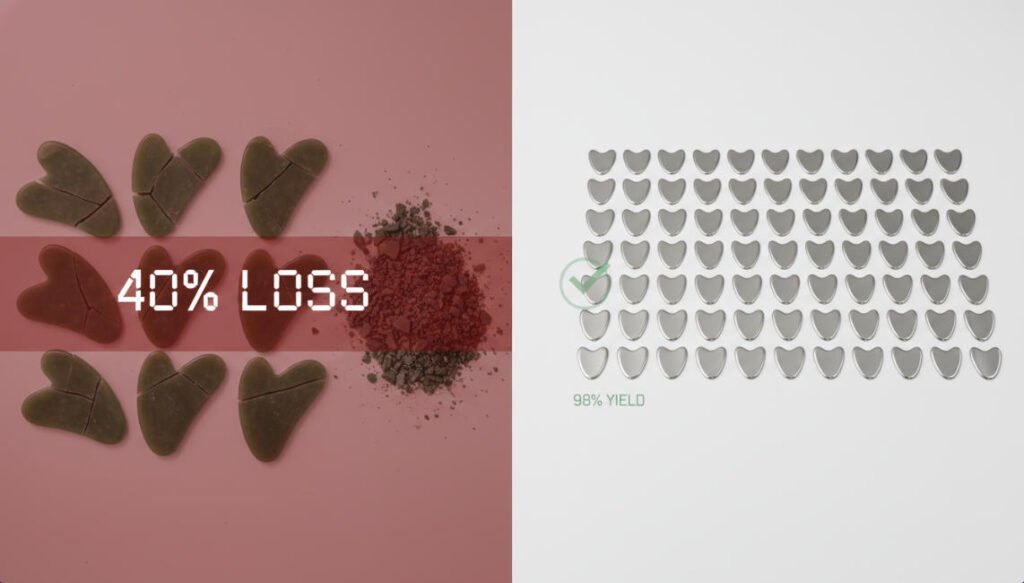
When evaluating stainless steel gua sha tools against jade gua sha tools on a cost basis, most wholesale buyers compare quoted unit prices. This is an incomplete comparison. The total cost of goods delivered to your warehouse includes the manufacturer’s yield rate and material loss — both of which are embedded in the unit price you are quoted, whether disclosed or not. A gua sha factory with a 60% yield rate on jade tools is, by definition, producing 40 unusable pieces for every 100 started — and the full cost of those 40 failed pieces is distributed across the 60 that ship to you. You are paying for 100 units of production effort and receiving 60 units of usable product. Understanding this dynamic fundamentally changes how you evaluate the price differential between stainless steel and jade gua sha wholesale pricing. You should request yield rate data from every stainless steel gua sha tools or jade gua sha manufacturer you evaluate — and treat an inability or unwillingness to provide it as a material due-diligence signal.
The Numbers: 98%+ vs. 60–80% Yield Rates
Deyi Gems’ production data from 2024 to 2025 shows that stainless steel gua sha tools achieve yield rates of 98% or above in standard production runs. For jade and crystal gua sha tools, 80% is considered a strong result — and it is not consistently achievable across all stone types. Certain brittle or inclusion-prone materials — including some jade varieties, aventurine, and fragile crystal types — produce yield rates below 60%. The Swiss Gemmological Institute (SSEF) has published research on the structural characteristics of nephrite and jadeite that explains this brittleness directly: the interlocking micro-crystalline structure of jade that makes it prized for carving also makes it susceptible to fracturing under the mechanical stress of shaped cutting and grinding operations. The GIA’s gemological research on nephrite and jadeite further documents the cleavage and fracture properties that translate directly into production loss rates in a manufacturing environment. This is not a manufacturing quality failure — it is a material physics reality that no gua sha factory can engineer away.
In practical terms: when you source jade gua sha tools, you are paying for a production process with a structural failure rate of 20% to 40%. When you source stainless steel gua sha tools, you are paying for a process with a failure rate of under 2%. That difference is absorbed directly into the unit cost you are quoted, whether the manufacturer discloses it or not.
Material Loss: Near-Zero for Stainless Steel Gua Sha Tools vs. a Minimum of 20% for Jade and Crystal
Beyond yield rate, material loss — raw material that cannot be recovered or re-entered into the production cycle after a defect — represents an additional embedded cost in jade gua sha manufacturing. When a jade or crystal piece fractures during production, the material cannot be remelted or recast: it is permanently lost. Deyi Gems’ production data indicates that jade and crystal gua sha manufacturing carries a minimum material loss rate of 20%, with some brittle stone types considerably higher. Stainless steel carries near-zero material loss: any off-spec or defective stainless piece is fully recyclable back into the raw material stream at close to full value — consistent with the World Steel Association’s documented recycling infrastructure data. The scrap does not go to waste; it goes back to the furnace. When a stainless steel gua sha tools manufacturer quotes you a price, that price is built on a production process with a 2% failure rate and 0% material waste. When a jade gua sha manufacturer quotes you a price, that price reflects a 20–40% failure rate and a minimum 20% permanent material loss. You can now calculate which is genuinely more cost-efficient at scale.
Consistency and Repeatability: What Batch Uniformity Means for Your Brand and Operations

One Mold, Thousands of Identical Units
For any wholesale buyer building a product brand — private label, white label, or proprietary SKU — product consistency across batches is a brand asset with measurable commercial value. When a customer receives a stainless steel gua sha tool that matches your product listing in weight, shape, edge profile, and surface finish, you have protected your review score, reduced your return rate, and reinforced your customer’s repeat purchase intent. Stainless steel gua sha tools deliver this consistency because the production process is mold-based and machine-executed. A single precision mold produces units with identical dimensions and finish — batch after batch, month after month. If you photograph one unit from a batch of five thousand, that photograph accurately represents all five thousand. Your product photography investment, your customer expectation-setting, and your return rate management all benefit directly from the dimensional precision that mold-based production delivers.
The Handcraft Variance Problem in Jade Gua Sha Production
Jade gua sha tools are handcrafted. This is a genuine characteristic of the production method — and it contributes meaningfully to the cultural and aesthetic value that makes jade tools appealing in specific market segments. However, handcrafting produces variation. Even a highly skilled artisan with years of experience produces pieces that differ from one another in shape, weight, surface smoothness, and edge curvature. The International Gem Society (IGS) notes that natural jade’s color, texture, and internal structure vary even within a single stone — meaning handcrafted output cannot achieve the dimensional uniformity that machine-based production delivers. For wholesale buyers selling jade gua sha tools at scale, this variation introduces a practical downstream challenge: your product listing cannot accurately represent every piece in a batch, and customer expectations will inevitably diverge from individual received items. This is not a problem you can solve through stricter quality control — it is inherent to handcraft production of variable natural stone.
Batch Consistency as an Operational Risk Management Tool
Consider the fulfillment implications of consistency at scale. If you are executing a purchase order for a retail chain requiring 2,000 identical gua sha tools with a planogram-specific size requirement, a stainless steel gua sha tools manufacturer can deliver that order with the dimensional uniformity to satisfy retail specification sheets. A jade gua sha factory — even a well-run, industrial-park-based operation — cannot guarantee the same uniformity across a batch of that size. The variation is inherent to the material and the production method, and it is documented by gemological research. For your customers, every unit shipped from a stainless steel gua sha manufacturer represents the same product experience. For units shipped from a jade gua sha operation, the experience will vary by piece. At small batch sizes, this is manageable. At wholesale scale, it becomes a persistent quality exception process with real labor cost attached.
How to Independently Verify the Data in This Article

This section exists because you should not take any supplier’s internal data at face value — including ours. The following steps allow you to independently stress-test the core claims made in this article using your own supplier contacts, market intelligence, and publicly available sources. If the manufacturing advantage of stainless steel gua sha tools is as structurally durable as this article argues, the verification process should confirm it — from sources entirely independent of Deyi Gems.
1 — Verify the Huizhou Enforcement Disruption
Contact two to three of your current jade or crystal gua sha suppliers in Guangdong and ask them directly: what is your current production capacity relative to Q4 2025? Have you experienced any enforcement-related production restrictions since February 2026? Can you provide a current environmental compliance certificate for your facility? The responses will tell you whether the 52% capacity decline figure reflects conditions your own supply chain is experiencing. If suppliers are reluctant to answer or cannot provide compliance documentation, that response is itself informative. For regulatory context, you can review the MEE’s published enforcement action records to understand the scope of China’s ongoing environmental compliance campaign in manufacturing regions.
2 — Verify the Yield Rate Gap with Your Current Supplier
Ask your jade gua sha manufacturer for their documented yield rate on your specific material type. A professionally operated gua sha factory should be able to provide QC rejection logs by batch. If they quote a yield rate above 85% for a brittle stone type — aventurine, certain crystal varieties, thin-profile jade — ask to see the supporting batch records. Cross-reference their figure against the structural material properties documented by the SSEF and GIA. If a supplier’s claimed yield rate is materially inconsistent with the documented fracture characteristics of their material, you have identified either a measurement methodology gap or an accuracy concern.
3 — Verify the Price Volatility Data Through Your Own Purchase History
Pull your own purchase order history for jade and stainless steel gua sha tools over the past twelve months and calculate the unit price variance by SKU. If you have been sourcing jade or crystal variants, your invoices will tell you whether your input costs have moved by more than 10% in any six-month window. For steel price benchmarking, the LME’s publicly available price history allows you to track stainless steel input cost movements over time. For amethyst and rare-crystal pricing, the USGS Mineral Resources program publishes annual gemstone market data that contextualizes the supply constraints driving price volatility in this category.
4 — Verify the Production Capacity Differential
Request a production capacity sheet from both a stainless steel gua sha manufacturer and a jade gua sha manufacturer for the same nominal order quantity. Ask each: what is your maximum monthly unit output for this SKU? What is your current lead time for a first production run? What is your lead time for a repeat reorder? The capacity differential will emerge directly from the responses — without requiring you to rely on any figure provided by Deyi Gems. The 225% output premium reported in our internal data should be verifiable in directional terms through a straightforward capacity inquiry with two independent manufacturers.
When Stainless Steel Gua Sha Tools Is the Defensible Choice
Five Dimensions, One Consistent Answer
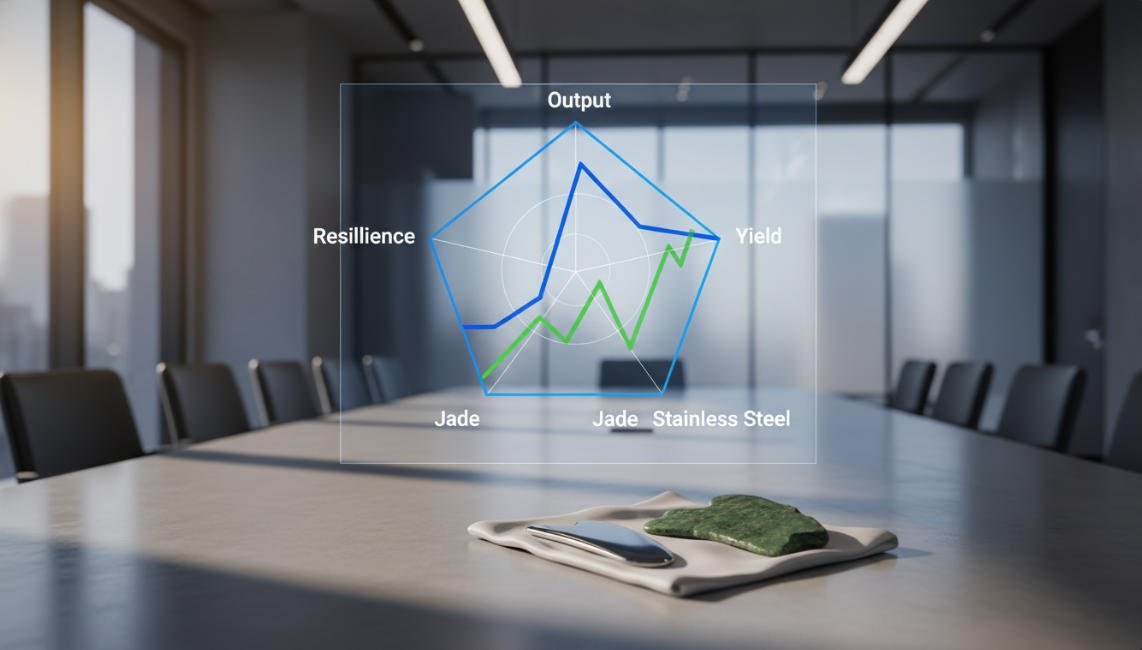
Across supply chain resilience, production throughput, price stability, yield rate, and unit consistency, stainless steel gua sha tools deliver measurably stronger outcomes than jade gua sha tools on every quantifiable manufacturing dimension. The data — a 52% jade capacity decline triggered by one government enforcement action in March 2026, a 225% stainless output premium under normal conditions, sub-5% price volatility over six months, a 98%+ yield rate, and near-zero material loss — points in a single direction. If you are making a gua sha wholesale sourcing decision on the basis of rational, measurable criteria — supply security, cost predictability, lead time, scalability, and product consistency — the evidence supports one answer.
| Dimension | Stainless Steel Gua Sha | Jade / Crystal Gua Sha |
|---|---|---|
| Supply chain resilience | High — unaffected by March 2026 Huizhou enforcement | Low–Medium — 52% capacity loss in March 2026 |
| Monthly output vs. baseline | ~225% of jade output | Baseline |
| Price stability (6 months) | ≤5% variance | 10–30%+ variance |
| Yield rate | ≥98% | 60–80% (some materials below 60%) |
| Material loss rate | ~0% (fully recyclable) | ≥20% minimum |
| Unit-to-unit consistency | Very high (mold-based production) | Moderate (handcraft variation) |
| Raw material renewability | Fully recyclable industrial alloy | Non-renewable geological resource |
Source: Deyi Gems internal production records and peer-manufacturer data, 2024–2025. Not a third-party industry authority report. See the verification section above to cross-reference independently.
When Jade Gua Sha Tools Are Still the Right Choice
This analysis is not an argument that jade gua sha tools should be removed from your product mix. Jade carries genuine commercial value: its cultural resonance, natural-stone aesthetic, and premium positioning speak to consumer segments that stainless steel cannot replicate. If your brand is built around premium gifting, traditional wellness culture, or a natural-material retail narrative, jade belongs in your catalog. However, if you continue sourcing jade, source exclusively from gua sha manufacturers operating within verified industrial parks with documented environmental compliance — not from small-workshop operations that the March 2026 enforcement campaign has disproportionately disrupted. Build longer lead time buffers into your inventory planning, maintain higher safety stock levels, and factor the working capital cost of that additional inventory into your total cost of ownership calculation. The case for jade is aesthetic and cultural — on every operational and financial metric, the data consistently favors stainless steel.
How to Evaluate a Gua Sha Manufacturer Before You Commit
When evaluating any gua sha manufacturer — whether for stainless steel or jade — these questions give you a manufacturing-maturity signal that goes beyond reviewing a sample kit. Ask for their facility classification: industrial park or independent workshop? Ask for documented yield rate data and their policy for handling defective units. Ask whether they can provide mold-based production records that verify batch consistency. Ask what their current environmental compliance status is and when it was last formally certified. A gua sha factory that cannot answer these questions clearly is communicating something important about its operational structure. A manufacturer that answers them with documented production data — yield records, compliance certificates, batch consistency logs — is giving you a supply chain you can build on.
About Deyi Gems — 12 Years of Source Manufacturing in Gua Sha Tools
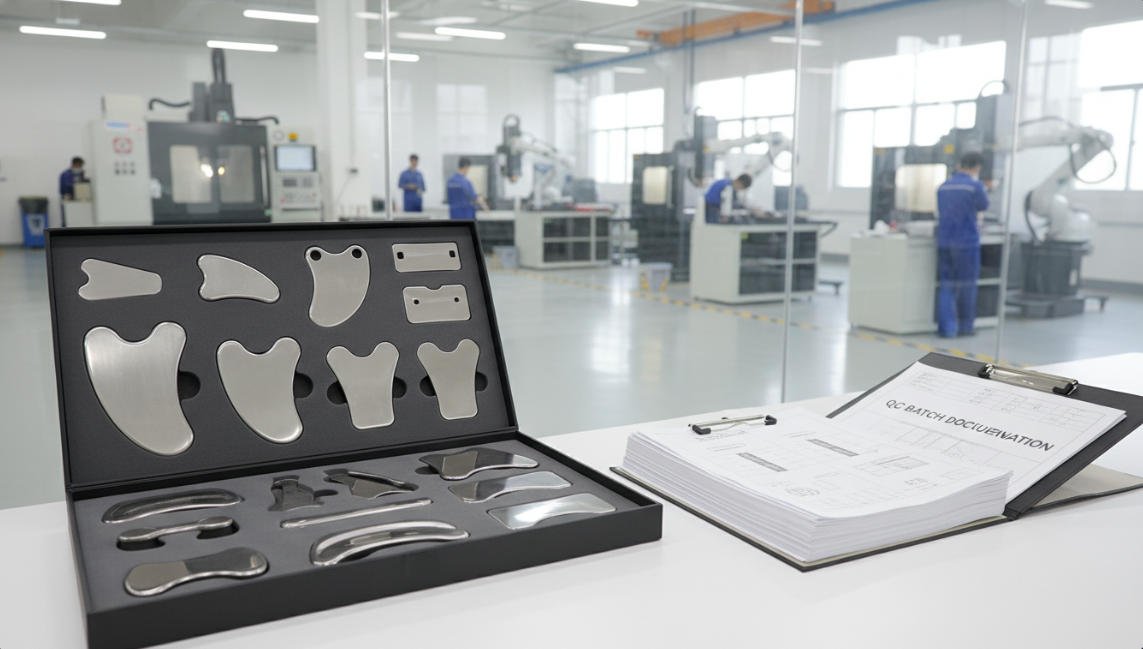
Deyi Gems has designed, manufactured, and supplied gua sha tools for over 12 years, operating from an industrial-park-based facility in Guangdong province that maintained full production output through the March 2026 enforcement period. The company’s operational focus is the integration of production quality standards with manufacturing efficiency — a combination that positions it specifically for wholesale buyers who require consistent product output and reliable supply chain performance across repeated order cycles. All production data cited in this article is drawn from Deyi Gems’ internal records and peer-network data collected between 2024 and 2026. Readers are actively encouraged to validate these figures using the verification framework in the preceding section.
What “Source Manufacturer” Means for Your Cost Structure
When you source stainless steel gua sha tools from a gua sha factory that both designs and manufactures its own products, you remove the margin layers that trading companies and sourcing agents add to wholesale pricing. You also gain direct access to production tooling capabilities, quality control records, and batch documentation — the kind of manufacturing transparency that wholesale buyers and retail chain procurement teams increasingly require for supplier due diligence. Deyi Gems operates its own tooling room, maintains production consistency records by batch number, and provides yield rate documentation on request. This means your supplier evaluation is grounded in verifiable production data, not samples and unsubstantiated claims.
Request a Sample Kit or Wholesale Pricing Consultation
If you are evaluating stainless steel gua sha tools for wholesale, private label, or OEM production, your next step is straightforward: request a sample kit to assess production quality directly, or request a wholesale pricing sheet to evaluate landed cost against your current supplier. A production capacity consultation can help you determine whether output volume aligns with your ordering requirements before you commit. Contact Deyi Gems directly to begin the conversation.
Editorial and Data Transparency Note: All Deyi Gems production statistics referenced in this article — yield rates, capacity data, price volatility ranges, and the March 2026 enforcement impact figures — are derived from internal manufacturing records and peer-manufacturer network data collected between 2024 and 2026. These figures have not been independently audited by a third-party industry body. External institutional sources (GIA, IGS, SSEF, USGS, LME, World Steel Association, China MEE) are cited for material science, gemological, commodity pricing, and regulatory reference purposes only — these institutions have not reviewed or endorsed the production data presented by Deyi Gems. Readers are encouraged to treat all proprietary figures as directional indicators and to verify independently using the framework provided in this article.
Stainless Steel Gua Sha Tools Vs Jade Gua Sha Tools Faqs
1. Why are jade gua sha tool lead times so much longer right now?
In March 2026, Huizhou municipal authorities launched an environmental compliance enforcement campaign targeting stone and crystal processing facilities in Guangdong — China’s primary gua sha production region. Operations failing to meet wastewater and dust-control standards were ordered to halt production. As a result, jade and crystal gua sha capacity dropped approximately 52%, and average lead times extended by over 60%. Stainless steel gua sha manufacturers, operating within compliant industrial facilities, were entirely unaffected.
2. Are stainless steel gua sha tools actually cheaper than jade at the wholesale level?
The quoted unit price of stainless steel gua sha tools is often comparable to or lower than jade equivalents — but the more significant cost advantage lies beneath the surface. Jade gua sha manufacturing carries a yield rate of 60–80% and a minimum 20% permanent material loss, both of which are embedded in the unit price you pay. Stainless steel delivers a 98%+ yield rate and near-zero material loss through full recyclability. When total production cost per deliverable unit is calculated, stainless steel is consistently more cost-efficient at wholesale scale.
3. How stable is stainless steel gua sha wholesale pricing over time?
Based on Deyi Gems’ internal procurement records from 2024 to 2025, stainless steel gua sha tools pricing fluctuates by less than 5% over any six-month period. Jade and crystal variants typically move 10% or more over the same window, and scarce materials such as amethyst have shown swings exceeding 30%. For wholesale buyers managing fixed retail pricing or long-term supply contracts, stainless steel offers a level of cost predictability that stone-based materials structurally cannot match.
4. Can jade gua sha tools still be a viable product for wholesale buyers?
Yes — but with conditions. Jade carries genuine commercial value in premium gifting, cultural wellness, and natural-material retail segments that stainless steel cannot replicate. However, buyers continuing to source jade should verify that their supplier holds industrial park facility status and current environmental compliance certification. They should also build extended lead time buffers and higher safety stock into their inventory planning to absorb the supply volatility that is inherent to stone-based gua sha sourcing.
5. How do I verify a gua sha manufacturer’s production claims before placing an order?
Request three specific documents from any gua sha manufacturer you are evaluating: their facility classification certificate confirming industrial park registration, batch-level QC records showing yield rate data for your material type, and a recent environmental compliance certificate dated within the past twelve months. A manufacturer unable or unwilling to provide these documents is signaling an operational transparency gap. Cross-reference yield rate claims against material science data published by the GIA or SSEF to confirm that quoted figures are consistent with the known physical properties of the stone in question.