
When evaluating stainless steel gua sha wholesale options, the most dangerous threats to your business are not the ones you can see during an initial sample inspection — they are the ones deliberately engineered to remain invisible. In a 2025 internal market audit, 30 gua sha tools from 30 different suppliers were purchased and independently tested. Every single one was labeled “304 stainless steel.” The results were unambiguous: among the 10 lowest-priced samples — those priced more than 20% below prevailing wholesale benchmarks — 8 out of 10 failed material verification entirely. Even within the standard price bracket, 4 out of 10 did not meet the 304 stainless steel specification they claimed. This is not an anecdote. It is a pattern. And if your procurement process relies on supplier self-declaration, you are already exposed.
The stainless steel gua sha market has expanded rapidly alongside global wellness trends, and that growth has attracted manufacturers whose primary competitive advantage is not quality — it is the appearance of quality. For any buyer operating in wholesale volumes, the financial and reputational consequences of sourcing adulterated or misrepresented products are compounding: customer returns, brand liability, regulatory scrutiny, and the loss of accounts that took years to build. Understanding where the fraud occurs, and how to detect it before it reaches your warehouse, is not optional due diligence. It is the foundational business risk you need to address before your next purchase order is signed.
- What a 30-Supplier Market Test Revealed About Stainless Steel Gua Sha Wholesale Quality
- Risk 1 — Stainless Steel Gua Sha Wholesale Material Grade Fraud
- Risk 2 — The Stainless Steel Gua Sha WholesaleSample Bait-and-Switch: Why a Perfect Sample Just Beginning
- Risk 3 — Stainless Steel Gua Sha Wholesale Polishing Grade Fraud: When "Mirror Finish" Becomes a Marketing Term
- Risk 4 — Stainless Steel Gua Sha Wholesale for Weight and Thickness Reduction
- Risk 5 — Batch Inconsistency: The Slow Erosion That Destroys Long-Term Supplier Relationships
- How to Identify a Trustworthy Stainless Steel Gua Sha Manufacturer — A Practical Evaluation Framework
- About Deyi Gems — 12 Years of Source-Level Stainless Steel Gua Sha Manufacturing
What a 30-Supplier Market Test Revealed About Stainless Steel Gua Sha Wholesale Quality
The internal audit referenced above was structured around three price tiers. The first tier — suppliers pricing more than 20% below standard stainless steel gua sha wholesale rates — produced the most damaging results: 8 of 10 tools confirmed as material substitution fraud, with the remaining 2 meeting 304 specifications but exhibiting measurably substandard surface polishing. The second tier — suppliers within a 20% band of standard pricing — showed 4 of 10 failing material verification, with an additional 2 passing material tests but displaying polishing quality inconsistencies. The third tier — suppliers pricing more than 20% above standard stainless steel gua sha wholesale benchmarks — produced the cleanest results: all 10 met 304 stainless steel standards, with 9 demonstrating acceptable polishing and only 1 falling short on surface finish.
It is important to be transparent about the limitations of this data. The sample size of 30 is statistically narrow, and the testing methodology is internal rather than third-party accredited. These figures should be treated as directional evidence, not industry-wide benchmarks. That said, the directional signal is consistent with what experienced sourcing professionals observe repeatedly: price compression below a material threshold is almost always achieved through material substitution, not operational efficiency. The question is not whether fraud exists in the stainless steel gua sha wholesale supply chain — the question is whether your current verification process is capable of catching it.
This means you need a procurement framework that goes beyond certificate requests and visual inspection, because neither of those methods is sufficient to detect what experienced counterfeiters have spent years learning to disguise.
30-Supplier Market Audit Results (June 2025)
| Price Tier | Sample Count | Confirmed Material Fraud | Passed 304 Verification | Poor Polishing (304 Confirmed) | Full Pass |
|---|---|---|---|---|---|
| >20% Below Benchmark | 10 | 8 (80%) | 2 (20%) | 2 of 2 passed | 0 (0%) |
| Within ±20% of Benchmark | 10 | 4 (40%) | 6 (60%) | 2 of 6 passed | 4 (40%) |
| >20% Above Benchmark | 10 | 0 (0%) | 10 (100%) | 1 of 10 passed | 9 (90%) |
| Total | 30 | 12 (40%) | 18 (60%) | 5 (28% of passed) | 13 (43%) |
Data source: Deyi Gems internal procurement audit, June 2025. Sample size is limited (n=30). Findings are directional and not statistically representative of the broader market.
A 6-Week Salt Water Immersion Test That Reframes the Material Risk Conversation
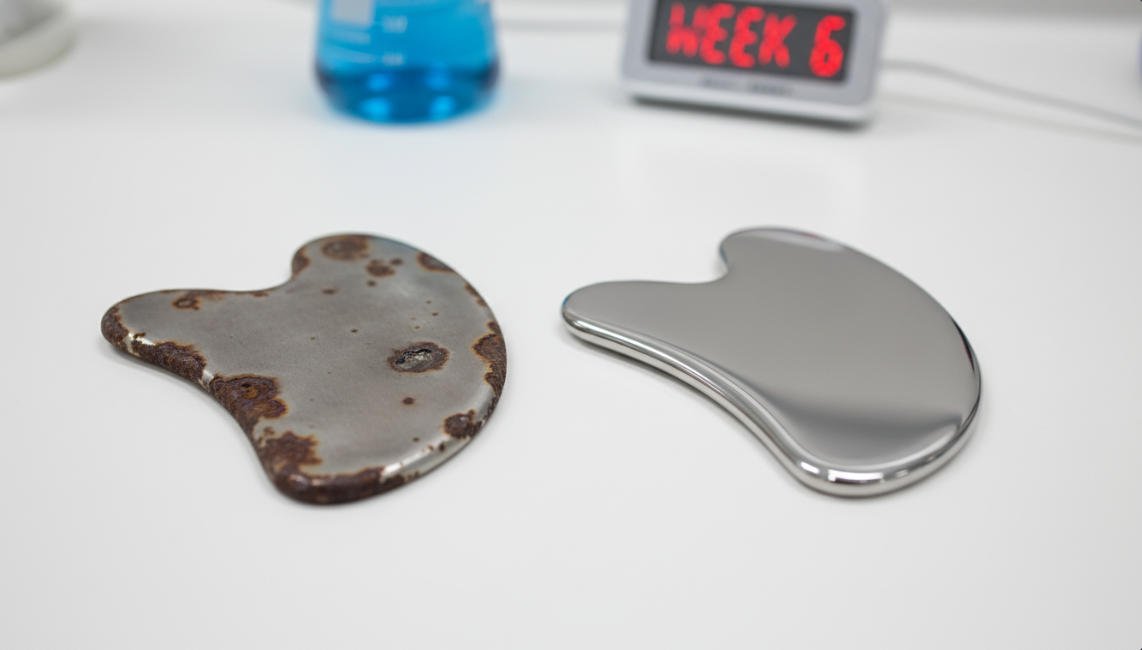
To move beyond price-tier analysis, a parallel material durability test was conducted in the same period. Two groups of 10 gua sha tools — one manufactured from 201 stainless steel, one from 304 stainless steel — were submerged in identical saline solutions under controlled conditions. The 201 stainless steel group began showing surface rust in individual samples by Week 2. By Week 3, 5 out of 10 exhibited visible corrosion. The deterioration accelerated: by Week 5, 9 out of 10 had developed rust points, and by Week 6, every sample in the 201 group showed measurable surface degradation. The 304 stainless steel group showed zero corrosion across the entire two-month observation window.
Why does this matter to your business specifically? Because your end customers are not using gua sha tools in controlled lab conditions — they are using them in humid environments, with skincare serums and oils, repeatedly over months and years. A tool that begins rusting within weeks of regular use does not just generate refund requests. It generates negative reviews that suppress organic conversion, social media complaints that erode brand credibility, and in markets with cosmetic tool safety regulations, potential liability exposure. According to ASTM International’s standard specifications for stainless steel, grade differentiation between 201 and 304 alloys is defined by nickel and chromium content ratios — differences that are invisible to the naked eye but structurally decisive in terms of corrosion resistance and long-term material integrity.
This means that accepting a supplier’s verbal or printed “304 SS” claim, without third-party material verification, is accepting a risk whose consequences are paid for not by your supplier — but by your customers, and ultimately, by your brand.
Salt Water Immersion Corrosion Test: 201 SS vs. 304 SS (June 2025)
| Week | 201 Stainless Steel (n=10) — Rust Points Detected | 304 Stainless Steel (n=10) — Rust Points Detected |
|---|---|---|
| Week 2 | 2 / 10 samples (20%) | 0 / 10 samples (0%) |
| Week 3 | 5 / 10 samples (50%) | 0 / 10 samples (0%) |
| Week 4 | 7 / 10 samples (70%) | 0 / 10 samples (0%) |
| Week 5 | 9 / 10 samples (90%) | 0 / 10 samples (0%) |
| Week 6 | 10 / 10 samples (100%) | 0 / 10 samples (0%) |
| Week 8 (Final) | — | 0 / 10 samples (0%) |
Both groups submerged in identical saline solution concentration under controlled ambient conditions. 304 SS group observed for a total of 8 weeks with zero corrosion detected across all samples.
Risk 1 — Stainless Steel Gua Sha Wholesale Material Grade Fraud
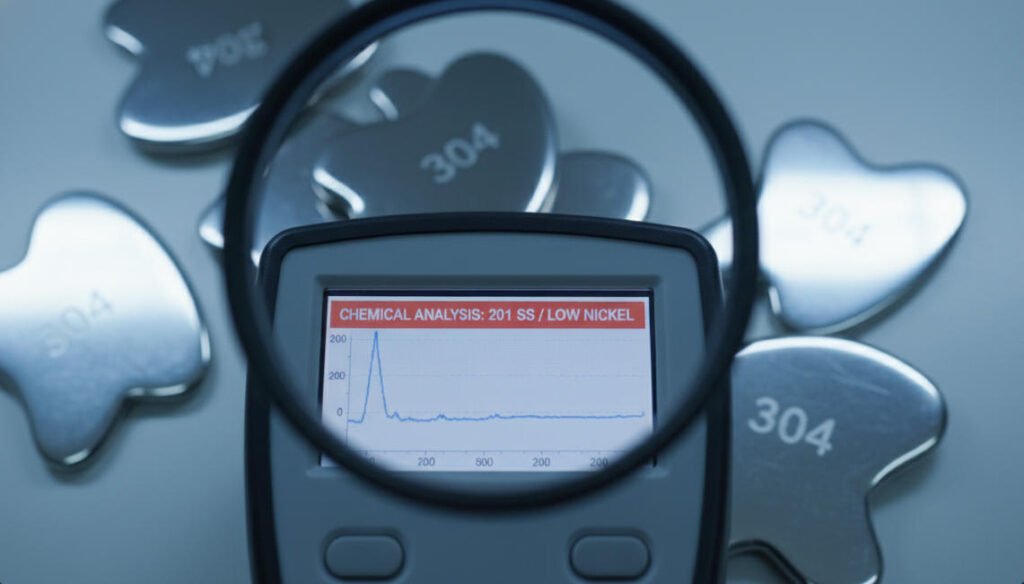
Material grade fraud is the most financially consequential risk in the stainless steel gua sha wholesale supply chain, precisely because it operates within the gap between what suppliers certify and what buyers can verify without specialized equipment. The substitution logic is straightforward: 201 stainless steel costs meaningfully less than 304, and 304 costs less than 316. A supplier who replaces 304 with 201 while charging 304 pricing captures that margin difference on every unit shipped. At wholesale volumes, that margin can represent thousands of dollars per container. The buyer absorbs the quality shortfall. The supplier captures the profit. And because the visual difference between grades is negligible to the untrained eye — and sometimes even to trained ones — the substitution frequently goes undetected until customer complaints begin accumulating months later.
The internal market test described in the opening section of this article quantified this dynamic with uncomfortable precision. But the broader industry context makes the finding even more significant. According to material science data published by ASM International, the nickel content differential between 201 and 304 stainless steel — typically 1% versus 8-10.5% respectively — produces dramatically different outcomes in corrosion resistance, skin contact safety, and long-term structural integrity. That is not a marginal difference in specification. It is a fundamental difference in material class. When a gua sha tool enters direct, repeated contact with facial skin, that difference translates into measurable allergy risk, accelerated surface degradation, and the release of metal ions that no responsible beauty brand should be delivering to its customers.
Understanding the Grade Hierarchy: 201, 304, and 316 Stainless Steel in the Context of Gua Sha Manufacturing
Stainless steel is not a single material — it is a family of iron-based alloys, and the differences between grades are chemically and mechanically significant. In the context of gua sha tools designed for direct skin contact, three grades dominate the market conversation: 201, 304, and 316. Each represents a different compromise between cost, corrosion resistance, and biocompatibility, and understanding that hierarchy is the prerequisite to evaluating any stainless steel gua sha supplier’s claims accurately.
Grade 201 sits at the bottom of the relevant hierarchy. It substitutes manganese for a significant portion of the nickel content found in higher grades, which reduces raw material cost but also reduces corrosion resistance and increases the risk of surface oxidation in humid or chemically active environments. For gua sha applications — where tools come into regular contact with sweat, oils, and skincare actives — 201 is a material that fails the basic durability and safety threshold. Grade 304, by contrast, contains 18% chromium and 8-10.5% nickel, a composition that provides the passive oxide layer responsible for genuine corrosion resistance. It is the accepted minimum standard for cosmetic tools intended for repeated skin contact, and it is the grade against which the majority of wholesale buyers calibrate their procurement specifications. Grade 316 adds molybdenum to the 304 composition, which enhances resistance to chloride corrosion and makes it the preferred option for medical-grade and marine-environment applications. While 316 represents a genuine quality premium over 304, the most critical risk in the stainless steel gua sha wholesale market is not buyers failing to upgrade to 316 — it is buyers being sold 201 while paying for 304.
The Specialty Steel Industry of North America (SSINA) maintains published technical resources on stainless steel grade differentiation that provide an independently verifiable foundation for evaluating supplier claims. Any procurement process that cannot reference external grade standards is a procurement process that depends entirely on supplier honesty — which, as the market test data demonstrates, is not a reliable variable.
How to Detect Stainless Steel Grade Fraud Before Your Container Leaves the Port
The most common buyer response to material fraud risk is to request a material certificate from the supplier. This approach has significant limitations. Material certificates can be falsified, reused from different batches, or issued for raw material that was later substituted during the manufacturing process. A certificate is a document — it verifies what a supplier is willing to put in writing, not what the physical product in your shipment actually contains. Your verification process needs to go further than paperwork.
The most reliable detection method available to stainless steel gua sha wholesale buyers is X-Ray Fluorescence (XRF) testing, a non-destructive analytical technique that measures the elemental composition of a metal sample and produces a grade-level determination within minutes. XRF testing equipment is available through third-party quality assurance firms in major manufacturing hubs, and the cost of testing a representative batch sample is negligible relative to the cost of receiving a fraudulent shipment. If you are sourcing from a stainless steel gua sha manufacturer for the first time, XRF testing of pre-shipment samples should be a non-negotiable contractual requirement, not an optional upgrade. The ASTM E1476 standard provides the technical framework for XRF analysis of stainless steel alloys and can serve as a reference specification when communicating testing requirements to third-party inspection firms.
A secondary verification layer is the magnet test — but it must be applied with an understanding of its limitations. High-manganese grades like 201 are sometimes weakly magnetic, and some 304 alloys develop slight magnetism after cold-working during manufacturing. The magnet test can screen out obvious substitutions, but it is not a substitute for XRF analysis. Think of it as a first filter, not a final verdict. Beyond material testing, you should also be evaluating the manufacturing context: a gua sha factory operating at price points that cannot support 304-grade raw material procurement is almost certainly not supplying 304-grade finished products, regardless of what the specification sheet says. Price is not proof of quality — but price that is structurally incompatible with claimed material cost is a reliable indicator of fraud.
This means your supplier evaluation process should combine documentary review, physical XRF testing, and price-structure analysis as integrated components — not treat any one of them as a standalone safeguard.
The Allergy and Skin Safety Dimension of Material Grade Selection
Beyond corrosion and durability, material grade selection in gua sha tools carries a direct skin safety implication that is increasingly relevant in markets with cosmetic product regulations. Nickel is the most common cause of contact dermatitis in metal-containing consumer products, according to data published by the American Academy of Dermatology. While 304 stainless steel contains nickel as a compositional element, the stable passive oxide layer formed by its chromium content effectively limits nickel ion release under normal use conditions. Lower-grade alloys with disrupted or thinner oxide layers — particularly those that have begun to corrode — release metal ions at rates that can trigger sensitization responses in users with nickel sensitivity.
For beauty brands and wellness distributors sourcing gua sha safe tools for end consumers, this is not a theoretical concern. It is a liability question. The European Union’s REACH regulation, administered by the European Chemicals Agency (ECHA), imposes strict limits on nickel release rates for products intended for prolonged skin contact. A tool manufactured from 201 stainless steel and experiencing surface corrosion may exceed those limits — meaning it is not just a quality problem, it is potentially a regulatory compliance failure in your target market.
This means selecting a stainless steel gua sha manufacturer who can demonstrate both the material grade used and the surface integrity of finished products is not a preference — it is a compliance prerequisite for any buyer operating in regulated markets.
Risk 2 — The Stainless Steel Gua Sha WholesaleSample Bait-and-Switch: Why a Perfect Sample Just Beginning
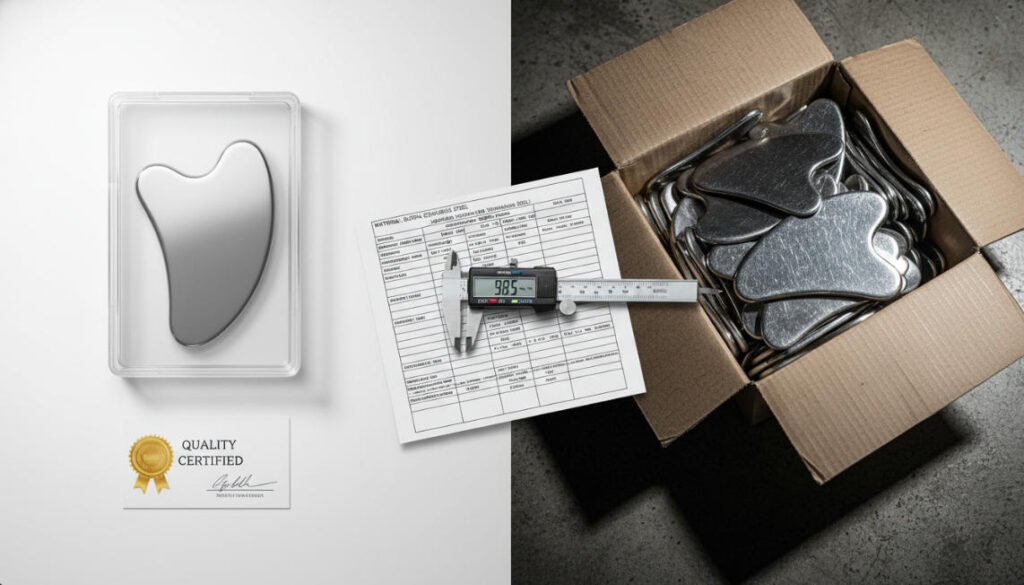
If material grade fraud is the most financially consequential risk in stainless steel gua sha wholesale sourcing, then sample-to-bulk inconsistency is the most psychologically disarming. It is disarming because it exploits the very process buyers use to protect themselves. You request a sample. The sample arrives and performs exactly as specified — the weight is correct, the finish is clean, the edges are smooth, the material verification passes. You approve the sample and place the bulk order. Six weeks later, a container arrives at your warehouse containing products that are measurably different from what you approved. The polish is duller. The edges feel slightly rougher. The weight tolerance has drifted. Individual units that would have failed your sample inspection are now distributed across 5,000 pieces of finished inventory.
This is not a hypothetical scenario. It is the most consistently reported sourcing failure among wholesale buyers of stainless steel beauty tools, and it has a structural explanation that goes beyond individual supplier dishonesty. The production logic behind sample manufacturing and bulk manufacturing are fundamentally different. Samples are produced in quantities of 1 to 10 units, often by experienced technicians who hand-select materials, apply additional polishing steps, and exercise quality judgment at each stage because the sample’s purpose is to win a contract. Bulk production runs are optimized for throughput — materials are processed in batches, polishing is mechanized, and quality control is statistical rather than individual. The sample represents what a supplier’s best workers can achieve under ideal conditions. The bulk order represents what the production line delivers under commercial pressure. These are not the same standard, and no amount of goodwill on the supplier’s part eliminates that structural gap without explicit contractual and procedural controls.
Why “We’ll Match the Sample” Is Not a Contractual Standard
The phrase “we will match the approved sample” appears in supplier communications with high frequency and legal meaninglessness. Without quantified specifications attached to the sample approval — specific weight tolerances, surface roughness parameters, material grade verification requirements, and defined acceptable variance ranges — the phrase commits the supplier to nothing that can be objectively measured or legally enforced. A bulk shipment that is 15% lighter than the approved sample, with a polishing finish that falls one grade below mirror standard, can still be argued to “match the sample” if your contract does not define those parameters in measurable terms.
Your sample approval process needs to generate a specification document, not just a physical approval. Every parameter that matters to your product quality should be quantified at the point of sample sign-off: material grade with XRF verification reference, weight in grams with acceptable tolerance band, thickness at defined measurement points, surface roughness grade, edge radius specification, and any surface treatment details. This document becomes the enforceable standard against which bulk production is measured. Without it, you are sourcing on trust rather than specification — and trust, at wholesale volumes, is a cost center waiting to be discovered. Any reputable stainless steel gua sha manufacturer should be willing to co-sign a detailed product specification sheet as a condition of order placement. Reluctance to do so is itself a meaningful signal.
Five Contractual Controls That Protect Your Stainless Steel Gua Sha Wholesale Order from Sample Divergence
Protecting your bulk order from sample-to-production drift requires contractual mechanisms, not just supplier relationship management. The first and most fundamental control is sealed sample retention: both buyer and supplier retain physically sealed, signed reference samples that serve as the objective comparison standard for any dispute resolution. The second control is pre-shipment inspection rights — specifically, the contractual right to commission a third-party quality inspection of finished goods before the shipment leaves the factory, with authority to reject non-conforming units at the supplier’s cost. Organizations such as SGS and Bureau Veritas operate inspection services in major Chinese manufacturing regions and can execute pre-shipment audits against your defined specification document.
The third control is batch-level material certification — requiring the supplier to provide material test reports generated from the same raw material batch used in your specific production run, not a generic grade certificate issued months earlier. The fourth control is a defined non-conformance remedy clause: if the bulk shipment fails to meet the agreed specification on any measurable parameter, the contract specifies whether the remedy is replacement, price adjustment, or return at supplier cost — and that remedy is triggered by objective measurement, not negotiation. The fifth control is a production monitoring provision for repeat orders, which grants the buyer the right to conduct unannounced factory audits during production — a provision that most gua sha factory operations will accept from serious long-term partners, and that opportunistic suppliers will resist. The pattern of resistance is itself diagnostic.
This means that before you place your next stainless steel gua sha wholesale order, you have the ability to install five specific contractual mechanisms that collectively close the sample-to-bulk gap — and the absence of any one of them represents a gap your supplier can exploit without technical breach of contract.
Risk 3 — Stainless Steel Gua Sha Wholesale Polishing Grade Fraud: When “Mirror Finish” Becomes a Marketing Term
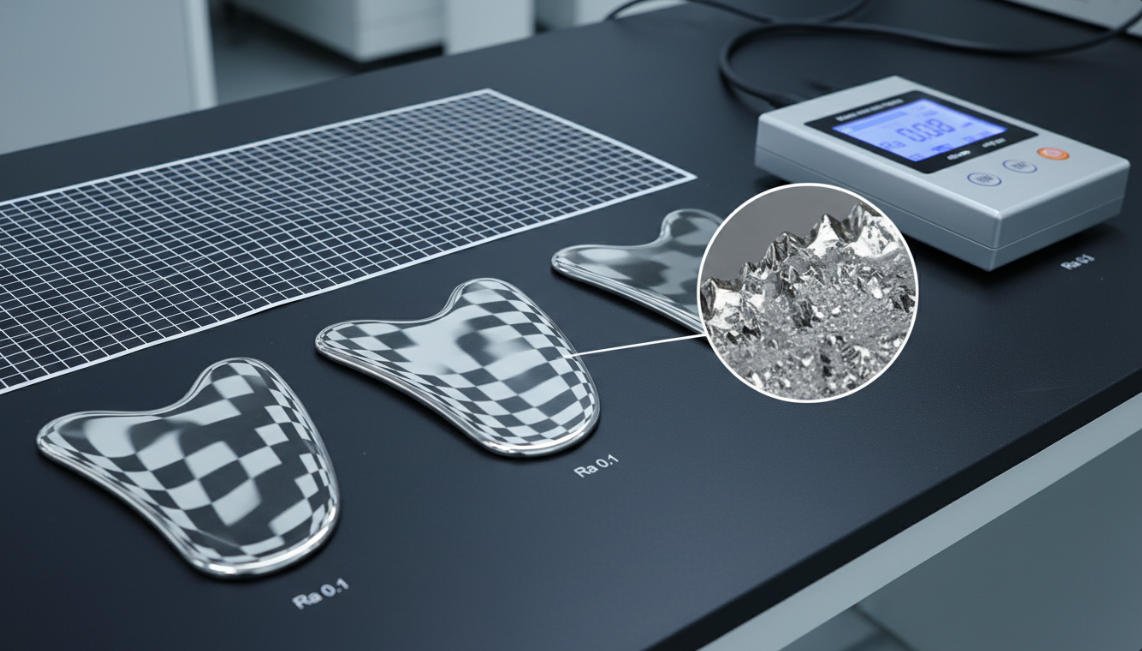
Surface polishing is the quality variable in gua sha tool manufacturing that is most directly connected to end-user safety, and it is simultaneously the variable most commonly misrepresented in stainless steel gua sha wholesale supplier communications. The term “mirror finish” is used liberally across supplier catalogs, product listings, and sample descriptions — but in the absence of a defined surface roughness standard, it is a subjective descriptor that can be applied to any surface that reflects light at a casual glance. The technical reality is considerably more specific. Surface finish in precision metal manufacturing is measured by Ra value — the arithmetic average of surface roughness deviations from a mean line, expressed in micrometers. A genuine mirror polish on a stainless steel gua sha tool achieves an Ra value of approximately 0.1 micrometers or below. A surface that looks reflective under showroom lighting but has not been finished to that standard may have an Ra value of 0.4 or higher — and the difference matters enormously when the tool is being drawn across facial skin.
According to surface engineering standards referenced by the Metal Finishing Suppliers’ Association, surface irregularities above the Ra 0.2 micrometer threshold are associated with microburr presence — microscopic sharp projections that are invisible to the naked eye but capable of causing micro-abrasion during repeated skin contact. For a gua sha tool used on the face, particularly around sensitive areas like the eye contour and jawline, the presence of microburrs is not a cosmetic quality issue. It is a safety issue. A tool that generates micro-abrasion during facial treatment is not gua sha safe by any reasonable definition, and for brands selling into wellness markets where consumer trust is the core asset, the reputational cost of a safety complaint driven by polishing failure is disproportionate to the cost of specifying finish quality correctly at the procurement stage.
How Electroplating and Surface Coating Disguise Polishing Quality Deficiencies
The more sophisticated version of polishing fraud does not involve simply overstating the quality of a mechanically polished surface — it involves applying a secondary surface treatment that masks the underlying polishing standard entirely. Electroplating and PVD coating are legitimate finishing techniques with genuine applications in stainless steel tool manufacturing. They can enhance corrosion resistance, alter surface color, and add decorative effects that have real market value. The fraudulent application of these techniques is different: coating is applied not to add value but to conceal the inadequate polishing of the substrate beneath. A surface that has not been brought to mirror-polish standard before coating is applied will feel smooth and look reflective immediately after coating — but the coating layer is not the same as the base material, and it does not share the base material’s durability.
Coating adhesion on inadequately prepared substrates fails under thermal cycling, mechanical stress, and chemical exposure — all of which occur in normal gua sha tool use. When the coating begins to delaminate, the under-polished substrate is exposed, along with whatever surface irregularities the coating was concealing. For buyers who have sourced coated tools at mirror-finish pricing, this failure mode creates a cascade of problems: the product aesthetic is destroyed, refund and replacement costs are incurred, and if the coating material itself does not meet cosmetic safety standards, there is a potential regulatory dimension to the failure as well. The European Chemicals Agency’s REACH substance restriction list includes several compounds historically used in electroplating processes — hexavalent chromium being the most significant — whose presence in products sold in EU markets represents a compliance failure independent of product performance.
How to Specify and Verify Polishing Quality in Your Stainless Steel Gua Sha Wholesale Procurement Process
The practical solution to polishing fraud is to replace subjective finish descriptions with measurable surface roughness specifications in your purchase agreements. Requiring an Ra value specification — with Ra ≤ 0.1 μm for mirror polish applications — transforms “mirror finish” from a marketing claim into a verifiable technical commitment. Third-party surface profilometry testing, available through quality assurance laboratories operating in major manufacturing hubs, can measure Ra values directly from finished product samples at low cost relative to the order values involved. This testing can be incorporated into the pre-shipment inspection process described in the previous section, creating a single inspection event that verifies both material grade and surface finish simultaneously.
Beyond specification and testing, visual inspection protocols can serve as a useful first-pass filter. A genuine mirror-polished stainless steel gua sha tool should produce a clear, undistorted reflection of a defined test card when held at arm’s length under standardized lighting. Edge examination under 10x magnification should reveal no visible burrs, tool marks, or surface irregularities. Any surface that shows directional polishing lines — the circular or linear marks left by insufficient polishing cycles — has not been brought to mirror standard, regardless of how it appears in photographs taken under optimized lighting conditions. Photographs, it should be noted, are among the least reliable indicators of actual surface finish quality, because lighting angle and camera settings can make a 0.4 Ra surface appear indistinguishable from a 0.08 Ra surface in a product image.
This means you can install measurable, verifiable polishing standards into your procurement process today — and that doing so removes the single largest subjective variable from your supplier evaluation framework, replacing it with a number that either passes or fails.
Risk 4 — Stainless Steel Gua Sha Wholesale for Weight and Thickness Reduction
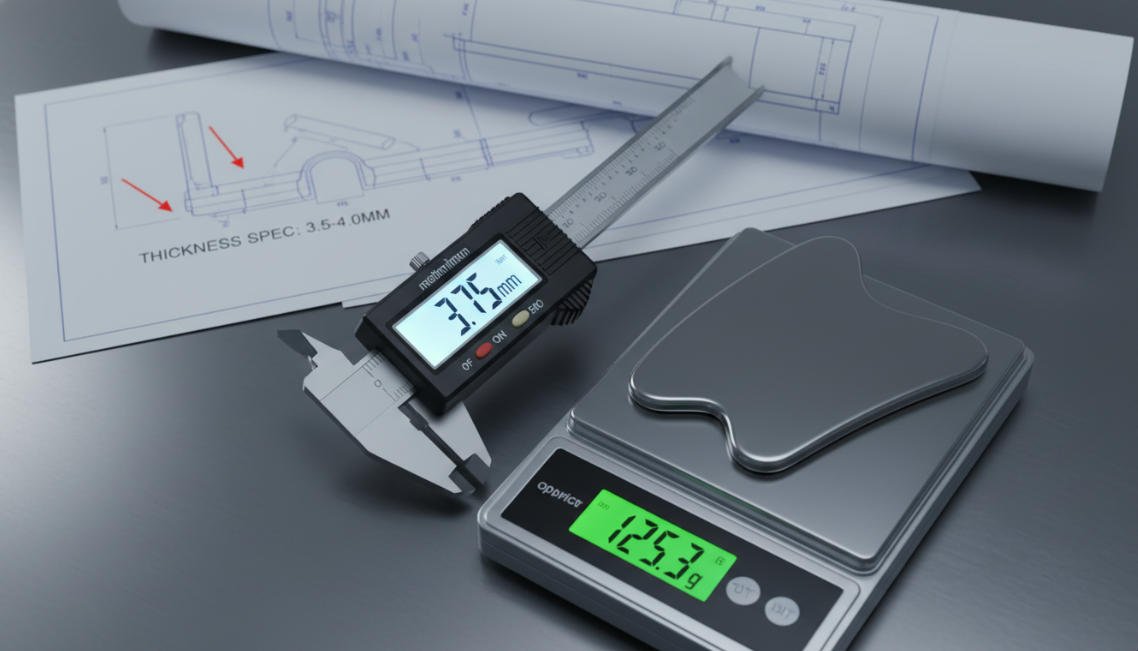
There is a category of quality compromise in stainless steel gua sha wholesale manufacturing that does not involve material substitution or surface treatment fraud — it involves dimensional reduction. Reducing the thickness of a stainless steel gua sha tool by 0.2 to 0.3 millimeters is a change that most buyers cannot detect through visual inspection or casual handling. It does not alter the color, the general shape, or the surface finish of the finished product. What it does alter is the structural behavior of the tool under the mechanical load of a gua sha treatment, the weight distribution that determines ergonomic performance, and the long-term resistance of the tool to deformation under repeated use. For a supplier operating at high volumes, a 0.2mm thickness reduction across the full product cross-section can represent a raw material saving of 8 to 12% per unit — a margin improvement that is captured entirely at the buyer’s expense, and the end consumer’s experience.
The consequences of thickness reduction manifest in ways that are difficult to attribute directly to dimensional non-conformance without measurement, which is precisely what makes it an effective cost-cutting mechanism from a supplier’s perspective. A tool that feels slightly lighter than expected may be rationalized as batch variation. A tool that develops a subtle flex under treatment pressure may be attributed to user technique. A tool that shows edge deformation after several months of professional use may be interpreted as normal wear. Each of these outcomes, individually, is ambiguous. Collectively, across a product category where consistent mechanical performance is the basis of professional user trust, they represent a systematic quality failure that erodes the reputation of the brand that sold the tool — not the factory that manufactured it.
How to Specify and Verify Dimensional Compliance in Stainless Steel Gua Sha Wholesale Orders
The practical control for thickness and weight fraud is measurement — and measurement requires specification. Your purchase agreement should define the nominal thickness at a minimum of three measurement points across the tool geometry, with an acceptable tolerance band of ±0.05mm for precision applications. Weight should be specified in grams with a tolerance of ±2% from nominal. Both parameters should be verified during pre-shipment inspection using calibrated digital calipers for thickness measurement and a precision laboratory balance for weight verification. Neither instrument is expensive, and both should be standard equipment for any third-party inspector you engage. According to dimensional measurement standards published by the National Institute of Standards and Technology (NIST), calibrated measurement tools used in quality inspection contexts should be traceable to national measurement standards — a requirement you can include in your third-party inspection brief to ensure the measurement data you receive is defensible.
Weight specification serves a dual function in your procurement framework. It verifies dimensional compliance directly — a tool that is within specification on thickness but below specification on weight indicates that material has been removed from a non-measured dimension, which warrants further investigation. It also provides a simple incoming inspection check that your own warehouse team can execute on a sampling basis when goods arrive, without specialized equipment. A precision kitchen scale accurate to 0.1 grams is sufficient for weight verification at the incoming inspection level. If the weight distribution of a received batch falls outside the specified tolerance band, you have objective grounds to escalate to a full dimensional inspection before the goods are accepted into inventory.
This means that by adding two numbers — a weight specification and a thickness specification — to your purchase agreement, you create a measurement-based tripwire that catches dimensional fraud at the pre-shipment stage, before non-conforming products reach your customers.
Risk 5 — Batch Inconsistency: The Slow Erosion That Destroys Long-Term Supplier Relationships
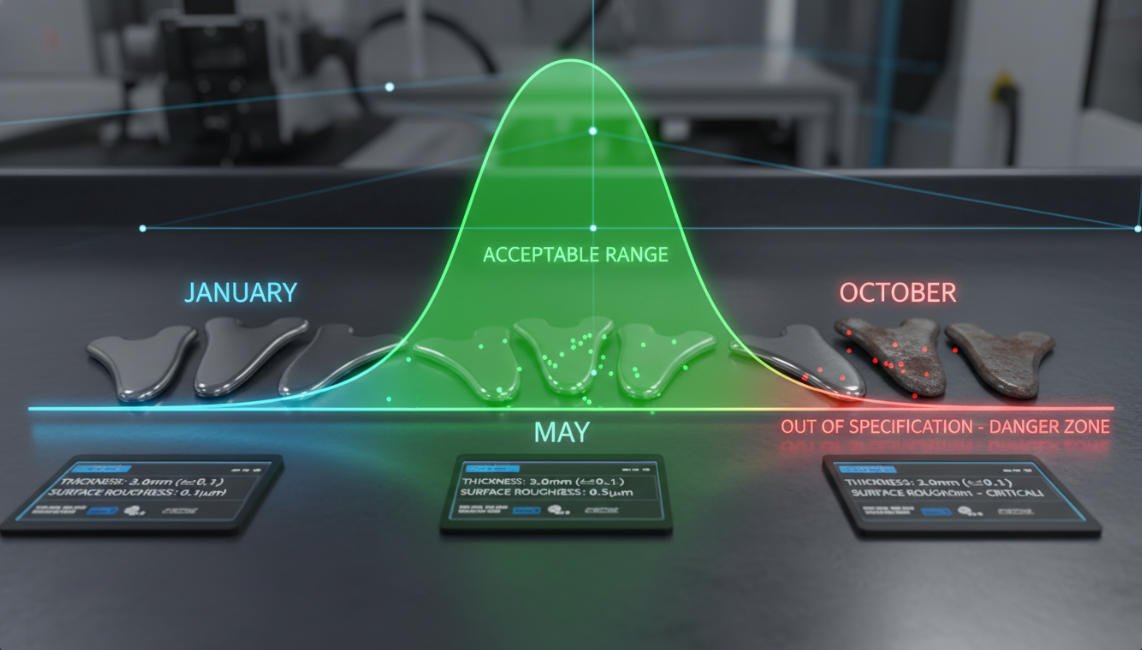
The risks described in the preceding sections — material fraud, sample divergence, polishing misrepresentation, dimensional reduction — are failures that can, in principle, be detected and addressed at the point of initial sourcing. Batch inconsistency is different. It is a risk that emerges over time, across multiple purchase orders, and it is the primary mechanism through which supplier relationships that appeared stable in the first six months deteriorate into costly, dispute-ridden entanglements by the end of the first year. For any buyer building a repeating revenue stream around stainless steel gua sha products, batch inconsistency is the risk with the highest cumulative cost — because it compounds across every reorder until it is identified and addressed.
Batch inconsistency has three primary causes, each of which operates independently and can interact with the others to amplify variation. The first is raw material batch variation: even within a nominally consistent stainless steel grade, different coils or sheets from different production runs at the mill level will exhibit minor compositional and surface characteristic differences that propagate through the manufacturing process. The second is subcontractor substitution: many gua sha factory operations that present as integrated manufacturers are in practice assembly and finishing operations that source semi-finished components from multiple subcontractors. When those subcontractors change — due to price pressure, capacity constraints, or relationship changes — the component characteristics change with them, often without disclosure to the buyer. The third cause is process parameter drift: in mechanized polishing and finishing operations, equipment wear, consumable degradation, and operator variability produce gradual shifts in output quality that are not captured by periodic quality checks unless those checks are designed with sufficient statistical rigor to detect trend-level changes rather than point-level failures.
How to Evaluate a Supplier’s Batch Consistency Before Committing to a Long-Term Contract
Your evaluation of a potential stainless steel gua sha manufacturer’s batch consistency capability should begin before the first order is placed, and it should be based on documentary evidence rather than verbal assurance. Request production quality records covering a minimum of six months of output — specifically, the incoming material inspection records, in-process quality check data, and outgoing inspection reports for the product type you intend to source. A supplier with genuine batch consistency management capability will have these records, will be able to present them in a structured format, and will not require extended lead time to produce them. The absence of structured quality records, or the production of records that appear to have been created for the purpose of the request rather than as part of an ongoing management process, is a reliable indicator of a quality system that exists on paper rather than in practice.
Beyond documentary review, request physical samples from three separate historical production batches — not samples produced specifically for your evaluation, but samples drawn from existing inventory that represents actual past production. Compare these samples against each other and against the supplier’s current sample using the same measurement protocol: weight, thickness at defined points, surface Ra value if accessible, and visual polish assessment under standardized lighting. The degree of variation you observe across three historical batches is your most reliable predictor of the variation you will experience across your future reorders. According to quality management frameworks referenced by ASQ (American Society for Quality), process capability analysis — specifically the measurement of Cpk indices across production batches — is the statistical foundation for predicting whether a manufacturing process will consistently deliver within specification. While full Cpk analysis may exceed the scope of a standard buyer audit, the underlying principle — that past process variation is the best predictor of future process variation — is directly applicable to your supplier evaluation methodology.
This means that the investment of time required to request and evaluate three historical batch samples before placing a long-term order is the most cost-effective risk management action available to you in the supplier selection process.
How to Identify a Trustworthy Stainless Steel Gua Sha Manufacturer — A Practical Evaluation Framework
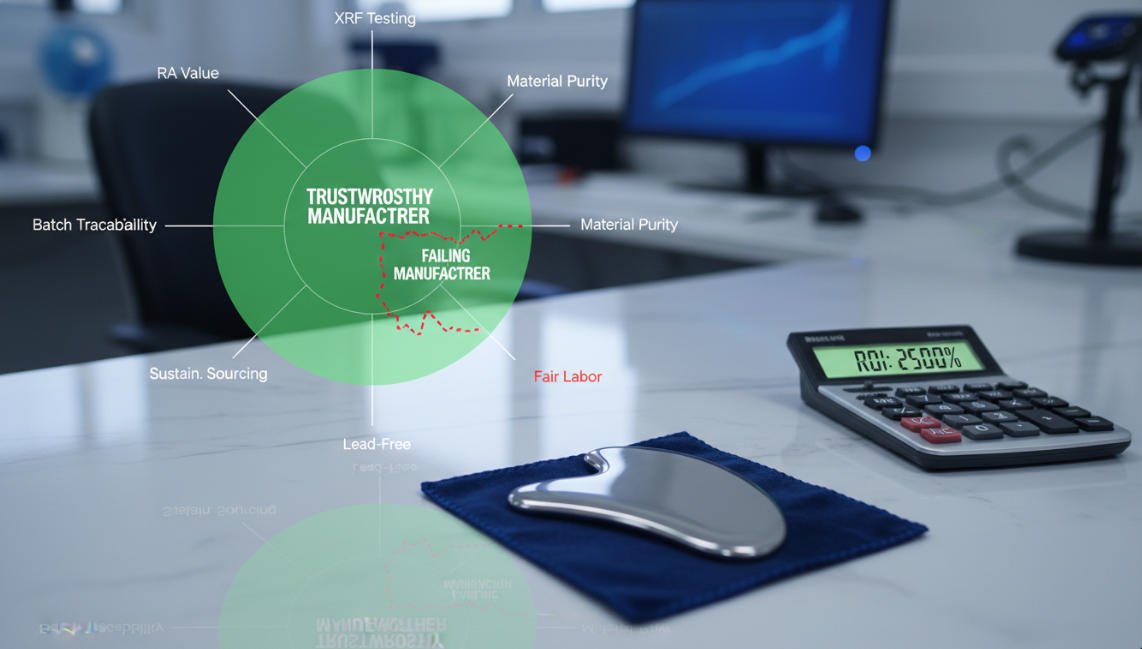
The six risks described in this article — material grade fraud, sample-to-bulk inconsistency, polishing misrepresentation, dimensional reduction, batch inconsistency, and surface treatment concealment — are not independent phenomena. They tend to cluster. A supplier whose pricing structure is incompatible with genuine 304 stainless steel procurement costs is also likely to be cutting dimensional specifications and applying coating to mask polishing deficiencies. Conversely, a stainless steel gua sha manufacturer who maintains transparent quality records, welcomes third-party inspection, and provides traceable material certification is operating within a quality management framework that makes the full cluster of fraud risks structurally less likely.
Your supplier evaluation framework should therefore function as an integrated assessment rather than a checklist of isolated verifications. The goal is not to catch a specific fraud — it is to determine whether the supplier’s operational structure is compatible with the quality commitments they are making. A factory that cannot show you its raw material receiving records, will not permit pre-shipment inspection, and produces certificates that cannot be traced to a specific production batch is telling you something important about its operational reality, regardless of what its catalog and sales representatives communicate.
Eight Questions That Separate Capable Manufacturers from Compliance Theater
Before placing any stainless steel gua sha wholesale order at significant volume, you should be able to answer the following eight questions based on documented evidence — not supplier representation. Can the supplier provide a mill certificate traceable to the specific raw material batch used in your production run? Does the supplier’s quality system include incoming material XRF verification, or does it rely on supplier certificates alone? Is the supplier willing to include pre-shipment inspection rights by a named third-party firm in the purchase contract? Can the supplier provide production quality records from the past six months showing consistent output against a defined specification? Does the supplier maintain sealed reference samples from each production batch for a defined retention period? Is the supplier willing to specify Ra surface roughness values in the product specification sheet? Can the supplier demonstrate that its production process — including any subcontracted operations — has not changed materially in the past twelve months? And finally, does the supplier have documented experience exporting to regulated markets, including familiarity with REACH compliance requirements and cosmetic product safety regulations in your target geography?
A supplier who answers yes to all eight questions with documentary support is operating at a level of quality management maturity that is statistically correlated with lower sourcing risk. A supplier who answers yes verbally but cannot produce documentation for five or more of these questions is describing a quality system that does not exist in operational practice. The distinction matters — because at stainless Steel gua sha wholesale volumes, the cost of discovering the difference after shipment is always higher than the cost of verifying it before the order is placed.
The ROI Case for Spending More on Verified Quality at the Sourcing Stage
For buyers evaluating the cost of implementing the verification framework described in this article — third-party XRF testing, pre-shipment inspection, sealed sample retention, dimensional measurement — the relevant financial comparison is not the cost of verification against zero. It is the cost of verification against the cost of a quality failure at scale. A pre-shipment inspection covering material grade verification, dimensional compliance, and surface finish assessment for a standard stainless steel gua sha wholesale order typically costs between $300 and $600 through established inspection firms. A container of 3,000 stainless steel gua sha tools that fails on material grade, requiring customer refunds, return logistics, and replacement sourcing, can generate direct costs in excess of $15,000 — before accounting for the brand damage, account loss, and reorder disruption that accompany a stainless steel gua sha wholesale quality failure.
The ROI of verified sourcing, calculated against the probability-weighted cost of an unverified sourcing failure, is not a marginal calculation. At a fraud rate of 4 in 10 within the standard price bracket — as indicated by the internal market audit described in the opening section — the expected cost of sourcing without verification is not a tail risk. It is a near-term operating expense waiting to be incurred. Buyers who treat verification cost as a line item to be minimized are, in effect, self-insuring against a risk with a 40% base rate occurrence probability in the standard price tier. That is not a risk management strategy. It is deferred expenditure.
This means every dollar invested in pre-shipment verification at the sourcing stage returns measurably more than one dollar in avoided failure cost — making rigorous supplier qualification not just a quality decision, but a straightforward financial one.
About Deyi Gems — 12 Years of Source-Level Stainless Steel Gua Sha Manufacturing
Deyi Gems was established as a source-level gua sha manufacturer with a specific operational focus: producing stainless steel gua sha tools that meet verifiable quality specifications across material grade, dimensional accuracy, and surface finish — consistently, across production batches, and at wholesale volumes. Over 12 years of manufacturing and export experience, the operational systems described in this article — XRF incoming material verification, sealed sample retention, pre-shipment inspection protocols, and documented batch quality records — are not procurement recommendations that Deyi Gems makes to its buyers. They are the internal processes that Deyi Gems applies to its own production.
If you are sourcing stainless steel gua sha tools for wholesale distribution and you have reached the end of this article, you now understand the specific risks in this supply chain and the specific controls that eliminate them. The next step is verification — and Deyi Gems invites you to apply the same verification framework described here to our own operation. Request a sample from a current production batch. Commission an independent XRF test on the material. Compare the weight and dimensions against the specification sheet. Ask for quality records from the past six months of production. Every one of these requests will be met with documentation, not with assurances.
For stainless steel gua sha wholesale inquiries, sample requests, or factory audit scheduling, contact the Deyi Gems team directly. Your sourcing decision should be based on evidence. We are prepared to provide it.