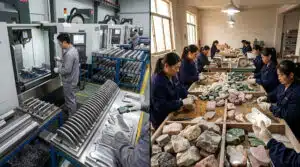
If you have ever sourced from a gua sha factory and received a flawless sample, only to find the bulk order looks noticeably different, you have already experienced the single biggest truth in this industry: consistency, not craftsmanship, is what separates a real gua sha manufacturer from a workshop that got lucky once. Even stone drawn from the same quarry, the same rough-material batch, can carry different veining, clarity, and hardness. That single fact explains most of the gua sha production risks you will encounter before you ever place a bulk order.
This is not a marketing page. It is a working breakdown of where things actually go wrong on the factory floor — and what you should ask any gua sha supplier before you commit to a container-sized order.
- Why Natural Stone Consistency Is the First Gua Sha Production Risk You'll Face
- Polishing Is Where Most Gua Sha Production Risks Actually Show Up
- Dimensional Precision — Why 0.5mm Decides Whether a Gua Sha Factory Ships or Scraps a Batch
- Bulk-Order Loss Rate — The Real Cost Driver Behind Every Gua Sha Production Quote
- Comparing Core Difficulty Points Across Materials in Gua Sha Manufacturer Operations
- FAQs
Why Natural Stone Consistency Is the First Gua Sha Production Risk You’ll Face

Natural jade, agate, crystal, and obsidian are not manufactured — they are mined, and that difference changes everything about how a gua sha factory has to operate. Two blocks of rough material pulled from the exact same mining face can still differ in color saturation, internal texture, and even hardness on the Mohs scale. According to the Gemological Institute of America (GIA), colored gemstone grading intentionally accounts for natural variation because no two pieces of rough material form under identical geological conditions. This is not a defect. It is geology. But it is also the reason why bulk consistency is the hardest problem in gua sha production.
Why Color-Matching Eats More Time Than Cutting in a Gua Sha Factory
Here is what actually happens on the floor: cutting a piece of jade or crystal takes minutes. Sorting and pairing that piece with others of matching tone, translucency, and thickness can take far longer. A responsible gua sha manufacturer will run every finished piece through a visual grading step before it ever reaches packaging, comparing tone, clarity, and surface pattern against a reference set. This means your bulk order should show far less color drift between the first piece and the five-thousandth piece, which translates directly into fewer customer complaints and fewer returns once the product reaches your shelf.
Western buyers, in particular, tend to demand a level of batch uniformity that is rarely questioned at the retail level but is extremely difficult to guarantee at the raw-material level. A gua sha supplier working with natural stone has to build in extra sorting labor specifically to meet this expectation — and any supplier who tells you sorting takes no extra time is either skipping the step or has not scaled past sample production yet. That is a warning sign worth remembering.
What This Means for a Guaha Manufacturer Sourcing Mixed Batches
If you have searched for a guaha manufacturer online, you have probably noticed that pricing between suppliers varies more than you’d expect for what looks like the same product photo. Part of that gap is exactly this sorting labor. A factory quoting a lower price on natural stone gua sha tools is often quoting for unsorted or loosely sorted batches, which shifts the color-matching burden — and the complaint risk — onto you after delivery. Knowing this before you order means you can ask the direct question: “What is your sorting tolerance, and can I see rejected-batch photos?” A real gua sha manufacturer will have an answer ready, because they reject batches constantly, not occasionally.
The International Gem Society (IGS) notes that clarity grading in colored stones already accounts for inclusions that would be considered flaws in diamonds but are treated as normal characteristics in gemstone material. Applied to gua sha production, this means a certain amount of internal texture is not a manufacturing failure — it is the material behaving like material. The real question is whether your gua sha supplier has a documented sorting standard, or whether “consistency” is just a word on their homepage.
Polishing Is Where Most Gua Sha Production Risks Actually Show Up

Cutting a stone into the right shape is a solved problem. Getting the surface to feel correct against human skin is not, and this is where a large share of production time in any serious gua sha factory actually goes. A gua sha tool is used in direct, repeated contact with the face and body, which means the edge geometry and surface finish are not cosmetic details — they are the entire functional purpose of the product.
Why Edge Rounding Determines Whether a Gua Sha Manufacturer Passes Quality Control
If an edge is even slightly under-rounded, it will drag or catch on skin instead of gliding, and that single flaw will get a product returned faster than any color inconsistency will. This means your quality control checkpoint cannot rely only on visual inspection — it needs a tactile pass, where a technician runs a finger along every edge before the piece is cleared. A gua sha manufacturer that skips this step is optimizing for speed over usability, and that tradeoff eventually shows up as refund requests, not as a line item on their production report.
The Mirror-Polish Problem Every Gua Sha Factory Has to Solve
Getting a true mirror finish on stone or metal is deceptively difficult. Common failure patterns include what the industry calls “orange peel” texture — a rippled surface that looks smooth from a distance but reads as rough under raking light — along with localized haze and fine scratch lines that survive multiple polishing passes. Each of these defects is invisible in a low-resolution product photo, which is exactly why so many buyers are surprised when a bulk shipment doesn’t match the sample.
Higher-grade polishing genuinely takes longer, and it produces a lower yield, because more pieces get rejected at the final inspection stage rather than passed through with minor flaws. So what does that mean for you as a buyer? It means the per-unit cost difference between a factory quoting a fast turnaround and one quoting a slower one is often not about greed — it is about how many pieces get thrown out before packaging. A gua sha supplier offering both a lower price and a faster timeline on high-polish products is quietly cutting one of those corners, and you are the one who eventually absorbs that cost through customer complaints.
How This Connects to Broader Gua Sha Production Risks in Bulk Orders
Polishing risk compounds with order size. A small sample run of ten pieces can absorb a slightly-off polish through hand-selection. A bulk run of ten thousand pieces cannot — the yield rate at the polishing stage becomes the actual limiting factor on how fast your order can ship, not the machinery, not the labor headcount, and not the cutting speed. This is one of the least visible gua sha production risks to a buyer who has never stood on a factory floor, yet it is often the single biggest driver of both cost and lead time.
The Swiss Gemmological Institute (SSEF) regularly documents how surface treatment quality affects both the optical appearance and the long-term durability of gemstone material, reinforcing that polish quality is not a purely cosmetic variable — it interacts with how the material wears over time. For a tool that is handled daily, that durability question is not academic. It is the difference between a product your customer replaces once and one they return within a month.
Dimensional Precision — Why 0.5mm Decides Whether a Gua Sha Factory Ships or Scraps a Batch

You might assume that a stone tool with no moving parts and no electronics would have loose tolerance requirements. It doesn’t. A gua sha tool is a hand-feel product, which means the human palm can detect a thickness variance as small as half a millimeter, and that variance changes how the edge glides across skin. This is one of the more counterintuitive gua sha production risks for anyone coming from a background in standard consumer goods manufacturing, where half a millimeter would barely register as a rounding error.
Why CNC Alone Doesn’t Solve Tolerance for a Gua Sha Manufacturer
CNC cutting gets a rough shape to roughly the right dimension, but it is the hand-finishing and polishing stages afterward that introduce the real drift. Every polishing pass removes a small, uneven layer of material, and on complex curved shapes — the kind most gua sha tools use — that removal is never perfectly symmetrical across the whole surface. A gua sha manufacturer running tight tolerance control has to measure thickness at multiple points on every piece, not just at the center, because a piece can pass a single-point caliper check and still fail at the edges where your hand actually applies pressure.
So what does that mean for you if you’re sourcing at scale? It means asking for multi-point thickness data — not a single average number — is a legitimate technical question, and any gua sha supplier who can’t produce it is likely only checking center-point thickness, which tells you almost nothing about edge-curvature consistency across a batch of ten thousand units.
Weight, Curvature, and Edge Consistency in a Gua Sha Factory Environment
High-end buyers routinely specify not just thickness but total weight, radius of curvature, and edge-curve consistency across an entire order. This level of specification exists because the tool’s perceived quality — its “feel” — comes almost entirely from these three measurements working together, not from any single one in isolation. A piece that’s the right thickness but the wrong weight distribution will still feel wrong in the hand, even if it passes every other visual inspection.
You should also know that complex outlines — anything beyond a simple flat oval — are where deviation risk climbs fastest, because more contour changes mean more chances for the polishing wheel to remove uneven material across the curve. This means that if your product design includes intricate scalloped edges or multi-curve profiles, you should expect a longer qualification period with your gua sha factory before bulk production begins, simply because more sample rounds are needed to lock in a stable tolerance window.
Bulk-Order Loss Rate — The Real Cost Driver Behind Every Gua Sha Production Quote

Here’s a question worth asking directly: is speed really the bottleneck in natural stone manufacturing, or is it something else entirely? In practice, it’s loss rate. Every single stage of turning rough material into a finished tool carries a risk of loss — chipping during cutting, hidden internal cracks revealed only after shaping, cracking during grinding, or edge blowout during final polishing. None of these failures are visible until they happen, which is exactly why loss rate, not machine speed, is the true constraint on how fast a gua sha factory can fulfill a large order.
Why Crystal and High-Inclusion Material Push Gua Sha Production Risks Higher
Crystal and heavily-included (“ice-crack” pattern) materials carry meaningfully lower yield rates than cleaner stone types, because their internal structure is less predictable under mechanical stress. A block that looks solid on the outside can fracture along an internal plane the moment a polishing wheel applies pressure at the wrong angle. This is why quotes for crystal gua sha tools are often higher than quotes for jade or agate tools of the same size — you’re not paying more for the same material, you’re absorbing the cost of a lower percentage of usable output per batch.
The GIA’s overview of quartz and crystal formation explains that internal fracture patterns in crystal quartz form during the mineral’s natural growth process, which means these weaknesses are baked into the material long before it ever reaches a workshop. So what does that mean practically? It means asking your gua sha supplier for their typical yield percentage on crystal versus jade is a fair and answerable question — and a supplier who quotes an identical yield rate across all material types is either rounding for convenience or hasn’t tracked the data carefully.
How Loss Rate Data Should Shape Your Sourcing Decisions
You should treat loss rate the way you’d treat a shipping lead time — as a number your gua sha manufacturer should be able to quote with some confidence, based on historical batch records rather than a rough guess. A factory that can tell you “our jade yield runs in a fairly narrow, predictable range and our crystal yield is meaningfully lower” is demonstrating that they actually track this metric internally. One that gives you a vague, universally high number for every material type is likely quoting optimism rather than data.
This matters directly for your landed cost calculations. If a gua sha factory quotes you a unit price without disclosing expected loss rate by material, you have no way to sanity-check whether that price is sustainable at scale or whether it will quietly increase once the factory starts absorbing real breakage numbers on your specific order.
Comparing Core Difficulty Points Across Materials in Gua Sha Manufacturer Operations

Not every material fails in the same place, and understanding where each one is genuinely hard helps you ask sharper questions of any gua sha supplier you’re evaluating.
Natural stone — jade, agate, obsidian — struggles most with material consistency and crack control, as covered above. Stainless steel tools, by contrast, face their hardest challenge at the mirror-polish stage and in edge hand-feel, since metal shows scratches and haze differently than stone under raking light. Zinc alloy tools carry a distinct risk profile centered on casting porosity — tiny air pockets trapped during the die-casting process — and on electroplating stability, since an uneven plating layer will corrode or discolor unevenly over time. Crystal, as already discussed, lives or dies on transparency and internal crack control, making it the most yield-sensitive material category of the four.
Why This Comparison Matters When Choosing a Gua Sha Factory for Multi-Material Lines
If your product line spans more than one material — say, a jade tool and a stainless steel tool in the same collection — you should expect your gua sha manufacturer to have distinct quality-control protocols for each, not a single generic checklist applied across materials. A factory that treats zinc alloy plating inspection the same way it treats jade color-sorting is applying the wrong lens to at least one of those two problems, and that mismatch tends to surface as quality complaints on whichever material got the wrong process.
You’re better positioned when you ask your gua sha supplier directly: “Walk me through your inspection checklist for each material in my order.” A supplier confident in their process will have a different answer for stone versus metal versus crystal, and that difference is itself a signal of real operational depth rather than a copy-pasted quality page.
FAQs
1. What’s the hardest part of gua sha factory production?
Material consistency. Natural stone from the same batch can still vary in color, clarity, and hardness, which is why sorting—not cutting—often takes the most time on the floor.
2. Why do gua sha manufacturer quotes vary so much for the same design?
Loss rate differs by material and supplier. Crystal and high-inclusion stone yield fewer usable pieces than jade, so your price reflects rejected batches, not just labor.
3. What tolerance should I expect from a gua sha supplier?
A 0.5mm thickness shift is noticeable in hand-feel. Ask for multi-point measurements across a batch, not a single center-point number, before approving bulk production.
4. Are gua sha production risks different for stone versus metal tools?
Yes. Stone struggles with cracks and color drift; stainless steel depends on mirror-polish and edge feel; zinc alloy risks casting porosity and uneven plating.
5. How do I check if a gua sha factory can handle bulk orders reliably?
Ask for batch-to-batch photos over several months and documented yield data. A good sample proves nothing—repeatable results at scale is the real test.