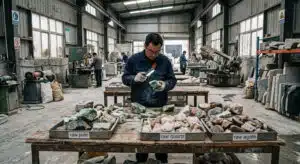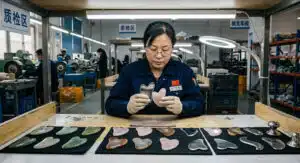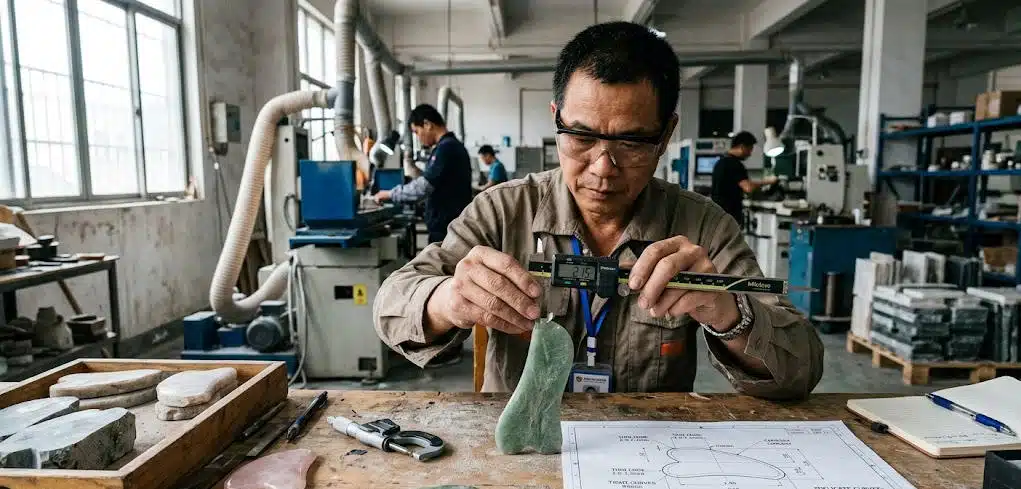
If a factory looks at your drawing and says “sure, we can make this” without asking a single question, that should worry you more than it reassures you. A workable gua sha custom design isn’t just a shape you approve on screen — it’s a piece of stone that has to survive CNC cutting, hand-shaping, and polishing without cracking, chipping, or losing its edge geometry along the way. In natural stone processing, wall sections thinner than roughly 3mm, tight inner curves, and unsupported points are where most yield loss actually happens, and on a first-run gua sha custom order, skipping design review can push scrap rates past 15-20% before anyone catches the problem. That number is the real difference between a production run you profit from and a batch you can’t sell. This guide walks through what gua sha custom manufacturing actually involves, where the risk sits, and how a serious gua sha manufacturer turns your drawing into a shape that survives contact with a grinding wheel thousands of times in a row.
- What Gua Sha Custom Manufacturing Actually Delivers (Beyond a Logo)
- The Hidden Manufacturing Risk Inside Every Gua Sha Custom Project
- Natural Stone Variation: Why "Identical Color" Isn't a Gua Sha Custom Promise You Should Accept
- Turning Vague Requests Into Measurable Gua Sha Custom Standards
- Gua Sha OEM vs. ODM: Picking the Right Path for Your Gua Sha Custom Idea
- The Gua Sha Custom Development Process, Step by Step
- What Actually Drives the Cost of a Gua Sha Custom Project
- Five Risks to Ask About Before You Sign With a Gua Sha Manufacturer
- Where Deyi Gems Fits Into Your Gua Sha Custom Plan
What Gua Sha Custom Manufacturing Actually Delivers (Beyond a Logo)
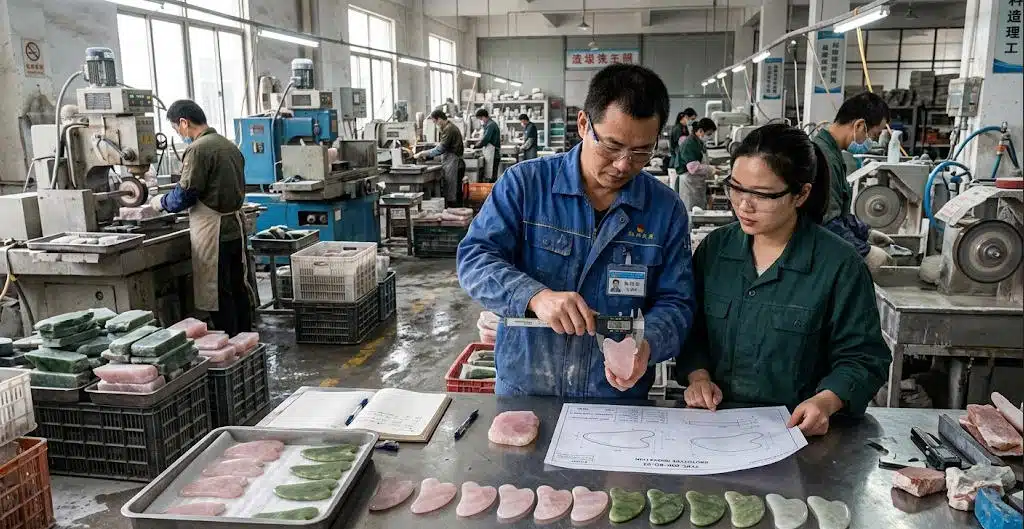
You’re not really paying a factory for cutting and polishing. You’re paying for the ability to get the exact same result on unit 1 and unit 10,000, and that’s a very different skill than simply owning a CNC machine. When you send a gua sha custom project to a supplier, you’re typically handing over 2D or 3D CAD files, target dimensions, edge radius requirements, material grade, logo placement, surface finish, packaging structure, and a tolerance range. What you’re buying back is a factory’s ability to hold every one of those variables steady across a full production batch, run after run. That’s true whether you’re ordering custom guasha tools in rose quartz, jade, or obsidian, and it’s the actual job description of a gua sha manufacturer — not simply owning a CNC machine.
A Perfect CAD File Doesn’t Guarantee a Manufacturable Gua Sha Custom Design
Here’s the part most brands don’t expect: a design can look flawless in SolidWorks or Rhino and still fail badly on the shop floor. Natural stone doesn’t behave like ABS plastic or aluminum. It has grain direction, internal micro-fractures, and hardness that varies even within a single block, so a curve that a CNC router handles fine in acrylic can chip a piece of rose quartz at the exact same radius. Ask yourself honestly — has your current supplier ever pushed back on a design detail, or have they said yes to everything you’ve sent them? If it’s always been yes, that’s not a good sign for your gua sha tools custom order. On a gua sha oem file specifically, that gap between drawing and reality is exactly what a design review is meant to catch before it becomes your problem.
The Real Deliverable Behind Any Gua Sha Custom Order: Repeatable Precision
What you actually want at the end of a gua sha custom project isn’t one beautiful sample — it’s a repeatable process. A single hand-polished prototype tells you almost nothing about whether the same edge profile, the same gloss level, and the same weight can be achieved across a batch of 5,000 pieces. This means you can treat the prototype stage of your gua sha custom project as a design-validation step rather than a finish-line moment, and that shift in mindset alone prevents a lot of expensive surprises later. A factory that understands this will build in checkpoints between prototype and mass production instead of jumping straight from one to the other, and that structure is what separates a gua sha manufacturer you can scale with from one you’ll outgrow after your first order. This is also what separates true gua sha custom development from a relabeled gua sha wholesale item wearing a new logo.
The Hidden Manufacturing Risk Inside Every Gua Sha Custom Project
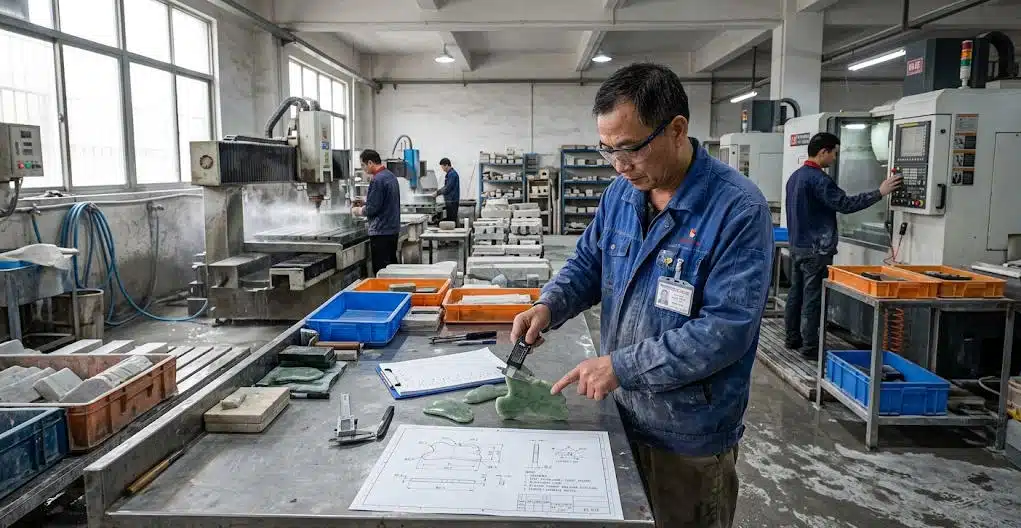
Most of the risk in a gua sha custom program doesn’t come from the factory’s equipment — it comes from geometry that was never checked against how stone actually cuts, grinds, and polishes. This is the single biggest gap between brands that get a smooth first production run and brands that get a phone call about a 30% reject rate. At Deyi Gems, this is the stage where a gua sha tools custom file earns or loses its manufacturability before a single cent gets spent on tooling.
Thin Zones, Sharp Angles, and Stress Points That Break Under CNC
Before a design goes anywhere near tooling, it needs to be checked for a handful of specific failure points: localized wall thickness that drops too low, inner curves that go deeper than the cutting head can safely follow, sharp corners and narrow edges stacked too close together, drilled holes positioned too near an outer edge, and any zone where thickness changes abruptly enough to create a stress concentration. Each of these looks harmless on a flat drawing and each one is a common source of cracking once the piece is actually under a grinding wheel. You can lower your risk substantially just by having someone check these six points before quoting, rather than after the first batch of prototypes comes back broken. This single check is often the difference between a smooth gua sha custom launch and a scrapped first batch.
What a DFM Review Checks Before Your Gua Sha Custom Tooling Is Cut
This is where Design for Manufacturing (DFM) review earns its place in the process. You’re responsible for deciding what the product should look like and do; a competent factory is responsible for telling you, honestly, whether that shape can be produced at scale without the yield collapsing. A proper DFM pass on a gua sha custom file typically checks curvature against the tooling’s stable cutting range, verifies that logo engraving depth won’t weaken the surrounding structure, and confirms the design still allows a polishing wheel physical access to every surface — a detail that’s easy to miss on a 3D render but obvious the moment someone tries to actually buff a tight inner groove by hand. Skipping this step to save a week of turnaround is one of the most common reasons gua sha custom projects go over budget, because fixing a stress-concentration problem after tooling is cut costs far more than catching it on a drawing. That discipline is exactly what a gua sha tools custom buyer is really paying for when a factory insists on DFM before it agrees to quote.
Natural Stone Variation: Why “Identical Color” Isn’t a Gua Sha Custom Promise You Should Accept
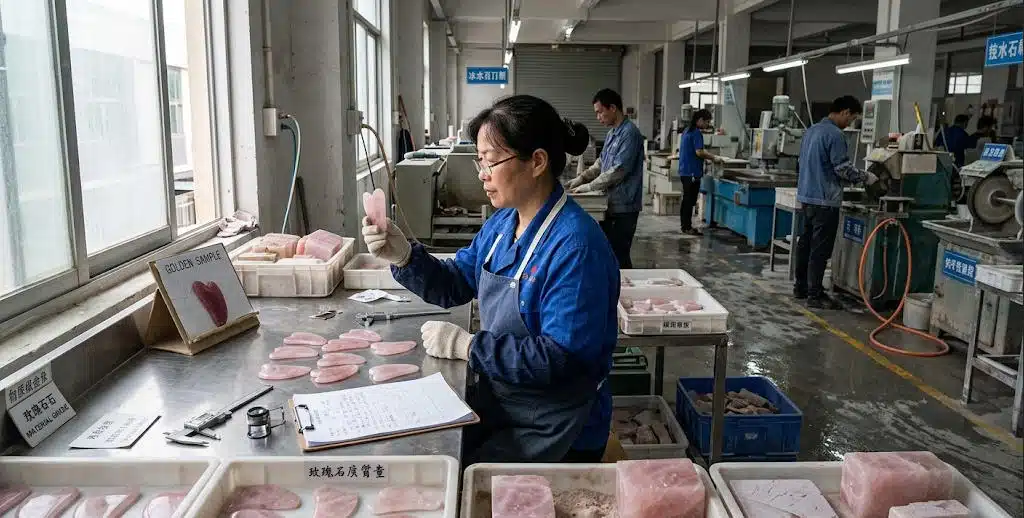
If a supplier promises your rose quartz or jade pieces will come out 100% identical in color, that promise should make you more cautious, not less — because it isn’t how natural stone works, and a factory that doesn’t say so upfront may not fully understand the material it’s cutting. Whether you’re placing a small gua sha wholesale order or a full gua sha custom program, the honest answer from any gua sha manufacturer should be the same: natural stone doesn’t come in identical batches.
Material Grade, Golden Sample, and Acceptable Variation
Rose quartz, clear quartz, amethyst, obsidian, agate, jade, fluorite, and labradorite are geological materials, not industrial polymers pulled from a uniform batch. Color, translucency, internal inclusions, and even hardness can shift from one section of raw material to another, sometimes within the same block. According to the International Gem Society’s guide to gem grading, even a single deposit of raw gem material naturally sorts into a wide range of sizes and color intensities the moment it’s graded — the same underlying physics that applies to any natural mineral your tools are cut from. This means you should replace “100% identical” language in your gua sha custom spec sheet with a three-part standard: a defined Material Grade, an approved Golden Sample, and a documented Acceptable Variation range. That combination gives your QC team something they can actually measure a shipment against, instead of an subjective argument about whether pink is “pink enough.” Building that standard into the contract is a basic requirement for any serious gua sha custom order, not an optional upgrade.
What GIA and IGS Data Say About Natural Stone Consistency
Independent gemological research backs this up directly. GIA’s own material notes on rose quartz quality factors point out that color in this stone ranges from very light pink to medium-dark pink within the same variety, often with visible zoning in a single piece. On the jade side, GIA’s breakdown of jadeite quality factors ranks color, transparency, and texture as three separate variables buyers must judge individually — not one uniform trait. The International Gem Society goes further with jadeite specifically, explaining that gemologists formally grade jade by treatment level — Type A being untreated natural material — precisely because natural color and clarity vary enough to require a structured classification system in the first place. Independent labs such as the Swiss Gemmological Institute SSEF, which has tested colored gemstones since 1972, exist for the same underlying reason: natural material needs a documented standard, not a verbal promise. So what does that mean for your production run? It means locking in your Golden Sample before tooling starts, not after the first shipment arrives and someone on your team is unhappy with the color mix. Every credible gua sha custom contract should reference that Golden Sample by name.
Turning Vague Requests Into Measurable Gua Sha Custom Standards
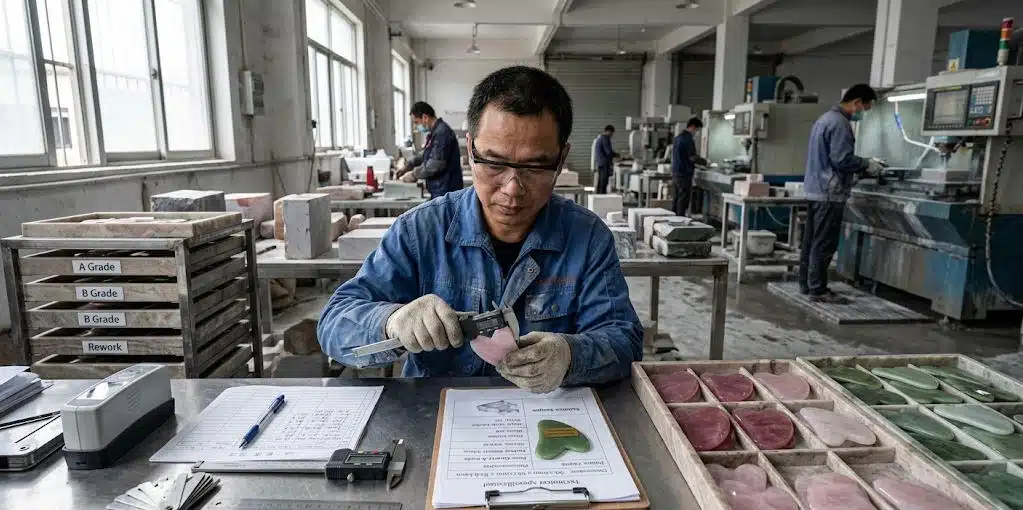
“The edge should feel smooth” and “the color should match” are the two phrases that cause more OEM disputes than almost anything else, and the reason is simple — neither one is measurable. A mature gua sha custom program replaces subjective language with numbers, ranges, and named references before the first prototype is even cut. That’s just as true for a small gua sha tools custom trial order as it is for a full engineering-level build.
The Spec Sheet Behind a Serious Custom Guasha Tools Order
You’ll get a far more predictable outcome from a custom guasha tools project if every subjective term in your brief gets converted into something a QC inspector can actually check against a ruler, a gloss meter, or a reference sample. The table below shows how that translation typically works in practice, and it’s a useful starting checklist for any gua sha custom spec sheet, not the finished document.
| What You Ask For | What Gets Measured Instead |
|---|---|
| Length / width / thickness | Target dimension + tolerance (e.g. ±0.3mm) |
| Edge feel | Radius value or documented Edge Profile |
| Surface finish | Gloss / Matte / Frosted, defined by a reference sample |
| Logo | Position, size, engraving method, allowed deviation |
| Material | Stone type + Material Grade |
| Color | Golden Sample + Acceptable Variation range |
| Cracks / chips | Written accept / reject threshold |
| Polish | Gloss level or Golden Sample reference |
| Packaging | Per-unit protection, tray structure, transit protection |
Where ISO-Based Inspection Fits Into a Gua Sha Custom Project
Once your spec sheet is measurable, the next question is how a batch actually gets checked before it ships. Most serious factories don’t inspect every single unit — instead they follow the ISO 2859 sampling standard, which defines Acceptable Quality Limits (AQL) and the sample size needed to accept or reject an entire lot with statistical confidence. In practice, this means a shipment of 5,000 pieces might only require a sample of a few hundred to be checked, sorted into minor, major, and critical defect categories, with critical defects typically held to a 0% tolerance. This means your gua sha custom contract should state the AQL level in writing — commonly something like 2.5 for cosmetic issues and a stricter number for dimensional or structural defects — rather than leaving “quality” as an undefined word in an email thread.
Gua Sha OEM vs. ODM: Picking the Right Path for Your Gua Sha Custom Idea
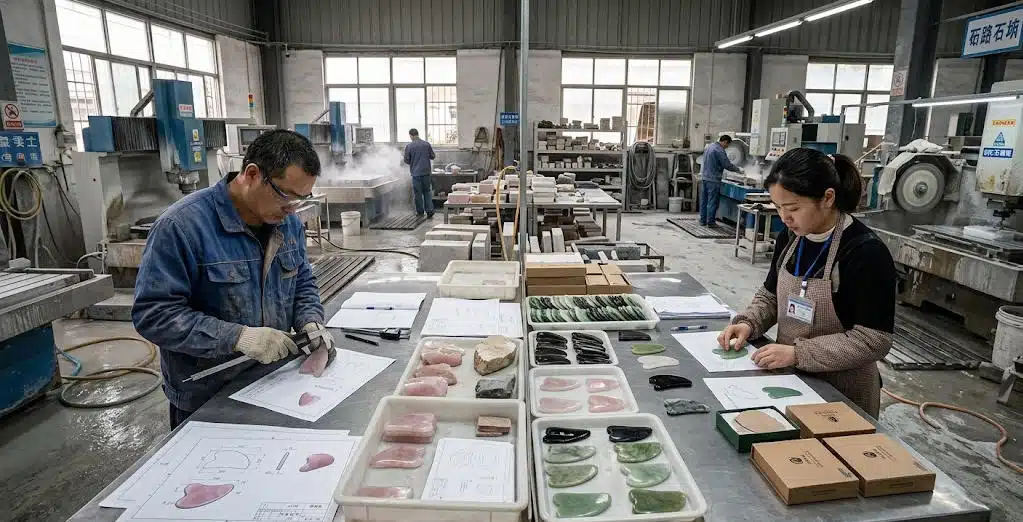
Not every brand needs the same depth of gua sha custom development, and knowing which model fits you before you request quotes will save weeks of back-and-forth with suppliers who aren’t actually set up for what you’re asking.
When Semi-Custom Beats a Full Gua Sha OEM Build
The distinction is simpler than it sounds: in a gua sha oem arrangement, you provide the design and the factory executes it at scale; in an ODM arrangement, the factory already has developed shapes and you select, modify, and brand one. If you’re a new brand without an in-house product design team, ODM usually gets you to market faster and with lower upfront development cost, since you’re choosing from tooling that already exists rather than paying to create it. If you already have a finished 2D/3D drawing, a defined material grade, and specific QC requirements, full gua sha oem is the path that actually protects your product differentiation, because nobody else is producing your exact shape. Neither path is inherently better — they solve different problems at different stages of a gua sha custom brand’s growth. Either way, a capable gua sha manufacturer should be able to tell you honestly which path your custom guasha tools idea actually needs, instead of pushing you toward whichever one is easier for their production line.
Gua Sha Wholesale Sourcing vs. True Development — Know the Difference
This is also where a lot of confusion happens with gua sha wholesale sourcing. Buying from a wholesale catalog and adding your logo is functionally closer to ODM than OEM, even if a supplier’s website uses “OEM” loosely to describe both. Before you commit, ask directly: who owns the CAD file, who pays if the design needs engineering changes, and who controls the tooling once it’s built? Those three answers tell you more about whether you’re getting real gua sha oem development or simple gua sha wholesale private-labeling than any label on a supplier’s homepage ever will. Deyi Gems works with brands at both ends of that spectrum, from straightforward gua sha wholesale selection through to ground-up development of custom guasha tools built entirely around your own drawing.
The Gua Sha Custom Development Process, Step by Step
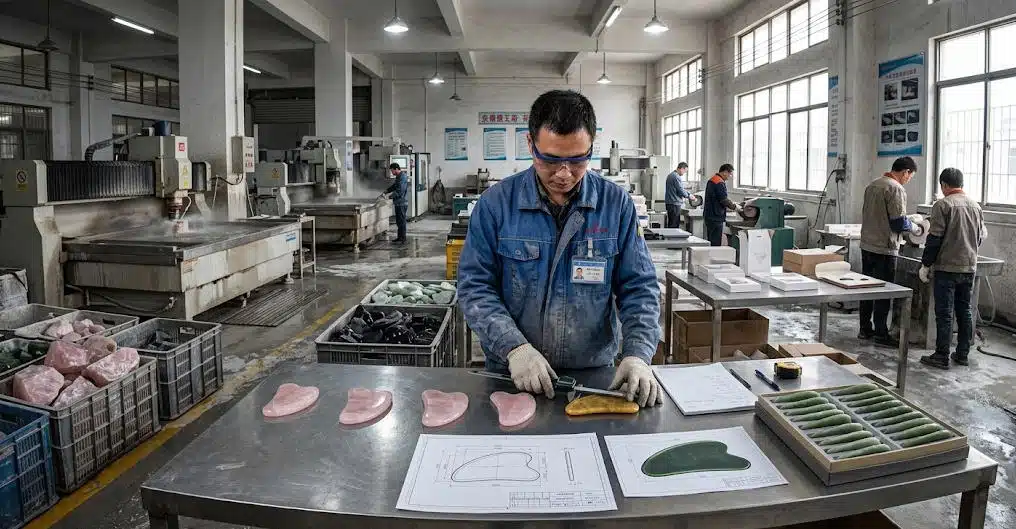
You don’t need to guess your way through a gua sha custom launch. The sequence below is the one that consistently produces a stable, sellable batch on the first real production run, rather than a second or third attempt. The same sequence applies whether you’re developing a single gua sha tools custom SKU or a full gua sha oem product line.
From Product Brief to DFM Approval
Start by building a complete OEM Product Brief that covers six areas: the product type and target market, the design files and dimensions, the material grade and acceptable natural variation, your branding specs, your packaging structure, and your written quality standards. Once that brief exists, the design should go through DFM review before anyone touches a prototype — checking thickness, edge risk, curvature limits, structural stress points, and whether your material choice is even appropriate for the shape you’ve drawn. This means you avoid paying for a prototype that was never going to survive mass production in the first place, which is a far cheaper mistake to catch on paper than in stone. Skipping the brief is the single most common shortcut that turns a straightforward gua sha custom order into a slow, expensive one.
Prototype, Golden Sample, and Pilot Run — Why Skipping Steps Costs More
From there, the recommended path is CAD, then DFM, then an initial prototype, then a revised prototype, and only then a confirmed Golden Sample — ideally paired with a technical drawing and a written QC specification, since those three documents together define what “correct” means for every future batch. After the Golden Sample is locked, run a small pilot batch before committing to full production; this is where you actually measure yield rate, crack rate, chip rate, polish consistency, color consistency, dimensional stability, and how well your packaging protects the product in transit. A design that looks perfect as a single sample but produces a 40% reject rate at scale is, from a business standpoint, still a failed design — which is exactly why pilot validation exists before you commit any gua sha custom program to a full production order.
What Actually Drives the Cost of a Gua Sha Custom Project
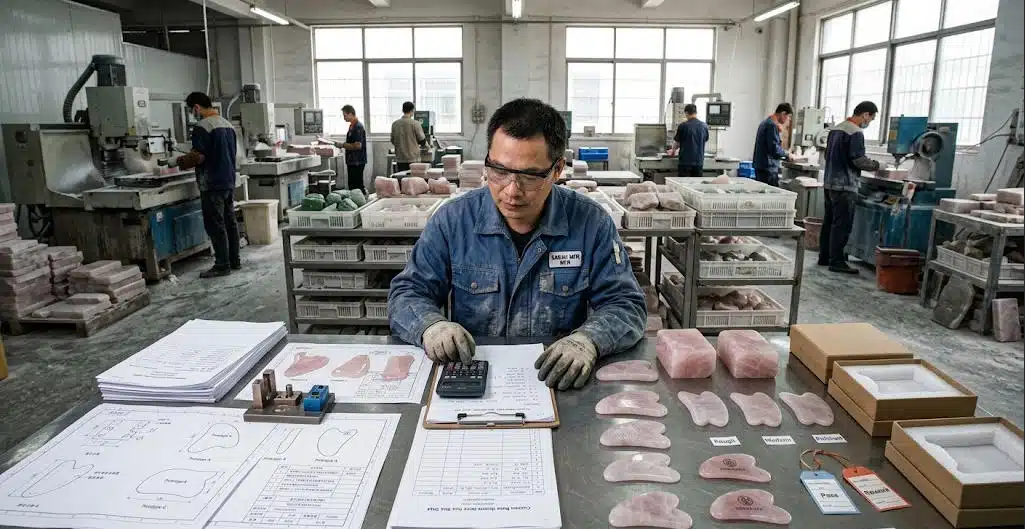
If you’re comparing a gua sha custom quote against the price of an off-the-shelf wholesale item, you’re comparing two different products, not two prices for the same one — and that mismatch is where most budget disappointment comes from. This is also the point where working with an experienced gua sha manufacturer pays off, because pricing a batch of custom guasha tools correctly means separating those two cost types from the very first quote, not after the invoice arrives.
Development Cost vs. Production Cost — Where Your Budget Goes
A clear-eyed gua sha custom budget separates two cost categories that too many quotes lump together. Development cost covers engineering evaluation, CAD revisions, prototyping, tooling, fixtures, and testing — the one-time investment required to make your design manufacturable. Production cost covers the recurring, per-unit expenses: raw material, cutting, CNC time, grinding, polishing, logo application, QC, and packaging.
| Cost Category | Typical Line Items |
|---|---|
| Development Cost (one-time) | Engineering review, CAD revisions, prototyping, tooling, fixtures, testing |
| Production Cost (per unit) | Raw material, cutting, CNC, grinding, polishing, logo, QC, packaging |
How Order Volume Changes Your Per-Unit Math
This means your per-unit price on a gua sha custom order will drop meaningfully as volume increases, because the fixed development cost gets spread across more units — the same tooling investment that adds several dollars to a 500-piece run might add only a fraction of that to a 5,000-piece run. Understanding that math upfront helps you set realistic order quantities instead of being surprised when a “custom” quote comes in well above a wholesale catalog price for what looks like a similar-sized batch. If your supplier can’t break a quote down into these two categories on request, that’s usually a sign they haven’t separated the two costs internally either, which makes future re-orders harder to price fairly. A transparent breakdown like this is a reasonable baseline to expect on any gua sha custom quote for custom guasha tools, regardless of order size.
Five Risks to Ask About Before You Sign With a Gua Sha Manufacturer

Before you commit tooling budget to a gua sha manufacturer, there are five specific risk areas worth putting in writing rather than assuming they’re covered. These same questions apply whether you’re placing a small gua sha tools custom trial order or committing to a full production partnership with Deyi Gems.
Design Liability and IP Ownership on a Gua Sha Custom Project
First, design risk: if your own drawing creates a manufacturing problem, your contract should say upfront how responsibility for that gets split, which is why a formal DFM Approval step matters as a documented checkpoint, not just an informal conversation. Second, intellectual property: you’ll want an NDA, a clear IP ownership clause, tooling ownership terms, and explicit language on who owns the CAD and engineering files — because “we built the mold” and “we own the mold” are two very different claims, and the contract should settle that before production starts, not after a disagreement. Third, natural stone color disputes get resolved by the Material Grade and Golden Sample system already covered above, so build that language into the contract itself rather than leaving it as a verbal understanding. Fourth, MOQ and cost structure should be split into development and production costs as described earlier, so you’re not comparing apples to oranges when quotes come in from different suppliers. Put all four of these in writing before your gua sha custom tooling gets cut, even on a modest gua sha tools custom order — the contract is far cheaper to write now than to negotiate after a dispute.
Why “We Can Make Anything You Draw” Should Worry You
The fifth risk is subtler and it’s about attitude, not paperwork. A factory that agrees to every design change without pushback isn’t being accommodating — it’s often avoiding a conversation about yield loss, crack risk, or polishing cost that it should be having with you. The relationship that actually protects your investment is one where you own the product direction and brand requirements, and your gua sha manufacturer brings material knowledge, engineering judgment, and production capability to turn that direction into something that survives mass production. If a structural detail can technically be built but would tank your yield rate or triple your polishing time, you want to hear that before tooling is cut, not after the first batch comes back with a rejection rate nobody budgeted for. That kind of honesty, more than any brochure, is what a gua sha custom partnership actually depends on.
Where Deyi Gems Fits Into Your Gua Sha Custom Plan
Deyi Gems has spent more than 12 years processing, designing, and manufacturing crystal and jade gua sha tools at the source, which is a long enough run to have seen most of the failure points described above happen in real production, not just on paper. Depending on where your brand is right now, you can work with Deyi Gems at three different levels: Basic OEM if you already have a finished design and just need material, manufacturing, and packaging execution; Engineering OEM if you want DFM review, CAD support, and material recommendations built into the process; or Full OEM Development if you’re starting from a concept and need a partner from CAD through pilot run to mass production. Deyi Gems also supports gua sha wholesale buyers who want to start with proven shapes before moving toward a fully custom program later. Whichever stage you’re at, the goal is the same one this entire guide has been pointing toward: your gua sha custom project should be defined by measurable standards, not verbal promises, before a single piece of tooling gets cut.