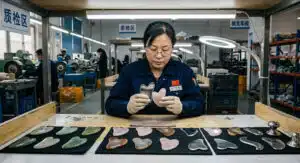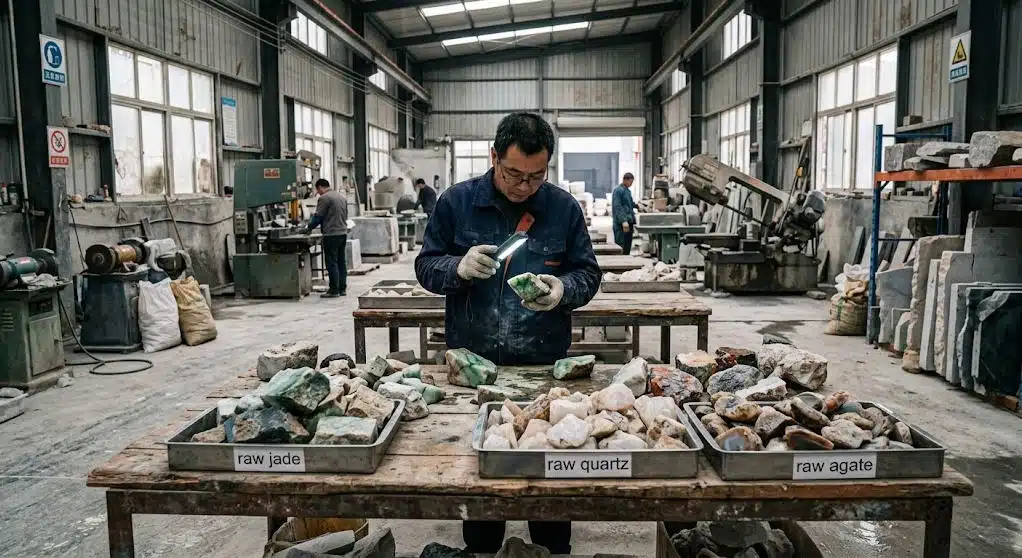
A gua sha manufacturer decides most of your product’s fate before the first cut is made, because raw material sourcing is the first quality check in gua sha production. Take a simple example: 100 kg of stone that yields 800 finished pieces costs 18.75% more per piece than 100 kg that yields 950 pieces, even when the price per kilogram is identical. Polishing cannot repair flaws the stone already carries inside it. So when you compare a gua sha supplier, look at how the factory manages its stone, not just whether the label says “jade.” This article covers what we see on the factory floor, where the risks sit, and what you can ask before placing a gua sha wholesale order made from natural gua sha material.
- What Your Gua Sha Manufacturer's Raw Material Choices Mean for Your Order
- How Raw Materials Affect Gua Sha Production and Quality at Your Gua Sha Manufacturer
- How a Gua Sha Manufacturer Sources Raw Materials: The 5-Step Process
- Questions to Ask Any Gua Sha Manufacturer About Raw Materials and Compliance
- FAQ: Gua Sha Manufacturer and Raw Material Questions
What Your Gua Sha Manufacturer’s Raw Material Choices Mean for Your Order
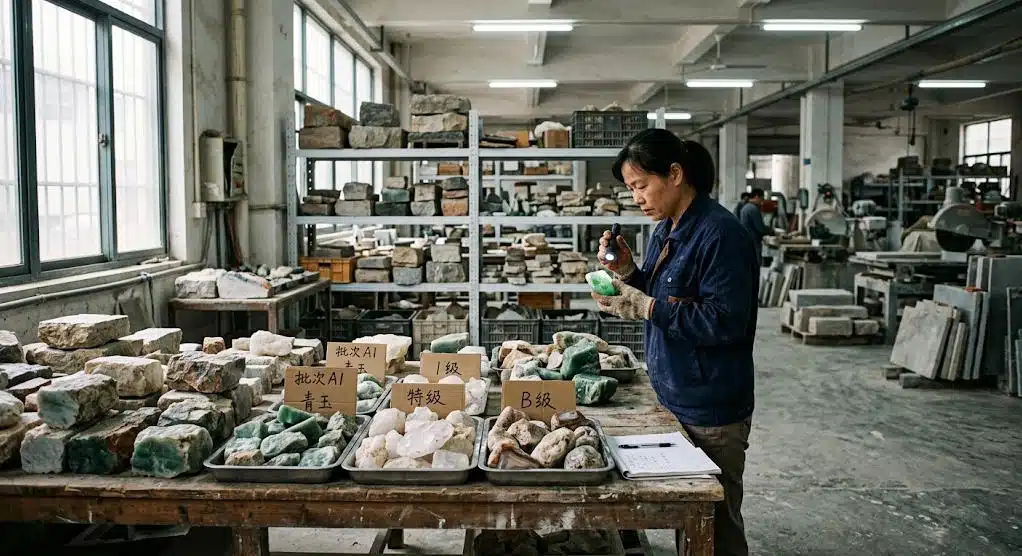
When a factory tells you it uses natural jade or crystal, you learn very little. The useful information sits behind that label: how the stone was chosen, checked, sorted, and tracked. Three questions cover most of what matters to you as a buyer.
Can Your Gua Sha Manufacturer Control Natural Variation?
Natural stone never behaves like sheet metal. Every block differs in color, translucency, and internal structure, and no factory can change that. What a gua sha manufacturer can control is the range: which blocks get bought, how they are graded, how batches are labeled, and what happens to blocks that fall outside the agreed limits. GIA’s jade quality guide groups quality by color, translucency, and texture, which gives you a practical vocabulary for writing that range down. This means you can replace “looks about the same” with a written tolerance that both sides can check against a sample.
So the better question is not “will every piece be 100% identical?” Ask instead whether your gua sha manufacturer can keep the variation inside the range you approved. A factory that answers with grading rules and batch records is showing you a process. A factory that answers “don’t worry” is showing you a promise.
Is Your Real Material Cost Under Control?
Price per kilogram is the number most buyers compare first, and it is the least reliable one. The figure that reaches your invoice is raw material cost divided by the number of pieces that pass QC. Using an illustrative $60 per kg, 100 kg costs $6,000. At 800 good pieces, each one carries $7.50 of material. At 950 good pieces, each one carries $6.32.
That gap of $1.18 per piece adds up quickly. On a 10,000-piece gua sha wholesale order, it comes to roughly $11,800 before labor, packaging, or freight enter the picture. The 800 and 950 figures are examples, not our reported yields, and real yields shift with stone type, thickness, and design.
You can check this yourself in three steps:
- Ask each factory for its typical yield per 100 kg on a design like yours.
- Divide the material cost by that yield.
- Compare the per-piece figures instead of the per-kilogram quotes.
This means you can spot a cheap quote that will cost you more per piece once waste is counted.
Will Your Delivery Date Hold?
Raw material links directly to your timeline. Purchasing feeds inventory, inventory feeds the gua sha production schedule, and the schedule sets your ship date. If a stone lot arrives short, fails inspection, or needs a re-order, every downstream step slides.
Have you ever received a “two more weeks” message that traced back to a material problem? That delay usually started at the purchasing desk, not on the polishing line. When you ask a factory how much approved stock it holds for your material and color, you are really asking about your delivery date. This means you can catch a schedule risk before your deposit goes out, not after.
How Raw Materials Affect Gua Sha Production and Quality at Your Gua Sha Manufacturer
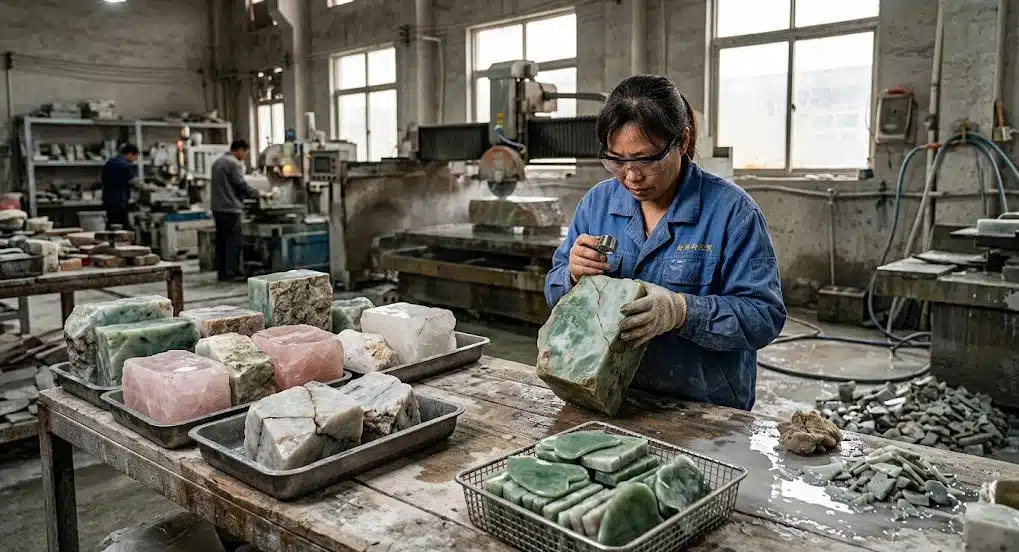
Most defects a buyer complains about were not created on the polishing line. They were already sitting in the stone when it arrived. Once you see how material flows through gua sha production, it becomes easier to tell which problems a factory can fix and which ones it can only reject.
Consistency: Why Identical Molds Still Give Different Pieces
Give two workers the same CNC program and the same template, and you can still end up with different pieces if the stone differs. Color shifts, texture changes, and translucency gaps all come from the block, not the machine. A gua sha manufacturer who buys from mixed lots will see this every week, and the only real defense is sorting before cutting.
That is why “consistent” needs a definition you can put in writing. In natural gua sha material, consistency means every piece stays inside the color, texture, and translucency range you approved, not that every piece looks identical. GIA’s jade description page explains why jade varies so widely in appearance, which is a useful reference when you set that range. This means you can approve a sample set once and reject any shipment that drifts outside it.
Surface Quality: Polishing Cannot Rescue a Weak Block
A micro-crack or a patch of uneven grain will still show after fine grinding. It may look like a dull spot, a faint line, or a texture that feels different under your thumb. The polishing step reveals these flaws rather than hiding them, so gua sha quality is largely decided before the stone reaches the wheel.
Hardness plays a part as well. Nephrite sits around 6 to 6.5 on the Mohs scale, jadeite around 6.5 to 7, and quartz varieties near 7, so each stone reacts differently to abrasive grit and polishing time. GIA’s quartz overview covers the structure of crystal materials in more detail. This means you can expect a different finishing process, and a different cost, for each material family rather than one flat price for “stone.”
What Cracks and Inclusions Do to Processing Loss
Cracks, mineral pockets, and unusable zones cost material at every stage. Cutting removes the damaged area, rough shaping removes more, and CNC and fine grinding remove a little again. When a block has many weak zones, the loss compounds at each step, which is how the 800-versus-950 yield gap from the earlier example appears in practice.
A responsible gua sha manufacturer maps usable areas on the block before cutting instead of slicing first and sorting later. Would you rather pay for waste that was avoidable or for a plan that avoided it? This means you can ask any gua sha supplier how it marks usable zones, and the answer will tell you how seriously it treats yield.
Processing Efficiency and Your Production Schedule
Hardness, thickness, internal structure, and crack position all change cutting speed, CNC settings, and polishing time. Two designs that look the same on paper can therefore take different hours on the floor. Operators slow down, adjust feed rates, or re-run passes when the stone pushes back.
For gua sha wholesale buyers, this is where quoted lead times quietly stretch. A quote built on an average stone is not the same as a quote built on the exact material you selected. This means you can ask for lead times tied to your specific stone and thickness, not a generic estimate.
After-Sales Risk: How Hidden Flaws Reach Your Customers
Raw material problems travel along two routes. In the first, a defective block leads to a machining fault, then a defective piece, and QC catches it before shipping. In the second, a hidden internal flaw passes inspection, survives transport, and only appears after your customer uses the tool, which turns into a complaint and then a return.
The second route is the expensive one, because it costs you reviews as well as money. Every extra inspection at the raw stage lowers that risk. This means you can treat incoming-material checks as insurance on your return rate.
How a Gua Sha Manufacturer Sources Raw Materials: The 5-Step Process
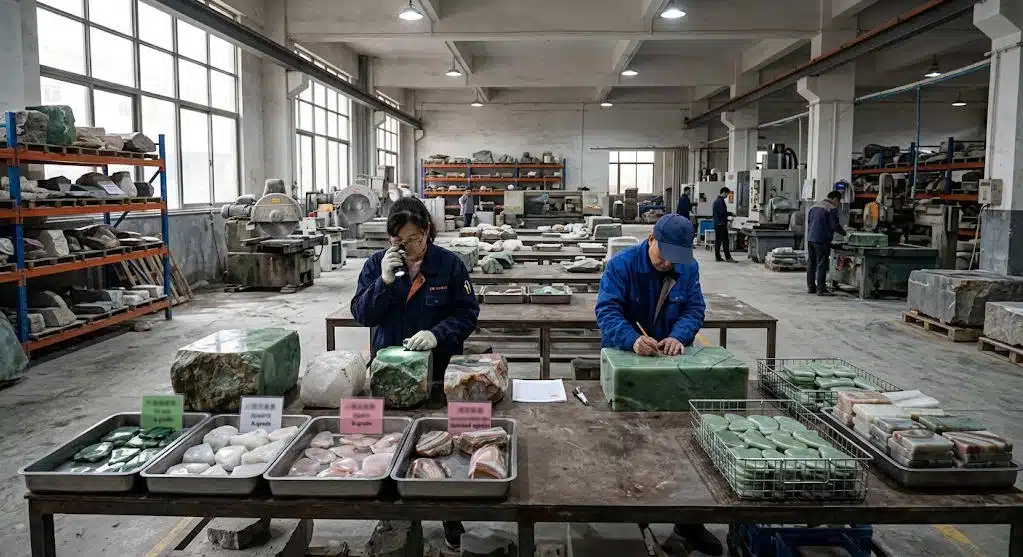
The full path runs in one line: customer requirement, material specification, supplier screening, incoming inspection, grading, purchase and stock-in, then a recheck before production. Each step exists because skipping it shows up later as waste, delay, or a complaint. Here is how the five core steps work, so you can follow the same logic when you audit any gua sha supplier, including us.
1: Write the Specification Before Any Stone Is Bought
A specification that says only “jade” or “crystal” invites trouble, because it leaves the buyer free to purchase whatever looks close and costs less. A workable spec names the material type, color range, translucency, texture and natural structure, hardness, size, block form, expected yield, and the natural variation you accept. For example, a 6mm natural stone board in light green, natural texture allowed, no through-cracks, gives purchasing a target it can actually check.
If your order calls for uniform color, the spec has to go further and define the color and texture limits with reference samples. Stainless steel tools follow a more industrial logic. You would confirm the grade (304 or 316L), sheet thickness, hardness, surface condition, dimensional tolerance, and batch or material certificates. ASTM’s stainless steel standards are a common reference for those grades. This means you can hand your gua sha manufacturer a written target, and the purchase gets judged against it instead of against someone’s memory.
2: Screen and Compare Suppliers
A mature gua sha manufacturer does not rely on one source. We compare price, supply stability, material specification, batch consistency, origin, past quality, lead time, defect rate, and how the supplier handles returns. Any single one can look fine on its own, so the comparison across all of them matters.
Here is a simple way to run the same check on your side:
- Ask how many material suppliers the factory uses for your stone.
- Ask how batches are labeled and traced.
- Ask what happened the last time a lot failed inspection.
Would you trust a factory whose entire supply hangs on one dealer? This means you can avoid the risk of a stalled order because a single source ran short.
3: Inspect Incoming Material Before It Enters Production
Raw stone should never go straight to the cutting table. For natural stone, the check covers visible cracks, chips, impurities, color, texture, translucency, block size, and the area that can actually be machined. The most important skill here is separating natural character from structural defect. Color variation, mineral inclusions, and texture are normal in natural gua sha material, while cracks that threaten machining or daily use are not.
IGS’s education resources and SSEF’s gemstone publications are useful places to learn how gem laboratories describe inclusions and treatments. Their vocabulary helps you ask sharper questions about what counts as acceptable. This means you can request inspection photos of your lot and judge them against the tolerance you wrote in Step 1.
4: Grade and Sort the Material
No two blocks in a lot match perfectly, so grading turns one mixed pile into usable categories. Grade A has stable color and structure and suits demanding products. Grade B carries some natural variation and still works for standard runs. Grade C shows clear defects and fits only specific items or needs further handling.
Buying and grading are two separate jobs. A block is not “good” because it was purchased; it becomes good once it is sorted and assigned to the right order. For your gua sha quality targets, this means you can specify which grade your order draws from and avoid mixed-grade surprises in the carton.
5: Plan the Cutting Around the Production Flow
The stone still has to pass through cutting, rough shaping, CNC, correction, fine grinding, polishing, and QC. So the cutting plan is set at purchase time, not after. Yield cannot be calculated by weight alone, because the chain looks like this: raw block, usable area, cutting loss, rough-shaping loss, CNC, fine-grinding and polishing loss, then finished pieces that pass.
Every link takes a share. A good plan lays out cutting lines to use the clean zones and keep waste out of the finished area. This means you can ask your gua sha manufacturer for the expected yield of your design, and use that number to compare quotes fairly across gua sha production partners.
Questions to Ask Any Gua Sha Manufacturer About Raw Materials and Compliance
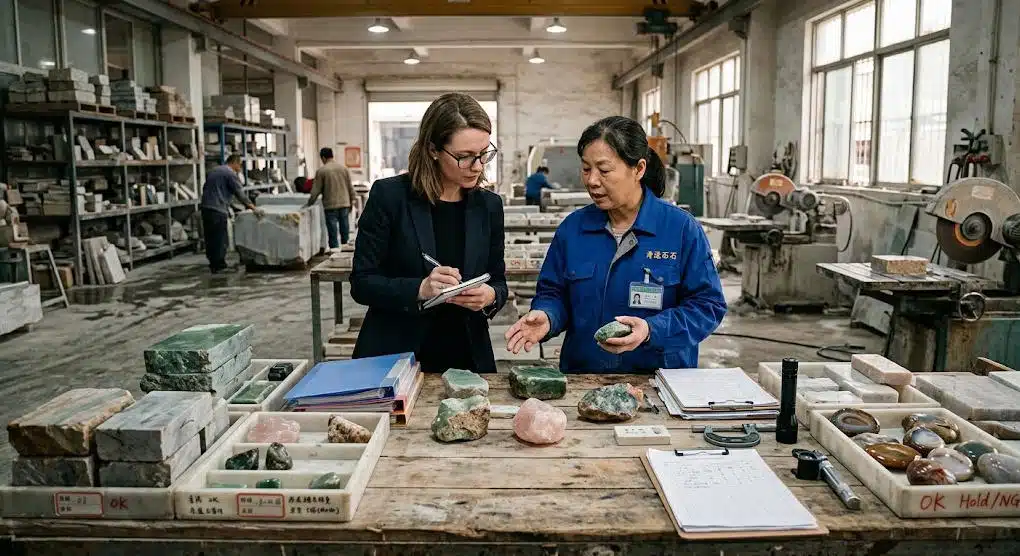
Before you sign a purchase order, a short conversation with your gua sha manufacturer can save you weeks of rework. The questions below come from problems we have seen on real orders, and they work with any gua sha supplier, including us. You do not need a lab of your own to use them, only a willingness to ask for specifics.
How to Audit a Gua Sha Manufacturer in Five Questions
Start with the specification. Ask how the factory writes down color, texture, and translucency limits, and whether it will attach reference samples to your order. A team that already keeps these records can answer in minutes, while a team that improvises will hesitate.
Next, ask about inspection. You want to hear how incoming stone is checked, who separates natural texture from structural cracks, and whether photos are kept for each lot. Then ask about grading, meaning which grade your order will draw from and what happens to the rest of the block.
Two more questions round out the audit. Ask for the typical yield per 100 kg on a design close to yours, and ask what the factory does when a lot fails inspection. The second answer tells you more about gua sha production discipline than any brochure, because it shows whether rejected stone is sent back, downgraded, or quietly used anyway. This means you can score any factory on the same five points and compare them side by side.
Compliance and Material Disclosure: What You Should Request
“Compliant” means different things by market, so start from where you sell. In the United States, tools that make skin-care claims may draw attention from the FDA’s cosmetics and devices guidance, and marketing language matters as much as the product itself. In the European Union, REACH governs chemical substances in articles, and it is worth asking whether any coatings, dyes, or adhesives are used on your tools. Stainless steel items should come with the grade certificate discussed earlier.
A responsible gua sha manufacturer should also tell you plainly whether a stone has been treated. Gemological laboratories such as SSEF and GIA publish extensive material on treatments like dyeing and impregnation, and jade is a well-known case. Under the US FTC Jewelry Guides, treated stones carry disclosure duties when sold as jewelry, and the same care is wise for wellness tools sold as natural. This means you can request a written statement of material origin and treatment status, so your product pages stay accurate and your risk stays low. Rules change, so confirm current requirements with your own legal or compliance adviser before you launch.
Risk Disclosure: What No Gua Sha Manufacturer Can Promise
Honesty helps you here, so here are the limits. No gua sha manufacturer can promise that natural stone will be identical from batch to batch, because the ground itself is not uniform. A stone can also hide a micro-crack that no visual check will find, and a small share of pieces may fail after shipping or use even with strong QC.
Supply can shift as well. A mine may run out of a certain color, a supplier may change quality, and your lead time may move as a result. What we can do is reduce these risks through written specifications, grading, inspection records, and buffer stock, not erase them. You should also treat any claim of “100% consistent natural stone” as a warning sign. This means you can build a small tolerance for natural variation into your product pages and returns policy, and avoid over-promising to your own customers.
Conclusion: Start Your Gua Sha Wholesale Order With the Stone
Raw material sourcing is where quality, cost, delivery, and after-sales risk begin, and every later step inherits its results. When you judge a gua sha manufacturer by its specifications, grading, inspection records, and real yield, you compare factories on the things that decide your outcome. Price per kilogram, by contrast, tells you very little about gua sha quality.
If you plan a gua sha wholesale order, send us your material, color, size, and quantity. You will receive a written specification, a grade recommendation, and an expected yield for your design, so you can review the numbers before you commit. Our team at Deyi Gems has processed jade and crystal gua sha tools for more than 12 years, and we are happy to show you our process in detail.
FAQ: Gua Sha Manufacturer and Raw Material Questions
1. Is natural gua sha material ever 100% identical between batches?
No. Color, texture, and translucency vary in natural stone. What you can control is the approved range, which a good gua sha manufacturer documents with samples and grading rules. This means you can accept variation you have already defined.
2. Why is price per kilogram not enough to compare gua sha suppliers?
Because the cost that matters is material cost divided by finished pieces. Two suppliers with the same kilogram price can differ by more than 18% per piece if their yields differ, as in the 800-versus-950 example. This means you can compare real cost only when you ask for yield.
3. How does raw material grading affect gua sha quality?
Grading assigns each block to the orders it suits, so demanding products draw from stable stone and lower grades go to items that tolerate variation. This means you can lock in the grade for your order and avoid mixed quality in one shipment.
4. Does raw material sourcing affect gua sha wholesale lead time?
Yes. Stock levels, supplier delivery, and inspection results all feed the production schedule. Ask how much approved material is on hand for your stone before you confirm dates. This means you can plan your launch around a realistic ship date.