
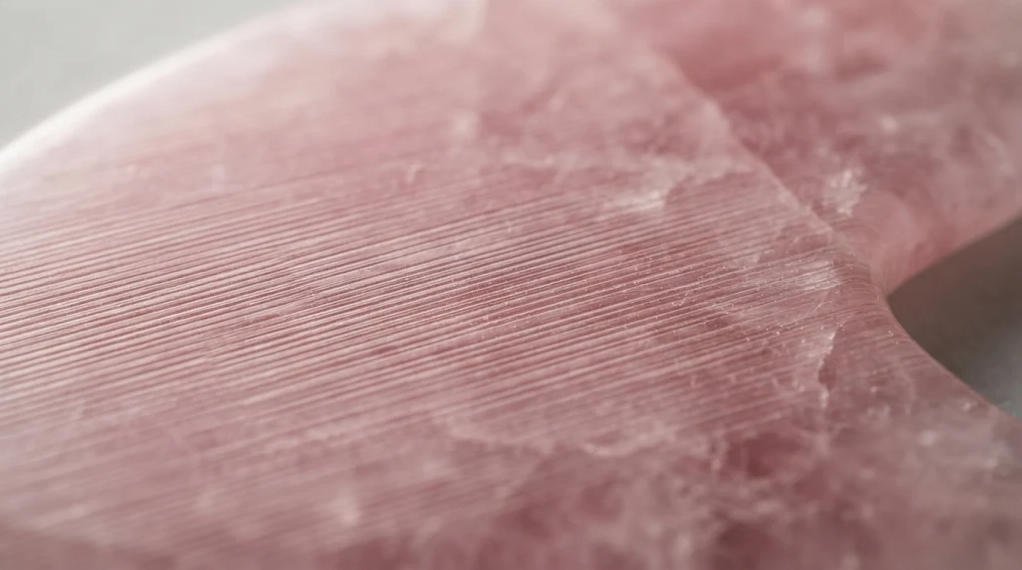
Gua sha production runs into the same six root causes of grinding wheel marks again and again: the wrong grit step, a worn wheel, too much pressure, the wrong wheel speed, weak hand-offs between stages, and thin cooling water. Quartz measures 7 on the Mohs scale, according to GIA’s rose quartz fact sheet, so a wheel that cuts it can also leave a groove that polish will not erase. This article shows you what a gua sha factory can control, what it cannot, and what you should ask before you order. A sound gua sha process uses a four-stage grit sequence, one inspection before polishing, and a 7-step rework routine. It also comes with limits, because natural stone varies and no gua sha manufacturer can honestly promise a zero-defect batch. If you buy through guasha wholesale channels, those limits become your risk too.
- What Grinding Marks Reveal About Gua Sha Production Risk
- How Grit Progression Works in Gua Sha Production
- Material Risk in Gua Sha Production: Quartz, Jade and Treated Stone
- What Causes Grinding Wheel Marks? Six Root Causes, Diagnosed by Pattern
- What Late Detection Costs in Gua Sha Production
- Rework or Scrap? How to Grade Marks in Gua Sha Production
- Compliance in Gua Sha Production: Safety Rules and Buyer Questions
What Grinding Marks Reveal About Gua Sha Production Risk
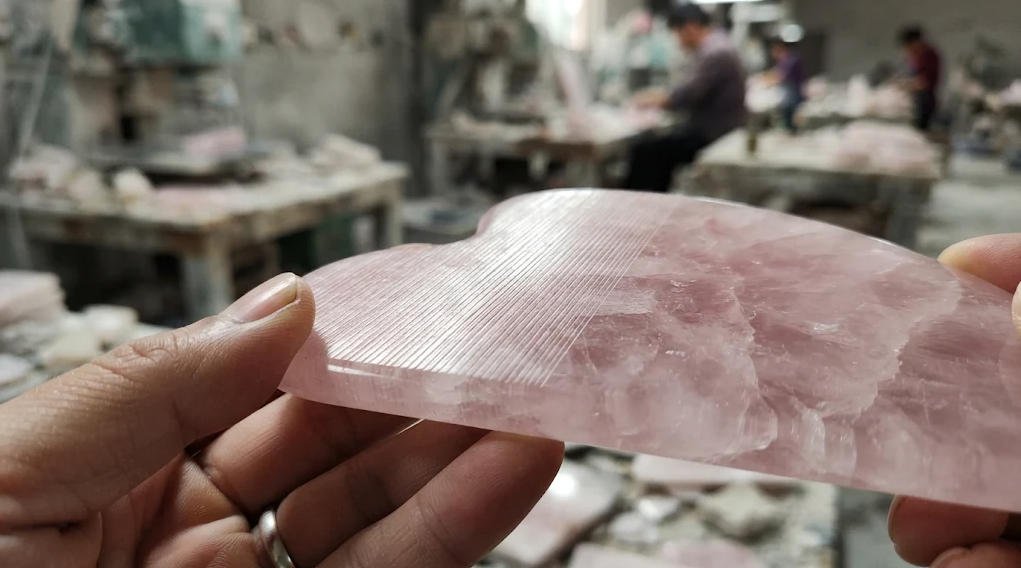
Start here: a grinding mark is not only a scratch you can see. It is a record of what happened on the grinding line. Read it correctly and you learn which wheel, which pressure or which water supply caused it. Read it wrongly and you pay for the same defect again in the next batch.
The Short Answer: Three Controls That Stop Most Marks
Three controls stop most grinding marks in gua sha production. The first is a grit sequence where each stage erases the last stage’s scratches. The second is a dedicated inspection before polishing. The third is graded rework that respects thickness tolerance. Everything below explains how to run them and how to tell when someone only claims to.
The grit sequence matters most. Polish improves gloss, but it does not promise to remove deep grinding scratches. A coarse wheel used on a nearly finished board therefore leaves a groove that survives every later step, and the polish only makes that groove easier to see. This means you can judge a supplier by asking which stage is expected to erase which scratch, instead of asking how shiny the sample looks.
The inspection is the cheapest control and the easiest to skip. Marks show up more clearly before polishing, because gloss scatters light and hides the pattern until a customer spots it under a bathroom lamp. One fixed light and a few tilted angles catch most of them. This means you can move defects out of the packing room and into a stage where fixing them is cheaper.
Why a Surface Defect Is Also a Disclosure Issue
Here is the uncomfortable part. A mark that survives to packing is a quality problem, but a mark that was found, covered with polish and shipped anyway is a disclosure problem. If you resell through guasha wholesale channels or marketplaces, you carry that risk downstream, because the end customer never meets the person who ground the stone. This article therefore follows a risk-disclosure format: for each control, it describes what works, what can still go wrong, and who pays when it does.
Natural stone adds a second layer. Veins, inclusions and fissures belong to the material, not to the wheel, so a fair gua sha manufacturer separates the two on the inspection sheet and tells you which defects are grounds for rejection. If your supplier files everything under “natural characteristics,” ask for close-up photos and a written definition. This means you can protect your return rate by agreeing on defect categories before the first order ships.
One more note before you read on. Nothing here promises that your next shipment will be defect-free. Wheels wear, stones hide internal flaws, and people get tired at hour seven of a shift. A supplier who admits this and shows you the control points is a safer bet than one who says it never happens. This means you can treat honest limits as a buying signal.
How Grit Progression Works in Gua Sha Production
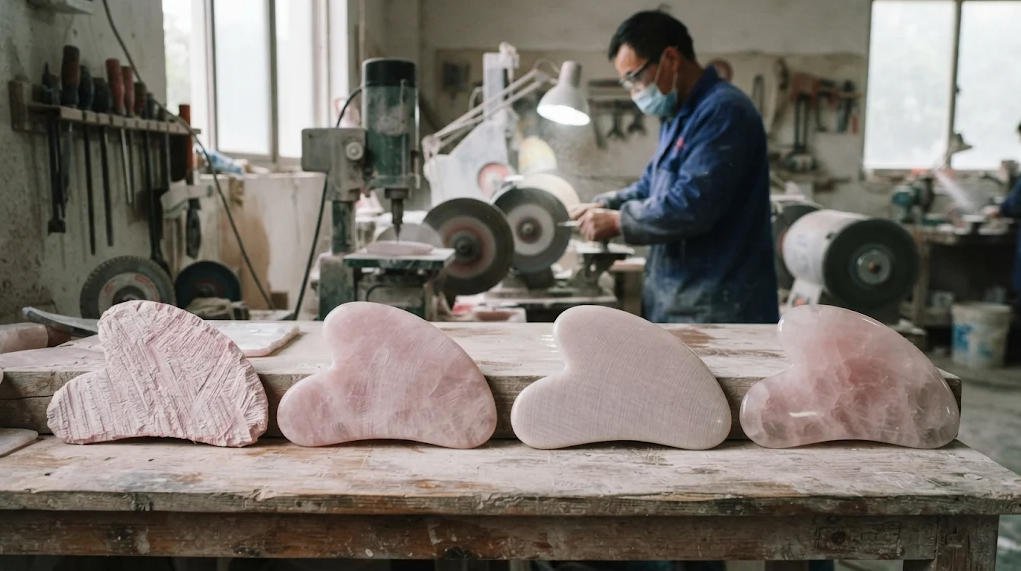
Grit progression is the backbone of the whole gua sha process. Rough grinding removes cutting traces and shapes the outline. Medium grinding erases the grooves that rough grinding left behind. Fine grinding refines the surface, and final grinding plus polishing deliver flatness and gloss. Each wheel has one job, and the rule is strict: the next stage must be able to remove what the previous stage left. Speed tempts people to skip steps, since a coarse wheel removes material fastest. This means you can ask for a stage checklist and see exactly where a supplier lets scratches slip through.
How to Set a Four-Stage Grit Sequence
You can set this up without borrowing anyone else’s numbers. First, pick a test batch of the exact stone you plan to run, whether that is rose quartz, amethyst or nephrite. Second, grind three sample boards through the rough and medium stages, then inspect each one under a single fixed light. If rough-stage marks are still visible, the grit jump is too large and the sequence needs an intermediate wheel. Third, repeat the same check from medium to fine and from fine to polish. Fourth, record wheel type, grit, pressure range and time for each stage on one card, and freeze that card for the material.
Keep one caveat in mind. Grit values and stage counts depend on stone type, wheel material and machine condition, so a card that works on quartz may behave differently on nephrite, which GIA lists at 6 to 6.5 on the Mohs scale, against 7 for quartz. This means you can replace guesswork with one documented trial, and you can compare two suppliers by the quality of their stage cards.
Why Polishing Cannot Hide Deep Scratches in Gua Sha Production
Polish is a finishing step, not a repair step. GIA’s durability guide treats hardness, toughness and stability as three separate factors, which is a useful reminder that a stone can resist scratching in general and still carry a deep groove from one wrong wheel. A groove cut at the rough stage usually sits well below the thin layer that polishing touches.
So here is a question worth asking the gua sha factory you are vetting: after the final polish, how do you know the groove is gone and not just filled with shine? A solid answer names an inspection under raking light before polishing begins. A weak answer points to the finished photo. This means you can stop paying for a final polish on boards that still need another fine-grinding pass.
Material Risk in Gua Sha Production: Quartz, Jade and Treated Stone
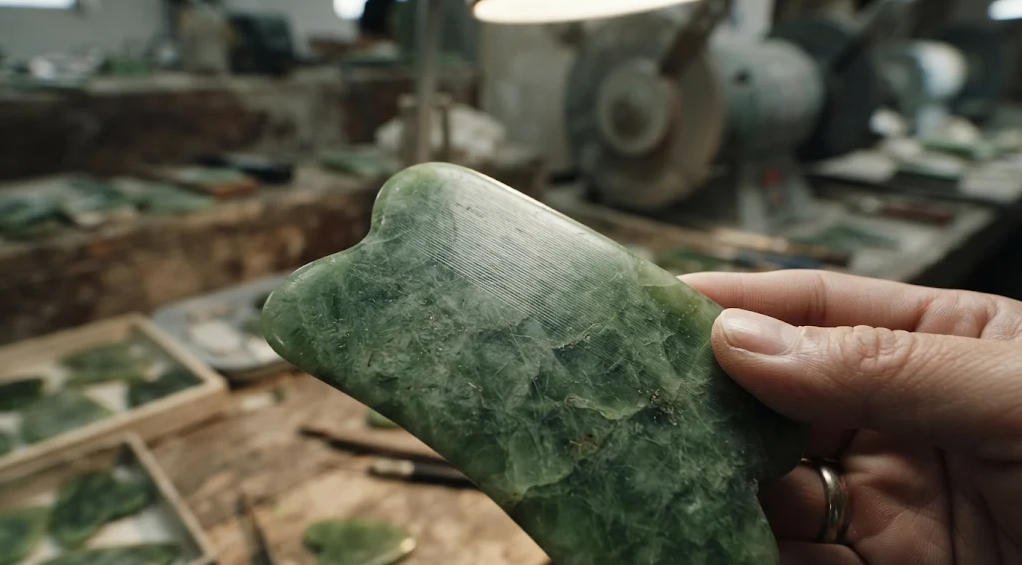
The stone you grind decides how forgiving the line is. GIA lists jadeite at 6.5 to 7 and nephrite at 6 to 6.5 on the Mohs scale, and it adds that both are very resistant to breaking or chipping, while quartz sits at 7. That toughness helps jade survive the wheel, but it does not stop a wrong wheel from cutting a groove. Every material in your range therefore needs its own trial card inside the gua sha process. This means you can avoid the common trap of copying quartz settings onto jade and discovering the difference in the finished batch.
How to Tell Natural Veins From Grinding Marks
Before anyone regrinds a board, someone has to decide whether the line on it is a defect at all. Wheel marks follow the motion of the tool: they run parallel, cross at a stage boundary, or repeat at regular intervals around a ring. Natural veins, inclusions and fissures follow the crystal instead, so they wander, shift as you tilt the piece, and ignore the direction of the wheel. Start by cleaning the board, then view it under one fixed light and photograph any doubtful line from two angles. Tag the photo with a code on the inspection sheet, so the acceptance rule is written down before a dispute starts.
The stakes are higher than they look. Regrinding a natural fissure can widen it, and a harmless internal feature then turns into a crack a customer can feel. This means you can protect both stone and reputation by classifying the line first and reaching for the wheel second.
What Treated or Coated Jade Means for Rework
Treated stone changes the rework conversation. GIA reports that jadeite is commonly bleached, dyed or polymer-impregnated, or treated with a combination of these, and that impregnation is not always easy to see under magnification. In GIA’s study of ten coated jadeite samples, the coating averaged about 16 μm in thickness and had a Mohs hardness of roughly 3, against about 7 for uncoated jadeite. The coated surfaces also showed irregular scratches that differed from ordinary polishing lines.
Put those numbers next to a grinding wheel and the risk is clear. A coating that thin can disappear in one careless pass, and the stone underneath may not match the stone you described. A gua sha factory cannot always spot a treatment by eye, and SSEF reminds clients that any laboratory statement refers to the situation at the time of testing. So if you run a jade line through guasha wholesale channels, ask for a written material declaration and an independent lab report on the higher-priced pieces. This means you can keep your product descriptions accurate and avoid reworking a surface you cannot describe honestly.
What Causes Grinding Wheel Marks? Six Root Causes, Diagnosed by Pattern
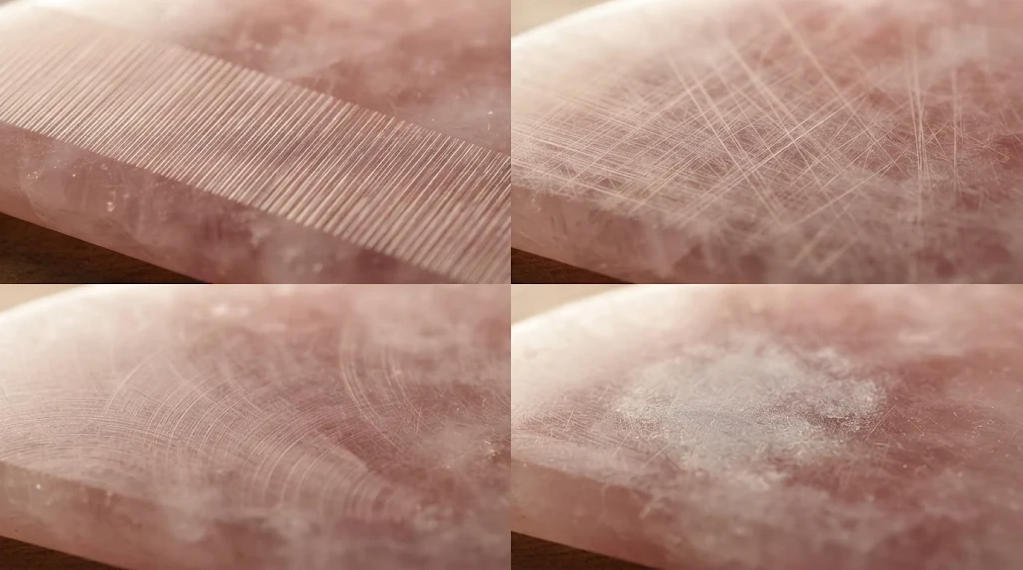
Marks are easier to fix once you can name their cause. The six root causes are an unsuitable grit step, a worn or clogged wheel, uneven pressure, a wheel speed that does not match the machine, weak hand-offs between stages, and cooling water that does not reach the cut. The grit step and the stage hand-offs were covered earlier, so this section deals with the other four. The quickest diagnostic is the pattern on the board itself. This means you can often point at one photo and say which part of the gua sha production line to open up first.
How to Read Parallel, Cross, Ring and Whitened Marks
Read the pattern like a chart. Parallel lines usually follow the direction the wheel moved. Crossed lines in different directions often mean one stage never finished erasing the one before it. A deep groove points at a coarse wheel or too much pressure, a ring or arc suggests a problem with wheel rotation or contact angle, and a cloudy white patch can mean grinding damage, micro-cracks or polish that never caught up. Photograph one example of each pattern and keep the set with your gua sha process documents. This means your operators, your inspectors and your gua sha manufacturer will describe defects in the same words, so rework notes actually make sense.
Wheels, Pressure and Speed: Fix the Machine Before the Operator
Worn wheels are the usual suspect. Grit grains go dull, stone dust clogs the surface, wear turns uneven, and the wheel starts touching the board in patches. The fix is routine: inspect on a schedule, clean or dress the wheel, replace it when wear is obvious, keep separate wheels for separate materials, and grind a test piece after every wheel change.
Pressure and speed come next. Heavy pressure removes more stone from one spot and can leave micro-cracks or chipped edges, so a stable pressure, a steady feed and a constant contact angle matter more than raw effort. Higher speed is not automatically better either: too fast adds friction heat, and too slow tempts operators to press harder to compensate. Set speed inside the wheel maker’s safe range, and check spindle, bearings and fixtures for vibration or runout. If marks repeat at regular intervals, suspect the machine before you retrain anyone. This means you can fix a defect once instead of chasing it every shift.
Why Cooling Water Failures Hit a Whole Gua Sha Production Batch
Wet grinding does three jobs: it cools the cut, flushes stone dust away, and stops loose grit from scratching the surface a second time. When flow is thin or the nozzle points at the wrong spot, heat builds, dust packs onto the wheel, and boards come out cloudy or rough. Because the same water serves every board on the line, the damage tends to show up across a whole batch rather than on one piece. GIA notes that everyday dust often contains quartz, which is why stones rated 7 or lower need careful cleaning. Recirculated slurry is a heavier version of the same problem, though that comparison is an inference, not a GIA finding.
So if a whole batch shows similar marks, check nozzle position, flow rate, settling tank and filters before you ask anyone to regrind. This means you can fix the cause once instead of paying for the same rework on the next batch.
What Late Detection Costs in Gua Sha Production
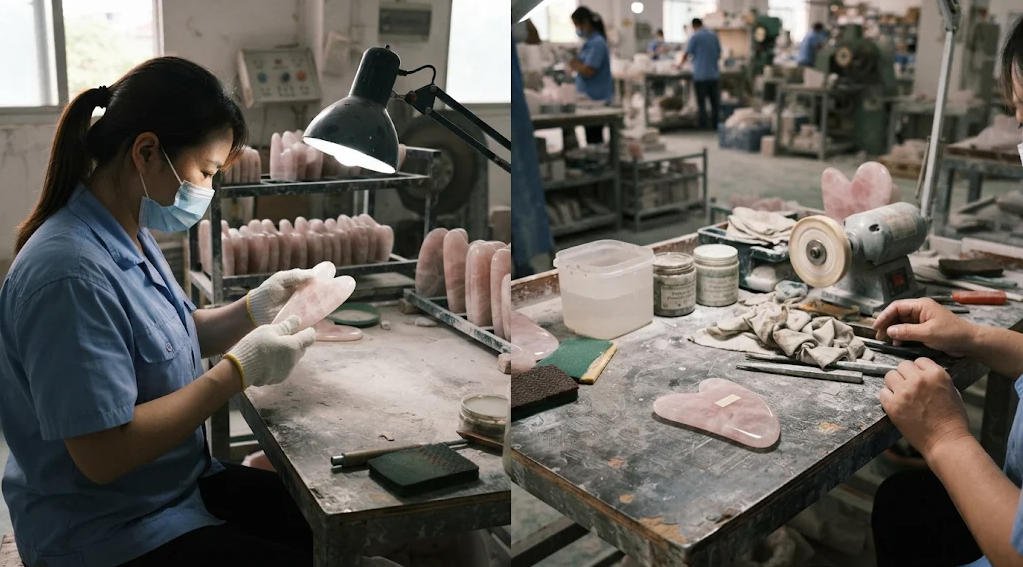
Most suppliers will tell you that late detection costs more, but few put a number on it. The figures below are assumptions, not measurements from any specific line, so swap in your own minutes and your own labor rate. The structure of the math holds on most lines. A mark caught before polishing needs one extra grind. A mark caught after polishing needs the grind, a repolish, a wash and a recheck, and every extra pass removes stone that your thickness tolerance may not be able to spare.
A Worked Cost Example (Illustrative Assumptions)
Assume a 1,000-piece batch with a 5% mark rate, which is 50 pieces. Catching a mark before polish costs about 2 minutes of regrinding per piece, so 100 minutes in total. Catching it after polish costs about 9 minutes per piece once repolishing, washing and re-inspection are added, so 450 minutes in total. That is 4.5 times the labor for the same 50 boards, plus a scrap risk if the extra passes push a piece below minimum thickness.
Now the honest part: inspection is not free. If checking every piece takes 10 seconds, that is about 167 minutes per batch. Each defect caught early saves 7 minutes (9 minus 2), so the check pays for itself only above roughly 24 defective pieces per 1,000, a 2.4% mark rate. At 5%, you net about 183 minutes per batch, which over 20 batches a month is roughly 61 hours, or about $366 at an assumed $6 per hour. At 1%, a full inspection loses money and sampling is the smarter choice. This means you can choose between full inspection and sampling by your own mark rate instead of by habit.
How to Run a Pre-Polish Inspection in Gua Sha Production
A five-minute routine is enough to add to your gua sha process. First, wash and dry the boards so slurry cannot hide a groove. Second, put them under one fixed light at one fixed position. Third, tilt each face through at least three angles and look closely at the main display face and the edges. Fourth, sort each piece as light, moderate or severe, using the photo set from your pattern guide. Fifth, record the count by wheel, shift and operator, so repeating patterns surface within days. A well-run gua sha factory does this before polishing, and a transparent gua sha manufacturer will show you the counts.
One risk deserves a flag. An inspection is only as good as the inspector, and eyes tire after an hour of staring at near-identical boards. Rotate inspectors, cap each session, and ask whether a second person re-checks a sample. Would you trust a check that nobody ever audits? This means you can ask for last month’s pre-polish counts and learn more than any sample board will tell you.
Rework or Scrap? How to Grade Marks in Gua Sha Production

Once a mark slips past the pre-polish check, the question is simple: fix it or bin it. The goal of rework is to remove the defect while giving up as little stone as possible, because every extra pass takes material you cannot put back. Marks fall into four grades. Light marks are shallow and small. Moderate marks are visible and too deep for polish alone. Severe marks are deep grooves or a loss of flatness. Structural damage means cracks, chipped edges or internal harm. This means you can ask any supplier to show you what each grade looks like and what happens to it next.
How to Rework Light and Moderate Marks Without Creating Dents
For a light mark, start by rinsing the board so polish residue and loose dust cannot scratch the surface again. Next, regrind only the affected spot with a fine tool and light pressure. Then repolish with a medium suited to the stone, wash the board, and inspect it again. Moderate marks need more care: confirm where the groove sits and how deep it runs, pick a grit that really removes it, work the defect area first, and step through intermediate grits instead of jumping between coarse and fine.
Here is the catch. If you grind only the groove on a flat board, you dig a shallow dip, especially in the middle of the face. For a large area, or any mark on the main display face, widen the work zone or regrind the whole face, then repolish so the gloss stays even. This means you should expect a reworked board to be slightly thinner than its neighbors, and you can check that against tolerance before it ships.
When to Scrap a Board, and Five Rework Mistakes to Avoid
Scrap is the right call when removing a groove would drop the board below minimum thickness, when flatness is already lost, or when micro-cracks or chipped edges sit beside the mark. Natural stone adds a warning of its own: aggressive regrinding can widen a natural fissure until the board splits. Polishing over structural damage is the riskiest shortcut on the line, because the failure shows up in a customer’s hand. A gua sha factory that scraps these boards is protecting you, not wasting stone.
Five mistakes cause most second-round defects. First, a coarse wheel on the second pass deepens the original scratch and adds new ones. Second, chasing one scratch while ignoring flatness; curved and shaped boards need tools that match their contour. Third, skipping the gloss recheck, so hazy patches and uneven reflections reach packing. Fourth, ignoring size, because a smooth board outside length, width or thickness tolerance does not ship. Fifth, sending reworked boards to packing without a full re-inspection for marks, new scratches, dents, edges, cracks and dimensions. This means you can use these five as an audit list the next time you tour or video-call a gua sha factory.
A 7-Step Rework Routine to Request From Your Gua Sha Manufacturer
A written routine keeps rework from turning into improvisation. Identify the defect and confirm it is a grinding mark rather than a natural feature. Grade it as light, moderate or severe. Choose the method and check the thickness margin. Rework with controlled pressure and a limited area. Clean and repolish. Inspect marks, flatness, size and edges. Finally decide: pass, rework again or scrap, with no release before the recheck. Ask your gua sha manufacturer for this routine in writing, and ask how often reworked boards fail the second inspection. This means you can see whether rework in gua sha production is a controlled step or a quiet habit.
Compliance in Gua Sha Production: Safety Rules and Buyer Questions

Compliance is where risk disclosure becomes concrete. Two sets of rules matter most to you: worker dust safety on the grinding floor, and product safety for goods sold into the EU. Neither shows up in a sample, which is why you need to ask for documents instead. This article is information, not legal advice, so confirm the details with a compliance adviser before you rely on them.
Dust Safety in Gua Sha Production: What OSHA’s Silica Standard Says
Grinding quartz makes dust, and OSHA defines respirable crystalline silica as quartz, cristobalite and tridymite in respirable airborne particles. Its general industry standard sets a permissible exposure limit of 50 µg/m³ as an 8-hour average and an action level of 25 µg/m³. Covered employers need a written exposure control plan, and dry sweeping is restricted where it could raise exposure. OSHA rules bind US workplaces, so a gua sha factory elsewhere answers to its local law, but these numbers are a useful benchmark when you ask about monitoring. Wet grinding is a common way to keep dust down, and it fits the cooling-water controls covered earlier in the gua sha process. This means you can request the factory’s dust-monitoring records and written exposure plan instead of accepting a verbal assurance.
Product Safety: What the EU GPSR Asks of Manufacturers
Regulation (EU) 2023/988, the General Product Safety Regulation, has applied since 13 December 2024 to consumer products offered in the EU through all sales channels, according to EUR-Lex. Manufacturers must design products to be safe, run an internal risk analysis, draw up technical documentation, place traceability information on the product or packaging, and provide contact details for complaints. Authorities can ask for details of other items in the same batch, and product information must be available for 10 years, with supply-chain traceability information for 6. Each product also needs a responsible economic operator inside the EU. If you sell guasha wholesale lots into Europe, batch numbers on your cartons are no longer a courtesy. This means you can build recall readiness into your supplier agreement now, instead of after a complaint arrives.
What to Ask a Gua Sha Manufacturer Before a Guasha Wholesale Order
Turn this article into six requests for your next guasha wholesale inquiry. Ask for the written grit card for your stone and the pre-polish inspection counts from the last month. Ask for the grade definitions and the rework and scrap rules, including the minimum thickness. Ask for wheel and machine check records, because repeating marks usually trace back to them. Ask for dust-monitoring records and the written exposure plan. Ask how batches are numbered and how long records are kept. Finally, ask for a material declaration, plus an independent lab report on higher-priced jade pieces, since treated stone changes what rework can safely do. A gua sha manufacturer that answers with documents is easier to trust than one that answers with a sample. This means you can compare suppliers on evidence in one afternoon.
Closing Disclosure: What Gua Sha Production Cannot Promise
Even with every control in place, gua sha production cannot promise a zero-defect batch. Stone hides internal flaws, wheels wear between checks, and inspectors miss things at the end of a long shift. What a sound gua sha process can promise is that defects get found early, graded honestly and reworked within tolerance, with records you can read. If you buy through guasha wholesale channels, ask for those records before you ask for a price. Would you rather discover the limits in a contract or in a customer review?