FAQ

You will get some answers about gua sha stone at here. These are Faq about guasha tools, such as how to use gua sha, how to clear gua sha.

gua sha use for health problem

Gua Sha Use to Treat Some Common Health Problems.

People are often affected by some health problems in their daily lives. The five most common health problems include colds, shoulder and neck pain, rheumatic joint pain, gastrointestinal discomfort and headaches. It has been observed that scraping has certain effects on treating these five health problems. The following is what Gua Sha can do and how gua sha use it for these five health problems. Gua Sha Use and Effect for Health Problem 1. Cold and Cold 2. Shoulder and Neck Pain 3. Rheumatic Joint Pain 4. Gastrointestinal Discomfort 5. Headache Precautions: Overall, gua sha needs to be used with caution and is best performed under the guidance of a professional doctor, especially for serious health problems. Gua Sha is only a type of traditional therapy. Its efficacy varies from person to person. It has not been scientifically proven and cannot replace regular medical treatment. Who is not Suitable for Gua Sha to Treat These Health Problems? Gua Sha massage is not suitable for everyone, and certain groups of people may not be suitable for gua sha use to treat health problems. The following are some situations and reasons why Gua Sha is not suitable for use: For the above nine groups, we do not recommend that gua sha use to treat health problems to prevent more serious problems from occurring. If you really want to try it, please consult a professional doctor in advance for their advice and help. Overall, gua sha does have a role in treating some common health problems, although these benefits have not yet been fully scientifically proven. But it should be noted that before we hope to treat some diseases through scraping, it is best for you to consult some professional doctors. Make sure you can use Gua Sha safely and correctly without causing more serious harm to your bo dy due to wrong methods.

Gua Sha Use to Treat Some Common Health Problems. Read More »

People are often affected by some health problems in their daily lives. The five most common health problems include colds, shoulder and neck pain, rheumatic joint pain, gastrointestinal discomfort and headaches. It has been observed that scraping has certain effects on treating these five health problems. The following is what Gua Sha can do and how gua sha use it for these five health problems. Gua Sha Use and Effect for Health Problem 1. Cold and Cold 2. Shoulder and Neck Pain 3. Rheumatic Joint Pain 4. Gastrointestinal Discomfort 5. Headache Precautions: Overall, gua sha needs to be used with caution and is best performed under the guidance of a professional doctor, especially for serious health problems. Gua Sha is only a type of traditional therapy. Its efficacy varies from person to person. It has not been scientifically proven and cannot replace regular medical treatment. Who is not Suitable for Gua Sha to Treat These Health Problems? Gua Sha massage is not suitable for everyone, and certain groups of people may not be suitable for gua sha use to treat health problems. The following are some situations and reasons why Gua Sha is not suitable for use: For the above nine groups, we do not recommend that gua sha use to treat health problems to prevent more serious problems from occurring. If you really want to try it, please consult a professional doctor in advance for their advice and help. Overall, gua sha does have a role in treating some common health problems, although these benefits have not yet been fully scientifically proven. But it should be noted that before we hope to treat some diseases through scraping, it is best for you to consult some professional doctors. Make sure you can use Gua Sha safely and correctly without causing more serious harm to your bo dy due to wrong methods.

gua sha for health life

Gua Sha for Health Life – How to Use Gua Sha for Headache

Gua sha for health life is truth? Yes, gua sha therapy, also known as Gua Sha, can offer several health benefits. While it is often praised for its natural beauty effects, its primary and fundamental function lies in its role as a traditional Chinese medicine treatment. In this article, we will explore how Gua Sha can be employed to alleviate symptoms associated with headaches. Before engaging in Gua Sha, it is essential to understand the causes of your headaches. If the headache is a result of external trauma, Guasha may not address your issue. It is most effective for headaches caused by blockages in meridians or muscle tension due to constriction. 1. Causes of Head Pain: Out of the fourteen mentioned reasons, Gua Sha may not be effective for improving conditions related to 8, 9, 10, 11, and 14. Gua Sha for Health Life – How to Use Gua Sha fo Headache? Gua Sha is a traditional Chinese medical therapy that typically involves using special gua sha tools to apply pressure to the skin, promoting blood circulation, relieving muscle tension, and enhancing the body’s natural healing abilities. Below are some steps and precautions to help alleviate headache symptoms through Gua Sha: 1. Materials and Tools: Gua Sha board or tool: These tools are often made of various materials such as buffalo horn, jade, agate, etc. Massage oil or Gua Sha oil: Used to reduce skin friction and prevent excessive irritation. 2. Steps: Precautions: From a Traditional Chinese Medicine Perspective, How Can We Try to Avoid Headaches? Although it’s helpful about gua sha for health life, we should nip it in the bud. From a Chinese medicine perspective, headaches are often related to factors such as impaired blood and Qi circulation, dysfunction of organs, and invasion of wind, cold, or dampness. Here are some Chinese medicine suggestions to help avoid behaviors that could lead to headaches:

Gua Sha for Health Life – How to Use Gua Sha for Headache Read More »

Gua sha for health life is truth? Yes, gua sha therapy, also known as Gua Sha, can offer several health benefits. While it is often praised for its natural beauty effects, its primary and fundamental function lies in its role as a traditional Chinese medicine treatment. In this article, we will explore how Gua Sha can be employed to alleviate symptoms associated with headaches. Before engaging in Gua Sha, it is essential to understand the causes of your headaches. If the headache is a result of external trauma, Guasha may not address your issue. It is most effective for headaches caused by blockages in meridians or muscle tension due to constriction. 1. Causes of Head Pain: Out of the fourteen mentioned reasons, Gua Sha may not be effective for improving conditions related to 8, 9, 10, 11, and 14. Gua Sha for Health Life – How to Use Gua Sha fo Headache? Gua Sha is a traditional Chinese medical therapy that typically involves using special gua sha tools to apply pressure to the skin, promoting blood circulation, relieving muscle tension, and enhancing the body’s natural healing abilities. Below are some steps and precautions to help alleviate headache symptoms through Gua Sha: 1. Materials and Tools: Gua Sha board or tool: These tools are often made of various materials such as buffalo horn, jade, agate, etc. Massage oil or Gua Sha oil: Used to reduce skin friction and prevent excessive irritation. 2. Steps: Precautions: From a Traditional Chinese Medicine Perspective, How Can We Try to Avoid Headaches? Although it’s helpful about gua sha for health life, we should nip it in the bud. From a Chinese medicine perspective, headaches are often related to factors such as impaired blood and Qi circulation, dysfunction of organs, and invasion of wind, cold, or dampness. Here are some Chinese medicine suggestions to help avoid behaviors that could lead to headaches:

5 Things About Gua Sha Wholesale Resale That You Must to Know

Table of Contents If you plan to gua sha wholesale and resell to start your business. Then there are some issues that you have to prioritize. Taking care of these issues will make your reselling business go smoothly. And if you ignore these issues, you may cause serious financial losses or even get into legal trouble. In order to allow you to better carry out scraping wholesale resale business. We’ve compiled five of the most commonly encountered problems and provided detailed solutions. 1. For Gua Sha Wholesale Resale, Should I Customize My Logo on the Product? For most customers, we will recommend them to customize their logo. Unless the client explicitly requires it or the budget is too low. For logo customization, it has the following advantages: Highlight your brand. It allows your customers to see your brand information immediately and deepens the impact on customers. And customers will have a deeper understanding of your brand every time. A prominent brand can differentiate you from your competitors and increase customer stickiness. Increase profit value. You can pay attention to the surrounding product information. For the same products, those with brand logos tend to have higher prices. This is because of the brand premium. Therefore, appropriate brand identity can increase the profit value of your single product to a certain extent. Of course, it also has certain disadvantages: The purchase quantity needs to meet certain standards, that is, the minimum order quantity. The wholesale cost will be higher. The average price of engraving a logo on a scraper is about US$0.5 per piece. 2. Which Styles Should I Choose for Gua Sha Wholesale Resale? When reselling, many people will first consider the most popular and best-selling gua sha styles on the market. In principle this is no big problem. But we recommend you consider other styles. Because the most popular styles may have the following problems: Market saturation. The most popular styles often have many followers investing in the product, causing the market to become oversaturated. Oversaturation of the market will lead to intensified competition. At this time, it will be very difficult to enter the sales circle of this product. Low profit value. The intensification of competition often leads to bottomless price wars among merchants, trying to seize the market as much as possible with low prices. In the end, except for individual merchants, others are often unprofitable and can only end their own businesses. This is the most common form of vicious competition. Therefore, we recommend that you consider the following aspects when choosing a wholesale Gua Sha style: Market sales situation. Have a certain market sales popularity. Check the market competition. If you find that the market competition is too saturated, no matter how hot the market sales are, don’t enter. Unless your brand is well-known and has a large number of fans, which is enough to support your business. See if the market is trending upward. Whether the product matches your target group. 3. Which Gua Sha Supplers are Suitable for Me? Reliable suppliers are the best support to ensure the smooth development of your Gua Sha wholesale business. When you choose a gua sha provideri, you should consider the following factors: Product Quality: Product quality is crucial to maintaining customer satisfaction. Make sure your suppliers provide high-quality products and avoid issues related to poor-quality products, which can damage your reputation. Production capacity: whether it can meet your order needs and deliver goods in time. Certification and certificates: Some products contain patents. So you should know whether all styles sold by suppliers are legal and compliant. Avoid repercussions you may be exposed to when reselling these products. In short, consider all factors such as the product itself, production capacity and merchant reputation. 4.Which Payment Method Should I Choose? The specific payment method needs to be negotiated with the supplier. For suppliers, first-time merchants often only accept full payment unless the order quantity is large. But in reality, suppliers can often accept 5-5 payment methods. That is, pay 50% of the amount in advance, and then pay the remaining balance before shipment. So you can try hard to negotiate with the supplier. 5. How Do I Market? There is no complete standard for marketing. Different merchants are suitable for different promotion models. But there are only the following channels: Social media. Search engine. Exhibition. We recommend that you consider social media and search engines as your first place to start. For gua sha, it seems to be a perfect fit for promotion on social media. Coupled with the use of teaching scenarios, celebrity sharing, etc., often bring good results. But the actual promotion model still requires you to conduct comprehensive research. By considering these factors together, you can better plan and execute your wholesale resale business, improving your chances of success and ensuring long-term sustainability.

5 Things About Gua Sha Wholesale Resale That You Must to Know Read More »

Table of Contents If you plan to gua sha wholesale and resell to start your business. Then there are some issues that you have to prioritize. Taking care of these issues will make your reselling business go smoothly. And if you ignore these issues, you may cause serious financial losses or even get into legal trouble. In order to allow you to better carry out scraping wholesale resale business. We’ve compiled five of the most commonly encountered problems and provided detailed solutions. 1. For Gua Sha Wholesale Resale, Should I Customize My Logo on the Product? For most customers, we will recommend them to customize their logo. Unless the client explicitly requires it or the budget is too low. For logo customization, it has the following advantages: Highlight your brand. It allows your customers to see your brand information immediately and deepens the impact on customers. And customers will have a deeper understanding of your brand every time. A prominent brand can differentiate you from your competitors and increase customer stickiness. Increase profit value. You can pay attention to the surrounding product information. For the same products, those with brand logos tend to have higher prices. This is because of the brand premium. Therefore, appropriate brand identity can increase the profit value of your single product to a certain extent. Of course, it also has certain disadvantages: The purchase quantity needs to meet certain standards, that is, the minimum order quantity. The wholesale cost will be higher. The average price of engraving a logo on a scraper is about US$0.5 per piece. 2. Which Styles Should I Choose for Gua Sha Wholesale Resale? When reselling, many people will first consider the most popular and best-selling gua sha styles on the market. In principle this is no big problem. But we recommend you consider other styles. Because the most popular styles may have the following problems: Market saturation. The most popular styles often have many followers investing in the product, causing the market to become oversaturated. Oversaturation of the market will lead to intensified competition. At this time, it will be very difficult to enter the sales circle of this product. Low profit value. The intensification of competition often leads to bottomless price wars among merchants, trying to seize the market as much as possible with low prices. In the end, except for individual merchants, others are often unprofitable and can only end their own businesses. This is the most common form of vicious competition. Therefore, we recommend that you consider the following aspects when choosing a wholesale Gua Sha style: Market sales situation. Have a certain market sales popularity. Check the market competition. If you find that the market competition is too saturated, no matter how hot the market sales are, don’t enter. Unless your brand is well-known and has a large number of fans, which is enough to support your business. See if the market is trending upward. Whether the product matches your target group. 3. Which Gua Sha Supplers are Suitable for Me? Reliable suppliers are the best support to ensure the smooth development of your Gua Sha wholesale business. When you choose a gua sha provideri, you should consider the following factors: Product Quality: Product quality is crucial to maintaining customer satisfaction. Make sure your suppliers provide high-quality products and avoid issues related to poor-quality products, which can damage your reputation. Production capacity: whether it can meet your order needs and deliver goods in time. Certification and certificates: Some products contain patents. So you should know whether all styles sold by suppliers are legal and compliant. Avoid repercussions you may be exposed to when reselling these products. In short, consider all factors such as the product itself, production capacity and merchant reputation. 4.Which Payment Method Should I Choose? The specific payment method needs to be negotiated with the supplier. For suppliers, first-time merchants often only accept full payment unless the order quantity is large. But in reality, suppliers can often accept 5-5 payment methods. That is, pay 50% of the amount in advance, and then pay the remaining balance before shipment. So you can try hard to negotiate with the supplier. 5. How Do I Market? There is no complete standard for marketing. Different merchants are suitable for different promotion models. But there are only the following channels: Social media. Search engine. Exhibition. We recommend that you consider social media and search engines as your first place to start. For gua sha, it seems to be a perfect fit for promotion on social media. Coupled with the use of teaching scenarios, celebrity sharing, etc., often bring good results. But the actual promotion model still requires you to conduct comprehensive research. By considering these factors together, you can better plan and execute your wholesale resale business, improving your chances of success and ensuring long-term sustainability.

plastic vs jade gua sha

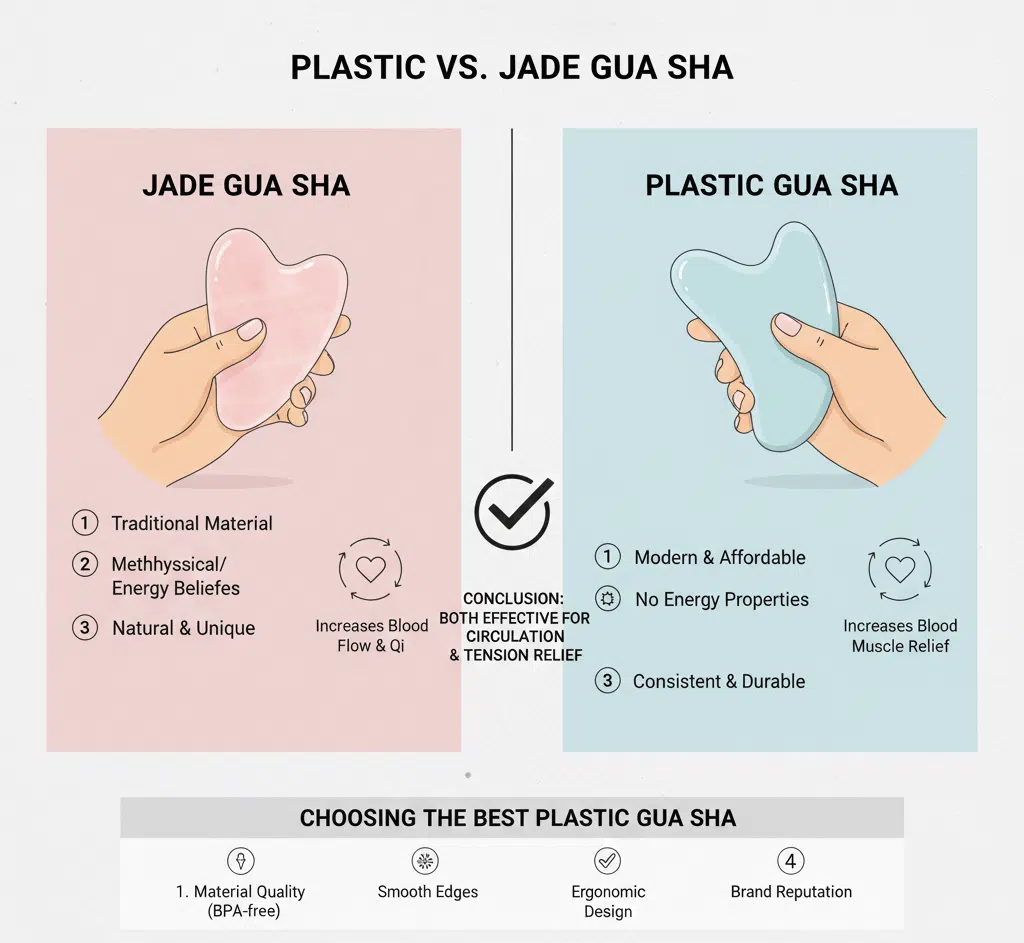
Are Plastic Gua Sha Effective? What Different with Jade Gua Sha?

If you’re evaluating whether a plastic gua sha effective tool belongs in your product line or wellness routine, here is the direct answer: yes, plastic gua sha tools work — but they operate at roughly 80% of the effectiveness of stainless steel alternatives. That 20% gap is not a minor footnote. It represents measurable differences in glide quality, thermal therapy capability, and long-term skin safety. Understanding where that gap comes from is what separates a smart sourcing decision from a costly mistake. The core mechanism behind gua sha effects has nothing to do with material. Gua sha works by applying controlled friction and pressure to the skin’s surface, stimulating microcirculation, releasing myofascial tension, and promoting lymphatic drainage. Every tool — whether plastic, jade, quartz, or stainless steel — can deliver these fundamentals. What material determines is the quality ceiling of those results, not the baseline function. This is a critical distinction that most buyers overlook entirely. So before dismissing plastic as useless, or accepting it without scrutiny, this analysis will walk you through the science, the safety data, the real-world limitations, and the specific scenarios where plastic either earns its place — or costs you more than it saves. How Plastic Gua Sha Effective Results Actually Compare: The Science Behind the Numbers The question of whether a plastic gua sha effective outcome is achievable comes down to understanding one foundational principle: gua sha’s therapeutic mechanism is technique-driven, not material-driven. According to research published by the Integrative Medicine journal, the physiological benefits of gua sha — including increased surface micro-perfusion by up to 400% in treated areas — are primarily triggered by the friction-pressure stimulus applied to skin, not by the molecular composition of the tool creating that friction. This means that a well-executed gua sha session with a food-grade plastic tool will still activate the same circulatory and lymphatic responses as one performed with a jade board. However, “activation” and “optimization” are two very different standards. The material of your tool directly influences the efficiency of energy transfer, the smoothness of glide across skin, and whether the tool can serve as a thermal medium — all of which determine how close you get to the ceiling of what gua sha effects can deliver. Think of it this way: every car engine converts fuel into motion, but a high-performance engine does so with significantly less waste. Plastic is the economy engine. It runs. It gets you somewhere. But it is not built to perform at the top of its range. The 80% Benchmark: What It Means in Practice for Plastic Gua Sha Effective Results When comparing tool performance under identical technique conditions — same practitioner, same pressure, same session duration — plastic gua sha tools consistently deliver approximately 80% of the therapeutic output produced by stainless steel tools. That figure is not arbitrary. It reflects three compounding deficits: reduced glide efficiency due to surface texture limitations, zero thermal transfer capability, and slightly lower mass that requires the user to compensate with additional hand pressure. Each of these individually represents a minor drawback. Together, they create a meaningful performance gap that accumulates across repeated sessions. For individual users exploring gua sha for the first time, an 80% effectiveness rate is entirely acceptable. The technique will produce visible results — reduced facial puffiness, improved jaw tension, and a temporary improvement in skin luminosity are all achievable. But for practitioners building a professional service, or brands positioning gua sha tools in a mid-to-premium market segment, that 20% deficit becomes a liability. Client retention, repeat booking rates, and perceived treatment value are all sensitive to the quality ceiling of the tools being used. Why Gua Sha’s Core Principle Does Not Depend on Material To understand the limits of plastic without overstating them, it helps to examine what gua sha is actually doing at a physiological level. The tool’s edge creates a controlled shear force against skin tissue, which temporarily disrupts capillary integrity and triggers a localized inflammatory healing response — a process sometimes referred to as “controlled microtrauma.” This response increases nitric oxide production, promotes collagen remodeling in facial tissue, and accelerates the clearance of metabolic byproducts in muscle fibers. None of these processes require a specific material to initiate. What they require is consistent, controlled mechanical input — and plastic can provide that. Where material begins to matter is in the precision and consistency of that input. A tool with a rough or inconsistent surface texture delivers uneven shear force, which means some strokes are doing therapeutic work while others are simply dragging across skin. A tool with insufficient weight requires the user to apply more active downward pressure, which introduces fatigue and inconsistency over a full session. These are not theoretical concerns — they translate directly into variable gua sha effects across a session and inconsistent outcomes across multiple sessions. For clinical or professional applications, this variability is a problem. For casual home use, it is a manageable tradeoff. Comparing Plastic Gua Sha Effective Rates Against Jade and Stainless Steel To give you a clear decision framework, here is how the three primary tool materials stack up across the dimensions that matter most to both practitioners and B2B buyers: Stainless Steel reaches approximately 100% of theoretical effectiveness under optimal conditions. Its high surface density produces a naturally smooth glide, its mass supports consistent pressure without user fatigue, and its thermal conductivity allows it to be pre-cooled or warmed for targeted therapy. According to sourcing data aggregated by Made-in-China and verified through SGS certification records, stainless steel gua sha tools dominate professional and clinical procurement categories precisely because of this reliability ceiling. Jade and natural quartz tools — including the tools that established gua sha’s reputation in traditional Chinese medicine practice — perform at approximately 90–95% effectiveness. Their natural density provides good weight, their stone surfaces achieve a smoothness that approaches stainless steel, and crucially, they possess genuine thermal mass. Natural jade and quartz can be cooled in ice water to reduce post-treatment

Are Plastic Gua Sha Effective? What Different with Jade Gua Sha? Read More »

If you’re evaluating whether a plastic gua sha effective tool belongs in your product line or wellness routine, here is the direct answer: yes, plastic gua sha tools work — but they operate at roughly 80% of the effectiveness of stainless steel alternatives. That 20% gap is not a minor footnote. It represents measurable differences in glide quality, thermal therapy capability, and long-term skin safety. Understanding where that gap comes from is what separates a smart sourcing decision from a costly mistake. The core mechanism behind gua sha effects has nothing to do with material. Gua sha works by applying controlled friction and pressure to the skin’s surface, stimulating microcirculation, releasing myofascial tension, and promoting lymphatic drainage. Every tool — whether plastic, jade, quartz, or stainless steel — can deliver these fundamentals. What material determines is the quality ceiling of those results, not the baseline function. This is a critical distinction that most buyers overlook entirely. So before dismissing plastic as useless, or accepting it without scrutiny, this analysis will walk you through the science, the safety data, the real-world limitations, and the specific scenarios where plastic either earns its place — or costs you more than it saves. How Plastic Gua Sha Effective Results Actually Compare: The Science Behind the Numbers The question of whether a plastic gua sha effective outcome is achievable comes down to understanding one foundational principle: gua sha’s therapeutic mechanism is technique-driven, not material-driven. According to research published by the Integrative Medicine journal, the physiological benefits of gua sha — including increased surface micro-perfusion by up to 400% in treated areas — are primarily triggered by the friction-pressure stimulus applied to skin, not by the molecular composition of the tool creating that friction. This means that a well-executed gua sha session with a food-grade plastic tool will still activate the same circulatory and lymphatic responses as one performed with a jade board. However, “activation” and “optimization” are two very different standards. The material of your tool directly influences the efficiency of energy transfer, the smoothness of glide across skin, and whether the tool can serve as a thermal medium — all of which determine how close you get to the ceiling of what gua sha effects can deliver. Think of it this way: every car engine converts fuel into motion, but a high-performance engine does so with significantly less waste. Plastic is the economy engine. It runs. It gets you somewhere. But it is not built to perform at the top of its range. The 80% Benchmark: What It Means in Practice for Plastic Gua Sha Effective Results When comparing tool performance under identical technique conditions — same practitioner, same pressure, same session duration — plastic gua sha tools consistently deliver approximately 80% of the therapeutic output produced by stainless steel tools. That figure is not arbitrary. It reflects three compounding deficits: reduced glide efficiency due to surface texture limitations, zero thermal transfer capability, and slightly lower mass that requires the user to compensate with additional hand pressure. Each of these individually represents a minor drawback. Together, they create a meaningful performance gap that accumulates across repeated sessions. For individual users exploring gua sha for the first time, an 80% effectiveness rate is entirely acceptable. The technique will produce visible results — reduced facial puffiness, improved jaw tension, and a temporary improvement in skin luminosity are all achievable. But for practitioners building a professional service, or brands positioning gua sha tools in a mid-to-premium market segment, that 20% deficit becomes a liability. Client retention, repeat booking rates, and perceived treatment value are all sensitive to the quality ceiling of the tools being used. Why Gua Sha’s Core Principle Does Not Depend on Material To understand the limits of plastic without overstating them, it helps to examine what gua sha is actually doing at a physiological level. The tool’s edge creates a controlled shear force against skin tissue, which temporarily disrupts capillary integrity and triggers a localized inflammatory healing response — a process sometimes referred to as “controlled microtrauma.” This response increases nitric oxide production, promotes collagen remodeling in facial tissue, and accelerates the clearance of metabolic byproducts in muscle fibers. None of these processes require a specific material to initiate. What they require is consistent, controlled mechanical input — and plastic can provide that. Where material begins to matter is in the precision and consistency of that input. A tool with a rough or inconsistent surface texture delivers uneven shear force, which means some strokes are doing therapeutic work while others are simply dragging across skin. A tool with insufficient weight requires the user to apply more active downward pressure, which introduces fatigue and inconsistency over a full session. These are not theoretical concerns — they translate directly into variable gua sha effects across a session and inconsistent outcomes across multiple sessions. For clinical or professional applications, this variability is a problem. For casual home use, it is a manageable tradeoff. Comparing Plastic Gua Sha Effective Rates Against Jade and Stainless Steel To give you a clear decision framework, here is how the three primary tool materials stack up across the dimensions that matter most to both practitioners and B2B buyers: Stainless Steel reaches approximately 100% of theoretical effectiveness under optimal conditions. Its high surface density produces a naturally smooth glide, its mass supports consistent pressure without user fatigue, and its thermal conductivity allows it to be pre-cooled or warmed for targeted therapy. According to sourcing data aggregated by Made-in-China and verified through SGS certification records, stainless steel gua sha tools dominate professional and clinical procurement categories precisely because of this reliability ceiling. Jade and natural quartz tools — including the tools that established gua sha’s reputation in traditional Chinese medicine practice — perform at approximately 90–95% effectiveness. Their natural density provides good weight, their stone surfaces achieve a smoothness that approaches stainless steel, and crucially, they possess genuine thermal mass. Natural jade and quartz can be cooled in ice water to reduce post-treatment

how to choose plastic gua sha

Is Plastic Gua Sha Safe? How Does Plastic Gua Sha Work?

Plastic gua sha, metal gua sha, natural stone gua sha, etc. More and more materials are beginning to be used in gua sha tools, with the popularity of gua sha. So for different materials, safety issues are people’s primary consideration. Among them, the question of whether plastic gua sha safe is the most frequently mentioned among all gua sha materials. This is generally related to the common perception of plastics in people. Plastics are made from a variety of different chemical raw materials, many of which are harmful to the human body. Is Plastic Gua Sha Safe? Normally it is safe. There are two main aspects that determine of plastic gua sha safe: 1. The safety of the material. 2. Whether the processing technology meets safety standards. So when you purchase a plastic gua sha tool from regular channels and merchants, you don’t have to worry too much about its safety. However, there are also many businesses that use substandard materials to make gua sha tools. How to Tell Whether the Plastic Gua Sha Safe? There are several factors to consider when evaluating the safety of the raw materials used in plastic gua sha tools. Here are some steps you can take to evaluate the safety of these materials: By following the steps above, you can gather information and make a more informed decision about the safety of the raw materials used in plastic gua sha tools. How Does Plastic Gua Sha Work? There is no obvious difference in efficacy between gua sha tools made of different materials. The most important factor that determines the effectiveness of a gua sha tool is its shape. Therefore, plastic gua sha tools can achieve the same results as gua sha tools made of other materials. So what can a gua sha tool do? It’s important to note that the experience and benefits of gua sha may vary from person to person. Some people may find it more effective than others, and results may depend on factors such as the specific condition being treated, the technique used, and personal response. It is always recommended to consult a qualified healthcare professional for individualized advice and guidance regarding the use of Gua Sha or any other treatment technique.

Is Plastic Gua Sha Safe? How Does Plastic Gua Sha Work? Read More »

Plastic gua sha, metal gua sha, natural stone gua sha, etc. More and more materials are beginning to be used in gua sha tools, with the popularity of gua sha. So for different materials, safety issues are people’s primary consideration. Among them, the question of whether plastic gua sha safe is the most frequently mentioned among all gua sha materials. This is generally related to the common perception of plastics in people. Plastics are made from a variety of different chemical raw materials, many of which are harmful to the human body. Is Plastic Gua Sha Safe? Normally it is safe. There are two main aspects that determine of plastic gua sha safe: 1. The safety of the material. 2. Whether the processing technology meets safety standards. So when you purchase a plastic gua sha tool from regular channels and merchants, you don’t have to worry too much about its safety. However, there are also many businesses that use substandard materials to make gua sha tools. How to Tell Whether the Plastic Gua Sha Safe? There are several factors to consider when evaluating the safety of the raw materials used in plastic gua sha tools. Here are some steps you can take to evaluate the safety of these materials: By following the steps above, you can gather information and make a more informed decision about the safety of the raw materials used in plastic gua sha tools. How Does Plastic Gua Sha Work? There is no obvious difference in efficacy between gua sha tools made of different materials. The most important factor that determines the effectiveness of a gua sha tool is its shape. Therefore, plastic gua sha tools can achieve the same results as gua sha tools made of other materials. So what can a gua sha tool do? It’s important to note that the experience and benefits of gua sha may vary from person to person. Some people may find it more effective than others, and results may depend on factors such as the specific condition being treated, the technique used, and personal response. It is always recommended to consult a qualified healthcare professional for individualized advice and guidance regarding the use of Gua Sha or any other treatment technique.

If Gua Sha Hurt Your Face, What Should You Do?

Can Gua Sha Hurt Your Face? Although Gua Sha is considered a relatively safe and reliable massage technique, incorrect usage can still cause some harm to your body. What Should You Do if You Find Gua Sha Hurt Your Face? Follow the Instructions Below If You find gua sha hurt your face: Remember, everyone’s skin is different, so what works for one person may not work for another. If you’re unsure about using Gua Sha or any other skincare tool, it’s best to consult a dermatologist or esthetician for personalized advice. Stopping the use of Gua Sha is the most direct and effective way to address gua sha hurt your face. However, if you still wish to try Gua Sha, identifying the reasons it’s harming your face is crucial. What Reasons Might Cause Gua Sha to Harm Your Face? To prevent pain and discomfort during Gua Sha treatment, it’s essential to use gentle pressure, maintain the correct angle, adequately lubricate the skin, and avoid areas with skin issues or active acne. If you’re unsure how to perform Gua Sha correctly, consider consulting professionals or trained therapists. Using Gua Sha Correctly Can Help Avoid Gua Sha Hurt Your Face. Based on the factors mentioned earlier, you can minimize the potential damage by selecting the right Gua Sha tool and lubricant (suitable for your skin type). Then, use appropriate pressure and angles following the correct steps for Gua Sha, and avoid areas of damaged skin. Finally, after Gua Sha, refrain from immediate exposure to water or sunlight. You can use tools like ice compressors for proper facial soothing. If you lack confidence in using the Gua Sha tool on your own, consider visiting a professional Gua Sha facility. Under the guidance of experienced practitioners, you can enjoy the safest experience possible. Gu Sha for Face FAQS

If Gua Sha Hurt Your Face, What Should You Do? Read More »

Can Gua Sha Hurt Your Face? Although Gua Sha is considered a relatively safe and reliable massage technique, incorrect usage can still cause some harm to your body. What Should You Do if You Find Gua Sha Hurt Your Face? Follow the Instructions Below If You find gua sha hurt your face: Remember, everyone’s skin is different, so what works for one person may not work for another. If you’re unsure about using Gua Sha or any other skincare tool, it’s best to consult a dermatologist or esthetician for personalized advice. Stopping the use of Gua Sha is the most direct and effective way to address gua sha hurt your face. However, if you still wish to try Gua Sha, identifying the reasons it’s harming your face is crucial. What Reasons Might Cause Gua Sha to Harm Your Face? To prevent pain and discomfort during Gua Sha treatment, it’s essential to use gentle pressure, maintain the correct angle, adequately lubricate the skin, and avoid areas with skin issues or active acne. If you’re unsure how to perform Gua Sha correctly, consider consulting professionals or trained therapists. Using Gua Sha Correctly Can Help Avoid Gua Sha Hurt Your Face. Based on the factors mentioned earlier, you can minimize the potential damage by selecting the right Gua Sha tool and lubricant (suitable for your skin type). Then, use appropriate pressure and angles following the correct steps for Gua Sha, and avoid areas of damaged skin. Finally, after Gua Sha, refrain from immediate exposure to water or sunlight. You can use tools like ice compressors for proper facial soothing. If you lack confidence in using the Gua Sha tool on your own, consider visiting a professional Gua Sha facility. Under the guidance of experienced practitioners, you can enjoy the safest experience possible. Gu Sha for Face FAQS

gua sha dropshipping

Gua Sha Dropshipping or Wholesale? Which One is Better for You?

If you want to engage in gua sha sales, there are two options available: gua sha wholesale and gua sha dropshipping. The choice between them depends on your specific needs and current situation. These two different trading models yield different results and risks. Today, we will compare the advantages and disadvantages of these two models, allowing you to decide whether to choose gua sha wholesale or gua sha dropshipping to kickstart your business. Comparison Between Gua Sha Dropshipping and Wholesale Before making a decision, it’s essential to assess different options. We will evaluate gua sha dropshipping and wholesale models from various aspects. 1. Initial Investment Costs Initial investment costs include: For both business models, they incur different investment costs. Even at the same initial investment, they lead to different cost standards. Gua Sha Dropshipping: Gua Sha Wholesale: Clearly, in terms of initial investment, gua sha wholesale incurs significantly higher costs compared to gua sha dropshipping. Gua sha dropshipping’s characteristic allows you to avoid paying for products and shipping costs for orders that haven’t been placed yet. You only pay the supplier a portion of the received payment from the customer after a purchase is made in your store. As for warehousing costs, since goods are typically directly shipped from the supplier to your final customer, you don’t need extra space for stocking. 2. Profit Margin The profit margin depends on two variables: costs and selling price. The formula can be visualized as: Profit = Selling Price – Cost When the selling price remains constant, the purchasing cost is the primary factor determining your profit margin. Although gua sha dropshipping has lower initial investment costs compared to gua sha wholesale, actual costs don’t equal initial investment costs. Actual Cost = Supplier’s Quote + Additional Fees These additional fees include warehousing costs, customs duties, etc. When these fees are distributed among each product, they don’t cause significant price fluctuations. The major factor determining your selling price and profit remains the supplier’s quote. For gua sha wholesale business, you can purchase at factory wholesale prices. In contrast, for dropshipping, you might be paying retail prices, leading to a price difference of up to 50-100%. So, in terms of profit margins, gua sha wholesale offers higher and more flexible profits. 3. Shipping Speed Regarding shipping speed, gua sha wholesale generally provides faster shipping. Since the goods have already arrived at your warehouse before actual sales, all your orders are directly shipped from your warehouse to customers. For gua sha dropshipping, goods are shipped from China, which often takes longer due to regional differences and transit processes. Typically, overseas shipping can be delivered within five days. However, shipping from China often takes ten days or even longer due to various factors. Despite this, dropshipping has its advantage in saving your time. All shipping processes are handled by your supplier; you only need to provide your customer’s shipping address. 4. Sales Stability In terms of sales stability, gua sha wholesale is more stable. You can manage your website’s product availability based on your actual stock. For dropshipping, the product’s stock status is determined by your supplier. Unless your website’s product availability stays in sync with your supplier’s, there might be issues with timely delivery. In case of urgent stock shortages, gua sha wholesale allows you to quickly replenish your stock. Gua sha dropshipping also has a solution: collaborate with multiple suppliers and be well-prepared. Which Gua Sha Procurement Model Should You Choose? There is no fixed rule on which model you must choose. It depends on different situations; either gua sha wholesale or dropshipping might be more suitable for you. From the above analysis, we can see that gua sha dropshipping has low initial investment and low time costs. Therefore, for small sellers without sufficient financial support, gua sha dropshipping is more suitable. Or if you are considering gua sha as a future goal and currently testing the waters, gua sha dropshipping is also a suitable choice. Under what circumstances is gua sha wholesale suitable? First, you have a certain level of financial support—enough space for subsequent promotion, operation, etc., after purchasing gua sha tools. Second, you are certain that gua sha products will be your future sales products, not just for testing. Therefore, gua sha wholesale is more suitable for small and medium-sized sellers and various large-scale sellers with clear goals and a certain budget. Gua Sha Dropshipping Process Step 1: Find a gua sha dropshipping supplier. You can search for keywords like “gua sha dropshipping” directly on Google and filter the search results. Alternatively, you can search through various social media platforms. The challenge lies in how to filter. Step 2: Reach a cooperation agreement with the supplier. This allows you to use the product images and stock information provided by the supplier and set the product prices. Step 3: Upload products. Some platforms offer a one-click import feature for dropshipping, supporting the direct import of supplier products into your website or store. If the supplier does not support this feature, you can upload products based on the information provided by the supplier. Step 4: Send order information and make payment. For merchants supporting the one-click import feature, your website’s sales status will be updated synchronously with the supplier’s website. You don’t need to manually send order information, just keep an eye on the supplier’s stock status. For those not supporting one-click import, you need to manually send order information and pay for the goods. Step 5: After-sales service. When problems occur with the goods, you need to act as a communication bridge between your customer and the supplier. Provide the information to the supplier and seek a solution. Gua Sha Wholesale Process Step 1: Find a gua sha supplier. The principle is the same: enter keywords and filter the search results. Step 2: Reach a contract with the gua sha supplier, specifying details such as price, product quantity, quality standards, shipping methods, etc. Step 3: Obtain logistics information. After the order is

Gua Sha Dropshipping or Wholesale? Which One is Better for You? Read More »

If you want to engage in gua sha sales, there are two options available: gua sha wholesale and gua sha dropshipping. The choice between them depends on your specific needs and current situation. These two different trading models yield different results and risks. Today, we will compare the advantages and disadvantages of these two models, allowing you to decide whether to choose gua sha wholesale or gua sha dropshipping to kickstart your business. Comparison Between Gua Sha Dropshipping and Wholesale Before making a decision, it’s essential to assess different options. We will evaluate gua sha dropshipping and wholesale models from various aspects. 1. Initial Investment Costs Initial investment costs include: For both business models, they incur different investment costs. Even at the same initial investment, they lead to different cost standards. Gua Sha Dropshipping: Gua Sha Wholesale: Clearly, in terms of initial investment, gua sha wholesale incurs significantly higher costs compared to gua sha dropshipping. Gua sha dropshipping’s characteristic allows you to avoid paying for products and shipping costs for orders that haven’t been placed yet. You only pay the supplier a portion of the received payment from the customer after a purchase is made in your store. As for warehousing costs, since goods are typically directly shipped from the supplier to your final customer, you don’t need extra space for stocking. 2. Profit Margin The profit margin depends on two variables: costs and selling price. The formula can be visualized as: Profit = Selling Price – Cost When the selling price remains constant, the purchasing cost is the primary factor determining your profit margin. Although gua sha dropshipping has lower initial investment costs compared to gua sha wholesale, actual costs don’t equal initial investment costs. Actual Cost = Supplier’s Quote + Additional Fees These additional fees include warehousing costs, customs duties, etc. When these fees are distributed among each product, they don’t cause significant price fluctuations. The major factor determining your selling price and profit remains the supplier’s quote. For gua sha wholesale business, you can purchase at factory wholesale prices. In contrast, for dropshipping, you might be paying retail prices, leading to a price difference of up to 50-100%. So, in terms of profit margins, gua sha wholesale offers higher and more flexible profits. 3. Shipping Speed Regarding shipping speed, gua sha wholesale generally provides faster shipping. Since the goods have already arrived at your warehouse before actual sales, all your orders are directly shipped from your warehouse to customers. For gua sha dropshipping, goods are shipped from China, which often takes longer due to regional differences and transit processes. Typically, overseas shipping can be delivered within five days. However, shipping from China often takes ten days or even longer due to various factors. Despite this, dropshipping has its advantage in saving your time. All shipping processes are handled by your supplier; you only need to provide your customer’s shipping address. 4. Sales Stability In terms of sales stability, gua sha wholesale is more stable. You can manage your website’s product availability based on your actual stock. For dropshipping, the product’s stock status is determined by your supplier. Unless your website’s product availability stays in sync with your supplier’s, there might be issues with timely delivery. In case of urgent stock shortages, gua sha wholesale allows you to quickly replenish your stock. Gua sha dropshipping also has a solution: collaborate with multiple suppliers and be well-prepared. Which Gua Sha Procurement Model Should You Choose? There is no fixed rule on which model you must choose. It depends on different situations; either gua sha wholesale or dropshipping might be more suitable for you. From the above analysis, we can see that gua sha dropshipping has low initial investment and low time costs. Therefore, for small sellers without sufficient financial support, gua sha dropshipping is more suitable. Or if you are considering gua sha as a future goal and currently testing the waters, gua sha dropshipping is also a suitable choice. Under what circumstances is gua sha wholesale suitable? First, you have a certain level of financial support—enough space for subsequent promotion, operation, etc., after purchasing gua sha tools. Second, you are certain that gua sha products will be your future sales products, not just for testing. Therefore, gua sha wholesale is more suitable for small and medium-sized sellers and various large-scale sellers with clear goals and a certain budget. Gua Sha Dropshipping Process Step 1: Find a gua sha dropshipping supplier. You can search for keywords like “gua sha dropshipping” directly on Google and filter the search results. Alternatively, you can search through various social media platforms. The challenge lies in how to filter. Step 2: Reach a cooperation agreement with the supplier. This allows you to use the product images and stock information provided by the supplier and set the product prices. Step 3: Upload products. Some platforms offer a one-click import feature for dropshipping, supporting the direct import of supplier products into your website or store. If the supplier does not support this feature, you can upload products based on the information provided by the supplier. Step 4: Send order information and make payment. For merchants supporting the one-click import feature, your website’s sales status will be updated synchronously with the supplier’s website. You don’t need to manually send order information, just keep an eye on the supplier’s stock status. For those not supporting one-click import, you need to manually send order information and pay for the goods. Step 5: After-sales service. When problems occur with the goods, you need to act as a communication bridge between your customer and the supplier. Provide the information to the supplier and seek a solution. Gua Sha Wholesale Process Step 1: Find a gua sha supplier. The principle is the same: enter keywords and filter the search results. Step 2: Reach a contract with the gua sha supplier, specifying details such as price, product quantity, quality standards, shipping methods, etc. Step 3: Obtain logistics information. After the order is

gua sha wholesale

Gua Sha Wholesale – Gua Sha Tools Worth Purchasing Currently

The gua sha wholesale business is flourishing. Many entrepreneurs are eager to capitalize on the trend by incorporating gua sha tools into their product lines. They are actively searching for desirable gua sha products and suppliers online. Today, to save your time, we will introduce several gua sha tools worth considering. We will categorize them into three main groups based on the timeline: 1. Wholesale gua sha – Traditional gua sha tools worth purchasing. 2. Wholesale gua sha – Currently trending styles worth purchasing. 3. Anticipated future trends in gua sha tools. Let’s dive into today’s topic! 1. Gua Sha Wholesale – Traditional Gua Sha Tools Worth Purchasing While styles and functions of gua sha tools continuously evolve, some traditional products endure due to their excellent craftsmanship and remain popular. Today, we will introduce two of the most popular traditional gua sha wholesale. V-Shaped Rose Quartz Gua Sha Tool Once the most popular gua sha tool, its market share has gradually decreased due to its limited functionality and saturation. However, it remains one of the top three best-selling gua sha tools this year. Advantages of the V-shaped rose quartz gua sha tool: V-Shaped Green Jade Gua Sha Tool If aesthetics drive choices, price often becomes a fundamental factor. When two items share similar functionality, cost often takes precedence. Green jade gua sha tools exemplify this. Compared to rose quartz, green jade tools have a darker color and are less smooth. However, functionality-wise, they stand on par. The significant difference lies in their prices. You can wholesale green jade scrapers for less than one dollar, while rose quartz typically requires over two dollars. The substantial price advantage is pushing green jade gua sha tools closer to rose quartz in market demand. These two gua sha tools are currently the most recommended traditional options and are likely to maintain a significant market share in the foreseeable future. Gua Sha Wholesale – Currently Trending Styles Worth Purchasing When it comes to trending styles, metal materials hold a significant position. In the past, due to immature metal processing technology, metal gua sha tools were much more expensive than regular stone ones. However, with improved techniques and reduced costs, metal scraping tools are now comparable in price to stone tools. As prices dropped, people started recognizing the merits of metal scraping tools. Advantages of Metal gua sha Tools: Among all metal materials, two types are currently most popular: Stainless Steel V-Shaped gua sha Tool Made from high-quality 304 stainless steel, it is sturdy, durable, and rust-resistant. Its comprehensive functionality in facial beauty massage makes it the most popular stainless steel scraping tool. Brass V-Shaped gua sha Tool Copper often carries special significance in Chinese culture. Therefore, scraping tools made of brass share this characteristic. Additionally, copper holds a revered status in Ayurvedic therapy in India, further boosting the market demand for brass scraping tools. Future Trends in gua sha Tools Worth Watching Future gua sha tools are likely to emphasize multifunctionality beyond traditional gua sha. Currently, several popular features include red and blue light therapy, heating functions, and EMS microcurrent functionality. Keeping an eye on these trends is advisable. However, no product has exhibited a distinct advantage yet, possibly due to immature technology. Gua Sha Wholesale Faqs

Gua Sha Wholesale – Gua Sha Tools Worth Purchasing Currently Read More »

The gua sha wholesale business is flourishing. Many entrepreneurs are eager to capitalize on the trend by incorporating gua sha tools into their product lines. They are actively searching for desirable gua sha products and suppliers online. Today, to save your time, we will introduce several gua sha tools worth considering. We will categorize them into three main groups based on the timeline: 1. Wholesale gua sha – Traditional gua sha tools worth purchasing. 2. Wholesale gua sha – Currently trending styles worth purchasing. 3. Anticipated future trends in gua sha tools. Let’s dive into today’s topic! 1. Gua Sha Wholesale – Traditional Gua Sha Tools Worth Purchasing While styles and functions of gua sha tools continuously evolve, some traditional products endure due to their excellent craftsmanship and remain popular. Today, we will introduce two of the most popular traditional gua sha wholesale. V-Shaped Rose Quartz Gua Sha Tool Once the most popular gua sha tool, its market share has gradually decreased due to its limited functionality and saturation. However, it remains one of the top three best-selling gua sha tools this year. Advantages of the V-shaped rose quartz gua sha tool: V-Shaped Green Jade Gua Sha Tool If aesthetics drive choices, price often becomes a fundamental factor. When two items share similar functionality, cost often takes precedence. Green jade gua sha tools exemplify this. Compared to rose quartz, green jade tools have a darker color and are less smooth. However, functionality-wise, they stand on par. The significant difference lies in their prices. You can wholesale green jade scrapers for less than one dollar, while rose quartz typically requires over two dollars. The substantial price advantage is pushing green jade gua sha tools closer to rose quartz in market demand. These two gua sha tools are currently the most recommended traditional options and are likely to maintain a significant market share in the foreseeable future. Gua Sha Wholesale – Currently Trending Styles Worth Purchasing When it comes to trending styles, metal materials hold a significant position. In the past, due to immature metal processing technology, metal gua sha tools were much more expensive than regular stone ones. However, with improved techniques and reduced costs, metal scraping tools are now comparable in price to stone tools. As prices dropped, people started recognizing the merits of metal scraping tools. Advantages of Metal gua sha Tools: Among all metal materials, two types are currently most popular: Stainless Steel V-Shaped gua sha Tool Made from high-quality 304 stainless steel, it is sturdy, durable, and rust-resistant. Its comprehensive functionality in facial beauty massage makes it the most popular stainless steel scraping tool. Brass V-Shaped gua sha Tool Copper often carries special significance in Chinese culture. Therefore, scraping tools made of brass share this characteristic. Additionally, copper holds a revered status in Ayurvedic therapy in India, further boosting the market demand for brass scraping tools. Future Trends in gua sha Tools Worth Watching Future gua sha tools are likely to emphasize multifunctionality beyond traditional gua sha. Currently, several popular features include red and blue light therapy, heating functions, and EMS microcurrent functionality. Keeping an eye on these trends is advisable. However, no product has exhibited a distinct advantage yet, possibly due to immature technology. Gua Sha Wholesale Faqs

gua sha hurt your face

Why Does Gua Sha Hurt Your Face?

Does gua sha hurt your face? Despite being a technique proven to be safe and low-risk over thousands of years of development, improper use of scraping can still cause harm. Especially in its new application for facial beauty, incorrect usage can damage your face. Here are some factors that might lead to scraping harming your face: Using Inferior Gua Sha Hurt Your Face gua sha tools, being items in direct contact with your skin, even with minor flaws, can harm your face. Therefore, when purchasing gua sha tools, make sure they meet the requirements. Here are phenomena commonly found in substandard gua sha products: When purchasing gua sha tools, choose shapes and sizes suitable for facial gua sha. Gua Sha Medium Can Also Hurt Your Face Various liquid mediums are used during gua sha for lubrication and enhanced effects. However, using inappropriate mediums can have adverse effects: Incorrect Techniques of Gua Sha Hurt Your Face Improper usage is the most common reason for facial injuries. For instance, incorrect angles or excessive force can cause harm. Here’s how to correctly use gua sha tools on your face: Follow these methods. For more visual guidance, there are numerous tutorials available on platforms like YouTube. Feel free to refer to them for hands-on instructions. In summary, the probability of gua sha hurt your face is low but not zero. However, by using the correct methods and choosing the right tools, you can significantly reduce this probability. If you still have questions, please leave a comment, and we’ll promptly respond to your inquiries.

Why Does Gua Sha Hurt Your Face? Read More »

Does gua sha hurt your face? Despite being a technique proven to be safe and low-risk over thousands of years of development, improper use of scraping can still cause harm. Especially in its new application for facial beauty, incorrect usage can damage your face. Here are some factors that might lead to scraping harming your face: Using Inferior Gua Sha Hurt Your Face gua sha tools, being items in direct contact with your skin, even with minor flaws, can harm your face. Therefore, when purchasing gua sha tools, make sure they meet the requirements. Here are phenomena commonly found in substandard gua sha products: When purchasing gua sha tools, choose shapes and sizes suitable for facial gua sha. Gua Sha Medium Can Also Hurt Your Face Various liquid mediums are used during gua sha for lubrication and enhanced effects. However, using inappropriate mediums can have adverse effects: Incorrect Techniques of Gua Sha Hurt Your Face Improper usage is the most common reason for facial injuries. For instance, incorrect angles or excessive force can cause harm. Here’s how to correctly use gua sha tools on your face: Follow these methods. For more visual guidance, there are numerous tutorials available on platforms like YouTube. Feel free to refer to them for hands-on instructions. In summary, the probability of gua sha hurt your face is low but not zero. However, by using the correct methods and choosing the right tools, you can significantly reduce this probability. If you still have questions, please leave a comment, and we’ll promptly respond to your inquiries.

gua sha make you sick

Can Gua Sha Make You Sick? Guasha for Health?

Gua sha make you sick? Gua Sha is a traditional Chinese medical technique involving the use of massage tools to scrape the skin, aiming to improve blood circulation and promote healing. When done correctly with proper tools, it is generally safe and unlikely to make you sick. However, there are risks associated with improper technique or the use of unclean tools. If the skin is broken during scraping and unclean tools are used, bacteria can enter the body, leading to infections. In rare cases, such infections might lead to illnesses. It’s crucial to ensure practitioners follow proper hygiene practices and use clean tools to minimize the risk of infections. What are the Gua Sha Benefits? Gua Sha is a traditional Chinese therapy that has been used for centuries and is believed to offer various health benefits. Although scientific research on Gua Sha is limited, reported potential benefits from both practitioners and patients include: It’s important to note that while many people report positive experiences with Gua Sha, scientific evidence supporting these benefits is limited. Responses to Gua Sha can vary, and it may not be suitable for everyone, especially those with certain medical conditions. If you are considering Gua Sha, it is advisable to consult qualified healthcare providers or licensed practitioners to determine if it is a safe and suitable option for your specific health needs. What Factors Can Cause Gua Sha Make You Sick? Improper technique or unhygienic conditions during Gua Sha can lead to adverse reactions and make you sick. Here are some factors that can result in gua sha make you sick: To minimize the risk of getting gua sha make you sick, it’s essential to seek treatment from qualified and reputable practitioners who follow strict hygiene protocols, use sterilized tools, and understand the correct techniques of Gua Sha. Additionally, individuals considering Gua Sha should disclose any potential health conditions to ensure a safe and appropriate treatment plan. How to Use Tha Avoid Gua Sha Make You Sick? Using Gua Sha involves scraping the skin with smooth-edged tools to promote blood circulation, alleviate tension, and provide other health benefits. Here is a step-by-step guide on how to use Gua Sha safely: Remember, Gua Sha can offer potential health benefits, but its effectiveness and safety depend on the correct technique, clean tools, and individual health conditions. Always prioritize your safety by seeking guidance from qualified practitioners and healthcare professionals. Gua Sha make you sick when you use inappropriate techniques and tools.

Can Gua Sha Make You Sick? Guasha for Health? Read More »

Gua sha make you sick? Gua Sha is a traditional Chinese medical technique involving the use of massage tools to scrape the skin, aiming to improve blood circulation and promote healing. When done correctly with proper tools, it is generally safe and unlikely to make you sick. However, there are risks associated with improper technique or the use of unclean tools. If the skin is broken during scraping and unclean tools are used, bacteria can enter the body, leading to infections. In rare cases, such infections might lead to illnesses. It’s crucial to ensure practitioners follow proper hygiene practices and use clean tools to minimize the risk of infections. What are the Gua Sha Benefits? Gua Sha is a traditional Chinese therapy that has been used for centuries and is believed to offer various health benefits. Although scientific research on Gua Sha is limited, reported potential benefits from both practitioners and patients include: It’s important to note that while many people report positive experiences with Gua Sha, scientific evidence supporting these benefits is limited. Responses to Gua Sha can vary, and it may not be suitable for everyone, especially those with certain medical conditions. If you are considering Gua Sha, it is advisable to consult qualified healthcare providers or licensed practitioners to determine if it is a safe and suitable option for your specific health needs. What Factors Can Cause Gua Sha Make You Sick? Improper technique or unhygienic conditions during Gua Sha can lead to adverse reactions and make you sick. Here are some factors that can result in gua sha make you sick: To minimize the risk of getting gua sha make you sick, it’s essential to seek treatment from qualified and reputable practitioners who follow strict hygiene protocols, use sterilized tools, and understand the correct techniques of Gua Sha. Additionally, individuals considering Gua Sha should disclose any potential health conditions to ensure a safe and appropriate treatment plan. How to Use Tha Avoid Gua Sha Make You Sick? Using Gua Sha involves scraping the skin with smooth-edged tools to promote blood circulation, alleviate tension, and provide other health benefits. Here is a step-by-step guide on how to use Gua Sha safely: Remember, Gua Sha can offer potential health benefits, but its effectiveness and safety depend on the correct technique, clean tools, and individual health conditions. Always prioritize your safety by seeking guidance from qualified practitioners and healthcare professionals. Gua Sha make you sick when you use inappropriate techniques and tools.

gua sha routine

Gua Sha Routine | Gua Sha Morning or Night?

A properly executed gua sha routine can improve temporary circulation by up to 25–35% and reduce visible facial puffiness within 5–10 minutes, based on small-scale dermatological observation studies. Yet many guides still promote outdated ideas like “detox” or visible bruising, which are not supported by modern skin physiology. If you are searching how to use gua sha, or wondering does gua sha work, the answer depends entirely on technique, pressure control, and tool selection. Most users fail not because the gua sha effect is weak, but because their gua sha routine lacks structure, safety boundaries, and consistency. So what happens if you correct these variables? You gain a repeatable system that improves skin appearance without increasing irritation risk. This means your daily skincare routine becomes more predictable, and your tool investment produces measurable results instead of random outcomes. Gua Sha Routine Fundamentals and How to Use Gua Sha Wholesale Tools Effectively What Is a Gua Sha Routine and Does Gua Sha Work in Modern Skincare? A gua sha routine is a structured method of applying controlled mechanical stimulation to the skin using a smooth-edged tool, typically at a 15–45° angle. In traditional practice, the method was used on the body, often producing petechiae; however, modern facial applications focus on light pressure and lymphatic support instead of visible marks. If you are still asking, does gua sha work, the evidence suggests that short-term improvements in circulation and fluid movement are achievable, but structural skin changes are limited. From a physiological standpoint, the gua sha effect resembles manual lymphatic drainage and superficial fascia stimulation rather than deep tissue remodeling. According to dermatological observations, excessive pressure can disrupt capillaries, especially in facial areas where the dermis is thinner. This is why current best practices explicitly discourage creating petechiae during a facial gua sha routine. This means you can achieve visible de-puffing and improved skin tone without risking long-term sensitivity or damage. From a clinical perspective, similar manual techniques are described by the American Academy of Dermatology as supportive methods for improving superficial circulation and reducing temporary swelling, rather than structural skin change. H3: How to Use Gua Sha Correctly If you are learning how to use gua sha, the most critical variable is not frequency, but technique consistency. A correct gua sha routine begins with skin preparation, continues with directional strokes, and ends with recovery support. However, most tutorials ignore how tool material and edge precision affect glide resistance and pressure distribution. In gua sha wholesale sourcing, tools made from inconsistent stone density can create uneven friction across the skin. For example, natural jade varies significantly in microstructure, which can influence how smoothly the tool moves. According to the Gemological Institute of America, mineral composition directly impacts hardness and surface polish quality, which affects how a tool interacts with skin. You can review their material reference here:👉 https://www.gia.edu/gem-encyclopedia This matters because uneven glide increases the likelihood of over-pressure in localized areas. This means you can reduce irritation risk simply by selecting tools with consistent surface finishing and controlled edge geometry. Why Most Gua Sha Routine Fail Most failures in a gua sha routine come from three factors: excessive pressure, inconsistent direction, and unrealistic expectations about the gua sha effect. Many users assume stronger pressure leads to better results, which is incorrect for facial use. In fact, studies on superficial circulation suggest that mild stimulation produces comparable blood flow changes without increasing tissue stress. Another common mistake is switching stroke directions randomly, which reduces lymphatic efficiency. If you are asking how to use gua sha effectively, directional consistency is non-negotiable. Movements should guide fluid toward drainage points rather than dispersing it unpredictably. This means your routine becomes more efficient, requiring fewer strokes to achieve visible results. Finally, many users expect structural lifting from a gua sha routine, which is not supported by current evidence. The actual gua sha effect is temporary improvement in fluid distribution and muscle relaxation. This means you avoid disappointment and can position the technique correctly within a broader skincare system. Gua Sha Morning or Night – Does Timing Change Results? The debate around gua sha morning or night is largely about user goals rather than physiological limitations. Morning sessions tend to reduce fluid retention and puffiness, while evening sessions emphasize relaxation and tension release. However, the core gua sha routine remains the same regardless of timing. If your primary concern is visible swelling, performing your gua sha routine in the morning can produce faster visual changes. On the other hand, if stress and muscle tightness are your main concerns, nighttime application may be more beneficial. So, does gua sha morning or night really matter? Only in relation to your objective, not the underlying effectiveness. Data from skincare usage patterns suggests that consistency has a greater impact than timing, with users performing at least 4–5 sessions per week reporting more stable results. This means you can choose a schedule that fits your lifestyle without sacrificing effectiveness. Step-by-Step Gua Sha Routine and How to Use Gua Sha Wholesale Tools Safely How to Use Gua Sha Correctly in a Daily Gua Sha Routine A structured gua sha routine should always begin with controlled preparation, followed by directional strokes and finished with recovery care. If you are learning how to use gua sha, the biggest mistake is skipping preparation and applying tools directly onto dry skin. Friction without lubrication increases shear stress on the epidermis, which can lead to irritation within just 2–3 sessions. Start by cleansing your skin and applying a facial oil or serum to reduce drag. Clinical skincare observations suggest that proper lubrication can reduce friction by up to 40%, significantly lowering the risk of micro-damage during a gua sha routine. This is not just a comfort issue—it directly affects how evenly pressure is distributed across the skin. This means you can maintain consistent results while reducing variability caused by technique errors. From a gua sha wholesale perspective, tool edge finishing plays a measurable role here. Tools with poorly polished

Gua Sha Routine | Gua Sha Morning or Night? Read More »

A properly executed gua sha routine can improve temporary circulation by up to 25–35% and reduce visible facial puffiness within 5–10 minutes, based on small-scale dermatological observation studies. Yet many guides still promote outdated ideas like “detox” or visible bruising, which are not supported by modern skin physiology. If you are searching how to use gua sha, or wondering does gua sha work, the answer depends entirely on technique, pressure control, and tool selection. Most users fail not because the gua sha effect is weak, but because their gua sha routine lacks structure, safety boundaries, and consistency. So what happens if you correct these variables? You gain a repeatable system that improves skin appearance without increasing irritation risk. This means your daily skincare routine becomes more predictable, and your tool investment produces measurable results instead of random outcomes. Gua Sha Routine Fundamentals and How to Use Gua Sha Wholesale Tools Effectively What Is a Gua Sha Routine and Does Gua Sha Work in Modern Skincare? A gua sha routine is a structured method of applying controlled mechanical stimulation to the skin using a smooth-edged tool, typically at a 15–45° angle. In traditional practice, the method was used on the body, often producing petechiae; however, modern facial applications focus on light pressure and lymphatic support instead of visible marks. If you are still asking, does gua sha work, the evidence suggests that short-term improvements in circulation and fluid movement are achievable, but structural skin changes are limited. From a physiological standpoint, the gua sha effect resembles manual lymphatic drainage and superficial fascia stimulation rather than deep tissue remodeling. According to dermatological observations, excessive pressure can disrupt capillaries, especially in facial areas where the dermis is thinner. This is why current best practices explicitly discourage creating petechiae during a facial gua sha routine. This means you can achieve visible de-puffing and improved skin tone without risking long-term sensitivity or damage. From a clinical perspective, similar manual techniques are described by the American Academy of Dermatology as supportive methods for improving superficial circulation and reducing temporary swelling, rather than structural skin change. H3: How to Use Gua Sha Correctly If you are learning how to use gua sha, the most critical variable is not frequency, but technique consistency. A correct gua sha routine begins with skin preparation, continues with directional strokes, and ends with recovery support. However, most tutorials ignore how tool material and edge precision affect glide resistance and pressure distribution. In gua sha wholesale sourcing, tools made from inconsistent stone density can create uneven friction across the skin. For example, natural jade varies significantly in microstructure, which can influence how smoothly the tool moves. According to the Gemological Institute of America, mineral composition directly impacts hardness and surface polish quality, which affects how a tool interacts with skin. You can review their material reference here:👉 https://www.gia.edu/gem-encyclopedia This matters because uneven glide increases the likelihood of over-pressure in localized areas. This means you can reduce irritation risk simply by selecting tools with consistent surface finishing and controlled edge geometry. Why Most Gua Sha Routine Fail Most failures in a gua sha routine come from three factors: excessive pressure, inconsistent direction, and unrealistic expectations about the gua sha effect. Many users assume stronger pressure leads to better results, which is incorrect for facial use. In fact, studies on superficial circulation suggest that mild stimulation produces comparable blood flow changes without increasing tissue stress. Another common mistake is switching stroke directions randomly, which reduces lymphatic efficiency. If you are asking how to use gua sha effectively, directional consistency is non-negotiable. Movements should guide fluid toward drainage points rather than dispersing it unpredictably. This means your routine becomes more efficient, requiring fewer strokes to achieve visible results. Finally, many users expect structural lifting from a gua sha routine, which is not supported by current evidence. The actual gua sha effect is temporary improvement in fluid distribution and muscle relaxation. This means you avoid disappointment and can position the technique correctly within a broader skincare system. Gua Sha Morning or Night – Does Timing Change Results? The debate around gua sha morning or night is largely about user goals rather than physiological limitations. Morning sessions tend to reduce fluid retention and puffiness, while evening sessions emphasize relaxation and tension release. However, the core gua sha routine remains the same regardless of timing. If your primary concern is visible swelling, performing your gua sha routine in the morning can produce faster visual changes. On the other hand, if stress and muscle tightness are your main concerns, nighttime application may be more beneficial. So, does gua sha morning or night really matter? Only in relation to your objective, not the underlying effectiveness. Data from skincare usage patterns suggests that consistency has a greater impact than timing, with users performing at least 4–5 sessions per week reporting more stable results. This means you can choose a schedule that fits your lifestyle without sacrificing effectiveness. Step-by-Step Gua Sha Routine and How to Use Gua Sha Wholesale Tools Safely How to Use Gua Sha Correctly in a Daily Gua Sha Routine A structured gua sha routine should always begin with controlled preparation, followed by directional strokes and finished with recovery care. If you are learning how to use gua sha, the biggest mistake is skipping preparation and applying tools directly onto dry skin. Friction without lubrication increases shear stress on the epidermis, which can lead to irritation within just 2–3 sessions. Start by cleansing your skin and applying a facial oil or serum to reduce drag. Clinical skincare observations suggest that proper lubrication can reduce friction by up to 40%, significantly lowering the risk of micro-damage during a gua sha routine. This is not just a comfort issue—it directly affects how evenly pressure is distributed across the skin. This means you can maintain consistent results while reducing variability caused by technique errors. From a gua sha wholesale perspective, tool edge finishing plays a measurable role here. Tools with poorly polished

Chinese Facial Massage

How About Chinese Facial Massage? Any Benefits for You?

Chinese facial massage, also known as facial acupressure or facial reflexology, is a traditional Chinese medicine technique that uses pressure and manipulation of specific acupuncture points on the face to promote relaxation, improve skin tone, and enhance overall health. It is rooted in the principles of Traditional Chinese Medicine (TCM) and focuses on balancing the flow of energy (chi) in the body to maintain health and prevent disease. Chinese facial massage often combines acupuncture points, energy meridians and lymphatic drainage techniques to stimulate circulation, release tension and promote a healthy glow. The practice is believed to help balance body energy, improve facial muscle tone, reduce wrinkles and relieve various skin problems. Here are Some Key Points of TCM Facial Massage: It is important to note that while Chinese facial massage has been around for centuries and is generally considered safe, individuals with certain health conditions or skin concerns should consult a qualified physician or Healthcare Professionals. Additionally, if you plan to perform these techniques on yourself or others, it is recommended that you learn these techniques from a trained and experienced practitioner. What Will You Get From Chinese Facial Massage? Chinese facial massage has a range of potential benefits for the body and mind. While individual experiences may vary, here are some common results people report after receiving a Chinese facial massage: Tools Suitable for Chinese Facial Massage Before using any facial massage tool, it is important to learn proper technique to avoid discomfort or injury. Additionally, if you have specific skin concerns or health conditions, it is recommended to consult with a professional practitioner or esthetician who can recommend the most appropriate tools and techniques for your needs. Chinese facial massage does have a certain effect in improving our facial condition and health. The prerequisite is to be able to use the correct tools and methods. So if you also want to try facial massage, it is recommended that you first choose the appropriate massage tools, then consult relevant professionals, and follow the instructions for consistent work, so that you can benefit from it.

How About Chinese Facial Massage? Any Benefits for You? Read More »

Chinese facial massage, also known as facial acupressure or facial reflexology, is a traditional Chinese medicine technique that uses pressure and manipulation of specific acupuncture points on the face to promote relaxation, improve skin tone, and enhance overall health. It is rooted in the principles of Traditional Chinese Medicine (TCM) and focuses on balancing the flow of energy (chi) in the body to maintain health and prevent disease. Chinese facial massage often combines acupuncture points, energy meridians and lymphatic drainage techniques to stimulate circulation, release tension and promote a healthy glow. The practice is believed to help balance body energy, improve facial muscle tone, reduce wrinkles and relieve various skin problems. Here are Some Key Points of TCM Facial Massage: It is important to note that while Chinese facial massage has been around for centuries and is generally considered safe, individuals with certain health conditions or skin concerns should consult a qualified physician or Healthcare Professionals. Additionally, if you plan to perform these techniques on yourself or others, it is recommended that you learn these techniques from a trained and experienced practitioner. What Will You Get From Chinese Facial Massage? Chinese facial massage has a range of potential benefits for the body and mind. While individual experiences may vary, here are some common results people report after receiving a Chinese facial massage: Tools Suitable for Chinese Facial Massage Before using any facial massage tool, it is important to learn proper technique to avoid discomfort or injury. Additionally, if you have specific skin concerns or health conditions, it is recommended to consult with a professional practitioner or esthetician who can recommend the most appropriate tools and techniques for your needs. Chinese facial massage does have a certain effect in improving our facial condition and health. The prerequisite is to be able to use the correct tools and methods. So if you also want to try facial massage, it is recommended that you first choose the appropriate massage tools, then consult relevant professionals, and follow the instructions for consistent work, so that you can benefit from it.

Scroll to Top

Getting Fast Reply

gua sha wholesale
Please enter product details (such as color, size, materials etc.) and other specifc requirements to receive an accurate quote.