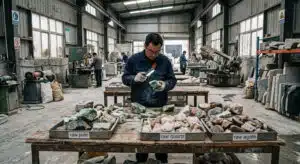
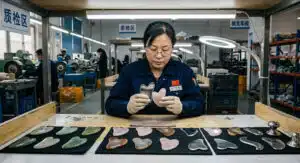
If you are researching jade gua sha wholesale, here is the most critical fact you need before contacting a single supplier: statistically, over 90% of products marketed as “jade gua sha tools” in the wholesale market are not true jade by mineralogical definition — and when the quoted price falls below $50 per unit, that figure approaches certainty. This is not an accusation of fraud. It is a structural reality created by the collision between how the gemstone industry defines jade and how the wellness product market uses the term. Understanding this gap is not optional background knowledge. It is the foundational risk-control decision that determines whether your procurement investment is protected or exposed from the first email you send to a jade gua sha supplier.
This guide is written from a manufacturing perspective — not a retail one. It is designed to give wholesale buyers, spa product distributors, and private-label brands an accurate picture of material science, process risk, and supplier evaluation criteria that most sourcing guides either omit or obscure.
- What "Jade" Really Means — And Why Most Jade Gua Sha Tools in the Wholesale Market Are Not What the Label Says
- The Complete Jade Gua Sha Wholesale Process
- Gua Sha Wholesale Risks — The Four Most Costly Problems Buyers Encounter and How to Prevent Them Before They Happen
- How to Evaluate a Jade Gua Sha Manufacturer — Five Factory-Level Criteria That Separate Reliable Suppliers from Procurement Risks
- The Questions Buyers Ask Most Before Their First Order, Answered From a Manufacturing Perspective
- A Manufacturing Perspective on What Responsible Jade Gua Sha Wholesale Sourcing Looks Like
- The Risk Control Framework That Every Jade Gua Sha Wholesale Buyer Needs
What “Jade” Really Means — And Why Most Jade Gua Sha Tools in the Wholesale Market Are Not What the Label Says

The Mineralogical Definition That the Wellness Industry Consistently Ignores
The word “jade” has a precise scientific definition that the gemological community has maintained for over a century. According to the Gemological Institute of America (GIA), only two minerals qualify as genuine jade: nephrite (软玉, of which Hetian jade is the most recognized variety) and jadeite (硬玉, best known commercially as emerald-green Burmese jadeite). Every other material — regardless of how it is marketed — is, by strict mineralogical classification, a jade simulant or substitute. This distinction matters enormously when you are making jade gua sha wholesale purchasing decisions, because the material name on a product listing is rarely the material inside the box.
The International Gem Society (IGS) provides a similarly clear framework: nephrite is a calcium magnesium silicate, while jadeite is a sodium aluminum silicate — both are metamorphic rocks with distinct physical properties, and neither is interchangeable with the serpentine or quartz-based materials that dominate the commercial gua sha supply chain. When a gua sha factory lists a product as “green jade gua sha,” there is a high probability that the material in question is serpentine, aventurine quartz, or Xiuyan jade (岫岩玉) — all of which are legitimate wellness materials with their own merits, but none of which are jade in the scientific sense.
The Three Jade Substitutes Dominating the Jade Gua Sha Wholesale Market
Understanding what you are actually buying requires familiarity with the three materials that account for the vast majority of jade gua sha tools wholesale production. The first is Green Jade (绿玉), a commercial term almost universally applied to serpentine — a magnesium silicate mineral with a waxy green appearance that resembles nephrite at a glance but scores only 2.5 to 4 on the Mohs hardness scale, significantly softer than true jade’s 6 to 7. The second is Green Aventurine (绿东陵), a quartz-family mineral with a characteristic sparkling appearance caused by fuchsite inclusions; it is durable, widely available, and substantially less expensive than jade, making it the dominant material in mid-range jade gua sha tools wholesale offerings. The third is Xiuyan jade (岫岩玉), another serpentine-group material from Liaoning Province, China, which is more translucent and visually refined than standard serpentine — it is, in fact, the material most likely to be genuinely confused with nephrite jade even by experienced buyers.
None of these substitutes are inherently problematic as wellness tools. Aventurine quartz, for example, has documented physical properties — including a Mohs hardness of 6.5 and excellent thermal stability — that make it well-suited for facial tool manufacturing. The problem is not the material itself. The problem is mislabeling, undisclosed substitution, and the pricing confusion that follows when buyers believe they are paying for jade and receive something fundamentally different. This means that your first protection in any jade gua sha wholesale transaction is accurate material identification — before you negotiate price, before you approve samples, and before you commit to an order.
Why True Jade Gua Sha Wholesale Is Economically Implausible at Commercial Scale
If true nephrite or jadeite is mineralogically superior, why do genuine jade gua sha tools represent such a negligible fraction of the market? The answer comes down to two converging supply-side realities. First, genuine jade raw material is geologically scarce. High-quality nephrite from Hetian (Xinjiang Province) and gem-grade jadeite from Myanmar are extracted in quantities that make them economically viable only for high-value carved objects, bangles, and collector pieces. The raw material volume required to sustain jade gua sha wholesale production at commercial scale simply does not exist in the primary jade supply chain. Second, even where small quantities of genuine jade raw material could theoretically be sourced, the price per kilogram is incompatible with wholesale economics. Premium Hetian nephrite can trade at prices that would make a single gua sha tool cost several hundred dollars in raw material alone — before any cutting, polishing, or margin is applied.
This means that when you receive a jade gua sha wholesale quotation that falls below $50 per unit — and most commercial quotations do — you are, with near certainty, looking at a substitute material. The 90% estimate cited in the introduction is not an exaggeration designed to alarm you. It is a conservative inference from basic geology and manufacturing economics. The correct response is not to reject those quotations, but to demand that the material be identified accurately and priced honestly. That is the first standard a qualified jade gua sha supplier should meet without hesitation.
The Complete Jade Gua Sha Wholesale Process

Most sourcing guides present the wholesale process as a linear checklist. That framing is misleading, because it implies that risk is evenly distributed across the timeline. It is not. In jade gua sha wholesale, risk is heavily concentrated in the earliest stage and progressively decreases as the order moves toward shipment — which means that buyers who invest the most scrutiny at the quotation phase will encounter the fewest problems at delivery. The six stages outlined below are not equal in importance, and this guide does not treat them as if they were.
1 — Quotation: The Highest-Leverage Decision Point in Jade Gua Sha Wholesale
The quotation stage is the single most consequential phase of any jade gua sha wholesale transaction. Every standard, every expectation, and every legal protection you will have for the remainder of the order is established here — or not established at all. Buyers who treat the quotation phase as a simple price negotiation consistently encounter the same problems downstream: materials that don’t match descriptions, quality grades that prove meaningless, and delivery timelines that expand indefinitely without contractual consequence. The quotation stage is where you set the rules of the transaction. If you do not set them clearly, you will operate without them.
How to protect yourself during the quotation phase: There are four questions that every buyer should put to a prospective jade gua sha supplier before any price discussion begins. The first is material identity: ask the supplier to name the specific mineral, not the commercial label. A supplier who responds with “green jade” or “natural jade” without specifying the mineral species — serpentine, aventurine, nephrite, or jadeite — is either uninformed about their own product or deliberately vague. Both are disqualifying. A qualified jade gua sha manufacturer will identify the material by mineral name without prompting, because they source it by mineral name from their raw material vendors.
The second question concerns quality standards. The terms “A-grade,” “A+ grade,” and “premium quality” that appear on virtually every gua sha factory price list are internal classification systems with no industry-wide definition. A grade designation only has commercial meaning when it is paired with measurable specifications: dimensional tolerance (typically ±0.2mm to ±0.5mm for precision tools), surface finish standards (polish grade, scratch allowance), color deviation parameters (ΔE value or visual reference samples), and acceptable defect thresholds for surface pitting, micro-fractures, and inclusions. Without these specifics in writing, a quality grade is marketing language, not a contractual commitment. This means your quality standard document — not the supplier’s grade label — must define what acceptable product looks like.
The third question addresses delivery timelines. Lead times for jade gua sha tools wholesale orders have no universal standard; they vary with order volume, product complexity, material availability, and factory capacity. What matters is not whether the timeline is short or long, but whether it is specific and contractually binding. A supplier who quotes “3-4 weeks” without a firm production start date, a milestone schedule, or a penalty clause for delays is offering you an aspiration, not a commitment. Delay risk in jade gua sha wholesale manufacturing is real: raw material procurement disruptions, equipment downtime, and concurrent order conflicts are endemic to the Chinese manufacturing environment, and without contractual accountability, your schedule is entirely dependent on the supplier’s prioritization decisions.
The fourth question — and arguably the most underasked — concerns material treatment. A segment of the gua sha factory market applies enhancement processes to raw materials before cutting: dyeing to intensify or homogenize color, resin impregnation to stabilize structurally weak stone, and surface coating to improve polish appearance. These treatments are not inherently illegal, but they carry two significant risks for buyers. First, the chemical agents used in some dyeing and impregnation processes have not been independently evaluated for skin contact safety — a critical concern for tools used in direct facial application. Second, treated materials are worth substantially less than untreated equivalents and should not be sold to end consumers at untreated prices. Any jade gua sha supplier who does not voluntarily disclose treatment status when asked, or who becomes evasive when the question is raised, should be removed from your supplier shortlist immediately.
2 — Sampling: The Only Objective Evidence of Supplier Capability
There is a Chinese manufacturing proverb that translates roughly as: “Words prove nothing; only evidence speaks.” It applies with particular force to jade gua sha wholesale procurement. Regardless of how detailed or reassuring a supplier’s quotation response is, a pre-production sample is the only instrument that can verify whether the supplier’s actual production output matches their stated standards. Research conducted across multiple sourcing categories consistently shows that 30% to 40% of quality failures in international wholesale orders are identifiable — and therefore preventable — at the sample stage. A supplier who cannot produce a sample that meets your specifications before production begins will not produce a full order that meets your specifications after it.
When evaluating samples for jade gua sha tools wholesale, your assessment should cover three dimensions. Dimensional accuracy: does the sample conform to the specified measurements within the agreed tolerance? Surface quality: are the polish level, edge finishing, and surface texture consistent with the written standard? And material authenticity: does the sample display the visual and physical characteristics consistent with the stated mineral — appropriate translucency, natural color distribution, and no evidence of coating or dye? If a sample passes all three dimensions, the supplier has demonstrated capability. If it fails any one of them, no assurance of improvement in full production should be accepted at face value.
3 — Production Monitoring: Tracking Progress Without Being on the Factory Floor
For most international buyers, direct oversight of production at a Chinese gua sha factory is logistically impractical. This does not mean production visibility is impossible. A structured monitoring protocol — agreed upon before production begins — gives buyers meaningful oversight without requiring physical presence. At minimum, this should include weekly photographic updates of production batches, in-process quality control documentation (showing rejection rates and defect categories), and a production milestone schedule with confirmed completion dates for each phase. Suppliers who are unwilling to provide this level of transparency during production are, statistically, more likely to encounter quality problems that they prefer to present as fait accompli at shipment rather than addressable issues during manufacturing.
4 — Quality Inspection: Locking in Standards Before the Goods Move
Quality inspection at the end of production is the last point at which problems can be corrected before they become your financial liability. The inspection must be conducted against the written quality standards established in the quotation phase — not against the supplier’s subjective assessment of what constitutes acceptable product. For jade gua sha wholesale orders above a threshold that justifies the cost (typically orders valued above $5,000), third-party inspection services such as QIMA or Bureau Veritas provide independent AQL (Acceptable Quality Level) sampling inspections that carry evidentiary weight in dispute resolution. The cost of a third-party inspection — typically $200 to $400 per inspection day — is a fraction of the cost of accepting a non-conforming shipment and managing the downstream consequences.
5 — Packaging: The Overlooked Variable That Directly Affects Your Landed Cost
Packaging decisions in jade gua sha wholesale have a direct and quantifiable impact on two cost variables: freight charges and transit breakage rates. Stone-based wellness tools are both heavy and fragile — a combination that creates specific packaging requirements that generic box-and-bubble-wrap solutions do not adequately address. Outer carton compression strength should be sufficient to withstand standard palletizing loads (minimum 200kg/m² for air freight configurations). Internal fixation must limit product movement to under 1mm in all axes — any greater movement during transit vibration creates cumulative micro-impact damage that, while not always visibly dramatic, produces the hairline fractures that generate customer complaints and return requests. Individual tool separation using die-cut foam or molded inserts reduces both product-to-product contact damage and the overall void fill required, which in turn reduces carton dimensions and freight volumetric weight charges. These are not abstract packaging recommendations. They translate directly into a measurable reduction in your total landed cost per unit.
6 — Shipping: Preparation Checklist After the Order Leaves Supplier Custody
Once goods enter the logistics network, neither buyer nor jade gua sha supplier has direct control over handling conditions. What you can control is your preparedness for every foreseeable event in the delivery chain. Real-time shipment tracking through the carrier’s system or a freight forwarder dashboard should be active from the moment the consignment is collected. If your shipment does not include a DDP (Delivered Duty Paid) arrangement, customs clearance documentation — commercial invoice, packing list, certificate of origin, and any required material certification — must be prepared and available before the shipment arrives at the destination port. Upon delivery, a structured unboxing inspection with photographic documentation of packaging condition before and after opening is essential for any damage claim that may need to be filed with the carrier or the jade gua sha manufacturer. Time-limited claim windows — typically 24 to 72 hours after delivery for visible damage — mean that unprepared buyers frequently lose their right to compensation simply through delayed documentation.
Gua Sha Wholesale Risks — The Four Most Costly Problems Buyers Encounter and How to Prevent Them Before They Happen

Risk in jade gua sha wholesale is not randomly distributed. After more than a decade of manufacturing experience in the stone wellness tool industry, the same four categories of problems account for the overwhelming majority of buyer losses, disputes, and supply chain failures. What makes these risks manageable is that all four are predictable — and predictable problems have preventable solutions, provided the buyer acts at the right stage of the procurement process rather than after the damage is done.
1 — Material Fraud in Jade Gua Sha Wholesale: Detection Methods That Work Before Payment
Material misrepresentation is the most structurally embedded gua sha wholesale risk in the industry, and it operates on a spectrum. At one end is straightforward mislabeling — calling serpentine “jade” because the commercial market accepts the terminology. At the other end is active deception involving treated materials: stones that have been dyed to simulate higher-value material coloration, or resin-impregnated to mask structural weakness that would be immediately apparent in untreated form. The Gemological Institute of America maintains comprehensive documentation on stone treatment types and their detection, and it is worth understanding their framework before you evaluate any jade gua sha supplier’s material claims.
For buyers without access to laboratory testing at the sourcing stage, a four-layer detection protocol applied to samples provides meaningful screening capability. The first layer is visual examination under natural light: genuine, untreated stone displays color variation that follows the natural growth structure of the mineral — color transitions are gradual, irregular, and three-dimensional. Dyed material, by contrast, tends to show color that concentrates along surface fractures and grain boundaries, creating patterns that appear to follow the stone’s surface rather than originate within its interior. The second layer is strong light transmission: holding the sample against a focused LED flashlight in a darkened environment reveals internal color distribution. Dye concentrations appear as localized color hotspots or streaks that do not correspond to natural inclusion patterns. The third layer is the alcohol wipe test — a cotton swab saturated with 95% isopropyl alcohol, applied with moderate pressure to a polished surface and then checked for color transfer. Surface-applied dyes and some coatings will show color transfer within 30 seconds; this test will not catch deeply impregnated dye but eliminates a substantial portion of low-quality treatment methods. The fourth layer — and the only one that provides definitive, legally defensible results — is laboratory gemological analysis. Organizations such as the Swiss Gemmological Institute (SSEF) provide material identification and treatment detection reports that can form the basis of supplier contractual compliance verification.
The commercial reality of jade gua sha wholesale is that laboratory testing of every incoming shipment is economically impractical for most buyers. The practical application of these detection methods is therefore at the sample stage: apply the full protocol to pre-production samples, establish material standards in writing based on what the approved sample represents, and use contract language that explicitly ties payment release to material conformance with the approved sample standard.
2 — Quality Inconsistency: Why Grade Labels from Any Gua Sha Factory Are Contractually Meaningless Without Written Specifications
The quality grading systems used across the gua sha factory landscape — A+, AA, AAA, premium, commercial — share one defining characteristic: none of them have standardized definitions that transfer between suppliers. A designation of “A-grade” at one jade gua sha manufacturer may correspond to what another factory categorizes as their second-tier commercial output. This is not deceptive practice in most cases; it is simply the absence of an industry-wide standard, combined with the commercial incentive to use aspirational-sounding terminology. The consequence for buyers is that grade labels carry zero contractual weight unless they are anchored to measurable specifications that both parties have agreed upon in writing.
The specification framework that actually protects buyers in jade gua sha wholesale procurement covers four measurable dimensions. Dimensional tolerance defines the acceptable deviation from specified length, width, and thickness measurements — for precision gua sha tools, ±0.3mm is a reasonable standard that most competent factories can achieve consistently. Surface finish standard defines the acceptable polish level, typically expressed as a scratch grade (no scratches visible under 10x magnification for A-grade product) combined with an allowable count of minor surface marks below a defined size threshold. Color consistency standard defines the acceptable variation between units in a batch, either through a ΔE color difference value (ΔE ≤ 3.0 is a common threshold for visually consistent batches) or through approved physical color reference samples retained by both parties. Structural integrity standard defines the acceptable threshold for surface pitting, micro-fractures, and edge chips — expressed as maximum defect size, maximum defect count per unit, and zero-tolerance zones (typically the working edge of the tool that contacts skin). These four dimensions, written into your purchase order or quality agreement, transform a supplier’s grade label from marketing language into an enforceable production standard. This means you are no longer dependent on a jade gua sha supplier’s subjective judgment about what constitutes acceptable product — you have established that judgment in advance, in writing.
3 — Transit Damage in Jade Gua Sha Tools Wholesale: Packaging and Carrier Standards That Reduce Breakage Rates
Transit damage in jade gua sha tools wholesale shipments is a category of loss that buyers consistently underestimate during the procurement planning phase and consistently overestimate the difficulty of preventing. Industry data from international logistics providers suggests that breakage rates for inadequately packaged stone wellness tools in air freight can reach 8% to 12% of units per shipment — a figure that, at commercial order volumes, represents a meaningful cost that compounds across multiple shipment cycles. The good news is that packaging-related transit damage is almost entirely preventable with the right specifications applied at the packaging design stage.
Five packaging parameters determine the transit safety profile of a jade gua sha wholesale shipment. Outer carton compression strength must be sufficient to withstand the stacking loads applied during palletization and freight consolidation — a minimum edge crush test (ECT) rating of 44 ECT for standard cartons, or 48 ECT for heavier product configurations. Cushioning layer thickness at all six carton faces should provide a minimum of 40mm of shock-absorbing material (EPE foam or equivalent) to handle the impact forces generated by drop events during handling. Individual unit separation must be achieved through die-cut foam inserts or molded compartments that hold each tool independently — tools in contact with each other during transit will produce mutual surface damage regardless of how well the outer carton is protected. Internal void space — the gap between the inner packaging assembly and the outer carton walls — must be minimized to below 1mm through tight-fitting insert design; larger voids allow the internal assembly to shift during vibration, creating impact loads that even well-cushioned individual units cannot fully absorb. Finally, for high-value jade gua sha wholesale orders, pre-shipment drop testing (ASTM D5276 standard, 60cm drop height from six faces and four edges) and vibration testing (ASTM D4169) provide quantitative confirmation that the packaging design performs to specification before the first shipment leaves the gua sha factory.
Carrier selection also has a measurable impact on breakage rates. Air freight, despite its higher per-kilogram cost, consistently produces lower breakage rates for fragile stone goods than sea freight — the handling environment is more controlled, transit duration is shorter, and the number of transfer events (each of which introduces impact risk) is substantially lower. For jade gua sha tools wholesale orders where unit value is above $15 per piece, the breakage risk reduction achieved by choosing air freight over sea freight typically offsets the freight cost differential within two to three shipment cycles when total landed cost per saleable unit is calculated correctly.
4 — Supply Chain Instability: Three Procurement Strategies That Protect Continuity
Supply chain instability in jade gua sha wholesale has structural causes that buyers cannot directly control: raw material availability fluctuations, manufacturing capacity constraints, labor market conditions in Chinese production regions, and the unpredictable impact of regulatory changes on stone processing operations. What buyers can control is how exposed they are to these structural risks — and that exposure is largely determined by three procurement decisions.
The first decision concerns supplier concentration. Buyers who source all of their jade gua sha tools wholesale volume from a single jade gua sha manufacturer operate with zero supply chain redundancy — any production disruption at that factory directly translates into a stockout situation with no fast recovery path. Building a qualified secondary supplier relationship — even if that supplier only accounts for 20% to 30% of normal order volume — provides a switchover capability that can be activated within days rather than the weeks or months required to qualify a new supplier under pressure.
The second decision concerns price discipline. The pressure to minimize unit cost in jade gua sha wholesale sourcing is understandable and commercially legitimate. However, there is a pricing floor below which suppliers cannot sustain the material quality, production consistency, and operational investment that stable supply requires. When a jade gua sha supplier accepts a price that eliminates their operating margin, the consequences appear predictably and quickly: material substitution to lower-cost inputs, quality control reduction to cut labor costs, and prioritization of more profitable customers during capacity-constrained periods. The cost of unstable supply — expedited freight, emergency sourcing, lost sales, and customer attrition — typically exceeds the unit cost savings that triggered the price compression in the first place.
The third decision concerns relationship continuity. Frequent supplier switching in jade gua sha wholesale sourcing does not reduce risk — it resets the trust and communication calibration that stable supply requires. Every new supplier relationship begins with an information asymmetry that takes multiple order cycles to resolve: you do not yet know their actual production capabilities, their real lead time performance, their quality consistency under pressure, or their problem-resolution behavior when something goes wrong. Maintaining a long-term working relationship with a qualified jade gua sha manufacturer — one where both parties understand each other’s standards, constraints, and expectations — produces supply stability that no amount of supplier-switching can replicate.
How to Evaluate a Jade Gua Sha Manufacturer — Five Factory-Level Criteria That Separate Reliable Suppliers from Procurement Risks

Supplier evaluation in the jade gua sha wholesale market is complicated by the fact that most manufacturers present themselves through the same commercial channels — trade platforms, websites, and sales representatives — using virtually identical language. Every listing claims “strict quality control,” “experienced production team,” and “competitive pricing.” None of these claims differentiate one supplier from another, because they are universal rather than specific. The evaluation framework below focuses on verifiable, factory-level evidence rather than marketing language — criteria that a genuinely capable jade gua sha manufacturer will be able to satisfy without hesitation and that an unqualified supplier will struggle to address concretely.
1 — Material Transparency: What Honest Jade Gua Sha Suppliers Say Without Being Asked
The single most reliable early indicator of a jade gua sha supplier’s overall integrity is how they describe their materials before you ask any questions. A supplier who proactively identifies their material as aventurine quartz, serpentine, or Xiuyan jade — using the correct mineral terminology rather than the commercial shorthand — is demonstrating a level of technical knowledge and commercial honesty that is both relatively rare and highly predictive of their behavior in other areas. A supplier who defaults to “natural jade” or “genuine jade” without specification, and who provides vague or evasive answers when the mineral identity is directly questioned, is telling you something important about how they will handle every other ambiguous situation in the transaction. Material transparency in the quotation phase does not cost a supplier anything — which is why the absence of it is meaningful.
2 — Written Quality Standards: What a Legitimate Gua Sha Factory Puts in a Specification Document
A gua sha factory with genuine quality management capability will be able to produce, without significant delay, a written quality specification document that covers dimensional tolerances, surface finish grades, color consistency parameters, and structural defect acceptance criteria. This document does not need to match your exact requirements — in fact, the negotiation between your quality requirements and the supplier’s standard specifications is a valuable part of the qualification process. What the document needs to demonstrate is that the factory has thought systematically about quality measurement, that they have defined acceptance criteria in terms that can be independently verified, and that they apply those criteria consistently across production batches. Factories that cannot produce such a document — or that produce one only after significant prompting and deliver a vague, non-measurable result — are operating quality control processes that are subjective and therefore unreliable.
3 — Production Lead Time Accountability in Jade Gua Sha Wholesale Sourcing
Lead time reliability is one of the most consequential and least rigorously evaluated criteria in jade gua sha wholesale supplier selection. A supplier’s quoted lead time is a data point; their actual lead time performance history is the evidence that matters. During supplier qualification, request production records or order history documentation that shows the ratio of on-time deliveries to total orders over the preceding 12 months. Qualified jade gua sha manufacturers who have invested in production planning and scheduling systems will have this data available. Those who do not track it are, by definition, not managing their delivery performance systematically. Additionally, a supplier’s willingness to accept contractual delivery penalty clauses — typically a percentage discount on the invoice value for each week of delay beyond the agreed date — is a reliable signal of their confidence in their own delivery capability. Suppliers who resist such clauses without providing specific, substantiated reasons are communicating their expectation that delays will occur.
4 — Communication Transparency During Production
The quality of communication during active production is a leading indicator of problem-resolution behavior when something goes wrong. A jade gua sha manufacturer who provides proactive production updates — photographs of production batches at defined milestones, quality control rejection logs, and immediate notification of any deviation from the agreed production schedule — is demonstrating an operational transparency that protects your interests throughout the manufacturing process. Suppliers who become difficult to reach, who provide vague responses to specific progress questions, or who consistently deliver “everything is on track” updates without supporting evidence are exhibiting a communication pattern that historically precedes delivery surprises. For buyers managing jade gua sha wholesale orders across multiple suppliers simultaneously, this communication behavior pattern is one of the most efficient ways to triage supplier reliability without requiring physical factory visits.
5 — Deyi Gems as a Manufacturing Benchmark: What 12 Years of Stone Tool Production Looks Like in Practice
Deyi Gems has operated as a source-level jade gua sha manufacturer for over 12 years, during which the production focus has remained specifically on jade and crystal wellness tools — not as a secondary product line within a broader stone goods operation, but as the primary manufacturing discipline. This specialization means that the material knowledge, tooling investment, and quality calibration at Deyi Gems is concentrated in a product category that many general stone factories treat as a commodity. When you source jade gua sha wholesale from Deyi Gems, your specifications are evaluated by a production team that has processed these specific materials — serpentine, aventurine quartz, Xiuyan jade, and related minerals — across thousands of production runs, not by generalist stone cutters applying unfamiliar techniques to an unfamiliar product format.
Deyi Gems applies dimensional tolerances of ±0.2mm as a production standard for precision gua sha tools, surface finish grading that is documented against physical reference samples retained for each client’s approved standard, and a material disclosure policy that identifies mineral species by name in all quotation documentation. This means that when you request a quotation from Deyi Gems, you receive a material identification, not a marketing label — and the quality standard attached to that quotation is measurable, not aspirational. For buyers who have experienced the supply chain instability and quality inconsistency that characterizes commodity-level jade gua sha wholesale sourcing, this operational specificity represents a risk reduction that compounds across every order cycle.
The Questions Buyers Ask Most Before Their First Order, Answered From a Manufacturing Perspective

The questions that follow represent the highest-frequency inquiries received during the sourcing process for jade gua sha wholesale orders. They are answered here from a manufacturing perspective — not a sales perspective — because the most useful answers to procurement questions come from understanding how production actually works, not from how suppliers prefer to present it.
Is There Such a Thing as Real Jade Gua Sha Tools Available for Jade Gua Sha Wholesale?
This is the question that sits beneath almost every jade gua sha wholesale sourcing inquiry, even when it is not asked directly. The honest answer, from a manufacturing standpoint, is this: genuine jade gua sha tools — made from certified nephrite or jadeite — exist in theory but are functionally absent from the commercial wholesale market. The raw material economics make wholesale production implausible. Premium-grade Hetian nephrite currently trades at prices that place the raw material cost of a single gua sha tool shape at several hundred dollars per unit before any cutting, shaping, or polishing labor is applied. Gem-quality jadeite is priced even higher, and the geological scarcity of both materials means that the raw material volumes required to sustain any meaningful jade gua sha tools wholesale production program simply are not available through conventional supply channels.
What this means practically for buyers is that your sourcing decision is not between “real jade” and “fake jade” — it is between accurately identified substitute materials and misidentified substitute materials. Aventurine quartz, Xiuyan jade, and serpentine are all legitimate wellness tool materials with documented physical properties that make them suitable for facial gua sha application. The International Gem Society provides mineralogical data on serpentine that confirms its safety profile for external use in its natural, untreated form. Your objective as a jade gua sha wholesale buyer is to ensure that whatever material you are purchasing is identified correctly, priced appropriately for what it is, and free from undisclosed treatments — not to pursue a material category that the supply chain cannot realistically deliver at wholesale economics.
What Is the Minimum Order Quantity for Jade Gua Sha Tools Wholesale, and How Does It Affect Unit Price?
Minimum order quantities in jade gua sha tools wholesale are not arbitrary thresholds — they reflect the fixed cost structure of stone tool manufacturing. Setup costs for a production run include tooling calibration, material procurement in minimum viable quantities from raw stone suppliers, and quality control baseline establishment. These fixed costs are distributed across the units in the order, which is why unit price decreases as order volume increases. At Deyi Gems, the production economics of jade gua sha wholesale orders follow a cost curve that most buyers find consistent with industry norms: entry-level MOQs for standard shapes typically begin in the range of 100 to 200 units per SKU, with meaningful unit price reductions occurring at the 500-unit and 1,000-unit thresholds as fixed costs are further distributed and raw material procurement achieves volume pricing from upstream suppliers.
The practical implication for buyers planning their first jade gua sha wholesale order is that the unit price quoted at minimum order quantity is not representative of the steady-state economics of a mature supplier relationship. A buyer who places a 200-unit initial order to validate quality, then scales to 1,000 units per order cycle after qualification, will typically see a unit cost reduction of 15% to 25% between those two volume levels — a ROI on the qualification investment that materializes within two to three order cycles. This means that the higher unit cost of a small initial order should be evaluated as a qualification investment, not as the long-term cost baseline of the jade gua sha wholesale relationship.
How Long Does a Complete Jade Gua Sha Wholesale Order Take From Quotation to Delivery?
Lead time in jade gua sha wholesale manufacturing is a function of three variables: order volume, product complexity, and the logistics channel selected for delivery. For standard gua sha shapes — facial gua sha boards, spoon shapes, and comb tools — in volumes between 200 and 500 units, production lead time at a competent gua sha factory typically falls between 15 and 25 working days from confirmed order and deposit receipt, assuming raw materials are in stock. Custom shapes requiring new tooling add 7 to 14 working days for tool fabrication and first-article approval before production can begin.
Logistics transit time adds to the total order cycle. Air freight from major Chinese manufacturing hubs to North American and European destinations typically requires 5 to 10 business days door-to-door, depending on customs clearance speed and final-mile delivery performance. Sea freight reduces per-kilogram shipping cost significantly but adds 25 to 40 days of transit time, plus port handling and customs clearance duration that varies by destination country and documentation completeness. For buyers managing inventory replenishment cycles for jade gua sha tools wholesale, the total order-to-delivery timeline for a standard air freight order should be planned at 30 to 40 days from quotation approval to warehouse receipt — a figure that accounts for production, pre-shipment inspection, export customs processing, and inbound logistics. Building this timeline into your inventory planning model eliminates the scenario where production delays or logistics variability create stockout situations that could have been avoided with an additional two-week buffer in the reorder schedule.
How Do I Verify That a Jade Gua Sha Supplier Is Telling the Truth About Their Materials?
Verification of material claims in jade gua sha wholesale sourcing operates at four levels of rigor, each providing a different degree of certainty at a different cost point. Level one is documentation review: request the supplier’s raw material purchase records showing the material name and supplier used for your product category. A jade gua sha manufacturer who sources aventurine quartz from a documented Chinese mineral supplier will have procurement records that confirm the material identity — and a willingness to share this documentation, even in summary form, is itself a meaningful indicator of transparency.
Level two is sample physical testing using the four-layer protocol described earlier in this guide — visual examination, strong light transmission, alcohol wipe, and UV light inspection. These methods cannot provide definitive mineralogical identification, but they eliminate a significant proportion of obvious treatment cases and provide a basis for escalating to more rigorous testing if anomalies are detected. Level three is third-party gemological testing of production samples. Services provided by institutions such as the SSEF Swiss Gemmological Institute or the GIA Laboratory produce material identification reports that definitively identify the mineral species and detect the presence of treatments including dyeing, resin impregnation, and surface coating. These reports cost between $50 and $150 per sample and provide the most legally defensible documentation of material conformance available to wholesale buyers. Level four — reserved for high-volume, ongoing jade gua sha wholesale relationships — is supplier audit, either conducted directly by the buyer’s representative or through a third-party audit service, which evaluates the raw material procurement chain, incoming material inspection procedures, and production floor quality control systems in an integrated assessment.
What Should I Do If the Products I Receive Do Not Match What Was Agreed?
Non-conformance situations in jade gua sha wholesale procurement are significantly easier to resolve when the quality standard was defined in writing before production began. If you have a written quality specification, an approved sample, and pre-shipment inspection documentation, you have the three elements required to make a credible, documented claim against a supplier for non-conforming goods. Without any one of these three elements, your position in a dispute is substantially weakened — which is why the investment in establishing them upfront pays dividends that extend well beyond the quality control function.
For material non-conformance that is identified after delivery, the claim process should begin within 24 to 72 hours of receipt — most supplier agreements and freight carrier liability frameworks impose time limits on damage and non-conformance claims that are strictly enforced. Photographic documentation of packaging condition, product condition, and specific defects should be systematic and comprehensive: photograph every affected unit against the approved sample, with measurement comparisons where dimensional non-conformance is claimed. If the jade gua sha supplier disputes the claim, the existence of third-party pre-shipment inspection records provides an independent, contemporaneous assessment of product condition at the point of factory release — a document that is difficult to contest and that typically accelerates dispute resolution significantly. For buyers considering the cost of third-party inspection services, this dispute resolution value alone — independent of the quality assurance function — frequently justifies the investment.
A Manufacturing Perspective on What Responsible Jade Gua Sha Wholesale Sourcing Looks Like

Deyi Gems was established with a specific manufacturing focus: stone wellness tools, produced at source, with an emphasis on material accuracy and production consistency over volume throughput. Over 12 years of operation as a jade gua sha manufacturer, the production environment at Deyi Gems has been built around the specific material and process requirements of gua sha tool manufacturing — not adapted from a generalist stone processing operation. This distinction has practical consequences for buyers who have experienced the quality inconsistency and material ambiguity that characterizes commodity jade gua sha wholesale sourcing.
What Jade Gua Sha Wholesale Buyers Can Expect From Deyi Gems at Each Stage of the Process
At the quotation stage, Deyi Gems provides material identification by mineral name — aventurine quartz, Xiuyan jade, serpentine, or other specified minerals — in all documentation, without requiring the buyer to ask. Quality specifications are provided as measurable parameters, not grade labels, and include the dimensional tolerances, surface finish standards, and defect acceptance criteria that define what conforming product looks like. This means that when you begin a jade gua sha wholesale conversation with Deyi Gems, your first interaction establishes the factual and contractual foundation of the order — not the sales relationship that will later need to be translated into production reality.
At the sample stage, Deyi Gems produces pre-production samples against the agreed specifications, with the understanding that sample approval constitutes the quality standard for the full production run. Samples that do not meet specification are identified and documented before they are sent — a practice that reflects production discipline rather than a desire to hide problems through selective sample presentation. This approach means that you can use the sample evaluation process as a genuine capability assessment rather than a formality, because the sample you receive represents actual production output rather than a hand-selected showcase piece.
During production, Deyi Gems provides structured progress updates at agreed milestones, including photographic documentation of production batches and quality control records. For buyers who have experienced the communication blackout that characterizes less disciplined gua sha factory operations — where updates are vague, infrequent, and followed by surprise delivery announcements — this transparency represents a qualitative difference in supply chain manageability that compounds across every order cycle.
The Manufacturing Philosophy Behind Deyi Gems’ Approach to Jade Gua Sha Tools Wholesale
The operational philosophy at Deyi Gems is grounded in a straightforward premise: the long-term value of a jade gua sha wholesale relationship is determined by what you can rely on, not by what you were promised. This means that material disclosure accuracy, quality standard consistency, and delivery performance reliability are treated as production requirements — not as sales differentiators to be deployed selectively. When a Deyi Gems quotation states that a product is made from aventurine quartz to a dimensional tolerance of ±0.2mm with a specific surface finish grade, those parameters are the production target that the manufacturing team is accountable to — not the starting point for a negotiation about what “close enough” means when the goods arrive.
For buyers evaluating jade gua sha wholesale sourcing options, the question worth asking is not which supplier makes the most impressive claims, but which supplier’s claims can be verified most directly through their documentation, their sample output, and their willingness to accept contractual accountability for the standards they assert. Deyi Gems operates with the expectation that buyers will ask exactly these questions — and that the answers, when examined against actual production evidence, will do the work that sales language cannot. Your jade gua sha wholesale procurement decisions carry real financial consequences. They deserve supplier partners who understand that, and who structure their manufacturing operations accordingly.
The Risk Control Framework That Every Jade Gua Sha Wholesale Buyer Needs

The risks embedded in jade gua sha wholesale sourcing are real, specific, and largely preventable — but only by buyers who understand where those risks are concentrated and act at the right stage of the procurement process to address them. Material misidentification is the industry’s foundational problem, and it is solved at the quotation stage through supplier transparency and written material specification. Quality inconsistency is solved by replacing grade labels with measurable acceptance criteria that are agreed upon before production begins. Transit damage is solved by packaging specifications and carrier selection decisions made before the goods leave the gua sha factory. Supply chain instability is solved by procurement strategy decisions — supplier diversification, rational price discipline, and relationship continuity — that operate at the level of your overall sourcing framework rather than any individual order.
The common thread in all four solutions is that they require action before the problem manifests, not after. Buyers who apply this preventive logic to their jade gua sha wholesale sourcing — who invest in supplier qualification, written standards, pre-shipment inspection, and packaging specification before they have experienced the losses that make those investments feel necessary — will consistently achieve better outcomes at lower total cost than buyers who treat each supply chain failure as an isolated incident to be resolved through negotiation after the fact. The manufacturing knowledge exists to support these preventive decisions. The supplier relationships that make them operationally viable also exist. What determines whether you benefit from them is the sourcing discipline you bring to the process from the first inquiry forward.