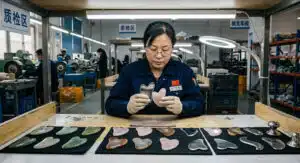
For Gua Sha Manufacturer, controlling cracking issues in Gua Sha production is not only about reducing production costs, but more importantly, about increasing customer trust and bringing greater value to customers (customer loyalty and trust).
Cracking in gua sha production is not a material defect in most cases. It is a manufacturing decision failure. The same piece of raw rose quartz or agate, processed by two different factories with different levels of process discipline, will produce dramatically different defect rates. One gua sha factory running controlled parameters might hold a structural defect rate below 2%. Another, cutting corners on cooling and sequencing, might see that number climb past 12% — without ever realizing the root cause, because the cracks often appear after shipment, not during in-house inspection. This distinction matters enormously if you are placing gua sha wholesale orders at any meaningful volume, because the cost of post-delivery defects — returns, replacements, reputation damage — lands entirely on you.
Understanding where cracking actually comes from inside a gua sha factory is the first step toward making better sourcing decisions. It also gives you a practical framework for evaluating suppliers before a single sample is cut.
- The Five Manufacturing Variables Behind Gua Sha Cracking
- Thermal Stress Management — The Highest-Impact Variable in Gua Sha Manufacturing
- Mechanical Stress and Vibration — The Damage That Leaves No Immediate Trace
- Process Sequencing — How Machining Order Determines Structural Outcome Before a Single Crack Appears
- Polishing Stage Damage — Where Good Blanks Get Damaged and Why Most Buyers Never Suspect It
- Workshop Environment — The Background Variable That Compounds Every Other Risk
- Micro-Crack Detection — The Quality Gate That Separates Process Confidence From Blind Shipping
- Standardized Process Parameters — Why Documentation Is the Only Way to Make Quality Repeatable
- A Note on Deyi Gems
- Faqs
The Five Manufacturing Variables Behind Gua Sha Cracking

There are five controllable variables inside any gua sha manufacturing environment that drive cracking risk. They are thermal stress, mechanical stress, process sequencing, polishing-stage damage, and workshop environment. Each one operates independently, and each one compounds the others. A factory that manages heat well but uses aggressive clamping fixtures is still running an uncontrolled process. A factory with correct sequencing but no staged polishing protocol is still leaving latent damage inside finished tools.
The word “controllable” is important here. None of these variables are mysterious. They are all addressable through documented process standards, proper equipment maintenance, and trained operator discipline. The question is not whether a gua sha supplier can control them — it is whether they have chosen to.
Why Crystal and Agate React Differently to Machining Stress
Not all stones crack the same way, and understanding why matters for anyone making material-specific purchasing decisions. According to gemological research published by the Gemological Institute of America (GIA), crystalline minerals like quartz — the base material for rose quartz, clear quartz, and amethyst — have directional cleavage planes that make them structurally anisotropic. This means their resistance to stress is not uniform in all directions. Apply cutting force or heat along the wrong axis, and the internal structure responds by propagating micro-fractures, often invisibly at first.
Agate behaves differently. As a microcrystalline form of quartz with a more randomized internal structure, it is somewhat less directionally vulnerable — but its banded composition creates density variation across the material, which means that aggressive machining can generate localized stress concentrations at transition zones between bands. In both cases, the material’s behavior under machining stress is not unpredictable — it is well-documented physics. A gua sha manufacturer working with these materials at a professional level does not discover this through trial and error. They design their process parameters around it from the start.
This means that when you evaluate a gua sha supplier, asking about material-specific machining protocols is a legitimate and useful question. A factory that applies identical CNC parameters to rose quartz, agate, and jade — without adjustment — is telling you something important about their level of material understanding.
Thermal Stress Management — The Highest-Impact Variable in Gua Sha Manufacturing

Of the five cracking variables, thermal stress is the one that causes the most damage and gets the least attention. It is easy to see a loose fixture or a worn cutting tool. It is much harder to see heat accumulating inside a piece of rose quartz during a 40-minute CNC run — until the crack shows up three days later during customer use. This is what makes thermal stress the highest-priority variable in any serious gua sha manufacturing operation, and it is the one where process discipline makes the most measurable difference.
The physics behind it are straightforward. When stone is machined at high speed without adequate cooling, localized temperatures at the cutting zone can spike significantly above ambient workshop temperature. For crystalline materials, this creates differential expansion between the heated surface zone and the cooler internal mass. According to material science data referenced by the International Gem Society (IGS), quartz has a relatively low thermal conductivity compared to metals, meaning heat does not dissipate quickly through the material. It builds up. And when it builds up unevenly, it creates internal stress gradients that exceed the material’s tensile strength at specific points — producing micro-fractures that are invisible to standard visual inspection.
For any gua sha supplier working with quartz-family materials at scale, this is not a theoretical risk. It is a routine production challenge that requires deliberate engineering solutions.
Where Heat Damage Actually Occurs During Gua Sha CNC Machining
Heat does not enter the equation at a single point during gua sha production. It accumulates across multiple stages, and understanding where each heat event occurs is necessary for controlling the total thermal load on any given piece.
The primary heat source is CNC cutting itself. Long-duration high-speed cutting passes — particularly when machining curved gua sha profiles that require continuous tool contact — generate sustained heat at the cutting interface. A second major source is dry polishing, where the abrasive wheel in direct contact with the stone surface generates frictional heat that concentrates at the contact point rather than dissipating into a coolant medium. Laser engraving, increasingly common for branding and customization on finished tools, creates extremely localized thermal spikes at the engraving path — a particular concern for thin-section areas near the tool edge. Finally, continuous machining without scheduled cooling intervals allows heat from successive operations to accumulate rather than dissipate between passes.
Each of these is a discrete, identifiable event. A gua sha manufacturer that has mapped these heat events into their production workflow can assign specific mitigation protocols to each one. A factory that has not done this mapping is managing thermal risk reactively — responding to cracks after they appear rather than preventing conditions that cause them.
Wet Machining as Standard Practice in Gua Sha Production
The most direct solution to thermal stress in stone machining is continuous coolant application throughout the cutting process — what the industry refers to as wet machining. In a properly configured gua sha factory, coolant is delivered continuously to the cutting zone throughout every CNC pass, not intermittently or only during roughing operations.
The functional benefits of wet machining extend beyond temperature control. Continuous water flow removes stone dust and swarf from the cutting zone, preventing abrasive particle buildup that increases friction and accelerates tool wear. It also lubricates the cutting interface, reducing the mechanical friction component of heat generation at the tool-stone contact point. The result is a cooler cutting environment, a cleaner workpiece surface, and measurably longer tool life — all from a single process discipline. Research on stone machining parameters consistently identifies coolant application as one of the highest-leverage variables for reducing thermal damage in crystalline material processing.
The absence of wet machining in a gua sha factory is not a minor gap. For quartz and agate materials specifically, dry machining at production speeds generates thermal conditions that no downstream inspection process can fully compensate for. You cannot inspect thermal stress out of a finished product. You can only prevent it from being introduced in the first place. This means that if you are placing gua sha wholesale orders for quartz-family tools, asking a supplier directly whether they run wet machining throughout CNC operations is one of the most useful qualification questions you can ask.
Cutting Speed, Feed Rate, and Layered Passes
Beyond coolant application, the parameters of the cutting operation itself — spindle speed, feed rate, and depth of cut per pass — have a direct relationship to thermal load. Some factories, under pressure to increase output, push these parameters toward their mechanical limits. High spindle speeds combined with deep single-pass cuts maximize material removal rate, but they also maximize instantaneous heat generation and cutting force at the tool-stone interface.
The correct approach for crystalline stone machining is layered cutting: multiple passes at conservative depth increments rather than single deep passes. This distributes the total thermal and mechanical load across time, allowing partial dissipation between passes and reducing peak stress at any single moment. Controlled continuous machining time — building in scheduled pauses for both tool and workpiece cooling during extended production runs — further reduces cumulative thermal accumulation. These are not conservative choices that sacrifice efficiency. A gua sha manufacturer running layered cutting protocols with appropriate coolant typically achieves lower defect rates, which means less rework, fewer replacement shipments, and lower effective production cost per saleable unit. The efficiency argument for aggressive parameters collapses when defect cost is factored in.
Post-Machining Cooling — Why the Cooldown Is Part of the Process
One of the less obvious but genuinely impactful thermal stress events in gua sha manufacturing happens after machining is complete. A freshly machined stone tool retains heat from the cutting process. How that heat is allowed to dissipate determines whether residual thermal stress remains in the finished piece.
The instinct in a high-throughput production environment is to move finished pieces quickly — into cold water for rapid cleaning, or into a cooled storage area to free up workspace. Both actions impose a rapid temperature change on a material that is still thermally elevated from machining. The differential between the hot workpiece and the cold medium creates a thermal shock event — essentially the same mechanism that causes a hot glass to crack when cold water is poured into it, but operating at a microscopic scale within the stone’s crystal structure. The correct protocol is natural ambient cooling: allowing machined pieces to reach approximate room temperature through passive air cooling before any temperature transition. This is a simple step that costs nothing beyond patience and workflow planning, but its absence is a consistent source of delayed cracking — defects that appear not during production, but after delivery. This means that when your gua sha supplier controls post-machining cooling properly, the tools you receive carry significantly lower risk of in-use cracking during your customers’ hands.
Mechanical Stress and Vibration — The Damage That Leaves No Immediate Trace

Thermal stress gets most of the attention in discussions about gua sha manufacturing risks, and for good reason. But mechanical stress is arguably the more insidious problem, because its effects are even more delayed and even harder to trace back to their source. A tool damaged by excessive clamping force or machining vibration will often look completely normal at every inspection stage — and then develop a visible crack weeks later, after it has already reached your customer.
This delay between cause and effect is what makes mechanical stress a particularly costly problem for gua sha wholesale buyers. By the time the defect is visible, the shipment has been received, possibly distributed, and the causal connection to a specific production parameter is nearly impossible to establish without detailed process records from the factory. Understanding how mechanical stress enters the product during manufacturing gives you a much stronger basis for evaluating whether a gua sha supplier has the process discipline to prevent it.
The three primary sources of mechanical stress in gua sha production are fixture clamping pressure, workpiece movement during machining, and cutting tool condition. Each one operates differently, but all three share the same fundamental mechanism: they introduce concentrated force into a stone material that has limited capacity to absorb and redistribute that force without internal damage.
How Fixture Design Affects Structural Integrity in Gua Sha Production
Every stone workpiece needs to be held securely during CNC machining. The challenge is that “securely” and “safely” are not always the same thing in stone processing. A fixture that clamps with sufficient force to prevent workpiece movement during aggressive cutting passes may simultaneously be applying enough localized pressure to initiate micro-fractures at the contact points — particularly for thin-section gua sha profiles where the geometry concentrates stress in predictable locations.
The engineering solution is soft-contact fixture design combined with distributed force application. Soft-contact fixtures use compliant interface materials — typically rubber, silicone, or engineered polymer pads — between the fixture jaw and the stone surface. This distributes clamping force across a larger contact area rather than concentrating it at discrete hard points, and it provides a degree of compliance that absorbs minor workpiece vibration rather than transmitting it rigidly into the material. Distributed clamping geometry — using multiple contact points spread across the workpiece profile rather than two opposing jaw faces — further reduces peak contact pressure at any single location.
For a gua sha factory working with thin tools like facial gua sha boards or multi-contour tools with varying cross-section thickness, fixture design is not a secondary concern. The geometry of the tool itself determines where stress will concentrate under any given clamping configuration. A factory that uses generic hard-jaw fixtures across all product geometries is applying a one-size-fits-all solution to a problem that is inherently geometry-specific. This means that you can verify whether your gua sha manufacturer has thought carefully about this by asking whether their fixture configurations are product-specific or standardized across tool types — the answer tells you a great deal about their process depth.
Workpiece Stability During Multi-Stage Machining
A related but distinct problem is workpiece movement during machining — not the gross movement that would immediately ruin a part, but micro-scale shifting and vibration that accumulates over a long machining sequence. As material is progressively removed from a stone blank during CNC operations, the workpiece geometry changes, which changes its mass distribution, its natural resonant frequency, and its contact relationship with the fixture. A clamping setup that held the workpiece perfectly stable at the beginning of a roughing pass may provide progressively less effective support as material is removed and the part becomes lighter and geometrically more complex.
In gua sha production, this is particularly relevant for tools with complex curved profiles — the multi-contour facial tools and curved board designs that are among the most commercially popular gua sha wholesale products. These shapes require extended multi-stage machining sequences that progressively change workpiece geometry, and they have thin sections that become structurally vulnerable to vibration at specific points in the process. A gua sha manufacturer managing this correctly will use intermediate re-fixturing steps during long machining sequences — repositioning and re-clamping the workpiece to maintain optimal support geometry as material is removed — rather than attempting to complete the full sequence from a single initial setup.
Tool Condition as a Direct Quality Variable
The third mechanical stress factor is cutting tool condition, and it is one of the most frequently underestimated sources of gua sha manufacturing risks. A sharp cutting tool in good condition generates a clean, controlled cutting action with predictable force vectors. A worn or partially damaged tool generates irregular cutting forces, increased friction, and vibration — all of which translate directly into mechanical stress inside the workpiece.
According to machining science principles documented by manufacturing engineering researchers, tool wear follows a predictable progression: an initial break-in period, a stable extended service period, and then a rapid degradation phase where cutting performance deteriorates sharply. The problem in production environments is that tools are often used into this degradation phase — because wear is gradual and hard to detect visually until it becomes severe, and because replacing tools represents a direct, visible production cost. The resulting defect costs — cracked tools, increased rework, replacement shipments — are less directly visible and easier to attribute to other causes.
A gua sha factory managing tool condition correctly maintains a documented replacement cycle based on measured cutting hours or part count rather than visual inspection alone. The GIA’s research on lapidary tool performance supports the principle that consistent tool condition is foundational to consistent cutting quality in gemstone and mineral processing. Tool replacement on schedule is not a cost — it is a defect prevention investment. This means that when your gua sha supplier runs a documented tool replacement cycle, the mechanical consistency of every cut across your entire production batch stays within controlled parameters, and the risk of vibration-induced micro-fractures drops measurably across the full order volume.
Process Sequencing — How Machining Order Determines Structural Outcome Before a Single Crack Appears

There is a particular type of manufacturing failure that is genuinely difficult to diagnose after the fact: the crack that was made inevitable by a decision taken at the very beginning of the machining sequence, long before the finished tool looked like anything close to a finished product. Process sequencing failures are like this. By the time the defect is visible, the causal decision is buried under several subsequent operations, and the connection between “we started with the edge” and “the edge broke during polishing” is not always obvious without a detailed understanding of how structural support works in progressive stone machining.
This is one of the areas where experience in gua sha production makes the most practical difference — not experience in the sense of years worked, but experience in the sense of having built a systematic understanding of how material behavior changes at each stage of a machining sequence. A gua sha manufacturer that has developed and documented correct sequencing protocols is not making educated guesses about what to cut first. They are applying structural logic to a material that behaves predictably when treated correctly and fails predictably when treated incorrectly.
Why Machining Thin Edges First Is a Structural Mistake
The most common sequencing error in gua sha factory operations — particularly in facilities that have not formalized their process documentation — is beginning the machining sequence with thin edge features rather than the main body mass. The logic behind this error is understandable: edges define the final profile, and operators often want to establish the finished geometry early. But the structural consequence of this approach is severe and largely unavoidable.
When thin edges are machined first, the surrounding material that would normally provide structural support during subsequent operations has already been removed or significantly reduced. The main body machining that follows generates vibration, cutting forces, and thermal cycling that act on a workpiece that no longer has the geometric rigidity to absorb them safely. The thin edge — already at reduced cross-section — becomes the stress concentration point for forces generated by operations nominally targeted at the body. The result is edge chipping or full edge fracture that appears to happen during body machining but was actually made inevitable by the sequencing decision made at the start of the operation.
For gua sha wholesale buyers, this matters because edge quality is one of the most visible and functionally critical attributes of a finished gua sha tool. A chipped or structurally compromised edge is not a cosmetic defect — it directly affects the tool’s performance and safety in use. A gua sha supplier that cannot explain their sequencing rationale for edge features is a supplier whose edge quality is controlled by operator habit rather than engineering logic, which means it will vary across operators, across shifts, and across production batches.
The Correct Four-Stage Machining Sequence for Gua Sha Tools
The correct approach to gua sha manufacturing sequencing follows a structural logic that keeps maximum material mass supporting the workpiece at every stage where significant cutting forces or vibration are present. Working through this sequence systematically eliminates the conditions that make edge failure probable.
The first stage is rough body machining — removing the majority of excess material from the main body of the tool while the blank still retains its full original geometry and structural rigidity. At this stage, the workpiece is at its most robust, and it can absorb the higher cutting forces associated with aggressive material removal without risk to any finished features, because no finished features yet exist. The second stage involves retaining a deliberate safety margin — a controlled amount of excess material left on all surfaces, including edge zones — rather than cutting to final dimensions during roughing. This margin maintains structural support geometry through the intermediate machining stages that follow.
The third stage addresses intermediate edge geometry — bringing edge profiles progressively closer to final dimensions while the body mass still provides meaningful structural support to the surrounding geometry. This is where material-specific parameters become particularly important: according to lapidary processing guidelines referenced by the International Gem Society, the feed rate and depth of cut for edge features in crystalline stone should be reduced relative to body machining parameters, reflecting the reduced local stiffness of thin-section geometry. The fourth and final stage is precision finishing of thin edge features — the curved working edges, the fine profile details, the surface transitions that define the functional and aesthetic character of the finished tool. By this stage, all significant cutting forces have already been applied to geometry that had full structural support. The thin edges are finished last, when the only operations remaining are light, controlled, and low-force.
This sequence is not complicated, but it requires deliberate process design and operator training to execute consistently. A gua sha factory that has formalized this sequence into documented work instructions eliminates the batch-to-batch variation that comes from individual operators making independent sequencing decisions based on personal preference or production pressure.
Polishing Stage Damage — Where Good Blanks Get Damaged and Why Most Buyers Never Suspect It

Ask most people where cracking risk is highest in gua sha production, and they will say cutting. The cutting stage is loud, aggressive, and visibly violent in its material removal. It feels like the dangerous part. But a significant proportion of structural defects in finished gua sha tools originate not during cutting, but during polishing — the stage that is supposed to be making the product better, not damaging it.
This happens because polishing is not a passive finishing operation. It is an active material removal process that applies mechanical pressure, frictional heat, and abrasive force to a surface that is progressively becoming thinner and more geometrically refined. The same thin edge features that required careful sequencing during cutting are now being subjected to polishing wheel pressure and rotational speed. If those parameters are not adjusted to reflect the reduced structural capacity of the finished geometry, polishing introduces the same categories of stress — thermal and mechanical — that cutting controls are designed to prevent.
For gua sha wholesale buyers, the polishing stage is particularly difficult to evaluate because its effects are often sub-surface. A polishing-induced micro-crack may not be visible on the finished surface but will propagate to a visible fracture under the repeated mechanical stress of actual use. This is another category of defect that appears to the customer as a product failure but originates in a specific production decision made weeks earlier.
Three-Stage Polishing vs. Single-Stage Shortcuts in Gua Sha Manufacturing
Correct polishing protocol in gua sha manufacturing follows a three-stage progression: coarse abrasive, medium abrasive, fine abrasive. Each stage serves a specific function that the next stage depends on. Coarse polishing removes the surface damage layer left by the final cutting passes — the micro-fractures, tool marks, and subsurface stress that cutting invariably introduces at the surface. Medium polishing refines the surface left by coarse polishing, removing the shallower damage introduced by the coarse abrasive itself. Fine polishing brings the surface to final optical quality, working on a surface that, by this point, has had its damage layer systematically removed rather than covered over.
The shortcut version — moving directly from cutting to fine polishing, or from coarse to fine without the intermediate stage — leaves subsurface damage in place while producing a surface that looks finished. The problem is not visible at inspection. It becomes visible under use, when the mechanical stress of normal gua sha application causes the residual subsurface cracks to propagate. Industry data on lapidary polishing quality consistently identifies skipped intermediate stages as a primary source of apparently cosmetic finishes that conceal structural weakness. A gua sha supplier running a documented three-stage polishing protocol eliminates this category of hidden damage systematically rather than relying on inspection to catch what the process has already introduced. This means that the tools reaching your customers have had their surface damage layer genuinely removed — not concealed — and will perform consistently across their full service life.
Edge Pressure Control During Polishing — The Parameter Most Factories Don’t Document
The second critical variable in gua sha production polishing is parameter adjustment for edge geometry. The working edges of a gua sha tool — the curved facial contact surfaces, the angled scraping edges — are geometrically thin and structurally less rigid than the body of the tool. Applying standard body polishing pressure and wheel speed to these features concentrates mechanical force and frictional heat in exactly the areas least capable of absorbing it.
Correct edge polishing requires explicitly reduced pressure settings and lower wheel rotational speed for thin-section features relative to body polishing parameters. The magnitude of the adjustment depends on the specific geometry — a fine curved edge on a rose quartz facial tool requires more conservative parameters than a thicker working edge on a jade board tool. According to gemstone processing standards discussed in SSEF Swiss Gemmological Institute’s technical publications, surface integrity in finished gemstone products is directly related to the controlled application of finishing forces relative to local geometry — a principle that applies equally to polished stone tools as to faceted gemstones.
A gua sha manufacturer that has documented edge-specific polishing parameters — separate from body polishing standards, adjusted for tool geometry — is managing this risk at the process design level rather than leaving it to individual operator sensitivity. The practical difference for you as a buyer is measurable: edge finish consistency across a production batch, and a significantly lower incidence of edge micro-cracking that shows up in customer use rather than incoming inspection.
Workshop Environment — The Background Variable That Compounds Every Other Risk

Workshop environment is not the primary driver of cracking in gua sha production. If thermal stress, mechanical stress, sequencing, and polishing parameters are all well-controlled, environmental factors alone are unlikely to cause significant defect rates. But environment operates as a compounding variable — it amplifies the effect of every other stress source that is already present in the material. A piece of rose quartz that carries residual thermal stress from an aggressive CNC pass will respond very differently to a sudden ambient temperature drop than a piece that was machined under controlled conditions. The residual stress provides the initiation point; the environmental trigger provides the energy that propagates it into a visible crack.
This is why serious gua sha manufacturing operations treat workshop environment control as a baseline discipline rather than an optional refinement. It costs relatively little to maintain stable temperature and humidity in a machining environment. The cost of not doing so — in defect amplification across an already-stressed production batch — can be significant. For gua sha wholesale buyers placing large volume orders, environmental instability at the factory level is a background risk multiplier that is easy to overlook during supplier qualification but shows up consistently in defect rate patterns over time.
Temperature Stability, Humidity, and Thermal Transition Management
The specific environmental conditions that create elevated cracking risk in gua sha factory operations fall into three categories. Extreme dryness — low ambient humidity — accelerates surface moisture loss from stone materials and can create surface tension gradients in materials with any residual moisture content. High humidity creates the inverse problem: moisture absorption in certain stone varieties can cause micro-expansion that interacts with existing internal stress. Neither extreme is optimal, and the transition between them — a workshop that swings between high and low humidity across seasons or even across days — creates cyclic stress that accumulates in materials over time.
Temperature instability follows the same logic. A workshop where temperature varies significantly between morning startup and afternoon production peak, or between summer and winter operation, subjects every piece of work-in-progress to repeated thermal cycling. For crystalline materials, each thermal cycle is a small stress event. Individually, none of these events causes visible damage. Cumulatively, across a production sequence that may span several days for complex tools, they add measurable stress to a material that is already carrying machining-induced stress from cutting and polishing operations.
The most acute environmental risk is rapid thermal transition — moving hot workpieces into cold storage, or bringing cold stone blanks directly into a heated machining environment without allowing them to equilibrate. A gua sha manufacturer managing this correctly maintains a defined temperature equilibration protocol for incoming raw material, ensures that machined pieces cool naturally before any temperature transition, and keeps workshop temperature variation within a controlled range across the production day. These are operational disciplines, not capital investments — but they require conscious process design and consistent enforcement to maintain. This means that when your gua sha supplier controls workshop environment systematically, the compounding effect of environmental stress on your production batch is eliminated, and the defect rate improvements from other process controls are preserved rather than partially offset by ambient conditions.
Micro-Crack Detection — The Quality Gate That Separates Process Confidence From Blind Shipping

Every manufacturing process, regardless of how well-controlled, operates within statistical tolerances. Parameters drift. Operators make judgment calls. Raw material carries natural variation that no incoming inspection fully captures. This is not a criticism of good manufacturing — it is an honest description of how production systems work in the real world. The implication is that manufacturing process controls, however rigorous, need to be paired with systematic detection protocols that catch what inevitably passes through even a well-managed process.
For gua sha production specifically, the detection challenge is significant because the most consequential defects — internal micro-fractures, subsurface polishing damage, hairline stress cracks — are not visible to standard visual inspection under normal lighting conditions. A finished tool can pass a visual quality check performed by an experienced inspector and still carry internal damage that will manifest as a visible crack within weeks of customer use. This gap between what visual inspection can detect and what actually determines product durability is where systematic detection methods create measurable value.
A gua sha factory running detection protocols that go beyond visual inspection is not signaling distrust in its own manufacturing. It is acknowledging the statistical reality of production and closing the gap between process confidence and verified product integrity. For gua sha wholesale buyers, the presence of multi-method detection in a supplier’s quality system is one of the most meaningful indicators of manufacturing maturity — more meaningful, in many ways, than the supplier’s description of their machining equipment.
Strong-Light Inspection — Reading Internal Structure Before the Surface Shows Anything
The first detection method applicable to gua sha manufacturing quality control is strong-light internal inspection — transmitting high-intensity light through the finished tool and examining the internal structure for shadows, discontinuities, and opacity variations that indicate sub-surface fractures or inclusions under stress.
For translucent materials — rose quartz, clear quartz, amethyst, light-colored agate — this method is particularly effective because the material’s translucency allows light to penetrate to meaningful depth, making internal features visible that would be completely undetectable under reflected-light visual inspection. A fracture plane inside a piece of rose quartz that is invisible under normal room lighting becomes clearly visible as a shadow or opacity boundary under strong transmitted light. The GIA’s gemological research on quartz varieties documents the optical properties of quartz-family materials that make transmitted light inspection effective for internal feature detection — properties that a gua sha manufacturer working with these materials at a professional level should be leveraging systematically in their quality control process.
Strong-light inspection is fast, non-destructive, and requires no consumables beyond the light source itself. Its main limitation is material opacity — it is less effective for darker or more opaque stones like dark jade or black obsidian. For the quartz and agate materials that represent the majority of gua sha wholesale volume, it should be considered a baseline detection requirement rather than an advanced method.
Acoustic Tap Testing — What Sound Reveals That Light Cannot
The second detection method is acoustic tap testing — striking the finished tool with a controlled impact and analyzing the resulting sound for indicators of structural discontinuity. A structurally intact stone tool produces a clear, sustained ring tone when tapped. A tool with internal fractures, cracks, or significant inclusions under stress produces a dull, shortened, or broken tone — because the fracture plane interrupts the acoustic wave propagation through the material.
Acoustic testing complements strong-light inspection by covering material types and crack orientations where transmitted light is less effective. An internal crack oriented parallel to the light transmission direction may be difficult to detect optically but will produce a clear acoustic signature. A crack in an opaque material section that light cannot penetrate will still generate a detectable change in tap-test tone. The two methods together cover a substantially larger portion of the defect population than either method alone.
In gua sha production at scale, acoustic testing can be performed rapidly by trained operators and does not require consumable materials or complex equipment. Its effectiveness depends on operator training and consistency — the ability to recognize subtle tone variations across many pieces in a production session. A gua sha supplier incorporating acoustic testing into their standard inspection workflow has invested in operator training, not just equipment, which is a meaningful indicator of quality system depth. According to lapidary quality assessment guidance from the International Gem Society, acoustic integrity testing is recognized as a standard method for evaluating structural soundness in finished stone products before they enter commercial distribution.
Dye Penetrant Testing — The Method Reserved for What Eyes and Ears Both Miss
The third detection method — dye penetrant testing — occupies a different position in the detection hierarchy. Where strong-light inspection and acoustic testing are practical for routine production-line use, dye penetrant testing is a more intensive method typically applied selectively to high-value pieces, products with complex thin-section geometry, or batches where process parameters deviated from standard during production.
The method works by applying a low-viscosity colored dye to the cleaned surface of a finished tool, allowing capillary action to draw the dye into any surface-connected cracks — including hairline fractures too fine to detect visually — and then removing excess surface dye and applying a developer that draws the absorbed dye back to the surface, making crack locations visible as colored indications against a clean background. For gua sha manufacturing applications, dye penetrant testing reveals the population of surface-connected micro-cracks that are below the resolution threshold of unaided visual inspection and outside the detection range of acoustic testing, which is primarily sensitive to through-thickness discontinuities rather than fine surface cracks.
The SSEF Swiss Gemmological Institute references surface integrity assessment methods in its technical publications on gemstone treatment detection — the same underlying principles of surface crack characterization that dye penetrant testing applies in a manufacturing quality control context. For gua sha wholesale buyers sourcing premium tools — professional-grade facial gua sha instruments, high-value rose quartz pieces, or custom-geometry tools with fine edge profiles — a supplier that incorporates dye penetrant testing in their final inspection protocol is operating at a level of quality assurance that materially reduces the risk of post-delivery surface defect claims. This means that the products reaching your end customers have been verified against a defect population that most suppliers never check for — a meaningful competitive advantage in markets where product quality directly drives repeat purchase and brand reputation.
Standardized Process Parameters — Why Documentation Is the Only Way to Make Quality Repeatable

Everything discussed in the preceding chapters — thermal stress management, mechanical stress control, process sequencing, polishing protocols, detection methods — depends for its effectiveness on one thing: consistent execution across every operator, every shift, and every production batch. A correct process parameter that exists only in the knowledge of one experienced operator is not a quality system. It is a single point of failure.
This is the problem that standardized process documentation solves. When CNC cutting parameters, polishing pressure settings, coolant application standards, tool replacement intervals, and inspection pass/fail criteria exist as documented standards — written down, accessible, enforced, and updated when process improvements are identified — the quality of the finished product stops depending on who happened to be running the machine that day. It depends on the documented standard, which is consistent regardless of operator, regardless of shift, and regardless of production volume.
For gua sha wholesale buyers, this has a direct commercial implication. When you place a reorder six months after your initial sample approval, you need confidence that what you receive matches what you approved. That confidence can only come from a supplier whose quality is controlled by documented standards rather than individual expertise. A gua sha manufacturer that can show you their process parameter documentation is showing you evidence that their quality system has been designed to be repeatable — not just capable of producing good results under ideal conditions, but reliably producing consistent results across the full production volume of a commercial order.
The Five Parameter Standards That Define a Controlled Gua Sha Manufacturing Process
The parameter documentation that defines a mature gua sha production quality system covers five distinct areas, each corresponding to a specific category of manufacturing risk discussed in this article.
CNC cutting parameters specify spindle speed, feed rate, depth of cut per pass, and coolant application rate for each material type and tool geometry in the production range. These parameters encode the thermal and mechanical stress management decisions that determine whether a given machining operation stays within safe stress limits for the material being cut. Polishing pressure standards specify wheel type, rotational speed, applied pressure, and stage progression for each surface zone of each tool geometry — body surfaces and edge features documented separately, reflecting their different structural characteristics and stress tolerance. Coolant application standards define the minimum coolant flow rate, application point, and monitoring requirements for wet machining operations, ensuring that coolant delivery remains within the range that provides effective thermal control rather than being treated as an on/off variable. Tool replacement intervals specify the maximum service life — in cutting hours or part count — for each cutting tool type before mandatory replacement, regardless of apparent visual condition. This removes operator judgment from a decision that has direct and documented impact on cutting quality and defect rate. Inspection criteria define the specific pass/fail standards for each detection method — the minimum light intensity and examination duration for strong-light inspection, the tone characteristics that constitute a fail in acoustic testing, the dye penetrant indication size that triggers rejection — ensuring that inspection decisions are consistent across inspectors and across production sessions.
Together, these five parameter sets constitute an auditable quality system that a gua sha supplier can demonstrate to buyers, not just describe. According to manufacturing quality management principles aligned with ISO 9001 standards — the international framework for quality management systems — documented process parameters and inspection criteria are foundational requirements for demonstrating process control capability to customers and auditors alike. A gua sha factory operating with this level of documentation is not making quality claims. It is providing verifiable evidence of quality control — which is a fundamentally different and more valuable proposition for any serious gua sha wholesale buyer making sourcing decisions at commercial scale.
A Note on Deyi Gems
Deyi Gems has been manufacturing crystal and jade gua sha tools for over 12 years as a source manufacturer — not a trading intermediary, but a factory with in-house design, machining, and quality control capability across the full range of quartz, agate, and jade materials. The manufacturing disciplines described in this article reflect the process standards that have been developed and refined across that production history. If you are evaluating gua sha suppliers for a wholesale program and want to discuss specific process parameters, material capabilities, or quality documentation, you are welcome to reach out directly.
Faqs
1. What causes gua sha tools to crack during manufacturing?
Cracking originates from five controllable manufacturing variables: thermal stress during CNC machining, mechanical clamping pressure, incorrect process sequencing, aggressive polishing parameters, and unstable workshop environment — not from raw material quality alone.
2. How does a professional gua sha manufacturer prevent thermal cracking?
By running continuous wet machining throughout CNC operations, controlling spindle speed and feed rate, using layered cutting passes, and allowing natural ambient cooling after machining — rather than rapid cold-water quenching.
3. What detection methods should a reliable gua sha supplier use before shipment?
Three methods cover the full defect spectrum: strong-light transmitted inspection for internal fractures, acoustic tap testing for hidden structural cracks, and dye penetrant testing for hairline surface cracks invisible to standard visual inspection.
4. Why does process sequencing affect edge quality in gua sha production?
Machining thin edges before the main body removes structural support prematurely. Subsequent operations then generate vibration against unsupported geometry, making edge chipping statistically inevitable regardless of how carefully the finishing pass is executed.
5. How do standardized parameters improve consistency across gua sha wholesale orders?
Documented CNC settings, polishing pressure standards, coolant specifications, tool replacement cycles, and inspection criteria remove operator-dependent variation. Your reorder matches your approved sample because the process is controlled by written standards, not individual judgment.