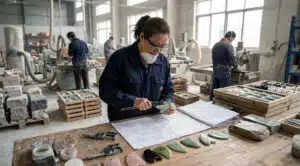
When you source gua sha tools at scale, the defects that cause the most damage to your business are rarely the obvious ones. A visibly shattered tool gets caught at inspection. What’s considerably harder to catch — and far more costly over time — is a shipment that arrives looking clean but starts showing hairline fractures two or three weeks after reaching your customers. In twelve years of gua sha production, the majority of these post-delivery failures trace back to one consistent root cause: thermal stress that entered the stone material somewhere in the manufacturing process and was never properly resolved.
Thermal stress occurs when different regions of a material expand or contract at different rates due to uneven temperature change. For brittle stone materials — quartz, jade, obsidian — the core of most gua sha wholesale and guasha wholesale inventory worldwide — a temperature differential of just 15 to 20°C across a small cross-section can generate internal fracture forces strong enough to initiate micro-cracks. The critical issue is that most of those cracks never reach the surface. They pass visual inspection without detection. They just don’t pass time.
What follows is not a general primer on gemstone physics. It is a working account of how thermal stress enters a gua sha manufacturing process at multiple points, what each of those points looks like in real production conditions, and what separates a gua sha manufacturer that manages this problem systematically from one that addresses it only at the inspection stage. If you’re evaluating a new gua sha factory or reviewing your current gua sha supplier‘s production capability, this framework gives you the right questions to ask — and a way to interpret the answers accurately.
There are no shortcuts in this kind of manufacturing discipline. But there is a consistent, measurable difference in outcomes between a gua sha manufacturer that has built thermal risk management into their process architecture and one that hasn’t — and that difference shows up in your defect rates, your return rates, and your per-shipment cost over time.
- What Thermal Stress Does to Crystal and Stone Gua Sha Tools — A Gua Sha Manufacturer Perspective
- Thermal Stress Doesn't Wait at One Station — How It Accumulates Across Every Stage of Gua Sha Production
- 5 Production Systems a Responsible Gua Sha Manufacturer Uses to Keep Thermal Stress From Compounding Across the Line
- Material-Specific Manufacturing — How a Gua Sha Manufacturer Adjusts Process Standards for Each Stone Type
- What Twelve Years of Gua Sha Production Has Actually Taught About Quality and Process Discipline
- FAQs For Gua sha Production Thermal Stress
What Thermal Stress Does to Crystal and Stone Gua Sha Tools — A Gua Sha Manufacturer Perspective

The physical mechanism behind thermal stress in stone materials is straightforward. When a cutting blade generates intense localized heat, the stone directly at the contact point expands. The material a few millimeters behind it, still at ambient temperature, resists that expansion. The boundary between them is where mechanical stress accumulates — and when that stress exceeds the local tensile strength of the material, fracture initiates, typically from a pre-existing microscopic flaw in the crystal structure.
According to the Gemological Institute of America (GIA), crystalline gemstone materials exhibit highly anisotropic thermal expansion behavior — meaning the rate of expansion varies significantly depending on the orientation of the crystal axis. In gua sha production terms, this means two tools cut from adjacent slabs of the same rough crystal can respond very differently to identical processing conditions. The crystal axis orientation, invisible to the eye, determines how heat distributes and dissipates internally. This is one of the core reasons why visual assessment of finished products is an inherently unreliable quality signal on its own — and why a competent gua sha manufacturer designs quality into the process rather than inspecting for it at the end.
The Four Types of Thermal Damage a Gua Sha Manufacturer Must Identify Before Final Inspection
Four distinct damage types emerge from thermal stress in stone gua sha tools, and understanding the difference between them determines where quality control actually needs to operate. Surface micro-cracks are the most visible — hairline fractures at or just below the surface, sometimes detectable under magnification but frequently missed during routine visual checks. Under mechanical stress during shipping or after several uses, these fractures propagate deeper into the material, eventually becoming visible failures at the customer level.
Dark fractures are internal cracks with no surface expression whatsoever. You can hold a finished tool up to a strong light source and see nothing unusual — yet the internal structure is already compromised. The International Gem Society (IGS) notes that repeated thermal cycling in brittle silicate materials can reduce fracture toughness by as much as 30% over time, and dark fractures are the primary physical manifestation of that cumulative degradation. Edge chipping occurs at the geometric perimeter of the tool, where processed and unprocessed material meet, and is particularly common in tools that experienced rapid temperature change during the cooling or washing stage. Internal structural fatigue is the hardest to detect and the most dangerous: a progressive weakening of the material’s internal cohesion through repeated thermal cycling that produces no localized fracture signature until the material finally fails under normal use load.
Three of these four damage types are effectively invisible to end-of-line visual inspection. This means the most important quality decisions in managing gua sha manufacturing risks are not made at the inspection table — they’re made inside the production process at each stage. This means you can only accurately evaluate a gua sha supplier‘s real quality performance by understanding their process discipline, not by examining their samples in isolation.
Why Brittle Materials Demand Different Standards From a Gua Sha Manufacturer
The three material families most prevalent in gua sha wholesale and guasha wholesale sourcing — quartz crystals, obsidian and glass-type materials, and high-hardness jade — each carry a different thermal risk profile. A gua sha manufacturer that applies the same cutting parameters, polishing durations, and cooling protocols across all three is, by definition, producing inconsistent results in at least two of those categories. The inconsistency doesn’t always appear in samples — it appears in volume production.
Quartz-family materials — clear quartz, rose quartz, amethyst — have a thermal conductivity of roughly 6 to 7 W/m·K, compared to aluminum at approximately 205 W/m·K. This means heat generated at the cutting surface dissipates extremely slowly through the bulk material. When coolant hits the surface, the surface cools rapidly — but the interior remains elevated for far longer. The fracture risk lives in that gradient, not in the absolute temperature of either surface or interior. A gua sha supplier claiming their quartz tools pass inspection is confirming only the surface condition of those tools. What happened internally during processing is an entirely separate question — and it’s the one that matters most.
Obsidian, as an amorphous volcanic glass, lacks the crystalline grain structure that allows crack propagation to arrest at grain boundaries. A crack in obsidian travels. Its thermal expansion coefficient of approximately 9 to 10 × 10⁻⁶/°C means even modest localized temperature increases — the kind that routine dry polishing generates — can trigger propagating fractures in already-machined pieces. A gua sha manufacturer without conservative, material-specific parameters for obsidian is accepting high batch-level variance as a structural feature of their output. For jadeite and dense nephrite, the challenge is different: their internal grain structure is heterogeneous — mineral composition varies across the cross-section — producing non-uniform thermal expansion rates within a single piece. The Swiss Gemmological Institute (SSEF) has documented how the interlocking mineral grain structure in jadeite creates localized stress concentration points under thermal loading conditions. Standardized parameters applied to jade without batch-level material evaluation will produce inconsistent output regardless of operator experience. This means a capable gua sha manufacturer treats incoming material evaluation as a production step, not an afterthought.
Thermal Stress Doesn’t Wait at One Station — How It Accumulates Across Every Stage of Gua Sha Production

The most common misreading of thermal stress in stone manufacturing is that it’s a cutting problem — something that arises at the most intense stage of the process and is managed there. The reality is considerably more demanding. Thermal stress is cumulative: each stage either adds to or partially relieves the strain already carried by the material. A tool that survives cutting without damage can still fail at the polishing stage, the laser engraving stage, or even during washing. When it does fail there, the root cause is almost never that final stage in isolation — it’s the accumulated load from everything that came before, combined with a temperature event the material could no longer absorb.
This is why a gua sha manufacturer managing only the most visible heat source leaves most of the actual gua sha manufacturing risks structurally unaddressed.
1 — CNC Cutting: Where a Gua Sha Manufacturer Faces the Highest Rate of Heat Generation
CNC cutting and diamond engraving represent the highest rate of thermal energy input per unit of time in any gua sha production environment. A cutting saw operating at 3,000 to 8,000 RPM against quartz or jade generates continuous frictional heat at the blade-material contact zone. Without active cooling, that contact zone can exceed 80 to 100°C within seconds — well above the threshold at which fracture risk becomes significant for brittle crystalline materials with low thermal conductivity.
The critical variable is not peak temperature — it’s the differential between the rate at which heat is generated and the rate at which it is removed. When generation exceeds removal, temperature accumulates, and it is that accumulation, more than any single temperature reading, that drives fracture initiation. A gua sha manufacturer with a disciplined cutting environment uses wet CNC processing: continuous water circulation, directed coolant spray at the blade-material interface, and micro-quantity lubrication (MQL) in precision operations where full-flood cooling would affect dimensional accuracy. The combined result is that cutting zone temperature is managed in real time, not allowed to peak and then be corrected after the fact. This means you receive tools where the internal structure has been thermally protected from the very first moment of contact with tooling — not inspected afterward, but protected during the process.
2 — Polishing: The Stage Every Gua Sha Manufacturer Should Treat With Equal Thermal Discipline
Polishing is consistently the most underestimated source of thermal stress in gua sha production. The energy levels involved are lower than in cutting, which creates a misleading impression of reduced risk. What polishing actually generates is sustained frictional heat through high-frequency abrasive contact — mechanically identical to the cutting process, just slower and over a longer accumulated duration per piece.
Both primary polishing methods in gua sha manufacturing — rotating polishing wheels and vibratory tumbler systems — operate through abrasive friction. Manual wheel polishing tends to concentrate heat in localized areas where the operator dwells on a single zone; tumbler polishing distributes heat more evenly but sustains it over longer total durations per batch. Neither approach is inherently safer from a thermal standpoint. Dry polishing — running either method without water or coolant — removes the only effective heat dissipation mechanism and represents one of the most consistently high-risk practices contributing to gua sha manufacturing risks in production environments that prioritize throughput over process discipline. Does your current gua sha factory run wet polishing consistently, or is it only applied intermittently? That single answer tells you more about batch-level quality variance than most sample comparisons will. This means a gua sha manufacturer who treats polishing as a thermally managed process step — not a fast finishing operation — is protecting product integrity at a stage most buyers never consider examining.
3 — Laser Engraving: How a Gua Sha Manufacturer Maps the Heat-Affected Zone on Custom Orders
Laser engraving carries the lowest probability of producing thermal damage in a standard gua sha production environment — but when it does produce damage, the severity can be substantial. A laser beam deposits extremely concentrated energy into a very small area: the heat-affected zone (HAZ) along an engraving path can reach temperatures of several hundred degrees Celsius in microseconds, while material just one millimeter away remains at room temperature. This is among the sharpest thermal gradients generated at any point in gua sha manufacturing.
When laser parameters — power, speed, pulse frequency, and pulse duration — are correctly calibrated for the specific material being processed, the HAZ is small, controlled, and the surrounding structure is preserved. When a single default parameter set is applied across material types without per-material adjustment, the HAZ expands. Internal micro-explosion points form along the engraving path. Fine radiating fractures extend outward from the HAZ boundary. Structural embrittlement progresses along engraved edges. For any gua sha wholesale buyer sourcing custom-engraved tools — logos, traditional patterns, brand text — the quality of a gua sha manufacturer‘s laser calibration process directly determines whether the batch performs or fails. This means you should always request a material-specific laser test sample before committing any custom engraving to full production volume — and a capable production partner should treat this as standard protocol, not an unusual request.
4 — Washing and Cooling: Why the Last Step in the Line Concentrates Some of the Highest Gua Sha Manufacturing Risks
Of all the gua sha manufacturing risks across the full production chain, the cooling stage is the one most frequently mismanaged — and the reason it’s mismanaged is that it intuitively feels like the safe part. The high-energy processing is complete. The product is finished. Cooling is just cooling.
The problem is thermal shock, and thermal shock is not caused by high temperature. It is caused by a rapid change in temperature. A quartz tool with a surface temperature of 40 to 45°C after polishing is not at significant fracture risk from that temperature alone. It is at risk the moment cold water is applied directly, or it’s placed on a cold metal surface, or it’s moved from a warm production room into an air-conditioned storage area before the internal temperature has equalized with the surface. The thermal gradient created by any of these events generates, in structural terms, the same category of mechanical force inside the material as a cutting blade — and any gua sha factory that hasn’t built a deliberate, protocol-driven cooling stage into their workflow is leaving the last quality-protection step in the production chain to chance. A gua sha manufacturer who understands this treats the cooling stage with the same process discipline as the cutting stage. This means that establishing a clear, documented post-processing cooling protocol is one of the highest-leverage improvements available in gua sha production risk management — and one of the most diagnostic questions you can put to any supplier.
5 Production Systems a Responsible Gua Sha Manufacturer Uses to Keep Thermal Stress From Compounding Across the Line

Managing thermal stress across a complete gua sha production line is not accomplished by fixing one stage or installing one piece of equipment. Because thermal stress is cumulative, an effective response requires interconnected protocols that address the problem at every stage and prevent load from one step from compounding into the next. The five systems described below define the operational difference between a gua sha factory that manages gua sha manufacturing risks proactively — before finished products exist — and one that manages them reactively at the inspection table.
1 — Continuous Cooling Infrastructure: The Foundation of Thermal Risk Management for Any Gua Sha Manufacturer
Continuous active cooling at every high-friction processing stage is the foundation of any credible thermal management system — not an upgrade, and not an optional feature. In CNC cutting and engraving operations, this means wet machining with circulating water coolant and directed spray at the blade-material contact zone, supplemented by MQL where precision operations require it. The combined effect is that the cutting zone temperature is controlled in real time rather than allowed to accumulate and then be corrected.
In polishing, the equivalent commitment is continuous water delivery to the polishing surface throughout the operation — not interval-based wetting, but continuous. For high-value material categories like jadeite and premium quartz, dedicated low-temperature coolant circulation replaces plain water. Studies in hard material processing engineering indicate that implementing continuous cooling across both cutting and polishing stages can improve yield rates in brittle stone materials by 8 to 12% — a direct reduction in per-unit replacement cost that compounds across every order you place. This means you can ask any potential gua sha supplier a single diagnostic question — is your polishing stage continuously wet, or is cooling managed periodically? — and use the answer as a meaningful proxy for their broader thermal process maturity.
2 — Staged Processing Rhythm: Why a Gua Sha Manufacturer That Deliberately Slows Down Produces More Consistent Output
Continuous processing — moving from rough cutting through to final polish without deliberate pause — generates cumulative thermal load that active cooling alone cannot fully compensate for. Each subsequent stage is entered with residual heat carried from the previous one. By the time a piece reaches polishing, it is already thermally loaded from cutting and grinding, and that pre-existing load amplifies the fracture risk at the polishing stage. Staged processing with mandatory cool-down intervals built into the workflow sequence addresses this directly.
In practice, this means rough grinding is followed by a defined cool-down interval before fine grinding begins. Fine grinding is similarly followed by cooling before polishing begins. Where tool geometry allows, multi-surface rotation is used — processing one face of the piece, then rotating to another, allowing the previously worked surface to dissipate heat before being contacted again. Total production time per piece is moderately longer in a staged workflow than in a continuous one. The yield improvement — fewer pieces with internal fracture, fewer with edge chipping, fewer structural fatigue failures — consistently makes staged processing the lower total cost approach across any meaningful production volume. This means you’re not paying for slower production. You’re paying for a higher percentage of each order arriving in usable condition — and the arithmetic on that trade-off is clear.
3 — Blade and Parameter Management: How a Gua Sha Manufacturer Controls the Variables Most Directly Responsible for Heat Generation
A dull diamond blade generates substantially more frictional heat than a sharp one, because it compresses and abrades material rather than cutting through it efficiently. Blade degradation is progressive and invisible — no sudden failure event, only a gradual increase in thermal load per unit of cutting work, accumulating across dozens of pieces before the pattern becomes detectable in output quality. Without a formal blade lifecycle tracking system, this degradation quietly drives gua sha manufacturing risks that are structurally difficult to trace back to their source.
A gua sha manufacturer managing blade condition as an active production variable tracks cutting volume per blade and enforces replacement at defined thresholds — not when blades look visually worn, but when they’ve reached the production volume at which thermal performance becomes statistically unreliable. CNC parameters — RPM, feed rate, and depth of cut per pass — must similarly be tuned to the specific material and geometry in production rather than applied as categorical defaults. Reducing spindle speed and feed rate adds modest cycle time per piece while reducing heat generation at the contact interface by a proportionally larger factor. Across any production run of meaningful volume, the reduction in thermally damaged pieces generates more recovered margin than the added cycle time costs. This means your effective cost per usable unit decreases — and a gua sha manufacturer with genuine process maturity can tell you specifically what their blade management and parameter settings produce in terms of yield improvement, by material category.
4 — Gradual Cooling Protocol: Why the Final Step Is Where a Gua Sha Manufacturer Protects Every Hour of Prior Processing
A formal cooling protocol is the production system most frequently absent from operations that are otherwise reasonably equipped. The prevailing assumption is that cooling happens naturally — pieces are set aside, they reach room temperature, and the process continues. The operational reality is that without a defined protocol, cooling becomes an invisible source of thermal shock events: a warm piece placed on a cold metal fixture, a batch moved to an air-conditioned storage area while still internally warm, production pressure that leads to packaging before internal temperatures have equalized.
A formal protocol specifies maximum surface temperature thresholds for proceeding from one stage to the next, mandatory cool-down durations indexed to material type and tool geometry, and defined environmental parameters for the cooling zone itself. For gua sha wholesale production involving premium stone categories — jadeite, high-grade quartz — this extends to temperature-controlled and humidity-controlled finishing environments. A gua sha manufacturer who has formalized this stage is protecting the accumulated value of every prior processing step — because a piece that makes it intact through cutting, grinding, and polishing can still fail in the packaging area if the cooling discipline isn’t present. This means that asking a gua sha supplier directly about their post-polishing cooling protocol is one of the most informative questions you can raise — and one that most buyers don’t think to ask until after a quality issue has already appeared.
5 — Stress-Aware Product Design: How Geometry Reduces Gua Sha Manufacturing Risks Before Processing Begins
Product geometry is rarely discussed as a thermal management tool, but in gua sha production, the shape of the finished tool directly determines where thermal stress concentrates during manufacturing — and how the finished product responds to the thermal cycling of normal daily use. Sharp corners, thin edge profiles, abrupt wall-thickness transitions, and deep engravings in thin cross-section areas are all geometric stress concentrators: locations where both thermal forces and mechanical forces amplify relative to the surrounding material.
Established mechanical engineering principles on stress concentration in brittle materials confirm that a corner with a radius approaching zero produces a stress concentration factor orders of magnitude higher than a rounded transition with even a modest radius. In gua sha production design terms: maintain minimum safe wall thickness at all edges, use large-radius transitions at all profile changes, and avoid deep engraving in zones where cross-sectional wall thickness approaches minimum. A gua sha manufacturer with genuine design-for-manufacturing capability integrates these principles before the first sample is produced — as a standard evaluation step applied to every new design, not as a reactive correction after a sample review reveals chipping. This means you can approach a capable gua sha manufacturer with design files and expect them to identify thermal-risk geometry before any tooling investment is committed — which is measurably less expensive than discovering the same problem during a first-run sample review.
Material-Specific Manufacturing — How a Gua Sha Manufacturer Adjusts Process Standards for Each Stone Type

No single set of processing parameters is appropriate for all the stone materials that appear in a gua sha wholesale or guasha wholesale product catalog. Quartz, obsidian, and jade differ substantially in thermal conductivity, fracture toughness, crystal grain homogeneity, and thermal expansion behavior. A gua sha factory applying the same CNC speeds, polishing durations, and cooling protocols across all three categories is producing quality variance that inspection alone will not resolve — because the variance is built into the process before any finished product is created. Material-specific process standards are not a premium feature. They are a basic requirement for consistent output at any production scale.
Processing Quartz-Family Crystals — What a Gua Sha Manufacturer Must Account for That Isn’t Visible on the Surface
Rose quartz, clear quartz, and amethyst are collectively the most widely sourced material category in gua sha wholesale and guasha wholesale ranges worldwide — and also the category where thermal damage is most likely to be invisible at inspection and most likely to manifest post-delivery. Quartz’s low thermal conductivity means the internal-to-surface temperature differential that drives fracture risk can persist for several minutes after a heat source is removed. The surface feels cool to the touch while the interior remains elevated — and it’s the material’s inability to equalize that differential quickly that creates the structural risk.
Processing adjustments for quartz-family materials include reduced cutting RPM relative to softer stone types, mandatory cool-down intervals between each grinding stage, wet polishing with periodic surface temperature verification, and extended natural cool-down time before packaging. The benchmark against which a gua sha manufacturer should be evaluated on quartz tools is not surface finish quality alone — it’s the internal material integrity, which is protected during processing and cannot be recovered once damaged. For buyers sourcing quartz tools destined for markets that require material quality declarations or testing certifications, the traceability of production parameters per batch is also a compliance-relevant factor that a capable gua sha factory should be able to provide. This means you can ask any potential production partner whether they maintain quartz-specific process parameters separate from their general stone settings — and treat that answer as a meaningful indicator of their material-level process sophistication.
Obsidian and Glass-Type Tools — The Highest-Risk Category in Gua Sha Production
Obsidian leaves the least margin for process error of any material in gua sha manufacturing. As an amorphous silicate glass, it lacks the grain boundaries that allow crystalline materials to arrest crack propagation — a fracture that initiates in obsidian travels. Its combination of low fracture toughness, high thermal expansion sensitivity, and near-zero tolerance for dry processing makes it the most technically demanding material in any gua sha factory‘s production range — and the clearest indicator of a gua sha manufacturer‘s actual production discipline across their full material offering.
Processing parameters for obsidian must be the most conservative of all material types: lower RPM, reduced feed rate, uninterrupted wet cutting, and shorter processing intervals before mandatory cool-down. Polishing must be continuously wet — even brief dry contact at elevated surface temperatures can initiate edge fractures visually indistinguishable from mechanical damage. The packaging and shipping protocol for obsidian products is also more demanding than for other materials, because thermal shock risk extends beyond the production floor. These tools should not be packaged while internally warm, and should be shipped with thermal insulation appropriate for transit environments involving significant ambient temperature swings. This means that yield rate stability across consecutive obsidian guasha wholesale orders is one of the most reliable indicators of whether a gua sha manufacturer‘s production system is genuinely suited to this material — or merely capable of producing occasional acceptable batches under controlled conditions.
Jade Processing — Why Every Batch Requires a Gua Sha Manufacturer‘s Active Material Evaluation
Jadeite and dense nephrite are not inherently more difficult to process than obsidian in an absolute sense — they are harder to process consistently. Their internal grain structure is heterogeneous: mineral composition varies across the cross-section, producing non-uniform thermal expansion rates within a single piece. The SSEF has established that the thermal behavior of jadeite is directly linked to its mineralogical composition — particularly the ratio of jadeite to associated mineral phases — which can vary substantially even within a single block of rough material. A gua sha manufacturer processing jade at a consistent quality level evaluates incoming material as a production step — identifying grain structure variation, flagging high-risk zones where different mineral compositions converge, and adjusting tool orientation and cutting path accordingly.
For gua sha wholesale and guasha wholesale buyers sourcing premium jade tools, the relevant question is not whether a gua sha factory can produce beautiful samples under controlled conditions — most can. The question is whether they can maintain consistent quality across the full natural variation range of their incoming raw material, which requires batch-level evaluation protocols rather than generalized parameter defaults. For buyers supplying jade products into retail markets with material origin or quality documentation requirements, the ability of a production partner to provide batch-level traceability records is also a direct compliance consideration. This means you should ask any potential gua sha manufacturer how they assess incoming jade material before setting production parameters — and a capable partner will have a specific, documented answer to that question, not a generalized assurance about quality standards.
What Twelve Years of Gua Sha Production Has Actually Taught About Quality and Process Discipline

The most durable lesson from twelve years of managing gua sha manufacturing risks across multiple material categories and production scales is this: consistent output quality is not primarily a function of operator expertise or equipment specification. It is a function of process architecture — the documented protocols, material-specific parameters, and stage-by-stage discipline that define what correct production looks like before any individual decision is made.
When thermal stress problems are managed reactively — through end-of-line inspection, post-production sorting, and batch-level rework — the production process continues generating the same failures with every run. The cost of reactive management includes not only the rejected pieces, but the inspection overhead, the rework labor where possible, and the cumulative relationship cost of explaining quality variance to customers across multiple order cycles. Production environments where thermal risk management is structurally embedded — through cooling infrastructure, staged workflows, material-specific parameters, and formal cooling protocols — produce a fundamentally different pattern: narrower quality variance batch to batch, fewer post-delivery failures, and a measurably lower total cost per usable unit over time. A gua sha manufacturer whose process is built around this discipline is a different category of supply partner than one whose quality depends primarily on end-of-line sorting.
The transition from reactive to proactive thermal management requires real investment. Formalizing blade lifecycle tracking, building cooling infrastructure into the production line, implementing material-specific process documentation, and establishing deliberate cool-down protocols all take time and committed operational resources. That investment has a return calculable directly from current yield and defect data. For any gua sha wholesale or guasha wholesale operation sourcing at meaningful volume, a 5% improvement in yield rate across a production relationship generates more recovered margin over twelve months than the infrastructure investment typically costs. You can run that arithmetic with your own order volume and current return rate — and the result will tell you exactly what a gua sha supplier‘s process discipline is actually worth to your operation.
FAQs For Gua sha Production Thermal Stress
1. Can thermal stress be completely eliminated?
No. The thermal stress generated during the manufacturing process of Gua Sha tools cannot be completely eliminated. It can only be mitigated through reasonable methods to reduce the impact of thermal stress on the product. This involves minimizing damage to the Gua Sha tools.
2. What effects do thermal stresses have during the gua sha production?
If the thermal stress during the manufacturing of gua sha is not properly handled, it may cause structural damage to the product due to thermal stress, including but not limited to the material becoming brittle, cracks appearing, and deformation.
3. How to eliminate or reduce the effects of thermal stress?
First, maintain continuous and stable cooling during cutting, carving, and other processes to prevent the product temperature from rising continuously. Second, control the degree of temperature change in the product.