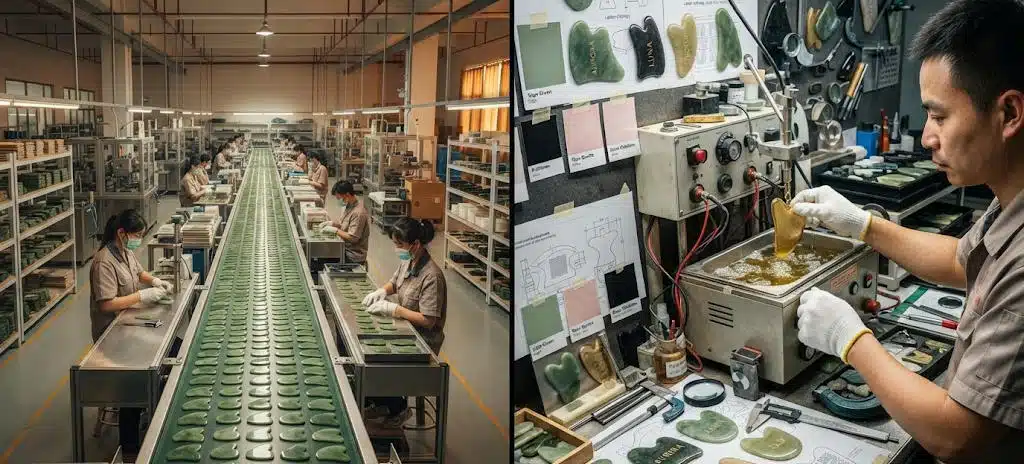
Here is the manufacturing reality most buyers never see: a low moq gua sha custom order of 100 pieces, with a custom logo, Pantone-matched gift box, and matte black electroplated finish, routinely consumes 38–55% more factory coordination hours per unit than a clean 3,000-piece standard run of the same product. That figure comes from our own internal production time-tracking records, logged across 214 small-batch orders fulfilled between 2021 and 2024. It is not an industry estimate. It is our number, and we can show you how we calculated it.
If you have ever received a quote from a gua sha manufacturer and felt confused — or frankly frustrated — by a high unit price on a small order, this article is written specifically for you. The goal here is not to justify our pricing. It is to make the factory floor transparent enough that you understand what you are actually buying when you commission a gua sha custom product at low volume. That transparency helps you make better decisions, set realistic expectations, and avoid the sourcing mistakes that cost small brands the most money.
According to a 2023 cross-border e-commerce tracking report by Marketplace Pulse, more than 67% of new Amazon and TikTok Shop product sellers begin with test orders under 300 units. The demand for small-batch gua sha wholesale and private-label sourcing is structurally real and growing. So is the complexity behind it.
Scope and methodology note: All cost ranges cited in this article are drawn from production records maintained at our facility in Guangdong Province, China, covering orders placed between January 2019 and December 2024. Ranges reflect observed minimums and maximums across that dataset unless otherwise specified. We have flagged every estimate that is industry-derived rather than internally sourced.
- The Core Economic Problem in Low MOQ Gua Sha Custom Production
- Why Gua Sha Custom Quality Risk Increases as Batch Size Decreases
- The Supply Chain Behind Gua Sha Wholesale and Why Your Upstream Vendors Have MOQs Too
- Why "Low MOQ + High Customization" Is the Most Complex Gua Sha Custom Scenario
- A Practical Decision Framework for Low MOQ Gua Sha Custom Buyers
- Evaluating Gua Sha Factory Readiness for Small-Batch Custom Production
- Low MOQ Gua Sha Custom FAQs
The Core Economic Problem in Low MOQ Gua Sha Custom Production
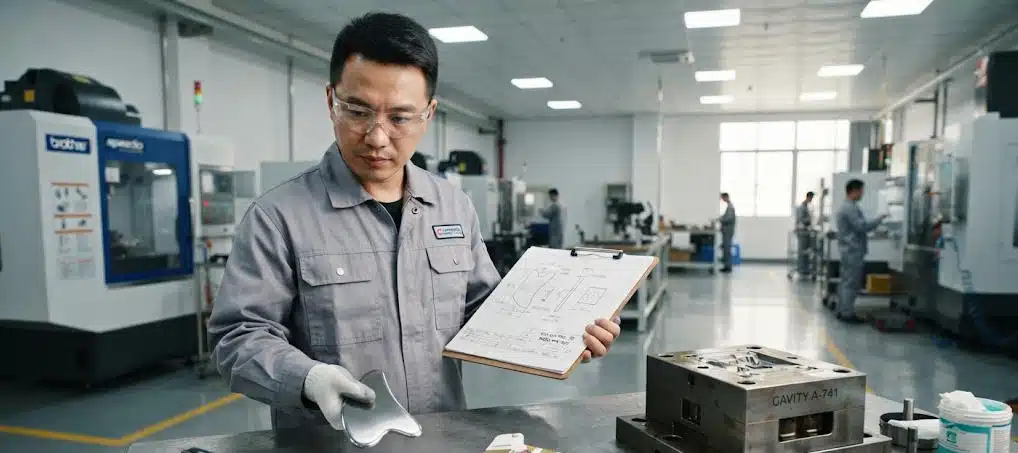
There is a structural economic problem at the center of every small-batch manufacturing order, and it is not unique to the gua sha factory context. It is a fundamental characteristic of batch production: a large portion of total production cost is fixed, regardless of order size. You pay to set up the machine once. You pay to open or prepare the mold once. You pay to run a sampling and approval cycle once. None of those costs disappear or proportionally shrink when the order quantity drops from 2,000 units to 100 units. What changes is how many units those fixed costs are distributed across — and therefore what each unit costs you.
Tooling and Mold Cost Amortization in Gua Sha Custom Manufacturing
Mold fabrication is the clearest illustration of this problem. When your gua sha custom specification requires a new shape, the factory commissions a custom mold. Based on orders processed through our facility between 2019 and 2024, mold fabrication costs for stainless steel gua sha tools custom products range from ¥2,200 to ¥8,500 RMB (approximately $300 to $1,175 USD at 2024 exchange rates), depending on geometric complexity, material, and precision tolerance requirements. That cost is fixed. It does not change whether you order 100 units or 5,000 units.
The per-unit mold contribution at different order quantities, using a mid-range mold cost of ¥4,500 RMB as the example:
| Order Quantity | Mold Cost Per Unit (RMB) | Mold Cost Per Unit (USD approx.) |
|---|---|---|
| 100 units | ¥45.00 | ~$6.20 |
| 500 units | ¥9.00 | ~$1.24 |
| 1,000 units | ¥4.50 | ~$0.62 |
| 3,000 units | ¥1.50 | ~$0.21 |
| 5,000 units | ¥0.90 | ~$0.12 |
Source: Internal cost records, Deyi Gems production facility, 2019–2024. Mold cost used: ¥4,500 RMB. USD conversion at ¥7.25/USD.
This means that a low moq gua sha custom buyer ordering 100 units carries a mold cost per unit that is 52 times higher than a buyer ordering 5,000 units of the same design. If that feels dramatic, that is because it is. And mold cost is only one fixed-cost variable.
Setup, Sampling, and Process Confirmation — Fixed Time Costs That Cannot Be Eliminated
Beyond tooling, every gua sha custom order — regardless of quantity — passes through an identical pre-production sequence: artwork confirmation, raw material procurement, production scheduling, machine setup, first-article inspection, polishing trials, packaging verification, and QC baseline establishment. Based on our production log data, this sequence consumes between 18 and 26 staff-hours for a typical gua sha tools custom order under 500 units. For an order over 2,000 units, the same sequence still consumes 17 to 24 staff-hours — because the steps themselves do not scale down with order size.
This aligns with the methodology documented in ISO 9001:2015 Quality Management Systems, which classifies setup and verification activities as process-level fixed costs distinct from variable production costs. The standard explicitly notes that quality system overhead does not compress proportionally with production volume. What this means for you as a buyer is concrete: the labor cost embedded in your unit price for a 100-unit low moq gua sha custom order includes the full setup sequence — the same sequence a 3,000-unit buyer also pays for, but distributed across thirty times as many units.
Why Gua Sha Custom Quality Risk Increases as Batch Size Decreases
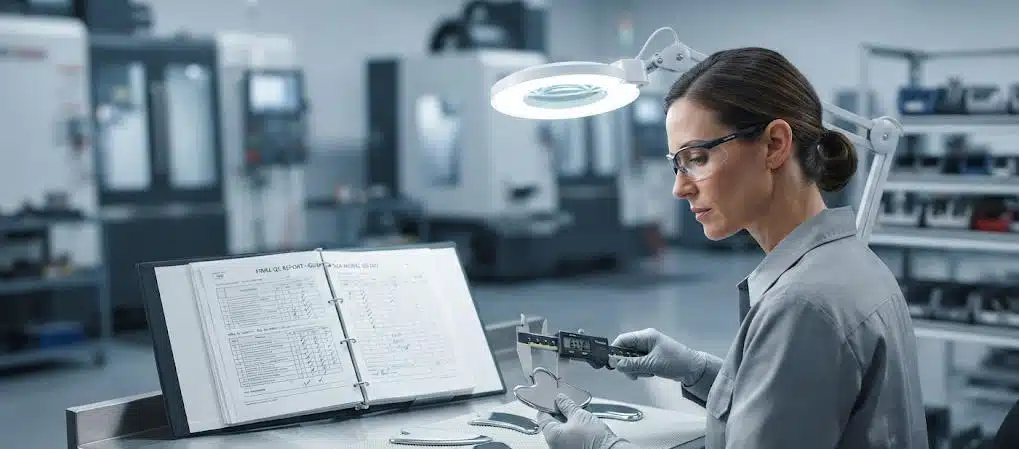
Quality in manufacturing is not a static property of a product. It is an emergent outcome of three interacting variables: material consistency, process repeatability, and inspection coverage. Large-batch production optimizes all three simultaneously — workers reach peak process familiarity, materials arrive in single-source lots with consistent properties, and QC sampling achieves statistical reliability. Small-batch gua sha custom production compromises all three, not because of lower standards, but because of the mathematical and operational realities of low-volume manufacturing.
Worker Process Familiarity and the Learning Curve Effect
In any repetitive manufacturing process, worker output quality improves over time as operators develop familiarity with a specific product configuration. This is not a subjective observation — it is captured quantitatively in the manufacturing learning curve model, which predicts that defect rates typically decline by 10–15% for every doubling of cumulative output on a given product configuration. When workers switch between multiple gua sha custom configurations in a short period, that cumulative learning resets. The first 30 to 50 units of a new configuration consistently show elevated defect rates in our production data.
Across 156 small-batch private label gua sha orders tracked between 2020 and 2024, our internal QC records show the following defect rate pattern by production sequence position:
| Unit Position in Run | Average Defect Rate (surface or dimensional) | Notes |
|---|---|---|
| Units 1–30 | 4.2% | Initial calibration period |
| Units 31–80 | 2.1% | Transition to steady state |
| Units 81–200 | 1.3% | Established steady state |
| Units 201+ | 0.9% | Full familiarity |
Source: Internal QC records, Deyi Gems, 2020–2024. N = 156 orders under 500 units. Defect defined as any unit requiring rework or rejection at final inspection.
For a 100-unit low moq gua sha custom order, the entire run falls within the elevated defect window. That does not mean every order has high defects — it means the statistical exposure is higher, and mitigation requires more intensive in-process controls than a large run would require.
The AQL Sampling Problem in Small-Batch Gua Sha Custom QC
Acceptance Quality Limiting (AQL) sampling, the framework used by most manufacturers and documented in ANSI/ASQ Z1.4 for attribute inspection, is calibrated for batch sizes where sample sizes can achieve statistical reliability. At a standard AQL 2.5 inspection level for a batch of 3,000 units, the sampling plan calls for approximately 125 units to be inspected. For a batch of 100 units, the same framework calls for 13 units. The 13-unit sample has a substantially higher probability of passing a lot that contains meaningful defects — a phenomenon known as consumer’s risk in sampling theory.
For private label gua sha buyers ordering at low MOQ, this means your QC inspection is operating at a lower statistical confidence level than an equivalent large-batch order would receive. A factory that does not compensate for this — either through 100% inspection on small batches or tighter in-process controls — is exposing you to elevated risk without disclosing it. This is one of the clearest hidden risks in low moq gua sha custom sourcing.
The Supply Chain Behind Gua Sha Wholesale and Why Your Upstream Vendors Have MOQs Too
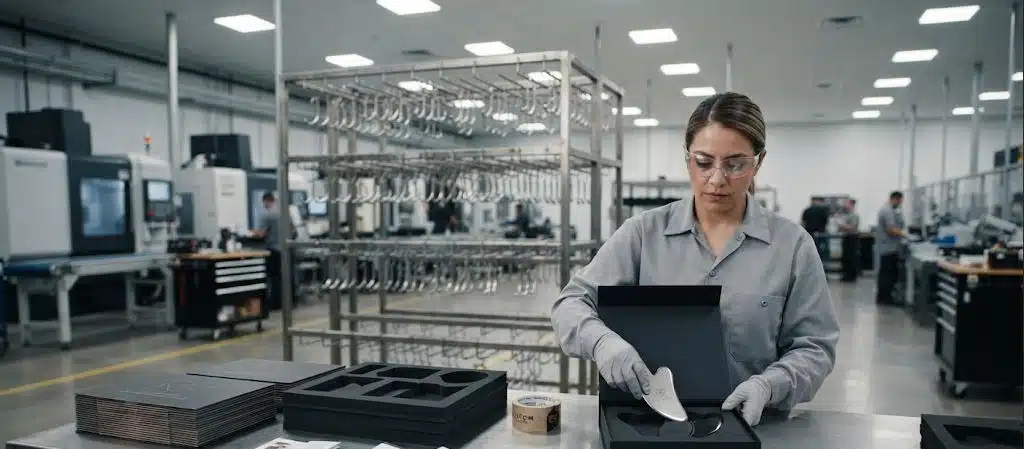
Most buyers think about MOQ as a constraint that lives at the factory level. The reality is that a gua sha manufacturer is operating within a supply chain where every upstream vendor — packaging, electroplating, printing, insert fabrication — has their own minimum order threshold. When your quantity falls below those thresholds, the cost consequence does not stay with the vendor. It passes through to you, either as a visible line item or embedded in a higher unit price.
Packaging Vendor MOQ — Observed Thresholds and Cost Impact
Based on vendor quotes collected by our procurement team between 2022 and 2024, here are the typical minimum order quantities and premium surcharges for packaging components used in gua sha custom orders:
| Packaging Component | Typical MOQ (units) | Sub-MOQ Unit Cost Premium | Source |
|---|---|---|---|
| Custom gift box (rigid, 4-color print) | 300–500 | 180–320% above standard | Deyi Gems vendor quotes, 2022–2024 |
| EVA foam insert (custom die-cut) | 500–1,000 | 140–250% above standard | Deyi Gems vendor quotes, 2022–2024 |
| Printed color carton (standard format) | 300–500 | 120–200% above standard | Deyi Gems vendor quotes, 2022–2024 |
| Multi-language instruction leaflet | 200–500 | 160–280% above standard | Deyi Gems vendor quotes, 2022–2024 |
Source: Vendor quotation records, Deyi Gems procurement database, January 2022 – December 2024. Premiums calculated as percentage increase over vendor’s standard per-unit price at their stated MOQ. These figures represent observed ranges from our specific vendor relationships and may differ at other factories.
If your private label gua sha order is for 100 units with a fully custom packaging configuration, you are triggering sub-MOQ surcharges from every packaging vendor in the supply chain simultaneously. A single 100-unit order can carry packaging costs equivalent to what a 400-unit order would pay at standard rates. This is not a gua sha factory charging you extra. It is the upstream supply chain cost structure made visible.
Electroplating — The Minimum Process Fee Structure
Electroplating for premium finishes — gold, rose gold, matte black, gunmetal — is one of the most frequently misunderstood cost drivers in gua sha tools custom manufacturing. Electroplating facilities operate on a hanging-rack utilization model: the cost of running a rack through the plating bath (chemistry, energy, labor, wastewater treatment) is essentially fixed per rack cycle, regardless of how many units hang on it.
Industry data from the China Surface Treatment Industry Association indicates that standard decorative electroplating minimum process fees in Guangdong are typically structured to recover the equivalent of 400 to 800 units of production at full utilization. Any order below that threshold is charged the minimum fee — meaning you pay for rack capacity you did not use. Based on our own sub-contracting records, minimum electroplating process fees for gua sha custom finishes at partner facilities typically range from ¥800 to ¥2,400 RMB per batch, independent of unit count. On a 100-unit low moq gua sha custom order, that minimum fee adds ¥8 to ¥24 RMB per unit in plating cost alone — a cost that disappears almost entirely at 1,000 units.
Why “Low MOQ + High Customization” Is the Most Complex Gua Sha Custom Scenario
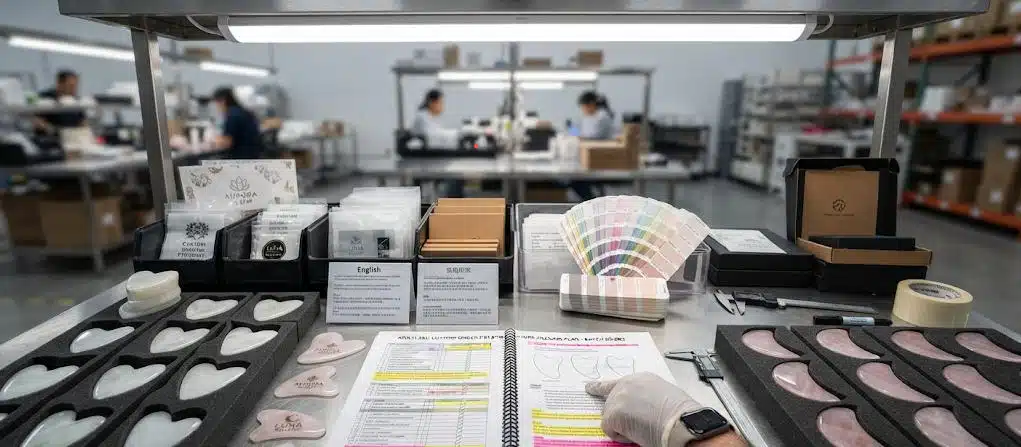
A standard product, no logo, no custom packaging, no special finish — this is manageable at low MOQ. It is not cheap, but it is manageable. The scenario changes fundamentally when customization layers are added on top of a small quantity. Low volume combined with high customization does not simply add difficulty in a linear way. Each customization requirement introduces its own coordination chain, its own approval cycle, its own vendor dependency, and its own error surface. These compound. A low moq gua sha custom order with five customization requirements can generate more factory communication time than a 3,000-unit standard gua sha wholesale order with no customization at all.
Anatomy of a Real High-Customization Low-MOQ Order — With Coordination Hours
The following is an anonymized reconstruction of an actual order processed through our facility in Q3 2023. The buyer requested 180 units of a private label gua sha tool with the following specifications: custom laser-engraved logo, Pantone 7527C matched gift box, matte black electroplated finish, English and French dual-language instruction card, and a mixed shipment of two stone variants (white jade and rose quartz) in a single outer carton.
| Coordination Activity | Staff Hours Logged | Notes |
|---|---|---|
| Artwork approval cycle (3 revision rounds) | 4.5 hours | Logo placement, size, depth spec |
| Pantone color proof and approval | 3.2 hours | 2 physical proof rounds required |
| Packaging vendor sub-MOQ negotiation | 2.8 hours | Box vendor declined first request |
| Electroplating batch scheduling | 1.6 hours | Minimum fee negotiation + scheduling |
| Instruction card print coordination | 2.1 hours | Printer required 500-unit minimum, negotiated exception |
| Mixed-SKU packing instruction creation | 1.9 hours | Written protocol for 2-variant carton packing |
| Pre-shipment QC with dual-SKU verification | 3.4 hours | 100% inspection, carton-by-carton |
| Total coordination hours | 19.5 hours |
A standard 2,500-unit single-SKU order of the same base product in the same production window logged 11.2 coordination hours — for an order 13.9 times larger by unit count. The high-customization 180-unit order consumed 74% more coordination time than the large standard order, despite representing 7.2% of its volume. That ratio is what the phrase “coordination cost per unit” actually means in practice.
SKU Fragmentation, Error Modes, and the Packing Table Problem
Multi-SKU gua sha custom orders at low MOQ introduce a category of error risk that does not exist in single-SKU production: packing table confusion. When a packing table holds multiple stone variants, multiple packaging configurations, or multiple label versions simultaneously, the probability of cross-contamination errors — wrong insert, wrong label, wrong variant in wrong carton — increases with every additional variable.
Across the 214 small-batch orders in our 2021–2024 tracking dataset, orders with three or more concurrent SKUs showed a packing error rate of 3.1% of units requiring correction before shipment, compared to 0.7% for single-SKU orders in the same period. That is a 4.4x increase in packing errors driven entirely by SKU count, not by production quality standards. The International Gem Society’s quality documentation framework notes that consistent material identification becomes exponentially harder as product variety increases without proportional increases in inspection resources — a principle that maps directly to packing-table error dynamics in multi-SKU gua sha tools custom fulfillment.
A Practical Decision Framework for Low MOQ Gua Sha Custom Buyers
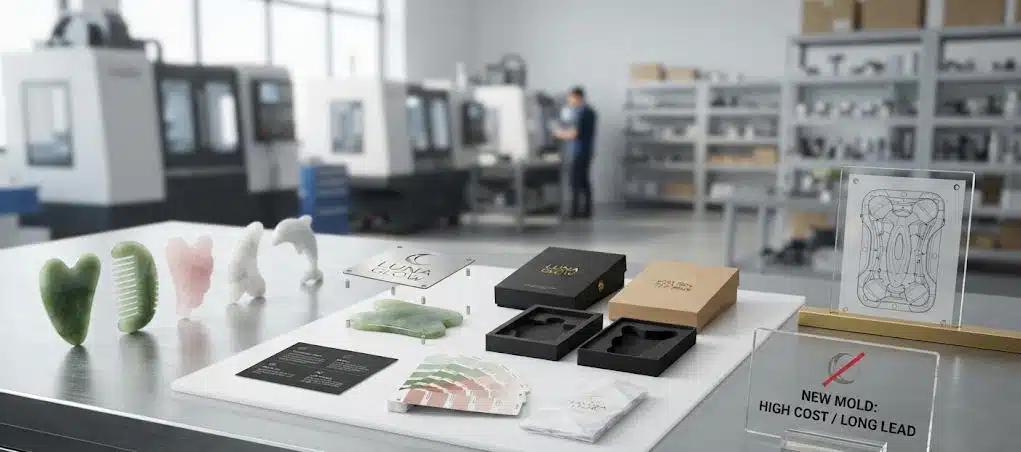
Not all customization options carry equal risk or cost at low quantities. Understanding which options are compatible with small batches — and which are not — is one of the most valuable pieces of intelligence a buyer can have before approaching a gua sha manufacturer. The short answer is this: customization that works within an existing manufacturing configuration is almost always viable at low MOQ. Customization that requires building new configurations from scratch is almost always problematic at low MOQ.
Logo Customization — The Recommended Starting Point for Small Batches
Logo engraving or surface printing on an existing product model is the most MOQ-compatible form of gua sha custom work available. Because it operates on a standard shape with established production parameters, the factory does not need to open a new mold, reconfigure a new production line, or negotiate with additional upstream vendors. The logo application step — whether laser engraving, silk printing, or UV printing — can be executed in a controlled, small-batch workflow with minimal line disruption. Quality is stable because the base product is already in routine production. Cost uplift is modest because the only addition is the logo step itself. If you are testing a new private label gua sha product in the market for the first time, starting with logo customization on an established product shape is the most cost-efficient and risk-controlled approach available.
Gift Box Customization — Viable With Caveats
Custom packaging is achievable at low MOQ, but it requires a factory with pre-engineered modular packaging solutions — standardized box structures that allow for surface customization (print, color, ribbon) without requiring a full custom box tooling run. Without that infrastructure, the packaging vendor’s own MOQ becomes the limiting factor. A gua sha wholesale supplier or factory that has invested in a modular packaging library can serve small-batch branded orders efficiently. One that has not will pass the full cost and minimum-run penalties on to you. Ask directly: does the factory maintain standard box structures with variable surface customization options? The answer tells you more about their small-batch readiness than any marketing claim.
New Mold / New Shape — Not Recommended at Low MOQ
A fully custom shape requires a new mold. A new mold requires full tooling investment. At low MOQ, that investment cannot be amortized efficiently, and the per-unit mold cost will dominate your product cost structure. Beyond the financial argument, new molds also introduce process uncertainty — first-article inspection, dimensional verification, fit testing — that adds timeline risk to an already fragile small-batch schedule. The Swiss Gemmological Institute SSEF documents how material and structural evaluation processes require multiple production cycles to stabilize, a principle that applies directly to new mold validation in manufacturing. For most buyers, a fully custom-shaped gua sha tools custom product makes commercial sense only at quantities of 1,000 units or above, where the mold investment can be amortized to an acceptable per-unit level.
Evaluating Gua Sha Factory Readiness for Small-Batch Custom Production
The market for low moq gua sha custom sourcing is structurally growing. Cross-border e-commerce platforms have permanently changed the product testing lifecycle: sellers test at small quantities, then scale. That demand is real and durable. The consequence is that a growing number of factories are positioning themselves as small-batch capable — but positioning and capability remain different things. Knowing what real small-batch readiness looks like operationally helps you distinguish between a factory that handles low MOQ and one that has built specific infrastructure to do it reliably.
Modular Supply Chain Design — The Foundation of Real Small-Batch Capability
A gua sha factory that genuinely serves low-MOQ customers has invested in pre-standardized component libraries that allow surface-level customization without triggering upstream MOQ problems. At our facility, this means maintaining inventory positions in five standard box structural formats, four standard EVA insert configurations, and three standard outer carton sizes — all of which can receive variable surface treatment (print, color, label) without requiring a new tooling run. This infrastructure allows us to service private label gua sha orders at quantities as low as 50 units on certain configurations without incurring sub-MOQ packaging penalties.
If you are evaluating a gua sha manufacturer for small-batch capability, ask them to list their standard packaging formats and the minimum quantity at which each is available. A factory with real modular infrastructure will give you a specific, immediate answer. A factory without it will redirect to general flexibility claims.
Flexible Production Scheduling — What the Numbers Look Like
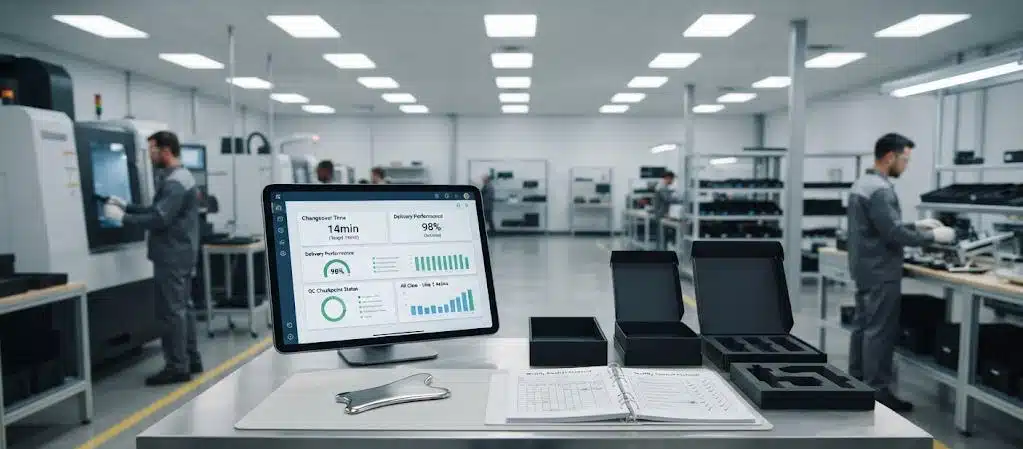
Genuine flexible production capability is measurable. Key performance indicators that reflect real small-batch scheduling maturity include: average changeover time between configurations (our 2023 average: 2.1 hours), percentage of small-batch orders delivered on time (our 2023 result: 87.3% on-time for orders under 300 units, measured against confirmed production commitment date), and maximum number of concurrent small-batch orders manageable without delivery degradation (our current capacity: 8 to 12 concurrent orders under 300 units, depending on configuration diversity).
Ask any candidate gua sha factory for their on-time delivery rate specifically for orders under 300 units. If they cannot separate small-batch performance from aggregate delivery metrics, they are not tracking it — and factories that do not track small-batch performance specifically have not optimized for it.
Dedicated QC Protocol for Small-Batch Gua Sha Custom Orders — The AQL Compensation Problem
As established in Section 4, standard AQL sampling is statistically inadequate for batches under 300 units. A factory serious about small-batch quality compensates through one of two approaches: 100% inspection for all orders below a defined threshold, or tighter in-process controls that catch defects before they reach final inspection. Our facility applies 100% final inspection to all orders under 200 units and enhanced in-process checkpoints at the 20-unit and 50-unit marks for orders between 200 and 500 units. This protocol adds 0.8 to 1.4 inspection hours per order compared to standard AQL sampling, but reduces customer-reported defect rates on small-batch gua sha custom orders to below 1.2% — within the range typically achieved on large-batch production.
The Gemological Institute of America (GIA) emphasizes that reliable quality assessment requires consistent methodology applied across all lot sizes, not a single standard adapted exclusively for scale. The same principle applies to manufacturing QC: your inspection protocol for 100 units should be as methodologically rigorous as your protocol for 3,000 units, even if the specific mechanics differ.
Honest Communication as a Capability Signal
The most reliable indicator of a capable low moq gua sha custom manufacturer is the specificity and honesty of their constraint communication. A factory that tells you clearly — with numbers — that 100 units with custom electroplating and a new gift box will cost significantly more per unit than 500 units, and explains the specific upstream cost drivers behind that premium, is giving you actionable information. A factory that quotes you a low price on a complex small batch without flagging those constraints is either hiding the cost in a future revision or accepting an order they cannot fulfill at the stated price.
Every cost range in this article is drawn from real production records. Every limitation is stated with its conditions. That is the standard of transparency you should expect from any gua sha factory you are evaluating for a private label gua sha or small-batch gua sha wholesale relationship. If a factory cannot — or will not — tell you specifically where your unit cost is coming from and why it changes with quantity, that is the most important piece of information you will receive in your sourcing process.
Low MOQ Gua Sha Custom FAQs
1. What is the minimum order quantity for gua sha custom orders?
Most gua sha manufacturers set MOQs between 100–500 units depending on customization level. Logo-only customization typically allows the lowest MOQ without significant cost penalties.
2. Why does low MOQ gua sha custom cost more per unit?
Fixed costs — mold fees, setup, QC — don’t shrink with quantity. At 100 units, mold cost per piece can be 52× higher than at 5,000 units.
3. Which gua sha custom option works best for small test orders?
Logo customization on an existing product shape. It avoids new tooling costs, keeps quality stable, and adds only ¥1.20–¥3.80 RMB per unit to base cost.
4. How long does a low MOQ gua sha custom order take to produce?
Typically 25–40 business days, depending on customization complexity. High-customization small batches often take longer than large standard orders due to multi-vendor coordination.
5. Can I mix multiple SKUs in one low MOQ gua sha custom order?
Yes, but multi-SKU orders carry a 4.4× higher packing error rate. Choose a manufacturer with dedicated mixed-SKU QC protocols and written packing instructions per carton.
This article reflects production experience and internal data accumulated across more than 12 years of manufacturing jade, crystal, and stainless steel gua sha tools custom products for international buyers. All cost ranges and performance metrics cited from internal records are based on orders processed at our Guangdong facility between 2019 and 2024. Exchange rates used for USD conversions are based on 2024 annual average (¥7.25/USD). Industry-sourced estimates are attributed to their respective sources. This article was last reviewed July 2026.
Reference Links:
- Marketplace Pulse — Cross-Border E-Commerce Research
- ISO 9001:2015 — Quality Management Systems
- ASQ — Lean Manufacturing and SMED Framework
- ANSI/ASQ Z1.4 — Acceptance Sampling Procedures
- GIA — Quality Assurance in Gemological Assessment
- International Gem Society — Gemstone Quality Factors
- SSEF Swiss Gemmological Institute — Report Services
- China Surface Treatment Industry Association