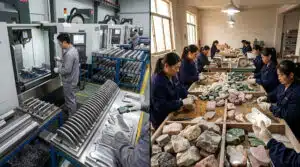
If you’ve asked for a two-color or three-color logo on a jade or rose quartz tool and been told “single color only,” you’re not the first buyer to feel like that answer came out of nowhere. In practice, close to 90% of the gua sha custom logo requests that move through a stone workshop end up approved in a single color, not because a factory is guarding some trade secret, but because the material and the process leave very little room for anything else. A guasha custom logo on jade or quartz isn’t printed the way a logo goes onto a plastic gadget. It’s laser-engraved and then filled by hand, one groove at a time, and that single fact decides almost everything else in this article. If you’re building a private label gua sha line, the sections below walk through exactly why, using the same numbers a gua sha manufacturer actually works from.
This isn’t a sales pitch for single color — it’s a disclosure of what actually happens on the bench between the day you approve artwork and the day boxes leave the warehouse. You’ll get the mechanical reasons, the cost math, and a step-by-step way to get your gua sha custom logo approved on the first attempt instead of the third.
- The Real Reason Behind Every Gua Sha Custom Logo Limit
- Inside a Gua Sha Custom Order: What Happens After You Send Your Logo File
- Why Fine Lines and Small Text Break Down in Hand Fill
- Color Bleed: The Hidden Risk in Multi-Color Gua Sha Custom Requests
- The Real Cost Math Behind a Second Color
- Material Science: Why Jade and Quartz Behave Differently Under a Laser
- How to Get a Gua Sha Custom Logo Approved on the First Try
- Compliance and Documentation: What a Responsible Gua Sha Manufacturer Should Disclose
The Real Reason Behind Every Gua Sha Custom Logo Limit

Plastic gua sha tools take logos through screen printing, pad printing, or UV printing, laying ink flat onto a smooth, mass-produced surface in seconds. Natural stone doesn’t offer that shortcut — jade and quartz are mined material, and every blank carries its own micro-texture that standard plastic-industry printing often won’t adhere to or survive daily skin contact. This is the starting point for understanding any gua sha custom program, and it’s why a gua sha logo on stone always begins with a laser, not a printer.
The industry’s workaround is laser engraving followed by hand-applied paint fill: a fiber laser cuts a shallow groove along your logo’s outline, and a worker then loads pigment into that groove by hand. This means your mark is physically part of the stone rather than sitting on top of it, so it won’t peel or wash off — but you also inherit the limits of a process built around a human hand instead of a machine head, which is the real story behind most gua sha custom decisions.
How Laser Engraving Sets the Ceiling for Your Gua Sha Custom Design
A laser can cut finer detail into stone than a human hand can then fill cleanly, and that gap is the actual bottleneck in any gua sha custom order, not the equipment. Engraving depth typically runs a few tenths of a millimeter, deep enough to hold pigment but shallow enough to protect the stone’s structural strength — cut deeper and you raise breakage risk during polishing and shipping.
So the laser stage rarely causes rejections on its own; it’s accurate and repeatable, and the same file produces the same groove every time. The variability enters at the very next stage, and that’s where a gua sha logo either turns out clean or turns out disappointing.
Why Hand-Painted Fill Replaces Industrial Printing
Industrial printing needs a flat, uniform surface at a fixed distance from the print head, and a curved gua sha custom tool rarely offers either one consistently. Stone’s texture and color variation make ink adhesion unreliable enough that most gua sha manufacturer teams won’t guarantee it for a logo meant to last years, which is why hand fill sidesteps the problem entirely by sitting paint inside a physical groove instead of on top of the surface.
The tradeoff is that hand fill is exactly what it sounds like — a person, a brush or fine needle, and a magnifier. This means your guasha custom logo‘s final appearance depends partly on engraving precision and partly on a worker’s steady hand, a very different quality model than a machine stamping identical ink onto identical plastic thousands of times an hour.
Inside a Gua Sha Custom Order: What Happens After You Send Your Logo File

Once you approve artwork, your file doesn’t go straight to a laser operator — it passes through a simplification review first, where a technician checks whether line weight, spacing, and color count are realistic for hand fill. Catching a problem here costs nothing; catching it after 500 pieces are engraved costs real time and money, which is why this step exists for every gua sha custom order regardless of size.
Two stages follow that review, and each one behaves differently depending on how many colors your guasha custom logo actually contains. Understanding both is the fastest way to understand why suppliers push back on complexity, and roughly one in five first-pass files needs at least one line-weight adjustment before it clears this review — which is normal, not a sign your design is a problem.
The Engraving Stage
The laser stage is fast and consistent. A single unit typically takes well under a minute to engrave, and a batch of a few hundred pieces can usually clear this stage in a single working day, since calibrated machine settings don’t drift much from piece to piece.
What does vary is stone hardness and surface finish, which affects how cleanly groove edges come out — a rougher polish on a lower-grade blank can produce a ragged edge that makes the next stage harder. This means your finished gua sha custom logo quality starts with blank quality as much as design quality, which is worth asking your supplier about before you finalize a quote.
The Manual Fill Stage
This is where time, skill, and color count collide. A worker fills each groove with pigment, wipes excess paint from the surrounding polished surface, and lets it cure before a smoothing pass seals the fill. For a single-color gua sha logo, this sequence might take a worker a minute or two per piece; add a second color and you’re not just doubling paint time, you’re adding a full separate drying cycle and a real chance the first color gets disturbed while the second one goes in.
A responsible gua sha manufacturer will tell you upfront that fill time doesn’t scale in a straight line with color count — it compounds, because every additional color has to fully cure before work can safely continue. That queuing effect is exactly what stretches a gua sha custom timeline from days into weeks, especially on larger gua sha wholesale batches where several colors are moving through the same limited team of painters at once.
Why Fine Lines and Small Text Break Down in Hand Fill

Ask ten stone-tool workshops what breaks first in a complicated logo and most point to the same handful of elements: thin outlines, tiny lettering, tightly packed graphics, gradient shading, and color blocks sitting right next to each other. None of these are impossible alone. The problem shows up when a gua sha custom order needs the same result on unit one and unit three hundred, not just on a single hero sample photographed for a catalog.
A sample made slowly by your most experienced painter can look close to flawless. Production reality is different — that same worker, or a less experienced one on a busy week, has to repeat that result at production speed across a full batch, and fine detail that survives a sample often doesn’t survive scale. That gap between sample quality and batch quality is one of the most common sources of disputes in this category.
Gua Sha Custom Logo Elements That Increase Rejection Rates
Line weight below roughly 0.3mm tends to blur or fill in entirely once paint is applied, since the groove itself is too narrow to hold a clean edge of pigment. Small text runs into the same wall — legible on a screen, illegible once it’s a few tenths of a millimeter deep in stone. Gradients are the hardest element of all, since hand fill works in flat color, not blended tone, so a gradient has to be faked with multiple discrete bands.
So when a factory asks you to simplify a logo for a gua sha custom run, it’s not an aesthetic opinion — it’s a rejection-rate forecast based on what that exact design element has done on previous batches. Ignore that advice and a meaningful share of units can fail final inspection, pushing your delivery date and your landed cost in the wrong direction at once.
What a Simplified Logo Actually Looks Like on Jade or Quartz
A simplified version of your gua sha logo usually keeps the recognizable shape and drops what doesn’t survive hand fill: thin strokes get thickened slightly, small text gets set in a cleaner sans-serif at a larger size, and touching color blocks get separated or merged into one. Most brands are surprised at how little identity is actually lost, since a logo engraved into stone reads differently than the same mark on a screen or a business card.
This means you can usually keep your brand recognizable while hitting production-friendly specs, as long as simplification happens before the laser runs rather than after a failed batch. A guasha custom logo that’s been pressure-tested this way tends to look more deliberate on the finished stone, not less, because it was designed for the material instead of just ported onto it.
Color Bleed: The Hidden Risk in Multi-Color Gua Sha Custom Requests

Bleed is the term workshops use when pigment from one color migrates into a neighboring groove during fill or cleanup, and it’s the single biggest quality risk in any multi-color gua sha custom request. It doesn’t happen because workers are careless — it happens because paint is fluid before it cures, grooves for different colors often sit only fractions of a millimeter apart, and cleaning excess paint off a curved stone surface is inherently harder than wiping a flat plastic panel.
Once bleed starts, it’s difficult to fully correct without damaging the surrounding finish, which is exactly why the industry treats multi-color logos as a meaningfully higher-risk category rather than just a longer to-do list. A private label gua sha brand that hasn’t budgeted for this risk in its timeline is the most common source of missed launch dates in this category.
How Bleed Happens Under a Loupe
Look at a bled edge under magnification and you’ll usually see a thin, feathered line of the wrong color intruding into the neighboring groove — small, but visible to the naked eye on a finished product. Connected or “through” logos, where lines cross a color boundary, are the worst case, since there’s no clean gap for a worker’s tool to stop at. Isolated color blocks with real spacing bleed far less often, which is why suppliers ask for spacing adjustments on multi-color art.
So the geometry of your gua sha custom logo matters as much as the color count itself. Two logos with the same number of colors can have very different rejection rates purely based on how much breathing room sits between color zones — a detail worth checking before you approve final art.
Consistency Across a Gua Sha Custom Production Batch
A single hand-painted sample can be touched up repeatedly until it looks right, but a gua sha custom production run doesn’t get that luxury at scale. Every unit in a batch needs to clear the same visual bar, and the more colors involved, the more units statistically drift outside it. Workshops that track this internally typically see rework or scrap rates climb noticeably once a design moves from one color to three or more, particularly on connected artwork.
That’s not a reason to avoid multi-color entirely — plenty of brands run it successfully. It is a reason to expect a longer timeline, a higher per-unit cost, and a gua sha wholesale quote that reflects the real labor involved rather than a flat per-piece rate that assumes single-color simplicity.
The Real Cost Math Behind a Second Color

Every additional color on a gua sha custom logo adds a full extra pass through the production line, not a proportional fraction of one. Each new color needs its own pigment mixing, its own fill pass, its own drying window, its own cleanup and inspection, and often its own touch-up round for units that didn’t clear inspection the first time. None of those steps can be skipped just because a second color feels like a small design change on your end.
Stack those steps up and the labor cost per unit for a two-color logo often runs meaningfully higher than a single-color equivalent, and three colors compounds further rather than adding a flat third increment. This means your quote for a multi-color gua sha custom order isn’t padding — it’s sequential labor that has to happen in a set order, with curing time in between that can’t be rushed without risking the exact bleed problem described above.
What Each Additional Color Adds to Your Gua Sha Custom Timeline
A single-color batch of a few hundred pieces might clear engraving and fill within about a week, depending on batch size and factory load. A two-color version of the same guasha custom logo order routinely adds several more days, mostly from sequential drying windows rather than the painting itself, and three colors can push a modest batch into two to three weeks or longer.
Rework is the quiet cost driver here. A misfilled color, a bleed event, or paint damaged while cleaning an adjacent color all send a unit back for correction, and every correction eats into the schedule you were quoted. This means your safest planning assumption for a multi-color gua sha custom logo is to build in buffer time from day one, rather than treating the initial quoted lead time as a hard guarantee.
ROI — When Multi-Color Actually Pays Off for Wholesale Orders
Multi-color isn’t automatically the wrong call. A brand running a flagship private label gua sha product at meaningful volume, where the extra cost per unit is small relative to retail price, can justify a two-color mark if it materially strengthens brand recognition on shelf or on camera. The math changes for a smaller gua sha wholesale test order, where added cost and extended timeline eat directly into margin on a batch you’re still validating.
A useful gut-check: if the added cost per unit for a second color is a small fraction of your retail price, and your order size is large enough to spread setup time across many units, multi-color can pencil out. If you’re still testing demand with a smaller gua sha custom batch, single color usually protects your margin and your launch date better, and you can always revisit color count once volume justifies it.
Material Science: Why Jade and Quartz Behave Differently Under a Laser

The stone itself changes how forgiving or unforgiving a gua sha custom logo process turns out to be. Jadeite and nephrite jade sit at roughly 6.5–7 and 6–6.5 respectively on the Mohs hardness scale, according to the Gemological Institute of America, while rose quartz and other quartz varieties sit at a firm 7, as GIA’s own gemstone reference confirms. Those numbers look close on paper, but a half-point on the Mohs scale can change how a groove edge responds to a laser and how cleanly it holds paint.
Jade’s real advantage isn’t hardness, it’s toughness — the International Gem Society explains that jade’s densely interwoven crystal structure, made of interlocking mineral grains in jadeite and fibers in nephrite, is what gives it resistance to chipping rather than pure scratch resistance. Quartz, by contrast, is harder but more brittle at fine edges, which is part of why engraving parameters for a jade gua sha custom blank and a quartz one aren’t identical, even when the logo file is the same.
Hardness, Toughness, and Why It Matters for Your Gua Sha Custom Logo
Hardness measures scratch resistance; toughness measures resistance to chipping, and GIA’s own durability guidance treats these as separate properties, alongside a third factor called stability. A material that’s hard but brittle can still chip at a fine engraved edge under laser heat, which is exactly why laser power and pass count get tuned per stone type rather than applied as one universal setting.
This means the “same” gua sha custom logo can genuinely need different engraving parameters depending on whether it’s going onto jade or quartz. A supplier who applies one blanket setting to every material is more likely to produce inconsistent edge quality than one who adjusts per stone, so it’s a fair question to ask before you commit to a run — especially if you’re scaling a private label gua sha catalog across multiple stone types.
What Gemological Standards Say About Surface Consistency
Independent testing bodies like the Swiss Gemmological Institute (SSEF) exist precisely because natural stone varies piece to piece in ways manufactured materials don’t, and that same variation is what a production team manages on every gua sha custom batch. A reference chart from the International Gem Society ranking gems by Mohs hardness is a useful check for any buyer who wants to understand why jade and quartz get treated slightly differently at the engraving stage.
So when a factory says fill technique or engraving depth shifts slightly between stone types, that’s not inconsistency — it’s the same natural material variation gemological labs have documented for decades. You can use that as a genuine screening question when evaluating a new gua sha manufacturer, since a team that explains this clearly is usually one that’s actually tuning its process rather than running every stone the same way by default.
How to Get a Gua Sha Custom Logo Approved on the First Try

Most of the back-and-forth on a gua sha custom logo order is avoidable with a handful of decisions made before artwork ever reaches a laser operator. None of these steps are complicated, but skipping them is the single most common reason a first sample gets rejected and a launch slips by two or three weeks.
Here’s the practical sequence that keeps a first sample clean instead of sending it back for revisions, and it applies whether you’re placing a small test order or a full gua sha wholesale run. None of these steps take more than a few minutes on your end, but skipping any one of them is the fastest way to add a week back onto your timeline.
- Start with vector artwork, not a raster image, so line weight and spacing stay precise when the file is resized for engraving.
- Set minimum line thickness at roughly 0.3mm or above, since anything thinner is a strong candidate for blurring once paint fills the groove.
- Keep text at a size that stays legible after a modest thickening pass, and avoid fonts with very thin strokes or serifs.
- Separate any touching color zones by a small visible gap rather than letting shapes butt directly against each other.
- Ask your supplier for a physical sample on your actual chosen stone before committing to a full production run, not just a digital mockup.
That fifth step matters more than it sounds. A screen rendering can’t show you how paint sits in a groove or how a curved surface catches light differently than a flat rendering suggests, so a physical sample is the only reliable way to confirm a guasha custom logo will look the way you expect once it’s actually on the product.
Preparing Your File Before You Submit
Before you send anything to a supplier, run your own gut-check against the elements flagged earlier: thin lines, small text, gradients, and tightly packed color blocks. If your gua sha logo has any of these, ask yourself whether a simplified version would still be recognizable, because that’s the exact question a technician will ask once your file lands on their desk. Bringing a pre-simplified version to the first conversation saves at least one full review cycle.
This means the fastest path to an approved gua sha custom sample isn’t submitting your most detailed logo and hoping it survives review. It’s submitting a version you’ve already stress-tested against the same constraints a production team will apply anyway, which is a five-minute exercise that can save you a full week of back-and-forth.
What to Ask Your Supplier Before You Pay a Deposit
Ask directly what your quoted lead time assumes: first-pass approval, or does it already include buffer for one round of rework? Ask whether the quote covers a physical sample before the full batch, and ask how the supplier handles units that fail inspection — replaced at their cost, or billed back to you. These questions sound blunt, but a gua sha manufacturer confident in its own process will answer them plainly rather than deflecting.
A supplier who can’t answer these clearly is telling you something important before you’ve spent a dollar. This means the deposit conversation is actually your best due-diligence window, not just a payment formality, so use it before committing to a gua sha wholesale volume you can’t easily unwind.
Compliance and Documentation: What a Responsible Gua Sha Manufacturer Should Disclose

Risk disclosure isn’t a courtesy in this category, it’s a practical necessity — the gap between what a buyer expects and what a guasha custom logo run can actually deliver is where most disputes start. A gua sha manufacturer that puts color-count limits, lead times, and MOQ tiers in writing before production starts is protecting both sides, not just covering itself, since verbal assurances don’t hold up once a batch comes back with rejected units.
You’re entitled to ask for this in writing, and a supplier who resists that request is worth treating as a warning sign rather than a formality to skip. This applies whether you’re placing a small first gua sha wholesale order or scaling an existing private label gua sha line into a new product category.
MOQ, Lead Time, and Gua Sha Custom Risk Disclosure in Writing
A clear order confirmation for any gua sha custom logo project should spell out color count, minimum line thickness, expected lead time under normal conditions, and what happens if inspection finds a meaningful defect rate. It should also state MOQ by color count, since a responsible supplier typically sets a higher minimum for multi-color runs to make the added setup and rework risk worth the labor investment on their end.
None of this needs to be complicated legal language. A one-page production brief that both sides sign before deposit is usually enough, and it becomes the reference point if a dispute ever comes up later. This means you walk into production with a shared, written definition of “acceptable,” instead of discovering a mismatch only after the batch is finished.
Private Label Gua Sha Contracts: What Should Be in Writing
If you’re building a private label gua sha brand, your contract should go further than a single order confirmation. It should cover laser-file ownership, whether your gua sha logo file can be reused for other clients, and reorder lead times once your design is already on file — details that matter more the longer you plan to work with the same supplier.
Put simply, you’re entitled to the same clarity a gua sha wholesale buyer would expect from any manufacturing partner in any category, not a lower bar just because the product happens to be a natural stone tool. Ask for it before your first deposit, and you’ll spend far less time firefighting later.
The Bottom Line for Your Next Gua Sha Custom Order
Single-color logos dominate this category because the process — laser engraving plus hand-painted fill — rewards simplicity and penalizes complexity at almost every stage, from engraving edge quality to fill consistency to final inspection. None of that means multi-color is off the table for you. It means going in with realistic expectations about timeline, cost, and MOQ, and a supplier willing to put those expectations in writing before you commit to a gua sha custom run.
Deyi Gems has spent more than a decade running exactly this process on jade and quartz gua sha custom tools, and the pattern described in this article holds true across nearly every order that comes through the workshop, single color or otherwise. If you’re weighing a gua sha logo decision for an upcoming launch, the questions above are the ones worth asking before you finalize artwork, not after your first batch comes back from inspection.